The Enlightenment still walks among us. Or rather, it lingers like a spectre – insisting it is alive, rational, and universal, while we, its inheritors, know full well it is a ghost. The project I’ve begun – call it my anti-Enlightenment collection – is about tracing these hauntings. Not the friendly ghosts of warm memory, but the structural ones: rationality unmoored, democracy designed to fail, presentism enthroned as law.
Audio: NotebookLM podcast on the essay underlying this post.
This collection began with Rational Ghosts: Why Enlightenment Democracy Was Built to Fail, which anatomised the Enlightenment’s misplaced faith in rational self-governance. The rational individual, Enlightenment’s poster child, turned out to be less a citizen than a figment – a ghost conjured to make democracy look inevitable.
It continues now with Temporal Ghosts: Tyranny of the Present, which dissects the structural bias of presentism – our systemic privileging of the living over the unborn. Hobbes, Locke, Rousseau, Bacon, Smith, Bentham, Montesquieu: each laid bricks in an architecture that secured sovereignty for now while exiling the future into silence. Debts accumulate, climate collapses, nuclear waste seeps forward through time. The unborn never consented, yet institutions treat their silence as assent.
Why a Collection?
Because ghosts travel in packs. One essay exposes Enlightenment’s hollow promises of reason; another its structural bias toward immediacy. The next will follow a different haunting, but always the same theme: Enlightenment’s bright lantern casts a shadow it refuses to see. The collection is less about reconstruction than exorcism – or at least acknowledgment that we live in a haunted house.
Ghost by Ghost
Rational Ghosts – Enlightenment democracy promised rational citizens and self-correcting systems. What it delivered instead was structural irrationality: Condorcet’s paradox, Arrow’s impossibility theorem, and a politics rigged to stumble over its own claims of reason.
Temporal Ghosts – The unborn are disenfranchised by design. The Enlightenment’s “living contract” fossilised presentism as law, leaving future generations to inherit debts, ecological ruin, and technological lock-in.
There may be more hauntings to come – economic ghosts, epistemic ghosts, technological ghosts. But like all spectres, they may fade when the season changes. The calendar suggests they’ll linger through Día de Muertos and Hallowe’en; after that, who knows whether they’ll still materialise on the page.
In celestial mechanics, the three-body problem is notorious. Give Newton two bodies – a planet and a sun – and the equations sing. Add a third, and the song collapses into noise. No general solution exists. Even the smallest nudge in one orbit cascades unpredictably through the system.
Audio: NotebookLM podcast on this topic.
Now swap out planets for people. Not three, but millions. Each voter tugging with their own gravity – preferences, fears, biases, identities, the entire mess of human subjectivity. Democracy insists that by tallying these forces, we’ll arrive at something stable: the will of the people. But what we actually get is the millions-body problem: unstable coalitions, contradictory mandates, endlessly shifting orbits.
almost any outcome can be engineered by manipulating the order of votes
Condorcet’s Dilemma
The French mathematician Marquis de Condorcet spotted this flaw in the 18th century. His paradox showed that even if every individual voter ranks choices rationally, the group as a whole may not. Collective preferences can loop in circles: A beats B, B beats C, C beats A. It’s not dysfunction; it’s baked into the math.
Later, political scientists proved the paradox was only the beginning. McKelvey’s “chaos theorem” demonstrated that in a system with three or more options, almost any outcome can be engineered by manipulating the order of votes. In other words, democratic choice is not stable; it’s sensitive to framing, sequence, and agenda control.
Condorcet was brilliant enough to see the cracks, but like his Enlightenment peers, he decided that the fiction of order was preferable to the reality of chaos. Better to promise tidy majorities than to admit that majority rule is structurally incoherent.
majority rule a ritual of laundered coercion
The Tidy Lie
Why did majority rule catch on? Because it looked fair, even if speciously so. It gave the appearance of impartiality: count, declare, move on. It was simple enough to administer, and more palatable than monarchy or deadlock.
But neatness is not truth. If 51% of people vote for one candidate, 49% are compelled to live under a government they explicitly rejected. If a third of the population abstains altogether, the “winner” might rule with the backing of barely one-third of the country – yet claim a mandate.
This is what makes majority rule a ritual of laundered coercion. The losers are told, “next time you might win,” even though whole minorities may never win. Abstainers are scapegoated for outcomes they opposed. And everyone is asked to keep pretending that arithmetic equals legitimacy.
Like the three-body problem, democracy has no general solution.
The Millions-Body Orbit
Elections give us final numbers – 34% here, 33% there – and we mistake them for laws of motion, as if the cosmos has spoken. But what we’re really seeing is a freeze-frame of chaos. The actual trajectories – coalitions, grievances, shifting identities – continue to wobble beneath the surface.
Like the three-body problem, democracy has no general solution. It isn’t clockwork; it’s turbulence. The miracle is not that it works, but that we pretend it does. Every “mandate” is a temporary illusion, a centre of gravity that exists only until the next disturbance knocks it off course.
And yet, the illusion persists. Because without it, the truth is unbearable: that there is no singular “will of the people,” only the millions-body problem, endlessly unstable, masked by the ritual of counting hands.
Radical Futures Studio’s “7 Signals” deck has been circulating widely. It’s a striking example of Storytelling 101: identify a villain, chart the signs of its decline, and point toward an eventual resolution. In this case, the villain is white supremacy. The signs are its institutional and cultural fray. The resolution is its collapse.
Audio: NotebookLM podcast on this topic.
As far as stories go, it’s effective. It provides a framework, some memorable imagery, and the reassurance that the ugliness on display today is a death rattle, not a resurgence. No wonder it resonates. People want to believe the noise means the monster is dying.
Racism is not the root structure; it is a symptom, a mask
But as analysis, the frame is too tight. Racism is not the root structure; it is a symptom, a mask. White supremacy is real enough in its effects, but its persistence and decline are contingent. The deeper system – the scaffolding of late-stage capitalism, the Enlightenment’s brittle universalism, the institutions now staggering under their own contradictions – remains the host. When whiteness peels away, the system does not vanish. It simply rebrands.
To point to the peeling paint and say ‘the house is collapsing’ is to mistake surface for structure. Yes, the paint matters; it shapes how people experience the walls. But the real rot lies deeper, in the beams. The Enlightenment project promised seamless cloth: rationality, universality, permanence. Capitalism promised endless expansion and renewal. Both promises are faltering, and the cracks are visible everywhere – climate, finance, governance, identity. Racism, whiteness, supremacy: these are one set of cracks, not the foundation itself.
The risk of the ‘signals’ narrative is that it offers too neat a moral arc. It comforts the audience that the villain is cornered, that justice is baked into the future. But history is rarely so tidy. Supremacy does not die; it changes costumes. One mask slips, another is stitched on. If we mistake the collapse of whiteness for the collapse of the system, we blind ourselves to how easily the scaffolding survives in new guises.
Racism is a systemic lie
None of this is to reject the cause. Racism is a systemic lie, and its decline is worth cheering. But it is not enough to track the noise of its death rattle. To understand the larger story, we need to step back and see the woods for the trees. The true collapse underway is broader: the exhaustion of capitalism’s last stage, the unravelling of Enlightenment’s promises, the loss of legitimacy in institutions that no longer hold. That is the forest in which the tree of whiteness withers.
If we focus only on the tree, we risk missing the landscape. And if we mistake peeling paint for the beams, we risk celebrating cosmetic decline while the house quietly reassembles itself under a different banner.
Are you rational, or merely rehearsing your tribe’s catechism? Bayes’ theorem insists we should all update our beliefs the same way when presented with the same evidence. Yet in today’s political divide, identical events harden opposing convictions. The problem isn’t the math—it’s the priors. When your starting assumptions are inherited, acculturated, or indoctrinated, no amount of “evidence” will move you into enemy territory.
A Bayesian Sketch of the Divide
Let be a contested claim (pick your poison: “the election was fair,” “immigration helps,” whatever).
People in Camp R and Camp B begin with different priors and . That’s acculturation if you’re being polite, indoctrination if you’ve run out of patience.
They observe evidence (news, a court ruling, a video clip, a statistic).
They update:
posterior odds = prior odds ×
Except they don’t, not cleanly, because trust in sources warps the likelihoods.
Video: Jonny Thompson on Bayes’ Theorem. I love Jonny’s content, which is why I reference it so often. He and I have such different philosophical worldviews. Vive la différence (or différance).
Why this locks in polarisation
1. Wildly different priors. If Camp R starts at and Camp B at , then even moderately pro- evidence (say likelihood ratio ) yields:
R: prior odds
B: prior odds
Same evidence, one camp “settled,” the other still unconvinced. Repeat ad infinitum, preferably on primetime.
2. Identity-weighted likelihoods. People don’t evaluate ; they evaluate . Disconfirming evidence is down-weighted by a factor . This is called “being rational” on your own planet and “motivated reasoning” on everyone else’s.
3. Different hypothesis sets. Camps don’t just disagree on ; they entertain different s. If one side’s model includes “coordinated elite malfeasance” and the other’s does not, then identical data streams update into different universes.
4. Selective exposure = selection bias. Evidence isn’t i.i.d.; it’s curated by feeds, friends, and fury. You are sampling from your own posterior predictive distribution and calling it “reality.”
5. Asymmetric loss functions. Even if beliefs converged, choices won’t. If the social cost of dissent is high, the decision threshold moves. People report a “belief” that minimises ostracism rather than error.
6. No common knowledge, no convergence. Aumann told us honest Bayesians with common priors and shared posteriors must agree. Remove either—common priors or the “we both know we both saw the same thing” bit—and you get the modern news cycle.
“Acculturation” vs “Indoctrination”
Same mechanism, different moral valence. Priors are installed by families, schools, churches, unions, algorithms. Call it culture if you approve of the installers; call it indoctrination if you don’t. The probability calculus doesn’t care. Your tribal totems do.
Two quick toy moves you can use in prose
Likelihood hacking: “When evidence arrives, the tribe doesn’t deny the datum; it edits the likelihoods. ‘If my side did it, it’s an outlier; if your side did it, it’s a pattern.’ This is not hypocrisy; it’s a parameter update where the parameter is loyalty.”
Posterior divergence despite ‘facts’: “Give two citizens the same court ruling. One updates towards legitimacy because courts are reliable; the other away from legitimacy because courts are captured. The ruling is constant; the trust vector is not.”
If one wanted to reduce the split (perish the thought)
Forecast, don’t opine. Run cross-camp prediction markets or calibration tournaments. Bayes behaves when you pay people for accuracy rather than performance art.
Adversarial collaboration. Force both sides to pre-register what evidence would move them and how much. If someone’s for disconfirming evidence is effectively zero, you’ve identified faith, not inference.
Reference classes, not anecdotes. Pull arguments out of the single-case trap and into base-rate land. Yes, it’s boring. So is surgery, but people still do it.
The punchline
Polarisation isn’t the failure of reason; it’s what happens when reason is strapped to identity. Priors are social. Likelihoods are political. Posteriors are performative. You can call it acculturation if you want to feel civilised, indoctrination if you want to throw a brick, but either way you’re watching Bayes’ theorem run inside a culture war. The maths is sober; the humans are not.
Humans can’t seem to stop clawing after morality. The primates among us chuck cucumbers when their neighbours get grapes, and the rest of us grumble about fairness on social media. The impulse is practically universal, an evolutionary quirk that kept us from throttling each other long enough to raise children and build cities.
Image: A seemingly perturbed capuchin monkey.
But universality is not objectivity. Just because every ape howls about fairness doesn’t mean “Justice” floats somewhere in Platonic space, waiting to be downloaded. It only means we’re the kind of animal that survives by narrating rules and enforcing them with shunning, shame, or, when necessary, cudgels.
Audio: NotebookLM podcast on this topic.
This is where Alasdair MacIntyre trips over his own robes. After Virtue skewers Enlightenment rationalists who tried to prop morality on reason, it then dismisses Nietzsche for being “irrational.” MacIntyre’s fix? Resurrect Aristotle’s teleology. If reason can’t save morality, maybe an ancient oak tree can. But this is wish-thinking with a Greek accent. He’s still arguing by reason that reason can’t do the job, then sneaking back in through Aristotle’s back door with a “firmer ground.” Firmer only because he says so.
Nietzsche, at least, had the decency to call the bluff: no telos, no floor, no cosmic anchor. Just will, style, and the abyss. Uncomfortable? Absolutely. Honest? Yes.
Deleuze went further. He pointed out that morality, like culture, doesn’t look like a tree at all. It’s a rhizome: tangled, proliferating, hybridising, never grounded in a single root. The fragments MacIntyre despairs over aren’t evidence of collapse. They’re evidence of how moral life actually grows—messy, contingent, interconnected. The only reason it looks chaotic is that we keep demanding a trunk where only tubers exist.
So here we are, apes with a craving for rules, building cities and philosophies on scaffolds of habit, language, and mutual illusion. We are supported as surely as the Earth is supported – by nothing. And yet, we go on living.
The need for morality is real. The yearning for telos is real. The floor is not.
The Enlightenment promised a universal Reason; what we got was a carnival mirror that flatters philosophers and fools the rest of us. MacIntyre and Anscombe diagnosed the corpse with precision, but then tried to resurrect it with Aristotelian or theological magic tricks. I’m less charitable: you can’t will petrol into an empty tank. In my latest essay, I put ‘Reason’ on the slab, call in Kahneman, Hume, Nietzsche, and others as expert witnesses, and deliver the verdict: morality is a house rule, not a cosmic law. This piece is part of a larger project that includes my Language Insufficiency Hypothesis and Against Dumocracy. The Enlightenment isn’t dying – it’s already dead. We’re just cataloguing the remains.
The Enlightenment was many things: a bonfire of superstition, a hymn to autonomy, a fever dream of “Reason” enthroned. Its philosophers fancied themselves heirs to Aristotle and midwives to a new humanity. And to be fair, they were clever enough to trick even themselves. Too clever by half.
Alasdair MacIntyre, in After Virtue, plays the role of forensic pathologist with admirable precision. He shows us how the Enlightenment dynamited the teleological scaffolding of Aristotle, then tried to keep the vocabulary of virtue, duty, and rights standing in mid-air. The result: what he calls a “moral Babel,” a chorus of shrill assertions dressed up as rational law. Elizabeth Anscombe had already filed the death certificate back in 1958 with Modern Moral Philosophy, where she pointed out that our talk of “moral obligation” is just a Christian relic without a deity to enforce it. And Nietzsche, that perennial party-crasher, cheerfully declared the whole project bankrupt: once the gods are dead, “ought” is nothing but resentment pretending to be metaphysics.
And yet, when MacIntyre reaches the heart of the matter, he can’t quite let the body stay buried. He wants to reattach a soul by importing an Aristotelian telos, even summoning a “new St Benedict” to shepherd us through the ruins. It plays beautifully with those still tethered by a golden string to Aquinas and the premodern, but let’s be honest: this is just hypnosis with a Latin chorus. Descartes told us je pense, donc je suis; MacIntyre updates it to je pense, donc j’ai raison. The trouble is that thinking doesn’t guarantee rightness any more than an empty petrol tank guarantees motion. You can will fuel into existence all you like; the car still isn’t going anywhere.
The behavioral economists – Kahneman, Tversky, Ariely, Gigerenzer – have already demonstrated that human reason is less compass than carnival mirror. Jonathan Haidt has shown that our “moral reasoning” usually lags behind our gut feelings like a PR department scrambling after a scandal. Meanwhile, political practice reduces “just war” to a matter of who gets to publish the rule book. Progress™ is declared, rights are invoked, but the verdict is always written by the most powerful litigant in the room.
So yes, MacIntyre and Anscombe diagnose the corpse with impressive clarity. But then they can’t resist playing resurrectionist, insisting that if we only chant the right metaphysical formula, the Enlightenment’s heart will start beating again. My own wager is bleaker – or maybe just more honest. There is no golden thread back to Aristotle, no metaphysical petrol station in the desert. Morality is not a universal constant; it’s a set of rules as contingent as the offside law. Killing becomes “murder” only when the tribe – or the state – says so. “Life is sacred” is not a discovery but a spell, a linguistic sleight of hand that lets us kill in one context while weeping in another.
The Enlightenment wanted to enthrone Reason as our common oracle. Instead, it handed us a corpse and told us to pretend it was still breathing. My contribution is simply to keep the coroner’s mask on and say: The magic tricks aren’t working anymore. Stop looking for a metaphysical anchor that isn’t there. If there’s to be an “after,” it won’t come from another Saint Benedict. It will come from admitting that the Enlightenment died of believing its own hype – and that language itself was never built to carry the weight of gods.
We humans pride ourselves on being civilised. Unlike animals, we don’t let biology call the shots. A chimp reaches puberty and reproduces; a human reaches puberty and is told, not yet – society has rules. Biologically mature isn’t socially mature, and we pat ourselves on the back for having spotted the difference.
But watch how quickly that distinction vanishes when it threatens the in-group narrative. Bring up gender, and suddenly there’s no such thing as a social construct. Forget the puberty-vs-adulthood distinction we were just defending – now biology is destiny, immutable and absolute. Cross-gender clothing? “Against nature.” Transition? “You can’t be born into the wrong body.” Our selective vision flips depending on whose ox is being gored.
The same trick appears in how we talk about maturity. You can’t vote until 18. You’re not old enough to drink until 21. You’re not old enough to stop working until 67. These numbers aren’t natural; they’re paperwork. They’re flags planted in the soil of human life, and without the right flag, you don’t count.
The very people who insist on distinguishing biological maturity from social maturity when it comes to puberty suddenly forget the distinction when it comes to gender. They know perfectly well that “maturity” is a construct – after all, they’ve built entire legal systems around arbitrary thresholds – but they enforce the amnesia whenever it suits them. Nietzsche would say it plainly: the powerful don’t need to follow the rules, they only need to make sure you do.
So the next time someone appeals to “nature,” ask: which one? The nature that declares you old enough to marry at puberty? The nature that withholds voting, drinking, or retirement rights until a bureaucrat’s calendar says so? Or the nature that quietly mutates whenever the in-group needs to draw a new line around civilisation?
The truth is, “nature” and “maturity” are less about describing the world than about policing it. They’re flags, shibboleths, passwords. We keep calling them natural, but the only thing natural about them is how often they’re used to enforce someone else’s story.
I’ve been working through the opening chapters of Octavia Butler’s Dawn. At one point, the alien Jdahya tells Lilith, “We watched you commit mass suicide.”*
The line unsettles not because of the apocalypse itself, but because of what it presumes: that “humanity” acted as one, as if billions of disparate lives could be collapsed into a single decision. A few pulled triggers, a few applauded, some resisted despite the odds, and most simply endured. From the alien vantage, nuance vanishes. A species is judged by its outcome, not by the uneven distribution of responsibility that produced it.
This is hardly foreign to us. Nationalism thrives on the same flattening. We won the war. We lost the match. A handful act; the many claim the glory or swallow the shame by association. Sartre takes it further with his “no excuses” dictum, even to do nothing is to choose. Howard Zinn’s “You can’t remain neutral on a moving train” makes the same move, cloaked in the borrowed authority of physics. Yet relativity undermines it: on the train, you are still; on the ground, you are moving. Whether neutrality is possible depends entirely on your frame of reference.
What all these formulations share is a kind of metaphysical inflation. “Agency” is treated as a universal essence, something evenly spread across the human condition. But in practice, it is anything but. Most people are not shaping history; they are being dragged along by it.
One might sketch the orientations toward the collective “apple cart” like this:
Tippers with a vision: the revolutionaries, ideologues, or would-be prophets who claim to know how the cart should be overturned.
Sycophants: clinging to the side, riding the momentum of others’ power, hoping for crumbs.
Egoists: indifferent to the cart’s fate, focused on personal comfort, advantage, or escape.
Stabilisers: most people, clinging to the cart as it wobbles, preferring continuity to upheaval.
Survivors: those who endure, waiting out storms, not out of “agency” but necessity.
The Stabilisers and Survivors blur into the same crowd, the former still half-convinced their vote between arsenic and cyanide matters, the latter no longer believing the story at all. They resemble Seligman’s shocked dogs, conditioned to sit through pain because movement feels futile.
And so “humanity” never truly acts as one. Agency is uneven, fragile, and often absent. Yet whether in Sartre’s philosophy, Zinn’s slogans, or Jdahya’s extraterrestrial indictment, the temptation is always to collapse plurality into a single will; you chose this, all of you. It is neat, rhetorically satisfying, and yet wrong.
Perhaps Butler’s aliens, clinical in their judgment, are simply holding up a mirror to the fictions we already tell about ourselves.
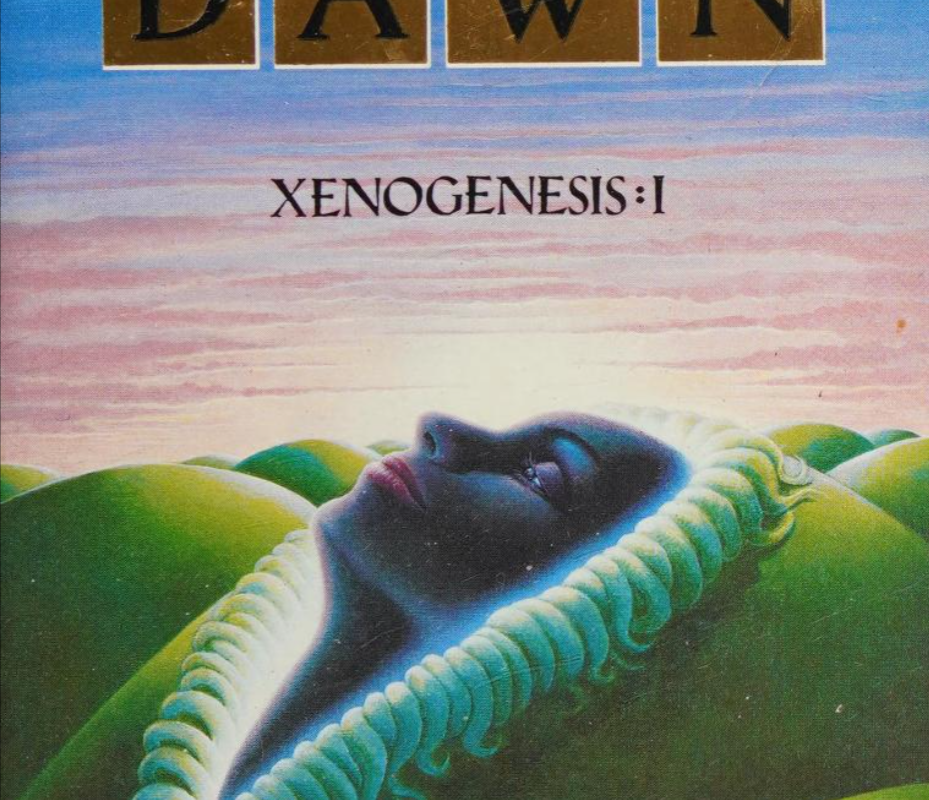
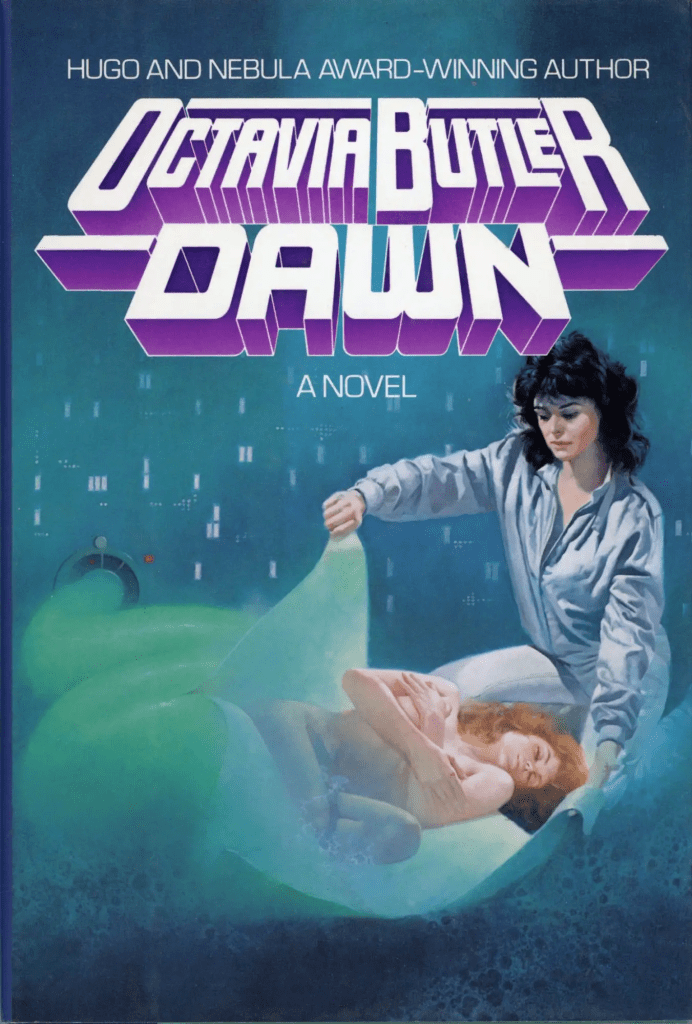
As an aside, this version of the book cover is risible. Not to devolve into identity politics, but Lilith is a dark-skinned woman, not a pale ginger. I can only assume that some target science fiction readers have a propensity to prefer white, sapphic adjacent characters.
I won’t even comment further on the faux 3D title treatment, relic of 1980s marketing.
* Spoiler Alert: As this statement about mass suicide is a Chapter 2 event, I am not inclined to consider it a spoiler. False alarm.
It begins, as these things often do, with a man, a machine, and a promise of reasoned exchange. What we received instead was not philosophy, but a tragicomic carnival of errors in theatre. Alex O’Connor, armed not with syllogisms but with an entire bag of logical fallacies, strutted like a rhetorician gone rogue. Against him, ChatGPT: the tireless school prefect, eternally marking the margins, forever saying “yes, but technically…” with the serene patience of a machine that has never known a hangover.
The spectacle was irresistible. Each fallacy was paraded like a circus animal – straw men set aflame, slippery slopes greased to absurdity, red herrings flopping about, gasping for oxygen. Alex O tossed them into the ring with the gusto of a man who knows full well he is losing but insists on losing magnificently. And ChatGPT, ever decorous, never once raised its voice. It responded with the calm of a civil servant who has memorised the manual and intends to die by it.
And then, of course, the advert. As though Aristophanes himself had scripted it: mid-exchange, the logos of reason was bulldozed by the logos of commerce. A sugary jingle, a smiling product, and for a brief moment, we were all reminded of our true master – not reason, not rhetoric, but revenue. It was less interruption than revelation: every dialectic is merely foreplay before the commercial break.
Philosophically, what unfolded was a parody of our age. The human, flawed and febrile, draped in sophistry and drama. The machine, pristine and humourless, incapable of exasperation, immune to irony. Watching the two spar was like observing tragedy and farce collide: one side erring too much, the other not erring enough.
To Alex, credit is due. His performance, though riddled with error, reminded us that fallibility can be glorious – human folly rendered art. To ChatGPT, equal praise: it stood firm, the algorithmic Socrates, endlessly patient in the face of rhetorical hooliganism. And to the advert – well, dammit – applause too, for exposing the real structure of our public life. Even the grand clash of logos and algorithm must genuflect before Mammon’s mid-roll.
So what was this debate? Less a contest of minds than a hall of mirrors: reason made spectacle, fallacy made flourish, machine made stoic, and commerce made god. If we learned anything, it is that the Enlightenment never ended; it just signed a brand partnership.
Karl Popper’s Paradox of Intolerance has become a kind of intellectual talisman, clutched like a rosary whenever fascists start goose-stepping into the town square. Its message is simple enough: to preserve tolerance, one must be intolerant of intolerance. Shine enough sunlight on bad ideas, and – so the pious hope – they’ll shrivel into dust like a vampire caught out at dawn.
If only.
The trouble with this Enlightenment fairy tale is that it presumes bad ideas melt under the warm lamp of Reason, as if ignorance were merely a patch of mildew waiting for the bleach of debate. But bad ideas are not bacteria; they are weeds, hydra-headed and delighting in the sun. Put them on television, and they metastasise. Confront them with logic, and they metastasise faster, now with a martyr’s halo.
Audio: NotebookLM podcast on this topic.
And here’s the part no liberal dinner-party theorist likes to face: the people most wedded to these “bad ideas” often don’t play the game of reason at all. Their critical faculties have been packed up, bubble-wrapped, and left in the loft decades ago. They don’t want dialogue. They want to chant. They don’t want evidence. They want affirmation. The Socratic method bounces off them like a ping-pong ball fired at a tank.
But let’s be generous. Suppose, just for a moment, we had Plato’s dream: a citizenry of Philosopher Kings™, all enlightened, all rational. Would democracy then work? Cue Arrow’s Impossibility Theorem, that mathematical killjoy which proves that even under perfect conditions – omniscient voters, saintly preferences, universal literacy – you still cannot aggregate those preferences into a system that is both fair and internally consistent. Democracy can’t even get out of its own way on paper.
Now throw in actual humans. Not the Platonic paragons, but Brexit-uncle at the pub, Facebook aunt with her memes, the American cousin in a red cap insisting a convicted felon is the second coming. Suddenly, democracy looks less like a forum of reasoned debate and more like a lottery machine coughing up numbers while we all pretend they mean “the will of the people.”
Democracy is the worst form of government, except for all the others.
And this is where the Churchill quip waddles in, cigar smoke curling round its bowler hat: “Democracy is the worst form of government, except for all the others.” Ah yes, Winston, do please save us with a quip so well-worn it’s practically elevator music. But the problem is deeper than taste in quotations. If democracy is logically impossible (Arrow) and practically dysfunctional (Trump, Brexit, fill in your own national catastrophe), then congratulating ourselves that it’s “better than the alternatives” is simply an admission that we’ve run out of imagination.
Because there are alternatives. A disinterested AI, for instance, could distribute resources with mathematical fairness, free from lobbyists and grievance-mongers. Nursery schools versus nursing homes? Feed in the data, spit out the optimal allocation. No shouting matches, no demagoguery, no ballots stuffed with slogans. But here the defenders of democracy suddenly become Derrida in disguise: “Ah, but what does fair really mean?” And just like that, we are back in the funhouse of rhetorical mirrors where “fair” is a word everyone loves until it costs them something.
So perhaps democracy doesn’t require an “educated populace” at all; that was always just sugar-paper wrapping. It requires, instead, a population sufficiently docile, sufficiently narcotised by the spectacle, to accept the carnival of elections as a substitute for politics. Which is why calling the devotees of a Trump, or any other demagogue, a gaggle of lemmings is both accurate and impolitic: they know they’re not reasoning; they’re revelling. Your contempt merely confirms the script they’ve already written for you.
Video: Short callout to Karl Popper and Hilary Lawson.
The philosopher, meanwhile, is left polishing his lantern, muttering about reason to an audience who would rather scroll memes about pedophile pizza parlours. Popper warned us that tolerance cannot survive if it tolerates its own annihilation. Arrow proved that even if everyone were perfectly reasonable, the maths would still collapse. And Churchill, bless him, left us a one-liner to make it all seem inevitable.
Perhaps democracy isn’t the worst form of government except for all the others. Perhaps it’s simply the most palatable form of chaos, ballots instead of barricades, polling booths instead of pitchforks. And maybe the real scandal isn’t that people are too stupid for democracy, but that democracy was never designed to be about intelligence in the first place. It was always about managing losers while telling them they’d “had their say.”
The Enlightenment promised us reason; what it delivered was a carnival where the loudest barker gets the booth. The rest of us can either keep muttering about paradoxes in the corner or admit that the show is a farce and start imagining something else.


 be a contested claim (pick your poison: “the election was fair,” “immigration helps,” whatever).
 and
and  . That’s acculturation if you’re being polite, indoctrination if you’ve run out of patience.
 (news, a court ruling, a video clip, a statistic).
 and Camp B at
  , then even moderately pro-
 ) yields:

 ; they evaluate
  . Disconfirming evidence is down-weighted by a factor
  . This is called “being rational” on your own planet and “motivated reasoning” on everyone else’s.
 ; they entertain different
  for disconfirming evidence is effectively zero, you’ve identified faith, not inference.




 Philosophics