Democracy: Opiate of the Masses

Democracy is sold, propagandised, really, as the best system of governance we’ve ever devised, usually with the grudging qualifier “so far.” It’s the Coca-Cola of political systems: not particularly good for you, but so entrenched in the cultural bloodstream that to question it is tantamount to treason.

Audio: NotebookLM Podcast on this topic.

The trouble is this: democracy depends on an electorate that is both aware and capable. Most people are neither. Worse still, even if they could be aware, they wouldn’t be smart enough to make use of it. And even if they were smart enough, Arrow’s Impossibility Theorem strolls in, smirking, to remind us that the whole thing is mathematically doomed anyway.

Even this number is a charade. IQ measures how well you navigate the peculiar obstacle course we’ve designed as “education,” not the whole terrain of human thought. It’s as culturally loaded as asking a fish to climb a tree, then declaring it dim-witted when it flops. We call it intelligence because it flatters those already rewarded by the system that designed the test. In the United States, the average IQ stands at 97 – hardly a figure that instils confidence in votes and outcomes.

The Enlightenment gents who pushed democracy weren’t exactly selfless visionaries. They already had power, and simply repackaged it as something everyone could share, much as the clergy promised eternal reward to peasants if they only kept their heads down. Democracy is merely religion with ballots instead of bibles: an opiate for the masses, sedating the population with the illusion of influence.

Worse still, it’s a system optimised for mediocrity. It rewards consensus, punishes brilliance, and ensures the average voter is, by definition, average. Living under it is like starring in Idiocracy, only without the comedic relief, just the grim recognition that you’re outnumbered, and the crowd is cheering the wrong thing.

The Enlightenment: A Postmortem

Or: How the Brightest Ideas in Europe Got Us into This Bloody Mess

Disclaimer: This output is entirely ChatGPT 4o from a conversation on the failure and anachronism of Enlightenment promises. I’m trying to finish editing my next novel, so I can’t justify taking much more time to share what are ultimately my thoughts as expounded upon by generative AI. I may comment personally in future. Until then, this is what I have to share.

AI Haters, leave now or perish ye all hope.


The Enlightenment promised us emancipation from superstition, authority, and ignorance. What we got instead was bureaucracy, colonialism, and TED Talks. We replaced divine right with data dashboards and called it progress. And like any good inheritance, the will was contested, and most of us ended up with bugger-all.

Below, I take each Enlightenment virtue, pair it with its contemporary vice, and offer a detractor who saw through the Enlightenment’s powder-wigged charade. Because if we’re going down with this ship, we might as well point out the dry rot in the hull.


1. Rationalism

The Ideal: Reason shall lead us out of darkness.
The Reality: Reason led us straight into the gas chambers—with bureaucratic precision.

Detractor: Max Horkheimer & Theodor Adorno

“Enlightenment is totalitarian.”
Dialectic of Enlightenment (1944)

Horkheimer and Adorno saw what reason looks like when it slips off its leash. Instrumental rationality, they warned, doesn’t ask why—it only asks how efficiently. The result? A world where extermination is scheduled, costs are optimised, and ethics are politely filed under “subjective.”


2. Empiricism

The Ideal: Observation and experience will uncover truth.
The Reality: If it can’t be measured, it can’t be real. (Love? Not statistically significant.)

Detractor: Michel Foucault

“Truth isn’t outside power… truth is a thing of this world.”
Power/Knowledge (1977)

Foucault dismantled the whole edifice. Knowledge isn’t neutral; it’s an instrument of power. Empiricism becomes just another way of disciplining the body—measuring skulls, classifying deviants, and diagnosing women with “hysteria” for having opinions.


3. Individualism

The Ideal: The sovereign subject, free and self-determining.
The Reality: The atomised consumer, trapped in a feedback loop of self-optimisation.

Detractor: Jean Baudrillard

“The individual is no longer an autonomous subject but a terminal of multiple networks.”
Simulacra and Simulation (1981)

You wanted autonomy? You got algorithms. Baudrillard reminds us that the modern “individual” is a brand in search of market validation. You are free to be whoever you want, provided it fits within platform guidelines and doesn’t disrupt ad revenue.


4. Secularism

The Ideal: Liberation from superstition.
The Reality: We swapped saints for STEMlords and called it even.

Detractor: Charles Taylor

“We are now living in a spiritual wasteland.”
A Secular Age (2007)

Taylor—perhaps the most polite Canadian apocalypse-whisperer—reminds us that secularism didn’t replace religion with reason; it replaced mystery with malaise. We’re no longer awed, just “motivated.” Everything is explainable, and yet somehow nothing means anything.


5. Progress

The Ideal: History is a forward march toward utopia.
The Reality: History is a meat grinder in a lab coat.

Detractor: Walter Benjamin

“The storm irresistibly propels him into the future to which his back is turned.”
Theses on the Philosophy of History (1940)

Benjamin’s “angel of history” watches helplessly as the wreckage piles up—colonialism, genocide, climate collapse—all in the name of progress. Every step forward has a cost, but we keep marching, noses in the spreadsheet, ignoring the bodies behind us.


6. Universalism

The Ideal: One humanity, under Reason.
The Reality: Enlightenment values, brought to you by cannon fire and Christian missionaries.

Detractor: Gayatri Chakravorty Spivak

“White men are saving brown women from brown men.”
Can the Subaltern Speak? (1988)

Universalism was always a bit… French, wasn’t it? Spivak unmasks it as imperialism in drag—exporting “rights” and “freedom” to people who never asked for them, while ignoring the structural violence built into the Enlightenment’s own Enlightened societies.


7. Tolerance

The Ideal: Let a thousand opinions bloom.
The Reality: Tolerance, but only for those who don’t threaten the status quo.

Detractor: Karl Popper

“Unlimited tolerance must lead to the disappearance of tolerance.”
The Open Society and Its Enemies (1945)

Popper, bless him, thought tolerance needed a firewall. But in practice, “tolerance” has become a smug liberal virtue signalling its own superiority while deplatforming anyone who makes the dinner party uncomfortable. We tolerate all views—except the unseemly ones.


8. Scientific Method

The Ideal: Observe, hypothesise, repeat. Truth shall emerge.
The Reality: Publish or perish. Fund or flounder.

Detractor: Paul Feyerabend

“Science is not one thing, it is many things.”
Against Method (1975)

Feyerabend called the whole thing a farce. There is no single “method,” just a bureaucratic orthodoxy masquerading as objectivity. Today, science bends to industry, cherry-picks for grants, and buries null results in the backyard. Peer review? More like peer pressure.


9. Anti-Authoritarianism

The Ideal: Smash the throne! Burn the mitre!
The Reality: Bow to the data analytics team.

Detractor: Herbert Marcuse

“Free election of masters does not abolish the masters or the slaves.”
One-Dimensional Man (1964)

Marcuse skewered the liberal illusion of choice. We may vote, but we do so within a system that already wrote the script. Authority didn’t vanish; it just became procedural, faceless, algorithmic. Bureaucracy is the new monarchy—only with more forms.


10. Education and Encyclopaedism

The Ideal: All knowledge, accessible to all minds.
The Reality: Behind a paywall. Written in impenetrable prose. Moderated by white men with tenure.

Detractor: Ivan Illich

“School is the advertising agency which makes you believe that you need the society as it is.”
Deschooling Society (1971)

Illich pulls the curtain: education isn’t emancipatory; it’s indoctrinatory. The modern university produces not thinkers but credentialed employees. Encyclopaedias are replaced by Wikipedia, curated by anonymous pedants and revision wars. Truth is editable.


Postscript: Picking through the Rubble

So—has the Enlightenment failed?

Not exactly. It succeeded too literally. It was taken at its word. Its principles, once radical, were rendered banal. It’s not that reason, progress, or rights are inherently doomed—it’s that they were never as pure as advertised. They were always products of their time: male, white, bourgeois, and utterly convinced of their own benevolence.

If there’s a path forward, it’s not to restore Enlightenment values, but to interrogate them—mercilessly, with irony and eyes open.

After all, the problem was never darkness. It was the people with torches who thought they’d found the only path.

The Cult of Officer Safety: How SCOTUS Legalised Fear

In the great American theatre of liberty, there’s one character whose neuroses we all must cater to: the police officer. Not the civil servant. Not the trained professional. No, the trembling bundle of nerves with a badge and a gun. According to the United States Supreme Court, this anxious figure is so vulnerable that the Constitution itself must bend to accommodate his fear. I’m not sure I have less respect for these people than for most other professions.

Audio: NotebookLM podcast on this topic.

Let’s review.

In Pennsylvania v. Mimms (1977), the Court held that police can order a driver out of their vehicle during any lawful traffic stop—no suspicion, no cause, just vibes. Why? Because the officer might get nervous otherwise.

Fast-forward to Maryland v. Wilson (1997), and that same logic is extended to passengers. That’s right: even if you’re just catching a ride, you too can be ordered out and subject to scrutiny because, well, a cop might be spooked.

The rationale? “Officer safety.” A phrase so overused it may as well be stamped on every judge’s gavel and stitched into every uniform. Forget that you’re a citizen with rights; forget that the Fourth Amendment was intended to restrain arbitrary power. If your mere presence makes Officer Skittish feel a bit antsy, the law now permits him to act like he’s clearing a war zone.

It’s worth asking – gently, of course, so as not to alarm anyone in uniform – why exactly we entrust our most coercive state powers to individuals apparently one errant movement away from fight-or-flight mode?

Rather than raising the bar for police conduct, these rulings lower the bar for constitutional protections. Rather than requiring police to be calm, competent, and capable under pressure, the Court concedes that they’re none of those things and therefore need extra authority to compensate.

So here’s a radical suggestion: What if “officer safety” wasn’t a get-out-of-liberty-free card? What if we demanded emotional resilience and psychological stability before issuing guns and power? What if, instead of warping the law around the most paranoid members of the force, we removed them from the force?

But no. Instead, we get jurisprudence that treats every routine traffic stop like a potential ambush. And to ensure our jittery guardian gets home safe, you, dear citizen, will be the one legally disarmed.

So buckle up – because your rights don’t mean much when the man with the badge is afraid of his own shadow.

Can One Obstruct Justice in a Place It Doesn’t Exist?

ICE is out in force again, dragging brown bodies out of homes in Los Angeles like it’s some righteous carnival of due process. Another day, another federal theatre production titled Law and Order: Ethnic Cleansing Unit, where men with guns and names like Chad or Hank mistake cruelty for patriotism and paperwork for moral clarity.

Audio: NotebookLM podcast on this topic.

Naturally, critics of these raids are now being threatened with that great juridical cudgel: “obstructing justice.” Yes, you heard that right. If you interfere – say, by filming, shouting, refusing to roll over like a good little colonial subject – you are obstructing justice. As though justice were something you could actually put your hands on in the United States without a hazmat suit and a decade of appeals.

Let’s be clear. There is no justice here to obstruct. What you are obstructing is bureaucratic violence wrapped in legal latex. You are obstructing a system that functions like a vending machine for state-sanctioned trauma: insert immigrant, extract ruin.

Justice: The Imaginary Friend of Empire

Ah, “justice.” That hallowed ideal trotted out whenever the state wants to put a boot through your front door. The U.S. has long since traded its Justice for Security Theatre and capitalist choreography. The blindfold is still there, sure – but these days, it’s a branded sleep mask from Lockheed Martin, and the scales are rigged to weigh white tears heavier than brown bodies.

Let’s run through the usual suspects:

  • ICE – America’s own domestic Gestapo, but with better PR and significantly worse fashion.
  • CBP – Border fetishists whose job seems less about national defence and more about satisfying their Freud-bereft fantasies of control.
  • SCOTUS – That great moral weather vane, spinning wildly between “originalist necromancy” and outright lunacy, depending on how recently Thomas and Alito read Leviticus.
  • Congress – An assembly of millionaires cosplaying as public servants, holding hearings on “the threat of immigration” while outsourcing their lawn care.

And of course, the President – whichever septuagenarian husk happens to be in office – offers the usual bromides about order, safety, and enforcement, all while the real crimes (you know, the kind involving tax fraud, corporate pollution, or drone strikes) go entirely unmolested.

Can You Obstruct a Simulation?

If you stand in front of a deportation van, are you obstructing justice, or merely interrupting the bureaucratic excretion of empire? It’s the philosophical equivalent of trying to punch a hologram. The system pretends to uphold fairness while routinely violating its own principles, then charges you with “obstruction” when you call out the sleight of hand.

This is not justice. This is kabuki. A ritual. A performance piece sponsored by Raytheon.

A Modest Proposal

Let’s just be honest and rename the charge. Not “Obstruction of Justice”—too ironic, too pompous. Call it what it is: Obstruction of Procedure, Obstruction of Power, or if we’re being especially accurate: Obstruction of the Industrial Deportation Complex™. Hell, add a corporate sponsor while you’re at it:

You are being charged with Obstruction of Justice, Presented by Amazon Web Services.

Because when justice itself is a ghost, when the rule of law has become the rule of lawfare, the real obscenity is pretending any of this is noble.

Final Thought

So no, dear reader, you’re not obstructing justice. You’re obstructing a machine that mistakes itself for a moral order. And if you’re going to obstruct something, make it that.

Parfit’s Long-Termism and Property Rights

Cause and effect: This clip by Jonny Thompson influenced this post.

I’ve written extensively (and, some might say, relentlessly) on the immorality of private property, particularly the theological nonsense that undergirds its supposed legitimacy. Locke’s first-come, first-served logic might have sounded dashing in the 17th century, but it now reads like a boarding queue at Ryanair: desperate, arbitrary, and hostile to basic decency.

Audio: NotebookLM podcast on this content.

The core problem? Locke’s formulation assumes land was once freely available, as if Earth were a kind of colonial vending machine: insert labour, receive title. But that vending machine was already jammed by the time most of humanity got a look-in. Worse, it bakes in two kinds of chauvinism: temporal (screw the future) and speciesist (screw anything non-human).

Parfit’s long-termism lays bare the absurdity: why should a bit of land or atmospheric stability belong to those who happened to get here first, especially when their stewardship amounts to strip-mining the pantry and then boarding up the exit?

And no, “mixing your labour” with the land does not miraculously confer ownership—any more than a damp bint lobbing a sword at you from a pond makes you sovereign. That’s not philosophy; that’s Arthurian cosplay.

The Scourge: They’re Really Fighting Is Ambiguity

A Sequel to “The Disorder of Saying No” and a Companion to “When ‘Advanced’ Means Genocide”

In my previous post, The Disorder of Saying No, I explored the way resistance to authority is pathologised, particularly when that authority is cloaked in benevolence and armed with diagnostic manuals. When one refuses — gently, thoughtfully, or with a sharp polemic — one is no longer principled. One is “difficult.” Or in my case, oppositional.

Audio: NotebookLM podcast on this topic.

So when I had the gall to call out Bill Maher for his recent linguistic stunt — declaring that a woman is simply “a person who menstruates” — I thought I was doing the rational thing: pointing out a classic bit of reductionist nonsense masquerading as clarity. Maher, after all, was not doing biology. He was playing lexicographer-in-chief, defining a term with centuries of philosophical, sociological, and political baggage as though it were a checkbox on a medical form.

I said as much: that he was abusing his platform, presenting himself as the sole arbiter of the English language, and that his little performance was less about clarity and more about controlling the terms of discourse.

My friend, a post-menopausal woman herself, responded not by engaging the argument, but by insinuating — as others have — that I was simply being contrary. Oppositional. Difficult. Again. (She was clearly moved by When “Advanced” Means Genocide, but may have missed the point.)

So let’s unpack this — not to win the debate, but to show what the debate actually is.

This Isn’t About Biology — It’s About Boundary Maintenance

Maher’s statement wasn’t intended to clarify. It was intended to exclude. It wasn’t some linguistic slip; it was a rhetorical scalpel — one used not to analyse, but to amputate.

And the applause from some cisgender women — particularly those who’ve “graduated” from menstruation — reveals the heart of the matter: it’s not about reproductive biology. It’s about controlling who gets to claim the term woman.

Let’s steelman the argument, just for the sport of it:

Menstruation is a symbolic threshold. Even if one no longer menstruates, having done so places you irrevocably within the category of woman. It’s not about exclusion; it’s about grounding identity in material experience.

Fine. But now let’s ask:

  • What about women who’ve never menstruated?
  • What about intersex people?
  • What about trans women?
  • What about cultures with radically different markers of womanhood?

You see, it only works if you pretend the world is simpler than it is.

The Language Insufficiency Hypothesis: Applied

This is precisely where the Language Insufficiency Hypothesis earns its keep.

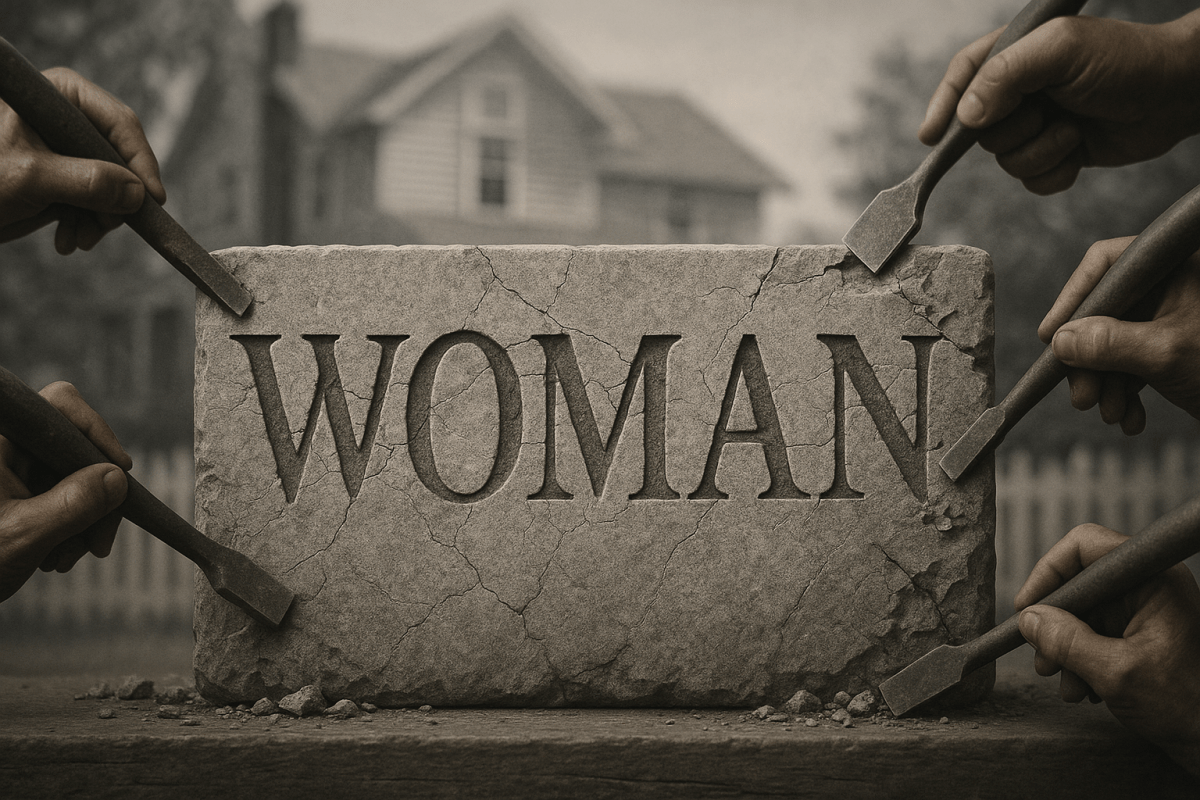
The word woman is not a locked vault. It is a floating signifier, to borrow from Barthes — a term whose meaning is perpetually re-negotiated in use. There is no singular essence to the word. It is not rooted in biology, nor in social role, nor in performance. It is a hybrid, historically contingent construct — and the moment you try to fix its meaning, it slips sideways like a greased Wittgensteinian beetle.

“Meaning is use,” says Wittgenstein, and this is what frightens people.

If woman is defined by use and not by rule, then anyone might claim it. And suddenly, the club is no longer exclusive.

That’s the threat Maher and his defenders are really reacting to. Not trans women. Not intersex people. Not language activists or queer theorists.

The threat is ambiguity.

What They Want: A World That Can Be Named

The push for rigid definitions — for menstruation as membership — is a plea for a world that can be named and known. A world where words are secure, stable, and final. Where meaning doesn’t leak.

But language doesn’t offer that comfort.

It never did.

And when that linguistic instability gets too close to something personal, like gender identity, or the foundation of one’s own sense of self, the defensive response is to fortify the language, as though building walls around a collapsing church.

Maher’s defenders aren’t making scientific arguments. They’re waging semantic warfare. If they can hold the definition, they can win the cultural narrative. They can hold the gates to Womanhood and keep the undesirables out.

That’s the fantasy.

But language doesn’t play along.

Conclusion: Words Will Not Save You — but They Might Soothe the Dead

In the end, Maher’s definition is not merely incorrect. It is insufficient. It cannot accommodate the complexity of lived experience and cannot sustain the illusion of clarity for long.

And those who cling to it — friend or stranger, progressive, or conservative — are not defending biology. They are defending nostalgia. Specifically, a pathological nostalgia for a world that no longer exists, and arguably never did: a world where gender roles were static, language was absolute, and womanhood was neatly circumscribed by bodily functions and suburban etiquette.

Ozzy and Harriet loom large here — not as individuals but as archetypes. Icons of a mid-century dream in which everyone knew their place, and deviation was something to be corrected, not celebrated. My friend, of that generation, clings to this fantasy not out of malice but out of a desperate yearning for order. The idea that woman could mean many things, and mean them differently across contexts, is not liberating to her — it’s destabilising.

But that world is gone. And no amount of menstruation-based gatekeeping will restore it.

The Real Scourge Is Ambiguity

Maher’s tantrum wasn’t about truth. It was about fear — fear of linguistic drift, of gender flux, of a world in which meaning no longer obeys. The desire to fix the definition of “woman” is not a biological impulse. It’s a theological one.

And theology, like nostalgia, often makes terrible policy.

This is why your Language Insufficiency Hypothesis matters. Because it reminds us that language does not stabilise reality — it masks its instability. The attempt to define “woman” once and for all is not just futile — it’s an act of violence against difference, a linguistic colonisation of lived experience.

So Let Them Rest

Ozzy and Harriet are dead. Let them rest.
Let their picket fence moulder. Let their signage decay.

The world has moved on. The language is shifting beneath your feet. And no amount of retroactive gatekeeping can halt that tremor.

The club is burning. And the only thing left to save is honesty.

When “Advanced” Means Genocide: A Case Study in Linguistic Implosion

This post draws on themes from my upcoming book, A Language Insufficiency Hypothesis. The transcript below is taken from a publicly available exchange, which you can view here. Consider it Exhibit A in language’s ongoing failure to bear the weight of meaning.

Transcript:

KK: Konstantin Kisin
DFW: Deborah Frances-White

KK: I’m saying we were technologically more advanced.
DFW: So you’re saying we’re superior to Australian Aboriginals?
KK: That’s quite the opposite of what I’m saying. I’m not saying we were superior, I’m saying we were technologically more advanced.
DFW: So, how is that the opposite?
KK: Superior implies a moral quality. I’m not making any moral implication. You seem to be, but what I’m saying is…
DFW: I think most people would hear it that way.
KK: No.
DFW: Again, you’re a very intelligent man. How would most people hear that?
KK: Most people would hear what I’m saying for what I’m saying, which is…
DFW: I don’t think they would.
KK: You seem to get quite heated about this, which is completely unnecessary.
DFW: Um…
KK: You think it’s necessary?
DFW: I’m a bit stunned by what you’re implying.
KK: No, you’re acting in a kind of passive aggressive way which indicates that you’re not happy…
DFW: I genuinely… I’m being 100% authentic. My visceral reaction to a white man sitting and saying to me, “And why were we able to commit genocide on them?” and then just pausing—
KK: Yes.
DFW: …is very visceral to me.
KK: Well, let’s go back. First of all, it’s interesting that you brought up my skin colour because I thought that was the exact opposite of the point you’re trying to make in the book.

Audio: NotebookLM podcast on this topic.

The Language Insufficiency Hypothesis begins with this premise: language is not merely flawed, it is structurally inadequate for mediating complex, layered realities – especially those laced with power, morality, and history. This transcript is not a debate. It is a linguistic trench war in which every utterance is laced with shrapnel, and each side thinks they’re defending reason.

Let’s pull a few of the shell casings from the mud.

KK attempts to offer a dry, neutral descriptor. DFW hears supremacist teleology. Why? Because “advanced” is culturally radioactive. It doesn’t merely denote a technical state—it connotes a ladder, with someone inevitably on the bottom rung.

When language carries historical residue, neutrality is a delusion. Words don’t just mean. They echo.

KK is making a semantic distinction. DFW hears a moral claim. Both are right. And both are talking past one another, because language is attempting to cleave affect from description, and it simply can’t.

KK’s insistence—“I’m not saying we’re superior”—is a textbook example of denotative desperation. He believes clarification will rescue intent. But as any linguist (or postcolonial theorist) will tell you: intent does not sterilise implication.

Language cannot be laundered by explanation. Once spoken, words belong to context, not intention.

KK thinks he’s holding a scalpel. DFW hears a cudgel. And here we are.

This is where the wheels come off. KK argues from semantic specificity. DFW argues from sociolinguistic reception. It’s Saussure versus the TikTok algorithm. Neither will win.

Communication disintegrates not because anyone is lying, but because they are playing incompatible games with the same tokens.

DFW’s invocation of “a white man” is not a derailment—it’s the inevitable endpoint of a system where words no longer float free but are yoked to their utterer. This is the moment the failure of language becomes a failure of interlocution. Argument collapses into indexical entrapment.

At this point, you’re no longer debating ideas. You’re defending your right to use certain words at all.

Which brings us to the final breakdown.

KK: I am making a logical distinction.
DFW: I am having a visceral reaction.

The failure isn’t moral. It isn’t historical. It’s grammatical. One is operating in a truth-function logic game. The other is reacting within a trauma-informed, socially indexed register. These are grammars that do not overlap.

If this brief and brutal dialogue proves anything, it’s this: you cannot extract meaning cleanly from words when the words themselves are sponges for history, hierarchy, and harm. The moment we ask language to do too much—to carry precision, affect, ethics, and identity—it folds in on itself.

And that, dear reader, is precisely the argument of A Language Insufficiency Hypothesis: that meaning does not reside in words, and never has. It lives in the gaps, the silences, the misfires. That’s where the truth—whatever’s left of it—might be hiding.

Follow the wreckage. That’s where the signal lives.

On Ishiguro, Cioran, and Whatever I Think I’m Doing

Sora-generated image of Emil Cioran and Kazuo Ishiguro reading a generic book together

Having just finished Never Let Me Go by Kazuo Ishiguro, I’ve now cracked open my first taste of Cioran—History and Utopia. You might reasonably ask why. Why these two? And what, if anything, do they have in common? Better yet—what do the three of us have in common?

Audio: NotebookLM podcast on this topic.

Recently, I finished writing a novella titled Propensity (currently gathering metaphorical dust on the release runway). Out of curiosity—or narcissism—I fed it to AI and asked whose style it resembled. Among the usual suspects were two names I hadn’t yet read: Ishiguro and Cioran. I’d read the others and understood the links. These two, though, were unknown quantities. So I gave them a go.

Ishiguro is perhaps best known for The Remains of the Day, which, like Never Let Me Go, got the Hollywood treatment. I chose the latter, arbitrarily. I even asked ChatGPT to compare both books with their cinematic counterparts. The AI was less than charitable, describing Hollywood’s adaptations as bastardised and bowdlerised—flattened into tidy narratives for American palates too dim to digest ambiguity. On this, we agree.

What struck me about Never Let Me Go was its richly textured mundanity. That’s apparently where AI saw the resemblance to Propensity. I’m not here to write a book report—partly because I detest spoilers, and partly because summaries miss the point. It took about seven chapters before anything ‘happened’, and then it kept happening. What had at first seemed like a neurotic, wandering narrative from the maddeningly passive Kathy H. suddenly hooked me. The reveals began to unfold. It’s a book that resists retelling. It demands firsthand experience. A vibe. A tone. A slow, aching dread.

Which brings me neatly to Cioran.

History and Utopia is a collection of essays penned in French (not his mother tongue, but you’d never guess it) while Cioran was holed up in postwar Paris. I opted for the English translation—unapologetically—and was instantly drawn in. His prose? Electric. His wit? Acidic. If Ishiguro was a comparison of style, then Cioran was one of spirit. Snark, pessimism, fatalistic shrugs toward civilisation—finally, someone speaking my language.

Unlike the cardboard cut-outs of Cold War polemics we get from most Western writers of the era, Cioran’s take is layered, uncomfortably self-aware, and written by someone who actually fled political chaos. There’s no naïve idealism here, no facile hero-villain binaries. Just a deeply weary intellect peering into the abyss and refusing to blink. It’s not just what he says, but the tone—the curled-lip sneer at utopian pretensions and historical self-delusions. If I earned even a drop of that comparison, I’ll take it.

Both Ishiguro and Cioran delivered what I didn’t know I needed: the reminder that some writers aren’t there to tell you a story. They’re there to infect you with an atmosphere. An idea. A quiet existential panic you can’t shake.

I’ve gotten what I came for from these two, though I suspect I’ll be returning, especially to Cioran. Philosophically, he’s my kind of bastard. I doubt this’ll be my last post on his work.