Nous vivons une époque où le langage est utilisé non pas pour éclairer, mais pour diviser et détourner. L’Obamacare, détesté dans son ensemble mais soutenu dans ses détails, en est un parfait exemple. Cela reflète un problème plus fondamental : des concepts comme « dérèglement climatique » ou « inégalités systémiques » deviennent des points de friction en raison de leur abstraction. Ce ne sont pas les scientifiques ou les activistes qui posent problème, mais une structure de pouvoir qui manipule le discours pour diluer l’action.
Déplaçons le débat. Comme pour l’Obamacare, déconstruisons les concepts en éléments concrets : énergies renouvelables, adaptation agricole, redistribution des richesses. Chaque brique est plus compréhensible et soutenable que le mur idéologique qu’on nous oppose.
Le langage, dans sa complexité, peut être insuffisant, mais il reste notre outil principal pour reconstruire des vérités fragmentées. À nous de le manier avec précision, en refusant de céder à ceux qui le déforment pour mieux nous diviser.
Cela illustre parfaitement ma notion de « dés-intégration ». Ce terme, que je préfère à la « déconstruction » de Derrida, se distingue également de l’usage courant de « désintégration ». Là où la « déconstruction » appartient au domaine littéraire et philosophique, et où la « désintégration » évoque une destruction pure, la « dés-intégration » renvoie à une méthode critique et analytique pour séparer un concept en ses composantes essentielles afin de le reconstruire ou le recontextualiser.
C’est exactement ce qu’il faut appliquer au débat sur le changement climatique d’origine anthropique. Plutôt que de nous enfermer dans des abstractions globales qui polarisent, il faut fragmenter ce débat en ses constituants concrets : l’énergie, l’industrie, l’agriculture, les infrastructures. En décomposant ces éléments, nous pouvons redonner du sens et du pragmatisme à des discussions souvent noyées sous l’idéologie.
LinkedIn est une plateforme horrible pour le partage. C’est pourquoi j’ai copié ma réponse ici. Si vous avez accès à LinkedIn, la conversation générale s’y déroule.
I don’t believe in the notions of ‘self’ or identities, but it makes for a nice thought experiment.
Imagine, just for a moment, that somewhere on this planet, there is someone who is your opposite in every conceivable way. They live as you do not. If you are kind, they are cruel. If you revel in the thrill of running through a rainstorm, they are the kind who sit comfortably by the fire, dreading the mere thought of a brisk step outdoors. If you drink to toast life’s joys, they abstain, unwilling to let a drop pass their lips. They are your anti-self—an inversion of who you are, lacking everything that you have and yet possessing everything that you do not.
To truly grow, we must encounter the other
As strange as it seems, this image is more than idle speculation. According to the Romantic poet John Keats, holding such an image of your anti-self is an essential part of the process of creating your own identity. The elusive art of true self-creation lies, paradoxically, in our capacity to hold in our minds those lives and feelings that are utterly different from our own. To truly grow, we must encounter the other—whether that other is someone we know or a shadowy, imagined version of who we could have been if only we’d chosen differently. This exercise is more than an intellectual indulgence; it is at the core of what Keats called ‘soul-making.’
Keats believed in the concept of the ‘chameleon poet’—the idea that writers, and indeed all human beings, must cultivate the ability to lose themselves in the perspectives of others. It is not enough to gaze upon the world through the singular lens of our own experience; to truly create, we must dissolve our egos and embrace a kaleidoscope of possibilities. A woman might explore the life of a soldier, writing deeply about a battle she’s never fought. A contented parent might dare to delve into the unimaginable grief of losing a child. Fiction writers, poets, artists—they all do this: they shed their own skin, assume another’s, and, in doing so, broaden the horizons of their own soul.
But Keats’ lesson here isn’t limited to the domain of poets and storytellers; it’s a practice that should extend to all of us. In what he evocatively called ‘the vale of soul-making,’ Keats posited that life offers each of us the raw materials to forge a soul, but we must engage imaginatively with all the lives we might lead, all the people we could be. We must dare to envision every possible road before us, not as a commitment but as an act of creation—enriching ourselves with the essence of each path before deciding which one we wish to tread.
We must set ablaze all our imagined lives just to make room for the one we decide to live.
And therein lies the heartbreak of it all. When we choose one possible life, we necessarily burn the others. In the very act of committing, we close other doors. We must set ablaze all our imagined lives just to make room for the one we decide to live. This thought is thrilling but also terrifying. Unlike a poet, who can glide into and out of fictional worlds, we must choose where we stand and stay there. We are not chameleons. We cannot flit endlessly between possibilities. We cannot write a library of books. We must write the one, and we must write it well.
Keats understood that the art of imagining one’s anti-self wasn’t about living vicariously forever in a land of could-have-beens. The exercise is in acknowledging these spectres of other lives, learning from them, and then committing, knowing full well what is lost in the process. Self-creation means being both the builder of one’s house and the one who tears down all the others, brick by potential brick. It means knowing who you could have been and yet, resolutely stepping into who you choose to be.
Embrace the anti-self
In a world obsessed with keeping every option open, Keats offers us the wisdom of finality. Burn off your possible lives and focus on writing the best version of the one that remains. Embrace the anti-self, learn from it, and commit once you have glimpsed all the possible worlds you might inhabit.
That is the paradoxical art of soul-making—of becoming whole while knowing you could have been anyone else. The beauty lies in the commitment, not in the drifting dream of endless potentiality. There is a deep satisfaction in choosing, in writing your own story, in saying, ‘This is who I am,’ even though you could have been another. And for that, we have John Keats to thank, the poet who understood that our anti-selves are not merely an idle game of imagination but the fuel for becoming fully human—the forge in which the soul is made.
I’m edging ever closer to finishing my book on the Language Insufficiency Hypothesis. It’s now in its third pass—a mostly subtractive process of streamlining, consolidating, and hacking away at redundancies. The front matter, of course, demands just as much attention, starting with the Preface.
The opening anecdote—a true yet apocryphal gem—dates back to 2018, which is evidence of just how long I’ve been chewing on this idea. It involves a divorce court judge, a dose of linguistic ambiguity, and my ongoing scepticism about the utility of language in complex, interpretative domains.
At the time, my ex-wife’s lawyer was petitioning the court to restrict me from spending any money outside our marriage. This included a demand for recompense for any funds already spent. I was asked, point-blank: Had I given another woman a gift?
Seeking clarity, I asked the judge to define gift. The response was less than amused—a glare, a sneer, but no definition. Left to my own devices, I answered no, relying on my personal definition: something given with no expectation of return or favour. My reasoning, then as now, stemmed from a deep mistrust of altruism.
The court, however, didn’t share my philosophical detours. The injunction came down: I was not to spend any money outside the marital arrangement. Straightforward? Hardly. At the time, I was also in a rock band and often brought meals for the group. Was buying Chipotle for the band now prohibited?
The judge’s response dripped with disdain. Of course, that wasn’t the intent, they said, but the language of the injunction was deliberately broad—ambiguous enough to cover whatever they deemed inappropriate. The phrase don’t spend money on romantic interests would have sufficed, but clarity seemed to be a liability. Instead, the court opted for what I call the Justice Stewart Doctrine of Legal Ambiguity: I know it when I see it.
Unsurprisingly, the marriage ended. My ex-wife and I, however, remain close; our separation in 2018 was final, but our friendship persists. Discussing my book recently, I mentioned this story, and she told me something new: her lawyer had confided that the judge disliked me, finding me smug.
This little revelation cemented something I’d already suspected: power relations, in the Foucauldian sense, pervade even our most banal disputes. It’s why Foucault makes a cameo in the book alongside Nietzsche, Wittgenstein, Saussure, Derrida, Borges, and even Gödel.
This anecdote is just one straw on the poor camel’s back of my linguistic grievances, a life filled with moments where language’s insufficiency has revealed itself. And yet, I found few others voicing my position. Hence, a book.
I aim to self-publish in early 2025—get it off my chest and into the world. Maybe then I can stop wittering on about it. Or, more likely, I won’t.
“Is the universe really infinite? Or could it loop back on itself like a sphere?” Sabine Hossenfelder’s words on the nature of space-time are arresting, not merely for the cosmological implications but for the deeper metaphor they offer. They strike a resonant chord with anyone wrestling with a different kind of infinite: the slippery expanse of language.
As Sabine walks us through the intricacies of curved space-time, she inadvertently shines a light on something equally abstract yet close to home—how language, like the universe, seems vast and unbounded but is, in practice, riddled with constraints. What if language itself, for all its apparent openness, is its own kind of finite geometry?
Drawing on my Language Insufficiency Hypothesis (LIH), I propose that Sabine’s insights into cosmology can offer a lens to explore the paradoxes of human communication. Language, like space-time, is internally defined, replete with loops, and prone to infinite configurations that fail to expand meaningfully. Let’s explore how the universe’s curvature mirrors the curvatures of our words.
The Closed Systems of Space and Language
In physics, the curvature of space-time is measured internally. You can determine if space is flat or curved by drawing a triangle and adding its angles. If they don’t sum to 180 degrees, you’re in curved space. Sabine highlights that this is true without any external reference point; the geometry is self-contained.
Language operates much the same way. Words and meanings are often bounded by the internal logic of the systems they inhabit—be they legal, technical, or ideological. Much like the curvature of space-time, linguistic meaning is determined not externally but within the context of its own closed system. Think of a term like “justice”: in a legal setting, it might add up to one interpretation, while in a political debate, its angles skew wildly. To an outsider, the system is opaque, even though it seems perfectly flat from within.
Infinite Expanses or Finite Loops?
Sabine explains that the universe might be infinite, but it might also loop back on itself, creating patterns of repetition. Her analogy of light travelling endlessly through a curved universe only to return to its origin provides a striking metaphor for language’s “effectiveness horizons.”
As concepts grow more abstract—freedom, truth, beauty—language seems to expand infinitely. But in practice, it often circles back, repeating itself in kaleidoscopic loops of contested meaning. Philosophers have debated terms like “good” or “justice” for millennia, yet here we are, still tracing the same paths, unable to break free from the system’s internal constraints. Language doesn’t expand into new meaning; it curves back on itself.
Schrödinger’s Words: Infinite Interpretations
One of Sabine’s most evocative ideas is the notion that in an infinite universe, there are infinite copies of you, some slightly different, some wildly so. A version of you with more hair. One with less brain. This multiplicity mirrors what I call Schrödinger’s Weasels: words that exist in multiple, contradictory states until “collapsed” by context.
Take a word like “freedom.” In political discourse, it can simultaneously mean the right to self-determination, freedom from government interference, or the economic liberty to exploit markets. Much like Sabine’s infinite configurations, these meanings coexist until someone forces them into a single interpretive frame. The result? Semantic exhaustion. A single word tries to carry the weight of an infinite universe.
The Precision Paradox
Sabine notes that asking what the universe expands into is a meaningless question because expansion describes relationships within space-time, not beyond it. Similarly, the pursuit of perfect precision in language often collapses into meaninglessness. Trying to pin down a word like “justice” leads to endless definitions, each requiring further clarification. It’s a Zeno’s paradox of semantics: the closer we get to precision, the more distance remains.
Lessons from Curved Space and Twisted Words
What does this tell us about the limits of language? Sabine’s insights reinforce the idea that complexity doesn’t always lead to clarity. Like the universe, language isn’t infinite in the way we might wish; it’s bounded by its own structure. The more abstract the concept, the greater the chance we’ll find ourselves lost in a linguistic loop, navigating words that seem to expand but merely repeat.
Understanding this doesn’t mean abandoning the pursuit of meaning but accepting its constraints. Just as cosmologists use models to map the unobservable edges of the universe, we can use frameworks like the Language Insufficiency Hypothesis to chart the limits of our words. Both efforts are acts of humility in the face of infinite complexity.
Closing Thought
If Sabine is right that there are infinitely many versions of ourselves in the universe, perhaps one of them has already solved the riddle of language. Or, more likely, they’ve just found a new loop to wander.
What do you think? Is language a closed system, forever folding back on itself? Or can we stretch it, like space-time, to infinity and beyond?
This skit is a comical take on in-group versus out-group language insufficiency. It’s a couple years old, so you may have seen it before.
This video illustrates how easy it is for miscommunication to occur in mixed-group settings. Trigger Warning: The humour is a bit weak and the focus is on stereotypes. If this isn’t quite up your street, just move on. Nothing to see here.
I wrote and published this article on LinkedIn. I even recycled the cover image. Although it is about the particular topic of Agile, it relates to the Language Insufficiency Hypothesis, so I felt it would be apt here as well. It demonstrates how to think about language insufficiency through the framework.
Agile in Name Only
For over two decades, I’ve been immersed in Agile and its myriad interpretations. One refrain has persisted throughout: Agile™ is “just about agility,” a term that anyone can define as they see fit. The ambiguity begs the question: What does it really mean?
On its face, this sounds inclusive, but it never passed my intuitive sniff test. I carried on, but as I reflected on my broader work concerning the insufficiency of language, this persistent fuzziness started to make sense. Agile’s conceptual murkiness can be understood through the lens of language and identity—particularly through in-group and out-group dynamics.
Otherness and the Myth of Universality
To those who truly understand agility, no elaborate definition is required. It’s instinctive, embedded in their DNA. They don’t need to label it; they simply are agile. Yet, for the out-group—the ones who aspire to the status without the substance—Agile™ becomes a muddy abstraction. Unable to grasp the core, they question its very existence, claiming, “Who really knows what Agile means?”
The answer is simple: Everyone but those asking this question.
The Agility Crisis
This disconnect creates a power shift. The in-group, small and focused, operates with quiet competence. Meanwhile, the out-group, larger and louder, hijacks the conversation. What follows is an inevitable dilution: “Agile is dead,” “Agile doesn’t work,” they declare. But these proclamations often reflect their own failures to execute or evolve, not flaws inherent to agility itself.
This pattern follows a familiar playbook: create a strawman—define Agile™ as something it’s not—then decry its inability to deliver. The result? Performative agility, a theatre of motion without progress, where the players confuse activity for achievement and rely on brittle, inextensible infrastructures.
Agile Beyond the Label
Ironically, the true practitioners of agility remain unbothered by these debates. They adapt, innovate, and thrive—with or without the label. Agile™ has become a victim of its own success, co-opted by those who misunderstand it, leading to a paradox: the louder the chorus claiming “Agile doesn’t work,” the more it underscores the gap between those who do agility and those who merely wear its name.
The lesson here is not just about Agile™ but about language itself. Words, when untethered from their essence, fail. They cease to communicate, becoming tools of obfuscation rather than clarity. In this, Agile™ mirrors a broader phenomenon: the insufficiency of language in the face of complexity and its misuse by those unwilling or unable to engage with its deeper truths.
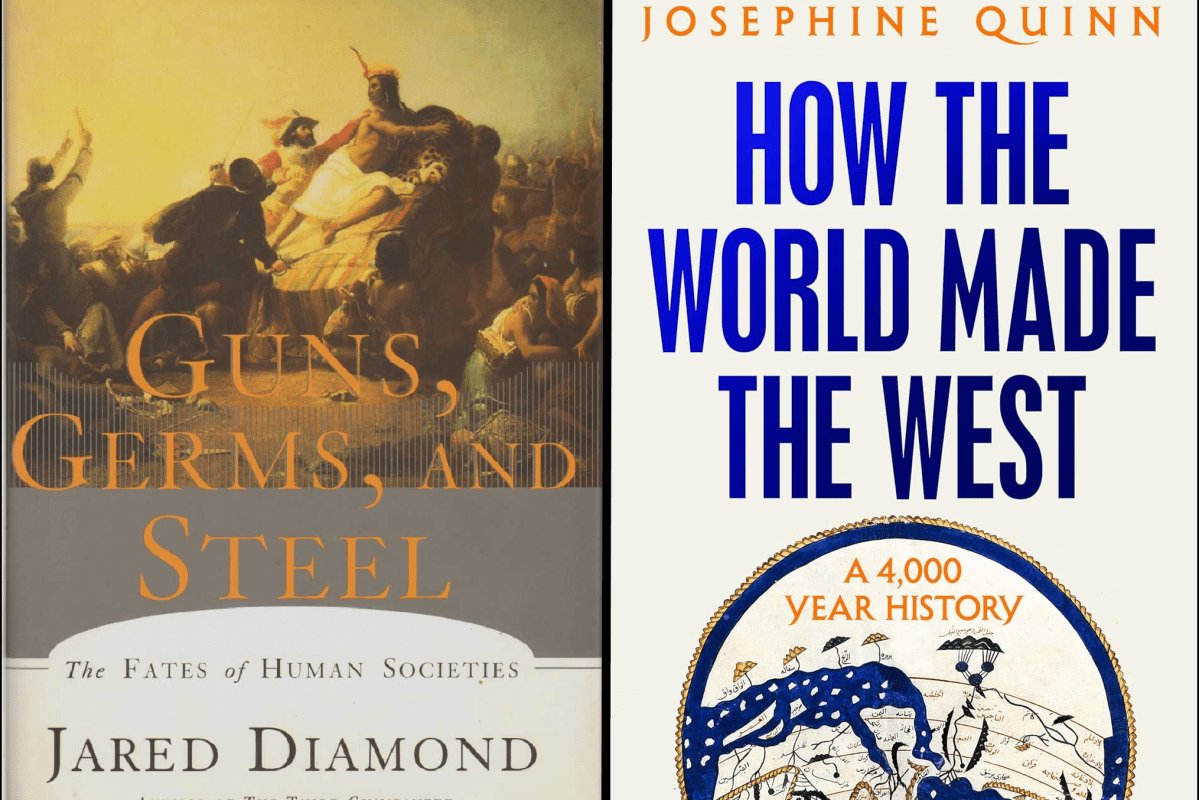
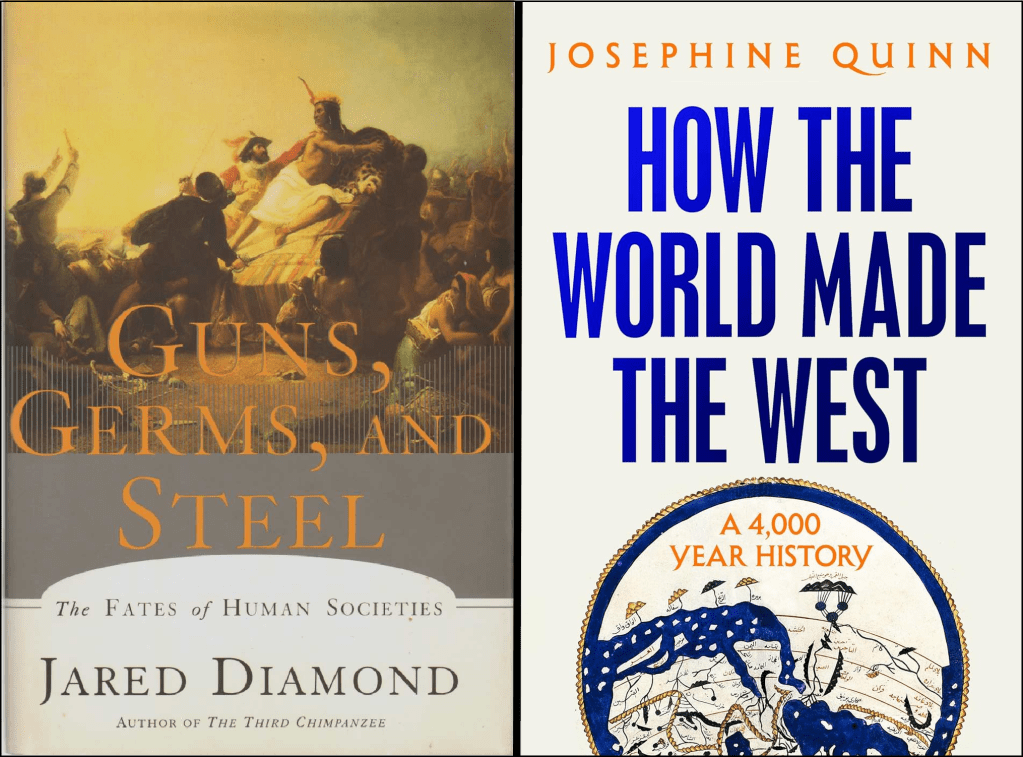
I am reading Jared Diamond’s Guns, Germs, and Steel: The Fates of Human Societies, the first and likely most famous of an informal trilogy. I thought I had already read it, but I think I only saw the PBS show. Having recently finished Josephine Quinn’s How the World Made the West, I wanted to revisit this perspective. The two books are presented in different styles and represent different perspectives, but they seem to be complementary.
Where Diamond focuses on environmental factors (an oft-voiced critique), Quinn focuses on human agency.
Diamond takes a bird’ s-eye view, looking for universal patterns and systemic explanations, whilst Quinn adopts a granular, specific approach, highlighting the fluidity and contingency of history.
Diamond deconstructs European dominance by attributing it to environmental luck, but his narrative risks sidelining the agency of colonised peoples. Quinn critiques the very idea of Western dominance, arguing that the concept of the West itself is a myth born of appropriation and exchange.
Rather than being wholly opposed, Diamond and Quinn’s approaches might be seen as complementary. Diamond provides the structural scaffolding – the environmental and geographic conditions that shape societies – whilst Quinn fills in the cultural and human dynamics that Diamond often glosses over. Together, they represent two sides of the historiographical coin: one focusing on systemic patterns, the other on the messiness of cultural particularities.
I’ve lived in Los Angeles a couple of times for a sum total of perhaps 15 years. The first time, I loved it. The next time, I was running on fumes. The first time, I was in my twenties – the second time in my forties. What a difference perspective and ageing makes. In my twenties, I was a pretty-boy punk-ass who owned the club scene on the Strip. In my forties, I was a wage slave.
This morning, I heard a country song on Insta with a line claiming ‘there are nines and dimes in all 50’, and it reminded me of a phrase we used when I lived in Los Angeles – ‘LA 7’. This is constructed on the egoist, sexist notion that if you were a 10, you’d have already moved to LA. If you still lived in, say, Iowa and were considered a 10, the exchange rate to LA would be a 7.
Then, I thought about the LA-NYC rivalry and wrote this article with some help from ChatGPT.
How L.A. and NYC Became the Centres of the Universe (According to Them)
It is a truth universally acknowledged that Los Angeles and New York City—those bickering siblings of American exceptionalism—believe themselves to be the sun around which the rest of us drearily orbit. Each is utterly convinced of its centrality to the human experience, and neither can fathom that people outside their borders might actually exist without yearning to be them. This is the essence of the ‘Centre of the Universe Complex,’ a condition in which self-importance metastasises into a full-blown cultural identity.
Let us begin with Los Angeles, the influencer of cities. L.A. doesn’t merely think it’s the centre of the universe; it believes it’s the universe, replete with its own atmosphere of smog-filtered sunlight and an economy powered entirely by dreams, green juice, and Botox. For L.A., beauty isn’t just a priority—it’s a moral imperative. Hence the concept of the ‘L.A. 10,’ a stunningly arrogant bit of mathematics whereby physical attractiveness is recalculated based on proximity to the Pacific Coast Highway.
Here’s how it works: a ’10’ in some picturesque-but-hopelessly-provincial state, say Nebraska, is automatically downgraded to a ‘7’ upon arrival in Los Angeles. Why? Because, according to L.A.’s warped ‘arithmetic, if she were a real 10, she’d already be there, lounging by an infinity pool in Malibu and ignoring your DMs. This isn’t just vanity—it’s top-tier delusion. L.A. sees itself as a black hole of good looks, sucking the beautiful people from every corner of the earth while leaving the ‘merely pretty’ to languish in flyover country. The Midwest, then, isn’t so much a place as it is an agricultural waiting room for future Angelenos.
But don’t be fooled—New York City is no better. Where L.A. is obsessed with beauty, NYC worships hustle. The city doesn’t just believe it’s important; it believes it’s the only place on earth where anything important happens. While L.A. is out perfecting its tan, NYC is busy perfecting its reputation as the cultural and intellectual capital of the world—or, at least, its part of the world, which conveniently ends somewhere in Connecticut.
This mindset is best summed up by that sanctimonious mantra, If you can make it here, you can make it anywhere. Translation: if you survive the daily humiliation of paying $4,000 a month for a shoebox apartment while dodging both rats and an existential crisis, you’ve unlocked the secret to life itself. New York isn’t about looking good; it’s about enduring bad conditions and then boasting about it as if suffering were an Olympic sport. In this worldview, the rest of the world is simply an unworthy understudy in NYC’s perpetual Broadway production.
And here’s the thing: neither city can resist taking cheap shots at the other. L.A. dismisses NYC as a grim, grey treadmill where fun goes to die, while NYC scoffs at L.A. as a vapid bubble of avocado toast and Instagram filters. It’s brains versus beauty, grit versus glamour, black turtlenecks versus Lululemon. And yet, in their relentless need to outshine one another, they reveal a shared truth: both are equally narcissistic.
This mutual self-obsession is as exhausting as it is entertaining. While L.A. and NYC bicker over who wears the crown, the rest of the world is quietly rolling its eyes and enjoying a life unencumbered by astronomical rent or the constant pressure to appear important. The people of Iowa, for example, couldn’t care less if they’re an ‘LA 7’ or if they’ve “made it” in New York. They’re too busy living comfortably, surrounded by affordable housing and neighbours who might actually help them move a sofa.
But let’s give credit where it’s due. For all their flaws, these two cities do keep the rest of us entertained. Their constant self-aggrandisement fuels the cultural zeitgeist: without L.A., we’d have no Kardashians; without NYC, no Broadway. Their rivalry is the stuff of legend, a never-ending soap opera in which both cities play the lead role.
So, let them have their delusions of grandeur. After all, the world needs a little drama—and nobody does it better than the cities that think they’re the centre of it.
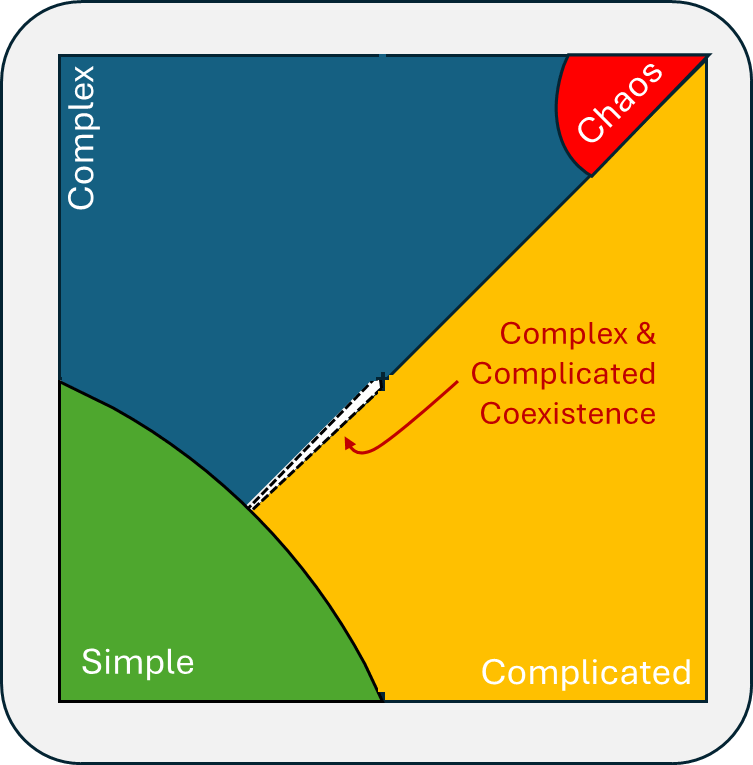
I participated in a thread recently. It prompted me to create a diagramme* to explain. This one:
I also wrote an article, but I’d like to share more here. As I was drafting this, I went through several iterations. This is just where I landed at the end. I’ll walk through it.
Keep It Simple, Stupid
Let’s begin at the origin. At the start, we’ve got simplicity in all directions. These are ingredients and building blocks. Nothing fancy. Perhaps these are atoms or Legos. They are easy to describe and easy to reproduce.
It’s Complicated
One can remain simple or venture up the Y-axis or out on the X-axis. Let’s go right. Eventually, we leave the land of Simplicity and cross into the land of Complication. This might be thought of as a linear journey, a land of addition and multiplication. Instead of a Lego piece, a single cell, or an atom, we’ve assembled structures from building blocks. Perhaps a Lego car or house. Perhaps a Death Star or Hogwarts. Perhaps we’ve gone from a single-celled organism to multicellular organisms or from an atom to a molecule or even a cluster of molecules. We’ve gone from a couple of hydrogens and an oxygen to a water molecule. Repeat this enough and we’ve got a glass or water – or an ocean.
In a nutshell, simple and complicated objects are predictable, designable, and controllable.
It’s Complex
Let’s travel up the Y-axis instead. Leaving the land of Simplicity, we end up in Complexity. Here, all bets are off. We are in a land of probability and uncertainty. Combining simple components results in unpredictable results, emergent properties, and self-organisation. Life is not linear on this path, so small differences in inputs can create wildly different outputs in each of magnitude and direction.
Morever, when a thing gets too complicated, it can no longer become complex. Emergence is not for the complicated.
Emergence is somewhat reserved for the complex, but where simple transitions to complicated, there is a tiny window that may allow both complicated and complex.
Medical doctors, lawyers, and judges have been the undisputed titans of professional authority for centuries. Their expertise, we are told, is sacrosanct, earned through gruelling education, prodigious memory, and painstaking application of established knowledge. But peel back the robes and white coats, and you’ll find something unsettling: a deep reliance on rote learning—an intellectual treadmill prioritising recall over reasoning. In an age where artificial intelligence can memorise and synthesise at scale, this dependence on predictable, replicable processes makes these professions ripe for automation.
Rote Professions in AI’s Crosshairs
AI thrives in environments that value pattern recognition, procedural consistency, and brute-force memory—the hallmarks of medical and legal practice.
Medicine: The Diagnosis Factory Despite its life-saving veneer, medicine is largely a game of matching symptoms to diagnoses, dosing regimens, and protocols. Enter an AI with access to the sum of human medical knowledge: not only does it diagnose faster, but it also skips the inefficiencies of human memory, emotional bias, and fatigue. Sure, we still need trauma surgeons and such, but diagnosticians are so yesterday’s news. Why pay a six-figure salary to someone recalling pharmacology tables when AI can recall them perfectly every time? Future healthcare models are likely to see Medical Technicians replacing high-cost doctors. These techs, trained to gather patient data and operate alongside AI diagnostic systems, will be cheaper, faster, and—ironically—more consistent.
Law: The Precedent Machine Lawyers, too, sit precariously on the rote-learning precipice. Case law is a glorified memory game: citing the right precedent, drafting contracts based on templates, and arguing within frameworks so well-trodden that they resemble legal Mad Libs. AI, with its infinite recall and ability to synthesise case law across jurisdictions, makes human attorneys seem quaintly inefficient. The future isn’t lawyers furiously flipping through books—it’s Legal Technicians trained to upload case facts, cross-check statutes, and act as intermediaries between clients and the system. The $500-per-hour billable rate? A relic of a pre-algorithmic era.
Judges: Justice, Blind and Algorithmic The bench isn’t safe, either. Judicial reasoning, at its core, is rule-based logic applied with varying degrees of bias. Once AI can reliably parse case law, evidence, and statutes while factoring in safeguards for fairness, why retain expensive and potentially biased judges? An AI judge, governed by a logic verification layer and monitored for compliance with established legal frameworks, could render verdicts untainted by ego or prejudice. Wouldn’t justice be more blind without a human in the equation?
The Techs Will Rise
Replacing professionals with AI doesn’t mean removing the human element entirely. Instead, it redefines roles, creating new, lower-cost positions such as Medical and Legal Technicians. These workers will:
Collect and input data into AI systems.
Act as liaisons between AI outputs and human clients or patients.
Provide emotional support—something AI still struggles to deliver effectively.
The shift also democratises expertise. Why restrict life-saving diagnostics or legal advice to those who can afford traditional professionals when AI-driven systems make these services cheaper and more accessible?
But Can AI Handle This? A Call for Logic Layers
AI critics often point to hallucinations and errors as proof of its limitations, but this objection is shortsighted. What’s needed is a logic layer: a system that verifies whether the AI’s conclusions follow rationally from its inputs.
In law, this could ensure AI judgments align with precedent and statute.
In medicine, it could cross-check diagnoses against the DSM, treatment protocols, and patient data.
A second fact-verification layer could further bolster reliability, scanning conclusions for factual inconsistencies. Together, these layers would mitigate the risks of automation while enabling AI to confidently replace rote professionals.
Resistance and the Real Battle Ahead
Predictably, the entrenched elites of medicine, law, and the judiciary will resist these changes. After all, their prestige and salaries are predicated on the illusion that their roles are irreplaceable. But history isn’t on their side. Industries driven by memorisation and routine application—think bank tellers, travel agents, and factory workers—have already been disrupted by technology. Why should these professions be exempt?
The real challenge lies not in whether AI can replace these roles but in public trust and regulatory inertia. The transformation will be swift and irreversible once safeguards are implemented and AI earns confidence.
Critical Thinking: The Human Stronghold
Professions that thrive on unstructured problem-solving, creativity, and emotional intelligence—artists, philosophers, innovators—will remain AI-resistant, at least for now. But the rote professions, with their dependency on standardisation and precedent, have no such immunity. And that is precisely why they are AI’s lowest-hanging fruit.
It’s time to stop pretending that memorisation is intelligence, that precedent is innovation, or that authority lies in a gown or white coat. AI isn’t here to make humans obsolete; it’s here to liberate us from the tyranny of rote. For those willing to adapt, the future looks bright. For the rest? The machines are coming—and they’re cheaper, faster, and better at your job.