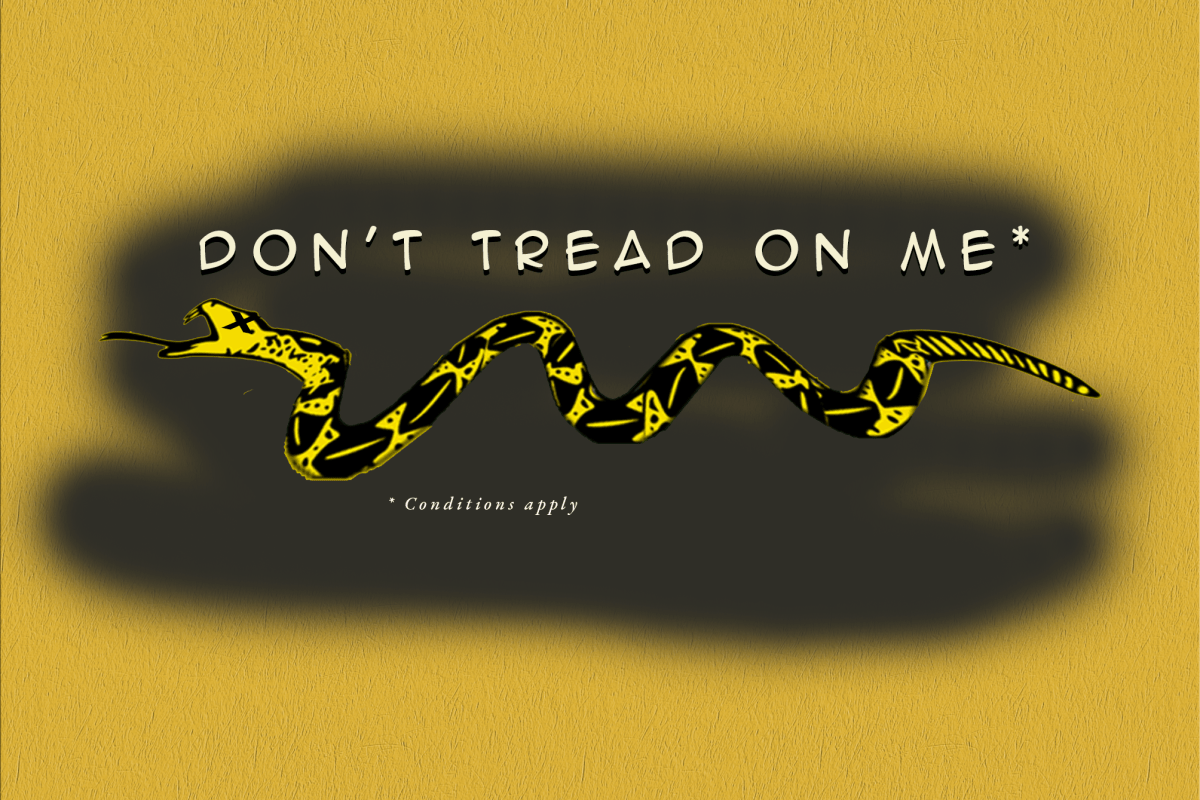
Don’t Tread on My Ass

Absolute liberty means absolute liberty, but what if the liberty you seek is death? The moment you carve out exceptions – speech you can’t say, choices you can’t make, exits you can’t take – you’ve left the realm of liberty and entered the gated community of permission.

Video: YouTube vid by Philosopher Muse.

And here’s the test most self-styled liberty lovers fail: you’re free to skydive without a parachute, but try ending your life peacefully and watch how quickly the freedom brigade calls in the moral SWAT team.

I’m not his usual audience; I’m already in the choir, but this eight-minute clip by Philosopher Muse is worth your time. It’s a lucid walk through the ethical terrain mapped by Sarah Perry in Every Cradle Is a Grave, and it’s one of the better distillations of antinatalist thought I’ve seen for the general public. Perry’s libertarian starting point is straightforward: if you truly own your life, you must also have the right to give it up.

He threads in the dark-glimmer insights of Emil Cioran’s poetic despair, Thomas Ligotti’s existential horror, David Benatar’s asymmetry, and Peter Wessel Zapffe’s tragic consciousness. Together they point to an uncomfortable truth: autonomy that stops short of death isn’t autonomy at all; it’s a petting zoo of freedoms where the gate is locked.

I’ve said this before, but it bears repeating. I once had a girlfriend who hated her life but was too afraid of hell to end it. She didn’t “pull through.” She overdosed by accident. Loophole closed, I suppose. That’s what happens when metaphysical prohibitions are allowed to run the operating system.

And here’s where I diverge from the purist libertarians. I don’t believe most people are competent enough to have the liberty they think they deserve. Not because they’re all dribbling idiots, but because they’ve been marinated for generations in a stew of indoctrination. For thousands of years, nobody talked about “liberty” or “freedom” as inalienable rights. Once the notion caught on, it was packaged and sold – complete with an asterisk, endless fine print, and a service desk that’s never open.

We tell ourselves we’re free, but only in the ways that don’t threaten the custodians. You can vote for whoever the party machine serves up, but you can’t opt out of the game. You can live any way you like, as long as it looks enough like everyone else’s life. You can risk death in countless state-approved ways, but the moment you calmly choose it, your autonomy gets revoked.

So yes, watch the video. Read Perry’s Every Cradle Is a Grave. Then ask yourself whether your liberty is liberty, or just a longer leash.

If liberty means anything, it means the right to live and the right to leave. The former without the latter is just life imprisonment with better marketing.

Ages of Consent: A Heap of Nonsense

A response on another social media site got me thinking about another Sorites paradox. The notion just bothers me. I’ve long held that it is less a paradox than an intellectually lazy way to manoeuvre around language insufficiency.

<rant>

The law loves a nice, clean number. Eighteen to vote. Sixteen to marry. This-or-that to consent. As if we all emerge from adolescence on the same morning like synchronised cicadas, suddenly equipped to choose leaders, pick spouses, and spot the bad lovers from the good ones.

But the Sorites paradox gives the game away: if you’re fit to vote at 18 years and 0 days, why not at 17 years, 364 days? Why not 17 years, 363 days? Eventually, you’re handing the ballot to a toddler who thinks the Prime Minister is Peppa Pig. Somewhere between there and adulthood, the legislator simply throws a dart and calls it “science.”

To bolster this fiction, we’re offered pseudo-facts: “Women mature faster than men”, or “Men’s brains don’t finish developing until thirty.” These claims, when taken seriously, only undermine the case for a single universal threshold. If “maturity” were truly the measure, we’d have to track neural plasticity curves, hormonal arcs, and a kaleidoscope of individual factors. Instead, the state settles for the cheapest approximation: a birthday.

This obsession with fixed thresholds is the bastard child of Enlightenment rationalism — the fantasy that human variation can be flattened into a single neat line on a chart. The eighteenth-century mind adored universals: universal reason, universal rights, universal man. In this worldview, there must be one age at which all are “ready,” just as there must be one unit of measure for a metre or a kilogram. It is tidy, legible, and above all, administratively convenient.

Cue the retorts:

  • “We need something.” True, but “something” doesn’t have to mean a cliff-edge number. We could design systems of phased rights, periodic evaluations, or contextual permissions — approaches that acknowledge people as more than interchangeable cut-outs from a brain-development chart.
  • “It would be too complicated.” Translation: “We prefer to be wrong in a simple way than right in a messy way.” Reality is messy. Pretending otherwise isn’t pragmatism; it’s intellectual cowardice. Law is supposed to contend with complexity, not avert its gaze from it.

And so we persist, reducing a continuous, irregular, and profoundly personal process to an administratively convenient fiction — then dressing it in a lab coat to feign objectivity. A number is just a number, and in this case, a particularly silly one.

</rant>

Democracy: The Idiot’s Opiate, The Sequel Nobody Asked For

Yesterday, I suggested democracy is a mediocre theatre production where the audience gets to choose which mediocre understudy performs. Some readers thought I was being harsh. I wasn’t.

A mate recently argued that humans will always be superior to AI because of emergence, the miraculous process by which complexity gives rise to intelligence, creativity, and emotion. Lovely sentiment. But here’s the rub: emergence is also how we got this political system, the one no one really controls anymore.

Like the human body being mostly non-human microbes, our so-called participatory government is mostly non-participatory components: lobbyists, donors, bureaucrats, corporate media, careerists, opportunists, the ecosystem that is the actual organism. We built it, but it now has its own metabolism. And thanks to the law of large numbers, multiplied by the sheer number of political, economic, and social dimensions in play, even the human element is diluted into statistical irrelevance. At any rate, what remains of it has lost control – like the sorcerer’s apprentice.

People like to imagine they can “tame” this beast, the way a lucid dreamer thinks they can bend the dream to their will. But you’re still dreaming. The narrative still runs on the dream’s logic, not yours. The best you can do is nudge it; a policy tweak here, a symbolic vote there, before the system digests your effort and excretes more of itself.

This is why Deming’s line hits so hard: a bad system beats a good person every time. Even if you could somehow elect the Platonic ideal of leadership, the organism would absorb them, neutralise them, or spit them out. It’s not personal; it’s structural.

And yet we fear AI “taking over,” as if that would be a radical departure from the status quo. Newsflash: you’ve already been living under an autonomous system for generations. AI would just be a remodel of the control room, new paint, same prison.

So yes, emergence makes humans “special.” It also makes them the architects of their own inescapable political microbiome. Congratulations, you’ve evolved the ability to build a machine that can’t be turned off.

Democracy: Opiate of the Masses

Democracy is sold, propagandised, really, as the best system of governance we’ve ever devised, usually with the grudging qualifier “so far.” It’s the Coca-Cola of political systems: not particularly good for you, but so entrenched in the cultural bloodstream that to question it is tantamount to treason.

Audio: NotebookLM Podcast on this topic.

The trouble is this: democracy depends on an electorate that is both aware and capable. Most people are neither. Worse still, even if they could be aware, they wouldn’t be smart enough to make use of it. And even if they were smart enough, Arrow’s Impossibility Theorem strolls in, smirking, to remind us that the whole thing is mathematically doomed anyway.

Even this number is a charade. IQ measures how well you navigate the peculiar obstacle course we’ve designed as “education,” not the whole terrain of human thought. It’s as culturally loaded as asking a fish to climb a tree, then declaring it dim-witted when it flops. We call it intelligence because it flatters those already rewarded by the system that designed the test. In the United States, the average IQ stands at 97 – hardly a figure that instils confidence in votes and outcomes.

The Enlightenment gents who pushed democracy weren’t exactly selfless visionaries. They already had power, and simply repackaged it as something everyone could share, much as the clergy promised eternal reward to peasants if they only kept their heads down. Democracy is merely religion with ballots instead of bibles: an opiate for the masses, sedating the population with the illusion of influence.

Worse still, it’s a system optimised for mediocrity. It rewards consensus, punishes brilliance, and ensures the average voter is, by definition, average. Living under it is like starring in Idiocracy, only without the comedic relief, just the grim recognition that you’re outnumbered, and the crowd is cheering the wrong thing.

The Myth of Causa Sui Creativity

(or: Why Neither Humans nor AI Create from Nothing)

In the endless squabble over whether AI can be “creative” or “intelligent,” we always end up back at the same semantic swamp. At the risk of poking the bear, I have formulated a response. Creativity is either whatever humans do, or whatever humans do that AI can’t. Intelligence is either the general ability to solve problems or a mysterious inner light that glows only in Homo sapiens. The definitions shift like sand under the feet of the argument.

Audio: NotebookLM podcast on this topic

Strip away the romance, and the truth is far less flattering: neither humans nor AI conjure from the void. Creativity is recombination, the reconfiguration of existing material into something unfamiliar. Intelligence is the ability to navigate problems using whatever tools and heuristics one has to hand.

The Causa Sui conceit, the idea that one can be the cause of oneself, is incoherent in art, thought, or physics. Conservation of energy applies as much to ideas as to atoms.

  • Humans consume inputs: books, conversations, music, arguments, TikTok videos.
  • We metabolise them through cognitive habits, biases, and linguistic forms.
  • We output something rearranged, reframed, sometimes stripped to abstraction.

The AI process is identical in structure, if not in substrate: ingest vast data, run it through a model, output recombination. The difference is that AI doesn’t pretend otherwise.

When a human produces something impressive, we call it creative without inspecting the provenance of the ideas. When an AI produces something impressive, we immediately trace the lineage of its inputs, as if the human mind weren’t doing the same. This is not epistemic rigour, it’s tribal boundary enforcement.

The real objection to AI is not that it fails the test of creativity or intelligence; it’s that it passes the functional test without being part of the club. Our stories about human exceptionalism require a clear line between “us” and “it,” even if we have to draw that line through semantic fog.

My Language Insufficiency Hypothesis began with the recognition that language cannot fully capture the reality it describes. Here, the insufficiency is deliberate; the words “creativity” and “intelligence” are kept vague so they can always be shifted away from anything AI achieves.

I cannot be causa sui, and neither can you. The only difference is that I’m willing to admit it.

The Enlightenment: A Postmortem

Or: How the Brightest Ideas in Europe Got Us into This Bloody Mess

Disclaimer: This output is entirely ChatGPT 4o from a conversation on the failure and anachronism of Enlightenment promises. I’m trying to finish editing my next novel, so I can’t justify taking much more time to share what are ultimately my thoughts as expounded upon by generative AI. I may comment personally in future. Until then, this is what I have to share.

AI Haters, leave now or perish ye all hope.


The Enlightenment promised us emancipation from superstition, authority, and ignorance. What we got instead was bureaucracy, colonialism, and TED Talks. We replaced divine right with data dashboards and called it progress. And like any good inheritance, the will was contested, and most of us ended up with bugger-all.

Below, I take each Enlightenment virtue, pair it with its contemporary vice, and offer a detractor who saw through the Enlightenment’s powder-wigged charade. Because if we’re going down with this ship, we might as well point out the dry rot in the hull.


1. Rationalism

The Ideal: Reason shall lead us out of darkness.
The Reality: Reason led us straight into the gas chambers—with bureaucratic precision.

Detractor: Max Horkheimer & Theodor Adorno

“Enlightenment is totalitarian.”
Dialectic of Enlightenment (1944)

Horkheimer and Adorno saw what reason looks like when it slips off its leash. Instrumental rationality, they warned, doesn’t ask why—it only asks how efficiently. The result? A world where extermination is scheduled, costs are optimised, and ethics are politely filed under “subjective.”


2. Empiricism

The Ideal: Observation and experience will uncover truth.
The Reality: If it can’t be measured, it can’t be real. (Love? Not statistically significant.)

Detractor: Michel Foucault

“Truth isn’t outside power… truth is a thing of this world.”
Power/Knowledge (1977)

Foucault dismantled the whole edifice. Knowledge isn’t neutral; it’s an instrument of power. Empiricism becomes just another way of disciplining the body—measuring skulls, classifying deviants, and diagnosing women with “hysteria” for having opinions.


3. Individualism

The Ideal: The sovereign subject, free and self-determining.
The Reality: The atomised consumer, trapped in a feedback loop of self-optimisation.

Detractor: Jean Baudrillard

“The individual is no longer an autonomous subject but a terminal of multiple networks.”
Simulacra and Simulation (1981)

You wanted autonomy? You got algorithms. Baudrillard reminds us that the modern “individual” is a brand in search of market validation. You are free to be whoever you want, provided it fits within platform guidelines and doesn’t disrupt ad revenue.


4. Secularism

The Ideal: Liberation from superstition.
The Reality: We swapped saints for STEMlords and called it even.

Detractor: Charles Taylor

“We are now living in a spiritual wasteland.”
A Secular Age (2007)

Taylor—perhaps the most polite Canadian apocalypse-whisperer—reminds us that secularism didn’t replace religion with reason; it replaced mystery with malaise. We’re no longer awed, just “motivated.” Everything is explainable, and yet somehow nothing means anything.


5. Progress

The Ideal: History is a forward march toward utopia.
The Reality: History is a meat grinder in a lab coat.

Detractor: Walter Benjamin

“The storm irresistibly propels him into the future to which his back is turned.”
Theses on the Philosophy of History (1940)

Benjamin’s “angel of history” watches helplessly as the wreckage piles up—colonialism, genocide, climate collapse—all in the name of progress. Every step forward has a cost, but we keep marching, noses in the spreadsheet, ignoring the bodies behind us.


6. Universalism

The Ideal: One humanity, under Reason.
The Reality: Enlightenment values, brought to you by cannon fire and Christian missionaries.

Detractor: Gayatri Chakravorty Spivak

“White men are saving brown women from brown men.”
Can the Subaltern Speak? (1988)

Universalism was always a bit… French, wasn’t it? Spivak unmasks it as imperialism in drag—exporting “rights” and “freedom” to people who never asked for them, while ignoring the structural violence built into the Enlightenment’s own Enlightened societies.


7. Tolerance

The Ideal: Let a thousand opinions bloom.
The Reality: Tolerance, but only for those who don’t threaten the status quo.

Detractor: Karl Popper

“Unlimited tolerance must lead to the disappearance of tolerance.”
The Open Society and Its Enemies (1945)

Popper, bless him, thought tolerance needed a firewall. But in practice, “tolerance” has become a smug liberal virtue signalling its own superiority while deplatforming anyone who makes the dinner party uncomfortable. We tolerate all views—except the unseemly ones.


8. Scientific Method

The Ideal: Observe, hypothesise, repeat. Truth shall emerge.
The Reality: Publish or perish. Fund or flounder.

Detractor: Paul Feyerabend

“Science is not one thing, it is many things.”
Against Method (1975)

Feyerabend called the whole thing a farce. There is no single “method,” just a bureaucratic orthodoxy masquerading as objectivity. Today, science bends to industry, cherry-picks for grants, and buries null results in the backyard. Peer review? More like peer pressure.


9. Anti-Authoritarianism

The Ideal: Smash the throne! Burn the mitre!
The Reality: Bow to the data analytics team.

Detractor: Herbert Marcuse

“Free election of masters does not abolish the masters or the slaves.”
One-Dimensional Man (1964)

Marcuse skewered the liberal illusion of choice. We may vote, but we do so within a system that already wrote the script. Authority didn’t vanish; it just became procedural, faceless, algorithmic. Bureaucracy is the new monarchy—only with more forms.


10. Education and Encyclopaedism

The Ideal: All knowledge, accessible to all minds.
The Reality: Behind a paywall. Written in impenetrable prose. Moderated by white men with tenure.

Detractor: Ivan Illich

“School is the advertising agency which makes you believe that you need the society as it is.”
Deschooling Society (1971)

Illich pulls the curtain: education isn’t emancipatory; it’s indoctrinatory. The modern university produces not thinkers but credentialed employees. Encyclopaedias are replaced by Wikipedia, curated by anonymous pedants and revision wars. Truth is editable.


Postscript: Picking through the Rubble

So—has the Enlightenment failed?

Not exactly. It succeeded too literally. It was taken at its word. Its principles, once radical, were rendered banal. It’s not that reason, progress, or rights are inherently doomed—it’s that they were never as pure as advertised. They were always products of their time: male, white, bourgeois, and utterly convinced of their own benevolence.

If there’s a path forward, it’s not to restore Enlightenment values, but to interrogate them—mercilessly, with irony and eyes open.

After all, the problem was never darkness. It was the people with torches who thought they’d found the only path.
From Thesaurus to Thoughtcrime: The Slippery Slope of Authorial Purity

I had planned to write about Beauvoir’s Second Sex, but this has been on my mind lately.

There’s a certain breed of aspiring author, let’s call them the Sacred Scribes, who bristle at the notion of using AI to help with their writing. Not because it’s unhelpful. Not because it produces rubbish. But because it’s impure.

Like some Victorian schoolmarm clutching her pearls at the sight of a split infinitive, they cry: “If you let the machine help you fix a clumsy sentence, what’s next? The whole novel? Your diary? Your soul?”

The panic is always the same: one small compromise and you’re tumbling down the greased chute of creative ruin. It starts with a synonym suggestion and ends with a ghostwritten autobiography titled My Journey to Authenticity, dictated by chatbot, of course.

But let’s pause and look at the logic here. Or rather, the lack thereof.

By this standard, you must also renounce the thesaurus. Shun the spellchecker. Burn your dictionary. Forbid yourself from reading any book you might accidentally learn from. Heaven forbid you read a well-constructed sentence and think, “I could try that.” That’s theft, isn’t it?

And while we’re at it, no editors. No beta readers. No workshopping. No taking notes. Certainly no research. If your brain didn’t birth it in a vacuum, it’s suspect. It’s borrowed. It’s… contaminated.

Let’s call this what it is: purity fetishism in prose form.

But here’s the twist: it’s not new. Plato, bless him, was already clutching his tunic about this twenty-four centuries ago. In Phaedrus, he warned that writing itself would be the death of memory, of real understanding. Words on the page were a crutch. Lazy. A hollow imitation of wisdom. True knowledge lived in the mind, passed orally, and refined through dialogue. Writing, he said, would make us forgetful, outsource our thinking.

Sound familiar?

Fast forward a few millennia, and we’re hearing the same song, remixed for the AI age:
“If you let ChatGPT restructure your second paragraph, you’re no longer the author.”
Nonsense. You were never the sole author. Not even close.

Everything you write is a palimpsest, your favourite genres echoing beneath the surface, your heroes whispering in your turns of phrase. You’re just remixing the residue. And there’s no shame in that. Unless, of course, you believe that distilling your top five comfort reads into a Frankenstein narrative somehow makes you an oracle of literary genius.

Here’s the rub: You’ve always been collaborating.

With your past. With your influences. With your tools. With language itself, which you did not invent and barely control. Whether the suggestion comes from a friend, an editor, a margin note, or an algorithm, what matters is the choice you make with it. That’s authorship. Let’s not play the slippery slope game.

The slippery slope argument collapses under its own weight. No one accuses you of cheating when you use a pencil sharpener. Or caffeine. Or take a walk to clear your head. But involve a silicon co-author, and suddenly you’re the Antichrist of Art?

Let’s not confuse integrity with insecurity. Let’s not confuse control with fear.

Use the tool. Ignore the purists. They’ve been wrong since Plato, and they’ll still be wrong when your great-grandchildren are dictating novels to a neural implant while bathing in synthetic dopamine.

The future of writing is always collaborative. The only question is whether you’ll join the conversation or sit in the corner, scribbling manifestos by candlelight, declaring war on electricity.

Of GenAI, Gatekeepers, and Moral Panic in Minor Key

I recently had a run-in with opponents of generative artificial intelligence, GenAI for the rest of us. What began as a modest question about feedback mechanisms in writing spiralled swiftly into a fire-and-brimstone sermon on the moral hazards of artificial authorship.

Audio: NotebackLM podcast on this topic.

It started on Reddit, that bastion of civil discourse, in the r/FictionWriting group. I asked, sincerely and succinctly: Is using AI as a pre-alpha reader worthwhile, or is the praise too algorithmically eager to trust?

Rather than respond to the question, the moderators responded with an ultimatum: “Admit to AI-use again and you’ll be banned.” Like any self-respecting heretic, I excommunicated myself.

Some members ranted about how AI might “steal their ideas” – presumably to be repackaged by tech barons and sold back to the masses in Kindle Unlimited drivel. That’s fine, I suppose, if you’re into intellectual solipsism, but what does this paranoid fantasy have to do with my ideas?

This wasn’t a discussion. It was a witch trial. AI wasn’t the threat – difference was. Deviate from the sacred rites of pen-to-paper purity, and you’ll be cast into the outer darkness, where there is weeping and gnashing of syntax.

The underlying problem is prescriptivism – not just linguistic, but moral. And like all moral panic, it has little to do with ethics and everything to do with control.

To borrow the analogy: as with abortion, if you don’t like them, don’t have one. Abortions, one might argue, carry significantly more moral weight than paragraph polishing. Or do they? At what point does a draft become a soul?

We are fast becoming a culture where the tool is the sin, and the sinner the tool.

Image: Exhibit A

Faithful to the Salt: Idioms, Interference, and the Philosophy of Flavour

Don’t get salty with me when I tell you I asked AI to write this for me. I was thinking that “take it with a grain of salt” or “take it with a pinch of salt” in English did not share the same meaning as “mettre son grain de selen français, so I asked ChatGPT for other uses of salt. This is why it doesn’t follow by usual style, if one can call it that.

🧂 Salt: That Most Misunderstood Metaphor

Salt has an image problem.

Despite being one of the most ancient and revered substances in human civilisation—once used as currency, treaty-sealer, and god-bait—it somehow gets dragged through the metaphorical gutter in modern idiom. In English, to take something “with a grain of salt” is to doubt it. To “add your grain of salt,” per the French idiom mettre son grain de sel, is to interrupt uninvited. Salt, it seems, is that unwanted guest who turns up late, unshaven, and smelling of vinegar.

And yet, salt is also life. Necessary. Essential. Literal. So what gives?

Let’s do what the internet never does and look at context.


🏴‍☠️ English: Cynicism in a Crystal

The English expression “take it with a grain of salt” (or, in older form, a pinch) comes from Latin cum grano salis, which likely implied adding a figurative preservative to dubious claims—treat this as you would old meat. In other words, don’t fully trust it unless you like dysentery.

We also say “he’s a bit salty” to mean grumpy, caustic, or prone to verbal cutlery. “Adding your two cents” is bad enough, but adding your grain of salt implies that what you’re contributing is both unsolicited and probably irritating.

Put simply, English idioms treat salt as if it’s the person in the meeting who thinks they’re clever. There’s a faint whiff of Protestantism here—suspicious of flavour, pleasure, and expressive enthusiasm. Plain oatmeal, plain truths, no seasoning required. Salt is vice. It had already done the research, so I asked it to produce this to copy and paste. You’re welcome.


🇫🇷 French: Salty Saboteurs

The French mettre son grain de sel is more or less the same: to butt in. To lob your unwanted opinion into someone else’s stew. Not unlike “putting in your two penn’orth” in British English—but somehow meaner, as if your salt is not just annoying, but wrong.

Salt, in this idiom, doesn’t enrich—it ruins. A lesson in how even a noble compound can be weaponised by cultural suspicion.


🏺 Hindi: Loyalty Seasoned with Honour

Contrast this with Hindi: namak harām — literally “unfaithful to salt.” This is a powerful accusation. It means you’ve betrayed someone who fed you, someone who sustained you. You’ve taken their salt and spat in their dish.

Conversely, namak halāl is a compliment: someone loyal, trustworthy, faithful to the hand that seasoned them. Salt is the symbol of obligation and honour—not interference.

It is covenantal.


🗾 Japanese: Salt as Mercy

塩を送る (shio o okuru) – “to send salt” – is a Japanese idiom meaning to help your enemy in their time of need. Based on a historical moment when Uesugi Kenshin sent salt to his rival, Takeda Shingen, when the latter’s supply was blockaded.

Salt, here, transcends enmity. It’s noble. A tool of ethics.

In short: send salt, don’t throw it.


🇩🇪 German & 🇪🇸 Spanish: Flavour as Personality

The Germans say “das Salz in der Suppe sein”—to be the salt in the soup. You’re what makes life interesting. Without you, it’s just… wet nutrition.

In Spanish, “ser la sal de la vida” means to be the zest of existence. Without salt, life is dull, bland, morally beige.

In these idioms, salt is essential. A little dangerous, maybe, but necessary. Just like any compelling person.


🇹🇷 Turkish: The Dry Salt of Privilege

The Turkish idiom “tuzu kuru” (lit. “dry salt”) means you’re doing fine. Perhaps too fine. You’re unaffected, aloof, in your tower of comfort while others stew.

Dry salt is privilege: unbothered, unsalted tears. An idiom with side-eye built in.


🕊️ Christianity: Salt of the Earth

The Gospels famously commend the righteous as “the salt of the earth.” Not merely good people, but the ones who preserve and season the whole damn world. And yet, “if salt loses its savour,” says Matthew 5:13, “wherewith shall it be salted?” A warning to remain vital. Relevant. Useful.

Even Jesus had thoughts about flavour fatigue.


⚖️ So… Is Salt Praised or Pitied?

Depends who you ask.

  • For some, salt is civic virtue (Hindi).
  • For others, it’s moral generosity (Japanese).
  • Sometimes it’s life’s spark (German, Spanish).
  • Sometimes it’s trouble in a shaker (English, French).

But the ambivalence is the point. Salt is essential—but easily overdone. Too little, and life is bland. Too much, and it’s ruined.

Like language, then: salt mediates between flavour and clarity. Add carefully. Stir well.


🧂 Final Sprinkle

Before you disparage someone for being “a bit salty,” ask yourself whether they’re really interfering—or simply adding what your grey little broth lacked all along.

And for heaven’s sake, be faithful to the salt you’ve eaten.

Understanding Generative AI

Ok. I admit this is an expansive claim, but I write about the limitations on generative artificial intelligence relative to writers. I wrote this after encountering several Reddit responses by writers who totally misunderstand how AI works. They won’t read this, but you might want to.

Click to visit the Ridley Park Blog for this article and podcast
Video: Cybernetic robot assisting a female writer (or stealing her work)