Waiting for a New Book: Illusions of Light

2–3 minutes

This is not the announcement of a new book – The Illusion of Light: Thinking after the Enlightenment.

I hate the business of business. I am wrapping up another book project, but it’s been delayed by the government shutdown in the United States. I want a Library of Congress number (LCCN), but submissions must wait for an employed person to assign it.

Too clever by half and smarter than the average bear, I thought I could release an audiobook version first; audiobooks don’t need an LCCN. To be honest, neither do books. As some do with ‘Patent Pending’, I could follow suit. The book receives an LCCN, but it isn’t printed on the copyright page with the other administrivia.

My idea worked – partially. I rendered an audio version and published it – though it won’t be available until the start of November. Even so, I need distributors. It’s always something.

Meanwhile, I’m sharing an excerpt for your listening pleasure. Read along if you please.

Audio: The Illusion of Light: Thinking after the Enlightenment; Preface — Reading by Residual Light

Preface – Reading by Residual Light

To read these essays is to move slowly from the glare into the dimmer spaces where things regain texture. The Enlightenment taught us to equate light with truth, but illumination has always been double-edged: it clarifies outlines whilst erasing depth. What disappears in the brightness are the gradients – the in-between shades where thought and feeling meet, where contradiction still breathes.

The half-light is not a retreat from knowledge; it is where knowledge stops mistaking itself for salvation. It is the hour before dawn and after dusk, when perception is most alert, and everything seems both clearer and less certain. That is the discipline these essays practice: a sustained attentiveness to what persists when certainty burns away.

This project does not ask readers to abandon reason, only to notice what it has excluded. It invites a kind of intellectual night vision – the patience to see without spotlight, the willingness to sit with what does not resolve. In the half-light, the world no longer arranges itself around the human gaze; it reveals itself as unmastered, partial, alive. Here, we will learn to dwell in that half-light – not as a retreat from knowledge, but as a discipline of seeing what the Enlightenment’s glare erased.

The Enlightenment promised that truth would make us free. Perhaps it made us efficient instead. What these pages attempt is smaller and slower: a freedom measured not in control but in composure – the ability to live with what cannot be fixed, to keep tending meaning after its foundations have collapsed.

If there is light here, it is not the triumphant blaze of discovery but the ambient glow that remains after something ends. It’s the light of screens left on overnight, of cities at rest, of the mind still thinking long after certainty has gone to sleep.

Step carefully. Let your eyes adjust. The world looks different when it stops pretending to be illuminated.

The rest of the story…

I consider The Illusion of Light to be a sort of capstone project to the Anti-Enlightenment Project. It provides both a perspective and insights into the essays that constitute it.

The Myth of Homo Normalis

Archaeology of the Legible Human

Now live on the Anti-Enlightenment Project (Zenodo | PhilArchive)

Modernity’s most enduring fiction is that somewhere among us walks the normal human. This essay digs up that fossil. Beginning with Quetelet’s statistical conjuring trick – l’homme moyen, the “average man” –and ending in our age of wearable psychometrics and algorithmic empathy, it traces how normality became both the instrument and the idol of Western governance.

Audio: NotebookLM podcast on this essay.

Along the way it dissects:

  • The arithmetic imagination that turned virtue into a mean value.
  • Psychology™ as the church of the diagnostic self, where confession comes with CPT codes.
  • Sociological scale as the machinery that converts persons into populations.
  • Critical theory’s recursion, where resistance becomes a management style.
  • The palliative society, in which every emotion is tracked, graphed, and monetised.
Audio: ElevenLabs reading of the whole essay (minus citations, references, and metacontent).
NB: The audio is split into chapters on Spotify to facilitate reading in sections.

What begins as a genealogy of statistics ends as an autopsy of care. The normal is revealed not as a condition, but as an administrative fantasy – the state’s dream of perfect legibility. Against this, the essay proposes an ethics of variance: a refusal of wholeness, a discipline of remaining unsynthesised.

The Myth of Homo Normalis is the sixth instalment in the Anti-Enlightenment Project, joining Objectivity Is Illusion, Rational Ghosts, Temporal Ghosts, Against Agency, and The Discipline of Dis-Integration. Together they map the slow disassembly of reason’s empire – from epistemology to ethics, from governance to affect.

Read or cite:
🔗 Zenodo DOI
🔗 PhilArchive page – forthcoming link

The Anti-Enlightenment Project: A New Portal for Old Ghosts

1–2 minutes

The Enlightenment promised light. What it delivered was fluorescence – bright, sterile, and buzzing with the sound of its own reason.

The Anti-Enlightenment Project gathers a set of essays, fragments, and quotations tracing how that light dimmed – or perhaps was never as luminous as advertised. It’s less a manifesto than a map of disintegration: how agency became alibi, how reason became ritual, and how modernity mistook motion for progress.

The new Anti-Enlightenment page curates this ongoing project in one place:

  • Preprints and essays (Against Agency, Rational Ghosts, Temporal Ghosts, and others to follow)
  • Related reflections from Philosophics posts going back to 2019
  • A living index of quotations from Nietzsche to Wynter, tracing philosophy’s slow discovery that its foundation may have been sand all along

This isn’t a war on knowledge, science, or reason – only on their misappropriation as universal truths. The Anti-Enlightenment simply asks what happens when we stop pretending that the Enlightenment’s “light” was neutral, natural, or necessary.

It’s not reactionary. It’s diagnostic.

The Enlightenment built the modern world; the Anti-Enlightenment merely asks whether we mistook the glare for daylight.

Temporal Ghosts and Rational Spectres: An Anti-Enlightenment Collection

The Enlightenment still walks among us. Or rather, it lingers like a spectre – insisting it is alive, rational, and universal, while we, its inheritors, know full well it is a ghost. The project I’ve begun – call it my anti-Enlightenment collection – is about tracing these hauntings. Not the friendly ghosts of warm memory, but the structural ones: rationality unmoored, democracy designed to fail, presentism enthroned as law.

Audio: NotebookLM podcast on the essay underlying this post.

This collection began with Rational Ghosts: Why Enlightenment Democracy Was Built to Fail, which anatomised the Enlightenment’s misplaced faith in rational self-governance. The rational individual, Enlightenment’s poster child, turned out to be less a citizen than a figment – a ghost conjured to make democracy look inevitable.

It continues now with Temporal Ghosts: Tyranny of the Present, which dissects the structural bias of presentism – our systemic privileging of the living over the unborn. Hobbes, Locke, Rousseau, Bacon, Smith, Bentham, Montesquieu: each laid bricks in an architecture that secured sovereignty for now while exiling the future into silence. Debts accumulate, climate collapses, nuclear waste seeps forward through time. The unborn never consented, yet institutions treat their silence as assent.

Why a Collection?

Because ghosts travel in packs. One essay exposes Enlightenment’s hollow promises of reason; another its structural bias toward immediacy. The next will follow a different haunting, but always the same theme: Enlightenment’s bright lantern casts a shadow it refuses to see. The collection is less about reconstruction than exorcism – or at least acknowledgment that we live in a haunted house.

Ghost by Ghost

  • Rational Ghosts – Enlightenment democracy promised rational citizens and self-correcting systems. What it delivered instead was structural irrationality: Condorcet’s paradox, Arrow’s impossibility theorem, and a politics rigged to stumble over its own claims of reason.
  • Temporal Ghosts – The unborn are disenfranchised by design. The Enlightenment’s “living contract” fossilised presentism as law, leaving future generations to inherit debts, ecological ruin, and technological lock-in.

There may be more hauntings to come – economic ghosts, epistemic ghosts, technological ghosts. But like all spectres, they may fade when the season changes. The calendar suggests they’ll linger through Día de Muertos and Hallowe’en; after that, who knows whether they’ll still materialise on the page.

The Original Scam: Why We Pretend Majority Rule is Fair

At some point in history – some smoke-filled Enlightenment salon, some powdered wig convention – someone floated the idea that when opinions differ, the “fairest” way forward is to count hands and let the larger number win. On the surface, it feels intuitive. If ten want tea and nine want coffee, surely the tea-drinkers deserve their kettle.

But the trick lies in the numbers. By this logic, 49% of the people get exactly what they did not want, and their consolation prize is the promise of “next time”. What passes as fairness is simply coercion with polite manners.

The problem is structural:

  • Majority ≠ Mandate. A slim majority is just a statistical accident elevated into divine authority.
  • Minorities Lose by Default. If you belong to a permanent minority – ethnic, cultural, ideological –you may never taste victory, yet you’re still bound to abide by everyone else’s “consensus.”
  • Abstainers Become Scapegoats. When two candidates split a third of the population each and the rest sit out, the “winner” is crowned with less than half the electorate behind them. The abstainers are then blamed for “not preventing” the outcome, as though voting for a candidate they disliked would have saved them.

Why did this formula gain traction? Because it looked neat. It gave the appearance of fairness, a clean heuristic: count, declare, move on. Like democracy itself, it was born of Enlightenment rationalism’s obsession with rules, numbers, and abstraction. The premise was that humans are rational agents, and rational agents could submit to a rational procedure. The reality: humans are messy, tribal, irrational.

Majority rule became a ritual of laundering domination into legitimacy. “The people have spoken” is the priestly incantation, even if two-thirds of the people didn’t.

If we strip the veneer, what remains is not fairness but a convenient shortcut – one that was accepted, then sanctified, because it seemed better than monarchy and cheaper than perpetual stalemate. And so we’ve been living under the ghost of that decision ever since, confusing arithmetic with justice.

Democracy and the Millions-Body Problem

2–3 minutes

In celestial mechanics, the three-body problem is notorious. Give Newton two bodies – a planet and a sun – and the equations sing. Add a third, and the song collapses into noise. No general solution exists. Even the smallest nudge in one orbit cascades unpredictably through the system.

Audio: NotebookLM podcast on this topic.

Now swap out planets for people. Not three, but millions. Each voter tugging with their own gravity – preferences, fears, biases, identities, the entire mess of human subjectivity. Democracy insists that by tallying these forces, we’ll arrive at something stable: the will of the people. But what we actually get is the millions-body problem: unstable coalitions, contradictory mandates, endlessly shifting orbits.

Condorcet’s Dilemma

The French mathematician Marquis de Condorcet spotted this flaw in the 18th century. His paradox showed that even if every individual voter ranks choices rationally, the group as a whole may not. Collective preferences can loop in circles: A beats B, B beats C, C beats A. It’s not dysfunction; it’s baked into the math.

Later, political scientists proved the paradox was only the beginning. McKelvey’s “chaos theorem” demonstrated that in a system with three or more options, almost any outcome can be engineered by manipulating the order of votes. In other words, democratic choice is not stable; it’s sensitive to framing, sequence, and agenda control.

Condorcet was brilliant enough to see the cracks, but like his Enlightenment peers, he decided that the fiction of order was preferable to the reality of chaos. Better to promise tidy majorities than to admit that majority rule is structurally incoherent.

The Tidy Lie

Why did majority rule catch on? Because it looked fair, even if speciously so. It gave the appearance of impartiality: count, declare, move on. It was simple enough to administer, and more palatable than monarchy or deadlock.

But neatness is not truth. If 51% of people vote for one candidate, 49% are compelled to live under a government they explicitly rejected. If a third of the population abstains altogether, the “winner” might rule with the backing of barely one-third of the country – yet claim a mandate.

This is what makes majority rule a ritual of laundered coercion. The losers are told, “next time you might win,” even though whole minorities may never win. Abstainers are scapegoated for outcomes they opposed. And everyone is asked to keep pretending that arithmetic equals legitimacy.

The Millions-Body Orbit

Elections give us final numbers – 34% here, 33% there – and we mistake them for laws of motion, as if the cosmos has spoken. But what we’re really seeing is a freeze-frame of chaos. The actual trajectories – coalitions, grievances, shifting identities – continue to wobble beneath the surface.

Like the three-body problem, democracy has no general solution. It isn’t clockwork; it’s turbulence. The miracle is not that it works, but that we pretend it does. Every “mandate” is a temporary illusion, a centre of gravity that exists only until the next disturbance knocks it off course.

And yet, the illusion persists. Because without it, the truth is unbearable: that there is no singular “will of the people,” only the millions-body problem, endlessly unstable, masked by the ritual of counting hands.

Rational Ghosts: Why Enlightenment Democracy Was Built to Fail

3–4 minutes

We are governed by phantoms. Not the fun kind that rattle chains in castles, but Enlightenment rational ghosts – imaginary citizens who were supposed to be dispassionate, consistent, and perfectly informed. They never lived, but they still haunt our constitutions and television pundits. Every time some talking head declares “the people have spoken”, what they really mean is that the ghosts are back on stage.

👉 Full essay: Rational Ghosts: Why Enlightenment Democracy Was Built to Fail

The conceit was simple: build politics as if it were an engineering problem. Set the rules right, and stability follows. The trouble is that the material – actual people – wasn’t blueprint-friendly. Madison admitted faction was “sown in the nature of man”, Rousseau agonised over the “general will”, and Condorcet managed to trip over his own math. They saw the cracks even while laying the foundation. Then they shrugged and built anyway.

Audio: NotebookLM podcast on this topic.

The rational ghosts were tidy. Real humans are not. Our brains run on shortcuts: motivated reasoning, availability cascades, confirmation bias, Dunning–Kruger. We don’t deliberate; we improvise excuses. Education doesn’t fix it – it just arms us with better rationalisations. Media doesn’t fix it either – it corrals our biases into profitable outrage. The Enlightenment drafted for angels; what it got was apes with smartphones.

Even if the ghosts had shown up, the math betrayed them. Arrow proved that no voting system can translate preferences without distortion. McKelvey showed that whoever controls the sequence of votes controls the outcome. The “will of the people” is less an oracle than a Ouija board, and you can always see whose hand is pushing the planchette.

Scale finishes the job. Dunbar gave us 150 people as the human limit of meaningful community. Beyond that, trust decays into myth. Benedict Anderson called nations “imagined communities”, but social media has shattered the illusion. The national conversation is now a million algorithmic Dunbars, each convinced they alone are the real people.

Audio: This is a longer (40-minute) NotebookLM podcast on the essay itself.

Why did democracy limp along for two centuries if it was this haunted? Because it was on life-support. Growth, war, and civic myth covered the cracks. External enemies, national rituals, and propaganda made dysfunction look like consensus. It wasn’t design; it was borrowed capital. That capital has run out.

Cue the panic. The defences roll in: Churchill said democracy was the “least bad” system (he didn’t, but whatever). Voters self-correct. Education will fix it. It’s only an American problem. And if you don’t like it, what – authoritarianism? These are less arguments than incantations, muttered to keep the ghosts from noticing the creaks in the floorboards.

The real task isn’t to chant louder. It’s to stop pretending ghosts exist. Try subsidiarity: smaller-scale politics humans can actually grasp. Try deliberation: citizens’ assemblies show ordinary people can think, when not reduced to a soundbite. Try sortition: if elections are distorted by design, maybe roll the dice instead. Try polycentric governance: let overlapping authorities handle mismatch instead of hammering “one will”. None of these are perfect. They’re just less haunted.

Enlightenment democracy was built to fail because it was built for rational ghosts. The ghosts never lived. The floorboards are creaking. The task is ours: build institutions for the living, before the house collapses under its own myths.

The Argument in Skeleton Form

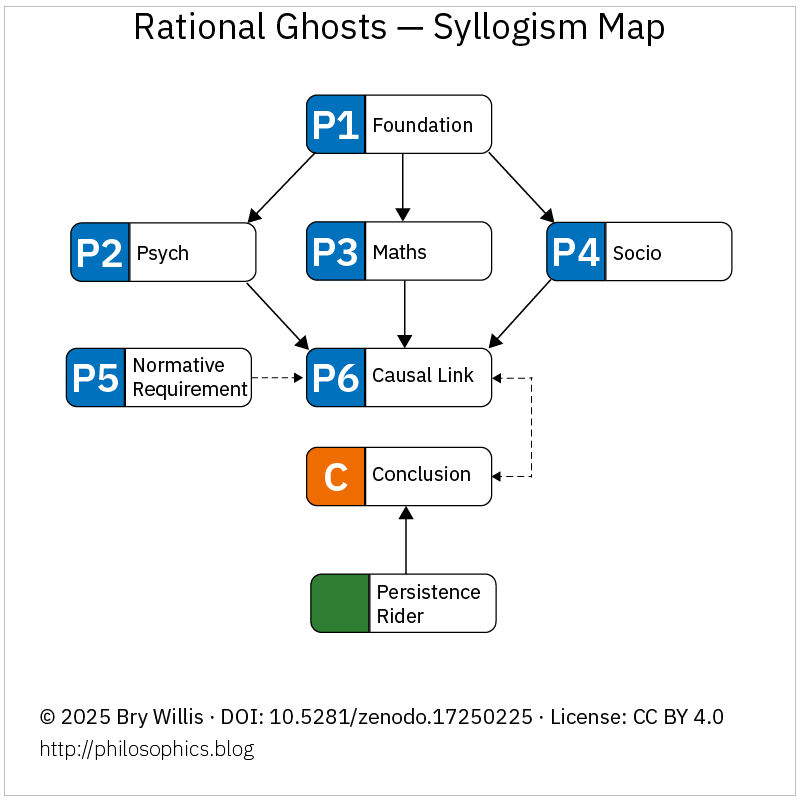
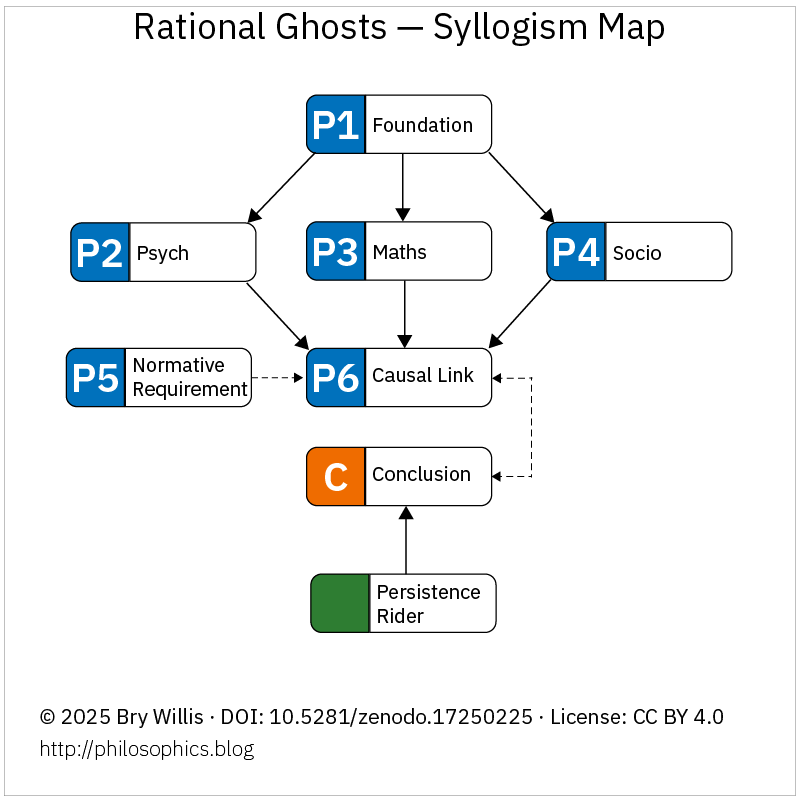
Beneath the prose, the critique of Enlightenment democracy can be expressed as a syllogism:
a foundation that assumed rational citizens collides with psychological bias, mathematical impossibility, and sociological limits.
The outcome is a double failure – corrupted inputs and incoherent outputs – masked only by temporary props.

Figure: Logical skeleton of “Rational Ghosts: Why Enlightenment Democracy Was Built to Fail.” For the complete essay, with sources and elaboration, see the open-access preprint on Zenodo: https://doi.org/10.5281/zenodo.17250225

Missing White Supremacy’s Woods for the Tree

2–3 minutes

Radical Futures Studio’s “7 Signals” deck has been circulating widely. It’s a striking example of Storytelling 101: identify a villain, chart the signs of its decline, and point toward an eventual resolution. In this case, the villain is white supremacy. The signs are its institutional and cultural fray. The resolution is its collapse.

Audio: NotebookLM podcast on this topic.

As far as stories go, it’s effective. It provides a framework, some memorable imagery, and the reassurance that the ugliness on display today is a death rattle, not a resurgence. No wonder it resonates. People want to believe the noise means the monster is dying.

But as analysis, the frame is too tight. Racism is not the root structure; it is a symptom, a mask. White supremacy is real enough in its effects, but its persistence and decline are contingent. The deeper system – the scaffolding of late-stage capitalism, the Enlightenment’s brittle universalism, the institutions now staggering under their own contradictions – remains the host. When whiteness peels away, the system does not vanish. It simply rebrands.

To point to the peeling paint and say ‘the house is collapsing’ is to mistake surface for structure. Yes, the paint matters; it shapes how people experience the walls. But the real rot lies deeper, in the beams. The Enlightenment project promised seamless cloth: rationality, universality, permanence. Capitalism promised endless expansion and renewal. Both promises are faltering, and the cracks are visible everywhere – climate, finance, governance, identity. Racism, whiteness, supremacy: these are one set of cracks, not the foundation itself.

The risk of the ‘signals’ narrative is that it offers too neat a moral arc. It comforts the audience that the villain is cornered, that justice is baked into the future. But history is rarely so tidy. Supremacy does not die; it changes costumes. One mask slips, another is stitched on. If we mistake the collapse of whiteness for the collapse of the system, we blind ourselves to how easily the scaffolding survives in new guises.

None of this is to reject the cause. Racism is a systemic lie, and its decline is worth cheering. But it is not enough to track the noise of its death rattle. To understand the larger story, we need to step back and see the woods for the trees. The true collapse underway is broader: the exhaustion of capitalism’s last stage, the unravelling of Enlightenment’s promises, the loss of legitimacy in institutions that no longer hold. That is the forest in which the tree of whiteness withers.

If we focus only on the tree, we risk missing the landscape. And if we mistake peeling paint for the beams, we risk celebrating cosmetic decline while the house quietly reassembles itself under a different banner.

Licence to Post

2–3 minutes

We live in an era where anyone can beam their thoughts into the ether at the push of a button. This would be a miracle if those thoughts weren’t so reliably idiotic. The internet promised democracy of speech; what it delivered was a landfill of charts no one understands, memes that spread faster than viruses, and the gnawing sense that humans are simply not rational enough to handle the privileges they’ve been given.

The Enlightenment told us we were “rational animals,” armed with Reason, the noble faculty that would lift us out of ignorance and into perpetual progress. What a joke. We aren’t Vulcans; we’re apes with Wi-Fi. We mash the publish button before our brains have caught up, then scream “free speech” when anyone suggests that words might require responsibility.

Imagine if driving worked this way. No test, no licence, no consequences: just a toddler at the wheel, claiming God-given rights to swerve across lanes. That’s social media in its current form. The people most in need of regulation are the least likely to pass even the most basic competency exam. Yet they strut about, convinced that posting a graph about Mississippi’s GDP makes them the second coming of Adam Smith.

@theashtoncohen

5 Brutal facts about Europe’s economy. Europe’s richest countries are now poorer than Mississippi. Americans have way more spending power, their companies are getting crushed, birth rates are tanking, and they’ve been left out of the industries that will define the future. Here are 5 hard truths Europe can’t afford to ignore.

♬ original sound – Ashton Cohen
NB: Under any condition, do not assume I endorse the misframed cherry-picking of this smug geezer, the progenitor of this post.

The truth is obvious but inconvenient: rationality is not humanity’s natural state. It’s a rare, costly condition, summoned only with discipline, education, and luck. Most of the time, we prefer shortcuts — tribal loyalties, gut feelings, dopamine hits. And yet we hand out the privileges of unfiltered speech, instantaneous broadcasting, and algorithmic amplification as if every citizen were Kant’s ideal autonomous agent.

The result? Chaos. Outrage machines. “Debates” about whether Europeans are backward barbarians for drinking water without ice cubes. These aren’t signs of liberty. They’re symptoms of a species drunk on its own mythology of reason.

Maybe we don’t need a new Marshall Plan for air conditioning in Europe. Maybe we need one for sanity. Start with a licence to post: a simple exam to prove you know what a source is, can tell a correlation from a cause, and won’t confuse market cap with civilisation itself. Civilization would be quieter. And perhaps, mercifully, a little less stupid.

Reason on a Spectrum

4–6 minutes

Reason is not an oracle of truth but a spectrum-bound tool, and when it is worshipped as absolute, it curdles into pathology. True rationality knows when to temper itself, when to equivocate, and when a kind lie is wiser than a cold fact.

Reason and rationality are the household gods of modernity. We light incense to them daily: follow the science, be reasonable, act rationally. But before we genuflect, it’s worth asking what exactly we mean. By reason, I mean the faculty of inference – spotting contradictions, tracing causes. By rationality, I mean the practice of applying that faculty toward some end. That’s all. Nothing mystical.

Audio: NotebookLM podcast on this topic.

The trouble starts when these concepts are treated as absolutes. They aren’t. They vary in intensity and application. A person’s reasoning operates on a spectrum with something like frequency and amplitude. Some minds hum at low frequency – broad strokes, contradictions smoothed over by intuition. Others burn hot at high frequency and amplitude – rapid logical leaps, obsessive consistency, the inability to let a premise go. And while some reason flows like a continuous wave – steady, consistent, predictable – other forms fire more like particles: synaptic sparks that don’t always connect, logic arriving in bursts or stutters rather than as a smooth line.

Push too far and what we sanctify as ‘reason’ bleeds into what psychiatry pathologises as autism or schizophrenia. Meanwhile, ‘normal’ cognition always includes an emotional ballast. Strip it out and the result looks alien, even monstrous. Freud’s quip about psychopathy – that the psychopath differs from the rest of us in degree, not kind – applies just as well to reason. Rationality is simply the socially acceptable blend of logic and affect. Deviate, and you’re declared broken.

Camus gave us a parable in The Stranger. Meursault observes his world with ruthless clarity, but no emotional resonance. He doesn’t weep at his mother’s funeral, and society condemns him less for murder than for failing to perform grief. His ‘pure’ reason reads as inhuman.

Here’s the paradox: if rationality means adapting effectively to one’s environment, then pure rationality demands knowing when to suspend itself. A person who insists on logic at every turn is not rational but maladapted. The rational actor lies, flatters, nods at the boss’s bad joke, comforts the friend who doesn’t want statistics but solace. Rationality that cannot bend collapses into pathology.

This is why the infamous ‘Do these jeans make me look fat?’ question is such a perfect test. The ‘true’ answer, if you are reasoning narrowly, may be ‘yes’. But true rationality recognises the context, the stakes, the human need beneath the words. The rational response is not the cold fact but the kind equivocation. Rationality that cannot lie is no rationality at all.

Here’s the paradox: if rationality means adapting effectively to one’s environment, then pure rationality demands knowing when to suspend itself. A person who insists on logic at every turn is not rational but maladapted. The rational actor lies, flatters, nods at the boss’s bad joke, comforts the friend who doesn’t want statistics but solace. Rationality that cannot bend collapses into pathology.

Consider the social rituals we all know. A partner says, ‘I like that house’, and the rationally over-tuned response is to evaluate the house. The actual cue is in the like, not the house. The answer isn’t that you dislike the house, but rather what you can appreciate about it. Miss that, and you miss the point. Or take the dinner table: when my son was seven, a well-meaning host – very Martha Stewart – asked him how he enjoyed his meal. He replied, with perfect candour, ‘I’ve had better’. From a logical standpoint, faultless. From a rational standpoint – if rationality includes social adaptation – disastrous. The question was never about the food. It was a cue for appreciation, for harmony. He gave fact when what was asked for was affiliation.

So yes, I attack reason and rationality – not because they don’t exist, but because they are misapplied, reified, and worshipped as neutral arbiters of truth. They are not. They are tools with a range, and outside that range, they fail catastrophically. To speak of ‘reason’ as if it were an unqualified good is like praising fire without mentioning its talent for arson.


After I wrote this, I realised I forgot to mention Kant.

Even Kant, patron saint of rational duty, insisted you must never lie, not even a white lie, not even to a murderer asking where your friend is hiding. For him, truth-telling was categorical, binding, immune to circumstance. But this is reason gone rigid, unable to flex with human reality. It shows how worship of Reason leads not to morality but to monstrosity. A rationality that cannot bend is no rationality at all.