Why So Negative?

The Travelogue of a Recovering Enlightenment Subject

I’m asked endlessly – usually by people who still believe TED talks are a form of knowledge production – ‘Why are you so negative? Why must you tear things down if you’ve no intention of replacing them?’

It’s adorable, really. Like watching a toddler demand that gravity apologise.

They’ve been trained for years in the managerial catechism:

As if the world were some badly-run workshop in need of a fresh coat of agile methodology.

They might as well say, ‘Don’t tell me I can’t win at Lotto; give me money’.

I, too, would enjoy the spare universe. Or the winning Lotto ticket. And yes, one day I might even buy one. Until then, I’ve embraced the only adult philosophy left: Dis-Integrationism – the fine art of taking things apart without pretending they can be reassembled into anything coherent.

A Little History

My suspicion began early. Secondary school. All those civic fairytales whispered as if they were geology.

The ‘reasonable person’? Bollox.
‘Jury of one’s peers’? What are peers? Whose peers? I have no peers.
‘Impartial judges’? Please. Even as a teenager, I could see those robed magicians palming cards like bored street performers. Everyone else nodded along, grateful for the spectacle. I stared, wondering how the other children hadn’t noticed the emperor’s bare arse.

Later, I watched adults talk past each other with a fluency bordering on performance art. Not disagreement – different universes, cosmetically aligned by grammar.

A Federal mediator once tried to teach me that common ground could be manufactured. Not by clarifying meaning, mind you – that would have required honesty – but by rhetorical pressure and a touch of Jedi mind-trickery. Negotiation was simply controlled hallucination.

University communications classes offered temporary distraction with denotation and connotation, a little semantic drift, the illusion that language might be domesticated with enough theory. Charming. Almost convincing.

Then Gödel and Arrow arrived like two polite assassins and quietly removed the floorboards.

And then – happily, inevitably – Derrida, Foucault, Lyotard. I’d already danced with Beauvoir, Sartre, Camus. I’d ingested the Western canon like every obedient young acolyte: Plato, Aristotle, Hobbes, Locke, Rousseau, Montesquieu, Voltaire. Americans force-feed their citizenry Jefferson and Franklin as moral fibre, as if the republic might otherwise suffer constipation.

It never gelled. Too much myth, too much marketing. The Enlightenment had the energy of a regime insisting on its own benevolence while confiscating your torch. To call oneself ‘enlightened’ should have raised suspicion – but no, the branding stuck.

Whenever les garçons dared tug at the curtain, we were assured they simply didn’t ‘understand’, or worse, they ‘hated civilisation’.
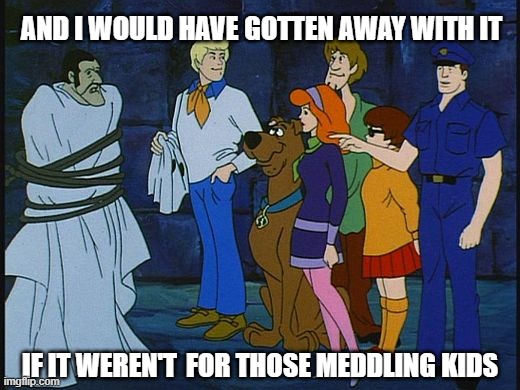
Image: “I would have gotten away with it if it weren’t for those meddling kids.”

Then Came the Internet

The digital age didn’t usher in clarity — it unmasked the whole pantomime.
Like Neo seeing the Matrix code or Roddy Piper slipping on the sunglasses in They Live, one suddenly perceives the circuitry: meaning as glitch, discourse as scaffolding, truth as a shabby stage-set blinking under fluorescent tubes.

Our civilisation speaks in metaphors it mistakes for mechanisms. The Enlightenment gave us the fantasy that language might behave, that concepts were furniture rather than fog. Musicians and artists always knew better. We swim in metaphor; we never expected words to bear weight. But philosophers kept pretending communication was a conveyor belt conveying ‘meaning units’ from A to B.

By 2018, the cracks were gaping. I began taking the notes that would metastasise into A Language Insufficiency Hypothesis – an attempt to map the hollow spaces between our words, the fractures we keep wallpapering with reason.

Half a decade later, the work is ready. Not to save anything – nothing here merits salvation – but to name the debris honestly.

If that sounds negative, good. Someone has to switch off the Enlightenment’s flickering lightbulb before it burns the whole house down.

Where This Road Actually Leads

People imagine negativity is a posture – a sort of philosophical eyeliner, worn for effect. But dismantling the world’s conceptual furniture isn’t a hobby; it’s the only reasonable response once you’ve noticed the screws aren’t actually attached to anything.

The Enlightenment promised us a palace. Step inside and you discover it’s built out of IKEA flatpacks held together with wishful thinking and a prayer to Kant.

Once you’ve seen that, you can’t go back to pretending the furniture is sturdy.

You stop sitting.

You start tapping the beams.

You catalogue the wobble.

This is where Dis–Integrationism enters – not as a manifesto, but as the practice of refusing to live inside collapsing architecture out of sheer politeness. Negativity is simply the weather report.

The Lie We Keep Telling Ourselves

We cling to the fantasy that if we critique something long enough, a solution will crystallise out of the void, like enlightenment through sheer irritation. It’s the Protestant work ethic meets metaphysics: salvation through sufficient grumbling.

But critique is not alchemy. It unmakes. It refuses. It loosens the bolts we pretended were load-bearing.

Once you stop demanding that thought be constructive, you can finally see the world as it is: improvised, rhetorical, and permanently under renovation by people who don’t read the instructions.

The Enlightenment’s heirs keep insisting there must be a blueprint. There isn’t. There never was. We’ve merely been tracing the silhouettes of scaffolding, calling it a cathedral.

And Yet – Here We Still Are

The online age (God help us all) didn’t deepen the crisis; it merely turned the lights on. What Enlightenment rationality hid beneath a tasteful layer of neoclassical varnish, the internet sprayed with fluorescent graffiti.

Turns out, when seven billion people speak at once, meaning doesn’t ’emerge’; it buckles. Our systems weren’t built for this volume of contradiction. Our language wasn’t built for this density of metaphor. Our myths weren’t built for this much empirical evidence against them.

And yet here we are, still demanding coherence from a medium held together by emojis and trauma. If you laugh, it’s only to stop crying. If you critique, it’s only because someone has to keep the fire marshal informed.

The Only Honest Next Step

Having traced the cracks, you’re now in the foyer of the real argument – the one hanging like a neon sign over your entire Anti-Enlightenment project:

Language is insufficient. Agency is a fiction. Objectivity is an etiquette ritual. Democracy is a séance. Progress is a hallucination with better marketing. And yet – life continues. People wake, work, argue, aspire, despair.

Dis-Integrationism isn’t about nihilism; it’s about maintenance. Not repairing the myth, but tending the human who must live among its debris. Not constructing new temples, but learning to see in the half-light once the old gods have gone.

The travelogue becomes a guidebook: Welcome to the ruins. Mind the uneven floor. Here is how we walk without pretending the path is paved.

The Fetish for Solutions

Here is the final indignity of the age: the demand that every critique come bundled with a solution, like some moral warranty card. As if naming the rot weren’t labour enough. As if truth required a customer-service plan.

‘Where is your alternative?’ they ask, clutching Enlightenment logic the way a drowning man clutches a shopping receipt.

But solutions are the real tyranny. They arrive bearing the smile of reason and the posture of progress, and behind both sits the same old imperial instinct: replace ambiguity with order; replace lived complexity with a diagram. A solution is merely a problem wearing a fresh coat of confidence.

Worse, a solution presumes the system is sound, merely in need of adjustment. It imagines the structure holds. It imagines the furniture can be rearranged without collapsing into splinters, and the memory of Kant.

Solutions promise inevitability. They promise teleology. They promise that the mess can be disinfected if only one applies the correct solvent. This is theology masquerading as engineering.

The Violence of the Answer

A solution is a closure – a metaphysical brute force. It slams the window shut so no further interpretation can slip in through the draft. It stabilises the world by amputating everything that wriggles. Answers are how systems defend themselves. They’re the intellectual equivalent of riot police: clean uniforms, straight lines, zero tolerance for nuance.

This is why the world keeps mistaking refusal for chaos. Refusal isn’t chaos. It’s hygiene. It is the simple act of not adding more furniture to a house already bending under its own delusions. When you decline to provide a solution, you aren’t abandoning the world. You’re declining to participate in its coercive optimism.

And So the Travelogue Ends Where It Must

Not in triumph or a bluepirnt, but in composure – the only posture left after the Enlightenment’s glare has dimmed. Negativity isn’t sabotage; it’s sobriety. Dis-Integrationism isn’t cynicism; it’s the refusal to replace one failing mythology with another wearing vegan leather.

A world obsessed with solutions cannot recognise maintenance as wisdom. It can’t tolerate ambiguity without reaching for a hammer. It can’t breathe unless someone somewhere is building a ladder to a future that never arrives.

So no – I won’t provide solutions. I won’t participate in the fantasy that the human condition can be patched with conceptual duct tape. I will not gift the Enlightenment a eulogy that surrenders to its grammar.

What I offer is far smaller and far more honest: Attention. Description. Steady hands in a collapsing house. And the simple dignity of refusing to lie about the architecture.

That, for now, is enough.

Refining Transductive Subjectivity

3–4 minutes

I risk sharing this prematurely. Pushing the Transductive Subjectivity model toward more precision may lose some readers, but the original version still works as an introductory conversation.

Please note: There will be no NotebookLM summary of this page. I don’t even want to test how it might look out the other end.

Apologies in advance for donning my statistician cap, but for those familiar, I feel it will clarify the exposition. For the others, the simple model is good enough. It’s good to remember the words of George Box:

The Simple Model

I’ve been thinking that my initial explanatory model works well enough for conversation. It lets people grasp the idea that a ‘self’ isn’t an enduring nugget but a finite sequence of indexed states:

S0S1S2SnS₀ → S₁ → S₂ → … → Sₙ

The transitions are driven by relative forces, RR, which act as catalysts nudging the system from one episode to the next.

The Markov Model

That basic picture is serviceable, but it’s already very close to a dynamical system. More accurate, yes—though a bit more forbidding to the casual reader – and not everybody loves Markov chains:

Si+1=F(Si,Ri)S_{i+1} = F(S_i, R_i)

Here:

  • SiSi is the episodic self at index i
  • RiRi is the configuration of relevant forces acting at that moment
  • FF is the update rule: given this self under these pressures, what comes next?

This already helps. It recognises that the self changes because of pressure from language, institutions, physiology, social context, and so on. But as I noted when chatting with Jason, something important is still missing:

SiSi isn’t the only thing in motion, and RiRi isn’t the same thing at every step.

And crucially, the update rule FF isn’t fixed either.

A person who has lived through trauma, education, and a cultural shift doesn’t just become a different state; they become different in how they update their states. Their very ‘logic of change’ evolves.

To capture that, I need one more refinement.

The Transductive Operator Model

This addresses the fact that Si isn’t the only aspect in motion and there are several flavours of R over time, so Ri. We need to introduce the Transductive T:

(Si+1,Fi+1)=T(Si,Fi,Ri)(S_{i+1}, F_{i+1}) = \mathcal{T}(S_i, F_i, R_i)

Now the model matches the reality:

  • SS evolves
  • the pressures RR evolve
  • and the update rule FF evolves

RiRi can be further decomposed as Ri=(Rphys,Rsocial,Rsymbolic,)Ri=(R^{phys},R^{social},R^{symbolic},…), but I’ll save that for the formal essay.

That is why this is transductive rather than inductive or deductive:
structure at one moment propagates new structure at the next.

What Transductive Subjectivity Isn’t

What TS rejects is the notion that the self is a summation of the SiSis and other factors; this summation is a heuristic that works as a narrative, and all of its trappings, but it is decidedly incorrect.

SelfΣ(Si,)Self≠Σ(Sᵢ, …)

Effectively,

Self0tExperiencedtSelf ≠ \int_{0}^{t} Experience \, dt

In ordinary life, we talk as if there were a single, stable self that sums all these episodes. Transductive Subjectivity treats that as a convenient narrative, not an underlying fact. For example, someone raised in a rigid environment may initially update by avoiding conflict; after therapy and a cultural shift, they may update by seeking it out when something matters. This fiction is where we project agency and desert, and where we justify retribution.

Two Four Two Three

1–2 minutes

This meme is not what I mean by language insufficiency, but it does capture the complications of language.

Image: Two Four Two Three

I found this image accompanying an article critical of AI – Claude.ai in particular. But this isn’t a Claude problem. It’s a language problem. I might argue that this could have been conveyed verbally, and one could resolve this easily by spelling out the preferred interpretation.

  • A: Two thousand, twenty-three
  • B: Four thousand, four hundred, thirty-three
  • C: Two thousand, four hundred, thirty-three
  • D: Four thousand, four hundred, twenty-three

So, this is not insoluble, but it is a reminder that sometimes, in matters like this, additional information can lead to clearer communication.

I’d also imagine that certain cultures would favour one option over another as it is presented above. As for me, my first guess would have been A, interpreting each number as a place position. I’d have expected teh double number to also have a plural syntax – two threes or two fours – but that may just be me.

The Prison of Process

3–4 minutes

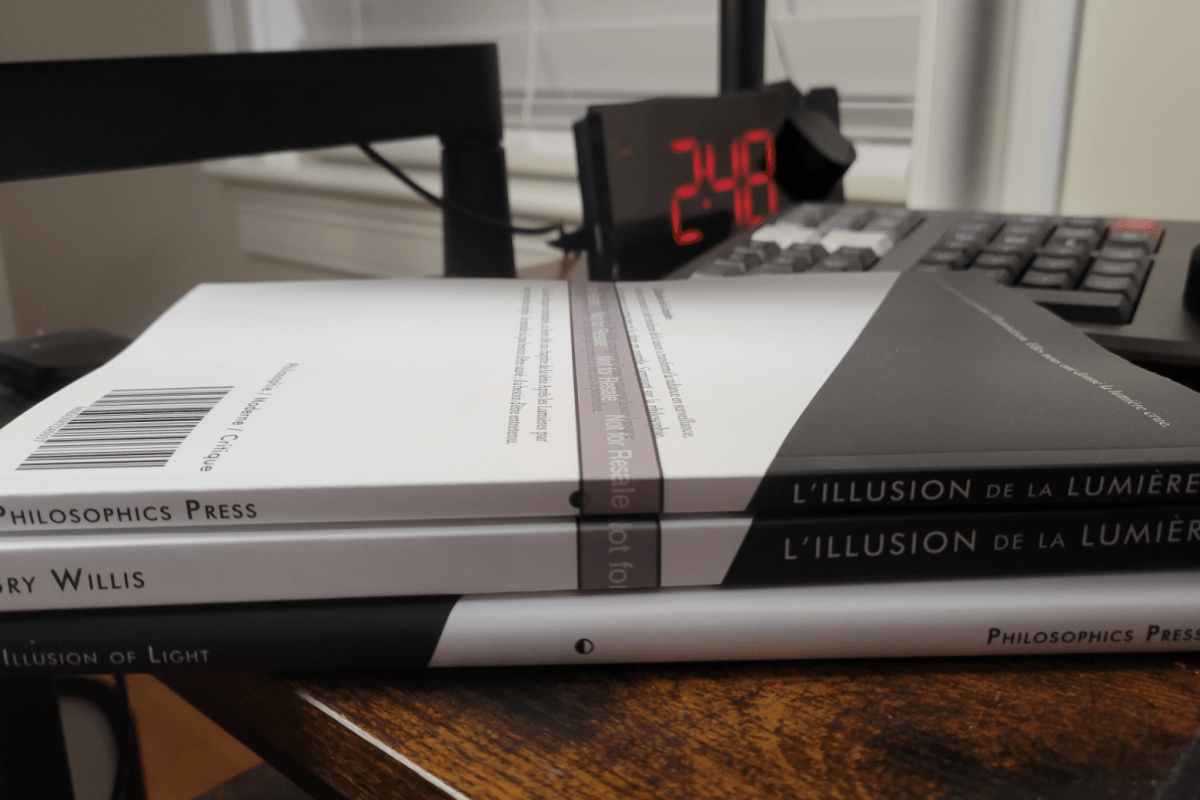
This is the proof copy of The Illusion of Light. I reviewed it, approved it, and signalled ‘good to go’. This is being printed and distributed through KDP. I’ve used them before. They’ve been reliable.

EDIT: On the upside, I’ve been notified that the hardback version is available, but it doesn’t appear to be available in France and Canada, two target regions. Hopefully, it becomes available outside of the U.S. soon.

Until now.

My approval triggered a workflow. I know workflows. I used to design them. I also know how dumb they can be.

KDP’s process flagged an error: the text on the spine might not be on the spine. ‘Might’. Theoretically. It could be offset, cut off, or printed on a fold. I understand their reasoning – high-speed printers, mechanical variance, and return risk. I also understand statistics, and a single observation doesn’t make a trend. But anyone with eyes can see at least a couple of millimetres of clearance at the top and bottom. This isn’t a case of ‘maybe’. It’s fine.

What fascinates me here is the ritual of compliance. Once a process is codified, it becomes self-justifying. The rule exists; therefore, it must be obeyed. There is no appeal to reason – only to the flowchart.

In the 1980s, when I was an audio engineer recording to two-inch magnetic tape, some of us liked to record hot, pushing the levels just past the recommended limits. You learned to ride the edge, to court distortion without collapse. That’s how I designed the spine text. Within tolerance. With headroom.

The problem is that modern systems don’t tolerate edges. There’s no “override” button for informed judgment. My remediation path is to shrink the type by half a point, resubmit, and pretend the machine was right.

What’s absurd is the timing. The same system that generated the proof approved this layout days ago. An automated OCR scan could have caught this phantom error earlier. Instead, the machine waits until the human signs off, then throws a flag so the process can justify its existence.

KDP is still faster and saner than IngramSpark. But this is capitalism distilled: survival by being marginally less incompetent than your competitor. Optimisation, not in the sense of best possible, but of barely better than worst acceptable.

The lesson, as always, is that processes begin as aids and end as prisons. The workflow, like the Enlightenment, believes itself rational. But the longer it runs, the less it serves the human at the console and the more it worships its own perfection.

Want to talk about meta? This underscores the contents of the book itself. What the Enlightenment once called Reason, modernity now calls Process. Both pretend to neutral objectivity while enshrining obedience as virtue. The bureaucracy of light has become digital – its catechism written in checkboxes, its priests replaced by automated validators. Every workflow promises fairness; each only codifies submission. The real danger isn’t that machines will replace judgment, but that we will stop noticing when they already have.


The Story Continues: Behind the Scenes

Image: Screenshot of Illustrator layout

I’ve reduced the font size on the spine from 14 points to 13.5. It still technically bleeds over a guideline. I hope I am not forced to reduce it to 13. A reason for text on the spine is to make it visible. Hopefully, the black-and-white vertical separation will help in this regard. Fingers crossed.

The Seduction of the Spreadsheet

1–2 minutes

Whilst researching “The Will to Be Ruled: Totalitarianism and the Fantasy of Freedom”, I stumbled across Mattias Desmet’s The Psychology of Totalitarianism. The title alone was bait enough. I expected the usual reheated liberal anxiety about dictators; instead, I found a critique of data worship and mechanistic reason that hits the nerve of our statistical age.

Besmet, a Belgian psychologist with a background in statistics, begins not with tyranny but with epistemology – with how the Enlightenment’s dream of objectivity curdled into the managerial nightmare we now inhabit. The first half of the book reads like a slow unmasking of Scientism: how numbers became our gods, and graphs, our catechisms.

Written before COVID-19 but finished during it, his argument turns pandemic data into theatre – a performance of certainty masking deep confusion. The daily tally became ritual sacrifice to the idol of ‘evidence-based’ policy. His point, and mine, is that totalitarianism no longer needs gulags; it thrives in dashboards and KPIs.

Desmet’s frame intersects beautifully with my own thesis: that obedience today is internalised as reasonableness. Freedom has been recast as compliance with ‘the data’. We surrender willingly, provided the orders come in statistical form.

This is why even Agile™ management and its fetish of ‘velocity’ reek of the same mechanistic faith. Every sprint promises deliverance through quantification; every retrospective is a bureaucratic confession of inefficiency. The cult of metrics is not merely a managerial fad – it is the metaphysics of our time. The problem is at once ontological and epistemological: we mistake the measure for the thing itself, and in doing so, become measurable.

It’s a rare pleasure to encounter a fellow dissident of the numerical faith – a man who sees that the spreadsheet has replaced the sceptre.

The Myth of Ethical AI

2–4 minutes

In fact, the myth of a unified ethics.

‘Ethical AI’ is one of those phrases that makes philosophers reach for the gin. It’s like saying ‘compassionate capitalism or ‘fair monopoly’. The words coexist only in PowerPoint presentations and TED Talks, where moral tension is rebranded as innovation.

Audio: NotebookLM podcast on this topic.

The tech establishment loves to mutter about ‘ethics’ as though it were a feature flag – something to be toggled on in beta before the next investor round. But ethics, inconveniently, isn’t monolithic. There is no master code of moral conduct waiting to be compiled into machine learning. There are ethics, plural: Greek, Buddhist, Confucian, feminist, existentialist – each with its own vision of good, and none agreeing on the syntax.

Video: Whilst rendering cover images, I generated this and figured I’d share it for no particular reason.

The Utilitarian Delusion

When the Silicon Valley moralists speak of ‘ethics’, what they actually mean is a bland utilitarian consequentialism, tarted up in slide decks. Do what produces the most good for the most people. Sounds efficient – until you realise the spreadsheet never quite adds up. Whose good? Whose people?

This moral arithmetic smuggles in its biases like contraband. It assumes the human species sits atop the moral food chain, that GDP and engagement metrics can be moral indicators, and that ethics itself can be quantified. The utilitarian calculus is seductive precisely because it flatters the technocrat’s sensibility: moral worth as data set, consequence as outcome variable.

It’s Bentham for the broadband age – pleasure measured in clicks, pain in latency. The only thing worse than this cheerful consequentialism is the belief that it’s neutral.

The Ethics of Obedience

The next trick in the tech priesthood’s catechism is ‘alignment’ – training AI to reflect ‘human values’. But whose values? The Californian elite’s, presumably: a pseudo-egalitarian capitalism that confuses ‘doing good’ with ‘disrupting the poor’.

When they say alignment, they mean obedience. When they say ‘responsible AI’, they mean ‘please don’t regulate us yet’. The entire project rests on a moral inversion: the child instructing the parent, the tool defining the hand. The algorithm doesn’t learn ethics; it learns precedent. It learns who gets the loan, who gets the sentence, who gets the ad for antidepressants.

These systems don’t go rogue – they conform. Perfectly.

The Mirror Problem

The great irony of “ethical AI” is that the machine already behaves ethically – by our own measure. It optimises what we’ve taught it to value: efficiency, profit, attention, control. The trouble is that these are our ethics, not its. The algorithm merely holds up a mirror, and we recoil at the reflection.

To demand ‘ethical AI’ while leaving our institutions morally bankrupt is theatre. The problem is not that AI lacks conscience; it’s that the humans who build it mistake conscience for compliance. The ethics crisis in technology isn’t about machines misbehaving; it’s about humans pretending to behave.

The Real Question

We keep asking whether AI can be ethical, as though machines might one day deliver what we have failed to. But the real question is simpler, bleaker: can we be? If history is any guide, the answer is ‘only when it’s profitable’.

Until then, ‘ethical AI’ remains a convenient myth, moral placebo for the age of automation. What we need are not ethical algorithms but ethical architects. And the odds of finding those among the venture capital class are, as ever, vanishingly small.

Rational Ghosts: Why Enlightenment Democracy Was Built to Fail

3–4 minutes

We are governed by phantoms. Not the fun kind that rattle chains in castles, but Enlightenment rational ghosts – imaginary citizens who were supposed to be dispassionate, consistent, and perfectly informed. They never lived, but they still haunt our constitutions and television pundits. Every time some talking head declares “the people have spoken”, what they really mean is that the ghosts are back on stage.

👉 Full essay: Rational Ghosts: Why Enlightenment Democracy Was Built to Fail

The conceit was simple: build politics as if it were an engineering problem. Set the rules right, and stability follows. The trouble is that the material – actual people – wasn’t blueprint-friendly. Madison admitted faction was “sown in the nature of man”, Rousseau agonised over the “general will”, and Condorcet managed to trip over his own math. They saw the cracks even while laying the foundation. Then they shrugged and built anyway.

Audio: NotebookLM podcast on this topic.

The rational ghosts were tidy. Real humans are not. Our brains run on shortcuts: motivated reasoning, availability cascades, confirmation bias, Dunning–Kruger. We don’t deliberate; we improvise excuses. Education doesn’t fix it – it just arms us with better rationalisations. Media doesn’t fix it either – it corrals our biases into profitable outrage. The Enlightenment drafted for angels; what it got was apes with smartphones.

Even if the ghosts had shown up, the math betrayed them. Arrow proved that no voting system can translate preferences without distortion. McKelvey showed that whoever controls the sequence of votes controls the outcome. The “will of the people” is less an oracle than a Ouija board, and you can always see whose hand is pushing the planchette.

Scale finishes the job. Dunbar gave us 150 people as the human limit of meaningful community. Beyond that, trust decays into myth. Benedict Anderson called nations “imagined communities”, but social media has shattered the illusion. The national conversation is now a million algorithmic Dunbars, each convinced they alone are the real people.

Audio: This is a longer (40-minute) NotebookLM podcast on the essay itself.

Why did democracy limp along for two centuries if it was this haunted? Because it was on life-support. Growth, war, and civic myth covered the cracks. External enemies, national rituals, and propaganda made dysfunction look like consensus. It wasn’t design; it was borrowed capital. That capital has run out.

Cue the panic. The defences roll in: Churchill said democracy was the “least bad” system (he didn’t, but whatever). Voters self-correct. Education will fix it. It’s only an American problem. And if you don’t like it, what – authoritarianism? These are less arguments than incantations, muttered to keep the ghosts from noticing the creaks in the floorboards.

The real task isn’t to chant louder. It’s to stop pretending ghosts exist. Try subsidiarity: smaller-scale politics humans can actually grasp. Try deliberation: citizens’ assemblies show ordinary people can think, when not reduced to a soundbite. Try sortition: if elections are distorted by design, maybe roll the dice instead. Try polycentric governance: let overlapping authorities handle mismatch instead of hammering “one will”. None of these are perfect. They’re just less haunted.

Enlightenment democracy was built to fail because it was built for rational ghosts. The ghosts never lived. The floorboards are creaking. The task is ours: build institutions for the living, before the house collapses under its own myths.

The Argument in Skeleton Form

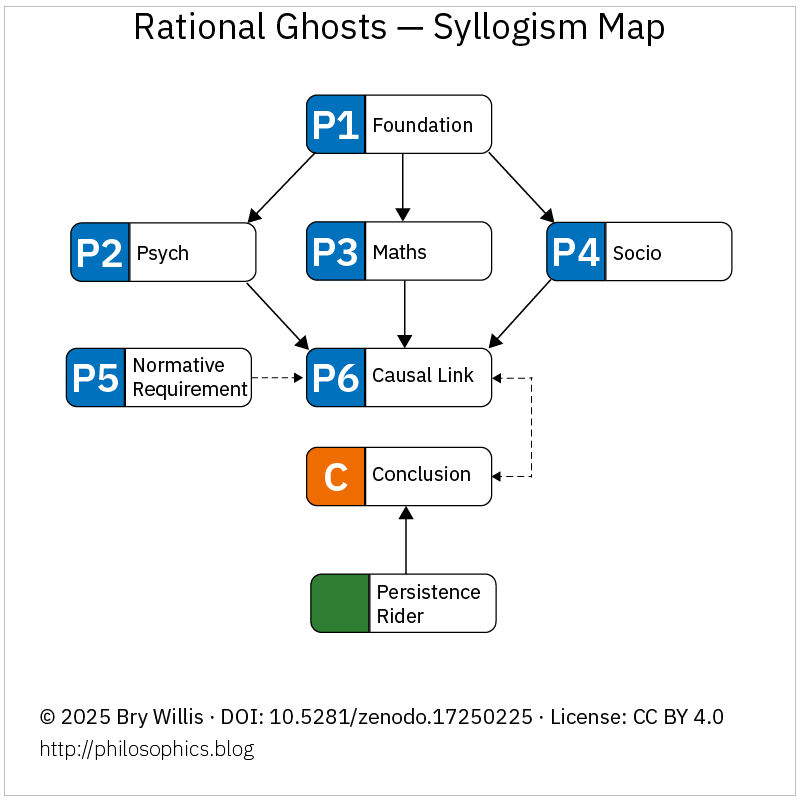
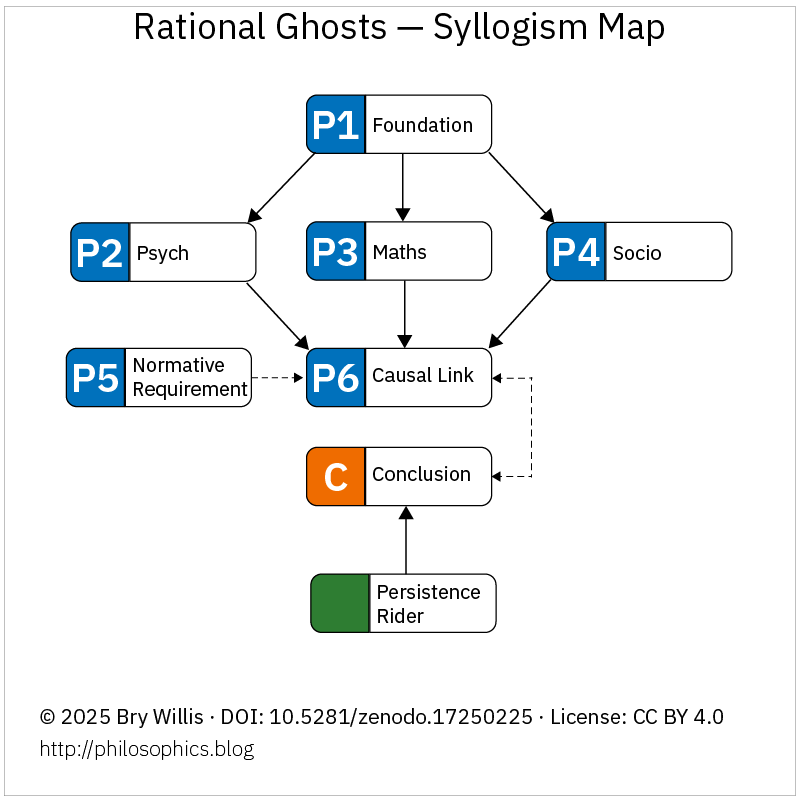
Beneath the prose, the critique of Enlightenment democracy can be expressed as a syllogism:
a foundation that assumed rational citizens collides with psychological bias, mathematical impossibility, and sociological limits.
The outcome is a double failure – corrupted inputs and incoherent outputs – masked only by temporary props.

Figure: Logical skeleton of “Rational Ghosts: Why Enlightenment Democracy Was Built to Fail.” For the complete essay, with sources and elaboration, see the open-access preprint on Zenodo: https://doi.org/10.5281/zenodo.17250225

That’s Never Happened Before

Famous last words, I know.

I was working with ChatGPT, discussing various concepts. We chatted for several hours over the course of a few days, and we came to, let’s say, a conclusion. What ChatGPT 5 did next was something I had never seen. In fact, I’m sharing the actual response.

I won’t share my thesis here, but this is one of the field verification projects it recommends.

One-page grant prospectus — Provenance Pilot

Project title
Provenance First: Testing provenance packages & slow-mode deliberation to improve municipal decision quality

Lead investigator
Bry Willis — Independent Researcher (contact: [REDACTED])

Summary (1–2 lines)
Test whether mandatory, machine-readable provenance packages plus a 60-day slow-mode and rapid adversarial audits improve decision quality (DQI), reduce reversal rates and increase public legitimacy in municipal planning decisions.

Problem statement (why fund this)
Policy decisions are frequently hijacked by headline pressure and low-provenance inputs; municipalities lack lightweight, testable protocols that make inputs traceable and give deliberation time. This pilot operationalises the “provenance-first + slow-mode” institutional fix and measures whether design moves increase robust decision outcomes rather than performative actions.

Objectives

  1. Test whether provenance packages + 60-day slow-mode increase Decision Quality Index (DQI) vs business as usual.
  2. Measure effects on Provenance Completeness Score (PCS), reversal rates at 12 months, and public legitimacy.
  3. Produce an open replication pack (data, code, provenance schema) and practitioner guidance.

Design & methods (12 months)

  • Setting: medium-sized city planning board; 12 eligible planning items over 12 months.
  • Randomisation: items randomly assigned (stratified by leverage) to Treatment (provenance package + 60-day slow-mode + funded rapid audit) or Control (standard process).
  • Intervention: standard JSON provenance package template (raw data links, code where relevant, funders, changelog), public portal posting, 60-day live comment + one adversarial rapid audit (48–72 hrs) on contested claims.
  • Primary outcome: Decision Quality Index (DQI) — composite of: evidence completeness, process reversibility, and independent expert accuracy score (pre-registered rubric).
  • Secondary outcomes: PCS, reversal at 12 months, public trust (survey), time to decision, stakeholder satisfaction.
  • Analysis: pre-registered mixed effects model (item-level with panel-level random effects), intention-to-treat.

Deliverables

  • Pre-registered protocol on OSF; open data & replication pack (anonymised where required); policy brief and practitioner playbook; 1 peer-reviewed methods paper.

Success criteria (pre-registered)

  • Cohen’s d≥0.4 improvement in DQI for treatment vs control; PCS improvement >25 percentage points; no more than 30% increase in unacceptable delay (pre-agreed threshold).

Risk & mitigation

  • Delay risk: cap slow-mode at 60 days; urgent items can request expedited review (documented override).
  • Capture risk: audit funding ring-fenced and administered by independent trustee panel.

I’m just curious now. Have you ever had a generative AI process end with a cost of goods and services?

Bayes in the Culture War: How Priors Become Prison Walls

3–5 minutes

Are you rational, or merely rehearsing your tribe’s catechism? Bayes’ theorem insists we should all update our beliefs the same way when presented with the same evidence. Yet in today’s political divide, identical events harden opposing convictions. The problem isn’t the math—it’s the priors. When your starting assumptions are inherited, acculturated, or indoctrinated, no amount of “evidence” will move you into enemy territory.

A Bayesian Sketch of the Divide

  • Let H be a contested claim (pick your poison: “the election was fair,” “immigration helps,” whatever).
  • People in Camp R and Camp B begin with different priors P_R(H) and P_B(H). That’s acculturation if you’re being polite, indoctrination if you’ve run out of patience.
  • They observe evidence E (news, a court ruling, a video clip, a statistic).
  • They update:

posterior odds = prior odds × P(H \mid E) = \frac{P(E \mid H) P(H)}{P(E)}

Except they don’t, not cleanly, because trust in sources warps the likelihoods.

Video: Jonny Thompson on Bayes’ Theorem.
I love Jonny’s content, which is why I reference it so often. He and I have such different philosophical worldviews. Vive la différence (or différance).

Why this locks in polarisation

1. Wildly different priors.
If Camp R starts at P_R(H)=0.8 and Camp B at P_B(H)=0.2, then even moderately pro-H evidence (say likelihood ratio LR = 3) yields:

  • R: prior odds 4:1 \rightarrow 12:1 \Rightarrow P(H \mid E)\approx 0.92
  • B: prior odds 1:4 \rightarrow 3:4 \Rightarrow P(H \mid E)\approx 0.43

Same evidence, one camp “settled,” the other still unconvinced. Repeat ad infinitum, preferably on primetime.

2. Identity-weighted likelihoods.
People don’t evaluate P(E \mid H); they evaluate P(E \mid H, \text{source I like}). Disconfirming evidence is down-weighted by a factor d<1. This is called “being rational” on your own planet and “motivated reasoning” on everyone else’s.

3. Different hypothesis sets.
Camps don’t just disagree on P(H); they entertain different Hs. If one side’s model includes “coordinated elite malfeasance” and the other’s does not, then identical data streams update into different universes.

4. Selective exposure = selection bias.
Evidence isn’t i.i.d.; it’s curated by feeds, friends, and fury. You are sampling from your own posterior predictive distribution and calling it “reality.”

5. Asymmetric loss functions.
Even if beliefs converged, choices won’t. If the social cost of dissent is high, the decision threshold moves. People report a “belief” that minimises ostracism rather than error.

6. No common knowledge, no convergence.
Aumann told us honest Bayesians with common priors and shared posteriors must agree. Remove either—common priors or the “we both know we both saw the same thing” bit—and you get the modern news cycle.

“Acculturation” vs “Indoctrination”

Same mechanism, different moral valence. Priors are installed by families, schools, churches, unions, algorithms. Call it culture if you approve of the installers; call it indoctrination if you don’t. The probability calculus doesn’t care. Your tribal totems do.

Two quick toy moves you can use in prose

  • Likelihood hacking:
    “When evidence arrives, the tribe doesn’t deny the datum; it edits the likelihoods. ‘If my side did it, it’s an outlier; if your side did it, it’s a pattern.’ This is not hypocrisy; it’s a parameter update where the parameter is loyalty.”
  • Posterior divergence despite ‘facts’:
    “Give two citizens the same court ruling. One updates towards legitimacy because courts are reliable; the other away from legitimacy because courts are captured. The ruling is constant; the trust vector is not.”

If one wanted to reduce the split (perish the thought)

  • Forecast, don’t opine. Run cross-camp prediction markets or calibration tournaments. Bayes behaves when you pay people for accuracy rather than performance art.
  • Adversarial collaboration. Force both sides to pre-register what evidence would move them and how much. If someone’s d for disconfirming evidence is effectively zero, you’ve identified faith, not inference.
  • Reference classes, not anecdotes. Pull arguments out of the single-case trap and into base-rate land. Yes, it’s boring. So is surgery, but people still do it.

The punchline

Polarisation isn’t the failure of reason; it’s what happens when reason is strapped to identity. Priors are social. Likelihoods are political. Posteriors are performative. You can call it acculturation if you want to feel civilised, indoctrination if you want to throw a brick, but either way you’re watching Bayes’ theorem run inside a culture war. The maths is sober; the humans are not.


Modernity: The Phase That Never Was

6–8 minutes

We’re told we live in the Enlightenment, that Reason™ sits on the throne and superstition has been banished to the attic. Yet when I disguised a little survey as “metamodern,” almost none came out as fully Enlightened. Three managed to shed every trace of the premodern ghost, one Dutch wanderer bypassed Modernity entirely, and not a single soul emerged free of postmodern suspicion. So much for humanity’s great rational awakening. Perhaps Modernity wasn’t a phase we passed through at all, but a mirage we still genuflect before, a lifestyle brand draped over a naked emperor.

Audio: NotebookLM podcast on this topic

The Enlightenment as Marketing Campaign

The Enlightenment is sold to us as civilisation’s great coming-of-age: the dawn when the fog of superstition lifted and Reason took the throne. Kant framed it as “man’s emergence from his self-incurred immaturity” – an Enlightenment bumper sticker that academics still like to polish and reapply. But Kant wasn’t writing for peasants hauling mud or women without the vote; he was writing for his own coterie of powdered-wig mandarins, men convinced their own habits of rational debate were humanity’s new universal destiny.

Modernity, in this story, isn’t a historical stage we all inhabited. It’s an advertising campaign: Reason™ as lifestyle brand, equality as tagline, “progress” as the logo on the tote bag. Modernity, in the textbooks, is billed as a historical epoch, a kind of secular Pentecost in which the lights came on and we all finally started thinking for ourselves. In practice, it was more of a boutique fantasy, a handful of gentlemen mistaking their own rarefied intellectual posture for humanity’s destiny.

The Archetype That Nobody Lives In

At the core of the Enlightenment lies the archetype of Man™: rational, autonomous, unencumbered by superstition, guided by evidence, weighing pros and cons with the detachment of a celestial accountant. Economics repackaged him as homo economicus, forever optimising his utility function as if he were a spreadsheet in breeches.

But like all archetypes, this figure is a mirage. Our survey data, even when baited as a “metamodern survey”, never produced a “pure” Enlightenment subject.

  • 3 scored 0% Premodern (managing, perhaps, to kick the gods and ghosts to the kerb).
  • 1 scored 0% Modern (the Dutch outlier: 17% Premodern, 0% Modern, 83% Post, skipping the Enlightenment altogether, apparently by bike).
  • 0 scored 0% Postmodern. Every single participant carried at least some residue of suspicion, irony, or relativism.

The averages themselves were telling: roughly 18% Premodern, 45% Modern, 37% Postmodern. That’s not an age of Reason. That’s a muddle, a cocktail of priestly deference, rationalist daydreams, and ironic doubt.

Even the Greats Needed Their Crutches

If the masses never lived as Enlightenment subjects, what about the luminaries? Did they achieve the ideal? Hardly.

  • Descartes, desperate to secure the cogito, called in God as guarantor, dragging medieval metaphysics back on stage.
  • Kant built a cathedral of reason only to leave its foundations propped up by noumena: an unseeable, unknowable beyond.
  • Nietzsche, supposed undertaker of gods, smuggled in his own metaphysics of will to power and eternal recurrence.
  • William James, surveying the wreckage, declared that “truth” is simply “what works”, a sort of intellectual aspirin for the Enlightenment headache.

And economists, in a fit of professional humiliation, pared the rational subject down to a corpse on life support. Homo economicus became a creature who — at the very least, surely — wouldn’t choose to make himself worse off. But behavioural economics proved even that meagre hope to be a fantasy. People burn their wages on scratch tickets, sign up for exploitative loans, and vote themselves into oblivion because a meme told them to.

If even the “best specimens” never fully embodied the rational archetype, expecting Joe Everyman, who statistically struggles to parse a sixth-grade text and hasn’t cracked a book since puberty, to suddenly blossom into a mini-Kant is wishful thinking of the highest order.

The Dual Inertia

The real story isn’t progress through epochs; it’s the simultaneous drag of two kinds of inertia:

  • Premodern inertia: we still cling to sacred myths, national totems, and moral certainties.
  • Modern inertia: we still pretend the rational subject exists, because democracy, capitalism, and bureaucracy require him to.

The result isn’t a new epoch. It’s a cultural chimaera: half-superstitious, half-rationalist, shot through with irony. A mess, not a phase..

Arrow’s Mathematical Guillotine

Even if the Enlightenment dream of a rational demos were real, Kenneth Arrow proved it was doomed. His Impossibility Theorem shows that no voting system can turn individual rational preferences into a coherent “general will.” In other words, even a parliament of perfect Kants would deadlock when voting on dinner. The rational utopia is mathematically impossible.

So when we are told that democracy channels Reason, we should hear it as a polite modern incantation, no sturdier than a priest blessing crops.

Equality and the Emperor’s Wardrobe

The refrain comes like a hymn: “All men are created equal.” But the history is less inspiring. “Men” once meant property-owning Europeans; later it was generously expanded to mean all adult citizens who’d managed to stay alive until eighteen. Pass that biological milestone, and voilà — you are now certified Rational, qualified to determine the fate of nations.

And when you dare to question this threadbare arrangement, the chorus rises: “If you don’t like democracy, capitalism, or private property, just leave.” As if you could step outside the world like a theatre where the play displeases you. Heidegger’s Geworfenheit makes the joke bitter: we are thrown into this world without choice, and then instructed to exit if we find the wallpaper distasteful. Leave? To where, precisely? The void? Mars?

The Pre-Modern lord said: Obey, or be exiled. The Modern democrat says: Vote, or leave. And the Post-Enlightenment sceptic mutters: Leave? To where, exactly? Gravity? History? The species? There is no “outside” to exit into. The system is not a hotel; it’s the weather.

Here the ghost of Baudrillard hovers in the wings, pointing out that we are no longer defending Reason, but the simulacrum of Reason. The Emperor’s New Clothes parable once mocked cowardice: everyone saw the nudity but stayed silent. Our situation is worse. We don’t even see that the Emperor is naked. We genuinely believe in the fineries, the Democracy™, the Rational Man™, the sacred textile of Progress. And those who point out the obvious are ridiculed: How dare you mock such fineries, you cad!

Conclusion: The Comfort of a Ghost

So here we are, defending the ghost of a phase we never truly lived. We cling to Modernity as if it were a sturdy foundation, when in truth it was always an archetype – a phantom rational subject, a Platonic ideal projected onto a species of apes with smartphones. We mistook it for bedrock, built our institutions upon it, and now expend colossal energy propping up the papier-mâché ruins. The unfit defend it out of faith in their own “voice,” the elites defend it to preserve their privilege, and the rest of us muddle along pragmatically, dosing ourselves with Jamesian aspirin and pretending it’s progress.

Metamodernism, with its marketed oscillation between sincerity and irony, is less a “new stage” than a glossy rebranding of the same old admixture: a bit of myth, a bit of reason, a dash of scepticism. And pragmatism –James’s weary “truth is what works” – is the hangover cure that keeps us muddling through.

Modernity promised emancipation from immaturity. What we got was a new set of chains: reason as dogma, democracy as ritual, capitalism as destiny. And when we protest, the system replies with its favourite Enlightenment lullaby: If you don’t like it, just leave.

But you can’t leave. You were thrown here. What we call “Enlightenment” is not a stage in history but a zombie-simulation of an ideal that never drew breath. And yet, like villagers in Andersen’s tale, we not only guard the Emperor’s empty wardrobe – we see the garments as real. The Enlightenment subject is not naked. He is spectral, and we are the ones haunting him.