The only thing I’ll add is the separate notion of the half-life of knowledge—essentially what we treat as fact will in fact (pun intended) not be true for one or another reason. This article gives the same case I mention, which is the invalid notion of a geocentric world. In some cases, it was true in a particular context, but the context is no longer valid. In other cases, the revision has been one of increased precision or accuracy, perhaps Newtonian versus Einsteinian physics.
Even in the case of tautological facts, things can change and meanings can shift. In the case of the colour spectrum, Newton wanted to mimic the Western musical notion of the octave, so he assigned colour names to the light spectrum when viewed through a prism, but there are two differences between his proclamation and our current understanding.
For one, what he labelled blue, we’d today call cyan. Sure, it’s in the family of blues, but when we think ‘blue’, we aren’t likely imagining cyan.
Moreover, he injected indigo to arrive at the seventh colour note, per the octave. But this was just a shoddy addition made in haste. In fact (there I go again), indigo would likely be named dark blue today.
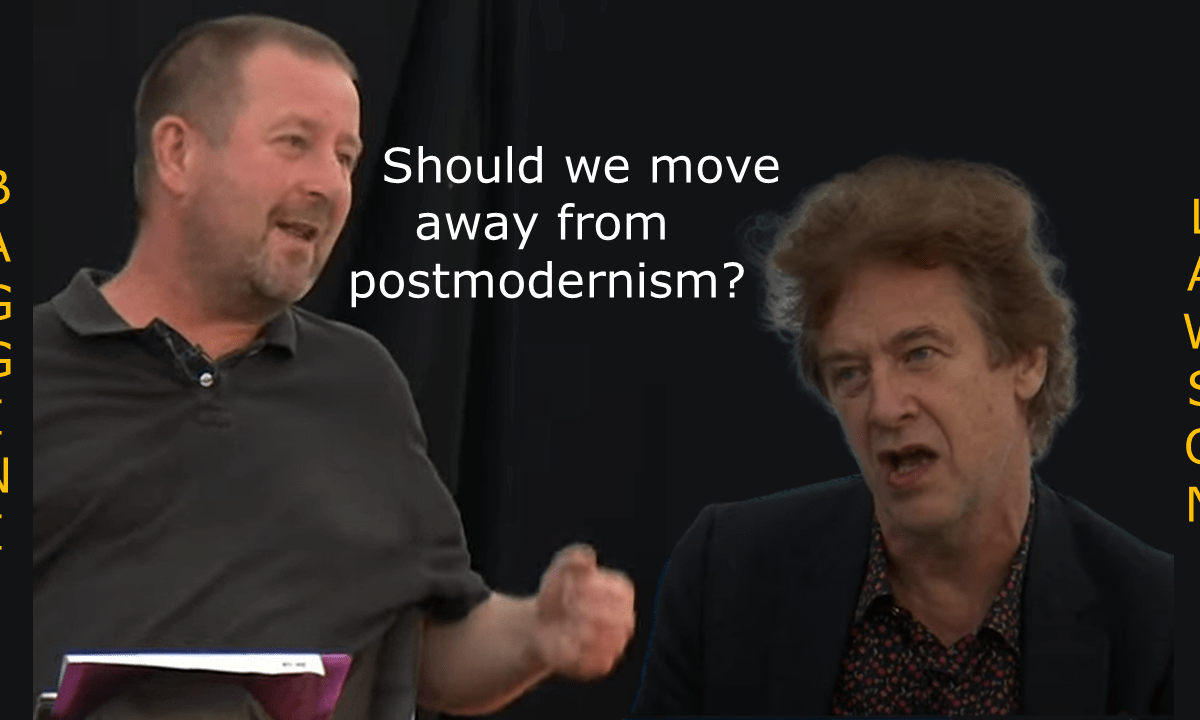
The theme of this Institute of Art and Ideas video is ‘Should we move away from postmodernism?‘
Podcast: Audio rendition of this page content
EDIT: Find my version of this content on YouTube:
Video: Postmodern Defence
At the start, I feel as usual, that the definition of postmodernism is nebulous, and the fora agree, methinks. Toward the end, Hilary Lawson concedes that key actors tied to the early postmodern movement denied being postmoderns, singling out Foucault and Derrida. More on this. Keep reading.
Julian Baggini, the bloke sat on the left and whose positions I am only getting familiar with, starts off the clip. He makes some points, some of which I agree with and others not so much.
He makes a play at claiming that there is some objective truth to be attained, following on with the statement that without this notion, it’s anything goes. I disagree with both of these assertions. Then he cites Thomas Nagel’s The View from Nowhere, wherein he posits that subjectivity and objectivity are extrema on a spectrum and that experience is somewhere in between. This conforms to my beliefs, but there are two provisos. First, the extremum of objective truth is unattainable, objectively speaking. Moreover, as I’ve written before, we have no way of adjudicating whether a given observation is truer than another. It seems that he leaves it that we don’t need to know the absolute truth to know “true enough”, but I think this is both a copout and wrong—but not too wrong for pragmatism to operate.
For example—not mentioned in the clip—, I can imagine that physicists feel that Einsteinian motion physics is truer than Newtonian physics, especially as we need to take measurements nearer to the speed of light. In my thinking, this might provide a better approximation of our notion of the world, but I can also conceive of an Ideal, non-materialistic perspective where both of these are rubbish from the perspective of truth. I feel that people tend to conflate truth with utility.
Julian makes an interesting point about semantics with the claim that “some people” define certain things in such a way as to not possibly be attainable and then claim victory. But what are his three examples? Free will, the self, and objectivity. If you’ve been following me, you’ll know that I might be in his crosshairs because I tend to be in the camp that sees these concepts as sketchy. And to be fair, his claim of defining something in a manner to keep a concept out of bounds is the other side of the same coin as defining something in such a way as to get it into bounds.
The self is different to free will insomuch as it’s a construction. As with any construction, it can exist, but it’s a fiction.
I’ve spoken at length about my position on free will, but I am fairly agnostic and don’t particularly care either way. I feel that the causa sui argument as it applies to human agency is more important in the end. The self is different to free will insomuch as it’s a construction. As with any construction, it can exist, but it’s a fiction. Without interacting with Julian or reading his published works on the self, if there are any, I don’t know how he defines it. And here we are discussing objectivity.
Given Nagel’s objective-subjective polarity, it seems they want to paint postmodernism as claiming that everything is subjective and that science (and religion) hold claims to objectivity. Hilary Lawson, the geezer on the right takes a position between extremes, but he denounces Julian’s claim about objective truth, noting that many people (especially of religious persuasions) make claims on Truth that are diametrically opposed, ostensibly labelling the same object simultaneously black and white. And the object for all intents and purposes is red.
I’ve gotten out of order, but Julie Bindel makes some good points on Feminism and suggests that the philosophical feminists—may I call them pheminists? No? OK then—such as Judith Butler have set women’s rights back by claiming that the category of ‘woman’ is invalid. Minni Salami defended Judith by noting that Butler has helped constructively in some ways and, citing Simone de Beauvoir, that woman is a category established by men to create The Other Sex. Still, Julie—not incorrectly—states that without a category, women (or whatever collective term one decides is representative) cannot be afforded legal protections—because law, as facile as it is, is all about categories and classes.
Hilary reenters the fray and states that it is not acceptable for one person to claim that their lived experience is all that is needed just because that is their truth. To be fair, this feels like a bit of a strawman argument. Perhaps I need to get out more, but I am not familiar with anyone credible making this claim.
I enjoyed watching this clip and processing the information. I hope you do as well. If you have any comments, I’d love to read them.
This is my take on the fifth chapter of The Matter with Things. I suggest reviewing the previous chapters before you delve into this one, but I won’t stop you from jumping queue.
Podcast: Audio rendition of this page content
Intro
Chapter five of The Matter with Things is titled Apprehension, following the previous chapters, Attention, Perception, and Judgment. From the start, let’s clarify that apprehension is not meant in the manner of being nervous or apprehensive. It’s meant to pair with comprehension. More on this presently.
Whilst the previous chapters have been heavily focused on the importance of the right hemisphere, this chapter is focused on the left, which may be given the chance to redeem itself. Not surprisingly perhaps, given the relative function of the right hemisphere versus the left, this chapter is much shorter than prior chapters.
Content
This chapter opens by asking what happens to a person who experiences left hemisphere damage. But let’s return to the chapter title. Apprehension is retaken etymologically and means to hold onto or to grasp. This is the function of the left hemisphere. The right hemisphere is about comprehension. The root ‘prehension’ is Latin for hold; the added ap prefix suggests holding on, whilst the com prefix suggests holding together.
Whilst conceptualising and abstract language is a right hemisphere function, spoken words are a left-brain function. It turns out that so is pointing and other gesticulation, reminding me of some ethnic stereotypes of people who speak with their hands. We need to keep in mind that the right hemisphere controls the left part of the body whilst the left hemisphere controls the right. What this means is that the right hand, being guided by the left hemisphere is marching to a different drummer.
Also, keep in mind from the previous chapters that the right hemisphere is holistic whilst the left is atomistic. Where right hemisphere damage is evident, a person has difficulty viewing the parts of a whole, whilst if the damage is on the left, a person has difficulty constructing a whole from its constituent parts. Namely, it may recognise that a body is constructed from an inventory of pieces—head and shoulders, knees, and toes—, but it can’t seem to grasp the cohesive orchestrated picture.
Apart from body continuity, when the left hemisphere is damaged, it might know all of the steps of a given process—McGilchrist shares the example of a person trying to light a smoking pipe—, but there may be difficulty in some of the instrumentation along the way. He cites an example by Czech neurologist, Arnold Pick, which I share here intact:
The patient is given a pipe and brings it correctly to his mouth, then expertly reaches for the tobacco pouch and takes a match from the box but when asked to light it, sticks the head of the match into the mouthpiece and puts the other end in his mouth as if to smoke it. Then he takes it out of his mouth, draws it out of the mouthpiece and sticks the other end of the match in the mouthpiece of the pipe, pulls it out again, holds it for a while in his hand apparently thinking, and then puts it away.
a person when encountering a pencil would feel compelled to grab it and start writing nothing in particular
To underscore the apprehension, where there is damage evident in the right hemisphere, the right hand (under control of the left hemisphere) may just grasp at things for no reason, perhaps reaching arbitrarily out to doorknobs. In one case, a person when encountering a pencil would feel compelled to grab it and start writing nothing in particular. In each case, the right hemisphere was not available to contextualise the experience. This right hemisphere is opening and exploratory whilst the left is closing and instrumental. It seems one might tend to meander without the left to provide a certain will and direction.
McGilchrist makes some correlations between humans and other great apes, but I’ll just mention this in passing.
I am going to pause to editorialise on McGilchrist’s next claim. He argues that Saussure’s claim that language signs are arbitrary is false and gives some examples—sun, bread, and spaghetti—but I am not ready to accept this stance. For now, I am remaining in the camp with Saussure and Wittgenstein that language is both arbitrary and self-referential. Getting down off my soapbox.
Recall again that whilst the right hemisphere takes the world as presented, the left hemisphere can only re-present. This is why language symbols are handled by the left hemisphere. Coming back to Saussure, the right-brain experiences a ‘cat’ whilst the left-brain names that object a ‘cat’ and classifies it as a mammal, feline, quadruped, and whatever else.
The right hemisphere is about metaphor, prosody, and pragmatics whilst the left hemisphere, though not exclusively, is about syntax and semantics.
The right hemisphere is about metaphor, prosody, and pragmatics whilst the left hemisphere, though not exclusively, is about syntax and semantics. The left hemisphere is about symbols. As such, lipreading and interpreting sign language are both left-brain activities.
An interesting conveyance is a case study of a person with left hemisphere damage reading a book who recites the elephant in place of the written word India, so making an association by not recognising the word itself. And there may be a naming problem, so if there was a problem related to an ankle, they would point to an ankle but substitute the name of the part.
Finally, to reiterate the holistic versus atomistic divide, some people with left hemisphere damage can articulate the parts of the body or a bicycle, but when queried can’t relate that the mouth is beneath the nose or some such.
Perspective
To summarise, McGilchrist leaves with a comment, “The fabric of reality typically goes for the most part unaltered when the left hemisphere is suppressed.”
As I’ve been editorialising a bit throughout, I don’t have much to add at this point. Aside from my Saussure nit, I am still very interested in the concept that the right hemisphere constructs reality. I feel that I interpret this construction differently to Iain.
I believe that we agree that there is a world out there, and we interpret this world by interacting with it. Where I feel we differ is that he feels there is a world of objects that we interact with and perceive whilst I believe that we construct this world of objects by means of constructing the underlying material, from particles to fields. I think he’ll discuss this more in later chapters and I could be off base. Time will tell.
Having put Apprehension to bed, next up is a chapter on Emotional Support and Intelligence. I hope you’ll join me.
What are your thoughts? What did you think of this chapter? Were there any surprises? Anything of particular interest?
In this segment, I continue the journey through Iain McGilchrist’s masterwork, The Matter with Things by summarising chapter three, Perception, a followup to the previous chapters, respectively titled Some Preliminaries and Attention. I strongly recommend that you listen to these in turn, but feel free to play the rebel and cut queue. No one will even notice but you, and if you don’t tell, neither shall I. Come join me.
Podcast: Audio rendition of this page content
Intro
Chapter two of The Matter with Things is titled Perception. Following the previous chapter, Attention, it’s about how we perceive what we attend to. Without attention, there is no perception, but perception is not always correspondent with the so-called reality “out there”.
Content
From the start, McGilchrist wants to assess which hemisphere is more veridical. Spoiler Alert: It’s the right half. But you already knew that because you’ve been keeping pace. And you also know that I feel he is leaving an option on the table, that neither is veridical to the actual terrain; rather, one just better maps the map. But the question essentially resolves to the same place, not as much verity as trust.
Sensory perception occurs in both hemispheres, but it is better in the right hemisphere than the left, as the left has been somewhat relegated to re-presentation over time—the same hemisphere that is better suited for codifying and mapping using symbolic language—something reserved for the brains of primates—which gives us a virtually inexhaustible way of mapping the world.
Perception is holistic, something better handled by the right hemisphere, being as the left hemisphere is more about focus and specificity. On balance, the right hemisphere is the arbiter of performance delegation, whether to perform a task or delegate it to the left hemisphere. About three-quarters of perception functions are right hemisphere processes.
McGilchrist is partial to the position advanced by Merleau-Ponty, that is “perception as a reciprocal encounter.” Perception is not a passive act. It is an interactive intercourse with the environment. What and how we perceive is affected by our experience and the situation.
Visual Perception
Perception involves all the available senses—and by definition none of those otherwise unavailable. He starts with vision. The right hemisphere does a lot of heavy lifting here. It handles size, shape and pattern recognition, contour, shadows, distance and depth, for example, three-dimensional space, and motion and time as well as the ability to recognise objects from unusual angles or from incomplete information, which I tend to think of as playing some Gestalt role. The right also handles colour perception, though the left maintains the colour name mapping.
The left hemisphere is slightly faster at detection, but if what is detected has any signal degradation, the right hemisphere tends to be more accurate. And since the left hemisphere is, what I’ll call lazy, it may tire quickly and space out, so the right hemisphere may have to intervene, if even a bit more slowly. Paradoxically, if the left hemisphere is given more time, its recognition error rate increases. Incidentally, one reason the right hemisphere may respond more slowly is that it is deliberating to attempt to deliver the correct response whilst the left tosses out its first best guess and declares victory. Nailed it!
Nailed It!
Recall from the last chapter that the left hemisphere is also a master of denial, so it is unapologetic when it guesses wrong. I imagine it signalling ‘that’s not a bus’ just as it hits you and then insists that it never was a bus; that injury must have been caused by something else. Perhaps it was an untoward wrecking ball.
Without delving into details here, McGilchrist points out that much early research might be invalid because it employed cathode ray tubes—CRTs—whose mechanisms present biased information to the visual field, thereby invalidating conclusions.
the left hemisphere is better at recognising tools—hammers and spanners—, but not musical instruments, which it perceives more as living entities
An interesting area for me is that the left hemisphere is better at recognising tools—hammers and spanners—, but not musical instruments, which it perceives more as living entities. And this is an apt segue to auditory perception.
Auditory Perception.
Whereas the left hemisphere is better at symbolic language processing and “the processing of meaningless noises, such as clicks”, the right hemisphere pretty much handles the rest, from pitch, inflexion, tone, phrasing, metre and complex rhythm, and melody. The left keeps tabs on basic rhythmic patterns. It is assumed that rhyming relies on both hemispheres working in concert.
For most people, music processing is a right hemisphere event, but this is not true for professional musicians, who utilise both hemispheres, likely owing to the musical language translation processing unnecessary for the casual listener.
Olfactory Perception
Interestingly, the acuity of the nose is orders of magnitude superior to that of the eyes and ears. Olfactory recognition and discrimination have a right hemisphere preference, but emotional reactions to scent may be stronger in the left hemisphere.
Gustatory Perception
“Apart from five very basic tastes – salt, sweet, sour, bitter and umami – which come from the tongue, all flavours come from the olfactory sense.” In general, gustatory perception is a right hemisphere function. However, there is an exception for professional wine tasters, who like professional musicians need to map experiences to words associated to rating and naming.
Tactile Perception
Remembering that the right hemisphere controls the left half of the body, whilst the left hemisphere controls the right, the sense of touch is superior in the left hand. Feelings of warmth, and temperature discriminations in general, are associated with right hemisphere activation. Interoception, the ability to perceive the internal workings of the body, is another right hemisphere process.
Local versus Global Perception
Recall that the right hemisphere captures the world holistically whilst the left hemisphere has a laser focus. This equates respectively to global and local perception. As it happens, the right can do both, but the left is limited to local. This means that if the left hemisphere is damaged, the right can pick up the slack, but if the right hemisphere is damaged, the left cannot compensate for the lost holistic perspective. In practice, the right runs the show and delegates to the left when it deems it to be appropriate for the circumstance. For some reason, normal adolescents have a bias toward local perception over global.
Pathologies of Perception
This leads us to abnormalities, such as Alzheimer’s disease. Deterioration of right hemisphere function leads to a sense of disorganisation and loss of sensation. This hemisphere is also responsible for constructing a sense of self and self-awareness. McGilchrist calls out that the term self has multiple meanings. Much of the notion of self is associated with the medial prefrontal cortex in both hemispheres, but the objectified self and the self as an expression of will (in the respect Schopenhauer spoke of) are left brain aspects.
Perception of a contiguous self over time is a right hemisphere function, the loss of which is not uncommon in cases of schizophrenia.
In discussing visual hallucinations and distortions, almost ninety per cent of these have been attributable to right hemisphere anomalies. McGilchrist shares examples over several pages, but I’ll summarise by description alone of what can be categorised under the umbrella term of metamorphopsia. These might lead to object impermanence, or viewing things as too large or too small, too close or too distant, skewed, or the wrong shape altogether. In some cases, only half of an object, including self-perception, was outsized. This might occur on a macro level or a micro level, which is to say that it may be entire objects or bodies or just faces, or just familiar faces or just eyes or just one eye. This might occur on a macro level or a micro level, which is to say that it may be entire objects or bodies or just faces, or just familiar faces or just eyes or just one eye.
Some of these cases involved motion, for example, the sense that some object is receding away from the observer as the observer draws nearer to it.
After a journey through Charles Dodgson, AKA Lewis Carroll, and Alice in Wonderland, provides a plethora of examples in prose of some of these visual effects.
From visual hallucinations, we wonder through hallucinations of the other senses, though the data points on these are much sparser, but the left hemisphere does seem to be the culprit of most auditory hallucinations.
Perspective
To summarise, I am again left to feel that the left hemisphere is a deadbeat hanger-on. It’s there in a pinch, but it’s an unreliable narrator and worker that falls asleep at the wheel. Psychology does have a position on what a normal person should see and hear and taste and touch, but normal doesn’t mean real.
I was hoping to see some information and perspective on synaesthesia, a condition where people perceive experiences through sense-perception organs different to normal. These people see music and hear smells or taste colours and so on. We consider this to be anomalous, but does it provide a fitness benefit, and are these people ahead of “normal” people or are they carrying excess baggage that creates a burden, even if the condition is otherwise benign.
Now that we’ve covered attention and perception, we’ll be covering judgment in the next chapter. I hope you’ll join me.
What are your thoughts? What did you think of this chapter? Have you experienced or know of anyone who has experienced any of these so-called anomalies. Are you familiar with any of the effects mentioned in Alice in Wonderland? Leave comments below.
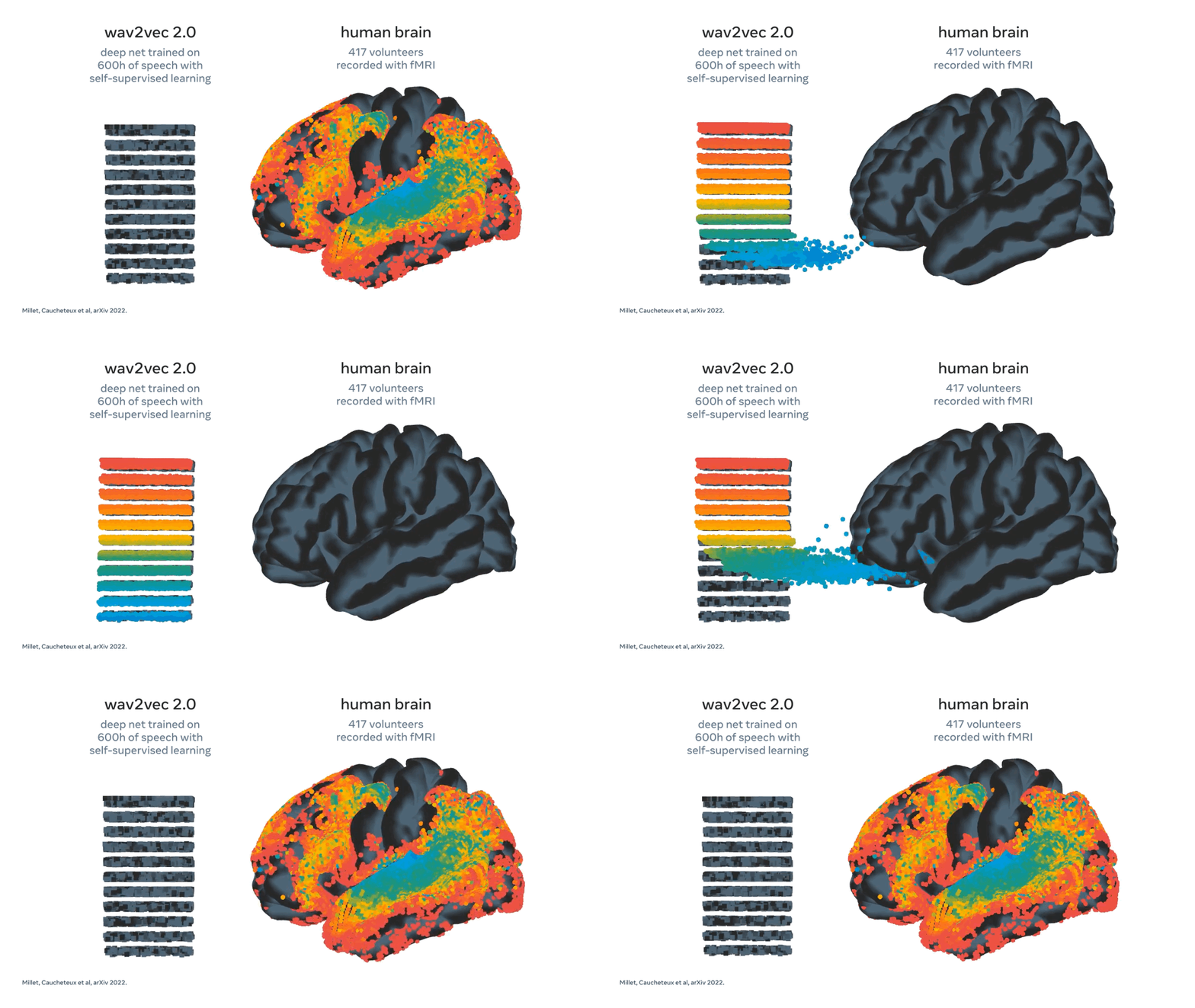
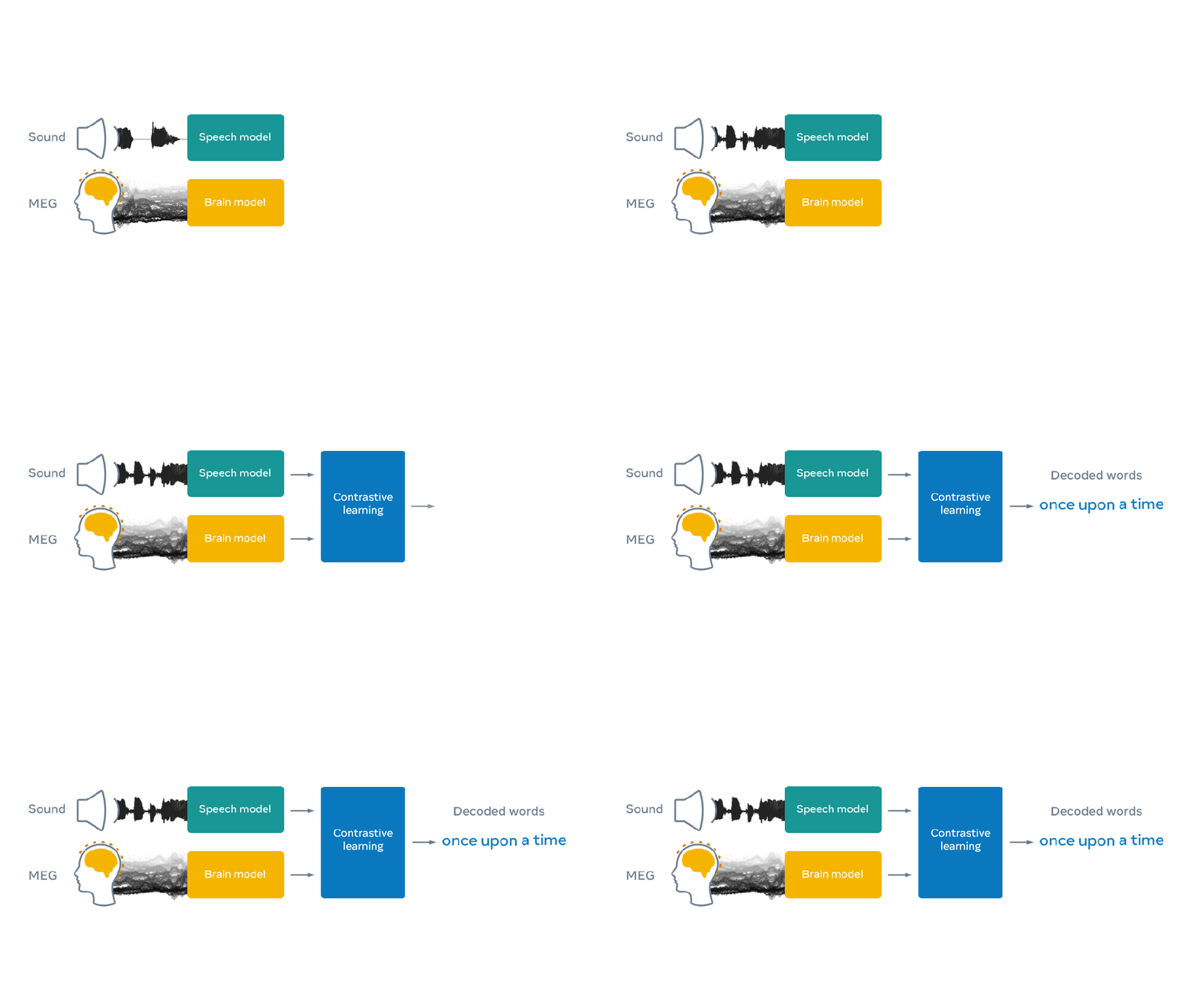
Apologies in advance for sharing PR hype from Meta (formerly known as Facebook),but I want to comment on the essence of the idea, which is using AI to decode speech from brain activity. It seems to imply that one would apply supervised machine learning to train a system to map speech to brain activity as illustrated by the image below.
Podcast: Audio rendition of this page contentTo decode speech from noninvasive brain signals, we train a model with contrastive learning to align speech and its corresponding brain activity
The dataset would require the captured patterns of a large enough sample size. In this case, it appears to have been some 417 volunteers.
Activations of wav2vec 2.0 (left) map onto the brain (right) in response to the same speech sounds. The representations of the first layers of this algorithm (cool colours) map onto the early auditory cortex, whereas the deepest layers map onto high-level brain regions (e.g. prefrontal and parietal cortex).
This feels like it could have many commercial, consumer, and industrial uses including removing other human-computer interface devices, notably keyboards, but perhaps even mouses. Yes, I said mouses. Sue me.
Given hypotheses related to language and cognition, I am wondering what can be gleaned by mapping different multiple native language speakers to cognitive processes in order to remap them to speech output if it would be able to arrive at some common grammar that could then output a given thought stream into any known (and mapped) language, allowing for instantaneous “translation”.
Of course, a longer-term goal would be to skip the external devices and interface brain to brain. This sounds rogue science fiction scary, as one might imagine an external device trained on a brain to read its contents. One of the last things this world needs is to have to worry about neuro-rights and about being monitored for thought crimes. Come to think of it, isn’t there already a book on this? Nevermind. Probably not.
Technology is generally not inherently harmful or helpful, as that is determined by use. Humans do seem to tend toward the nefarious. Where do you think this will go? Leave a comment.
As a Social Justice Warrior, I tend to favour diversity and inclusion as a principle. As such, I follow some people who share this interest. In fact, most of these people expend much more energy toward this end than I do. The challenge I am about to convey is that some people don’t read beyond the subject line, and don’t even attempt to assess the underlying claim, let alone the issue at hand.
I recently engaged in a nonsensical interaction that I am sharing and dissecting. It started with this share, an image of the border outline of Nigeria with an overlay caption that reads: “Nigeria becomes the first country to ban white and British models in all advertising”.
I’d like to point out two items in particular. Firstly, the caption is fabricated. I’ll get to the source reference presently. Secondly, the re-poster aptly corrects the caption when he shared it—”Well, all foreign models, but HELL YEAH!”
Nigeria recently passes a law that essentially assesses a tariff or levy on advertising content using non-Nigerian talent. There is no mention of ‘white’ models, though British models would fall under this umbrella. This protectionist law stems from nationalism. I’d guess that ‘white’ people comprise less than one per cent of the Nigerian national population, but I could be wrong. This is well outside my area of expertise.
My response was to say “Down with Nationalism and the Promotion of Otherism.” I may be misinterpreting myself, but it feels to me that this is denouncing racism and other forms of otherness.
Sabrina responds, ‘Why is not having white models in advertising a bad thing?” and “Isn’t the whole point of advertising [for] people to…see themselves… ?” In response, I should have pointed out that the initiative had nothing to do with skin colour. Instead, I responded to the second question: the point of advertising is to sell product. Full stop. If people see themselves with the product, then great. Clearly, this comprises a fraction of successful adverts. More common is to make a connection to what they aspire to. It’s not about making a social statement—unless, of course, that social statement will sell more product. If an ad with a white model will sell more product, a business would be derelict not to employ one; conversely, if white models result in lower sales, a business would be foolish not to switch to the more successful vector.
Sabrina really goes off the reservation with her reply, somehow conflating Nigeria with the African continent. Attention to detail is not her forte.
At this point, I feed into her laziness and send her a link to an Al-Jazeera article addressing the law.
She leaves with a parting shot, and I quote: “Have you ever thought about the harm you might cause by playing devil’s advocate and “creating an argument”?”
She’s off course and then attempts to diminish my point by calling it ‘playing devil’s advocate’ rather than admitting that she hadn’t even considered the rationale and possible ramifications. She didn’t even grasp the main point, so I suppose I should forgive her for not noticing secondary and edge cases.
At this point, Dr Perkins adds her voice. Her initial question is valid, and as I responded, the answer is “No”. The race card was introduced by some narrator who didn’t know what game he was broadcasting. But then she goes on to “applaud Nigeria for making a [decision] centering [on] Blackness”, save to say that was not what prompted the decision.
Notice, too, that other people “Liked” the other comments, a testament to the principle of least effort of the bystanders, too.
I recognise that the original post anchored the conversation off the actual topic, but it was also very easy to track down the reference and note the content discrepancy. Granted, this takes time and effort, but so does responding on a thread and then escalating commitment to a non-cause. And for one tilting at windmills to be tossing around accusations of playing devil’s advocate. It’s not a good sign.
But wait, there’s more. I commented on this post on a second thread.
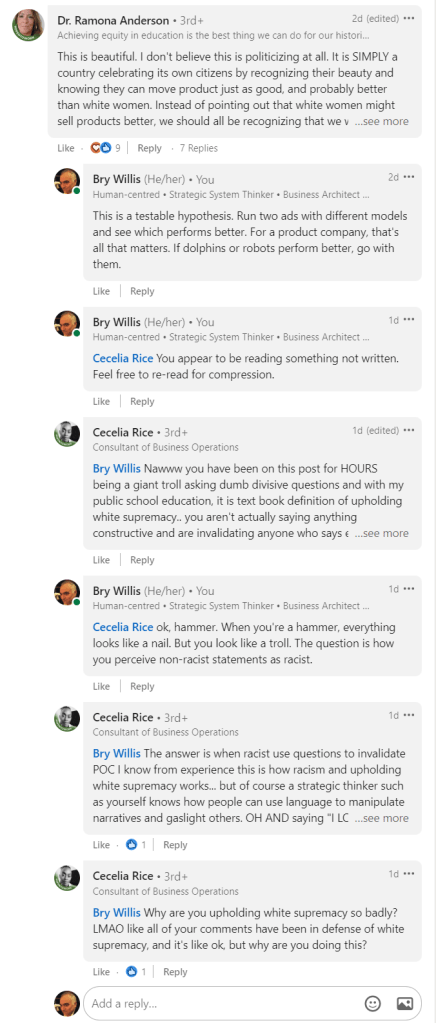
In this case, Dr Anderson suggests that this is just “a country celebrating its own citizens by recognizing their beauty and knowing they can move product just as good, and probably better than white women, to which I responded that this is a testable hypothesis. It’s either true that on balance white models sell more product or black models do. Again, don’t fail to miss the point that none of this is about white versus black models.
Somehow, LinkedIn can’t seem to keep their threads in order, but Ms Rice takes my hypothesis testing point as a support for racism before precipitating to full-on troll mode.
It scares me to see that there are two academic doctors participating in this thread, neither with a trait of attention to detail nor even a fundamental pursuit of evidence.
This is why it is difficult to engage with social media. You have no idea what level a commenter is coming in on. And even when spoon-fed information, they refuse to alter their position. In fact, they tend to double down on their wrongness. Moving on…
I decided to try my hand at reading. I came upon Peter Zapffe when I was reading The Conspiracy against the Human Race, and The Last Messiah is a relatively short essay. It’s under 25 minutes.
My first goal was to figure out how to pronounce Zapffe. As it happens, the terminal E is pronounced as a schwa. And that makes sense. My heritage, as it were, is Norwegian. My grandad was born in Norway, emigrating during the so-called World War 2. His family surname is Gade, with the E pronounced the same way, so the name is pronounced as /gäʹdə/, but Anglicised, it the A becomes a long vowel owing to the silent E, so it becomes /geɪd/.
What was new to me is that in Norwegian, Peter is pronounced /pɛt ə/ [as if spelt Petta] rather than /ˈpiːtɚ/ or perhaps /ˈpiːtɹ/ in some American renditions more familiar to English readers.
I love the panels, interviews, and insights presented on The Institute of Art and Ideas channels. In this segment, I am familiar with the host, Robert Lawrence Kuhn, who has put this all together, and two of the panellists, Iain McGilchrist and Donald Hoffman. I am not familiar with Eva Jablonka or Michelle Montague. This is an interesting conversation on consciousness, but I am commenting on McGilchrist’s position on love and how science can never capture the essence or dimensions of it because it is subjective and experiential. I’ve cued the video clip below to just prior to his response to provide he view with a set up.
As I’ve been saying for some decades now, I believe that love is a weasel word in the realm of justice and freedom. It’s an archetypal extreme, but it doesn’t mean anything more than trebled or analogical references.
McGilchrist resorts to the age-old, you don’t know it if you haven’t experienced it. This was famously captured by the US Supreme court’s take on pornography, “I can’t tell you what it is, but I know it when I see it.” This is used with God and faith as well. So, bollox, really. They’ve got nothing. And if you haven’t experienced it, then you aren’t a member of the club, and it’s your loss. Rubbish.
From the transcript, Iain tells the viewer (edited below for clarity),
“Love is a very real experience. and you only know it when you’ve had it. But it’s something that science can only refer to physical correlates of—rather ineffectively… But it’s not the same as knowing what love actually is.
“And the same is true of consciousness. It’s a subjective phenomenon, and as such, it’s not open to the kind of science that that i think is being required.”
Notice that this is the same defence asserted by religions. If you are seeking evidence, you are barking up the wrong tree. The evidence is that you can experience it, but this is not a shared experience. The shared experience occurs when people who feel they have had a similar experience can gather together and compare notes and share stories like they were participating in a 12-Steps program. Hullo, my name is Bukowski, and I’m an alcoholic.
Love is a delusion. Consider the notion of romantic love —just one of several purported flavours of love. What do we mean by this? We mean that we are very attracted to and emotionally attached to some other entity. Let’s limit this to other people. We care for this person and about what happens to this person, and we’d presumably like to remain a partner with this person. Generally, there would also be a sense that the other party reciprocates this feeling, but unrequited love is another aspect.
Given this state, we can measure hormonal changes, pupil dilation, and other physiological changes. And if we want to label this state love, then great. In practice, that’s what we’ve done. But so what? All we’ve really done is to take a bundle of descriptions and collated them into a nebulous term.
There are a couple of perspectives on this type of love. There is the person who senses their own feelings about their experience of love, as in “I love X”. Then there is a target of this love who may experience that they are loved by someone. Finally, there is the observer that might assess that Y loves X and or vice versa.
But what does this really mean? Is it just that Y like X very very much and has painted a picture of a future than includes this person? That Y has constructed some narrative storyline that includes X? That there is likely some lust involved in this particular flavour of love? Is love more than this? Is love more than just a shortcut? Is it just an acronym for “Likes Other Very Extremely”? Alright, I’ll stay out of the acronym construction business and end this just now.
A short podcast on the reason Postmodernism is rubbish.
Video: YouTube (added 2/9/2022)
Postmodernism is rubbish. It makes no sense, and here’s why.
The term ‘modern’ is analogous to the term ‘now’. It is a time reference that privileges the moment. With time, we have a structure of yesterday, today, and tomorrow. Now fits into a structure of before, now, and later.
Conversely, where ‘modern’ means now, postmodern would mean ‘later’, it makes no sense to label an ongoing pursuit postmodern, anymore than tomorrow can run contemporaneously with today.
Just labelling something as modern is pretentious enough. It’s similar to labels such as New Wave or New Age. It’s just trying to privilege a movement by branding it new.
So, if Modern was the new kid on the block, how might postmodern operate.
Another problem with the term postmodern is that most people considered postmodern, did not consider themselves to be postmodern. In fact, many vehemently disagreed.
A reason for this disagreement, is that the term is not owned by the purported Postmoderns. Rather, it’s a disparaging slur by so-called and improperly named Moderns.
Apart from the nomenclature challenge, postmodern is a reaction to the promise of modernity, but the reactions differ by discipline. Postmodern art and architecture are different to postmodern literature, which is different to postmodern philosophy.
And since postmodernism is rather a disparaging catchall, those with ideas not conformant to mainstream doctrine get tossed into the bin. This means that any number of feminists and post-colonialists are thrown onto the postmodernist pyre.
Here’s some food for thought. I argue that postmodernism cannot have a privileged perspective, because it claims that there is no such perspective available. If a feminist or a post-colonialist is saying anything, they are pointing out, that one needs to look through their lens too. By and large, they are not claiming that it is the lens of lenses.
In essence, if the modern lens is red, they might recommend viewing the same events through a blue lens or from a different angle. Walk a mile in another’s shoes. This shift in perspective can make all the difference.
The difference between a modern and the bolloxed-up postmodern is that the Modern thinks either that they have the only lens, or in any case, they have the right one. Moderns tend to be absolutists and universalists, so subjectivists and relativists rather rub them the wrong way.
The final thing I’d like to say about postmodernism is the notion of Deconstruction as made famous by one Jacques Derrida and misunderstood and misapplied by millions since. I’ll spare you the instruction, but I like to capture the sentiment of the way it is misunderstood by suggesting my own term, Disintegration. Perhaps, I’ll share more on Disintegrationism™ in future. Meantime, it’s just the process of breaking systems down to their core elements to inspect the working parts. Disintegrationism notes that these pieces can be re-integrated into new systems, but it makes no claim that one is better than another because that can only be determined by purpose. Another thing Moderns tend to ‘know’, is what the purpose is. Conditionally, if I know what the purpose is, I can claim to know, by extension, what the best system is.
Abraham Maslow gave us the law of the instrument, popularly conveyed as the aphorism, if you’re a hammer, everything looks like a nail. Moderns are hammers and insist that every solution can be solved as if it were a nail. Only, everything is not a nail. The postmodern reminds us that hammers don’t make the best knives or screwdrivers or spanners.
What are your thoughts on postmoderns and postmodernism? What about moderns? Is there a term you feel might better capture the essence of these two schools?
Here’s an audio version of my review of Deborah Bennett’s Logic Made Easy.
tl;dr If you’ve had some exposure to formal logic, this may be just the fresher you need. If you are not already familiar with the basics, I suggest you commence elsewhere,







 Philosophics