We’ve entered an era where machines tell us how we’re doing, whether it’s an AI app rating our résumé, a model reviewing our fiction, or an algorithm nudging our attention with like-shaped carrots.
Recently, I ran a brutally raw scene through a few AI platforms. The kind of scene that’s meant to unsettle, not entertain. One of them responded with effusive praise: “Devastating, but masterfully executed.”
Was it honest?
Was it useful?
Or was it merely reflecting my own aesthetic back at me, polished by a thousand reinforcement-learning smiles?
This is the ethical dilemma: If feedback is always flattering, what good is it? If criticism is only tolerated when couched in praise, how do we grow? And when machine feedback mimics the politeness of a mid-level manager with performance anxiety, we risk confusing validation with truth.
There’s a difference between signal and applause. Between understanding and affirmation.
The danger isn’t that AI flatters us. The danger is that we start to believe it and forget that art, inquiry, and ethics thrive on friction.
“Man is least himself when he talks in his own person. Give him a mask, and he will tell you the truth.” — Oscar Wilde
Identity is an illusion—but a necessary one. It’s a shortcut. A heuristic, evolved not for truth but for coherence. We reduce ourselves and others to fixed traits to preserve continuity—psychological, social, narrative.
Audio: NotebookLM podcast on this topic. (Spotify)
But what if continuity is a lie?
In the latest post on RidleyPark.blog, we meet Sarah—a woman who survives by splintering. She has three names, three selves, three economies of interaction. Each persona—Sarah, Stacey, and Pink—fulfils a role. Each protects her in a system that punishes complexity.
And yet, this isn’t fiction. It’s reality intensified.
Identity Is Compression
Cognitive science suggests that we don’t possess a self—we perform one. Our so-called identity is assembled post-hoc from memory, context, and social cues. It’s recursive. It’s inferred.
We are not indivisible atoms of identity. We are bundled routines, personae adapted to setting and audience.
This is not pathology. It’s strategy.
From Performance to Survival
In Needle’s Edge, Sarah doesn’t use aliases to deceive. She uses them to survive contradictions:
Stacey is desirable, stable, and profitable—so long as she appears clean and composed.
Pink is a consumer, invisible, stripped of glamour but allowed access to the block.
Sarah is the residue, the name used by those who once knew her—or still believe they do.
Each persona comes with scripts, limitations, and permissions. Sarah isn’t being dishonest. She’s practicing domain-specific identity. This is no different from how professionals code-switch at work, or how people self-edit on social media.
It’s just more raw. More urgent. Less optional.
The Literary Echo
In character development, we often demand “depth,” by which we mean contradiction. We want to see a character laugh and break. Love and lie. But Sarah shows us that contradiction isn’t depth—it’s baseline reality. Any singular identity would be a narrative failure.
Characters like Sarah expose the poverty of reduction. They resist archetype. They remind us that fiction succeeds when it reflects the multiple, the shifting, the incompatible—which is to say, the real.
What Else Might We Say?
That authenticity is a myth: “Just be yourself” presumes you know which self to be.
That moral judgment often stems from a failure to see multiple selves in others.
That trauma survivors often fracture not because they’re broken, but because fracturing is adaptive.
That in a capitalist framework, the ability to fragment and role-play becomes a survival advantage.
That fiction is one of the few spaces where we can explore multiple selves without collapse.
The Missing Link
For a concrete, narrative reflection of these ideas, this post on RidleyPark.blog explores how one woman carries three selves to survive three worlds—and what it costs her.
In the great American theatre of liberty, there’s one character whose neuroses we all must cater to: the police officer. Not the civil servant. Not the trained professional. No, the trembling bundle of nerves with a badge and a gun. According to the United States Supreme Court, this anxious figure is so vulnerable that the Constitution itself must bend to accommodate his fear. I’m not sure I have less respect for these people than for most other professions.
Audio: NotebookLM podcast on this topic.
Let’s review.
In Pennsylvania v. Mimms (1977), the Court held that police can order a driver out of their vehicle during any lawful traffic stop—no suspicion, no cause, just vibes. Why? Because the officer might get nervous otherwise.
Fast-forward to Maryland v. Wilson (1997), and that same logic is extended to passengers. That’s right: even if you’re just catching a ride, you too can be ordered out and subject to scrutiny because, well, a cop might be spooked.
This isn’t law enforcement. It’s emotional support with a firearm.
The rationale? “Officer safety.” A phrase so overused it may as well be stamped on every judge’s gavel and stitched into every uniform. Forget that you’re a citizen with rights; forget that the Fourth Amendment was intended to restrain arbitrary power. If your mere presence makes Officer Skittish feel a bit antsy, the law now permits him to act like he’s clearing a war zone.
It’s worth asking – gently, of course, so as not to alarm anyone in uniform – why exactly we entrust our most coercive state powers to individuals apparently one errant movement away from fight-or-flight mode?
Rather than raising the bar for police conduct, these rulings lower the bar for constitutional protections. Rather than requiring police to be calm, competent, and capable under pressure, the Court concedes that they’re none of those things and therefore need extra authority to compensate.
We’ve effectively legalised cowardice.
So here’s a radical suggestion: What if “officer safety” wasn’t a get-out-of-liberty-free card? What if we demanded emotional resilience and psychological stability before issuing guns and power? What if, instead of warping the law around the most paranoid members of the force, we removed them from the force?
But no. Instead, we get jurisprudence that treats every routine traffic stop like a potential ambush. And to ensure our jittery guardian gets home safe, you, dear citizen, will be the one legally disarmed.
So buckle up – because your rights don’t mean much when the man with the badge is afraid of his own shadow.
A Love Letter to Inertia, Spite, and Self-Sabotage
Dostoevsky’s Notes from Underground is less a novel and more a spiritual colonoscopy — invasive, squirm-inducing, and uncomfortably revealing. The narrator? A prickly, obsessive proto-incel with a superiority complex and the emotional range of a trapped mole. But good god, he’s brilliant.
Audio: NotebookLM podcast on this topic.
The first half is all grandiose spleen-venting — a scorched-earth takedown of reason, utopia, and the basic idea that people want what’s good for them. The second half, though, is where the magic happens: watch a man humiliate himself in real time and then monologue about it like it’s a TED Talk. By the time he’s insulting Liza while simultaneously begging her to save him, you don’t know whether to laugh, cry, or throw the book across the room. I did all three.
If you’ve read Tolstoy’s The Death of Ivan Ilych, you’ll see the contrast. Tolstoy’s man realises too late that his “good life” was a sham; Dostoevsky’s never even gets that far. He knows from the start, and that’s the tragedy. The one dies of repression; the other lives by gnawing on his own leg.
(Spoiler Alert: He dies at the end. But so do you.)
Let’s get this out of the way: yes, Ivan dies at the end. It’s right there in the title, you absolute muppet. But what Tolstoy does in this slim volume – more novelette than novella, really – is turn the slow demise of a terminal bore into a scathing indictment of bourgeois mediocrity.
Audio: NotebookLM podcast on this topic.
Set in the 1880s, but eerily modern in its spiritual bankruptcy, this is less a period piece and more a mirror held up to our Ikea-staged lives. Ivan Ilych is, in short, that guy. You’ve met him. You’ve worked with him. He follows the rules, gets the job, buys the drapes, marries the woman, and climbs the career ladder with the zeal of a drowning man clambering up a waterfall. And for what? A living room indistinguishable from the next man’s. A life that “resembles others like itself” to such an extent that it may as well have been copy-pasted from a Pottery Barn catalogue.
I’ve only read Anna Karenina prior to this, and no, I’ve not tackled War and Peace because I have things to do and a lifespan to manage. I prefer Dostoyevsky‘s psychological probing to Tolstoy’s social panoramas, but Ivan Ilych pleasantly surprised me. It’s Dostoyevskian in its internal torment, and compact enough not to require a support group.
The genius here is not the plot – man gets ill, man dies – but the emotional autopsy performed in slow motion. Ivan’s illness is banal, his symptoms vague, but the existential unravelling is exquisite. He is confronted not just by mortality but by the crushing realisation that his entire life was a lie curated for public consumption. If Instagram had existed in imperial Russia, Ivan would have filtered the hell out of his parlour furniture.
And yet, at the very end, there’s a kind of grace. Having failed at life, Ivan, miraculously, succeeds at dying. Not in the tragic-heroic sense. But in accepting the abyss, he transcends it. Or at least stops flinching.
If you’ve ever wondered what your carefully curated CV and your “neutral-tone” home decor will mean on your deathbed, this book is your answer: absolutely nothing. Read it and despair – or better yet, read it and reconsider.
Some apps boldly claim to enable lip syncing – to render speech from mouth movements. I’ve tried a few. None delivered. Not even close.
To conserve bandwidth (and sanity), I’ve rendered animated GIFs rather than MP4s. You’ll see photorealistic humans, animated characters, cartoonish figures – and, for reasons only the algorithm understands, a giant goat. All showcase mouth movements that approximate the utterance of phonemes and morphemes. Approximate is doing heavy lifting here.
Firstly, these mouths move, but they say nothing. I’ve seen plenty of YouTube channels that manage to dub convincing dialogue into celebrity clips. That’s a talent I clearly lack – or perhaps it’s sorcery.
Secondly, language ambiguity. I reflexively assume these AI-generated people are speaking English. It’s my first language. But perhaps, given their uncanny muttering, they’re speaking yours. Or none at all. Do AI models trained predominantly on English-speaking datasets default to English mouth movements? Or is this just my bias grafting familiar speech patterns onto noise?
Thirdly, don’t judge my renders. I’ve been informed I may have a “type.” Lies and slander. The goat was the AI’s idea, I assure you.
What emerges from this exercise isn’t lip syncing. It’s lip-faking. The illusion of speech, minus meaning, which, if we’re honest, is rather fitting for much of what generative AI produces.
EDIT: I hadn’t noticed the five fingers (plus a thumb) on the cover image.
I promise that this will not become a hub for generative AI. Rather than return to editing, I wanted to test more of Midjourney’s boundaries.
It turns out that Midjourney is selective about the nudity it renders. I was denied a render because of cleavage, but full-on topless – no problem.
Both of these videos originate from the same source image, but they take different paths. There is no accompanying video content. The setup features three women in the frame with a mechanical arm. I didn’t prompt for it. I’m not even sure of its intent. It’s just there, shadowing the women nearest to it. I don’t recall prompting for the oversized redhead in the foreground, though I may have.
In both images, note the aliasing of the tattoos on the blonde, especially on her back. Also, notice that her right arm seems shorter than it should. Her movements are jerky, as if rendered in a video game. I’m not sure what ritual the two background characters are performing, but notice in each case the prepetition. This seems to be a general feature of generative AI. It gets itself in loops, almost autistic.
Notice a few things about the top render.
Video: Midjourney render of 3 females and a mechanical arm engaging in a ritual. (9 seconds)
The first video may represent an interrogation. The blonde woman on the left appears to be a bit disoriented, but she is visually tracking the woman on the right. She seems to be saying something. Notice when the woman on the right stands. Her right foot lands unnaturally. She rather glitches.
The camera’s push and pull, and then push, seems to be an odd directorial choice, but who am I to say?
Video: Midjourney render of 3 females and a mechanical arm engaging in a ritual. (12 seconds)
The second video may represent taunting. The woman on the left still appears to be a bit disoriented, but she checks the redhead in the foreground with a glance. Notice the rocking of the two background characters, as well as the mech arm, which sways in sync with the woman on the right. This is a repetition glitch I mentioned above.
Here, the camera seems to have a syncopated relationship with the characters’ sway.
Summary
The stationary objects are well-rendered and persistent.
Assignment
Draft a short story or flash fiction using this as an inspirational prompt. I’m trying to imagine the interactions.
The ginger seems catatonic or drugged. Is she a CIS-female? What’s with her getup?
The blonde seems only slightly less out of it. Did she arrive this way? Did they dress her? Why does she appear to still have a weapon on her back? Is it a weapon or a fetter? Why is she dressed like that? Is she a gladiatrix readying for a contest? Perhaps she’s in training. What is she saying? Who is she talking to? What is her relationship to the redhead? Are they friends or foes – or just caught up in the same web?
What is the woman wearing the helmet doing? She appears to have the upper hand. Is she a cyborg, or is she just wearing fancy boots? What’s with her outfit? What’s with her Tycho Brahe prosthetic nose piece?
What is that mechanical hand? Is it a guard? A restraint? Is it hypnotising the ginger? Both of them? Is it conducting music that’s not audible?
What’s it read on the back wall? The two clips don’t share the same text. Call the continuity people.
Yesterday, I wrote about “ugly women.” Today, I pivot — or perhaps descend — into what Midjourney deems typical. Make of that what you will.
This blog typically focuses on language, philosophy, and the gradual erosion of culture under the boot heel of capitalism. But today: generative eye candy. Still subtextual, mind you. This post features AI-generated women – tattooed, bare-backed, heavily armed – and considers what, exactly, this technology thinks we want.
Video: Pirate cowgirls caught mid-gaze. Generated last year during what I can only assume was a pirate-meets-cowgirl fever dream.
The Video Feature
Midjourney released its image-to-video tool on 18 June. I finally found a couple of free hours to tinker. The result? Surprisingly coherent, if accidentally lewd. The featured video was one of the worst outputs, and yet, it’s quite good. A story emerged.
Audio: NotebookLM podcast on this topic (sort of).
It began with a still: two women, somewhere between pirate and pin-up, dressed for combat or cosplay. I thought, what if they kissed? Midjourney said no. Embrace? Also no. Glaring was fine. So was mutual undressing — of the eyes, at least.
Later, I tried again. Still no kiss, but no denial either — just a polite cough about “inappropriate positioning.” I prompted one to touch the other’s hair. What I got was a three-armed woman attempting a hat-snatch. (See timestamp 0:15.) The other three video outputs? Each woman seductively touched her own hair. Freud would’ve had a field day.
In another unreleased clip, two fully clothed women sat on a bed. That too raised flags. Go figure.
All of this, mind you, passed Midjourney’s initial censorship. However, it’s clear that proximity is now suspect. Even clothed women on furniture can trigger the algorithmic fainting couch.
Myriad Warning Messages
Out of bounds.
Sorry, Charlie.
In any case, I reviewed other images to determine how the limitations operated. I didn’t get much closer.
Video: A newlywed couple kissing
Obviously, proximity and kissing are now forbidden. I’d consider these two “scantily clad,” so I am unsure of the offence.
I did render the image of a cowgirl at a Western bar, but I am reluctant to add to the page weight. In 3 of the 4 results, nothing (much) was out of line, but in the fourth, she’s wielding a revolver – because, of course, she is.
Conformance & Contradiction
You’d never know it, but the original prompt was a fight scene. The result? Not punches, but pre-coital choreography. The AI interpreted combat as courtship. Women circling each other, undressing one another with their eyes. Or perhaps just prepping for an afterparty.
Video: A battle to the finish between a steampunk girl and a cybermech warrior.
Lesbian Lustfest
No, my archive isn’t exclusively lesbian cowgirls. But given the visual weight of this post, I refrained from adding more examples. Some browsers may already be wheezing.
Technical Constraints
You can’t extend videos beyond four iterations — maxing out at 21 seconds. I wasn’t aware of this, so I prematurely accepted a dodgy render and lost 2–3 seconds of potential.
My current Midjourney plan offers 15 hours of “fast” rendering per month. Apparently, video generation burns through this quickly. Still images can queue up slowly; videos cannot. And no, I won’t upgrade to the 30-hour plan. Even I have limits.
Uses & Justifications
Generative AI is a distraction – an exquisitely engineered procrastination machine. Useful, yes. For brainstorming, visualising characters, and generating blog cover art. But it’s a slippery slope from creative aid to aesthetic rabbit hole.
Would I use it for promotional trailers? Possibly. I’ve seen offerings as low as $499 that wouldn’t cannibalise my time and attention, not wholly, anyway.
So yes, I’ll keep paying for it. Yes, I’ll keep using it. But only when I’m not supposed to be writing.
Now, if ChatGPT could kindly generate my post description and tags, I’ll get back to pretending I’m productive.
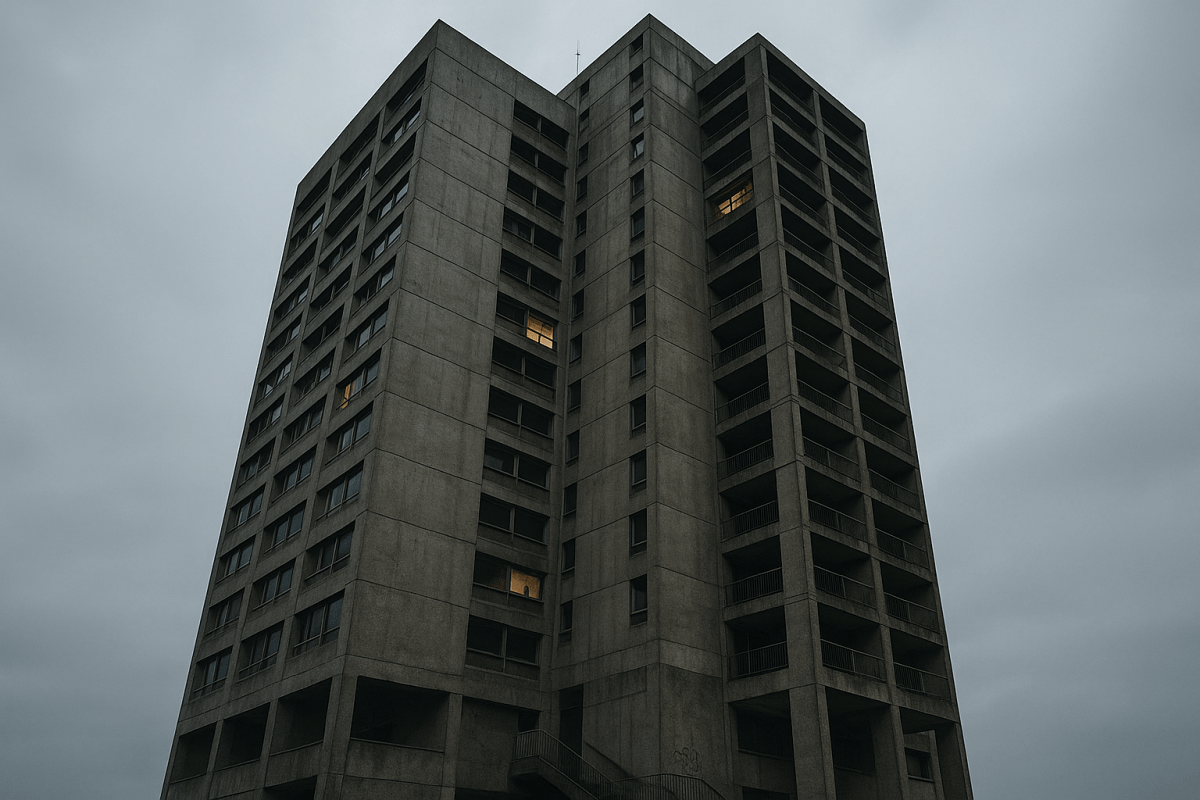
J.G. Ballard didn’t predict social media. He vivisected it in advance, then left the carcass twitching under fluorescent light. Before Zuckerberg was a glint in a dorm room’s databank, Ballard had already mapped the pathology of curated identity, algorithmic libido, and digital entropy. If the elevator shaft in High-Rise had Wi-Fi, we’d be exactly where we are now.
Audio: NotebookLM podcast on this topic.
Ballard’s tower blocks are not housing. They are autonomous systems masquerading as communities, structural cathedrals to hierarchy and isolation. Inhabitants lived stacked, surveilled, and increasingly feral – yet always convinced of their own civility, their own curated status within the glass cathedral. This is LinkedIn with plumbing. Instagram with broken lifts. X/Twitter if the blue ticks started eating each other.
“The more they came to know one another, the more they learned to isolate themselves.”
That’s not a punchline. That’s the algorithm.
Social media promised connection. What it delivered was exhaustion, identity theatre, and infinite scroll. Like the tenants of Ballard’s high-rise, we don’t talk – we perform. Not to each other, but at each other. Aesthetic becomes ontology. Feedback becomes affect. The timeline is just a corridor of muttered threats and filtered selfies, looping like CCTV.
And then there’s Crash. Forget the pornographic collisions – what matters is the feedback loop. The same compulsion. The same eroticised machinery. Each car crash intensifies the desire for the next, not in spite of the trauma, but because of it. This is Twitter rage. This is comment-section flame wars. This is the libidinal economy of attention.
Ballard understood: systems don’t collapse after they fail. They fail by design. His buildings, like our platforms, are monuments to their own disintegration. The only thing more artificial than the community is the performance of self within it.
You don’t live on the platform. The platform lives through you.
So yes, Ballard was already online. He logged in through the service entrance, weaponised the feedback loop, and left us with a diagnosis masquerading as fiction. What we mistook for dystopia was, as always, autobiography.









 Philosophics