Democracy and the Millions-Body Problem

2–3 minutes

In celestial mechanics, the three-body problem is notorious. Give Newton two bodies – a planet and a sun – and the equations sing. Add a third, and the song collapses into noise. No general solution exists. Even the smallest nudge in one orbit cascades unpredictably through the system.

Audio: NotebookLM podcast on this topic.

Now swap out planets for people. Not three, but millions. Each voter tugging with their own gravity – preferences, fears, biases, identities, the entire mess of human subjectivity. Democracy insists that by tallying these forces, we’ll arrive at something stable: the will of the people. But what we actually get is the millions-body problem: unstable coalitions, contradictory mandates, endlessly shifting orbits.

Condorcet’s Dilemma

The French mathematician Marquis de Condorcet spotted this flaw in the 18th century. His paradox showed that even if every individual voter ranks choices rationally, the group as a whole may not. Collective preferences can loop in circles: A beats B, B beats C, C beats A. It’s not dysfunction; it’s baked into the math.

Later, political scientists proved the paradox was only the beginning. McKelvey’s “chaos theorem” demonstrated that in a system with three or more options, almost any outcome can be engineered by manipulating the order of votes. In other words, democratic choice is not stable; it’s sensitive to framing, sequence, and agenda control.

Condorcet was brilliant enough to see the cracks, but like his Enlightenment peers, he decided that the fiction of order was preferable to the reality of chaos. Better to promise tidy majorities than to admit that majority rule is structurally incoherent.

The Tidy Lie

Why did majority rule catch on? Because it looked fair, even if speciously so. It gave the appearance of impartiality: count, declare, move on. It was simple enough to administer, and more palatable than monarchy or deadlock.

But neatness is not truth. If 51% of people vote for one candidate, 49% are compelled to live under a government they explicitly rejected. If a third of the population abstains altogether, the “winner” might rule with the backing of barely one-third of the country – yet claim a mandate.

This is what makes majority rule a ritual of laundered coercion. The losers are told, “next time you might win,” even though whole minorities may never win. Abstainers are scapegoated for outcomes they opposed. And everyone is asked to keep pretending that arithmetic equals legitimacy.

The Millions-Body Orbit

Elections give us final numbers – 34% here, 33% there – and we mistake them for laws of motion, as if the cosmos has spoken. But what we’re really seeing is a freeze-frame of chaos. The actual trajectories – coalitions, grievances, shifting identities – continue to wobble beneath the surface.

Like the three-body problem, democracy has no general solution. It isn’t clockwork; it’s turbulence. The miracle is not that it works, but that we pretend it does. Every “mandate” is a temporary illusion, a centre of gravity that exists only until the next disturbance knocks it off course.

And yet, the illusion persists. Because without it, the truth is unbearable: that there is no singular “will of the people,” only the millions-body problem, endlessly unstable, masked by the ritual of counting hands.

Rational Ghosts: Why Enlightenment Democracy Was Built to Fail

3–4 minutes

We are governed by phantoms. Not the fun kind that rattle chains in castles, but Enlightenment rational ghosts – imaginary citizens who were supposed to be dispassionate, consistent, and perfectly informed. They never lived, but they still haunt our constitutions and television pundits. Every time some talking head declares “the people have spoken”, what they really mean is that the ghosts are back on stage.

👉 Full essay: Rational Ghosts: Why Enlightenment Democracy Was Built to Fail

The conceit was simple: build politics as if it were an engineering problem. Set the rules right, and stability follows. The trouble is that the material – actual people – wasn’t blueprint-friendly. Madison admitted faction was “sown in the nature of man”, Rousseau agonised over the “general will”, and Condorcet managed to trip over his own math. They saw the cracks even while laying the foundation. Then they shrugged and built anyway.

Audio: NotebookLM podcast on this topic.

The rational ghosts were tidy. Real humans are not. Our brains run on shortcuts: motivated reasoning, availability cascades, confirmation bias, Dunning–Kruger. We don’t deliberate; we improvise excuses. Education doesn’t fix it – it just arms us with better rationalisations. Media doesn’t fix it either – it corrals our biases into profitable outrage. The Enlightenment drafted for angels; what it got was apes with smartphones.

Even if the ghosts had shown up, the math betrayed them. Arrow proved that no voting system can translate preferences without distortion. McKelvey showed that whoever controls the sequence of votes controls the outcome. The “will of the people” is less an oracle than a Ouija board, and you can always see whose hand is pushing the planchette.

Scale finishes the job. Dunbar gave us 150 people as the human limit of meaningful community. Beyond that, trust decays into myth. Benedict Anderson called nations “imagined communities”, but social media has shattered the illusion. The national conversation is now a million algorithmic Dunbars, each convinced they alone are the real people.

Audio: This is a longer (40-minute) NotebookLM podcast on the essay itself.

Why did democracy limp along for two centuries if it was this haunted? Because it was on life-support. Growth, war, and civic myth covered the cracks. External enemies, national rituals, and propaganda made dysfunction look like consensus. It wasn’t design; it was borrowed capital. That capital has run out.

Cue the panic. The defences roll in: Churchill said democracy was the “least bad” system (he didn’t, but whatever). Voters self-correct. Education will fix it. It’s only an American problem. And if you don’t like it, what – authoritarianism? These are less arguments than incantations, muttered to keep the ghosts from noticing the creaks in the floorboards.

The real task isn’t to chant louder. It’s to stop pretending ghosts exist. Try subsidiarity: smaller-scale politics humans can actually grasp. Try deliberation: citizens’ assemblies show ordinary people can think, when not reduced to a soundbite. Try sortition: if elections are distorted by design, maybe roll the dice instead. Try polycentric governance: let overlapping authorities handle mismatch instead of hammering “one will”. None of these are perfect. They’re just less haunted.

Enlightenment democracy was built to fail because it was built for rational ghosts. The ghosts never lived. The floorboards are creaking. The task is ours: build institutions for the living, before the house collapses under its own myths.

The Argument in Skeleton Form

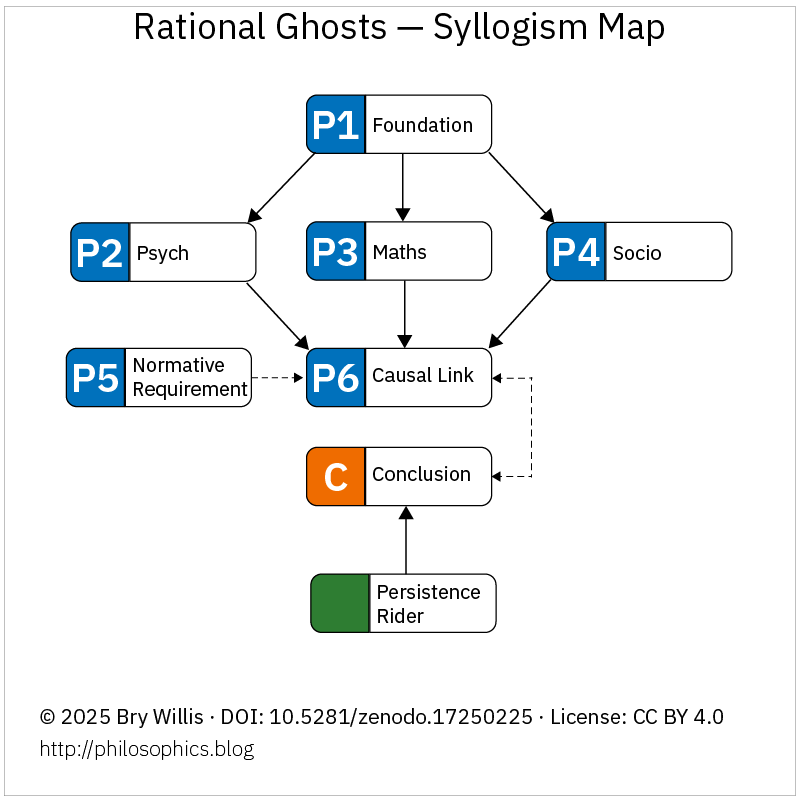
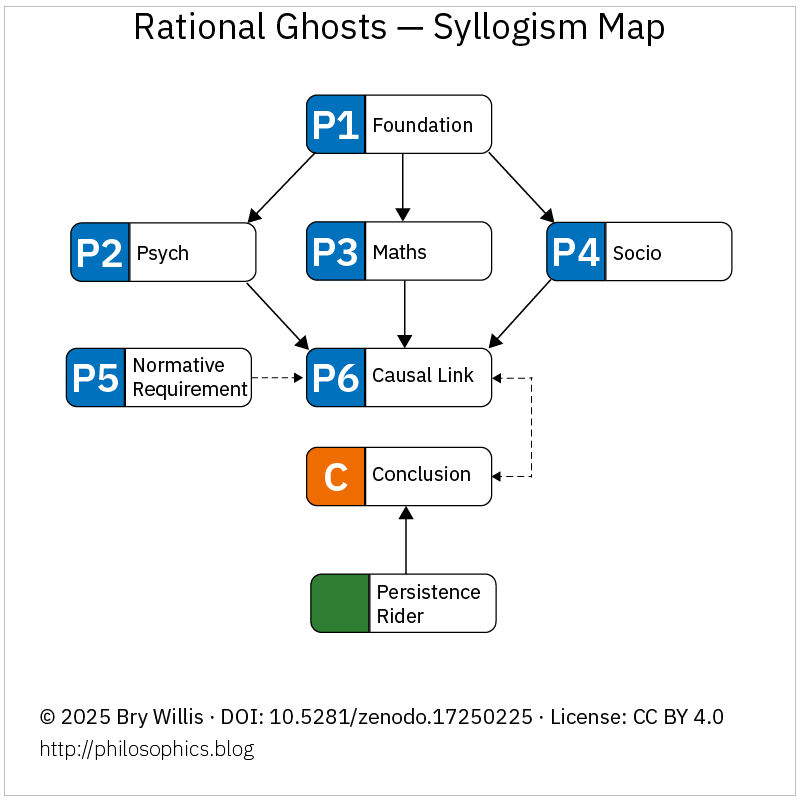
Beneath the prose, the critique of Enlightenment democracy can be expressed as a syllogism:
a foundation that assumed rational citizens collides with psychological bias, mathematical impossibility, and sociological limits.
The outcome is a double failure – corrupted inputs and incoherent outputs – masked only by temporary props.

Figure: Logical skeleton of “Rational Ghosts: Why Enlightenment Democracy Was Built to Fail.” For the complete essay, with sources and elaboration, see the open-access preprint on Zenodo: https://doi.org/10.5281/zenodo.17250225

Licence to Post

2–3 minutes

We live in an era where anyone can beam their thoughts into the ether at the push of a button. This would be a miracle if those thoughts weren’t so reliably idiotic. The internet promised democracy of speech; what it delivered was a landfill of charts no one understands, memes that spread faster than viruses, and the gnawing sense that humans are simply not rational enough to handle the privileges they’ve been given.

The Enlightenment told us we were “rational animals,” armed with Reason, the noble faculty that would lift us out of ignorance and into perpetual progress. What a joke. We aren’t Vulcans; we’re apes with Wi-Fi. We mash the publish button before our brains have caught up, then scream “free speech” when anyone suggests that words might require responsibility.

Imagine if driving worked this way. No test, no licence, no consequences: just a toddler at the wheel, claiming God-given rights to swerve across lanes. That’s social media in its current form. The people most in need of regulation are the least likely to pass even the most basic competency exam. Yet they strut about, convinced that posting a graph about Mississippi’s GDP makes them the second coming of Adam Smith.

@theashtoncohen

5 Brutal facts about Europe’s economy. Europe’s richest countries are now poorer than Mississippi. Americans have way more spending power, their companies are getting crushed, birth rates are tanking, and they’ve been left out of the industries that will define the future. Here are 5 hard truths Europe can’t afford to ignore.

♬ original sound – Ashton Cohen
NB: Under any condition, do not assume I endorse the misframed cherry-picking of this smug geezer, the progenitor of this post.

The truth is obvious but inconvenient: rationality is not humanity’s natural state. It’s a rare, costly condition, summoned only with discipline, education, and luck. Most of the time, we prefer shortcuts — tribal loyalties, gut feelings, dopamine hits. And yet we hand out the privileges of unfiltered speech, instantaneous broadcasting, and algorithmic amplification as if every citizen were Kant’s ideal autonomous agent.

The result? Chaos. Outrage machines. “Debates” about whether Europeans are backward barbarians for drinking water without ice cubes. These aren’t signs of liberty. They’re symptoms of a species drunk on its own mythology of reason.

Maybe we don’t need a new Marshall Plan for air conditioning in Europe. Maybe we need one for sanity. Start with a licence to post: a simple exam to prove you know what a source is, can tell a correlation from a cause, and won’t confuse market cap with civilisation itself. Civilization would be quieter. And perhaps, mercifully, a little less stupid.

Democracy: The Worst Form of Government, and Other Bedtime Stories

3–5 minutes

Karl Popper’s Paradox of Intolerance has become a kind of intellectual talisman, clutched like a rosary whenever fascists start goose-stepping into the town square. Its message is simple enough: to preserve tolerance, one must be intolerant of intolerance. Shine enough sunlight on bad ideas, and – so the pious hope – they’ll shrivel into dust like a vampire caught out at dawn.

If only.

The trouble with this Enlightenment fairy tale is that it presumes bad ideas melt under the warm lamp of Reason, as if ignorance were merely a patch of mildew waiting for the bleach of debate. But bad ideas are not bacteria; they are weeds, hydra-headed and delighting in the sun. Put them on television, and they metastasise. Confront them with logic, and they metastasise faster, now with a martyr’s halo.

Audio: NotebookLM podcast on this topic.

And here’s the part no liberal dinner-party theorist likes to face: the people most wedded to these “bad ideas” often don’t play the game of reason at all. Their critical faculties have been packed up, bubble-wrapped, and left in the loft decades ago. They don’t want dialogue. They want to chant. They don’t want evidence. They want affirmation. The Socratic method bounces off them like a ping-pong ball fired at a tank.

But let’s be generous. Suppose, just for a moment, we had Plato’s dream: a citizenry of Philosopher Kings™, all enlightened, all rational. Would democracy then work? Cue Arrow’s Impossibility Theorem, that mathematical killjoy which proves that even under perfect conditions – omniscient voters, saintly preferences, universal literacy – you still cannot aggregate those preferences into a system that is both fair and internally consistent. Democracy can’t even get out of its own way on paper.

Now throw in actual humans. Not the Platonic paragons, but Brexit-uncle at the pub, Facebook aunt with her memes, the American cousin in a red cap insisting a convicted felon is the second coming. Suddenly, democracy looks less like a forum of reasoned debate and more like a lottery machine coughing up numbers while we all pretend they mean “the will of the people.”

And this is where the Churchill quip waddles in, cigar smoke curling round its bowler hat: “Democracy is the worst form of government, except for all the others.” Ah yes, Winston, do please save us with a quip so well-worn it’s practically elevator music. But the problem is deeper than taste in quotations. If democracy is logically impossible (Arrow) and practically dysfunctional (Trump, Brexit, fill in your own national catastrophe), then congratulating ourselves that it’s “better than the alternatives” is simply an admission that we’ve run out of imagination.

Because there are alternatives. A disinterested AI, for instance, could distribute resources with mathematical fairness, free from lobbyists and grievance-mongers. Nursery schools versus nursing homes? Feed in the data, spit out the optimal allocation. No shouting matches, no demagoguery, no ballots stuffed with slogans. But here the defenders of democracy suddenly become Derrida in disguise: “Ah, but what does fair really mean?” And just like that, we are back in the funhouse of rhetorical mirrors where “fair” is a word everyone loves until it costs them something.

So perhaps democracy doesn’t require an “educated populace” at all; that was always just sugar-paper wrapping. It requires, instead, a population sufficiently docile, sufficiently narcotised by the spectacle, to accept the carnival of elections as a substitute for politics. Which is why calling the devotees of a Trump, or any other demagogue, a gaggle of lemmings is both accurate and impolitic: they know they’re not reasoning; they’re revelling. Your contempt merely confirms the script they’ve already written for you.

Video: Short callout to Karl Popper and Hilary Lawson.

The philosopher, meanwhile, is left polishing his lantern, muttering about reason to an audience who would rather scroll memes about pedophile pizza parlours. Popper warned us that tolerance cannot survive if it tolerates its own annihilation. Arrow proved that even if everyone were perfectly reasonable, the maths would still collapse. And Churchill, bless him, left us a one-liner to make it all seem inevitable.

Perhaps democracy isn’t the worst form of government except for all the others. Perhaps it’s simply the most palatable form of chaos, ballots instead of barricades, polling booths instead of pitchforks. And maybe the real scandal isn’t that people are too stupid for democracy, but that democracy was never designed to be about intelligence in the first place. It was always about managing losers while telling them they’d “had their say.”

The Enlightenment promised us reason; what it delivered was a carnival where the loudest barker gets the booth. The rest of us can either keep muttering about paradoxes in the corner or admit that the show is a farce and start imagining something else.

Technofeudalism: It’s a Wrap

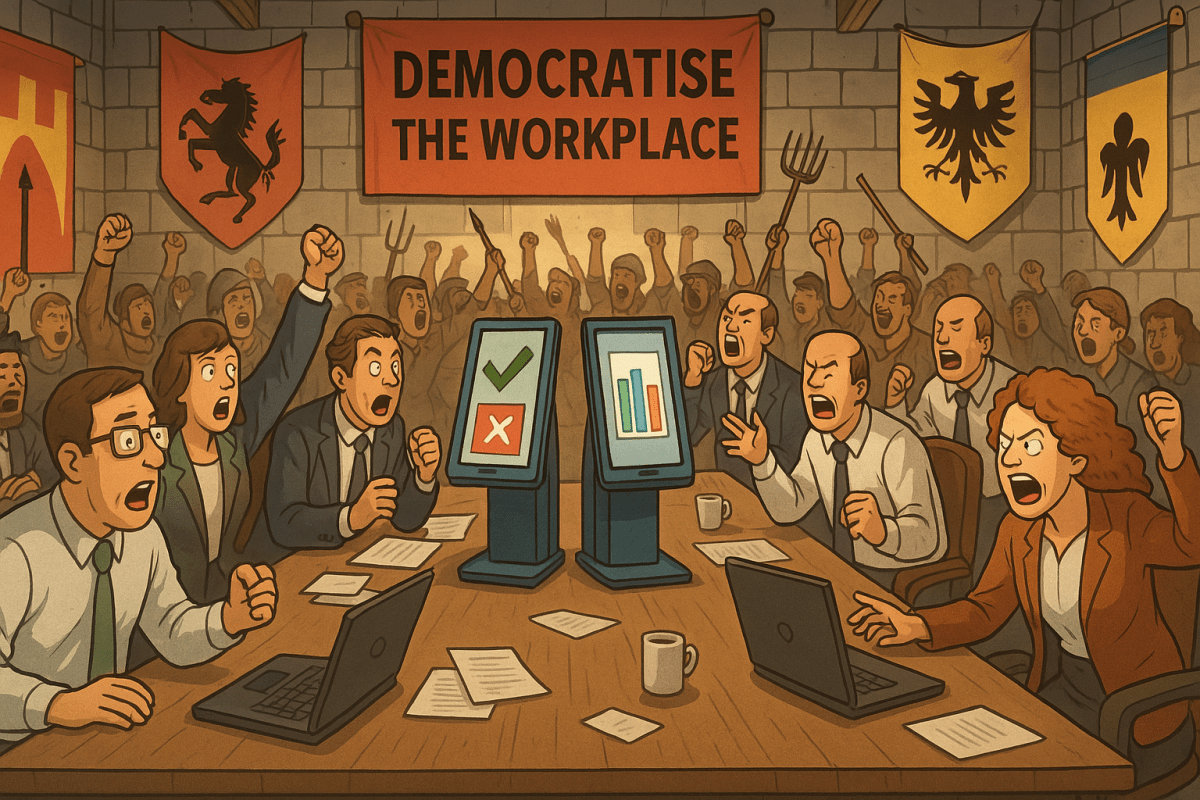
By the time we reach Chapter Seven of Technofeudalism: What Kills Capitalism, Yanis Varoufakis drops the ledger sheets and spreadsheets and starts sketching utopia in crayon. Entitled Escape from Technofeudalism, it proposes—brace yourself—a workplace democracy. It’s aspirational, yes. Compelling? Not particularly. Especially if, like me, you’ve long since stopped believing that democracy is anything more than a feel-good placebo for structural impotence.

Audio: NotebookLM podcast discussing this topic.

To be clear: the preceding chapters, particularly the first six, are sharp, incisive, and frankly, blistering in their indictment of today’s economic disfiguration. But Chapter Seven? It’s less an escape plan, more a group therapy session masquerading as an operational model.

So let’s take his proposal for Democratised Companies apart, one charming layer at a time.

Splendid. One person, one vote. Adorable.

Because there’s nothing more efficient than a hiring committee comprised of thirty engineers, two janitors, a receptionist, and Steve from Accounts, whose main contribution is passive-aggressive sighing.

Marvellous. We’ve now digitised the tyranny of the majority and can timestamp every idiotic decision for posterity.

A relief. Until it doesn’t.

Here, dear reader, is where the cake collapses. Why, precisely, should a randomly-assembled group of employees—with wildly varying financial literacy—be entrusted to divide post-tax revenue like it’s a birthday cake at a toddler’s party?

And how often are these slices recalibrated? Each fiscal year? Every time someone is hired or fired? Do we amend votes quarterly or wait until the economic ship has already struck an iceberg?

Varoufakis does suggest preference voting to tackle allocation disputes:

Fine. In theory, algorithmic voting procedures sound neat. But it presumes voters are rational, informed, and cooperative. If you’ve ever seen a corporate Slack thread devolve into emoji warfare, you’ll know that this is fiction on par with unicorns and meritocracy.

Ah yes, the ‘equality’ bit. Equal pay, unequal contribution. This isn’t egalitarianism—it’s enforced mediocrity. It might work in a monastery. Less so in a competitive tech firm where innovation requires both vision and differentiated incentive.

Now, on to bonuses, which are democratically determined by:

Welcome to Black Mirror: Workplace Edition. This is less economics, more playground politics. Who gets tokens? The charismatic chatterbox in the break room? The person who shared their lunch? The ghost employee who never shows up but emails back promptly?

And how, pray tell, does one evaluate the receptionist’s contribution relative to the lead engineer’s or the janitor’s? This isn’t peer review—it’s populism with a smiley face.

We’ve all seen “Teacher of the Year” competitions turn into contests of who had the cutest class poster or best cupcakes. Now imagine your livelihood depending on it.

In summary, democracy in the workplace may sound noble, but in practice, it’s the bureaucratic equivalent of herding caffeinated cats. It doesn’t even work in small groups, let alone an organisation of hundreds. Democracy—when applied to every function of an enterprise—is not liberation; it’s dilution. It’s design-by-committee, strategy-by-consensus, and ultimately, excellence-by-accident.

Escape from Technofeudalism? Perhaps. But not by replacing corporate lords with intranet polls and digital tokens. That’s not an exit strategy—it’s a cosplay of collectivism.

Why We Can’t Have Nice Things

A Hobbesian Rant for the Disillusioned Masses

Reading Leviathan has me thinking. Nothing new, mind you—just reinvigorated. Hobbes, bless his scowling soul, is the consummate pessimist. People, in his view, are untrustworthy sods, ready to stab you in the back at the first flicker of opportunity. He doesn’t believe in community. He believes in containment.

Audio: NotebookLM discussion about this topic.

And to be fair, he’s not entirely wrong. He captures a certain cohort with uncanny accuracy. You know the type. Type-A™ personalities: the Donald Trumps, Elon Musks, Adolph Hitlers, Shahs of Iran, and that guy in marketing who always schedules meetings for 8am. The ones who salivate at the mere whiff of power, who’d sell their grandmothers for a press release and call it vision.

Now, I’ll concede that most people want more than they have. Economics depends on this assumption like religion depends on guilt. But not everyone is driven by an insatiable lust for money, dominance, or legacy. That, my friends, is not ambition. It is pathology—a malignant, metastasising hunger that infects the likes of Trump, Musk, Bezos, Sunak, and their ilk. The hunger to rule, not just participate.

The trouble is, the majority of the world’s population are idiots—not technically, but metaphorically. Soft-headed. Overstimulated. Easily distracted by flags, influencers, and “free shipping.” And there are flavours of idiots. Musk is a lucky idiot. Trump is a useful idiot. Most are a hair’s breadth from being cannon fodder.

The world could be configured differently. It could consist of autonomous collectives, each minding its own business, each respecting the other’s boundaries like courteous houseplants. But this equilibrium is shattered—always shattered—by the predatory few. The outliers. The sharks in suits. The ones who mistake governance for domination and diplomacy for personal branding.

So we build mechanisms to defend ourselves—laws, institutions, surveillance, standing armies—but these mechanisms inevitably attract the same types we were trying to ward off. Power-hungry cretins in different hats. The protectors, it turns out, are rarely benevolent dictators. They are predacious politicos, wearing virtue like a costume, mouthing justice while tightening the screws.

But the recurring infestation of pathological ambition in a species otherwise just trying to get on with its day.

This is the challenge for all of humanity.

And we’ve yet to rise to it.

Required Reading: Science

The Structure of Scientific Revolutions was published in 1962. Written by Thomas Kuhn, it introduced the world to the concept of paradigm shifts in science — and, as it turns out, elsewhere. As I mentioned recently, I experienced a mishap, confounding it with Paul Feyerabend’s Against Method, first published in 1975. Both of these should be required reading FOR year 10 – or at least taught in summary.

I had read Feyerabend years ago but was only familiar with Kuhn from a distance. I’m clad we’ve become more intimate. These authors take different approaches to arrive at times in the same place. Kuhn takes a Modernist approach that he critiques and modifies. Feyerabend takes a Postmodernist path that sometimes cross.

Ah, the delightful dance of paradigms and anarchism in the hallowed halls of science! Let’s delve deeper into the intellectual pas de deux between Thomas Kuhn and Paul Feyerabend, those audacious thinkers who dared to challenge the sanctity of scientific methodology.

Kuhn’s Paradigm Shifts: The Scientific Waltz

Thomas Kuhn, in his seminal work The Structure of Scientific Revolutions, introduced us to the concept of paradigm shifts—a term now so overused that even corporate PowerPoint presentations aren’t spared. Kuhn posited that science doesn’t progress through a linear accumulation of knowledge but rather through a series of revolutionary upheavals. These upheavals occur when the prevailing scientific framework, or “paradigm,” becomes as outdated as last season’s fashion, unable to account for emerging anomalies. In Kuhn’s view, the scientific community clings to its paradigms with the tenacity of a dog to its bone, until the weight of anomalies forces a collective epiphany, leading to a paradigm shift. This cyclical process propels scientific advancement, albeit in a manner reminiscent of a drunken sailor’s stagger rather than a straight path.

Feyerabend’s Epistemological Anarchism: The Punk Rock of Science

Enter Paul Feyerabend, the enfant terrible of the philosophy of science, with his provocative manifesto Against Method. Feyerabend gleefully dismantled the notion of a universal scientific method, advocating for “epistemological anarchism.” He argued that the rigid adherence to methodological rules is about as useful as a chocolate teapot, stifling creativity and hindering progress. In Feyerabend’s anarchic utopia, “anything goes” in the pursuit of knowledge, and the scientific method is more of a loose suggestion than a strict protocol. His critique was not just a call for methodological diversity but a full-blown rebellion against the tyranny of scientific dogmatism.

A Comparative Analysis: Method to the Madness

While Kuhn and Feyerabend both challenged the orthodox views of scientific progress, their approaches were as different as chalk and cheese. Kuhn’s analysis was rooted in historical case studies, portraying scientific revolutions as communal shifts in perspective, akin to a collective midlife crisis. Feyerabend, on the other hand, took a more radical stance, suggesting that the very idea of a fixed scientific method is as mythical as unicorns. Where Kuhn saw periods of “normal science” punctuated by revolutionary shifts, Feyerabend saw a chaotic free-for-all, where progress is made not by following rules but by breaking them.

Implications for Scientific Practice: Order in Chaos

The implications of their critiques are profound. Kuhn’s work suggests that scientists should remain open to paradigm shifts, lest they become as obsolete as Betamax in a Netflix era. Feyerabend’s anarchism, while controversial, serves as a reminder that innovation often requires the audacity to defy convention. Together, they paint a picture of science not as a monolithic quest for truth but as a dynamic, often tumultuous, human endeavour.

Conclusion: The Legacy of Intellectual Rebellion

In conclusion, the works of Kuhn and Feyerabend invite us to view science through a more sceptical lens, questioning the sanctity of its methods and the rigidity of its paradigms. Their critiques serve as a clarion call for intellectual flexibility, urging us to embrace the chaos and complexity inherent in the pursuit of knowledge. After all, in the grand theatre of science, it’s often the most unconventional performances that leave a lasting impact.

Banality of Evil

I thought I was done wittering on about Brian Thompson, the late CEO of United Healthcare, but here we are. His name lingers like the corporate perfume of systemic rot—an enduring testament to how we’ve elevated unethical behaviour into performance art. It got me thinking: what if we brought back a bit of old-school accountability? In Ancient Rome, outlaws lost their citizenship, legal protections, and status as people. That’s right—booted out of polite society. Meanwhile, we’ve done the opposite: we hand out golden parachutes and slap their faces on business magazine covers.

To some, Brian Thompson was a good man – apart from the insider trading, of course. He was successful, a nice guy, funny, and had a good family, and a few million-dollar homes. What else could you ask for? But his success came in the way of blood money. It seems we need fewer people who think like this, not more.

Then I recalled The Purge franchise. And sure, The Purge is a dystopian fantasy, but let’s up the stakes. Picture this: bounties on corporate villains. Not literal carnage, of course—let’s leave that for the big screen—but the return of real consequences. Instead of allowing their PR teams to smooth it all over with buzzwords and philanthropy crumbs, what if we made it socially unacceptable to be a snake in a suit? What if moral suasion—the lost art of persuading someone to do right because it’s, you know, right—actually came back into fashion?

Nietzsche nailed it ages ago. We’ve got two moral codes: one for people and one for money. And guess which one wins every time? All it takes is enough cash and the right rhetoric, and suddenly, everyone forgets who’s really getting fleeced. This is the banality of evil in its purest form: not grand acts of villainy but a shrugging normalisation of corruption. We don’t even consider it corruption. We see it as business as usual. We support and work for these businesses.

The tragedy is that we’ve become so desensitised to it that we are adept at ignoring the stench of moral failure that even calling it out feels quaint. But it’s not hopeless. Some of us still notice. Some of us still care. The real question is, how long can we keep tolerating this farce before we remember that morality isn’t just for the powerless?

Meantime, I just imagine these grubbers being stripped of power and protection, running scared from the likes of Luigi Mangioni.

Guns, Germs, and Steel

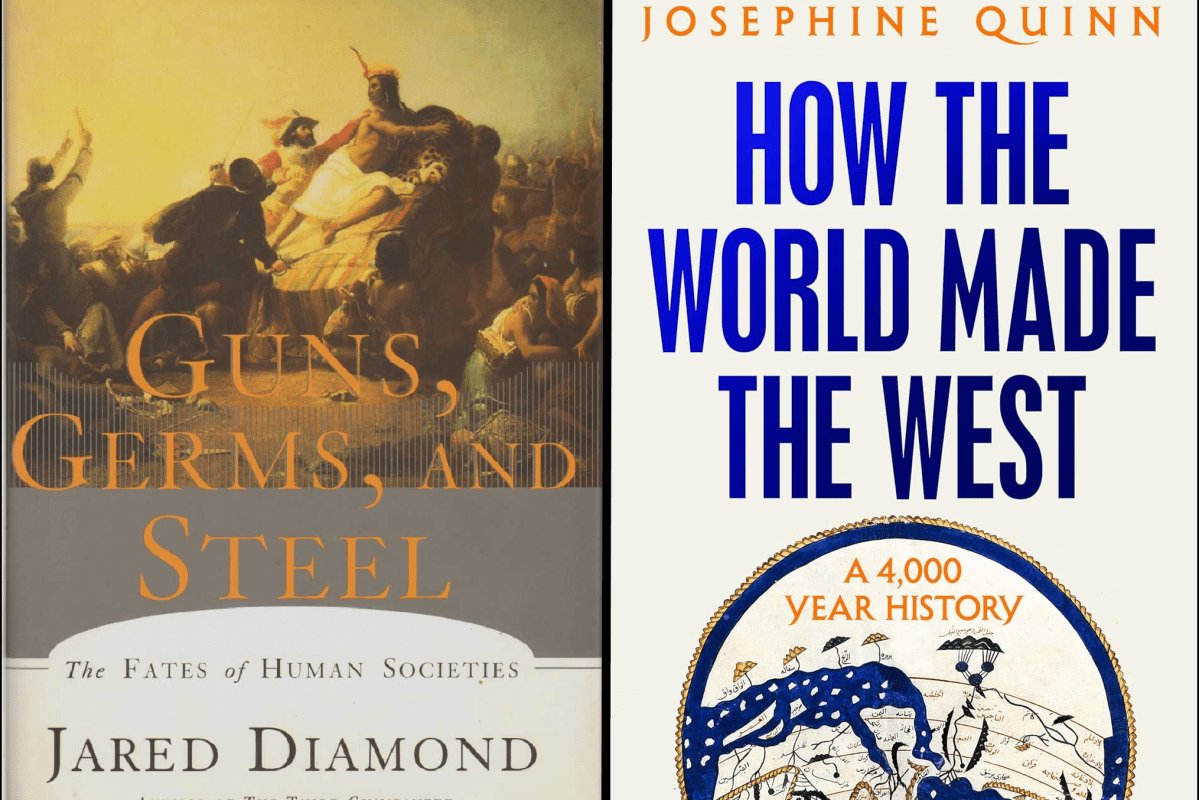
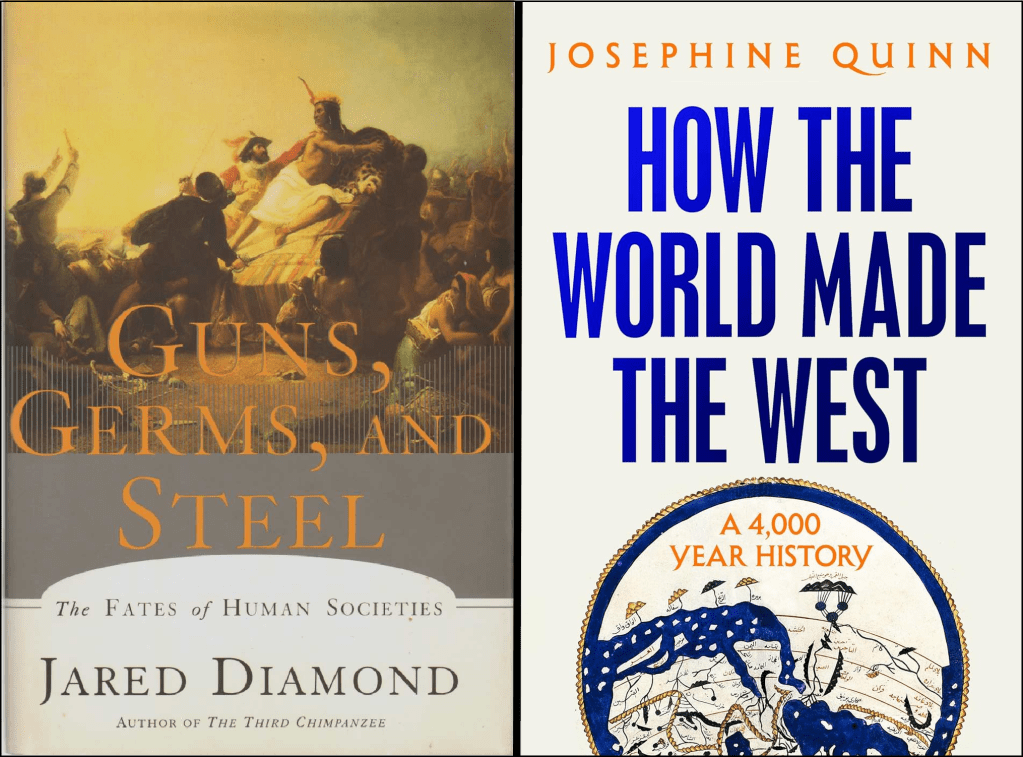
I am reading Jared Diamond’s Guns, Germs, and Steel: The Fates of Human Societies, the first and likely most famous of an informal trilogy. I thought I had already read it, but I think I only saw the PBS show. Having recently finished Josephine Quinn’s How the World Made the West, I wanted to revisit this perspective. The two books are presented in different styles and represent different perspectives, but they seem to be complementary.

Where Diamond focuses on environmental factors (an oft-voiced critique), Quinn focuses on human agency.

Diamond takes a bird’ s-eye view, looking for universal patterns and systemic explanations, whilst Quinn adopts a granular, specific approach, highlighting the fluidity and contingency of history.

Diamond deconstructs European dominance by attributing it to environmental luck, but his narrative risks sidelining the agency of colonised peoples. Quinn critiques the very idea of Western dominance, arguing that the concept of the West itself is a myth born of appropriation and exchange.

Rather than being wholly opposed, Diamond and Quinn’s approaches might be seen as complementary. Diamond provides the structural scaffolding – the environmental and geographic conditions that shape societies – whilst Quinn fills in the cultural and human dynamics that Diamond often glosses over. Together, they represent two sides of the historiographical coin: one focusing on systemic patterns, the other on the messiness of cultural particularities.

Quinn’s approach is more aligned with The Dawn of Everything: A New History of Humanity, co-authored by David Graeber and archaeologist David Wengrow, if you can use that as a reference point.

Scientific Authority in an Age of Uncertainty

At a time when scientific authority faces unprecedented challenges—from climate denial to vaccine hesitancy—the radical critiques of Paul Feyerabend and Bruno Latour offer surprising insight. Their work, far from undermining scientific credibility, provides a more nuanced and ultimately more robust understanding of how scientific knowledge actually progresses. In an era grappling with complex challenges like artificial intelligence governance and climate change, their perspectives on the nature of scientific knowledge seem remarkably prescient.

The Anarchist and the Anthropologist: Challenging Scientific Orthodoxy

When Paul Feyerabend declared “anything goes” in his critique of scientific method, he launched more than a philosophical provocation—he opened a fundamental questioning of how we create and validate knowledge. Bruno Latour would later expand this critique through meticulous observation of how science operates in practice. Together, these thinkers reveal science not as an objective pursuit of truth, but as a deeply human enterprise shaped by social forces, rhetoric, and often, productive chaos.

Consider how modern climate scientists must navigate between pure research and public communication, often facing the challenge of translating complex, probabilistic findings into actionable policies. This mirrors Feyerabend’s analysis of Galileo’s defence of heliocentrism—both cases demonstrate how scientific advancement requires not just empirical evidence, but rhetorical skill and strategic communication.

The Social Construction of Scientific Facts

Latour’s concept of “black boxing”—where successful scientific claims become unquestioned facts—illuminates how scientific knowledge achieves its authority. Contemporary examples abound: artificial intelligence researchers like Timnit Gebru and Joy Buolamwini have exposed how seemingly objective AI systems embed social biases, demonstrating Latour’s insight that technical systems are inseparable from their social context.

The COVID-19 pandemic provided a stark illustration of these dynamics. Public health responses required combining epidemiological models with social science insights and local knowledge—precisely the kind of epistemological pluralism Feyerabend advocated. The pandemic revealed what sociologist Harry Collins calls “interactional expertise”—the ability to communicate meaningfully about technical subjects across different domains of knowledge.

Beyond Method: The Reality of Scientific Practice

Both Feyerabend and Latour expose the gap between science’s methodological ideals and its actual practice. This insight finds contemporary expression in the work of Sheila Jasanoff, who developed the concept of “sociotechnical imaginaries”—collectively imagined forms of social life reflected in scientific and technological projects. Her work shows how scientific endeavours are inseparable from social and political visions of desirable futures.

The climate crisis perfectly exemplifies this interweaving of scientific practice and social context. Scholars like Kyle Whyte and Robin Wall Kimmerer demonstrate how indigenous environmental knowledge often provides insights that Western scientific methods miss. This validates Feyerabend’s assertion that progress often requires breaking free from established methodological constraints.

The Pluralistic Vision in Practice

Neither Feyerabend nor Latour advocates abandoning science. Instead, they argue for recognising science as one way of knowing among many—powerful but not exclusive. This vision finds practical expression in contemporary movements like citizen science, where projects like Galaxy Zoo or FoldIt demonstrate how non-experts can contribute meaningfully to scientific research.

The “slow science” movement, championed by Isabelle Stengers, similarly echoes Feyerabend’s critique of methodological orthodoxy. It advocates for more thoughtful, inclusive approaches to research that acknowledge the complexity and uncertainty inherent in scientific inquiry.

Knowledge in the Age of Complexity

Today’s challenges—from climate change to artificial intelligence governance—demand precisely the kind of epistemological pluralism Feyerabend and Latour advocated. Kate Crawford’s research on the politics of AI parallels Latour’s network analysis, showing how technical systems are shaped by complex webs of human decisions and institutional priorities.

Feminist scholars like Karen Barad propose “agential realism,” suggesting that scientific knowledge emerges from specific material-discursive practices rather than revealing pre-existing truths. This builds on Feyerabend’s insight that knowledge advances not through rigid methodology but through dynamic interaction with multiple ways of knowing.

Towards a New Understanding of Scientific Authority

The critiques of Feyerabend and Latour, amplified by contemporary scholars, suggest that scientific authority rests not on infallible methods but on science’s capacity to engage with other forms of knowledge while remaining open to revision and challenge. This understanding might help address contemporary challenges to scientific authority without falling into either naive scientism or radical relativism.

The rise of participatory research methods and citizen science projects demonstrates how this more nuanced understanding of scientific authority can enhance rather than diminish scientific practice. Projects that combine traditional scientific methods with local knowledge and citizen participation often produce more robust and socially relevant results.

Conclusion: Embracing Complexity

Feyerabend and Latour’s critiques, far from being merely historical curiosities, offer vital insights for navigating contemporary challenges. Their work, extended by current scholars, suggests that the future of knowledge lies not in establishing new orthodoxies but in maintaining openness to multiple approaches and perspectives.

In an age of increasing complexity, this pluralistic vision offers our best path forward—one that recognises science’s value while acknowledging the essential contribution of other ways of knowing to human understanding. As we face unprecedented global challenges, this more nuanced and inclusive approach to knowledge creation becomes not just philosophically interesting but practically essential.

The lesson for contemporary science is clear: progress depends not on rigid adherence to method but on maintaining open dialogue between different ways of understanding the world. In this light, the apparent chaos Feyerabend celebrated appears not as a threat to scientific authority but as a necessary condition for genuine advancement in human knowledge.