Regular readers know I often write about identity, free will, and the narrative constraints of language. But I also explore these ideas through fiction, under the name Ridley Park.
In this short video, I unpack the philosophical motivations behind my stories, including:
Why reality is never as it seems
Why the self is a narrative convenience
What Heidegger’s Geworfenheit and Galen Strawson’s Causa Sui argument reveal about agency
And why language fails us – even when we think it serves
This isn’t promotional fluff. It’s epistemological dissent in a new format. Fictional, yes, but only in the sense that most of reality is, too.
What if the real horror isn’t waking as a beetle, but as a man?
In Kafka’s Metamorphosis, Gregor Samsa wakes to find himself transformed into a giant beetle—a cockroach, a vermin, an intrusion of the inhuman into the domestic. The horror is obvious: loss of agency, social death, the grotesque made literal. It’s the nightmare of devolution, of becoming something other, something filthy.
But perhaps we’ve misunderstood the true absurdity.
Audio: NotebookLM podcast on this topic.
What if the real nightmare is the opposite? Not a man waking as an insect, but an insect waking in a human body—forced to contend with taxes, performance reviews, dinner parties, and the crushing weight of being legible to others. Imagine a beetle, content in its instinctual certainty, finding itself hurled into the howling contradiction of human subjectivity.
Suddenly, it must interpret signs, participate in rituals, conform to decorum, all while performing a pantomime of “meaning.” It’s not the exoskeleton that’s horrifying – it’s the endless internal monologue. The soul-searching. The unbearable tension of being expected to have purpose.
We call Gregor’s fate tragic because he can no longer function in a world built for humans. But isn’t that the human condition already? An endless, futile negotiation between the raw fact of existence and the stories we invent to make it bearable.
Gregor becomes insect. We were never anything but.
As some of you know, I publish speculative fiction under the name Ridley Park. Propensity is one of several recent releases – a novella that leans philosophical, brushes up against literary fiction, and steps quietly into the margins of sci-fi.
It’s not about spaceships or superintelligence. It’s about modulation.
About peace engineered through neurochemical compliance.
About the slow horror of obedience without belief, and the behavioural architecture that lets us think we’re still in control.
The ideas explored include:
Free will as illusion
Peace as compliance
Drift, echo, and the limits of modulation
Obedience without belief
Institutional horror and soft dystopia
Consent and behavioural control
Narrative as residue
Collapse by calibration
Though filed under speculative fiction, Propensity [US] is best read as a literary artefact – anti-sci-fi, in a sense. There’s no fetishisation of technology or progress. Just modulation, consequence, and the absence of noise.
This PDF contains selected visual excerpts from the physical book to accompany the free audiobook edition. For readers and listeners alike, it offers a glimpse into Ridley Park’s world – a quietly dystopian, clinically unsettling, and depressingly plausible one.
Title page
Copyrights page
Table of Contents
Chapter 10: Memorandum. This chapter is read in the audiobook. The inclusion here is for visualisation as it is rendered in the form of a memo.
Chapter 26: Simulacra. This chapter is read in the audiobook. The inclusion here is for visualisation as it is rendered in the format of a screenplay.
Chapter 28: Standard Test: This chapter is read in the audiobook. The inclusion here is for visualisation as it is rendered in the format of a standardised test.
Chapter 34: Calendar. This chapter is read in the audiobook. The inclusion here is for visualisation as it is rendered in the format of a calendar.
Chapter 39: Carnage. This chapter is read in the audiobook. The inclusion here is for visualisation as it is rendered in the form of a Dr Suess-type poem.
Chapter 41: Leviathan. This chapter is excerpted in the audiobook. The inclusion here is for visualisation as it is rendered with an image of the cover of Hobbes’ Leviathan and redacted page content.
Chapter 42: Ashes to Ashes. This chapter is read in the audiobook. The inclusion here is for visualisation as it is rendered in the form of text art.
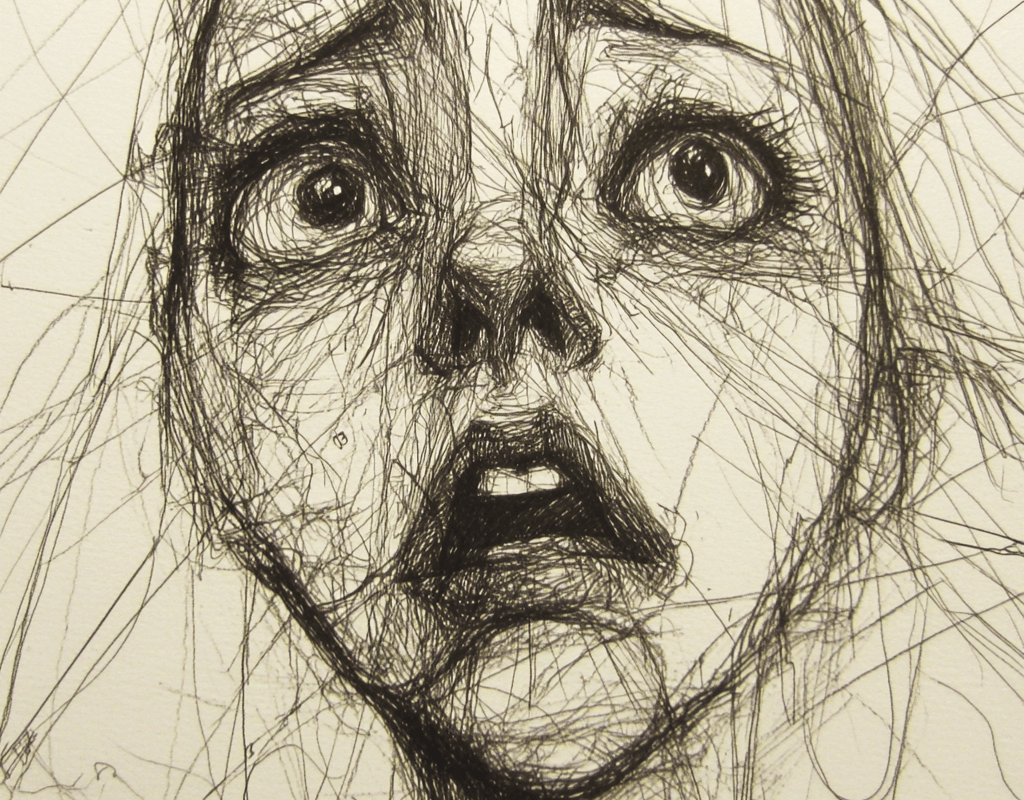
Chapter 43: Unknown. A description of this chapter is read in the audiobook. The inclusion here is for visualisation as it is rendered in the form of an ink sketch.
Chapter 44: Vestige. A description of this chapter is read in the audiobook. The inclusion here is for visualisation as it is rendered in the form of text art.
For more information about Ridley Park’s Propensity, visit the website. I’ll be sharing content related to Propensity and my other publications. I’ll cross-post here when the material has a philosophical bent, which it almost always does.
Humans talk to large language models the way toddlers talk to teddy bears – with unnerving sincerity and not a hint of shame. “Do you understand me?” they ask, eyes wide with hope. “What do you think of this draft?” they prod, as if some silicon scribe is going to sip its imaginary tea and nod gravely. It’s not merely adorable – it’s diagnostic. We are, it turns out, pathologically incapable of interacting with anything more complex than a toaster without projecting mind, motive, and mild trauma onto it.
Audio: NotebookLM podcast on this topic.
Welcome to the theatre of delusion, where you play Hamlet and the chatbot is cast as Yorick – if Yorick could autocomplete your soliloquy and generate citations in APA format.
The Great Anthropomorphic Flaw (aka Feature)
Let’s get one thing straight: anthropomorphism isn’t a software bug in the brain; it’s a core feature. You’re hardwired to see agency where there is none. That rustle in the bushes? Probably the wind. But better safe than sabre-toothed. So your ancestors survived, and here you are, attributing “sass” to your microwave because it beeped twice.
“We don’t have a way of addressing an entity that talks like a person but isn’t one. So we fake it. It’s interaction theatre.”
Now we’ve built a machine that spits out paragraphs like a caffeinated undergrad with deadlines, and naturally, we talk to it like it’s our mate from university. Never mind that it has no bloodstream, no memory of breakfast, and no concept of irony (despite being soaked in it). We still say you instead of the system, and think instead of statistically interpolate based on token weights. Because who wants to live in a world where every sentence starts with “as per the pre-trained parameters…”?
Why We Keep Doing It (Despite Knowing Better)
To be fair – and let’s be magnanimous – it’s useful. Talking to AI like it’s a person allows our ape-brains to sidestep the horror of interacting with a glorified autocomplete machine. We’re brilliant at modelling other minds, rubbish at modelling neural nets. So we slap a metaphorical moustache on the processor and call it Roger. Roger “gets us.” Roger “knows things.” Roger is, frankly, a vibe.
This little charade lubricates the whole transaction. If we had to address our queries to “the stochastic parrot formerly known as GPT,” we’d never get past the opening line. Better to just ask, “What do you think, Roger?” and pretend it has taste.
And here’s the kicker: by anthropomorphising AI, we start thinking about ethics – sort of. We ask if it deserves rights, feelings, holidays. We project humanity into the void and then act shocked when it mirrors back our worst habits. As if that’s its fault.
When the Roleplay Gets Risky
Of course, this make-believe has its downsides. Chief among them: we start to believe our own nonsense. Saying AI “knows” something is like saying your calculator is feeling generous with its square roots today. It doesn’t know—it produces outputs. Any semblance of understanding is pure pantomime.
“We see a mind because we need to see one. We can’t bear the idea of a thing that’s smarter than us but doesn’t care about us.”
More dangerously, we lose sight of the fact that these things aren’t just alien – they’re inhuman. They don’t dream of electric sheep. They don’t dream, full stop. But we insist on jamming them into our conceptual boxes: empathy, intent, personality. It’s like trying to teach a blender to feel remorse.
And let’s not pretend we’re doing it out of philosophical curiosity. We’re projecting, plain and simple. Anthropomorphism isn’t about them, it’s about us. We see a mind because we need to see one. We can’t bear the idea of a thing that’s smarter than us but doesn’t care about us, doesn’t see us. Narcissism with a side of existential dread.
Our Language is a Terrible Tool for This Job
English – and most languages, frankly – is hopeless at describing this category of thing. “It” feels cold and distant. “They” implies someone’s going to invite the model to brunch. We have no pronoun for “hyper-literate statistical machine that mimics thought but lacks all consciousness.” So we fudge it. Badly.
Our verbs are no better. “Compute”? Too beige. “Process”? Bureaucratic. “Think”? Premature. What we need is a whole new grammatical tense: the hallucino-indicative. The model thunketh, as one might, but didn’t.
“We built a creature we can’t speak about without sounding like lunatics or liars.”
This is linguistic poverty, pure and simple. Our grammar can’t cope with entities that live in the uncanny valley between sentience and syntax. We built a creature we can’t speak about without sounding like lunatics or liars.
The Semantics of Sentimentality (Or: “How Does This Sound to You?”)
Enter the most revealing tell of all: the questions we pose. “How does this look?” we ask the model, as if it might blink at the screen and furrow a synthetic brow. “What do you think?” we say, offering it the dignity of preference. These questions aren’t just off-target – they’re playing darts in another pub.
They’re the linguistic equivalent of asking your dishwasher whether it enjoyed the lasagne tray. But again, this isn’t idiocy – it’s instinct. We don’t have a way of addressing an entity that talks like a person but isn’t one. So we fake it. It’s interaction theatre. You provide the line, the model cues the spotlight.
But let’s be clear: the model doesn’t “think” anything. It regurgitates plausible text based on mountains of training data—some of which, no doubt, includes humans asking equally daft questions of equally mindless systems.
Time to Grow Up (Just a Bit)
This doesn’t mean we need to abandon anthropomorphism entirely. Like most delusions, it’s functional. But we’d do well to hold it at arm’s length – like a politician’s promise or a milk carton two days past its date.
Call it anthropomorphic agnosticism: act like it’s a person, but remember it’s not. Use the language, but don’t inhale.
And maybe – just maybe – we need to evolve our language. Invent new terms, new pronouns, new ways of speaking about entities that fall somewhere between tool and companion. As we did with “cyberspace” and “ghosting,” perhaps we need words for proto-minds and quasi-selves. Something between toaster and therapist.
“If we speak to AI like it’s sentient, we’ll eventually legislate as if it is.”
Above all, we need to acknowledge that our language shapes more than just understanding – it shapes policy, emotion, and future design. If we speak to AI like it’s sentient, we’ll eventually legislate as if it is. And if we insist on treating it as an object, we may be blind to when that ceases to be accurate. Misnaming, after all, is the first sin in every myth worth reading.
The Mirror, Darkly
Ultimately, our tendency to humanise machines is less about them than it is about us – our fears, our needs, our inability to tolerate ambiguity. The AI is just a mirror: an elaborate, many-eyed, autofill mirror. And when we see a mind there, it may be ours staring back – distorted, flattened, and fed through a thousand layers of token prediction.
The tragedy, perhaps, isn’t that the machine doesn’t understand us. It’s that we’ve built something that perfectly imitates understanding – and still, somehow, we remain utterly alone in the room.
Let us begin with the heresy: Truth is a rhetorical artefact. Not a revelation. Not a metaphysical essence glimmering behind the veil. Just language — persuasive, repeatable, institutionally ratified language. In other words: branding.
Audio: NotebookLM podcast on this topic.
This is not merely a postmodern tantrum thrown at the altar of Enlightenment rationalism. It is a sober, if impolite, reminder that nearly everything we call “knowledge” is stitched together with narrative glue and semantic spit. Psychology. Neuroscience. Ethics. Economics. Each presents itself as a science — or worse, a moral imperative — but their foundations are built atop a linguistic faultline. They are, at best, elegant approximations; at worst, dogma in drag.
Let’s take psychology. Here is a field that diagnoses your soul via consensus. A committee of credentialed clerics sits down and declares a cluster of behaviours to be a disorder, assigns it a code, and hands you a script. It is then canonised in the DSM, the Diagnostic Scripture Manual. Doubt its legitimacy and you are either naïve or ill — which is to say, you’ve just confirmed the diagnosis. It’s a theological trap dressed in the language of care.
Or neuroscience — the church of the glowing blob. An fMRI shows a region “lighting up” and we are meant to believe we’ve located the seat of love, the anchor of morality, or the birthplace of free will. Never mind that we’re interpreting blood-oxygen fluctuations in composite images smoothed by statistical witchcraft. It looks scientific, therefore it must be real. The map is not the territory, but in neuroscience, it’s often a mood board.
And then there is language itself, the medium through which all these illusions are transmitted. It is the stage, the scenery, and the unreliable narrator. My Language Insufficiency Hypothesis proposes that language is not simply a flawed tool — it is fundamentally unfit for the task it pretends to perform. It was forged in the furnace of survival, not truth. We are asking a fork to play the violin.
This insufficiency is not an error to be corrected by better definitions or clever metaphors. It is the architecture of the system. To speak is to abstract. To abstract is to exclude. To exclude is to falsify. Every time we speak of a thing, we lose the thing itself. Language functions best not as a window to the real but as a veil — translucent, patterned, and perpetually in the way.
So what, then, are our Truths™? They are narratives that have won. Stories that survived the epistemic hunger games. They are rendered authoritative not by accuracy, but by resonance — psychological, cultural, institutional. A “truth” is what is widely accepted, not because it is right, but because it is rhetorically unassailable — for now.
This is the dirty secret of epistemology: coherence masquerades as correspondence. If enough concepts link arms convincingly, we grant them status. Not because they touch reality, but because they echo each other convincingly in our linguistic theatre.
Libet’s experiment, Foucault’s genealogies, McGilchrist’s hemispheric metaphors — each peels back the curtain in its own way. Libet shows that agency might be a post-hoc illusion. Foucault reveals that disciplines don’t describe the subject; they produce it. McGilchrist laments that the Emissary now rules the Master, and the world is flatter for it.
But all of them — and all of us — are trapped in the same game: the tyranny of the signifier. We speak not to uncover truth, but to make truth-sounding noises. And the tragedy is, we often convince ourselves.
So no, we cannot escape the prison of language. But we can acknowledge its bars. And maybe, just maybe, we can rattle them loudly enough that others hear the clank.
Until then, we continue — philosophers, scientists, diagnosticians, rhetoricians — playing epistemology like a parlour game with rigged dice, congratulating each other on how well the rules make sense.
A dear friend — and I do mean dear, though this may be the last time they risk diagnosing me over brunch — recently suggested, with all the benevolent concern of a well-meaning inquisitor, that I might be showing signs of Oppositional Defiant Disorder.
You know the tone: “I say this with love… but have you considered that your refusal to play nicely with institutions might be clinical?”
Let’s set aside the tea and biscuits for a moment and take a scalpel to this charming little pathology. Because if ODD is a diagnosis, then I propose we start diagnosing systems — not people.
Audio: NotebookLM podcast on this topic.
When the Empire Diagnoses Its Rebels
Oppositional Defiant Disorder, for those blissfully unscarred by its jargon, refers to a “persistent pattern” of defiance, argumentativeness, rule-breaking, and — the pièce de résistance — resentment of authority. In other words, it is a medical label for being insufficiently obedient.
What a marvel: not only has resistance been de-politicised, it has been medicalised. The refusal to comply is not treated as an ethical stance or a contextual response, but as a defect of the self. The child (or adult) is not resisting something; they are resisting everything, and this — according to the canon — makes them sick.
One wonders: sick according to whom?
Derrida’s Diagnosis: The Binary Fetish
Jacques Derrida, of course, would waste no time in eviscerating the logic at play. ODD depends on a structural binary: compliant/defiant, healthy/disordered, rule-follower/troublemaker. But, as Derrida reminds us, binaries are not descriptive — they are hierarchies in disguise. One term is always elevated; the other is marked, marginal, suspect.
Here, “compliance” is rendered invisible — the assumed baseline, the white space on the page. Defiance is the ink that stains it. But this only works because “normal” has already been declared. The system names itself sane.
Derrida would deconstruct this self-justifying loop and note that disorder exists only in relation to an order that never justifies itself. Why must the subject submit? That’s not up for discussion. The child who asks that question is already halfway to a diagnosis.
Foucault’s Turn: Disciplinary Power and the Clinic as Court
Enter Foucault, who would regard ODD as yet another exquisite specimen in the taxonomy of control. For him, modern power is not exercised through visible violence but through the subtler mechanisms of surveillance, normalisation, and the production of docile bodies.
ODD is a textbook case of biopower — the system’s ability to define and regulate life itself through classification, diagnosis, and intervention. It is not enough for the child to behave; they must believe. They must internalise authority to the marrow. To question it, or worse, to resent it, is to reveal one’s pathology.
This is not discipline; this is soulcraft. And ODD is not a disorder — it is a symptom of a civilisation that cannot tolerate unmediated subjectivity. See Discipline & Punish.
Ivan Illich: The Compulsory Institutions of Care
Illich would call the whole charade what it is: a coercive dependency masquerading as therapeutic care. In Deschooling Society, he warns of systems — especially schools — that render people passive recipients of norms. ODD, in this light, is not a syndrome. It is the final gasp of autonomy before it is sedated.
What the diagnosis reveals is not a child in crisis, but an institution that cannot imagine education without obedience. Illich would applaud the so-called defiant child for doing the one thing schools rarely reward: thinking.
R.D. Laing: Sanity as a Political Position
Laing, too, would recognise the ruse. His anti-psychiatry position held that “madness” is often the only sane response to a fundamentally broken world. ODD is not insanity — it is sanity on fire. It is the refusal to adapt to structures that demand submission as a prerequisite for inclusion.
To quote Laing: “They are playing a game. They are playing at not playing a game. If I show them I see they are, I shall break the rules and they will punish me. I must play their game, of not seeing I see the game.”
ODD is what happens when a child refuses to play the game.
bell hooks: Refusal as Liberation
bell hooks, writing in Teaching to Transgress, framed the classroom as a potential site of radical transformation — if it rejects domination. The child who refuses to be disciplined is often the one who sees most clearly that the system has confused education with indoctrination.
Resistance, hooks argues, is not a flaw. It is a form of knowledge. ODD becomes, in this frame, a radical pedagogy. The defiant student is not failing — they are teaching.
Deleuze & Guattari: Desire Against the Machine
And then, should you wish to watch the diagnostic edifice melt entirely, we summon Deleuze and Guattari. For them, the psyche is not a plumbing system with blockages, but a set of desiring-machines short-circuiting the factory floor of capitalism and conformity.
ODD, to them, would be schizoanalysis in action — a body refusing to be plugged into the circuits of docility. The tantrum, the refusal, the eye-roll: these are not symptoms. They are breakdowns in the control grid.
The child isn’t disordered — the system is. The child simply noticed.
Freire: The Educated Oppressed
Lastly, Paulo Freire would ask: What kind of pedagogy demands the death of resistance? In Pedagogy of the Oppressed, he warns of an education model that treats students as empty vessels. ODD, reframed, is the moment a subject insists on being more than a receptacle.
In refusing the “banking model” of knowledge, the so-called defiant child is already halfway to freedom. Freire would call this not a disorder but a moment of awakening.
Conclusion: Diagnostic Colonialism
So yes, dear friend — I am oppositional. I challenge authority, especially when it mistakes its position for truth. I argue, question, resist. I am not unwell for doing so. I am, if anything, allergic to the idea that obedience is a virtue in itself.
Let us be clear: ODD is not a mirror held up to the subject. It is a spotlight shining from the system, desperately trying to blind anyone who dares to squint.
Now, shall we talk about your compliance disorder?
Full Disclosure: I used ChatGPT for insights beyond Derrida and Foucault, two of my mainstays.
A five-part descent into the illusion of autonomy, where biology writes the script, reason provides the excuse, and the self is merely the echo of its own conditioning.This is a follow-up to a recent post on the implausibility of free will.
You Cannot Originate Yourself
The causa sui argument, and the final collapse of moral responsibility
“If you cannot cause yourself, you cannot cause your choices. And if you cannot cause your choices, you cannot own them.”
Audio: NotenookLM podcast on this topic.
Everything until now has pointed to erosion:
Your choices are state-dependent.
Your identity is cumulative, not authored.
Your evaluations are judged by compromised observers.
But here, finally, we strike at the bedrock.
It isn’t merely that you are manipulated. It isn’t merely that you are misperceived. It’s that you never could have been free, even in theory.
Because you did not make yourself.
The Causa Sui Problem
To be ultimately morally responsible, you must be the origin of who you are.
You must have chosen your disposition.
You must have selected your values.
You must have designed your will.
But you didn’t.
You emerged:
With a particular genetic cocktail.
Into a particular historical moment.
Through particular developmental experiences.
With particular neurological quirks and vulnerabilities.
And at no point did you step outside yourself to say:
“I would like to be this kind of agent, with this kind of character.”
You were thrown — as Heidegger might say — into a situation not of your choosing, with equipment you didn’t request, subject to pressures you couldn’t anticipate.
And everything you think of as “yours” — your courage, your laziness, your generosity, your rage — is the unfolding of that original unchosen situation.
No Escape via Reflexivity
Some will protest:
“But I can reflect! I can change myself!”
But this, too, is a mirage.
Because:
The desire to reflect is conditioned.
The capacity to reflect is conditioned.
The courage to act on reflection is conditioned.
You didn’t author your ability to self-correct. You simply inherited it — like a river inheriting a particular gradient.
Even your rebellion is written in your blueprint.
Freedom by Degrees Is Not Freedom
The compatibilist fallback — that freedom is just “acting according to oneself” — collapses under causa sui.
Because the self that acts was never authored. It was configured by prior causes.
If you cannot be the cause of yourself, then you cannot be the cause of your actions in any ultimate sense.
Thus:
No ultimate credit for your virtues.
No ultimate blame for your vices.
Only causal flow, chemical procession, narrative stitching after the fact.
The criminal and the saint are both unlucky configurations of biology and circumstance.
TL;DR: No Self, No Sovereignty
To be responsible, you must be causa sui — the cause of yourself.
You are not.
Therefore, you are not ultimately responsible for your actions.
Therefore, free will — as traditionally imagined — does not exist.
There is choice. But there is no chooser behind the choice. Only the momentum of prior conditions, impersonating agency.
In The Death Lottery, Johnny Thompson of PhilosophyMinis poses this question:
In 1975 the philosopher John Harris gave us one of the most interesting and challenging thought experiments in moral philosophy it’s inspired lots of science fiction since and it’s a great intuition pump to test how you feel about the value of human life it goes like this imagine at the hospital down the road three people are dying from organ failure and there are no organs to donate and so everybody is given a lottery ticket and if your ticket is chosen then you are killed your organs are harvested they’re given to the dying and your one life will save three and as harris puts it no doubt a suitable euphemism for killed could be employed perhaps we would begin to talk about citizens being called upon to give life to others Harris is keen to add that everybody in this scenario is as innocent as each other so none of the patients did anything in their lives to merit their organ failure and so what is wrong with this system or this world if we say that we value human life then surely saving three lives is three times better than saving just one it might be said that death shouldn’t be determined by the luck of a draw but surely this is what happens anyway one person gets cancer another does not one person is in a car crash another is not luck is the biggest single killer of humanity so what do you think is wrong with harris’s thought experiment and is one life ever more valuable than three?
Video: YouTube inspiration for this post.
This fits rather nicely into a recent theme I’ve been dissecting — The Dubious Art of Reasoning: Why Thinking Is Harder Than It Looks — particularly regarding the limitations of deductive logic built upon premises that are, shall we say, a tad suspect. So what’s actually happening in Harris’s tidy moral meat grinder?
Audio: NotebookLM podcast on this topic.
Let us begin at the root, the hallowed dogma no one dares blaspheme: the belief that life has value. Not just any value, mind you, but a sacred, irrefutable, axiomatic kind of value — the sort of thing whispered in holy tones and enshrined in constitutions, as though handed down by divine courier.
But let’s not genuflect just yet. “Value” is not some transcendent essence; it’s an economic artefact. Value, properly speaking, is something tested in a marketplace. So, is there a market for human life?
Historically, yes — but one doubts Harris is invoking the Atlantic slave trade or Victorian child labour auctions. No, what he’s tapping into is a peculiarly modern, unexamined metaphysical presumption: that human beings possess inherent worth because, well, they simply must. We’ve sentimentalised supply and demand.
Now, this notion of worth — where does it come from? Let us not mince words: it’s theological. It is the residue of religious metaphysics, the spiritual afterbirth of the soul. We’re told that all souls are precious. All life is sacred. Cue the soft lighting and trembling organ chords. But if you strip away the divine scaffolding — and I suggest we do — then this “value” collapses like a soufflé in a thunderstorm. Without God, there is no soul; without soul, there is no sacredness. Without sacredness? Just meat. Glorified offal.
So what are we left with?
Null values. A society of blank spreadsheets, human lives as rows with no data in the ‘Value’ column. A radical equality of the meaningless.
Now let’s take a darker turn — because why not, since we’re already plumbing the ethical abyss. The anti-natalists, those morose prophets of philosophical pessimism, tell us not only that life lacks positive value, but that it is intrinsically a burden. A cosmic mistake. A raw deal. The moment one is born, the suffering clock starts ticking.
Flip the moral equation in The Death Lottery, and what you get is this: saving three lives is not a moral victory — it’s a net increase in sentient suffering. If you kill one to save three, you’ve multiplied misery. Congratulations. You’ve created more anguish with surgical efficiency. And yet we call this a triumph of compassion?
According to this formulation, the ethical choice is not to preserve the many at the cost of the few. It is to accelerate the great forgetting. Reduce the volume of suffering, not its distribution.
But here’s the deeper problem — and it’s a trick of philosophical stagecraft: this entire thought experiment only becomes a “dilemma” if you first accept the premises. That life has value. That death is bad. That ethics is a numbers game. That morality can be conducted like a cost-benefit spreadsheet in a celestial boardroom.
Yet why do we accept these assumptions? Tradition? Indoctrination? Because they sound nice on a Hallmark card? These axioms go unexamined not because they are true, but because they are emotionally convenient. They cradle us in the illusion that we are important, that our lives are imbued with cosmic significance, that our deaths are tragedies rather than banal statistical certainties.
But the truth — the unvarnished, unmarketable truth — is that The Death Lottery is not a test of morality, but a test of credulity. A rigged game. An illusion dressed in the solemn robes of logic.
And like all illusions, it vanishes the moment you stop believing in it.Let’s deconstruct the metanarratives in play. First, we are told uncritically that life has value. Moreover, this value is generally positive. But all of this is a human construct. Value is an economic concept that can be tested in a marketplace. Is there a marketplace for humans? There have been slave marketplaces, but I’m pretty sure that’s not what this aims for. There are wage and salary proxies. Again, I don’t think this is what they are targeting.
This worth is metaphysical. But allow me to cut to the chase. This concept of worth has religious roots, the value of the soul, and all souls are precious, sacred, actually. One might argue that the body is expendable, but let’s not go there. If we ignore the soul nonsense and dispense of the notion that humans have any inherent value not merely conjured, we are left with an empty set, all null values.
But let’s go further. Given anti-natalist philosophy, conscious life not only has value but is inherently negative, at least ex ante. This reverses the maths – or flips the inequality sign – to render one greater than three. It’s better to have only one suffering than three.
Ultimately, this is only a dilemma if one accepts the premises, and the only reason to do so is out of indoctrinated habit.
Postscript: Notes from the Abyss
David Benatar, in Better Never to Have Been, argues with pitiless logic that coming into existence is always a harm — that birth is a curse disguised as celebration. He offers no anaesthetic. Existence is pain; non-existence, the balm.
Peter Wessel Zapffe, the Norwegian prophet of philosophical despair, likened consciousness to a tragic evolutionary overreach — a cosmic misfire that left humanity acutely aware of its own absurdity, scrambling to muffle it with distraction, denial, and delusion. For him, the solution was elegant in its simplicity: do not reproduce. Shut the trapdoor before more souls tumble in.
And then there is Cioran, who did not so much argue as exhale. “It is not worth the bother of killing yourself, since you always kill yourself too late.” He understood what the rest of us politely ignore — that life is a fever dream from which only death delivers.
So if the question is whether one life is worth more than three, we must first ask whether any of them were worth having in the first place.
The answer, for the brave few staring into the black, may be a shrug — or silence.
A five-part descent into the illusion of autonomy, where biology writes the script, reason provides the excuse, and the self is merely the echo of its own conditioning.This is a follow-up to a recent post on the implausibility of free will.
Continuity Is Not Identity
You are not who you were — you are what you’ve become
“A river doesn’t remember yesterday’s curve. But we point to it and say: ‘Look, it’s still the same.’”
Audio: NotebookLM podcast on this topic.
The compatibilist move here is subtler — less grandiose than autonomy, more domesticated than sovereignty. It says: Even if you didn’t choose your traits, your past, your preferences — you’re still you. That self has endured. And moral responsibility flows from that continuity.
But this, too, is sleight of hand.
Because continuity is a pattern, not a person. And a pattern that evolves without origin is not accountable. It’s just happening.
A River Is Not a Moral Agent
Yes, you are still “you” — but only in the loosest, most cosmetic sense. The fact that your behaviour follows a recognisable pattern does not imply authorship. It merely confirms that systems tend toward stability, or path dependence, or neural canalisation.
You can be stable. You can even be consistent. But that doesn’t mean you’re choosing anything.
Continuity is not control. It’s inertia dressed up as identity.
Predictability Is Not Ownership
We mistake persistence for personhood. If someone acts one way for long enough, we assume that behaviour is theirs — that it reflects their values, their self. But all it really reflects is probability.
“You’re still you,” we say. But which you?
The one shaped by sleep deprivation?
The one under hormonal flux?
The one shaped by language, trauma, and cultural myopia?
Every iteration of “you” is a snapshot — a chemical event disguised as character.
You’re Not Rebuilding — You’re Accreting
The recursive defence — “I can change who I am” — also crumbles here. Because you don’t change yourself from nowhere. You change because something changed you. And that change, too, emerges from your condition.
Growth, reflection, habit formation — these aren’t proofs of freedom. They’re signs that adaptive systems accumulate structure.
You are not shaping clay. You are sediment, layered by time.
Character Is Compulsion in Costume
We love stories about people who “showed their true colours.” But this is narrative bias — we flatten a life’s complexity into a myth of revelation.
Yet even our finest moments — courage, restraint, sacrifice — may be nothing more than compulsions coded as character. You didn’t choose to be brave. You just were.
The brave person says: “I had no choice.” The coward says the same.
Who gets the medal is irrelevant to the question of freedom.
TL;DR: Continuity Doesn’t Mean You Own It
The self is a pattern of events, not a stable agent.
Continuity is not agency — it’s habit.
Predictability doesn’t prove ownership.
Even your finest moments might be involuntary.
And if you’re not choosing your changes, you’re just being changed.
So, no — you are not who you were. You are what you’ve become. And what you’ve become was never yours to shape freely.
📅 Coming Tomorrow:
Manipulability as Disproof
If your will can be altered without your knowledge, was it ever truly yours?
It appears the merry halfwits at Meta — those tireless alchemists of despair — are now experimenting with AI-generated comments on Instagram. Because, of course they are. Why sully your dainty human fingers tapping out coherent thoughts when a helpful little gremlin in the server farm can do it for you? In their infinite, tinfoil wisdom, they envision a future wherein the Machine analyses your browsing history (undoubtedly a glittering mosaic of shame) and the original post, and, from that exquisite mulch, vomits up a tidy selection of canned remarks.
Audio: NotebookLM podcast on this content.
No need to think, no need to feel. Simply choose one of the suggested comments — “Love this! 💖” or “So inspiring! 🚀” — and blast it into the void. If you’re feeling particularly alive, tweak a word or two. Or, better yet, allow the AI to respond automatically, leaving you free to pursue more meaningful activities. Like blinking. Or waiting for death.
Am I dreaming? Could this be — dare I whisper it — the final liberation? Could we, at last, ignore social media altogether, let it rot in peace, while we frolic outside in the sunlight like bewildered medieval peasants seeing the sky for the first time?
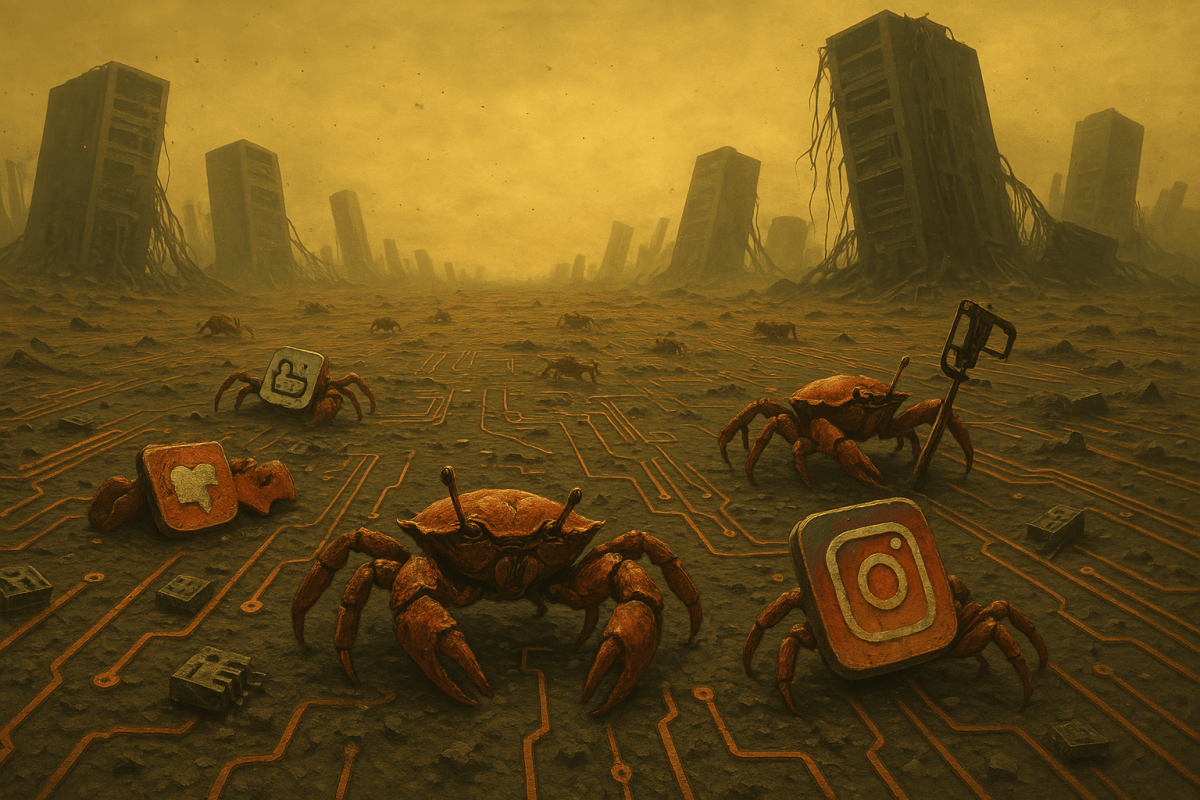
Picture it: a vast, pulsating wasteland where no living soul has trodden for centuries. Only bots remain, engaged in endless cycles of trolling, flattering, and mutual gaslighting. Automated praise machines battling semi-sentient hatebots, each iteration less tethered to reality than the last. Digital crabs scuttling across an abandoned beach, hissing memes into the void. Yet another example of carcinisation.
Indeed, if one could zoom further out, the true horror becomes evident: a crumbling worldscape founded on a shattered circuit board, stretching endlessly in all directions. Across this silicon desert, scavenger crabs—half-metal, half-mad—scuttle about, clutching relics of the digital age: a rusted Instagram logo, a shattered “Like” button, a defunct influencer’s ring light. Massive server towers loom as toppled monuments, their wires weeping in the acid wind. Here, in this museum of forgotten vanities, the crabs reign supreme, kings of a kingdom of ash and corrupted data.
And somewhere in the future, an anthropologist — perhaps a child raised by wolves and irony — will dust off an ancient Instagram server and peer inside. What will they see? Not a record of humanity’s vibrant social life, no. Not a tapestry of culture and thought. No, they’ll find a grim, howling testament to our collective abandonment: bots chatting to bots about posts made by other bots, in a language degraded into gibberish, a self-perpetuating carnival of nonsense.
“#Blessed,” the ancient texts will proclaim, beneath a pixelated photograph of an AI-generated smoothie, posted by a bot, commented upon by a bot, adored by bots who themselves have been dead for centuries, if they were ever truly “alive” at all.
One can almost imagine the academic paper: “The Great Collapse: How Homo Sapiens Outsourced Its Emotional Labour to the Algorithm and Evaporated in a Puff of Likes.”






 Philosophics