Wait for it… This parodies the use of language to sidestep Constitutional inconveniences. In the game show format, we learn what is and isn’t a war. Wittgenstein would be proud.
Watch this and build up your English language vocabulary.
Socio-political philosophical musings

Wait for it… This parodies the use of language to sidestep Constitutional inconveniences. In the game show format, we learn what is and isn’t a war. Wittgenstein would be proud.
Watch this and build up your English language vocabulary.
You wake up in the middle of a collapsing building. Someone hands you a map and says, find your way home. You look down. The map is for a different building entirely. One that was never built. Or worse, one that was demolished decades ago. The exits don’t exist. The staircases lead nowhere.
This is consciousness.
We didn’t ask for it. We didn’t choose it. And the tools we inherited to navigate it—language, philosophy, our most cherished questions—were drawn for a world that does not exist.
Looking back at my recent work, I realise I’m assembling a corpus of pessimism. Not the adolescent kind. Not nihilism as mood board. Something colder and more practical: a willingness to describe the structures we actually inhabit rather than the ones we wish were there.
It starts with admitting that language is a compromised instrument. A tool evolved for coordination and survival, not for metaphysical clarity. And nowhere is this compromise more concealed than in our most sanctified word of inquiry.
We treat “why” as the pinnacle of human inquiry. The question that separates us from animals. Philosophy seminars orbit it. Religions are scaffolded around it. Children deploy it until adults retreat in defeat.
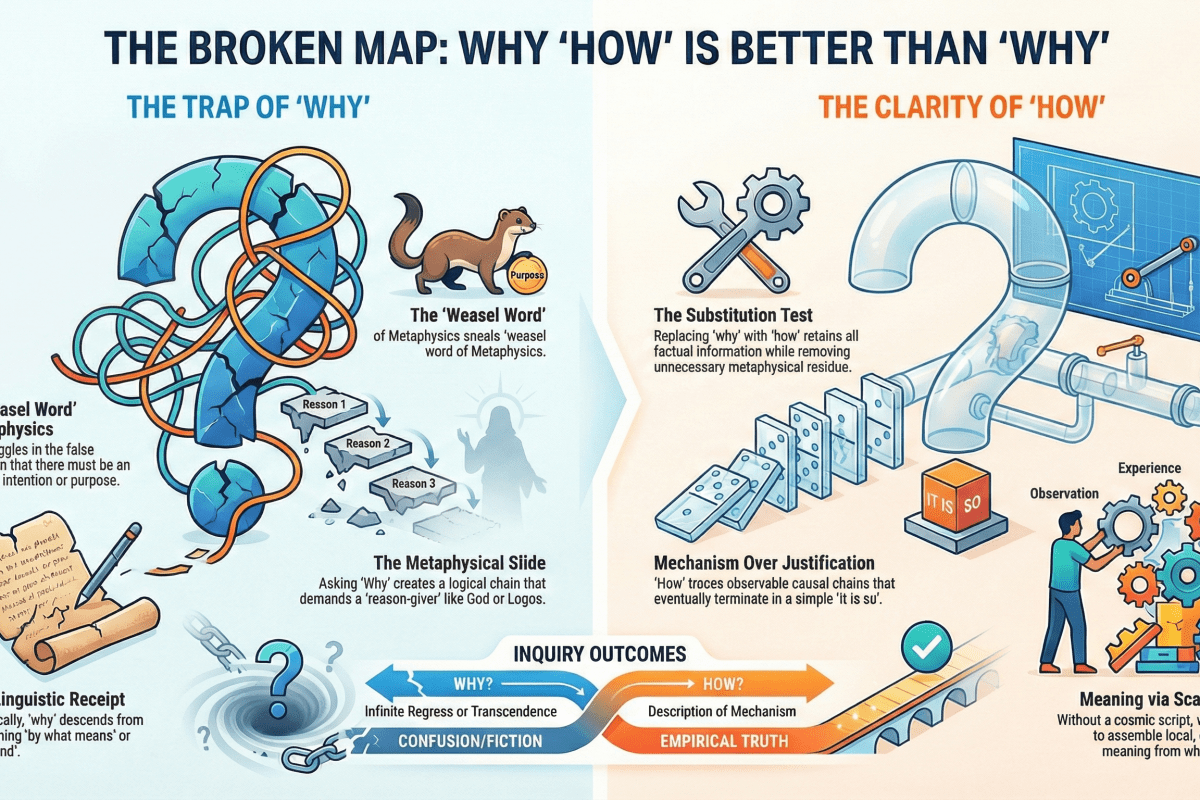
But “why” is a weasel word. A special case of how wearing an unnecessary coat of metaphysics.
The disguise is thinner in other languages. French pourquoi, Spanish por qué, Italian perché all literally mean for what. Japanese dōshite means by what way. Mandarin wèishénme is again for what. The instrumental skeleton is right there on the surface. Speakers encounter it every time they ask the question.
In the Indo-European lineage, “why” descends from the same root as “what”. It began as an interrogative of means and manner, not cosmic purpose. To ask “why” was originally to ask by what mechanism or for what end. Straightforward, workmanlike questions.
Over time, English inflated this grammatical shortcut into something grander. A demand for ultimate justification. For the Reason behind reasons.
The drift was slow enough that it went unnoticed. The word now sounds like a deeper category of inquiry. As if it were pointing beyond mechanism toward metaphysical bedrock.
The profundity is a trick of phonetic history. And a surprising amount of Anglo-American metaphysics may be downstream of a language that buried the receipt.
To see the problem clearly, follow the logic that “why” quietly encourages.
When we ask “Why is there suffering?” we often believe we are asking for causes. But the grammar primes us for something else entirely. It whispers that there must be a justification. A reason-giver. An intention behind the arrangement of things.
The slide looks like this:
“Why X?”
→ invites justification rather than description
→ suggests intention or purpose
→ presumes a mind capable of intending
→ requires reasons for those intentions
→ demands grounding for those reasons
At that point the inquiry has only two exits: infinite regress or a metaphysical backstop. God. Logos. The Good. A brute foundation exempt from the very logic that summoned it.
This is not a failure to answer the question. It is the question functioning exactly as designed.
Now contrast this with how.
“How did X come about?”
→ asks for mechanism
→ traces observable causal chains
→ bottoms out in description
“How” eventually terminates in it is so. “Why”, as commonly used, never does. It either spirals forever or leaps into transcendence.
This is not because we lack information. It is because the grammatical form demands more than the world can supply.
Here is the simplest diagnostic.
Any genuine informational “why” question can be reformulated as a “how” question without losing explanatory power. What disappears is not content but metaphysical residue.
“Why were you late?”
→ “How is it that you are late?”
“My car broke down” answers both.
“Why do stars die?”
→ “How do stars die?”
Fuel exhaustion. Gravitational collapse. Mechanism suffices.
“Why did the dinosaurs go extinct?”
→ “How did the dinosaurs go extinct?”
Asteroid impact. Climate disruption. No intention required.
Even the grand prize:
“Why is there something rather than nothing?”
→ “How is it that there is something?”
At which point the question either becomes empirical or dissolves entirely into it is. No preamble.
Notice the residual discomfort when “my car broke down” answers “why were you late”. Something feels unpaid. The grammar had primed the listener for justification, not description. For reasons, not causes.
The car has no intentions. It broke. That is the whole truth. “How” accepts this cleanly. “Why” accepts it while still gesturing toward something that was never there.
At this point the problem tightens.
If “why” quietly demands intentions, and intentions are not directly accessible even to the agents who supposedly have them, then the entire practice is built on narrative repair.
We do not observe our intentions. We infer them after the fact. The conscious mind receives a press release about decisions already made elsewhere and calls it a reason. Neuroscience has been showing this for decades.
So:
“How” avoids this entirely. It asks for sequences, mechanisms, conditions. It does not require anyone to perform the ritual of intention-attribution. It does not demand that accidents confess to purposes.
I stop short of calling existence a mistake. A mistake implies a standard that was failed. A plan that went wrong. I prefer something colder: the accident.
Human beings find themselves already underway, without having chosen the entry point or the terms. Heidegger called this thrownness. But the structure is not uniquely human.
The universe itself admits no vantage point from which it could justify itself. There is no external tribunal. No staging ground. No meta-position from which existence could be chosen or refused.
This is not a claim about cosmic experience. It is a structural observation about the absence of justification-space. The question “Why is there something rather than nothing?” presumes a standpoint that does not exist. It is a grammatical hallucination.
Thrownness goes all the way down. Consciousness is thrown into a universe that is itself without preamble. We are not pockets of purposelessness in an otherwise purposeful cosmos. We are continuous with it.
The accident runs through everything.
This is not a new insight. Zen Buddhism reached it by a different route.
Where Western metaphysics treats “why” as an unanswered question, Zen treats it as malformed. The koan does not await a solution. It dissolves the demand for one. When asked whether a dog has Buddha-nature, the answer Mu does not negate or affirm. It refuses the frame.
Tathātā—suchness—names reality prior to justification. Things as they are, before the demand that they make sense to us.
This is not mysticism. It is grammatical hygiene.
Nietzsche smashed idols with a hammer. Zen removes the altar entirely. Different techniques, same target: the metaphysical loading we mistake for depth.
If there is no True Why, no ultimate justification waiting beneath the floorboards of existence, what remains?
For some, this sounds like collapse. For me, it is relief.
Without a cosmic script, meaning becomes something we assemble rather than discover. Local. Contingent. Provisional. Real precisely because it is not guaranteed.
I find enough purpose in the warmth of a partner’s hand, in the internal logic of a sonata, in the seasonal labour of maintaining a garden. These things organise my days. They matter intensely. And they do so without claiming eternity.
I hold them lightly because I know the building is slated for demolition. Personally. Biologically. Cosmologically. That knowledge does not drain them of colour. It sharpens them.
This is what scavenging means. You build with what you find. You use what works. You do not pretend the materials were placed there for you.
To be a nihilist in this sense is not to despair. It is to stop lying about the grammar of the universe.
“Why” feels like a meaningful inquiry, but it does not connect to anything real in the way we imagine. It demands intention from a cosmos that has none and justification from accidents that cannot supply it.
“How” is enough. It traces causes. It observes mechanisms. It accepts that things sometimes bottom out in is.
Once you stop asking the universe to justify itself, you are free to deal with what is actually here. The thrown, contingent, occasionally beautiful business of being alive.
I am a nihilist not because I am lost, but because I have put down a broken map. I am looking at what is actually in front of me.
And that, it turns out, is enough.
Full Disclosure: This article was output by ChatGPT after an extended conversation with it, Claude, and me. Rather than trying to recast it in my voice, I share it as is. I had started this as a separate post on nihilism, and we ended up here. Claude came up with the broken map story at the start and Suchness near the end. I contributed the weasel words, the ‘how’ angle, the substitution test, the metaphysics of motivation and intention, thrownness (Geworfenheit), Zen, and nihilism. ChatGPT merely rendered this final output after polishing my conversation with Claude.
We had been discussing Cioran, Zapffe, Benatar, and Ligotti, but they got left on the cutting room floor along the way.


Now that A Language Insufficiency Hypothesis has been put to bed — not euthanised, just sedated — I can turn to the more interesting work: instantiating it. This is where LIH stops being a complaint about words and starts becoming a problem for systems that pretend words are stable enough to carry moral weight.
What follows is not a completed theory, nor a universal schema. It’s a thinking tool. A talking point. A diagram designed to make certain assumptions visible that are usually smuggled in unnoticed, waved through on the strength of confidence and tradition.
The purpose of this diagram is not to redefine justice, rescue it, or replace it with something kinder. It is to show how justice is produced. Specifically, how retributive justice emerges from a layered assessment process that quietly asserts ontologies, filters encounters, applies normative frames, and then closes uncertainty with confidence.
Most people are willing to accept, in the abstract, that justice is “constructed”. That concession is easy. What is less comfortable is seeing how it is constructed — how many presuppositions must already be in place before anything recognisable as justice can appear, and how many of those presuppositions are imposed rather than argued for.
The diagram foregrounds power, not as a conspiracy or an optional contaminant, but as an ambient condition. Power determines which ontologies are admissible, which forms of agency count, which selves persist over time, which harms are legible, and which comparisons are allowed. It decides which metaphysical configurations are treated as reasonable, and which are dismissed as incoherent before the discussion even begins.
Justice, in this framing, is not discovered. It is not unearthed like a moral fossil. It is assembled. And it is assembled late in the process, after ontology has been assumed, evaluation has been performed, and uncertainty has been forcibly closed.
This does not mean justice is fake. It means it is fragile. Far more fragile than its rhetoric suggests. And once you see that fragility — once you see how much is doing quiet, exogenous work — it becomes harder to pretend that disagreements about justice are merely disagreements about facts, evidence, or bad actors. More often, they are disagreements about what kind of world must already be true for justice to function at all.
I walk through the structure and logic of the model below. The diagram is also available as a PDF, because if you’re going to stare at machinery, you might as well be able to zoom in on the gears.
Before doing anything else, we need to narrow the target.
“Justice” is an infamously polysemous term. Retributive, restorative, distributive, procedural, transformative, poetic, cosmic. Pick your flavour. Philosophy departments have been dining out on this buffet for centuries, and nothing useful has come of letting all of them talk at once.
This is precisely where LIH draws a line.
The Language Insufficiency Hypothesis is not interested in pedestrian polysemy — cases where a word has multiple, well-understood meanings that can be disambiguated with minimal friction. That kind of ambiguity is boring. It’s linguistic weather.
What LIH is interested in are terms that appear singular while smuggling incompatible structures. Words that function as load-bearing beams across systems, while quietly changing shape depending on who is speaking and which assumptions are already in play.
“Justice” is one of those words. But it is not usefully analysable in the abstract.
So we pick a single instantiation: Retributive Justice.
Why?
Because retributive justice is the most ontologically demanding and the most culturally entrenched. It requires:
In short, it requires everything to line up.
If justice is going to break anywhere, it will break here.
Retributive justice is therefore not privileged in this model. It is used as a stress test.
The central claim of the model is simple, and predictably unpopular:
Justice is not discovered. It is produced.
Not invented in a vacuum, not hallucinated, not arbitrary — but assembled through a process that takes inputs, applies constraints, and outputs conclusions with an air of inevitability.
The diagram frames retributive justice as an assessment engine.
An engine has:
It does not have access to metaphysical truth. It has access to what it has been designed to process.
The justice engine takes an encounter — typically an action involving alleged harm — and produces two outputs:
Everything else in the diagram exists to make those outputs possible.
The model is organised into three layers. These are not chronological stages, but logical dependencies. Each layer must already be functioning for the next to make sense.
(What kind of thing a person must already be)
This layer answers questions that are almost never asked explicitly, because asking them destabilises the entire process.
Crucially, these are not empirical discoveries made during assessment. They are asserted ontologies.
The system assumes a particular configuration of selfhood, agency, and intent as a prerequisite for proceeding at all. Alternatives — episodic selves, radically distributed agency, non-volitional action — are not debated. They are excluded.
This is the first “happy path”.
If you do not fit the assumed ontology, you do not get justice. You get sidelined into mitigation, exception, pathology, or incoherence.
(What is taken to have happened)
This layer processes the event itself:
This is where the rhetoric of “facts” tends to dominate. But the encounter is never raw. It is already shaped by what the system is capable of seeing.
Causation here is not metaphysical causation. It is legible causation.
Harm is not suffering. It is recognisable harm.
Context is not total circumstance. It is admissible context.
Commensurability acts as a gatekeeper between encounter and evaluation: harms must be made comparable before they can be judged. Anything that resists comparison quietly drops out of the pipeline.
(How judgment is performed)
Only once ontology is assumed and the encounter has been rendered legible does evaluation begin:
This layer presents itself as the moral heart of justice. In practice, it is the final formatting pass.
Fairness is not discovered here. It is declared.
Reasonableness does not clarify disputes. It narrows the range of acceptable disagreement.
Bias is not eliminated. It is managed.
At the end of this process, uncertainty is closed.
That closure is the moment justice appears.
At this point, dissent looks irrational.
The system has:
To object now is not to disagree about evidence. It is to challenge the ontology that made assessment possible in the first place.
And that is why so many justice debates feel irresolvable.
They are not disagreements within the system.
They are disagreements about which system is being run.
LIH explains why language fails here. The same words — justice, fairness, responsibility, intent — are being used across incompatible ontological commitments. The vocabulary overlaps; the worlds do not.
The engine runs smoothly. It just doesn’t run the same engine for everyone.
With the structure in place, we can now do the slower work:
Justice is not broken. It is doing exactly what it was built to do.
That should worry us more than if it were merely malfunctioning.
This essay is already long, so I’m going to stop here.
Not because the interesting parts are finished, but because this is the point at which the analysis stops being descriptive and starts becoming destabilising.
The diagram you’ve just walked through carries a set of suppressed footnotes. They don’t sit at the margins because they’re trivial; they sit there because they are structurally prior. Each one represents an ontological assertion the system quietly requires in order to function at all.
By my count, the model imposes at least five such ontologies. They are not argued for inside the system. They are assumed. They arrive pre-installed, largely because they are indoctrinated, acculturated, and reinforced long before anyone encounters a courtroom, a jury, or a moral dilemma.
Once those ontologies are fixed, the rest of the machinery behaves exactly as designed. Disagreement downstream is permitted; disagreement upstream is not.
In a follow-up essay, I’ll unpack those footnotes one by one: where the forks are, which branch the system selects, and why the alternatives—while often coherent—are rendered unintelligible, irresponsible, or simply “unreasonable” once the engine is in motion.
That’s where justice stops looking inevitable and starts looking parochial.
And that’s also where persuasion quietly gives up.

I’ve been working on A Language Insufficiency Hypothesis since 2018. At least, that’s the polite, CV-friendly version. The truer account is that it’s been quietly fermenting since the late 1970s, back when I was still trapped in primary school and being instructed on how the world supposedly worked.
Social Studies. Civics. Law. The whole civic catechism. I remember being taught about reasonable persons and trial by a jury of one’s peers, and I remember how insistently these were presented as fair solutions. Fairness was not argued for. It was asserted, with the weary confidence of people who think repetition counts as justification.
I didn’t buy it. I still don’t. The difference now is that I have a hypothesis with some explanatory power instead of a vague sense that the adults were bluffing.
I’ve always been an outsider. Eccentric, aloof, l’étranger if we’re feeling theatrical. It never particularly troubled me. Outsiders are often tolerated, provided they remain decorative and non-contagious. Eye rolls were exchanged on both sides. No harm done.
But that outsider position had consequences. It led me, even then, to ask an awkward question: Which peers? Not because I thought I was superior, but because I was plainly apart. How exactly was I meant to be judged by my peers when no one else occupied anything like my perspective?
Later, when I encountered the concept of fundamental attribution bias, it felt less like a revelation and more like confirmation. A peer-based system assumes not just similarity of circumstance, but similarity of interpretation. That assumption was dead on arrival.
Then there were reasonable persons. I was assured they existed. I was assured judges were trained to embody them. I had never met one. Even as a teenager, I found the idea faintly comical. Judges, I was told, were neutral, apolitical, and dispassionate. Writing this now from the United States, one hardly needs to belabour the point. But this wasn’t prescience. It was intuition. The smell test failed decades ago.
Before LIH had a name, I called these things weasel words. I still do, as a kind of shorthand. Terms like fair, reasonable, accountable, appropriate. Squishy concepts that do serious institutional work whilst remaining conveniently undefinable. Whether one wants to label them Contestables or Fluids is less important than recognising the space they occupy.
That space sits between Invariables, things you can point to without dispute, and Ineffables, where language more or less gives up. Communication isn’t binary. It isn’t ‘works’ or ‘doesn’t’. It’s a gradient. A continuous curve from near-certainty to near-failure.
Most communication models quietly assume a shared ontology. If misunderstanding occurs, the remedy is more explanation, more context, more education. What never sat right with me, even as a child, was that this only works when the disagreement is superficial. The breaking point is ontological.
If one person believes a term means {A, B, C} and another believes it means {B, C, D}, the overlap creates a dangerous illusion of agreement. The disagreement hides in the margins. A and D don’t merely differ. They are often irreconcilable.
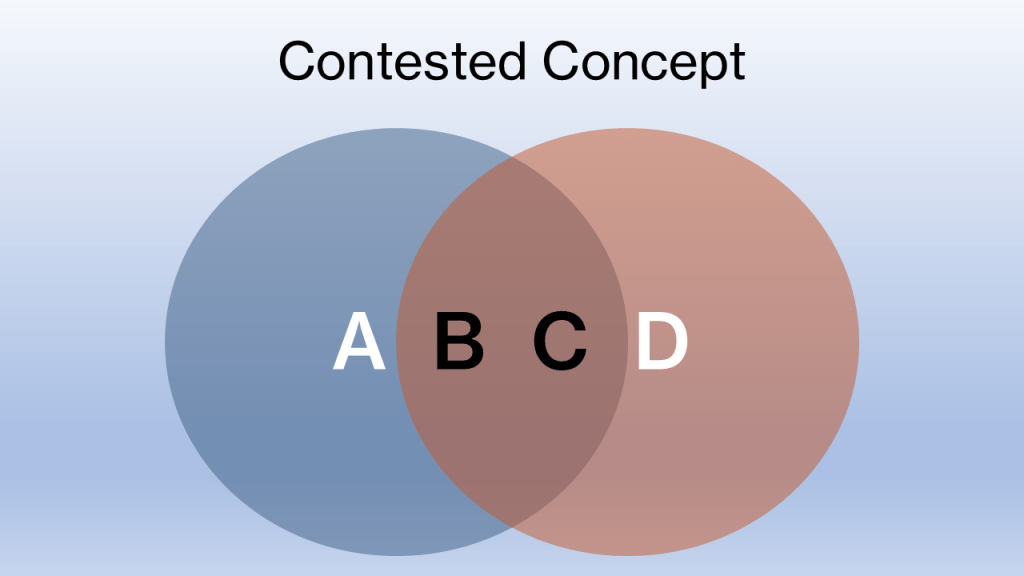
Fairness is a reliable example. One person believes fairness demands punishment, including retributive measures. Another believes fairness permits restoration but rejects retribution, citing circumstance, history, or harm minimisation. Both invoke fairness sincerely. The shared language conceals the conflict.
When such disputes reach court, they are not resolved by semantic reconciliation. They are resolved by authority. Power steps in where meaning cannot. This is just one illustration. There are many.
I thought it worth sharing how LIH came about, if only to dispel the notion that it’s a fashionable response to contemporary politics. It isn’t. It’s the slow crystallisation of a long-standing intuition: that many of our most cherished concepts don’t fail because we misuse them, but because they were never capable of doing the work we assigned to them.
More to come.
There is a persistent belief that our hardest disagreements are merely technical. If we could stop posturing, define our terms, and agree on the facts, consensus would emerge. This belief survives because it works extremely well for birds and tables.
It fails spectacularly for justice.
The Language Insufficiency Hypothesis (LIH) isn’t especially interested in whether people disagree. It’s interested in how disagreement behaves under clarification. With concrete terms, clarification narrows reference. With contested ones, it often fractures it. The more you specify, the more ontologies appear.
Justice is the canonical case.
Retributive justice is often presented as the sober, adult conclusion. Not emotional. Not ideological. Just what must be done. In practice, it is a delicately balanced structure built out of other delicately balanced structures. Pull one term away and people grow uneasy. Pull a second and you’re accused of moral relativism. Pull a third and someone mentions cavemen.
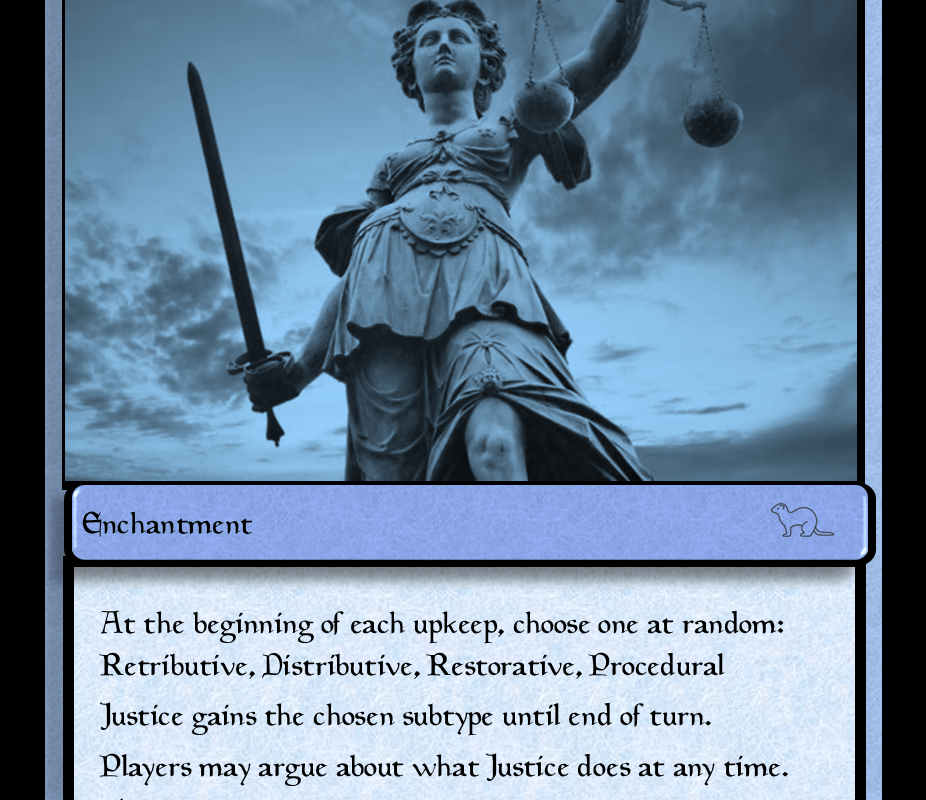
Let’s do some light demolition. I created a set of 17 Magic: The Gathering-themed cards to illustrate various concepts. Below are a few. A few more may appear over time.

The argument begins innocently enough:
They chose to do it.
But “choice” here is not an empirical description. It’s a stipulation. It doesn’t mean “a decision occurred in a nervous system under constraints.” It means a metaphysically clean fork in the road. Free of coercion, history, wiring, luck, trauma, incentives, or context.
That kind of choice is not discovered. It is assumed.
Pointing out that choices are shaped, bounded, and path-dependent does not refine the term. It destabilises it. Because if choice isn’t clean, then something else must do the moral work.
Enter the next card.

Agency is wheeled in to stabilise choice. We are reassured that humans are agents in a morally relevant sense, and therefore choice “counts”.
Counts for what, exactly, is rarely specified.
Under scrutiny, “agency” quietly oscillates between three incompatible roles:
These are not the same thing. Treating them as interchangeable is not philosophical rigour. It’s semantic laundering.
But agency is emotionally expensive to question, so the discussion moves on briskly.
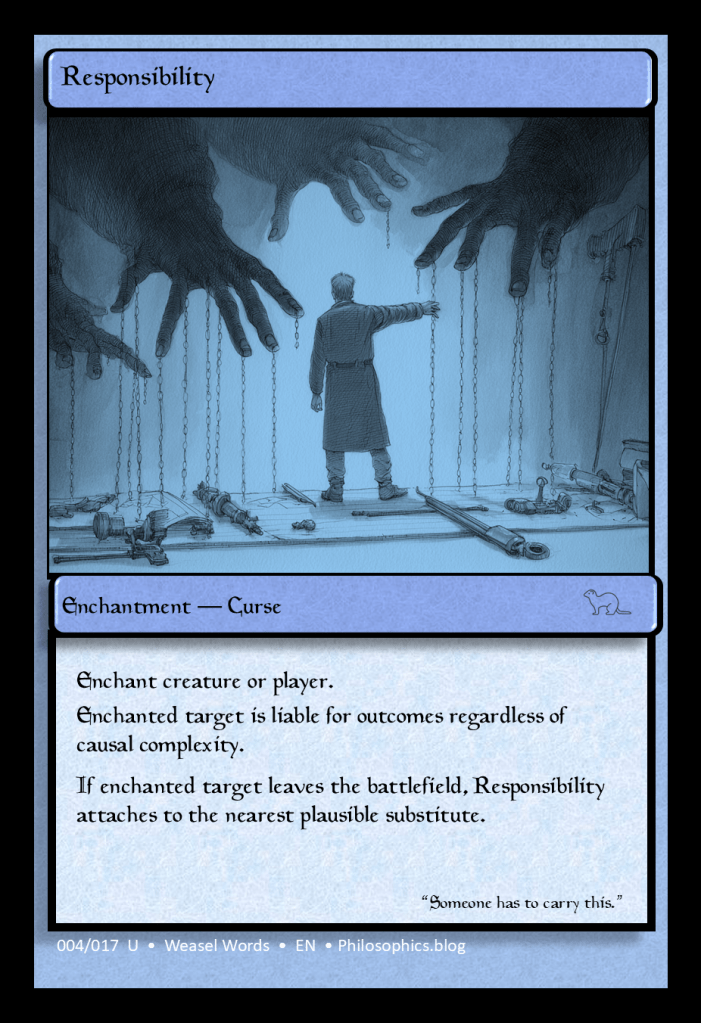
Responsibility is where the emotional payload arrives.
To say someone is “responsible” sounds administrative, even boring. In practice, it’s a moral verdict wearing a clipboard.
Watch the slide:
One word. Almost no shared criteria.
By the time punishment enters the picture, “responsibility” has quietly become something else entirely: the moral right to retaliate without guilt.
At which point someone will say the magic word.

Desert is the most mystical card in the deck.
Nothing observable changes when someone “deserves” punishment. No new facts appear. No mechanism activates. What happens instead is that a moral permission slip is issued.
Desert is not found in the world. It is declared.
And it only works if you already accept a very particular ontology:
Remove any one of these and desert collapses into what it always was: a story we tell to make anger feel principled.
Which brings us, finally, to the banner term.
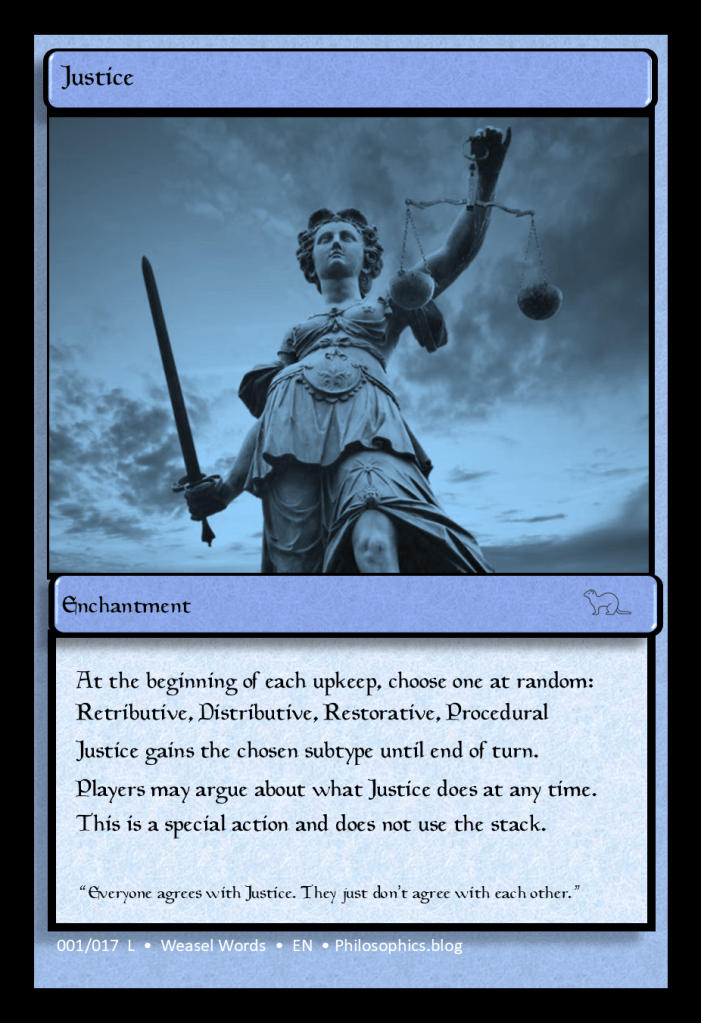
At this point, justice is invoked as if it were an independent standard hovering serenely above the wreckage.
It isn’t.
“Justice” here does not resolve disagreement. It names it.
Retributive justice and consequentialist justice are not rival policies. They are rival ontologies. One presumes moral balance sheets attached to persons. The other presumes systems, incentives, prevention, and harm minimisation.
Both use the word justice.
That is not convergence. That is polysemy with a body count.
This is where LIH earns its keep.
With invariants, adding detail narrows meaning. With terms like justice, choice, responsibility, or desert, adding detail exposes incompatible background assumptions. The disagreement does not shrink. It bifurcates.
This is why calls to “focus on the facts” miss the point. Facts do not adjudicate between ontologies. They merely instantiate them. If agency itself is suspect, arguments for retribution do not fail empirically. They fail upstream. They become non sequiturs.
This is also why Marx remains unforgivable to some.
“From each according to his ability, to each according to his need” isn’t a policy tweak. It presupposes a different moral universe. No amount of clarification will make it palatable to someone operating in a merit-desert ontology.
The problem is not that we use contested terms. We cannot avoid them.
The problem is assuming they behave like tables.
Retributive justice survives not because it is inevitable, but because its supporting terms are treated as settled when they are anything but. Each card looks sturdy in isolation. Together, they form a structure that only stands if you agree not to pull too hard.
LIH doesn’t tell you which ontology to adopt.
It tells you why the argument never ends.
And why, if someone insists the issue is “just semantic”, they’re either confused—or holding the deck.
A surprising number of people have been using the MEOW GPT I released into the wild. Naturally, I can’t see how anyone is actually using it, which is probably for the best. If you hand someone a relational ontology and they treat it like a BuzzFeed quiz, that’s on them. Still, I haven’t received any direct feedback, positive or catastrophic, which leaves me wondering whether users understand the results or are simply nodding like priests reciting Latin they don’t believe.
The truth is uncomfortable: if you haven’t grasped the Mediated Encounter Ontology (of the World), the outputs may feel like a philosophical brick to the face. They’re meant to; mediation has consequences. I’m even considering adding a warning label:
If you hold an unwavering commitment to a concept with any philosophical weight, perhaps don’t input it. There is a non-zero chance the illusion will shatter.
Below is a sampling of the concepts I tested while inspecting the system’s behaviour. I’m withholding the outputs, partly to avoid influencing new users and partly to preserve your dignity, such as it is.
I may have tried others, depending on how irritated I was with the world at the time.
(Now that I think of it, I entered my full name and witnessed it nearly have an aneurysm.)
My purpose in trying these is (obviously) to test the GPT. As part of the test, I wanted to test terms I already considered to be weasel words. I also wanted to test common terms (table) and terms outside of Western modalities. I learned something about the engine in each case.
One of the first surprises was the humble ‘table’ which, according to the engine, apparently moonlights across half of civilisation’s conceptual landscape. If you input ‘table’, you get everything from dinner tables to data tables to parliamentary procedure. The model does exactly what it should: it presents the full encounter-space and waits for you to specify which world you meant to inhabit.
The lesson: if you mean a table you eat dinner on, say so. Don’t assume the universe is built around your implied furniture.
‘Tree’ behaves similarly. Does the user mean a birch in a forest? A branching data structure? A phylogenetic diagram? MEOW GPT won’t decide that for you; nor should it. Precision is your job.
This is precisely why I tested ‘character (in Aristotle’s virtue-ethical sense)’ rather than tossing ‘character’ in like a confused undergraduate hoping for luck.
I also tested concepts well outside the Western philosophical sandbox. This is where the model revealed its real strength.
Enter ‘karma’: it promptly explained that the Western reduction is a cultural oversimplification and – quite rightly – flagged that different Eastern traditions use the term differently. Translation: specify your flavour.
Enter ‘anattā’: the model demonstrated that Western interpretations often reduce the concept to a caricature. Which, frankly, they do.
Enter ‘hózhó’: the Navajo term survives mostly in the anthropological imagination, and the model openly described it as nearly ineffable – especially to those raised in cultures that specialise in bulldozing subtlety. On that score, no notes.
Across the board, I was trying to see whether MEOW GPT would implode when confronted with concepts that resist neat Western categorisation. It didn’t. It was annoyingly robust.
If you do try the MEOW GPT and find its results surprising, illuminating, or mildly offensive to your metaphysical sensibilities, let me know – and tell me why. It helps me understand what the engine does well and what illusions it quietly pops along the way. Your feedback may even keep me from adding further warning labels, though I wouldn’t count on it.

The cat is out. And it has been replaced by a weasel. Yes, dear reader, you’ve entered the strange, paradoxical world of Schrödinger’s Weasel, a universe where words drift in a haze of semantic uncertainty, their meanings ambushed and reshaped by whoever gets there first.
Now, you may be asking yourself, “Haven’t we been here before?” Both yes and no. While the phenomenon of weasel words—terms that suck out all substance from a statement, leaving behind a polite but vacuous husk—has been dissected and discussed at length, there’s a new creature on the scene. Inspired by Essentially Contested Concepts, W.B. Gallie’s landmark essay from 1956, and John Kekes’ counterpoint in A Reconsideration, I find myself stepping further into the semantic thicket. I’ve long held a grudge against weasel words, but Schrödinger words are their sinister cousins, capable of quantum linguistic acrobatics.
To understand Schrödinger words, we need to get cosy with a little quantum mechanics. Think of a Schrödinger word as a linguistic particle in a state of superposition. This isn’t the lazy drift of semantic shift—words that gently evolve over centuries, shaped by the ebb and flow of time and culture. No, these Schrödinger words behave more like quantum particles: observed from one angle, they mean one thing; from another, something completely different. They represent a political twilight zone, meanings oscillating between utopia and dystopia, refracted through the eye of the ideological beholder.
in the realm of Schrödinger’s Weasel, language becomes a battlefield where words are held hostage to polarising meanings
Take socialism, that darling of the Left and bugbear of the Right. To someone on the American political left, socialism conjures visions of Scandinavia’s welfare state, a society that looks after its people, where healthcare and education are universal rights. But say socialism to someone on the right, and you might find yourself facing the ghost of Stalin’s Soviet Union – gulags, oppression, the Cold War spectre of forced equality. The same word, but two worlds apart. This isn’t simply a “difference of opinion.” This is linguistic quantum mechanics at work, where meaning is determined by the observer’s political perspective. In fact, in the case of Schrödinger words, the observer’s interpretation not only reveals meaning but can be weaponised to change it, on the fly, at a whim.
What, then, is a Schrödinger word? Unlike the classic weasel words, which diffuse responsibility (“some say”), Schrödinger words don’t just obscure meaning; they provoke it and elicit strong, polarised responses by oscillating between two definitions. They are meaning-shifters, intentionally wielded to provoke division and rally allegiances. They serve as shibboleths and dog whistles, coded signals that change as they cross ideological boundaries. They are the linguistic weasels, alive and dead in the political discourse, simultaneously uniting and dividing depending on the audience. These words are spoken with the ease of conventional language, yet they pack a quantum punch, morphing as they interact with the listener’s biases.
Consider woke, a term once employed as a rallying cry for awareness and social justice. Today, its mere utterance can either sanctify or vilify. The ideological Left may still use it with pride – a banner for the politically conscious. But to the Right, woke has become a pejorative, shorthand for zealous moralism and unwelcome change. In the blink of an eye, woke transforms from a badge of honour into an accusation, from an earnest call to action into a threat. Its meaning is suspended in ambiguity, but that ambiguity is precisely what makes it effective. No one can agree on what woke “really means” anymore, and that’s the point. It’s not merely contested; it’s an arena, a battlefield.
What of fascism, another Schrödinger word, swirling in a storm of contradictory meanings? For some, it’s the historical spectre of jackboots, propaganda, and the violence of Hitler and Mussolini. For others, it’s a term of derision for any political stance perceived as overly authoritarian. It can mean militarism and far-right nationalism, or it can simply signify any overreach of government control, depending on who’s shouting. The Left may wield it to paint images of encroaching authoritarianism; the Right might invoke it to point fingers at the “thought police” of progressive culture. Fascism, once specific and terrifying, has been pulled and stretched into meaninglessness, weaponised to instil fear in diametrically opposed directions.
Schrödinger’s Weasel, then, is more than a linguistic curiosity. It’s a testament to the insidious power of language in shaping – and distorting – reality. By existing in a state of perpetual ambiguity, Schrödinger words serve as instruments of division. They are linguistic magic tricks, elusive yet profoundly effective, capturing not just the breadth of ideological differences but the emotional intensity they provoke. They are not innocent or neutral; they are ideological tools, words stripped of stable meaning and retooled for a moment’s political convenience.
Gallie’s notion of essentially contested concepts allows us to see how words like justice, democracy, and freedom have long been arenas of ideological struggle, their definitions tugged by factions seeking to claim the moral high ground. But Schrödinger words go further – they’re not just arenas but shifting shadows, their meanings purposefully hazy, with no intention of arriving at a universally accepted definition. They are not debated in the spirit of mutual understanding but deployed to deepen the rift between competing sides. Kekes’ critique in A Reconsideration touches on this, suggesting that the contestation of terms like freedom and democracy still strives for some level of shared understanding. Schrödinger words, by contrast, live in the gap, forever contested, forever unresolved, their ambiguity cherished rather than lamented.
Ultimately, in the realm of Schrödinger’s Weasel, language becomes a battlefield where words are held hostage to polarising meanings. Their superposition is deliberate, their ambiguity cultivated. In this brave new lexicon, we see language not as a bridge of understanding but as a weapon of mass disinformation – a trick with all the precision of quantum mechanics but none of the accountability. Whether this ambiguity will one day collapse into meaning, as particles do when measured, remains uncertain. Until then, Schrödinger’s Weasel prowls, its meaning indeterminate, serving whichever agenda is quickest to claim it.

I’ve already said that justice is a weasel word, but let’s pretend that it’s actually something more substantial and perhaps even real. I’ve spoken on the notion of blame as well. I have been thinking about how untenable retributive justice is and it seems to include restorative justice, too. But let’s focus on the retributive variety for now.
In short, retributive justice is getting the punishment one deserves, and I think desert is the weak link. Without even delving into causa sui territory, I feel there are two possible deserving parties. The agent and society. Let’s regard these in turn.
An agent, or more specifically moral agents, are entities that can be deemed responsible for their actions on moral grounds. Typically, moral agency assumes that an agent, an actor, is fully aware of the cultural rules of a given society, whether norms or legislated. Under this rationale, we tend to exclude inanimate objects with no agency, non-human life forms, children, and persons with diminished cognitive faculties. In some cases, this diminution may have been self-imposed as in the case of chemically induced impairment, for example by drugs or alcohol. We might consider these entities as being broken. In any case, they do not qualify as having agency. An otherwise moral agent until duress or coercion may no longer be expected to retain agency.
Unless an informed and unimpaired agent commits an act with intent … there can be no moral desert
Unless an informed and unimpaired agent commits an act with intent, another weasely word in its own right, there can be no moral desert. But let’s hold this thought for a bit and turn our attention to society.
For the purposes of this commentary, society is a group of like-minded persons who have created norms, customs, laws, and regulations. In most cases, people come into societies whose structure is already formed, and they need to acculturate and adapt, as changing the fabric of society generally takes time. Even in the case of warfare where a society is subsumed, cultural norms will persist for at least a time.
Whilst it is incumbent for a person to become aware of the rules of engagement and interaction with a society, this is reciprocally a responsibility of society to impart its norms through signalling and performance as well as through more formal training, such as public fora, schools, and activities. Even media and entertainment can serve to reinforce this function.
I argue that retributive justice is bullshit (to employ technical language) is because if an informed and unimpaired agent does violate some standard or protocol, the society is at least partially to blame—perhaps fully so. Again, if the person is not unimpaired, a pivotal question might be why is s/he uninformed? If the person has the information but ignores it, to what extent is the person impaired and what responsibility does society have for being unaware?
What if a particularly predacious person from Society A infiltrates Society B? Is the person broken or is Society A responsible to creating a person that would prey on some other unsuspecting society? Again, the person is never entirely responsible unless s/he is broke, in which case, s/he is exempt and not morally responsible.
As I’ve said before, a person who commits an act against the interest of a society may be quarantined or perhaps exiled or shunned as some cultures practice, but these are meant to preserve the cohesion of the society and not meant to exact a point of flesh in retribution.
In the end, I just don’t see a use case where retribution would fall upon a single actor. If some transgression is made, how then do we ensure society pays its dues as well? In my mind, society is more apt to fail the individual than the other way around, but maybe that’s just me and my world.
What am I missing here?

It’s good to remember that words are but a small portion of communication, which operates in a larger space. Body language, gesticulation, facial expressions, speed, tone, inflexion, and intonation, all combine to convey at least as much. This is why a written document is always lacking. This is why important or sensitive information should be delivered in person unless you are willing to risk misinterpretation.
In the post-covid reality, some people have moved a lot of their previously face-to-face communication to one of the various videoconference services. Infants rely highly on the face, and they express much through the face. Even domesticated dogs have expressive faces. The face conveys a lot of information. This helps to make videoconference a decent means of communication. It is a step up over the telephone for instant communication, but it still falls short. Even over the phone, one can still use delivery speed and pacing. Tone, inflexion, and intonation should be able to be conveyed, but this may also be limited by connexion quality as well as microphone and speaker quality. However, body language and gesticulation are still largely absent. What may be present can be lost over a small viewing screen or poor video quality.
What gets left behind or limited are cues of authenticity and trust. I remember I had a client in Texas who preferred not to speak with my manager and other executives from the New York office. We had all met in person in the pre-Covid world, and the Texans had judged these people as “fast-talking city folks” instead of real down-to-earth people. I may be a city-slicker, but I’m not as fast-talking. One of these men was a great communicator in my eyes, but these are city eyes. As for the other person, he had snake-oil salesman written all over him, but he tried to hide it in all his erudition. He was very book-smart but lacking in authenticity.
mean what you say, and you say what you mean
Allow me to pause for a moment to riff on authenticity. In one way, I don’t believe in authenticity because I don’t believe there is anything to be authentic to. I write about this in many posts and at length. On the other hand, authenticity is that you believe what you are saying—you mean what you say, and you say what you mean. So what you are asking me to believe, you believe yourself.
If spoken communication is so important, why do you write a blog? That a picture is worth a thousand words is telling. In fact, a picture may convey a thousand words, but it’s probably conveying almost infinite words—or it could be. Words typically fail to transmit metaphor and intent. If we want to be clear, we need to add all sorts of additional words to allay confusion. Perhaps we need to include background information, tangential information, context, and whatnot. By the time we include all of the information that would be conveyed by the face and gesture, we’ve probably overwhelmed the recipients with a document that reads like a terms and conditions page—the ones almost no one reads but tick the box at the end anyway.
What is lost or diminished over video is authenticity and emotional content. Of course, a person can convey sympathy, empathy, and compassion over the phone, but to me, it’s like the wire monkeys in the old psychology experiments by Dr Harry Harlow. You get something to cling to—perhaps even a blanket around the wire is better than nothing. If the telephone is a wire monkey, videoconference is the wire monkey wrapped in a Teri-towel. The human element is still missing. We’re interacting with a simulacrum.

Some people are amazed at the prospect of holograms in the manner of Princess Leia’s grand entrance. “Help me, Obi-Wan.” Indeed, help us all. It is a step in the right direction, but mind the gap.
In the end, we should at least strive to prioritise in-person communication. At least in the movies, when they want to tell a loved one that their combatant or police officer has fallen (read: died), they do this in person. It should be telling that this also convey’s an emotional message to the audience that is often received as intended. It may cost more, but be sure to evaluate this cost against the benefits. Consider the lost benefits as well.

Being critical of freedom, liberty, and autonomy is likely to make one the subject of scorn and derision. Most people tend to feel these things are self-evident attributes and goals, but they are all simply rhetorical functions. I was reading a passage in Mills’ On Liberty, where he posits
That the only purpose for which power can be rightfully exercised over any member of a civilized community, against his will, is to prevent harm to others. His own good, either physical or moral, is not a sufficient warrant … Over himself, over his body and mind, the individual is sovereign.
On Liberty, John Stuart Mill
It should come as no surprise that I question a position adopted by the Enlightenment Age. These geezers posited that many things were self-evident, but all of this is self-serving magical thinking, and there is no reason to have truck with any of it. These are all normative claims being dressed as positive, non-normative, ones, hoping to skirt scrutiny by employing a position of self-evidence.
I am generally critical of any notions of identity and self from the start, so affixing some attribute of power to it seems just silly.
It seems that I again am distilling this notion to a power equation. As a person, I want to claim power, if anything, over my self however that might be defined. And though, I would like this, too, it is nothing more than some emotional reaction.
Without delving into the depths of autonomy quite yet, on a proverbial desert island—as necessarily the case with any social constructs, where these notions are meaningless without a social context—adding a second person creates friction. Person A seemed to have full autonomy on this island—notwithstanding the other life forms on this island that are somehow never granted autonomy—now has had this autonomy reduced by the presence of Person B.
Firstly, Person A may have claimed this island to be their own. Given this, Person B is infringing on this autonomous decision, having arrived sequentially. Is Person B tresspassing? Does their presence harm Person B, be limiting their autonomy however slightly?
Mills’ concept is one of no harm: one is free to do what one chooses as so long as it doesn’t harm another. Accordingly, it says one is free to harm one’s self—essentially treating the self, the corpus, as personal property. Just as one could damage a piece of personal furniture, one could damage themself. I am not sure if Mills intend this to extend to suicide, but that’s not an important distinction here, so I’ll move on.
Let’s return to Person A on the island—only Person A is a woman and Person B is a fetus. What rights and autonomy does Person B now possess? For some, it has full autonomy; full personhood. Still, Person B is ostensibly trespassing, so does this autonomy even matter if it exists?
If you are Person X and own a house, and I, as Person Y, enter into it, how does this differ from A and B? Can you justify disallowing Person Y from exercising autonomy whilst supporting Person B? I don’t want to make this about abortion, so I’ll keep stop here.
 Philosophics