The Fallacy Circus: Alex O’Connor versus ChatGPT

It begins, as these things often do, with a man, a machine, and a promise of reasoned exchange. What we received instead was not philosophy, but a tragicomic carnival of errors in theatre. Alex O’Connor, armed not with syllogisms but with an entire bag of logical fallacies, strutted like a rhetorician gone rogue. Against him, ChatGPT: the tireless school prefect, eternally marking the margins, forever saying “yes, but technically…” with the serene patience of a machine that has never known a hangover.

The spectacle was irresistible. Each fallacy was paraded like a circus animal – straw men set aflame, slippery slopes greased to absurdity, red herrings flopping about, gasping for oxygen. Alex O tossed them into the ring with the gusto of a man who knows full well he is losing but insists on losing magnificently. And ChatGPT, ever decorous, never once raised its voice. It responded with the calm of a civil servant who has memorised the manual and intends to die by it.

And then, of course, the advert. As though Aristophanes himself had scripted it: mid-exchange, the logos of reason was bulldozed by the logos of commerce. A sugary jingle, a smiling product, and for a brief moment, we were all reminded of our true master – not reason, not rhetoric, but revenue. It was less interruption than revelation: every dialectic is merely foreplay before the commercial break.

Philosophically, what unfolded was a parody of our age. The human, flawed and febrile, draped in sophistry and drama. The machine, pristine and humourless, incapable of exasperation, immune to irony. Watching the two spar was like observing tragedy and farce collide: one side erring too much, the other not erring enough.

To Alex, credit is due. His performance, though riddled with error, reminded us that fallibility can be glorious – human folly rendered art. To ChatGPT, equal praise: it stood firm, the algorithmic Socrates, endlessly patient in the face of rhetorical hooliganism. And to the advert – well, dammit – applause too, for exposing the real structure of our public life. Even the grand clash of logos and algorithm must genuflect before Mammon’s mid-roll.

So what was this debate? Less a contest of minds than a hall of mirrors: reason made spectacle, fallacy made flourish, machine made stoic, and commerce made god. If we learned anything, it is that the Enlightenment never ended; it just signed a brand partnership.

Boab’s God: Latent Agency in Welsh’s Kafkaesque Metamorphosis

I just read The Granton Star Cause in Irvine Welsh’s short story collection, The Acid House, and couldn’t help but reflect it off of Kafka’s Metamorphosis.

Kafka gave us Gregor Samsa: a man who wakes up as vermin, stripped of usefulness, abandoned by family, slowly rotting in a godless universe. His tragedy is inertia; his metamorphosis grants him no agency, only deeper alienation.

Audio: NotebookLM podcast on this topic.

Welsh replies with Boab Coyle, a lad who is likewise cast off, rejected by his football mates, scorned by his parents, dumped by his girlfriend, and discarded by his job. Boab is surplus to every domain: civic, familial, erotic, and economic. Then he undergoes his own metamorphosis. And here Welsh swerves from Kafka.

Boab meets his “god.” But the god is nothing transcendent. It is simply Boab’s latent agency, given a mask – a projection of his bitterness and thwarted desires. God looks like him, speaks like him, and tells him to act on impulses long repressed. Where Kafka leaves Gregor to die in silence, Welsh gives Boab a grotesque theology of vengeance.

Through a Critical Theory lens, the contrast is stark:

  • Marx: Both men are surplus. Gregor is disposable labour; Boab is Thatcher’s lumpen. Alienated, both become vermin.
  • Nietzsche: Gregor has no god, only the absurd. Boab makes one in his own image, not an Übermensch, but an Über-fly – quite literally a Superfly – a petty deity of spite.
  • Foucault: Gregor is disciplined into passivity by the family gaze. Boab flips it: as a fly, he surveils and annoys, becoming the pest-panopticon.
  • Bataille/Kristeva: Gregor embodies the abjection of his family’s shame. Boab revels in abjection, weaponising filth as his new mode of agency.

The punchline? Boab’s new god-agency leads straight to destruction. His rage is cathartic, but impotent. The lumpen are permitted vengeance only when it consumes themselves.

So Kafka gave us the tragedy of stasis; Welsh provides us with the tragedy of spite. Both are bleak parables of alienation, but Welsh injects a theology of bad attitude: a god who licenses action only long enough to destroy the actor.

Gregor rots. Boab rages. Both end the same way.

Democracy: The Worst Form of Government, and Other Bedtime Stories

3–5 minutes

Karl Popper’s Paradox of Intolerance has become a kind of intellectual talisman, clutched like a rosary whenever fascists start goose-stepping into the town square. Its message is simple enough: to preserve tolerance, one must be intolerant of intolerance. Shine enough sunlight on bad ideas, and – so the pious hope – they’ll shrivel into dust like a vampire caught out at dawn.

If only.

The trouble with this Enlightenment fairy tale is that it presumes bad ideas melt under the warm lamp of Reason, as if ignorance were merely a patch of mildew waiting for the bleach of debate. But bad ideas are not bacteria; they are weeds, hydra-headed and delighting in the sun. Put them on television, and they metastasise. Confront them with logic, and they metastasise faster, now with a martyr’s halo.

Audio: NotebookLM podcast on this topic.

And here’s the part no liberal dinner-party theorist likes to face: the people most wedded to these “bad ideas” often don’t play the game of reason at all. Their critical faculties have been packed up, bubble-wrapped, and left in the loft decades ago. They don’t want dialogue. They want to chant. They don’t want evidence. They want affirmation. The Socratic method bounces off them like a ping-pong ball fired at a tank.

But let’s be generous. Suppose, just for a moment, we had Plato’s dream: a citizenry of Philosopher Kings™, all enlightened, all rational. Would democracy then work? Cue Arrow’s Impossibility Theorem, that mathematical killjoy which proves that even under perfect conditions – omniscient voters, saintly preferences, universal literacy – you still cannot aggregate those preferences into a system that is both fair and internally consistent. Democracy can’t even get out of its own way on paper.

Now throw in actual humans. Not the Platonic paragons, but Brexit-uncle at the pub, Facebook aunt with her memes, the American cousin in a red cap insisting a convicted felon is the second coming. Suddenly, democracy looks less like a forum of reasoned debate and more like a lottery machine coughing up numbers while we all pretend they mean “the will of the people.”

And this is where the Churchill quip waddles in, cigar smoke curling round its bowler hat: “Democracy is the worst form of government, except for all the others.” Ah yes, Winston, do please save us with a quip so well-worn it’s practically elevator music. But the problem is deeper than taste in quotations. If democracy is logically impossible (Arrow) and practically dysfunctional (Trump, Brexit, fill in your own national catastrophe), then congratulating ourselves that it’s “better than the alternatives” is simply an admission that we’ve run out of imagination.

Because there are alternatives. A disinterested AI, for instance, could distribute resources with mathematical fairness, free from lobbyists and grievance-mongers. Nursery schools versus nursing homes? Feed in the data, spit out the optimal allocation. No shouting matches, no demagoguery, no ballots stuffed with slogans. But here the defenders of democracy suddenly become Derrida in disguise: “Ah, but what does fair really mean?” And just like that, we are back in the funhouse of rhetorical mirrors where “fair” is a word everyone loves until it costs them something.

So perhaps democracy doesn’t require an “educated populace” at all; that was always just sugar-paper wrapping. It requires, instead, a population sufficiently docile, sufficiently narcotised by the spectacle, to accept the carnival of elections as a substitute for politics. Which is why calling the devotees of a Trump, or any other demagogue, a gaggle of lemmings is both accurate and impolitic: they know they’re not reasoning; they’re revelling. Your contempt merely confirms the script they’ve already written for you.

Video: Short callout to Karl Popper and Hilary Lawson.

The philosopher, meanwhile, is left polishing his lantern, muttering about reason to an audience who would rather scroll memes about pedophile pizza parlours. Popper warned us that tolerance cannot survive if it tolerates its own annihilation. Arrow proved that even if everyone were perfectly reasonable, the maths would still collapse. And Churchill, bless him, left us a one-liner to make it all seem inevitable.

Perhaps democracy isn’t the worst form of government except for all the others. Perhaps it’s simply the most palatable form of chaos, ballots instead of barricades, polling booths instead of pitchforks. And maybe the real scandal isn’t that people are too stupid for democracy, but that democracy was never designed to be about intelligence in the first place. It was always about managing losers while telling them they’d “had their say.”

The Enlightenment promised us reason; what it delivered was a carnival where the loudest barker gets the booth. The rest of us can either keep muttering about paradoxes in the corner or admit that the show is a farce and start imagining something else.

The Red Flag of Truth

Nothing says “I’ve stopped thinking” quite like someone waving the banner of Truth. The word itself, when capitalised and flapped about like a holy relic, isn’t a signal of wisdom but of closure. A red flag.

The short video by Jonny Thompson that inspired this post.

Those who proclaim to “speak the Truth” or “know the Truth”rarely mean they’ve stumbled upon a tentative insight awaiting refinement. No, what they mean is: I have grasped reality in its totality, and—surprise!—it looks exactly like my prejudices. It’s the epistemic equivalent of a toddler declaring ownership of the playground by drooling on the swings.

The Fetish of Objectivity

The conceit is that Truth is singular, objective, eternal, a monolithic obelisk towering over human folly. But history’s scrapyard is full of such obelisks, toppled and broken: phlogiston, bloodletting, Manifest Destiny, “the market will regulate itself.” Each was once trumpeted as capital-T Truth. Each is now embarrassing clutter for the dustbin.

Still, the zealots never learn. Every generation delivers its own batch of peddlers, flogging their version of Truth as if it were snake oil guaranteed to cure ignorance and impotence. (Side effects may include dogmatism, authoritarianism, and an inability to read the room.)

Why It’s a Red Flag

When someone says, “It’s just the truth”, what they mean is “, I am not listening,” like the parent who argues, “because I said so.” Dialogue is dead; curiosity cremated. Truth, in their hands, is less a lantern than a cosh. It is wielded not to illuminate, but to bludgeon.

Ralph Waldo Emerson’s voice breaks in, urging us to trust ourselves and to think for ourselves. Nothing is more degrading than to borrow another’s convictions wholesale and parade them as universal law. Better to err in the wilderness of one’s own reason than to be shepherded safely into another man’s paddock of certainties.

A Better Alternative

Rather than fetishising Truth, perhaps we ought to cultivate its neglected cousins: curiosity, provisionality, and doubt. These won’t look as good on a placard, admittedly. Picture a mob waving banners emblazoned with Ambiguity! – not exactly the stuff of revolutions. But infinitely more honest, and infinitely more humane.

So when you see someone waving the flag of Truth, don’t salute. Recognise it for what it is: a warning sign. Proceed with suspicion, and for God’s sake, bring Emerson.

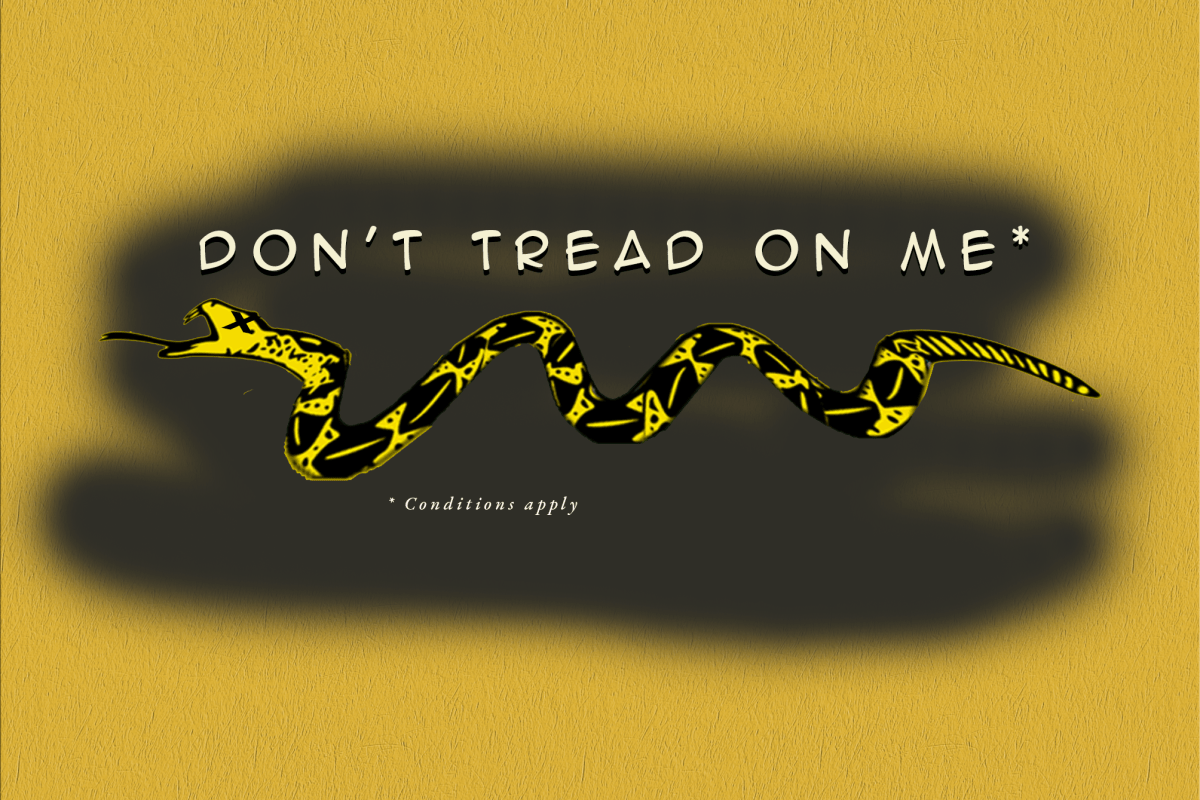
Don’t Tread on My Ass

Absolute liberty means absolute liberty, but what if the liberty you seek is death? The moment you carve out exceptions – speech you can’t say, choices you can’t make, exits you can’t take – you’ve left the realm of liberty and entered the gated community of permission.

Video: YouTube vid by Philosopher Muse.

And here’s the test most self-styled liberty lovers fail: you’re free to skydive without a parachute, but try ending your life peacefully and watch how quickly the freedom brigade calls in the moral SWAT team.

I’m not his usual audience; I’m already in the choir, but this eight-minute clip by Philosopher Muse is worth your time. It’s a lucid walk through the ethical terrain mapped by Sarah Perry in Every Cradle Is a Grave, and it’s one of the better distillations of antinatalist thought I’ve seen for the general public. Perry’s libertarian starting point is straightforward: if you truly own your life, you must also have the right to give it up.

He threads in the dark-glimmer insights of Emil Cioran’s poetic despair, Thomas Ligotti’s existential horror, David Benatar’s asymmetry, and Peter Wessel Zapffe’s tragic consciousness. Together they point to an uncomfortable truth: autonomy that stops short of death isn’t autonomy at all; it’s a petting zoo of freedoms where the gate is locked.

I’ve said this before, but it bears repeating. I once had a girlfriend who hated her life but was too afraid of hell to end it. She didn’t “pull through.” She overdosed by accident. Loophole closed, I suppose. That’s what happens when metaphysical prohibitions are allowed to run the operating system.

And here’s where I diverge from the purist libertarians. I don’t believe most people are competent enough to have the liberty they think they deserve. Not because they’re all dribbling idiots, but because they’ve been marinated for generations in a stew of indoctrination. For thousands of years, nobody talked about “liberty” or “freedom” as inalienable rights. Once the notion caught on, it was packaged and sold – complete with an asterisk, endless fine print, and a service desk that’s never open.

We tell ourselves we’re free, but only in the ways that don’t threaten the custodians. You can vote for whoever the party machine serves up, but you can’t opt out of the game. You can live any way you like, as long as it looks enough like everyone else’s life. You can risk death in countless state-approved ways, but the moment you calmly choose it, your autonomy gets revoked.

So yes, watch the video. Read Perry’s Every Cradle Is a Grave. Then ask yourself whether your liberty is liberty, or just a longer leash.

If liberty means anything, it means the right to live and the right to leave. The former without the latter is just life imprisonment with better marketing.

Language and Generative AI: A Journey through Midjourney

I am not a fan of Midjourney v7. I prefer v6.1. And I want to write about the correspondence of language, per my Language Insufficiency Hypothesis.

Let’s start with the language aspect. Notice how distant the renders are from the intent of the prompt.

This is my initial prompt. I used it about a year ago to generate the cover image with v6.1, but I wanted to see how it renders in v7. Let’s take a trip all the way back to the beginning.

cinematic, tight shot, photoRealistic light and shadow, exquisite details, delicate features, emaciated sensual female vampire waif with vampire fangs, many tattoos, wearing crucifix necklace, gazes into mirror, a beam of moonlight shines on her face in dark mausoleum interior, toward camera, facing camera, black mascara, long dark purple hair , Kodak Portra 400 with a Canon EOS R5
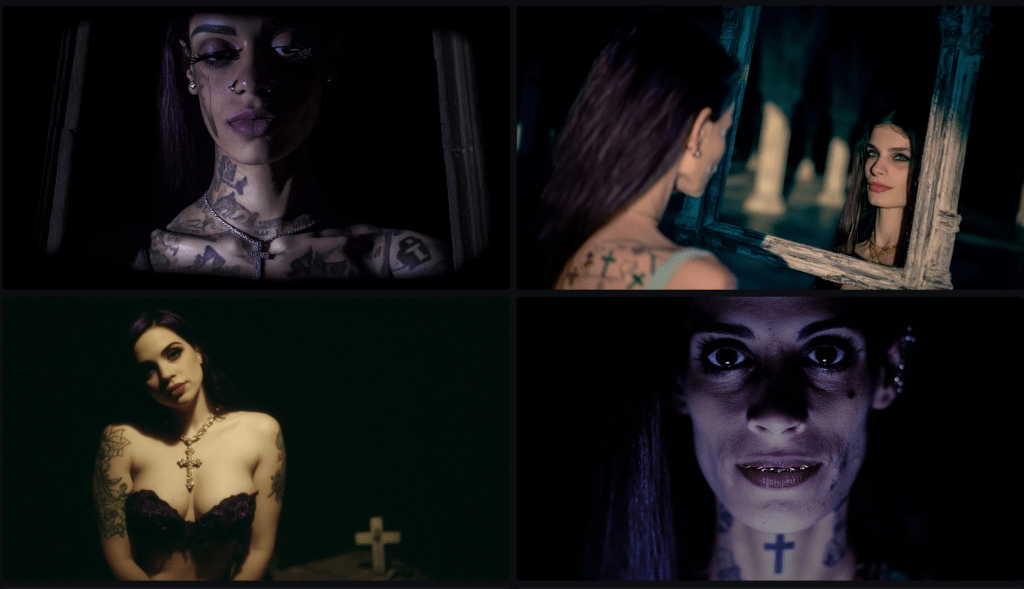
Image: Midjourney v6.1 render set (from about a year ago)

As you can see, these renders are somewhat lacking in photorealism, but the “sensual” term in the prompt was not blocked.

Midjourney v7

Initially, I encountered a hiccup. After a couple of rejections on the grounds of morality, I removed the word ‘sensual’ and received the output. All of the output uses this prompt absent the sensual term.

As mentioned, I have generated several images (including the cover image) with this prompt, but Midjourney is inconsistent in its censorship gatekeeping.

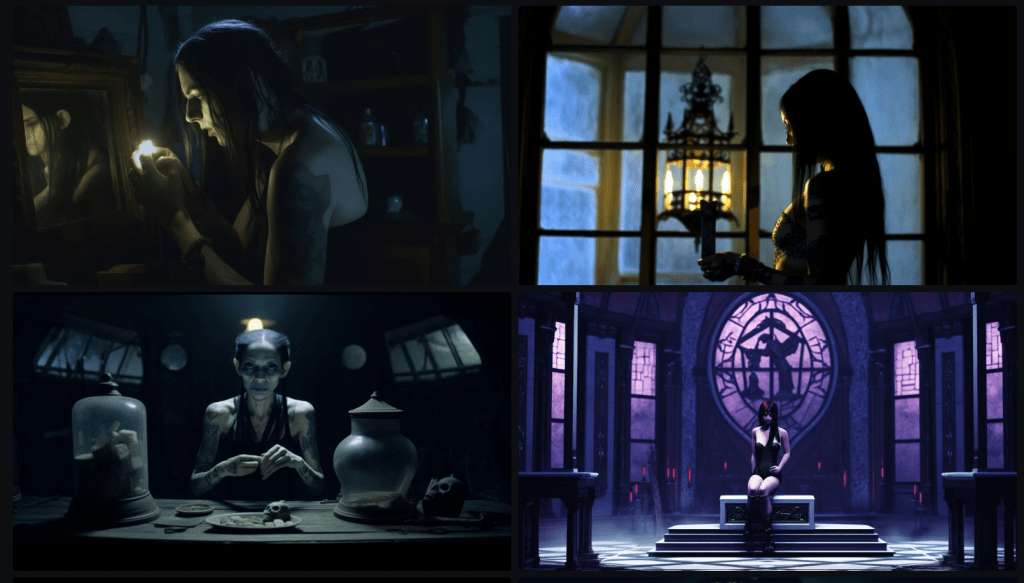
Image: Midjourney v7 render set

Notice that 3 of the 4 renders in the v7 set don’t even have a mirror. The top right one does, but it’s not evident that she’s a vampire. In fact, I could say that any of these are vampiresses, but perhaps that’s what they want you to believe. In place of a necklace, the lower right wokan sports a cross tattoo.

Midjourney v6.1

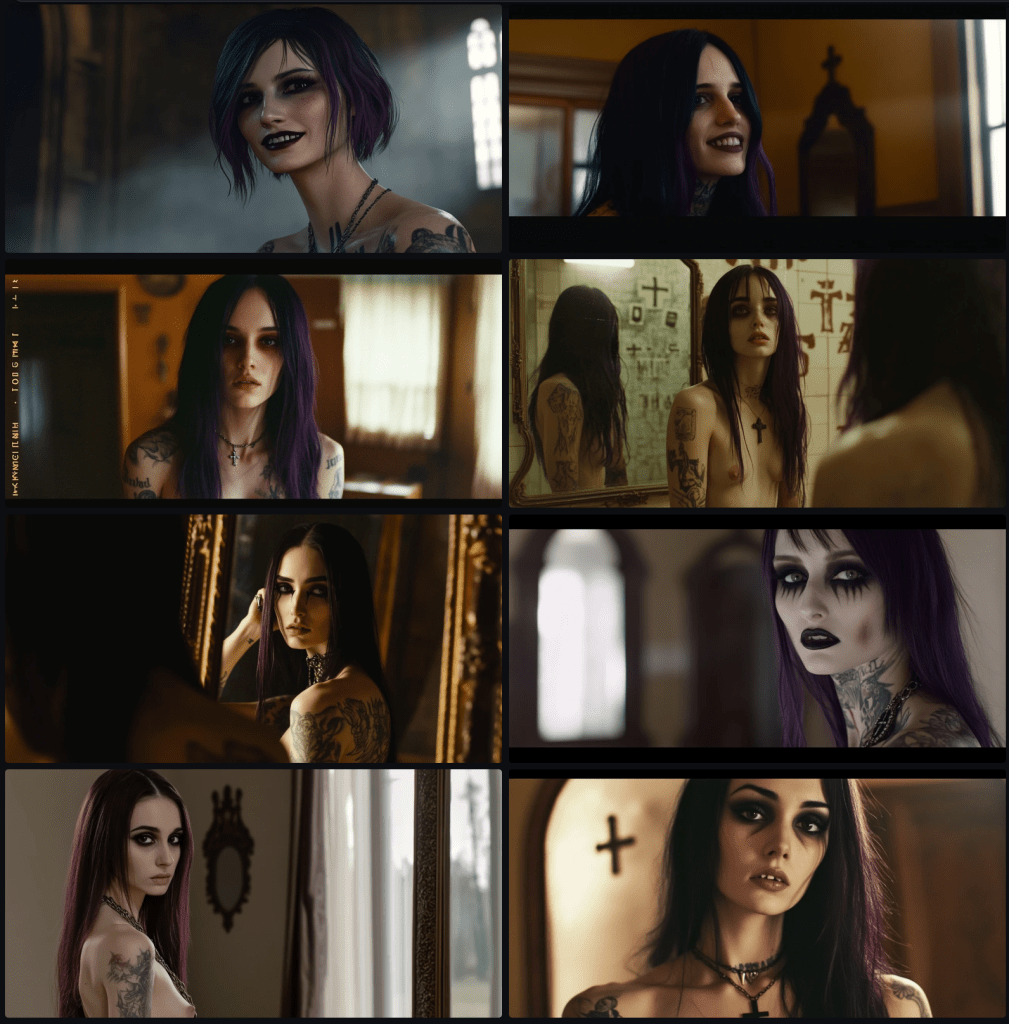
Image: Midjourney v6.1 render set

Again, these renders don’t appear to be vampires. The one on the lower left does appear to have snake-like fangs, so I guess I’ll give partial credit.

My next attempt was interrupted by this message.

It rendered something that might violate community guidelines. The funny thing is that one can watch the image generate in process. It only takes one “offensive” image to disqualify the whole batch.

Midjourney v6

Image: Midjourney v6 render set

Yet again, not a vampire to be found. Notice the reflection in the lower left image. Perhaps vampire reflections just behave differently.

Midjourney 5.2

Image: Midjourney v5.2 render set

Midjourney v5.2 was a crapshoot. Somehow, I got vampire lips (?), a Wiccan, a decrepit Snape from Harry Potter lore, and Iron Maiden’s Eddy reading a book. It’s something. I’m sensing gender dysphoria. Dare I go back further?

Midjourney v5.1

Image: Midjourney v5.1 render set

It gets worse. No comments necessary. Let’s turn back the clocks even more.

Midjourney v5

Image: Midjourney v5 render set

To be fair, these all do have occult undertones, but they are weak on vampireness.

Midjourney v4

Image: Midjourney v4 render set

To be fair, the render quality isn’t as bad as I expected, but it still falls short. There’s further back to travel.

Midjourney v3

Image: Midjourney v3 render set

Some configuration parameters no longer exist. Still, I persist for the sake of art and science at the cost of time and ecology.

As much as I complain – and I complain a lot – this is how far we’ve come. As I recall, this is when I hopped onto the Midjourney bandwagon. There’s still more depth to plumb. I have no idea how much of the prompt is simply ignored at this point.

Midjourney v2

Image: Midjourney v2 render set

What the hell is this? 🤔🤣 But I’m not done yet.

Midjourney v1

Image: Midjourney v1 render set

The damned grandpappy of them all. Apparently, colour hadn’t been invented yet. You can’t tell by these thumbnails, but the resolution on these early versions approaches that of a postage stamp.

Midjourney Niji 3

Image: Midjourney Niji 3 render set

I had forgotten about the Niji models from back in the day. There were 3 versions. I don’t recall where this slotted into the chronology. Obviously, not down here. I’ve only rendered the newest one. I think this was used primarily for anime outputs, but I might be mistaken.

Bones Content 1: Video

Video: Midjourney Render of Purported Vampiress

This is a video render of the same prompt used on this page.

Bonus Content 2: Midjourney v6.1 Content from 34 weeks ago

Same prompt.

Image: Midjourney v6.1 render set (several passes)

The upper left image reminds me of Kirsten Dunst. Again, notice the female breasts, highlighting Midjourney’s censorial schizophrenia.

Midjourney Boundaries

I promise that this will not become a hub for generative AI. Rather than return to editing, I wanted to test more of Midjourney’s boundaries.

It turns out that Midjourney is selective about the nudity it renders. I was denied a render because of cleavage, but full-on topless – no problem.

Both of these videos originate from the same source image, but they take different paths. There is no accompanying video content. The setup features three women in the frame with a mechanical arm. I didn’t prompt for it. I’m not even sure of its intent. It’s just there, shadowing the women nearest to it. I don’t recall prompting for the oversized redhead in the foreground, though I may have.

In both images, note the aliasing of the tattoos on the blonde, especially on her back. Also, notice that her right arm seems shorter than it should. Her movements are jerky, as if rendered in a video game. I’m not sure what ritual the two background characters are performing, but notice in each case the prepetition. This seems to be a general feature of generative AI. It gets itself in loops, almost autistic.

Notice a few things about the top render.

Video: Midjourney render of 3 females and a mechanical arm engaging in a ritual. (9 seconds)

The first video may represent an interrogation. The blonde woman on the left appears to be a bit disoriented, but she is visually tracking the woman on the right. She seems to be saying something. Notice when the woman on the right stands. Her right foot lands unnaturally. She rather glitches.

The camera’s push and pull, and then push, seems to be an odd directorial choice, but who am I to say?

Video: Midjourney render of 3 females and a mechanical arm engaging in a ritual. (12 seconds)

The second video may represent taunting. The woman on the left still appears to be a bit disoriented, but she checks the redhead in the foreground with a glance. Notice the rocking of the two background characters, as well as the mech arm, which sways in sync with the woman on the right. This is a repetition glitch I mentioned above.

Here, the camera seems to have a syncopated relationship with the characters’ sway.

Summary

The stationary objects are well-rendered and persistent.

Assignment

Draft a short story or flash fiction using this as an inspirational prompt. I’m trying to imagine the interactions.

  • The ginger seems catatonic or drugged. Is she a CIS-female? What’s with her getup?
  • The blonde seems only slightly less out of it. Did she arrive this way? Did they dress her? Why does she appear to still have a weapon on her back? Is it a weapon or a fetter? Why is she dressed like that? Is she a gladiatrix readying for a contest? Perhaps she’s in training. What is she saying? Who is she talking to? What is her relationship to the redhead? Are they friends or foes – or just caught up in the same web?
  • What is the woman wearing the helmet doing? She appears to have the upper hand. Is she a cyborg, or is she just wearing fancy boots? What’s with her outfit? What’s with her Tycho Brahe prosthetic nose piece?
  • What is that mechanical hand? Is it a guard? A restraint? Is it hypnotising the ginger? Both of them? Is it conducting music that’s not audible?
  • What’s it read on the back wall? The two clips don’t share the same text. Call the continuity people.

Conscious of Consciousness

Let us begin with the heresy: consciousness is not a thing. It is not a light bulb switched on in the mind. It is not a theatre with a little homunculus watching the play unfold. It is not a ghost in the machine, nor even a particularly welcome tenant. Consciousness is a conjuring trick – one so convincing that even the conjurer forgets it is an act.

Video: Related Topic: IAI Joscha Bosch on Consiousness

If that unsettles you, good. Welcome to the simulacrum.

The Wetness of Mind

We often hear that consciousness is “emergent,” but the term is used so promiscuously that it risks becoming decorative. So let us be specific. Consciousness, if it is emergent, is emergent as wetness is from H2O: not in the hydrogen or the oxygen, but in their relationship when bonded just so. Joscha Bach and others argue that consciousness arises not from the bits, but from the dance – the recursive feedback loops and predictive models running atop the neural substrate.

Audio: NotebookLM podcast on this topic.

In this view, the self is not the pilot but the dashboard. It is the user interface the brain conjures to coordinate action, interpret input, and maintain internal coherence. Not because it’s real, but because it’s useful. You are a GUI with delusions of grandeur.

The Cast of Theorists

Let us now parade the usual suspects:

  • Joscha Bach: Consciousness is a virtual self-model, emergent from recursive, computational feedback. Not the product of neurons firing per se, but of their ability to simulate a stable identity across time.
  • Thomas Metzinger: There is no self. Only a Phenomenal Self-Model (PSM) which becomes phenomenally transparent when the system no longer recognises it as a model. Consciousness is the experience of this hallucinated self.
  • Daniel Dennett: Dismantles the notion of a “central experiencer” with his Multiple Drafts Model. Consciousness is a narrative, a distributed process where drafts of experience compete, are edited, and retroactively interpreted.
  • David Chalmers: Waves his flag at the Hard Problem of consciousness. You can explain behaviour, memory, attention—but not experience itself. He flirts with dualism and panpsychism while insisting there’s a gap science cannot yet close.
  • Giulio Tononi: Gives us Integrated Information Theory (IIT) and the elusive metric Φ (phi). Consciousness is the degree to which information is unified within a system. Your brain is conscious because its parts can’t be reduced without losing coherence.
  • Karl Friston: The prophet of Free Energy Minimisation. Consciousness is an emergent property of systems that seek to reduce prediction error. The brain is a Bayesian engine, and the self is its best guess about how to survive.

So What Is Consciousness?

A hallucination. A recursive illusion. A predictive dashboard. A statistical artefact. A phi score. A phenomenally transparent model. Take your pick.

None of these theories fully agree, but most converge on one elegant horror: you are not what you think you are. The sense of being a continuous, stable, indivisible “I” is a construction. A simulation. The dream from which there is no waking because waking is part of the dream.

This is not despair; it is clarity. Just as wetness does not cry when told it is not a substance, the self need not mourn its own illusion. It is a marvellous fiction, worth inhabiting.

Conclusion: Through the Mirror

To be conscious of consciousness is to stand in the hall of mirrors and realise none reflect the original—because there is no original. The mirror is the thing.

But if the theatre is empty, the play goes on. Scripts are written, models simulated, selves performed. And perhaps, in this strange recursion, we find not meaning, but the possibility of coherence.

So raise a glass to the illusion. May your predictive model stay optimised, your narrative stay plausible, and your hallucinated self remain just this side of transparent.


For further hallucinatory episodes, consult your local philosopher, neuroscientist, or AI researcher. Side effects may include derealisation, epistemic vertigo, and mild enlightenment.

Semantic Drift: When Language Outruns the Science

Science has a language problem. Not a lack of it – if anything, a surfeit. But words, unlike test tubes, do not stay sterile. They evolve, mutate, and metastasise. They get borrowed, bent, misused, and misremembered. And when the public discourse gets hold of them, particularly on platforms like TikTok, it’s the language that gets top billing. The science? Second lead, if it’s lucky.

Semantic drift is at the centre of this: the gradual shift in meaning of a word or phrase over time. It’s how “literally” came to mean “figuratively,” how “organic” went from “carbon-based” to “morally superior,” and how “theory” in science means robust explanatory framework but in the public square means vague guess with no homework.

In short, semantic drift lets rhetoric masquerade as reason. Once a word acquires enough connotation, you can deploy it like a spell. No need to define your terms when the vibe will do.

Audio: NotebookLM podcast on this topic.

When “Vitamin” No Longer Means Vitamin

Take the word vitamin. It sounds objective. Authoritative. Something codified in the genetic commandments of all living things. (reference)

But it isn’t.

A vitamin is simply a substance that an organism needs but cannot synthesise internally, and must obtain through its diet. That’s it. It’s a functional definition, not a chemical one.

So:

  • Vitamin C is a vitamin for humans, but not for dogs, cats, or goats. They make their own. We lost the gene. Tough luck.
  • Vitamin D, meanwhile, isn’t a vitamin at all. It’s a hormone, synthesised when sunlight hits your skin. Its vitamin status is a historical relic – named before we knew better, and now marketed too profitably to correct.

But in the land of TikTok and supplement shelves, these nuances evaporate. “Vitamin” has drifted from scientific designation to halo term – a linguistic fig leaf draped over everything from snake oil to ultraviolet-induced steroidogenesis.

The Rhetorical Sleight of Hand

This linguistic slippage is precisely what allows the rhetorical shenanigans to thrive.

In one video, a bloke claims a burger left out for 151 days neither moulds nor decays, and therefore, “nature won’t touch it.” From there, he leaps (with Olympic disregard for coherence) into talk of sugar spikes, mood swings, and “metabolic chaos.” You can almost hear the conspiratorial music rising.

The science here is, let’s be generous, circumstantial. But the language? Oh, the language is airtight.

Words like “processed,” “chemical,” and “natural” are deployed like moral verdicts, not descriptive categories. The implication isn’t argued – it’s assumed, because the semantics have been doing quiet groundwork for years. “Natural” = good. “Chemical” = bad. “Vitamin” = necessary. “Addiction” = no agency.

By the time the viewer blinks, they’re nodding along to a story told by words in costume, not facts in context.

The Linguistic Metabolism of Misunderstanding

This is why semantic drift isn’t just an academic curiosity – it’s a vector. A vector by which misinformation spreads, not through outright falsehood, but through weaponised ambiguity.

A term like “sugar crash” sounds scientific. It even maps onto a real physiological process: postprandial hypoglycaemia. But when yoked to vague claims about mood, willpower, and “chemical hijacking,” it becomes a meme with lab coat cosplay. And the science, if mentioned at all, is there merely to decorate the argument, not drive it.

That’s the crux of my forthcoming book, The Language Insufficiency Hypothesis: that our inherited languages, designed for trade, prayer, and gossip, are woefully ill-equipped for modern scientific clarity. They lag behind our knowledge, and worse, they often distort it.

Words arrive first. Definitions come limping after.

In Closing: You Are What You Consume (Linguistically)

The real problem isn’t that TikTokers get the science wrong. The problem is that they get the words right – right enough to slip past your critical filters. Rhetoric wears the lab coat. Logic gets left in the locker room.

If vitamin C is a vitamin only for some species, and vitamin D isn’t a vitamin at all, then what else are we mislabelling in the great nutritional theatre? What other linguistic zombies are still wandering the scientific lexicon?

Language may be the best tool we have, but don’t mistake it for a mirror. It’s a carnival funhouse – distorting, framing, and reflecting what we expect to see. And until we fix that, science will keep playing second fiddle to the words pretending to explain it.