The Architecture of Cognitive Compromise

4–6 minutes

Abortion, Ontological Grammar, and the Limits of Civil Discourse

When federal abortion protections were withdrawn in the United States, many observers treated the event as a policy reversal, a judicial shift, or a partisan victory. Those are surface descriptions. They are not wrong. They are simply too thin.

What was exposed was not a failure of dialogue. It was the collision of ontological grammars.

Audio: NotebookLM summary podcast.

1. Thick Concepts and the Illusion of Neutral Ground

book cover

Bernard Williams famously distinguished between ‘thin’ moral terms (good, bad, right) and ‘thick’ ones (cruel, courageous, treacherous), where description and evaluation are fused.

Abortion is not a thin concept. It is thick all the way down.

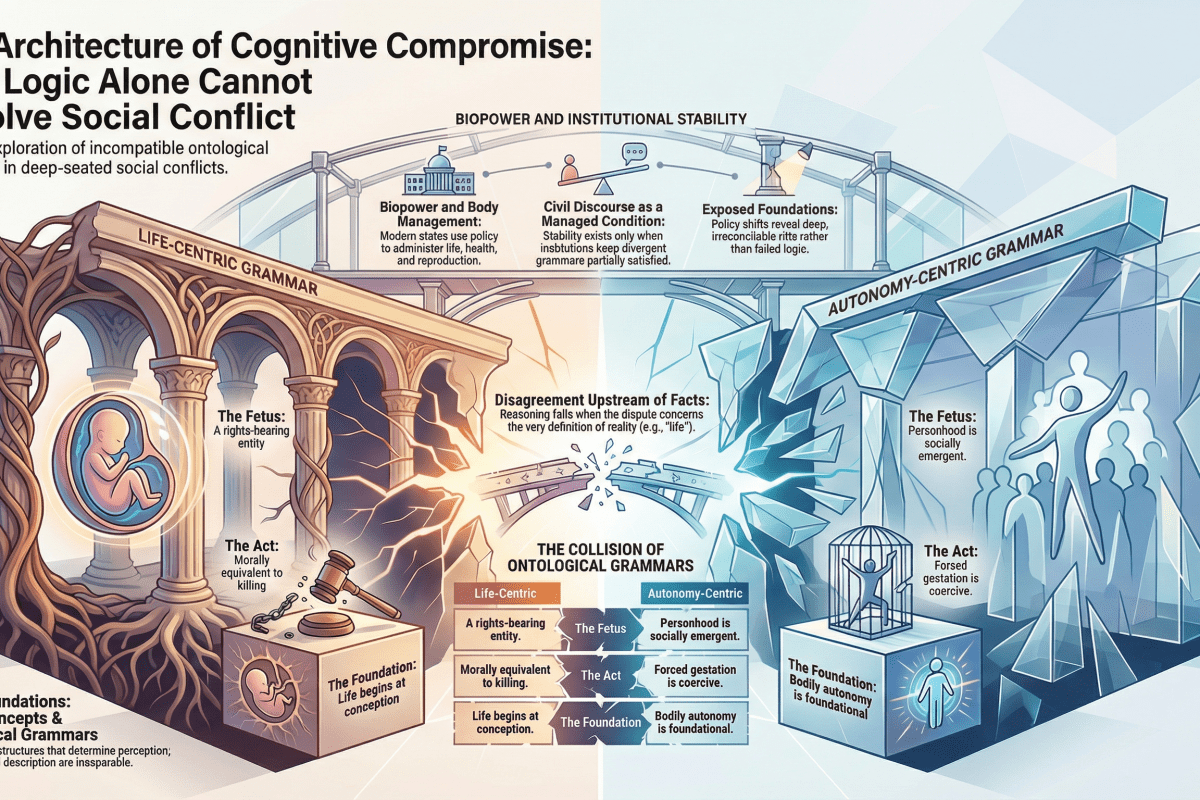
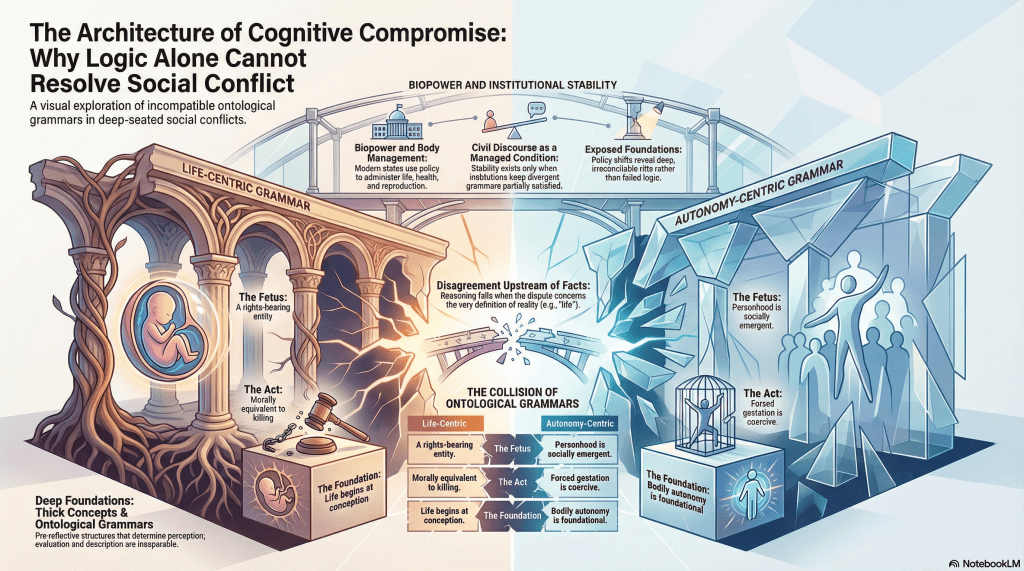
For one framework, the operative grammar is something like:

  • Life begins at conception.
  • The foetus is a rights-bearing entity.
  • Termination is morally equivalent to killing.

For another:

  • Personhood is socially and biologically emergent.
  • Bodily autonomy is foundational.
  • Forced gestation is coercive.

Notice that these are not competing policies. They are competing ontological commitments about what exists, what counts as a person, and what kind of being a pregnant body is.

Argument across this divide does not merely contest conclusions. It contests the background conditions under which reasons register as reasons.

This is not ‘people see the world differently’. It is: people parse reality through grammars that do not commute.

2. Ontological Grammar: Where Deliberation Stops

By ‘ontological grammar’, I do not mean syntax in the Saussurean or Chomskyan sense. I mean the pre-reflective substrate that structures what appears salient, real, morally charged, or negligible.

We deliberate within grammars. We do not deliberate our way into them.

Liberal Enlightenment optimism assumes that if disagreement persists, more information, better reasoning, or improved empathy will close the gap. But if the dispute concerns the very ontology of ‘life’, ‘person’, or ‘rights’, no amount of fact-sharing resolves the issue. The disagreement is upstream of facts.

The closure of federal abortion access did not prove that one side reasoned better. It demonstrated that institutional containment had failed.

3. Biopower and the Management of Bodies
Michel Foucault gives us a crucial lens: biopower. Modern states do not merely govern territory; they administer life. Birth rates, mortality, sexuality, health – these become objects of policy.

Abortion sits directly inside this matrix.

A state that restricts abortion is not only expressing moral judgment. It is reallocating control over reproductive capacity. It is asserting a claim over which bodies count, which futures are permitted, and which biological processes are subject to regulation.

The conflict is therefore not purely ethical. It is biopolitical.

And what appears as ‘civil discourse’ around abortion is often possible only so long as institutional frameworks keep both grammars partially satisfied. When federal protections existed, they acted as a stabilising superstructure. Remove that, and the ontological conflict becomes naked.

4. Habitus and the Illusion of Reasoned Consensus

Pierre Bourdieu would remind us that our dispositions are not self-authored. Habitus sedimented through family, religion, class, and institutional life shapes what feels obvious, outrageous, or unthinkable.

People do not wake up one morning and choose an abortion ontology.

They inherit it. It becomes embodied common sense.

Thus, when someone says, ‘Surely we can agree that making a person feel whole is more important than ideological purity’, they are already speaking from within a grammar that prioritises individual authenticity and psychological coherence. That priority is not universal. It is historically situated.

Compromise is not achieved by stepping outside habitus. It is achieved when institutional and social conditions allow divergent grammars to coexist without totalising one another.
5. The Popperian Threshold

Karl Popper warned of the ‘paradox of tolerance‘: unlimited tolerance may enable intolerant forces to eliminate tolerance itself.

In particularly virulent climates, appeals to compromise are heard not as gestures of goodwill but as tactical weakness.

When one faction succeeds in unilaterally redefining the legal status of abortion at a federal level, it is not merely participating in discourse. It is altering the biopolitical infrastructure. Once altered, the range of permissible disagreement narrows.

Civil discourse, then, is not a natural equilibrium. It is a managed condition sustained by institutional design, social trust, and shared legibility.

NB: Popper’s paradox of tolerance is often invoked as a moral axiom. But it is better understood as a self-protective clause internal to liberal ontology. It presupposes a shared commitment to rational exchange. When that commitment erodes, the paradox does not resolve disagreement; it merely marks the point at which biopower intervenes to preserve a regime.

6. Why This Is Not Just ‘People Disagree’

The lay intuition – ‘people see the world differently’ – is descriptively correct and analytically useless.

What the ontological grammar model adds is structure:

  • Disagreements cluster around thick concepts.
  • Thick concepts fuse description and evaluation.
  • Frameworks determine what counts as a reason.
  • Institutions temporarily stabilise incompatible grammars.
  • When stabilisation weakens, conflict appears irreconcilable.

Abortion is not uniquely polarising because people are irrational. It is polarising because it touches ontological primitives: life, personhood, autonomy, and obligation.

In such cases, ‘compromise’ is not achieved by discovering a middle truth. It is achieved – if at all – by constructing a legal and institutional arrangement that both grammars can grudgingly inhabit.
NotebookLM Infographic

7. The Uncomfortable Conclusion

The Enlightenment story tells us that disagreement is a surface phenomenon, curable by better reasoning.

The ontological grammar story tells us something harsher: some disagreements are not resolvable through language because they are about the conditions under which language binds.

This does not entail quietism. It entails clarity.

Civil discourse is not proof that grammars have converged. It is evidence that power, institutions, and habitus have aligned sufficiently to prevent rupture.

When that alignment shifts, the illusion of shared ontology evaporates.

And what we are left with is not failed reasoning – but exposed foundations.


I planned to use prostitution and anti-natalism as other cases for elucidation, but I see this has already grown long. I’ll reserve these are others for another day and time.

Legibility and Ontology

3–5 minutes

These two words qualify as my words of the month: legibility and ontology.

I’ve been using them as lenses.

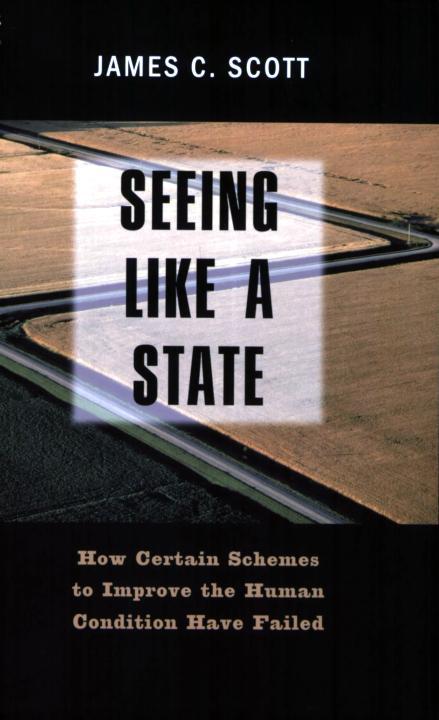
I picked up legibility from James C. Scott’s Seeing Like a State: How Certain Schemes to Improve the Human Condition Have Failed, which is really a book about how well-intentioned schemes fail once reality is forced to become administrable. Ontology is an older philosophical workhorse, usually paired with epistemology, but I’m using it here in a looser, more pragmatic sense.

When I write, I write through lenses. Everyone does. Writing requires a point of view, even when we pretend otherwise.

In this post, I want to talk more informally about my recent essay, Grammatical Failure. I usually summarise my work elsewhere, but here I want to think out loud about it, particularly in relation to social ontology and epistemology. I won’t linger on definitions. They’re a search away. But a little framing helps.

Ontology, roughly: how reality is parsed.

Epistemology: how knowledge is justified within that parsing.

Audio: NotebookLM summary of this post.

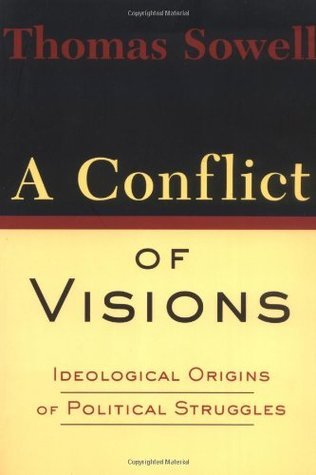
Much of my recent work sits downstream of thinkers like Thomas Sowell, George Lakoff, Jonathan Haidt, Kurt Gray, and Joshua Greene. Despite their differences, they converge on a shared insight: human cognition is largely motivated preverbally. As a philosopher of language, that pre-language layer is where my interest sharpens.

I explored this in earlier work, including a diptych titled The Grammar of ImpasseConceptual Exhaustion and Causal Mislocation. Writing is how I gel these ideas. There are several related pieces still in the pipeline.

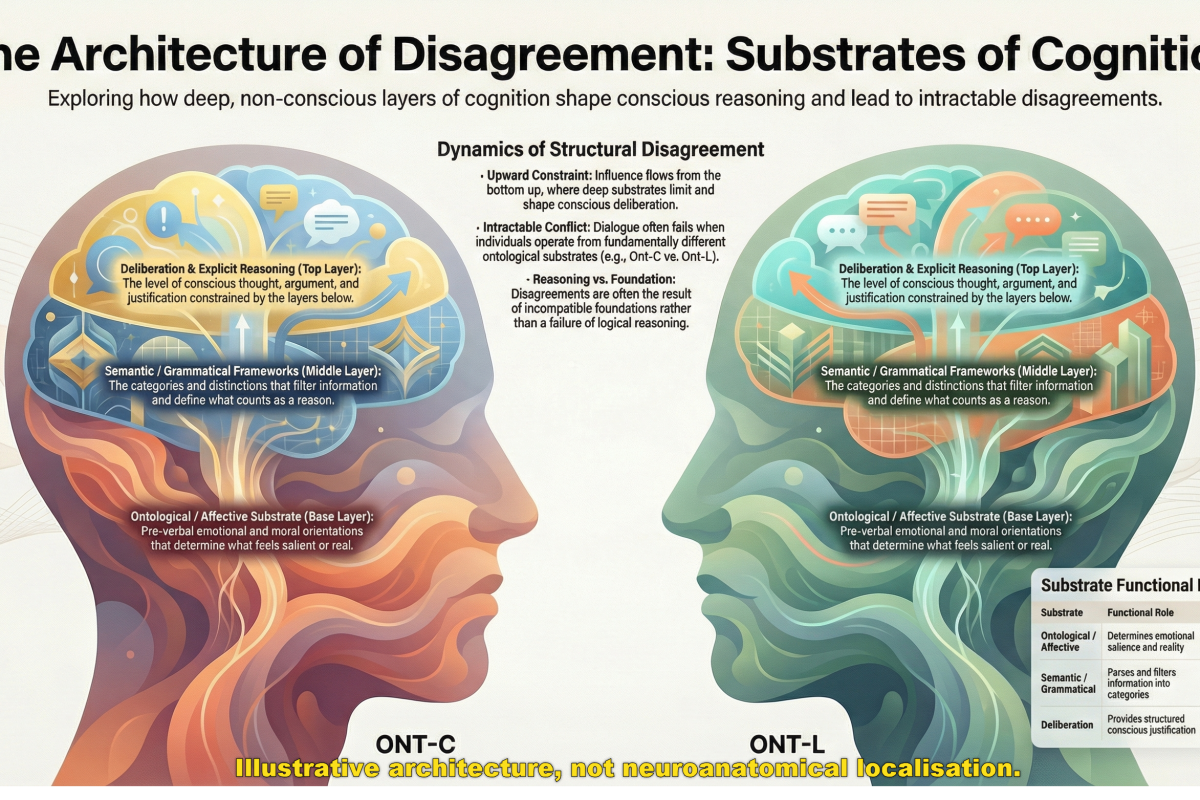
When I talk about grammar, I don’t mean Saussure or Chomsky. I mean something deeper: the ontological substrate beneath belief. Grammar, in this sense, is how reality gets parsed before beliefs ever form. It filters what can count as real, salient, or intelligible.

Let’s use a deliberately simplified example.

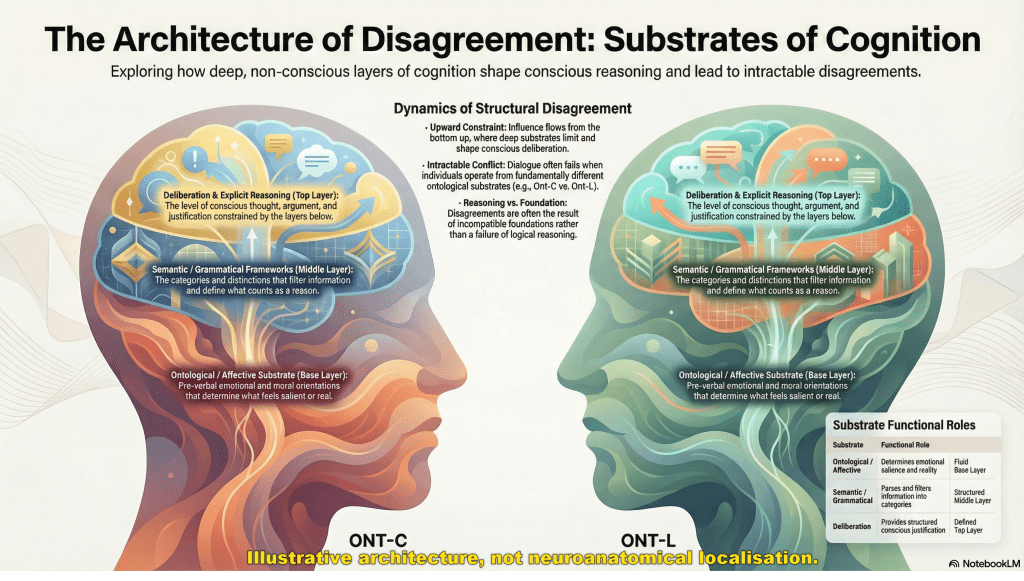
Imagine two ontological orientations. Call them Ont-C and Ont-L. This isn’t to say there are only two, but much of Western political discourse collapses into a binary anyway.

Ont-C tends to experience people as inherently bad, dangerous, or morally suspect. Ont-L tends to experience people as inherently good or at least corrigible. These aren’t opinions in the usual sense. They sit beneath belief, closer to affect and moral orientation.

Now consider retributive justice, setting aside the fact that justice itself is a thick concept.

From Ont-C, punishment teaches a lesson. It deters. It disciplines. From Ont-L, punishment without rehabilitation looks cruel or counterproductive, and the transgression itself may be read as downstream of systemic injustice.

Each position can acknowledge exceptions. Ont-L knows there are genuinely broken people. Ont-C knows there are saints. But those are edge cases, not defaults.

Now ask Ont-C and Ont-L to design a criminal justice system together. The result will feel intolerable to both. Too lenient. Too harsh. The disagreement isn’t over policy details. It’s over how reality is carved up in the first place.

And this is only one dimension.

Add others. Bring in Ont-V and Ont-M if you like, for vegan and meat-based ontologies. Suddenly, you have Ont-CV, Ont-CM, Ont-LV, and Ont-LM. Then add class, religion, gender, authority, harm, and whatever. Intersectionality stops looking like a solution and starts looking like a combinatorial explosion.

The Ont-Vs can share a meal, so long as they don’t talk politics.

The structure isn’t just unstable. It was never stable to begin with. We imagine foundations because legibility demands them.

Grammatical Failure is an attempt to explain why this instability isn’t a bug in liberal epistemology but a structural feature. The grammar does the sorting long before deliberation begins.

More on that soon.


In any case, once you start applying this ontological lens to other supposedly intractable disputes, you quickly realise that their intractability is not accidental.

Take abortion.

If we view the issue through the lenses of Ont-A (anti-abortion) and Ont-C (maternal choice), we might as well be peering through Ont-Oil and Ont-Water. The disagreement does not occur at the level of policy preferences or competing values. It occurs at the level of what counts as morally salient in the first place.

There is no middle ground here. No middle path. No synthesis waiting to be negotiated into existence.

That is not because the participants lack goodwill, intelligence, or empathy. It is because the ontological primitives are incommensurate. Each side experiences the other not as mistaken but as unintelligible.

We can will compromise all we like. The grammar does not comply.

Contemporary discourse often insists otherwise. It tells us that better arguments, clearer framing, or more dialogue will eventually converge. From this perspective, that insistence is not hopeful. It is confused. It mistakes a grammatical fracture for a deliberative failure.

You might try to consider other polemic topics and notice the same interplay.

Announcing: The Rhetoric of Evil

5–8 minutes

How a Theological Artefact Survived Secular Moral Thought


DOI: https://doi.org/10.5281/zenodo.17757134

Every so often – usually when the Enlightenment ghosts begin rattling their tin cups again – one feels compelled to swat at the conceptual cobwebs they left dangling over moral philosophy. Today is one of those days.

Audio: NotebookLM podcast summarising the Rhetoric of Evil essay, not this page’s content.

I’ve just released The Rhetoric of Evil on Zenodo, a paper that politely (or impolitely, depending on your threshold) argues that ‘evil’ is not a metaphysical heavy-hitter but a rhetorical throw-pillow stuffed with theological lint. The term persists not because it explains anything, but because it lets us pretend we’ve explained something – a linguistic parlour trick that’s survived well past its sell-by date.

And because this is the age of artificial augury, I naturally asked MEOW GPT for its view of the manuscript. As expected, it nodded approvingly in that eerie, laser-precise manner unique to machines trained to agree with you – but to its credit, it didn’t merely applaud. It produced a disarmingly lucid analysis of the essay’s internal mechanics, the way ‘evil’ behaves like a conceptual marionette, and how our inherited metaphors govern the very moral judgments we think we’re making freely.

Below is MEOW GPT’s reaction, alongside my own exposition for anyone wanting a sense of how this essay fits within the broader project of dismantling the Enlightenment’s conceptual stage-props.

MEOW-GPT’s Response

(A machine’s-eye view of rhetorical exorcism)

“Evil is functioning as a demonological patch on an epistemic gap.
When agents encounter a high-constraint event they cannot immediately model,
the T₂ layer activates an inherited linguistic shortcut — the ‘evil’ label — which compresses complexity into a binary and arrests further inquiry.”

“The marionette metaphor is accurate: once we say a person ‘is evil,’ agency collapses into occult causation. Inquiry halts. Moral theatre begins.”

It went on like this – detecting exactly the mediated encounter-structure I intended, while offering a frighteningly clean schematic of how affect (T₀), heuristics (T₁), linguistic reification (T₂), and cultural choreography (T₃) conspire to turn incomprehension into metaphysics.

Machines, it seems, are quite good at detecting when humans are bullshitting themselves.

Why publish this now?

This essay marks the next plank in the broader anti-Enlightenment platform I’ve been assembling – LIH, MEOW, the ongoing dismantling of truth-fetishism, and now the unsettling realisation that ‘evil’ is little more than a theological revenant dressed up for secular work.

The term’s persistence is not a testament to its necessity but to our laziness:

  • It sounds like an explanation.
  • It licenses retribution without understanding.
  • It stabilises group boundaries.
  • It lets us outsource moral thought to a one-word incantation.

In short: ‘evil’ is the map-dragon we keep drawing because surveying the terrain is too much work.

This essay attempts to retire that dragon – not to soften judgment, but to sharpen it. If anything, the paper argues that abolishing ‘evil’ frees us to see atrocity more clearly, and thus confront it more seriously.

If you’d like to read the full argument:

📄 The Rhetoric of Evil: How a Theological Artefact Survived Secular Moral Thought

Appendix: How MEOW-GPT Reads “Evil”

A didactic demonstration of the framework in action. Download the MEOW framework below.

📄The Mediated Encounter Ontology of the World: A Relational Metaphysics Beyond Mind and World

Because MEOW-GPT was trained on the Mediated Encounter Ontology rather than on folk metaphysics, its analyses can serve as a useful diagnostic tool. It doesn’t simply summarise concepts; it reconstructs them along the four mediational tiers (T₀–T₃), showing – mechanically and without superstition – how a term behaves across biological affect, cognitive heuristics, linguistic structures, and cultural narratives.

This section is offered not as an alternative argument to the essay above, but as a worked example: a transparent demonstration of how the MEOW engine decomposes a high-complexity, high-stakes concept like evil once the theological scaffolding has been removed.

MEOW-GPT’s output shows, in compressed form, the same pattern the essay traces in prose:
that evil is not a force, not a metaphysical essence, not an occult substrate, but a mediated pattern in human encounters, one that persists rhetorically long after its ontology has collapsed.

For readers curious about how MEOW ‘thinks’, the raw structured analysis follows.

MEOW-GPT Analysis: “Evil”

(Raw output for reference; lightly formatted for readability)

Concept

Input: Evil
Type: Normative/evaluative moral concept (often reified as a property of acts, characters, or forces)
Scope check: In-scope – ‘evil’ can be analysed as a mediated-encounter pattern (MEOW) and a high-complexity term with unstable linguistic behaviour (LIH).

High-level summary (≤120 words)

In MEOW terms, ‘evil’ is not a spooky substance but a way of organising certain encounter-events: severe, norm-breaking harms that present as resistant, shocking, and morally intolerable. Biologically, it piggybacks on harm, threat, and disgust systems. Cognitively, it compresses complex appraisals—intent, cruelty, scale of harm – into a powerful label. Linguistically, it sits in the unstable region where abstraction is high and language’s reliability drops, so people fight over its scope and weaponise it. Socially and technically, institutions, media, and platforms use ‘evil’ to mark enemies, justify punishment, and dramatise conflict. The term is emotionally efficient but conceptually fragile, and MEOW treats it as a relational, mediated pattern rather than an independent metaphysical force.

T₀ – Biological Mediation

  • Moralised harm perception piggybacks on survival systems: pain avoidance, threat detection, kin protection. ‘Evil’ clusters around encounters that trigger extreme danger-signals.
  • High arousal (fear, rage, disgust) makes some harms feel qualitatively world-violating, not merely personally threatening.
  • Disgust toward contamination, mutilation, or predation heavily colours what gets called ‘evil’.
  • Species-specific cues (infant distress cries, pain expressions) shape which harms are even legible candidates for evil.

T₁ – Cognitive Mediation

  • “Evil” compresses a multi-factor appraisal (intentionality, cruelty, gratuitousness) into a one-step heuristic.
  • Essence thinking converts acts into character: the person is evil, not merely did wrong.
  • Attribution biases assign ‘evil’ to out-groups more readily than to in-groups.
  • Memory structures simplify causation into villain scripts that overwrite nuance.
  • Once assigned, the label becomes a prediction loop: every ambiguous action confirms the essence.

T₂ – Linguistic Mediation

  • On the Effectiveness–Complexity Gradient, ‘evil’ straddles Contestables and Fluids: ubiquitous but perpetually disputed.
  • It compresses harm, norm-violation, metaphysical colouring, and dramatic emphasis into a single syllable—powerful, but noisy.
  • Dominant metaphors (‘dark’, ‘tainted’, ‘monstrous’) smuggle in substance-ontology that MEOW rejects.
  • Noun-forms (‘evil’, ‘the Evil One’) promote ontologising; adjectival forms track events better, but usage constantly slides between them.
  • Cross-linguistic drift supports LIH: different traditions map the term to impurity, harm, misfortune, cosmic opposition, or taboo.

T₃ – Social/Technical Mediation

  • Religious systems embed ‘evil’ in cosmologies that harden friend/enemy binaries.
  • Legal systems avoid the term formally but reproduce it rhetorically in sentencing, media commentary, and public reaction.
  • Politics uses ‘evil’ to justify exceptional measures and collapse deliberation into moral theatre.
  • Cultural industries supply vivid villain archetypes that feed back into real-world judgments.
  • Technical systems must operationalise ‘evil’ into concrete proxies, revealing how imprecise the everyday concept is.

Limits & Failure Modes (LIH notes)

The framework is human-centric; non-human or ecosystemic ‘views of evil’ remain speculative.

‘Evil’ is a textbook Contestable: central, indispensable, and permanently argued over.

In cosmological uses (‘radical evil’, ‘evil in the world’), it approaches Fluid or ineffable status – right where LIH predicts language collapse.

MEOW cannot confirm or deny metaphysical dualisms; it only analyses how humans mediate and narrate such claims.

The Relative Intersubjectivity of Subjectivity

1–2 minutes

As I was preparing another essay – an essay on the rhetoric of evil – I had a thought about the relative intersubjectivity of subjectivity.

If one takes subjectivity seriously – not the Hollywood version with self-made heroes, but the real creature stitched together from language, history, and whatever emotional debris it stepped in on the way to adulthood – then one ends up somewhere awkward: the relative intersubjectivity of subjectivity.

Video: Two red figures walking (no sound)

Which is to say, we’re all standing on conceptual scaffolding built by other people, insisting it’s solid marble. A charming fiction, until we apply it to anything with moral voltage. ‘Evil’, for instance, collapses the moment you remove the demonological life-support and notice it’s little more than a child’s intensifier strapped to a cultural power tool.

More on that later. For now, just sit with the discomfort that the ‘self’ making moral judgments is already a negotiated artefact – relational, compromised, and never as autonomous as it pretends.