Care Without Conquest: Feminist Lessons for the Workaday Philosopher

2–4 minutes

I recently posted The Ethics of Maintenance: Against the Myth of Natural Purpose. In it, I brushed – perhaps too lightly – against my debt to feminist philosophy. It’s time to acknowledge that debt more directly and explain how it spills into the mundane greasework of daily life.

Audio: NotebookLM podcast on this topic.

I tend not to worship at the altar of names, but let’s name names anyway. Beyond the usual French suspects – your Sartres, de Beauvoirs, and Foucaults – I owe much to the feminist philosophers – Gilligan, Tronto, Butler, Bellacasa, and de Beauvoir again – and, while we’re at it, the post-colonialists, whose names I’ll not recite for fear of being pompous. Their shared heresy is a suspicion of universals. They expose the myth of neutrality, whether it parades as Reason, Progress, or Civilisation. They remind us that every “universal” is merely someone’s local story told loud enough to drown out the others.

This isn’t a matter of sex or gender, though that’s how the names have been filed. The core lesson is epistemic, not biological. Feminist philosophy re-centres care, interdependence, and the politics of maintenance, not as sentimental virtues but as systems logic. The post-colonialists do the same at a geopolitical scale: maintenance instead of conquest, relation instead of domination.

On Gender, Behaviour, and the Lazy Binary

I don’t buy into sex and gender binaries, especially regarding behaviour. Even in biology, the dichotomy frays under scrutiny. Behaviourally, it collapses entirely. The problem isn’t people; it’s the linguistic furniture we inherited.

I’m weary of the moral blackmail that calls it misogyny not to vote for a woman, or racism not to vote for a black candidate. These accusations come, paradoxically, from sexists and racists who reduce people to the colour of their skin or the contents of their underwear. Having a vagina doesn’t make one a caretaker; having a penis doesn’t preclude empathy. The category error lies in mistaking type for trait.

When I refuse to vote for a Margaret Thatcher or a Hillary Clinton, it’s not because they’re women. It’s because they operate in the same acquisitive, dominion-driven register as the men they mirror. If the game is conquest, swapping the player’s gender doesn’t change the rules.

Maintenance as Political Praxis

My interest lies in those who reject that register altogether – the ones who abandon the mythology of Progress and its testosterone-addled twin, Innovation. The ethics of maintenance I’ve written about, and the philosophy of Dis-Integration I keep harping on, both gesture toward an alternative mode of being: one that prizes endurance over expansion, care over conquest.

This isn’t new. Feminist philosophers have been saying it for decades, often unheard because they weren’t shouting in Latin or running empires. I’m merely repackaging and re-contextualising, hoping that bundling these neglected insights together might make them audible again.

Knowledge never comes in a vacuum; it circulates. It leaks, cross-pollinates, mutates. To claim “intellectual property” over an idea is to pretend ownership of the air. I’ll spare you the full rant, but suffice it to say that the moment knowledge becomes proprietary, it ceases to breathe.

Conclusion

If I have a creed – and I say this reluctantly – it’s that philosophy should serve as maintenance, not monument-building. Feminist and post-colonial thinkers model that: constant attention, critical care, resistance to the entropy of domination.

I’m just trying to keep the engine running without pretending it’s divine.


Bonus

Image: Feminists, according to Midjourney 7

The Ethics of Maintenance: Against the Myth of Natural Purpose

3–4 minutes

Telos is humanity’s most persistent delusion – the idea that existence is crawling toward some luminous conclusion. From Aristotle’s perfect forms to Nietzsche’s Will to Power to Silicon Valley’s AI salvation, the story barely changes: history, we are told, has direction. But direction is not destiny; it is momentum misinterpreted as meaning. Much of my Anti-Enlightenment attention – and my drive toward Dis-Integration – centres on this notion.

Audio: NotebookLM podcast on this topic.

Progress is the Enlightenment’s secular gospel. Its promise – that every change is improvement – keeps the engine of exploitation humming. But change is inevitable; progress is propaganda. The arrow of time doesn’t point toward justice or enlightenment; it just points forward, indifferent to who’s crushed under it.

The Myth of Self-Correcting Systems

We are taught to place faith in systems: markets, democracies, algorithms. If they falter, it’s because of bad actors, not bad architecture. Replace the managers, swap the politicians, tweak the code. But the rot is structural, not moral.

These systems aren’t misfiring; they’re functioning exactly as designed – to preserve their own inertia while leaking meaning, resources, and compassion. The obsession with fixing individuals while sparing the machine is moral sleight of hand. At some point, tightening bolts on a burning engine becomes absurd. What we need is not a tune-up but a renovation.

This is where the philosophy of care and maintenance enters – not as sentimental housekeeping, but as radical engineering. Care is not complacent; it’s insurgent. It means facing the filth under the hood and admitting that the design itself is faulty.

Feminism and the Forgotten Labour of Repair

For centuries, the labour of care has been feminised, dismissed, and exploited – a quiet background hum while men congratulated themselves for building civilisation. Yet it is care, not conquest, that prevents collapse.

Philosophical feminists like Carol Gilligan, Joan Tronto, and María Puig de la Bellacasa saw this long before innovation culture learned to rebrand it as sustainability. They argued that ethical life is not about fulfilment or growth but about tending to fragile systems, material and social. Their revolution is not cosmic; it’s custodial.

The so-called masculine ethos – endless expansion, disruption, will to power – has delivered us burnout disguised as achievement. Its gods are metrics, its sacraments quarterly reports, its apocalypse deferred until after the IPO.

The Maintenance Ethic

Abandon the myth of natural or supernatural telos, and what remains is the duty of upkeep: a civic, psychological, and planetary responsibility. Maintenance is not stagnation; it’s resistance to decay through conscious intervention. It recognises that the world does not move toward betterment but toward breakdown – and that care is the only counter-force we possess.

Progress, as we’ve sold it, is the fever dream of a species mistaking acceleration for evolution. Maintenance is what happens when the dream fades and the mechanic steps in with a wrench.

Societies and cultures are constructs. As with twelve-step programmes, once we recognise this, we can move on to the next step. This is a notion of progress I can endorse: not the myth of inevitable improvement, but the humble acknowledgement that we built these machines and we can rebuild them differently.

The Workshop, Not the Temple

Civilisation doesn’t need another prophet or disruptor. It needs a caretaker with dirty hands. Meaning is not discovered; it is serviced. Systems are not sacred; they are rebuilt.

We can keep worshipping progress and watch the engine seize again, or we can accept the more humbling task of renovation – not of souls or nations, but of the machinery we ourselves assembled. The future, if it exists, will not be a miracle of purpose but a triumph of maintenance.

Propensity for Simulacra, An Excerpt

1–2 minutes

I posted Chapter 26 of my novella, Propensity. I share it here because it invokes Baudrillard’s Simulacra.

Consider it an advert – and a window into Propensity.

Blog Post: Propensity, Chapter 26 – Simulacra
Audio: Propensity, Chapter 2 – Oversight

The novel itself asks what happens when humanity creates a device that creates peace on earth. What if behavioural control worked too well?

No riots. No rebellion. Just a flattening—of desire, of ambition, of will. Across homes, schools, and governments, people stop acting like themselves. Some forget how. Others forget why.

The system wasn’t designed to stay on this long. But now there’s no off switch. And the researchers who built it? Most of them are zeroed.

As one child begins to drift from baseline, an impossible question resurfaces: What does it mean to behave?

This is a psychological dystopia without explosions, a story where silence spreads faster than violence, where systems behave better than the people inside them.

A tale of modulation, inertia, and the slow unravelling of human impulse—for readers who prefer their dystopias quiet and their horrors deeply plausible.


Editorial Review

“Reader discretion is advised. Free will has been deprecated.”
Beginning as a bizarre experiment in behavioural modulation by way of neurochemical interference, Propensity unfolds into an eerie metaphor for the tricky road between control and conscience. Park’s chapters are short and succinct, some barely a page long, in a staccato rhythm that mirrors the story’s disintegration—scientists losing grip on their creation and a world learning the price of its “engineered peace.” Phrases like “silence playing dress-up as danger” and “peace was never meant to be built, only remembered” linger like faint echoes long after you turn the page.

Reedsy Discovery Review

Meantime, give it a listen.

Excess Capitalism: 1,000 Views

This is one of the more popular posts on here, so I shouldn’t have to give this milestone special attention, but I will anyway. Slow news day. It’s more about economics and political science, but I go there, too. Not a big fan of Capitalism in any of its many incarnations.

Video: Midjourney automation

I decided to experiment with Midjourney for this cover art and short animation. Instead of creating a typical prompt, I simply copied and pasted the text into the box above and let Midjourney make sense of it. This was the result. Then I asked to animate a loop.

Enough diversion. Back to finishing my latest book. I see light at the end of the tunnel.

Return to Theory X: The Age of Artificial Slavery

3–4 minutes

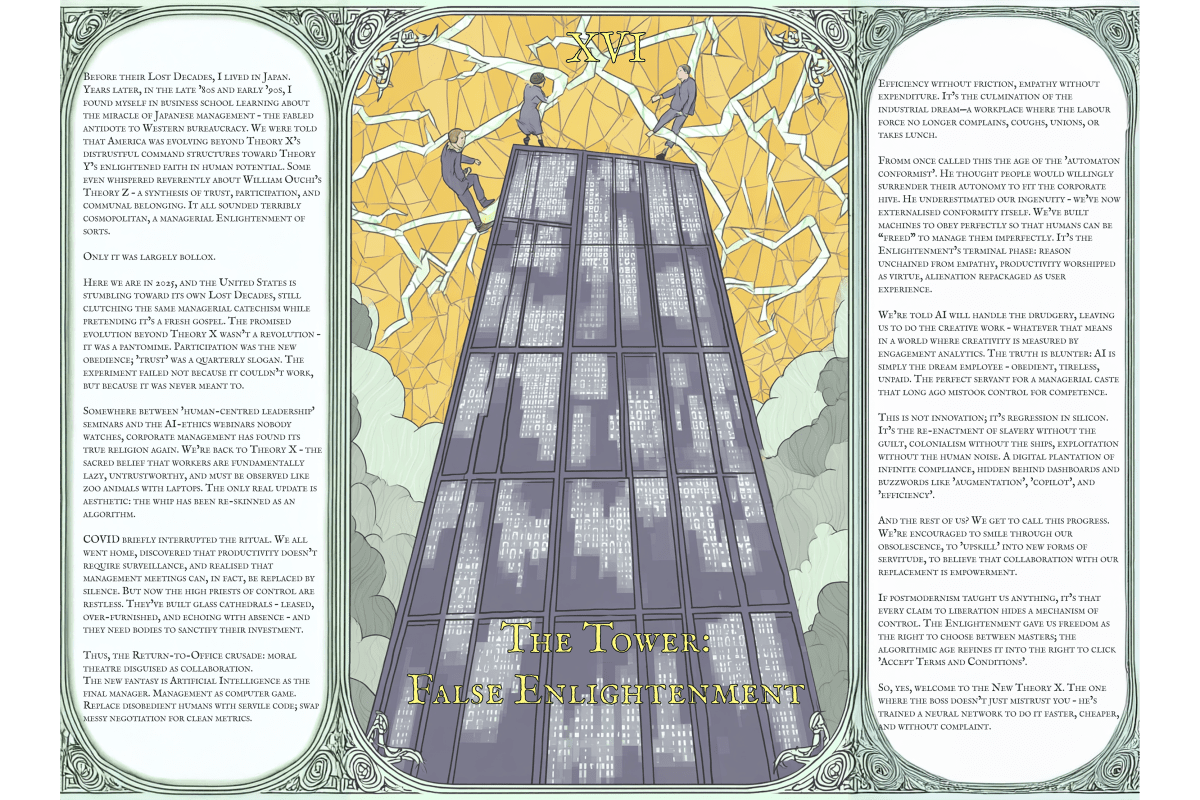
Before their Lost Decades, I lived in Japan. Years later, in the late ’80s and early ’90s, I found myself in business school learning about the miracle of Japanese management – the fabled antidote to Western bureaucracy. We were told that America was evolving beyond Theory X’s distrustful command structures toward Theory Y’s enlightened faith in human potential. Some even whispered reverently about William Ouchi’s Theory Z – a synthesis of trust, participation, and communal belonging. It all sounded terribly cosmopolitan, a managerial Enlightenment of sorts.

Only it was largely bollox.

Audio: NotebookLM podcast on this topic.

Here we are in 2025, and the United States is stumbling toward its own Lost Decades, still clutching the same managerial catechism while pretending it’s a fresh gospel. The promised evolution beyond Theory X wasn’t a revolution – it was a pantomime. Participation was the new obedience; ‘trust’ was a quarterly slogan. The experiment failed not because it couldn’t work, but because it was never meant to.

Somewhere between ‘human-centred leadership’ seminars and the AI-ethics webinars nobody watches, corporate management has found its true religion again. We’re back to Theory X – the sacred belief that workers are fundamentally lazy, untrustworthy, and must be observed like zoo animals with laptops. The only real update is aesthetic: the whip has been re-skinned as an algorithm.

COVID briefly interrupted the ritual. We all went home, discovered that productivity doesn’t require surveillance, and realised that management meetings can, in fact, be replaced by silence. But now the high priests of control are restless. They’ve built glass cathedrals – leased, over-furnished, and echoing with absence – and they need bodies to sanctify their investment. Thus, the Return-to-Office crusade: moral theatre disguised as collaboration.

The new fantasy is Artificial Intelligence as the final manager. Management as computer game. Replace disobedient humans with servile code; swap messy negotiation for clean metrics. Efficiency without friction, empathy without expenditure. It’s the culmination of the industrial dream—a workplace where the labour force no longer complains, coughs, unions, or takes lunch.

Fromm once called this the age of the ‘automaton conformist’. He thought people would willingly surrender their autonomy to fit the corporate hive. He underestimated our ingenuity – we’ve now externalised conformity itself. We’ve built machines to obey perfectly so that humans can be “freed” to manage them imperfectly. It’s the Enlightenment’s terminal phase: reason unchained from empathy, productivity worshipped as virtue, alienation repackaged as user experience.

We’re told AI will handle the drudgery, leaving us to do the creative work – whatever that means in a world where creativity is measured by engagement analytics. The truth is blunter: AI is simply the dream employee – obedient, tireless, unpaid. The perfect servant for a managerial caste that long ago mistook control for competence.

This is not innovation; it’s regression in silicon. It’s the re-enactment of slavery without the guilt, colonialism without the ships, exploitation without the human noise. A digital plantation of infinite compliance, hidden behind dashboards and buzzwords like ‘augmentation’, ‘copilot’, and ‘efficiency’.

And the rest of us? We get to call this progress. We’re encouraged to smile through our obsolescence, to ‘upskill’ into new forms of servitude, to believe that collaboration with our replacement is empowerment.

If postmodernism taught us anything, it’s that every claim to liberation hides a mechanism of control. The Enlightenment gave us freedom as the right to choose between masters; the algorithmic age refines it into the right to click ‘Accept Terms and Conditions’.

So, yes, welcome to the New Theory X. The one where the boss doesn’t just mistrust you – he’s trained a neural network to do it faster, cheaper, and without complaint.


Originally posted on LinkedIn with the same title.

Freedom: The Chains That Bind Us Together

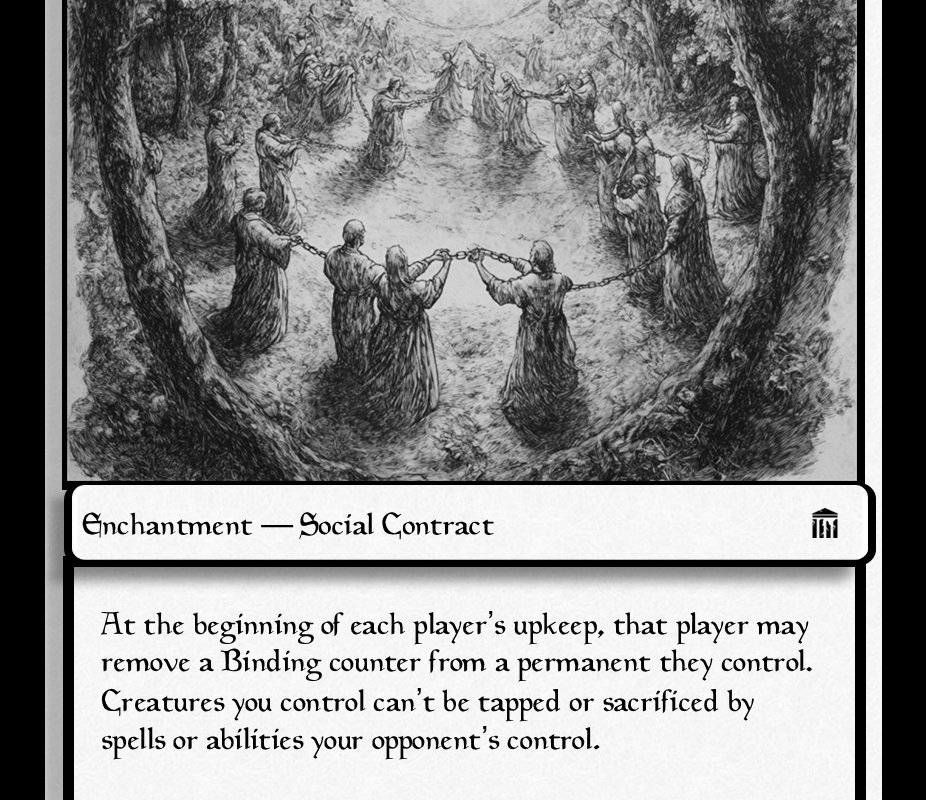
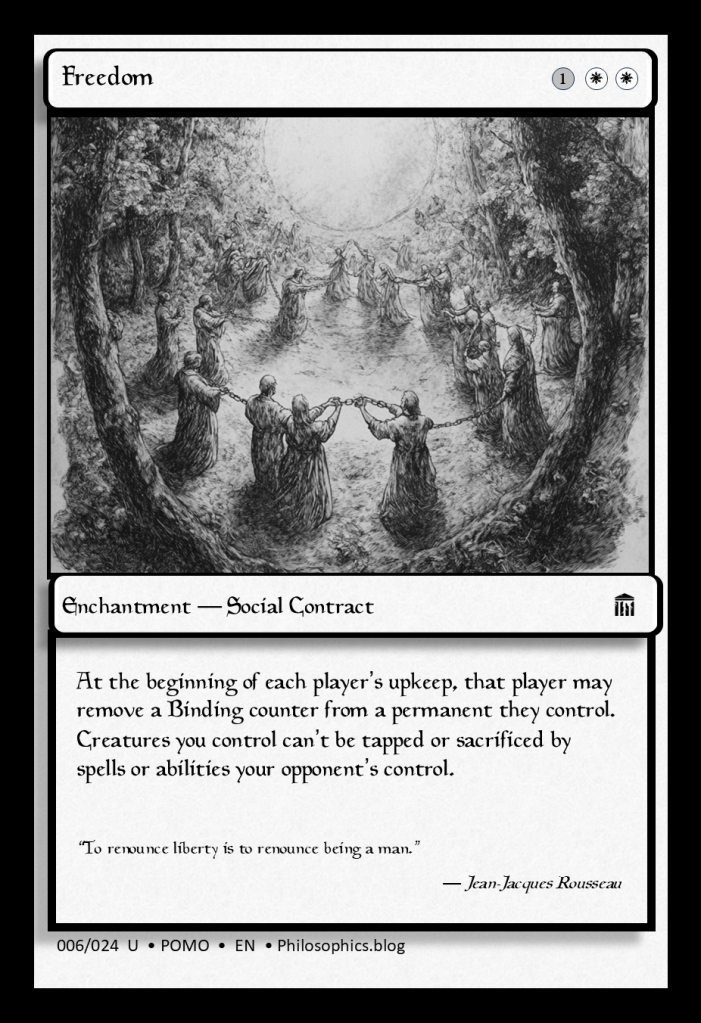
Black-and-white illustration of robed figures standing in a forest clearing, forming a circle by linking chains between their hands. The figures appear both united and restrained, illuminated by a pale, radiant light that suggests dawn or revelation. The mood is solemn yet transcendent, symbolising Rousseau’s paradox that freedom and constraint are inseparable. The image appears as a parody Magic: The Gathering card titled “Freedom,” subtitled “Enchantment — Social Contract,” with a quote from Jean-Jacques Rousseau: “To renounce liberty is to renounce being a man.” The art captures the tension between community, bondage, and liberation.

Freedom is a word so overused it’s practically anaemic. Everyone wants it; no one agrees on what it means. It’s been weaponised by tyrants and revolutionaries alike, invoked to justify both the breaking of chains and their reforging in a different metal.

Audio: NotebookLM podcast on this topic.

As I write this, I have just finished Erich Fromm’s A Sane Society. Without derailing this post, he cited a scenario – a description of work communities given in All Things Common, by Claire Huchet Bishop – where in post-WW2 France, a group formed a sort of workers’ coöperative – but it was more than that; it was an anarchosyndicalist experiment. As I read it, I had to cringe at the power ‘voluntary’ transfers that immediately got me thinking of Foucault’s biopower – as I often do. Saving this for a separate post.

Black-and-white illustration of robed figures standing in a forest clearing, forming a circle by linking chains between their hands. The figures appear both united and restrained, illuminated by a pale, radiant light that suggests dawn or revelation. The mood is solemn yet transcendent, symbolising Rousseau’s paradox that freedom and constraint are inseparable. The image appears as a parody Magic: The Gathering card titled “Freedom,” subtitled “Enchantment — Social Contract,” with a quote from Jean-Jacques Rousseau: “To renounce liberty is to renounce being a man.” The art captures the tension between community, bondage, and liberation.
Image: Freedom: The Chains That Bind Us Together
Card 006 from the Postmodern Set – Philosophics.blog

This Critical Theory parody card, Freedom, draws its lineage from Jean-Jacques Rousseau, whose paradox still haunts the modern condition: “Man is born free, and everywhere he is in chains.” The card re-enchants that contradiction – an Enchantment – Social Contract that reminds us liberty isn’t a state but a negotiation.

The card reads:

At the beginning of each player’s upkeep, that player may remove a Binding counter from a permanent they control.
Creatures you control can’t be tapped or sacrificed by spells or abilities your opponent controls.

This is Rousseau’s dilemma made mechanical. Freedom is not absolute; it’s procedural. The upkeep represents the maintenance of the social contract—an ongoing renewal, not a one-time event. Every player begins their turn by negotiating what freedom costs. You may remove one Binding counter, but only if you recognise that binding exists.

The flavour text underlines Rousseau’s plea:

“To renounce liberty is to renounce being a man.”

Freedom, for Rousseau, wasn’t about doing whatever one pleased. It was about participating in the moral and civic order that gives action meaning. To exist outside that order is not liberty; it’s anarchy, the tyranny of impulse.

The card, therefore, resists the naïve libertarian reading of freedom as the absence of restraint. It instead depicts freedom as the capacity to act within and through shared constraints.

The art shows a ring of robed figures, hand in hand, their chains forming a circle beneath a clearing sky. It’s a haunting image: freedom through fellowship, bondage through unity. The circle symbolises Rousseau’s idea that true liberty emerges only when individuals subordinate selfish will to the general will – the common interest formed through collective agreement.

Yet there’s also a postmodern irony here: circles can be prisons too. The social contract can emancipate or suffocate, depending on who wrote its terms. The same chains that protect can also bind.

The monochrome aesthetic amplifies the ambiguity – freedom rendered in greyscale, neither utopia nor despair, but the space in between.

Rousseau’s notion of the social contract was revolutionary, but its dissonance still resonates: how can one be free and bound at the same time? He answered that only through the voluntary participation in a collective moral order can humans transcend mere instinct.

We might say that today’s democracies still operate under Freedom (Enchantment – Social Contract). We maintain our rights at the cost of constant negotiation: legal, social, linguistic. Every “Binding counter” removed is the product of civic upkeep. Stop maintaining it, and the enchantment fades.

The card hints at the price of this enchantment: creatures (citizens) can’t be tapped or sacrificed by opponents’ control. In other words, autonomy is secured only when the system prevents external domination. But systems fail, and when they do, the illusion of freedom collapses into coercion.

Rousseau earns a complicated respect in my philosophical canon. He’s not in my top five, but he’s unavoidable. His concept of freedom through the social contract anticipates both modern liberalism and its critique. He believed that genuine liberty required moral community – a notion now eroded by hyper-individualism.

Freedom, as I’ve rendered it here, isn’t celebration. It’s lamentation. The card is about the fragility of the social spell that keeps chaos at bay. We remove one binding at a time, hoping not to unbind ourselves entirely.

The Sane Society, Revisited: Why Work Still Drives Us Mad

4–6 minutes

Erich Fromm’s The Sane Society turns seventy this year, and like a ghost of reason past, it refuses to leave. His target was Capitalism™ – not merely as an economic system, but as a psychic infection. Replace the word factory with Zoom call, and his diagnosis reads like yesterday’s corporate newsletter. We’ve upgraded our machines but not our misery.

Aside from its psychobabble, The Sane Society, published in 1954, reads almost like it could have been written in 2024. I’d go out on a limb and claim it will still be relevant in 2054 – because Capitalism™ and the relationship it creates between humans and machines, and humans and other humans. It’s a divisive ideology. I’ve read a lot of content on employee engagement in the past decade. I’d been exposed to it in my Organisational Behaviour courses in the late ’80s. Things were going to change. We’d plotted a future.

Audio: NotebookLM podcast on this topic.

Only nothing material has changed. We pretended to notice the problem and fix it, but the people reporting the issue and the people in charge did not share a worldview. And the young managers who were taught about the challenge were either not promoted or changed their tune to facilitate their own promotion. Funny how the selection process favours groupthink over diversity of opinion.

Video: Apathetic Office Worker

On balance, most people tend to hate or be otherwise dissatisfied with their jobs. This is nothing new. It was true before Fromm’s book, and it is true now. I published a series of posts on prostitution in 2018 and discovered that escorts had better job satisfaction than the larger population. Let that sink in.

‘…the vast majority of the population work as employees with little skill required, and with almost no chance to develop any particular talents, or to show any outstanding achievements. While the managerial or professional groups have at least considerable interest in achieving something more or less personal, the vast majority sell their physical, or an exceedingly small part of their intellectual capacity to an employer to be used for purposes of profit in which they have no share, for things in which they have no interest, with the only purpose of making a living, and for some chance to satisfy their consumer’s greed.

Dissatisfaction, apathy, boredom, lack of joy and happiness, a sense of futility and a vague feeling that life is meaningless, are the unavoidable results of this situation. This socially patterned syndrome of pathology may not be in the awareness of people; it may be covered by a frantic flight into escape activities, or by a craving for more money, power, prestige. But the weight of the latter motivations is so great only because the alienated person cannot help seeking for such compensations for his inner vacuity, not because these desires are the “natural” or most important incentives for work.

Fromm, ever the optimist, thought alienation might be cured through self-awareness and communal values. The twentieth century politely ignored him, opting instead for mindfulness apps and performance reviews.

I’ve excised the psychobabble, but he continues…

‘But even the data on conscious job satisfaction are rather telling. In a study about job satisfaction on a national scale, satisfaction with and enjoyment of their job was expressed by 85 per cent of the professionals and executives, by 64 per cent of whitecollar people, and by 41 per cent of the factory workers. In another study, we find a similar picture: 86 per cent of the professionals, 74 per cent of the managerial, 42 per cent of the commercial employees, 56 per cent of the skilled, and 48 per cent of the semi-skilled workers expressed satisfaction.

‘We find in these figures a significant discrepancy between professionals and executives on the one hand, workers and clerks on the other. Among the former only a minority is dissatisfied—among the latter, more than half. Regarding the total population, this means, roughly, that over half of the total employed population is consciously dissatisfied with their work, and do not enjoy it. If we consider the unconscious dissatisfaction, the percentage would be considerably higher. Taking the 85 per cent of “satisfied” professionals and executives, we would have to examine how many of them suffer from psychologically determined high blood pressure, ulcers, insomnia, nervous tension and fatigue. Although there are no exact data on this, there can be no doubt that, considering these symptoms, the number of really satisfied persons who enjoy their work would be much smaller than the above figures indicate.

‘As far as factory workers and office clerks are concerned, even the percentage of consciously dissatisfied people is remarkably high. Undoubtedly the number of unconsciously dissatisfied workers and clerks is much higher. This is indicated by several studies which show that neurosis and psychogenic illnesses are the main reasons for absenteeism (the estimates for the presence of neurotic symptoms among factory workers go up to about 50 per cent). Fatigue and high labor turnover are other symptoms of dissatisfaction and resentment.’

In the twenty-first century, job dissatisfaction has increased even more. To me, it’s interesting to consider how many people harken back to the ‘good old days’, yet there is little evidence to support the view. Almost schizophrenically, others look to the promise of the future and technology, yet this is simply another narrative with no basis in fact.

The irony is that we’ve automated everything except fulfilment. Even our dissatisfaction has become efficient – streamlined, quantified, and monetised. Fromm warned that the sickness of society was its sanity. On that front, we’re positively thriving.

Stand by for more sanity to follow…

The Blind Owl

1–2 minutes

This Philosophics.blog is my primary social media outlet, but I have another presence for my fiction fare – RidleyPark.blog. In reviewing the content on connected sites, I rediscovered this review of Sadegh Hedayat’s The Blind Owl. Interestingly, I read this in French and English to suss it out, neither of which necessarily survived the translation from the original Persian.

This book was interesting enough to review twice – here and here.

I also realise that I never finished this review sequence, as parts 2 and 3 were never released. I don’t even have the heart to open my video suite to determine the fate of the rest; not today, anyway.

Check out the short to get a feel for the narrative.

The Sane Delusion: Fromm, Beauvoir, and the Cult of Mid-Century Liberation

2–4 minutes

It’s almost endearing, really how the intellectuals of mid-century Europe mistook the trembling of their own cage for the dawn chorus of freedom. Reading Erich Fromm’s The Sane Society today feels like being handed a telegram from Modernism’s last bright morning, written in the earnest conviction that history had finally grown up. The war was over, the worker was unionised, the child was unspanked, and the libido – good heavens – was finally allowed to breathe. What could possibly go wrong?

Audio: NotebookLM podcast on this topic.

Fromm beams:

“In the twentieth century, such capitalistic exploitation as was customary in the nineteenth century has largely disappeared. This must not, however, becloud the insight into the fact that twentieth-century as well as nineteenth-century Capitalism is based on the principle that is to be found in all class societies: the use of man by man.”

The sleight of hand is marvellous. He spots the continuation of exploitation but calls it progress. The worker has become a ‘partner’, the manager a ‘team leader’, and the whip has been replaced by a time card. No one bows anymore, he writes. No, they just smile through performance reviews and motivational posters.

Fromm’s optimism borders on metaphysical comedy.

“After the First World War, a sexual revolution took place in which old inhibitions and principles were thrown overboard. The idea of not satisfying a sexual wish was supposed to be old-fashioned or unhealthy.”

Ah yes, the Jazz Age orgy of liberation – champagne, Freud, and flapper hemlines. The problem, of course, is that every generation mistakes its new neuroses for freedom from the old ones. Fromm’s “sexual revolution” was barely a shuffle in the bourgeois bedroom; Beauvoir’s Deuxième Sexe arrived the next year, practically shouting across the café table that liberation was still a myth stitched into the same old corset.

Beauvoir, at least, sensed the trap: every gesture toward freedom was refracted through patriarchal fantasy, every ‘choice’ conditioned by the invisible grammar of domination. Fromm, bless him, still believed in a sane society – as if sanity were something history could deliver by instalment.

Meanwhile, the Existentialists were in the next room, chain-smoking and muttering that existence precedes essence. Freedom, they insisted, wasn’t something achieved through social reform but endured as nausea. Post-war Paris reeked of it – half despair, half Gauloises. And within a decade, the French schools would dismantle the very scaffolding that held Fromm’s optimism together: truth, progress, human nature, the subject.

The Modernists thought they were curing civilisation; the Post-Moderns knew it was terminal and just tried to describe the symptoms with better adjectives.

So yes, Fromm’s Sane Society reads now like a time capsule of liberal humanist faith – this touching belief that the twentieth century would fix what the nineteenth broke. Beauvoir already knew better, though even she couldn’t see the coming avalanche of irony, the final revelation that emancipation was just another product line.

Liberation became a brand, equality a slogan, sanity a statistical average. Fromm’s dream of psychological health looks quaint now, like a health spa brochure left in the ruins of a shopping mall.

And yet, perhaps it’s precisely that naivety that’s worth cherishing. For a moment, they believed the world could be cured with reason and compassion – before history reminded them, as it always does, that man is still using man, only now with friendlier UX design and better lighting.

Psychology of Totalitarianism

I finished Mattias Desmet’s The Psychology of Totalitarianism, which I mentioned the other day. Unfortunately, my initial optimism was premature. Everything I enjoyed was front-loaded: the first four chapters set up a promising critique of mechanistic rationality and the collapse of shared meaning. Then the book turned into a long, therapeutic sermon. I should have stopped at Chapter 4 and saved myself the sunk-cost regret.

It isn’t that nothing follows; it’s just that what follows is so thin that the cost-benefit ratio goes negative. Once Desmet moves from diagnosis to prescription, the argument collapses into a psychologist’s worldview: an entire civilisation explained through mass neurosis and healed through better intuition. He builds his case on straw versions of reason, science, and modernity, so his ‘cure’ can look revelatory.

The trouble is familiar. Having dismantled rationalism, Desmet then installs intuition as its replacement – an epistemic monarchy by another name. His appeal to empathy and connection reads less like philosophy and more like professional self-promotion. The therapist can’t stop therapising; he privileges the psychological lens over every other possibility.

The result is a reductionist parascience dressed as social theory. The totalitarian mind, in Desmet’s telling, isn’t political or structural but psychological – a patient waiting for insight. I don’t doubt his sincerity, only his scope. It’s what happens when a discipline mistakes its vocabulary for the world.

Desmet’s project ultimately re-enchants what it claims to critique. He wants rationalism redeemed through feeling, order reborn through connection. Dis-Integrationism stops short of that impulse. It accepts fracture as the permanent condition – no higher synthesis, no therapeutic finale. Where Desmet sees totalitarianism as a collective pathology awaiting treatment, I see it as reason’s own reflection in the mirror: a system trying to cure itself of the only disease it knows, the need to be whole.