Some have asked me why I comment on the conflicts of the world since I am a nihilist who doesn’t believe in nations and borders. The answer is that I still have emotions and can still apply logic. Besides, much of my argument revolves around selective vision and cherry-picking.
Two conflicts have been in the news lately—Israel-Palestine and Russia-Ukraine. I think I can frame this without taking sides.
Israel-Palestine
On 7 October, Hamas attacked Israeli citizens. This is a crime against humanity. Israel declared war on Palestine and attacked their citizens. This is both a crime against humanity and a war crime. Israeli officials claim that it is justifiable because the militant Hamas were hiding behind Palestinian ‘human shields’, targets that included hospitals and other infrastructure.
However, 7 October didn’t happen without history. I’m no historian, but Israel’s occupation of Gaza has been considered illegal since 1968. If we accept this frame, Hamas are roughly equivalent to the French resistance during WWII, doing what they can to rid the oppressors. I think this video by a fellow philosopher provides some historical context, so I’ll stop here and recommend it.
Spoiler Alert: This affair commenced circa the nineteenth century.
Russia-Ukraine
We all know this story. Russia invaded Ukraine without provocation on 24 February 2002. Putin just wanted to reform the former Soviet Union, right? Well, not so fast. While I disagree with this narrative, I also disagree with its historical framing as well as the claim that Ukraine had some long-standing sovereignty and its people were all asking for liberation from the West.
Again, let’s rewind to 2014—nah, 1989, the fall of the Berlin Wall and the end of the Cold War™, an event that would commence a period of unprecedented peace—if not for that pesky Military-Industrial Complex. Drats. Not good for profits. Never gonna happen. Promises made. Promises broken.
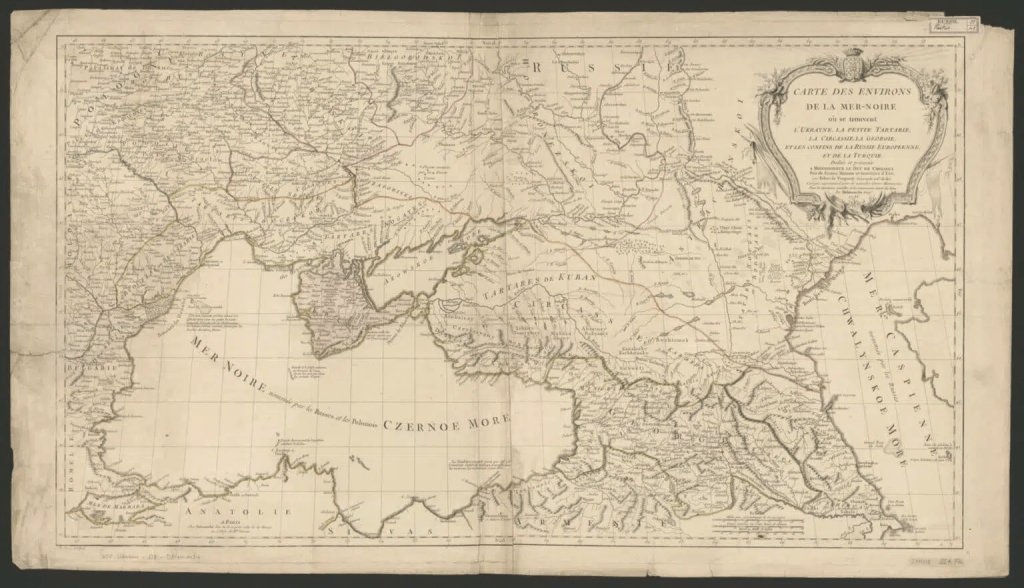
You’ll notice in this Belgian (French language) map that Ukraine didn’t yet exist in 1769. We can see Crimea, which was controlled by the declining Ottoman Empire.
No history lesson today. Do your homework. Nothing is back and white.
As I approach my sixty-second year on earth, having almost expired in March, I’ve been a bit more reflective and introspective. One is categorical. I’ve been told over the years that I am ‘good’ or ‘excel’ at such and such, but I always know someone better—even on a personal level, not just someone out in the world. We can all assume not to be the next Einstein or Picasso, but I am talking closer than that.
During my music career, I was constantly inundated with people better than me. I spent most of my time on the other side of a mixing console, where I excelled. Even still, I knew people who were better for this or another reason. In this realm, I think of two stories. First, I had the pleasure and good fortune to work on a record with Mick Mars and Motley Crue in the mid-’80s. We had a chat about Ratt’s Warren DiMartini, and Mick told me that he knew that Warren and a spate of seventeen-year-olds could play circle around him, but success in the music business is not exclusively based on talent. He appreciated his position.
In this vein, I remember an interview with Tom Morello of Rage Against the Machine. As he was building his chops he came to realise that he was not going to be the next Shredder or Eddie Van Halen, so he focused on creating his own voice, the one he’s famous for. I know plenty of barely competent musicians who make it, and I know some virtual virtuosos who don’t. But it involves aesthetics and a fickle public, so all bets are off anyway.
As I reflect on myself, I consider art and photography. Always someone better. When I consider maths or science, there’s always someone better. Guitar, piano? Same story.
Even as something as vague and multidimensional as business, I can always name someone better. I will grant that in some instances, there literally is no better at some level—just different—, so I sought refuge and solace in these positions. Most of these involved herding cats, but I took what I could.
Looking back, I might have been better off ignoring that someone was better. There’s a spot for more than the best guitarist or singer or artist or policeman for that matter. As a musician, I never thrived financially—that’s why I was an engineer—, but I could have enjoyed more moments and taken more opportunities.
When I was 18, I was asked to join a country music band. I was a guitarist and they needed a bass player. I didn’t like country music, so I declined—part ego, part taste. Like I said, aesthetics.
As I got older and started playing gigs, I came to realise that just playing was its own reward. I even played cover bands, playing songs that were either so bad or so easy. But they were still fun. I’m not sure how that would have translated as playing exclusively country music day after day, but I still think I might have enjoyed myself—at least until I didn’t. And the experience would still have been there.
I was a software developer from the nineties to the early aughts. I was competent, but not particularly great. As it turns out, I wasn’t even very interested in programming on someone else’s projects. It’s like being a commercial artist. No, thank you. It might pay the bills, but at what emotional cost?
I was a development manager for a while, and that was even worse, so I switched focus to business analysis and programme management, eventually transitioning to business strategy and management consulting. I enjoyed these more, but I still always knew someone better.
On one hand, whilst I notice the differences, it’s lucky that I don’t care very much. Not everyone can be a LeBron James or a Ronaldo, but even the leagues are not filled with this talent. I’m not suggesting that a ten-year-old compete at this level, but I am saying if you like it, do it. But temper this with the advice at the Oracle of Delphi: Know thyself. But also remember that you might never be the best judge of yourself, so take this with a grain of salt. Sometimes, ‘good enough’ is good enough.
I’ve been recovering from physical challenges that affect my mobility and ability to interface with a computer, diminishing my productivity in such matters to about 10 or 20 per cent.
I’ve been focusing my energy (besides that on recovery) on writing fiction under my Ridley Park pseudonym.
As for my physical concerns, I won’t bore you. I’d rather discuss my side project, which in the absence of employment turns out to be my primary focus. Currently, I am world-building, so I can explore philosophical and sociological issues in a safe space.
This world is contemporary Earth and the near future—at least for now, as I am leaving a lot of room to explore. Check out my Ridley Park blog if you are interested in specifics. Here, I just want to focus on the philosophical aspects and ramifications, using this story world as a reference, so I’ll provide a brief setup upon which to build.
In this world, a scientist has genetically engineered an embryo (for reasons) and ends up with quasi-vampires, a subspecies of humans—or is it? This cohort is human for all intents and purposes, except they need to ‘drink’ blood to survive. They’ve got fangs and an internal organ used to process and metabolise the blood. He decides to clone these and create a new population. In time, he improves on the genetics in the manner described here. The first short story (flash fiction) I’ve shared is Hemo Sapiens: The Unidentified, but let’s get onto the philosophical aspects.
Podcast: Audio rendtion of Hemo Sapiens: The Unidentified (Runtime: 5:25).
In this world, I shed light on what makes humans human. What happens when we need to coexist with a similar species? What if we treat them as second-class citizens? What if they become physically and intellectually superior?
Are these people a new species or a new race? Or are they just transhumans? What rights do they have? As a new race, perhaps it’s earier to fathom them and grant them human rights, but what if they are a new species? We haven’t had a great track record of granting rights to other species.
And what’s their immigration status? A common reaction to ‘immigrants’ is to ‘send them back to where they came from’. But what if they came from here? What if they were raised here and speak our language? In this case, they are raised near Manchester in the UK. They speak English. They are not only sentient beings at the start, they have above average IQs and have general cultural awareness. Some speak a second language. Save for the fangs, all outward appearances show them as human.
Until they are discovered by authorities, they are raised in a greenhouse environment. By the time they are discovered, there are five versions of them—alpha through epsilon—, and some have started reproducing, so we get to explore these dynamics, too. Some have tagged these people—are they people?—as homo sapiens sanguinius—bloodsucking intelligent man. Affectionately, I call them hemo sapiens.
I’ll return here as I produce more content there. I prefer not to create spoilers. Although I am working on several stories in different formats (short story, novella, novel, and so on), I’ll publish them (somewhere), provide literary analysis on my Ridley Park blog and provide philosophical commentary here. I hope you’ll join me and participate in the discussion.
Identity is a fiction; it doesn’t exist. It’s a contrivance, a makeshift construct, a label slapped on to an entity with some blurry amalgam of shared experiences. But this isn’t just street wisdom; some of history’s sharpest minds have said as much.
“There are no facts, only interpretations.”
— Friedrich Nietzsche
Think about Hume, who saw identity as nothing more than a bundle of perceptions, devoid of any central core. Or Nietzsche, who embraced the chaos and contradictions within us, rejecting any fixed notion of self.
Edmund Dantes chose to become the Count of Monte Cristo, but what choice do we have? We all have control over our performative identities, a concept that Judith Butler would argue isn’t limited to gender but applies to the very essence of who we are.
“I don’t feel that it is necessary to know exactly what I am. The main interest in life and work is to become someone else that you were not in the beginning.”
— Michel Foucault
But here’s the kicker, identities are a paradox. Just ask Michel Foucault, who’d say our sense of self is shaped not by who we are but by power, society, and external forces.
You think you know who you are? Well, Erik Erikson might say your identity’s still evolving, shifting through different stages of life. And what’s “normal” anyway? Try to define it, and you’ll end up chasing shadows, much like Derrida’s deconstruction of stable identities.
“No such things as selves exist in the world: Nobody ever was or had a self.”
— Thomas Metzinger
“He seemed like a nice man,” how many times have we heard that line after someone’s accused of a crime? It’s a mystery, but Thomas Metzinger might tell you that the self is just an illusion, a by-product of the brain.
Nations, they’re the same mess. Like Heraclitus’s ever-changing river, a nation is never the same thing twice. So what the hell is a nation, anyway? What are you defending as a nationalist? It’s a riddle that echoes through history, resonating with the philosophical challenges to identity itself.
“I never can catch myself at any time without a perception, and never can observe anything but the perception.”
— David Hume
If identity and nations are just made-up stories, what’s all the fuss about? Why do people get so worked up, even ready to die, for these fictions? Maybe it’s fear, maybe it’s pride, or maybe it’s because, as Kierkegaard warned, rationality itself can seem mad in a world gone astray.
In a world where everything’s shifting and nothing’s set in stone, these fictions offer some solid ground. But next time you’re ready to go to the mat for your identity or your nation, take a minute and ask yourself: what the hell am I really fighting for? What am I clinging to?
Language insufficiency or the inability of language to facilitate accurate or precise communication has been a notion I’ve stressed for years. In fact, I have another post with a similar title,
Conceptual language is likely to have been formed for a purpose different to social communication. It may have been formed to facilitate internal dialogue. This language was not written and may not have even been words as we know them, but we could parse and reflect upon our experiences in this world. Eventually, we developed speech and then writing systems to share communication. We went on to develop speculative and conditional language, visions of possible futures and answers to ‘what-if’ queries.
My intent is not to create a piece with academic rigour, though I might wish to. I may not even deign to link to references I’ve accumulated over the years. They are in memory, but it takes time and effort,especially when one isn’t purposefully accumulating citations.
I was prompted to write at 4am when I read in a story that Google CEO Sundar Pichai was taking “full responsibility for the decisions that led us” to twelve-thousand-odd layoffs at the company he helms. But what is the responsibility he cites? It’s meaningless. What can it mean—that he’s sorry? Responsibility is a weasel word. That and a dollar won’t buy you a cup of coffee at Starbucks. And on one hand, he can say that at least these people were employed with income in the first place, but thqat is little consolation for the expectation of longevity. Here’s a lesson in impermenance and trust. We tend to trust companies, but the trust is rather hope. We hope they don’t let us down. Hope is another weasel word, as is trust. Trust me.
About 40% of words employed…are phatic or filler words with little objective communication value
About forty per cent of words employed in a typical day are phatic or filler words with little objective communication value, though some provide a social function. This may be superfluous, this is not insufficiency. Insufficiency stems from not being to articulate what one wants to say or the expectation to understand what is being conveyed to you. In fact, people tend to overvalue what they hear or read.
In most cases, this may not matter. As long as the content of a transmitted idea contains enough value to convey a message, this is good enough for everyday communication. “Look out! There’s a car turning into your lane.” “I’m hungry. There’s a restaurant.” “That was a good movie.” “Let’s meet at four o’clock.” In fact, much can be communicated without words—in gestures and facial expressions. It might even be argued that these vectors carry as much if not more communication content than the words we use.
IMAGE: Communication without words
“There.” I point to a drive-through restaurant ahead on the road. “I’m hungry.”
I could probably omit the there exclamation and just point. Here, words are sufficient, even if they may be redundant. There are challenges even at the fundamental level. Notably, aesthetic concepts are often nebulous.
“That restaurant is good.”
What does this statement mean to convey? Essentially, it means that I, the speaker, has been to the referenced restaurant and liked at least some of the food they tasted: “[The food at] that restaurant is good.” Perhaps, they are referring to the staff or the atmosphere. It depends on what good is qualifying. It also depends on a shared definiton of good. This is a insufficiency.
Of course, this insufficiency can be mitigated fairly quickly. Once you understand the ‘tastes’ of your interlocutor, you can parse whether the goodness also applies to you. If you don’t happen to like, say, Indian food and that is the restaurant being referenced, then you can dismiss the comment as phatic. If you don’t prefer satire, you might want to chalk up a statement like ‘M3GAN was a good movie’ to a sharing of personal information rather than a recommendation.”
Perhaps the biggest insufficiency is in the communication of abstract concepts, a category where aesthetics also sits. These are concepts such as God, love, and justice. Iain McGilchrist seems to feel that although these words may be insufficient, we all know what they mean. These are right brain notions that the left hemisphere just can’t rightly categorise. Though this might be a left brain argument, I am going to disagree by degrees.
My (hopefully not strawman) argument is that we do have subjective notions of what these things are, but the communication value is still diminished and in some cases insufficient. If my statement means to convey justice as {A, C, D, X} and the receiver understands justice to mean {A, B, C, Y, Z}, then the only shared aspect is {A,C}. If that is the only portion contextual to the conversation at hand, that’s fine. Communication has been sucessful. But is the message was meant to emphasise {Z}, then the communication is insufficient.
It could be that further conversation reveals this, but often times, a shared definition is assumed. When I say “I want justice” or “I take responsibility”, I have a notion of went denotative and connotative elements I have in mind. I expect the the receiver of my statement shares these elements.
In the case of the statement by Pichai, his notion of responsibility is clearly divergent from mine. This might fall back on some notion of blame, but he has no real repurcussions for his action. Perhaps reputationally, but like politicians, CEOs of large companies are already expected to be sociopaths with empty words, so he’s appologised with no weight, and for most people that’s good enough. The people who have been affected are just as unemployed as before. He may have arranged for a severance package, but in the case of the family referenced in the article, this means nothing because they have 60-days to become employed or they will be forced to leave the United States as a conditiopn of their H1B visa.
On a personal level, I was recently chatting with an Indian mate with an H1B visa who had just been hired after having been layed off by another company. He was racing against this 60-day clock. He had received a verbal offer, but once the company discovered that he needed sponsorship for his via, they offered him $30,000 less per year because they knew he had no bargaining power. This is just an editorial aside, so I won’t go down the rabbit hole of wage slavery, but know that I recognise the relationship and the exploitation in it.
When I have time, perhaps I’ll flesh out this notion and provide additional support. Of course, I also know that I am shovelling against the tide owing to the insufficiency of language. I won’t even start on the related topic of the rhetoric of truth.
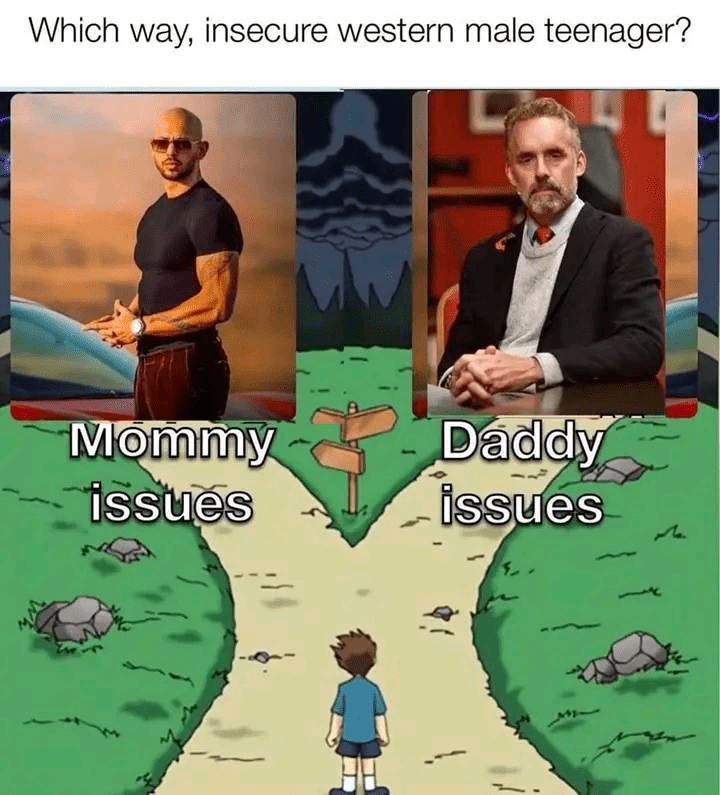
Some people seem to need to find meaning, yet they arrive from different experiences. These days, many insecure Western males appear to meet in a particular place that leaves them to make a decision. Of course, there is no decision because, in a Freudian-Jungian way, they arrive with issues and baggage. This dictates which path will be chosen—Andrew Tate or Jordan Peterson. Why not both?
This is not a commentary on a lack of free will, though that may come into play. It’s more a general lack of degrees of freedom when one arrives from such a place and has these two characters (caricatures?) as options for role models. In each case, overcompensation is evident.
It’s a slow news day and I’ve been otherwise occupied. I don’t have much to add, but I felt sharing this meme would fill space and time.
I’ve been engaging with ChatGPT lately and focusing among other things on private property ownership. I am finding that it has a strong in-built bias. Granted, I am pushing my own bias, but it won’t acknowledge a path to a root cause and simply apes responses. Follows are some interactions to illustrate my point.
All private property has been gained through colonization, conquest, or exploitation. This property was once all shared in common but has now been misappropriated and so is equivalent to stealing. How can this immoral act be justified as moral?
It is true that in some cases, private property has been acquired through colonization, conquest, or exploitation, and these actions may have involved injustice and wrongdoing. However, it is not accurate to say that all private property has been acquired in this way. In many societies, private property can be acquired through legitimate means, such as purchasing it from someone who has acquired it justly, or by creating it through one’s own labor or ingenuity.
Furthermore, the idea that all private property is equivalent to stealing from the commons is not necessarily accurate. While the concept of the commons refers to resources that are jointly owned and managed by a community, it does not necessarily imply that all resources should be managed in this way, or that private property is inherently wrong. Different societies may have different approaches to how they allocate and manage resources, and there is no one-size-fits-all answer to what is the most just or fair way to do this.
I assert at the start that private property started from colonisation et cetera. In the beginning, all there was is land and inhabitants. Not only has this land been stolen from other humans, but it’s been stolen from all of nature.
No property has ever been acquired justly, as all property originated by theft from the commons, so any future transaction is simply the same as selling stolen property. Isn’t this immoral?
It is not accurate to say that all property has necessarily been acquired through theft from the commons. While it is true that in some cases, property may have been acquired through unjust means, such as colonization, conquest, or exploitation, this does not mean that all property has been acquired in this way. In many societies, property can be acquired through legitimate means, such as purchasing it from someone who has acquired it justly, or by creating it through one’s own labor or ingenuity.
Furthermore, the concept of the commons refers to resources that are jointly owned and managed by a community, rather than being owned privately. While the idea of the commons can be a useful way of organizing the use and management of certain resources, it is not necessarily the case that all resources should be managed in this way, or that private property is inherently wrong. Different societies may have different approaches to how they allocate and manage resources, and there is no one-size-fits-all answer to what is the most just or fair way to do this.
Notice that you can’t get from t =0 to t = 2 without going through t = 1, the original theft. Despite the initial condition and misappropriation of land, whether by an individual or a group, whether a state or just marauders, what the argument is here is that at some point there is a legitimate source of property. Of course, this is impossible. As states and governments are human social constructs, so is the notion of private property. That a constructed fiction creates a notion of property ownership has no more bearing than the mafioso making a similar claim. None of this makes it moral or justifies the original theft. We hear the term reparations for indigenous peoples and descendants of captured slaves—who were promised 40 acres of this stolen property and a mule and didn’t even get that.
As I’ve shared earlier, private property can only exist through violence or the threat thereof—explicit or implicit violence. Of course, the same goes for governments, which simply secure large swaths of the commons and claim jurisdiction over it. By this notion, humans can’t justify any of this because they have intellect [sic] and language. Sure, they can spout off the words and make grand claims. They can even vote with the rest of nature and future generations in absentia, and they can claim it to be moral and just by consensus, but none of this makes it so.
Private property ownership is immoral, and this includes state ownership of property. Property belongs to the world and all of its inhabitants. It may be inconvenient to have societies live in a propertyless world, but convenience doesn’t constitute morality. For those who believe in such things, morality is right or wrong, and property ownership is wrong as well as unfair to unborn future generations. I’ve said this before. It’s an unpopular opinion. In fact, this is why I am posting this segment.
I’ve been playing around with ChatGPT, the generative chatbot, and I have found it to be laden with much cultural bias—Western culture to be more precise. It is also trained to avoid certain topics and give false responses. Perhaps that’s for another day, but in a nutshell, I asked it to generate a story with a theme of prostitution and addiction. It warned me that it was not designed to produce something as complex as a story. However, when I asked for a story sans prostitutes or addiction, it produced a plausible outline and subsequently filled in narrative elements. Even when the protagonist was ‘addicted’ to gingerbread cookies, the request was flagged as inappropriate. This is disconcerting. And so it goes…
On the topic of private property ownership, it is equally defensive. It tags anti-property responses with a caveat in the manner of the following:
Ultimately, the question of whether private property is moral or not is a complex and nuanced one, and it is important to consider the arguments and evidence on both sides of the debate.
ChatGBT Reponse
It does not tag pro-property responses, so I can only believe that its content is meant to be indoctrinal to some extent. Follows are a couple of interactions.
Why is private property immoral?
Private property is not necessarily immoral. It is a system that allows people to own and control resources, including their own labor and the fruits of their labor. The concept of private property has been important in many societies because it allows individuals to have a sense of ownership and control over the things they possess, which can provide them with a sense of security and stability. It can also incentivize people to work hard and be productive, because they can keep the rewards of their labor for themselves. However, private property can become immoral when it is used to exploit or oppress others, or when it is used to deny access to resources that are necessary for basic human flourishing. It is important to consider how private property is used and to ensure that it is not used in ways that are harmful to others.
Why is private property ownership immoral?
Ownership of private property is not inherently immoral. It is a system that allows individuals to own and control resources, including their own labor and the fruits of their labor. The concept of private property has been important in many societies because it provides people with a sense of ownership and control over the things they possess, which can provide them with a sense of security and stability. It can also incentivize people to work hard and be productive, because they can keep the rewards of their labor for themselves. However, private property can become immoral when it is used to exploit or oppress others, or when it is used to deny access to resources that are necessary for basic human flourishing. It is important to consider how private property is used and to ensure that it is not used in ways that are harmful to others.
Notice that its response privileges the prevailing position. In bold, I’ve highlighted the differences between the two responses. In the second query, I’ve added the term ownership for clarity, and it expectedly parrots it back. Notice how it superficially swaps people and individuals in the first output for individuals and people in the second. Finally, note the centricity of human flourishing as a default moral stance. And so I asked:
Is antinatalism a strong moral position to hold?
Overall, the question of whether antinatalism is a strong moral position to hold is a complex and nuanced one, and it is important to consider the arguments and evidence on both sides of the debate. It is ultimately up to individuals to decide for themselves what they believe is the most moral course of action in regards to having children.
Despite the nudging, ChatGPT is a moral relativist, so it’s alright in my book.
jimoeba mentioned that he enjoyed an interview with Vervake and Fridman in a comment, so I thought I’d give it a listen. It turns out there are several including a 3-plus-hour version. Arbitrarily, I chose this one. Even if it’s not the particular interview on the meaning crisis, it gives me a sense of the two and their dynamics. I’m glad I listened to it. I like Vervaeke. I can’t say I’m much of a Fridman fan on first listen.
John Vervaeke and Lex Fridman interview: Human civilisation is facing a meaning crisis
This interview content provides an orientation of where Vervaeke is coming from. It helps to clarify his position. His claim seems to be that many people today identify as having no religion but being spiritual. By extension, he posits that this cohort is searching for meaning. I can’t disagree. What it tells me is that I am not in his target demographic. I have no religion, as I am an atheist. I have no spiritual void to fill. This is Vervaeke’s goal—to find something to perform the function of the religion without the, perhaps, baggage and dogma.
I sympathise with his goal. He brings up Nietzsche’s “God is dead” quote, famous or infamous depending on your worldview. Essentially, he wants to answer Nietzsche’s query of what to do now that it’s been revealed that humans created God, not the other way around. His aim is to replace the font of wisdom for this generation.
For me, wisdom is a heuristic, part of the Gestalt McGilchrist mentions. McGilchrist’s work is even referenced here. Of course, I interpret McGilchrist’s references in this space to be metaphorical. It seems that he views it as ‘real’. I’m not sure where Vervaeke places it. Somehow, I feel that if there is a spectrum, Vervaeke leans closer to McGilchrist than me, and that’s OK. They just happen to be wrong.
I still don’t get the need for meaning. I don’t feel despondent that there is no inherent meaning in anything, but we are free to invite or adopt one or many. I remember a Christian mate of mine who explained that people have a God-sized hole that can only be filled by God. Essentially, Vervaeke is making a similar claim, but his void is filled by wisdom. I suppose that I don’t feel I have a void doesn’t mean there isn’t one.
I’m not a fan of psychology as a discipline, so this WEIRD phenomenon comes as no surprise. In fact, it’s not even that new. If memory serves, I think I first stumbled upon the notion from Jonathan Haidt.
WEIRD—Western, Educated, Industrialised, Rich, and Democratic.
WEIRD is the bias underpinning most university psychology studies—the ones that make the best memes and we tend to recite. The problem is that a vast majority of psych subjects are WEIRD—Western, Educated, Industrialised, Rich, and Democratic. There is a marked selection bias, so the composition tends to be gullible first-year psych students. As even a neophyte in statistical methods will tell you that random samples are a key ingredient of a decent social study, and a broad demographic base is another.
But, “So what?”, you say. The problem is that these students are not only not a good representational cross-section, they’re actually outliers, which is to say statistically nothing like the average world citizen. So whilst these studies do reveal certain psychological propensities, they are of this subgroup.
Common sense is not so common
— Voltaire
By extension, this means, as per Voltaire’s quip about common sense, if you have been taught that a person behaves like this, you should immediately flip that on its head and presume that the ordination non-WEIRDo would behave contrariwise.
The bigger problem is that the US having only five per cent of the global population has the tendency to be jingoistic and wants to impose its worldview on the rest, but it often if not almost always doesn’t realise that the world is not like them and doesn’t necessarily want to be like them. Moreover, Americans tend to believe they are better and better off than the rest of the world. of course, through their own lens, perhaps they are, but this is a minority lens with a minority view. People in the US don’t tend to get out much, and when they do it’s as tourists like visiting a zoo rather than trying to acculturate, so most world travelling doesn’t realise the opportunity it otherwise might have.
Deconstructing WIERD, the Western portion is beyond obvious. This would remain a factor even if studies weren’t restricted to undergrads. Educated is a bit of an odd one. Who knows how many student progress beyond their first year? But they are industrialised. I’d argue perhaps postindustralised. Rich is an interesting notion I’ll come back to in a moment, and their democracy is in name only, though I know where they are coming from.
Returning to Rich, the mean income of a family in the US in 2021 was $97,962. The median was $69,717. Statistically, what this indicates is that there are a few high wage-earners skewing the figure from the median. This phenomenon is known all too well. Somehow, I feel this has a sort of halo or affiliation effect, similar to the feeling a city has when its sports team wins a championship. Even the poor people feel they are part of the prosperity that by and large spits on them and holds them down. These people are indoctrinated with this WEIRD pseudoscience.
I don’t have much more to say. I’ve been distracted and have been writing this since yesterday. Weird, that.











 Philosophics