A Case for Intersectionalism

The Space Between

In the great philosophical tug-of-war between materialism and idealism, where reality is argued to be either wholly independent of perception or entirely a construct of the mind, there lies an underexplored middle ground—a conceptual liminal space that we might call “Intersectionalism.” This framework posits that reality is neither purely objective nor subjective but emerges at the intersection of the two. It is the terrain shaped by the interplay between what exists and how it is perceived, mediated by the limits of human cognition and sensory faculties.

Audio: Podcast conversation on this topic.

Intersectionalism offers a compelling alternative to the extremes of materialism and idealism. By acknowledging the constraints of perception and interpretation, it embraces the provisionality of knowledge, the inevitability of blind spots, and the productive potential of uncertainty. This essay explores the foundations of Intersectionalism, its implications for knowledge and understanding, and the ethical and practical insights it provides.

Reality as an Intersection

At its core, Intersectionalism asserts that reality exists in the overlapping space between the objective and the subjective. The objective refers to the world as it exists independently of any observer—the “terrain.” The subjective encompasses perception, cognition, and interpretation—the “map.” Reality, then, is not fully contained within either but is co-constituted by their interaction.

Consider the act of seeing a tree. The tree, as an object, exists independently of the observer. Yet, the experience of the tree is entirely mediated by the observer’s sensory and cognitive faculties. Light reflects off the tree, enters the eye, and is translated into electrical signals processed by the brain. This process creates a perception of the tree, but the perception is not the tree itself.

This gap between perception and object highlights the imperfect alignment of subject and object. No observer perceives reality “as it is” but only as it appears through the interpretive lens of their faculties. Reality, then, is a shared but imperfectly understood phenomenon, subject to distortion and variation across individuals and species.

The Limits of Perception and Cognition

Humans, like all organisms, perceive the world through the constraints of their sensory and cognitive systems. These limitations shape not only what we can perceive but also what we can imagine. For example:

  • Sensory Blind Spots: Humans are limited to the visible spectrum of light (~380–750 nm), unable to see ultraviolet or infrared radiation without technological augmentation. Other animals, such as bees or snakes, perceive these spectra as part of their natural sensory worlds. Similarly, humans lack the electroreception of sharks or the magnetoreception of birds.
  • Dimensional Constraints: Our spatial intuition is bounded by three spatial dimensions plus time, making it nearly impossible to conceptualise higher-dimensional spaces without resorting to crude analogies (e.g., imagining a tesseract as a 3D shadow of a 4D object).
  • Cognitive Frameworks: Our brains interpret sensory input through patterns and predictive models. These frameworks are adaptive but often introduce distortions, such as cognitive biases or anthropocentric assumptions.

This constellation of limitations suggests that what we perceive and conceive as reality is only a fragment of a larger, potentially unknowable whole. Even when we extend our senses with instruments, such as infrared cameras or particle detectors, the data must still be interpreted through the lens of human cognition, introducing new layers of abstraction and potential distortion.

The Role of Negative Space

One of the most intriguing aspects of Intersectionalism is its embrace of “negative space” in knowledge—the gaps and absences that shape what we can perceive and understand. A compelling metaphor for this is the concept of dark matter in physics. Dark matter is inferred not through direct observation but through its gravitational effects on visible matter. It exists as a kind of epistemic placeholder, highlighting the limits of our current sensory and conceptual tools.

Similarly, there may be aspects of reality that elude detection altogether because they do not interact with our sensory or instrumental frameworks. These “unknown unknowns” serve as reminders of the provisional nature of our maps and the hubris of assuming completeness. Just as dark matter challenges our understanding of the cosmos, the gaps in our perception challenge our understanding of reality itself.

Practical and Ethical Implications

Intersectionalism’s recognition of perceptual and cognitive limits has profound implications for science, ethics, and philosophy.

Science and Knowledge

In science, Intersectionalism demands humility. Theories and models, however elegant, are maps rather than terrains. They approximate reality within specific domains but are always subject to revision or replacement. String theory, for instance, with its intricate mathematics and reliance on extra dimensions, risks confusing the elegance of the map for the completeness of the terrain. By embracing the provisionality of knowledge, Intersectionalism encourages openness to new paradigms and methods that might better navigate the negative spaces of understanding.

Ethics and Empathy

Ethically, Intersectionalism fosters a sense of humility and openness toward other perspectives. If reality is always interpreted subjectively, then every perspective—human, animal, or artificial—offers a unique and potentially valuable insight into the intersection of subject and object. Recognising this pluralism can promote empathy and cooperation across cultures, species, and disciplines.

Technology and Augmentation

Technological tools extend our sensory reach, revealing previously unseen aspects of reality. However, they also introduce new abstractions and biases. Intersectionalism advocates for cautious optimism: technology can help illuminate the terrain but will never eliminate the gap between map and terrain. Instead, it shifts the boundaries of our blind spots, often revealing new ones in the process.

Conclusion: Navigating the Space Between

Intersectionalism provides a framework for understanding reality as a shared but imperfect intersection of subject and object. It rejects the extremes of materialism and idealism, offering instead a middle path that embraces the limitations of perception and cognition while remaining open to the possibilities of negative space and unknown dimensions. In doing so, it fosters humility, curiosity, and a commitment to provisionality—qualities essential for navigating the ever-expanding terrain of understanding.

By acknowledging the limits of our maps and the complexity of the terrain, Intersectionalism invites us to approach reality not as a fixed and knowable entity but as an unfolding interplay of perception and existence. It is a philosophy not of certainty but of exploration, always probing the space between.

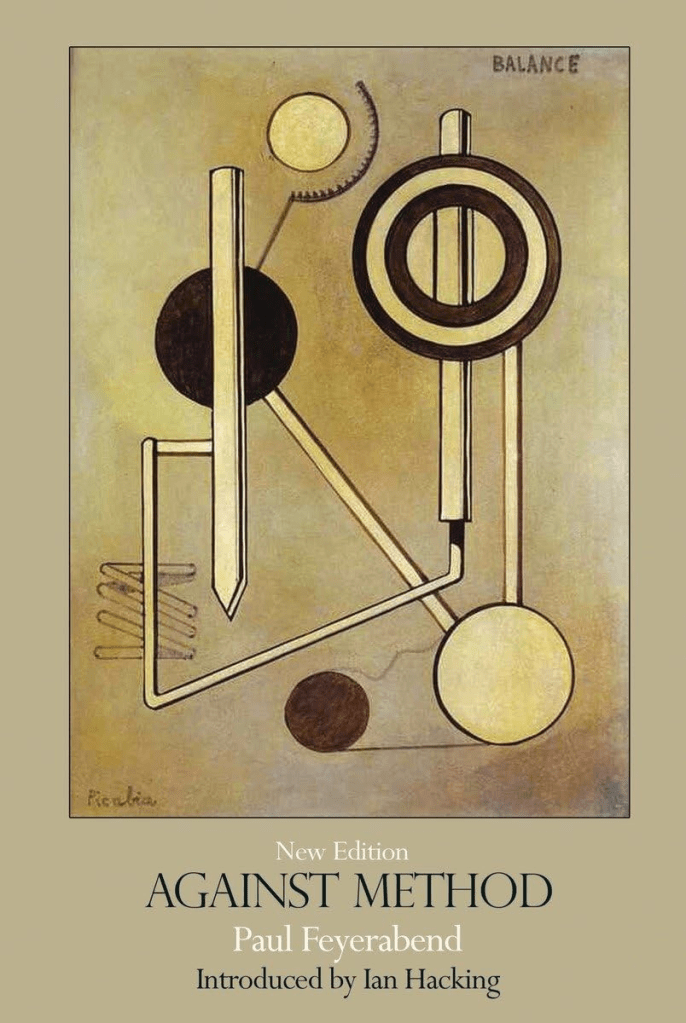
Paul Feyerabend’s Against Method: Chapter 1

What if science’s greatest achievements came not from following rules, but from breaking them? What if progress depends more on chaos than on order? In Against Method, philosopher Paul Feyerabend presents a provocative thesis: there is no universal scientific method, and the progress we celebrate often emerges from breaking established rules rather than following them.

I read Against Method years ago but decided to re-read it. It’s especially interesting to me because although I advocate systems thinking, I don’t believe everything should be or can be systematised. More generally, this bleeds into my feelings about government, politics, and institutions.

Whilst Feyerabend’s focus is on science, one can pull back the lens and see that it covers all such systems and systematic beliefs. I may write a separate article on this, but for now, I’ll focus on Against Method.

The Anarchist’s View of Science

Feyerabend’s critique strikes at the heart of how we think about knowledge and progress. He argues that science has advanced not through rigid adherence to methodology, but through a combination of creativity, rhetoric, and sometimes even deception. His concept of “epistemological anarchism” suggests that no single approach to knowledge should dominate – instead, multiple methods and perspectives should compete and coexist.

Consider Galileo’s defense of heliocentrism. Rather than relying solely on empirical evidence, Galileo employed persuasive rhetoric, selective data, and careful manipulation of public opinion. For Feyerabend, this isn’t an aberration but a typical example of how scientific progress actually occurs. The story we tell ourselves about the scientific method – as a systematic, purely rational pursuit of truth – is more myth than reality.

From Religious Dogma to Scientific Orthodoxy

The Age of Enlightenment marked humanity’s shift from religious authority to scientific rationality. Yet Feyerabend argues that we simply replaced one form of dogma with another. Scientism – the belief that science alone provides meaningful knowledge – has become our new orthodoxy. What began as a liberation from religious constraints has evolved into its own form of intellectual tyranny.

This transition could have taken a different path. Rather than elevating scientific rationality as the sole arbiter of truth, we might have embraced a more pluralistic approach where multiple ways of understanding the world – scientific, artistic, spiritual – could coexist and cross-pollinate. Instead, we’ve created a hierarchy where other forms of knowledge are dismissed as inferior or irrational.

The Chaos of Progress

In Chapter 1 of Against Method, Feyerabend lays the groundwork for his radical critique. He demonstrates how strict adherence to methodological rules would have prevented many of science’s greatest discoveries. Progress, he argues, often emerges from what appears to be irrational – from breaking rules, following hunches, and embracing contradiction. Indeed, rationalism is over-rated.

This isn’t to say that science lacks value or that methodology is meaningless. Rather, Feyerabend suggests that real progress requires flexibility, creativity, and a willingness to break from convention. Many breakthrough discoveries have been accidental or emerged from practices that would be considered unscientific by contemporary standards.

Beyond the Monolith

Our tendency to view pre- and post-Enlightenment thought as a simple dichotomy – superstition versus reason – obscures a richer reality. Neither period was monolithic, and our current reverence for scientific method might be constraining rather than enabling progress. Feyerabend’s work suggests an alternative: a world where knowledge emerges from the interplay of multiple approaches, where science exists alongside other ways of understanding rather than above them.

As we begin this exploration of Against Method, we’re invited to question our assumptions about knowledge and truth. Perhaps progress depends not on rigid adherence to method, but on the freedom to break from it when necessary. In questioning science’s monopoly on truth, we might discover a richer, more nuanced understanding of the world – one that embraces the chaos and contradiction inherent in human inquiry.

This is the first in a series of articles exploring Feyerabend’s Against Method. Join me as we challenge our assumptions about science, knowledge, and the nature of progress itself.

The Scientist’s Dilemma: Truth-Seeking in an Age of Institutional Constraints

In an idealised vision of science, the laboratory is a hallowed space of discovery and intellectual rigour, where scientists chase insights that reshape the world. Yet, in a reflection as candid as it is disconcerting, Sabine Hossenfelder pulls back the curtain on a reality few outside academia ever glimpse. She reveals an industry often more concerned with securing grants and maintaining institutional structures than with the philosophical ideals of knowledge and truth. In her journey from academic scientist to science communicator, Hossenfelder confronts the limitations imposed on those who dare to challenge the mainstream — a dilemma that raises fundamental questions about the relationship between truth, knowledge, and institutional power.

I’ve also created a podcast to discuss Sabine’s topic. Part 2 is also available.

Institutionalised Knowledge: A Double-Edged Sword

The history of science is often framed as a relentless quest for truth, independent of cultural or economic pressures. But as science became more institutionalised, a paradox emerged. On the one hand, large academic structures offer resources, collaboration, and legitimacy, enabling ambitious research to flourish. On the other, they impose constraints, creating an ecosystem where institutional priorities — often financial — can easily overshadow intellectual integrity. The grant-based funding system, which prioritises projects likely to yield quick results or conform to popular trends, inherently discourages research that is too risky or “edgy.” Thus, scientific inquiry can become a compromise, a performance in which scientists must balance their pursuit of truth with the practicalities of securing their positions within the system.

Hossenfelder’s account reveals the philosophical implications of this arrangement: by steering researchers toward commercially viable or “safe” topics, institutions reshape not just what knowledge is pursued but also how knowledge itself is conceptualised. A system prioritising funding over foundational curiosity risks constraining science to shallow waters, where safe, incremental advances take precedence over paradigm-shifting discoveries.

Gender, Equity, and the Paradoxes of Representation

Hossenfelder’s experience with gender-based bias in her early career unveils a further paradox of institutional science. Being advised to apply for scholarships specifically for women, rather than being offered a job outright, reinforced a stereotype that women in science might be less capable or less deserving of direct support. Though well-intentioned, such programs can perpetuate inequality by distinguishing between “real” hires and “funded outsiders.” For Hossenfelder, this distinction created a unique strain on her identity as a scientist, leaving her caught between competing narratives: one of hard-earned expertise and one of institutionalised otherness.

The implications of this dilemma are profound. Philosophically, they touch on questions of identity and value: How does an individual scientist maintain a sense of purpose when confronted with systems that, however subtly, diminish their role or undercut their value? And how might institutional structures evolve to genuinely support underrepresented groups without reinforcing the very prejudices they seek to dismantle?

The Paper Mill and the Pursuit of Legacy

Another powerful critique in Hossenfelder’s reflection is her insight into academia as a “paper production machine.” In this system, academics are pushed to publish continuously, often at the expense of quality or depth, to secure their standing and secure further funding. This structure, which rewards volume over insight, distorts the very foundation of scientific inquiry. A paper may become less a beacon of truth and more a token in an endless cycle of academic currency.

This pursuit of constant output reveals the philosopher’s age-old tension between legacy and ephemerality. In a system driven by constant publication, scientific “advancements” are at risk of being rendered meaningless, subsumed by an industry that prizes short-term gains over enduring impact. For scientists like Hossenfelder, this treadmill of productivity diminishes the romantic notion of a career in science. It highlights a contemporary existential question: Can a career built on constant output yield a genuine legacy, or does it risk becoming mere noise in an endless stream of data?

Leaving the Ivory Tower: Science Communication and the Ethics of Accessibility

Hossenfelder’s decision to leave academia for science communication raises a question central to contemporary philosophy: What is the ethical responsibility of a scientist to the public? When institutional science falters in its pursuit of truth, perhaps scientists have a duty to step beyond its walls and speak directly to the public. In her pivot to YouTube, Hossenfelder finds a new audience, one driven not by academic pressures but by genuine curiosity.

This shift embodies a broader rethinking of what it means to be a scientist today. Rather than publishing in academic journals read by a narrow circle of peers, Hossenfelder now shares her insights with a public eager to understand the cosmos. It’s a move that redefines knowledge dissemination, making science a dialogue rather than an insular monologue. Philosophically, her journey suggests that in an age where institutions may constrain truth, the public sphere might become a more authentic arena for its pursuit.

Conclusion: A New Paradigm for Scientific Integrity

Hossenfelder’s reflections are not merely the story of a disillusioned scientist; they are a call to re-evaluate the structures that define modern science. Her journey underscores the need for institutional reform — not only to allow for freer intellectual exploration but also to foster a science that serves humanity rather than merely serving itself.

Ultimately, the scientist’s dilemma that Hossenfelder presents is a philosophical one: How does one remain true to the quest for knowledge in an age of institutional compromise? As she shares her story, she opens the door to a conversation that transcends science itself, calling us all to consider what it means to seek truth in a world that may have forgotten its value. Her insights remind us that the pursuit of knowledge, while often fraught, is ultimately a deeply personal, ethical journey, one that extends beyond the walls of academia into the broader, often messier realm of human understanding.

The Fragility of Our Systems: A Reflection on Noble vs. Dawkins

Denis Noble’s critique of Richard Dawkins’ approach to genetics isn’t just a scientific debate; it’s a microcosm of a much larger issue: our inadequate grasp of systems thinking. This inadequacy resonates through every layer of our social, political, and economic frameworks, revealing why these systems often fail us—they are simply too fragile.

VIDEO: Denis Noble explains his revolutionary theory of genetics | Genes are not the blueprint for life

Why do we struggle with systems thinking? The concept itself demands an understanding of boundaries, dimensions, and interactions that are often far beyond our regular scope. More often than not, we define system boundaries too narrowly. We overlook crucial dimensions and, crucially, miss the interactions. This isn’t just an academic observation; it’s a practical one. In my experience, even when we do acknowledge broader boundaries, management frequently undermines their importance, limiting the scope of what’s considered relevant.

Since the 1980s, my interest in genetics has been piqued by Dawkins’ seminal works like The Selfish Gene and The Blind Watchmaker. Dawkins has long championed a gene-centric view of evolution, one that has shaped our understanding of biology for decades. However, Denis Noble challenges this perspective, advocating for a systems-level view that considers not just the genes but the interactions between a myriad of biological processes. This isn’t just genetics; it’s a profound illustration of systems thinking—or our lack thereof.

I’m not suggesting we discard Dawkins’ contributions to science, but Noble’s arguments are compelling and warrant serious consideration. They underscore a broader philosophical dilemma: our rhetorical constructs often overshadow deeper truths. In discussing the nuances between Dawkins’ and Noble’s theories, I argue that rhetoric, for better or worse, becomes our only accessible truth. While there may be more fundamental truths out there, they are often beyond our grasp, obscured not just by our cognitive limitations but also by the very language we use to discuss them.

So, which is true? The answer might be less about choosing sides and more about acknowledging our limitations in understanding and managing complex systems. Perhaps it’s time to consider that in the quest for truth, acknowledging our blind spots is just as important as the truths we defend.

Apologies in advance for linking a teaser video that leads to a paywall, but the relevant content is self-contained.

Determinism and the Three-Body Problem

The debate over free will often distils down to a question of determinism—indeterminism, hard or soft determinism, or something else. Poincare’s approach to the three-body problem is an apt metaphor to strengthen the deterministic side of the argument.

Quantum theory introduces aspects of indeterminism, but that doesn’t support the free will argument. Moreover, between quantum events, the universe is again deterministic. It’s simply been reset with the last exogenous quantum event.

Prima facia, Determinism and Chaos might seem strange bedfellows. And therein lies the rub. Chaos theory essentially tells us that even in a scenario of chaos, all possible outcomes can be calculated. They just must be calculated stepwise via numerical integration. Even this leaves us with estimations, as owing to Heisenberg’s Uncertainty Principle and the infinitude of slicing space, we can’t actually calculate the precise answer, although one exists.

My point is that not knowing what is being determined doesn’t invalidate the deterministic nature or process.

Hemo Sapiens: Awakening

I’ve been neglecting this site as I’ve been focusing on releasing my first novel, which I’ve now managed successfully. I published it under a pseudonym: Ridley Park. The trailer is available here and on YouTube.

Hemo Sapiens: Awakening is the first book in the Hemo Sapiens series, though the second chronologically. The next book will be a prequel that tells the story about where the Hemo Sapiens came from and why. I’ve got a couple of sequels in mind, too, but I don’t want to get ahead of myself.

In summary, Hemo Sapiens is shorthand for Homo Sapiens Sanguinius, a seeming sub-species of Hemo sapiens Sapiens—us. In fact, they are genetically engineered clones. It’s a work of near-future speculative fiction. It’s available in hardcover, paperback, and Kindle. If you’ve got a Kindle Unlimited account, you can view it for free in most markets. The audiobook should be available in a couple weeks if all goes well.

Awakening explores identity, belonging, otherness, and other fictions. It talks about individualism and communalism. It looks at mores, norms, and more.

Check it out, and let me know what you think.

Bell Curves and Constructivism

I recently had a discussion with my son about a controversial academic topic. He was struggling to find someone willing to engage in a meaningful dialogue. People on both sides of the issue seemed either emotionally invested without evidentiary support or lacking sufficient background knowledge for substantive debate. Moreover, due to the current political correctness and cancel culture environment, even gathering new data on this unpopular subject is challenging. This exemplifies the failure of the scientific community to uphold impartial inquiry, a key factor underlying my view that scientific consensus is predicated more on rhetorical appeals than dispassionate analysis.

The topic stemmed from The Bell Curve, a 1994 book by psychologist Richard J. Herrnstein and political scientist Charles Murray. The authors argued that intelligence, as measured by IQ tests, has a strong genetic component, with race and ethnicity as statistically significant variables. Specifically, they claimed the average IQ score for whites in the US was one standard deviation higher than for blacks – 102 versus 85, as depicted in the chart below.

While the details are less relevant here, the core issue is the purported gap between racial groups. As shown, there is substantial overlap in the bell curves, but the one representing blacks is notably shifted leftward from the white curve.

As a statistician, I tend to focus more on methodological rigour and meta-analyses than the mathematical computations themselves, which I presume were executed properly.

My first consideration was the validity of IQ tests as a proxy for achievement, given the cultural biases these metrics contain. Even accepting the IQ gap argument, issues around test construction leave open the ‘so what?’ question. However, the study’s findings were largely replicated 15 years later, suggesting some robustness.

My son observed that the current sociopolitical climate would likely preclude similar research from being funded or published today. Accusations of racism would be inevitable, even for a purely academic inquiry on this topic – creating an artificial blind spot in the science.

While understandable given the history of eugenics abuses, refusing to objectively investigate testable hypotheses is antithetical to the scientific method, which relies on falsifiability and replication. Without permitting studies to potentially confirm or refute a claim, we are left guessing. This is how scientific narratives are socially constructed – not by a disinterested search for truth, but through consensus and conformity enforcement.

I am sceptical of social science approaches generally, which often appear pseudoscientific. However constructive criticism should apply equally to so-called hard sciences like physics, where incompatible models of quantum gravity and dark matter proliferate, awaiting the next paradigm shift.

In summary, my son’s concern was that even proposing this controversial thesis as a dissertation topic could lead to professional censure. Personally, I take no position on the veracity of this hypothesis. However, as a matter of scientific integrity and public policy relevance, arbitrarily declaring certain academic questions off limits seems contrary to the principles of an enlightened, post-Enlightenment society. We cannot refuse to ask difficult questions for fear of inconvenient answers.

The Matter with Things: Chapter Eleven Summary: Science’s Claims on Truth

Chapter eleven is the first of three chapters discussing truth from the perspective of science. These chapters are followed by truth as seen from other perspectives, namely, reason and intuition.

Check out the table of contents for this series of summaries. I continue to render interstitial commentaries in grey boxes with red text, so the reader can skip over and just focus on the chapter summary.

The author posits that in the West, most of us trust science to deliver the truth of the matter, as “science alone holds out the promise of stable knowledge on which we can rely to build our picture of the world“. He admits that it does have value, but it has inherent limitations and yet draws us in like moths to a flame. Here, he distinguishes between the discipline and practice of science and Scientism as it is practised by laypeople. Science understands its place and domain boundaries. Scientism is omnipotent with delusions of grandeur that will never be realised.

Some philosophically naïve individuals become very exercised if they sense that the status of science as sole purveyor of truth is challenged

— Iain McGilchrist, The Matter with Things, chapter 10

Politicians who promote science as a bully pulpit prey on the public in a manner similar to bludgeoning them with religious notions.

Science is heavily dependent on the exercise of what the left hemisphere offers.

ibid.

The point the book makes is that like the turtles that go all the way down, science doesn’t have a grasp on what’s beyond the last turtle. Like trying to answer the toddler who can ask an infinite number of ‘why‘ questions, the scientist gets to a point of replying ‘that’s just the way things are’, or the equivalent of ‘it’s bedtime’.

Scientific models are simply extended metaphors. A challenge arises when a model seems to be a good fit and we forget about alternative possibilities getting locked into Maslow’s law of the instrument problem, where ‘to a man with a hammer, everything begins to look like a nail’. Moreover, the left hemisphere is fixated on instrumentation, so it’s always trying to presume a purpose behind everything. Nothing can just be.

This is likely where Scientism begins to trump science.

He quotes:

Dogmatism inevitably obscures the nature of truth.

— Alfred Whitehead

McGilchrist points out that a goal or promise of science is to be objective and take the subject out of the picture. Unfortunately, this is not possible as the necessity for metaphor ensures we cannot be extricated. Objectivity is legerdemain. We create a scenario and claim it to be objective, but there is always some subject even if unstated. He goes into length illuminating with historical characters.

The sciences do not try to explain, they hardly even try to interpret, they mainly make models … The justification of such a mathematical construct is solely and precisely that it is expected to work.

— John von Neumann

In fact, science itself is predicated on assumptions that have not and can not be validated through science.

In conclusion, McGilchrists wants to emphasise ‘that just because what we rightly take to be scientific truths are not ‘objective’ in the sense that nothing human, contingent and fallible enters into them, this does not mean they have no legitimate claim to be called true.’ ‘The scientific process cannot be free from assumptions, or values.’

Following this chapter are several pages containing dozens of plates of images.

What is Life?

George Harrison asked What Is Life? in a song, but he had a spiritual bent. The question is actually even more fundamental. Science has no settled meaning of what life is. Some posit that a virus is not life, and there is a multicellular organism discovered here on earth that requires no oxygen to survive. So when we are looking for signs of life on other planets, what is it that we are looking for exactly?

I spend a lot of time calling out weasel words, but we can’t even reliably define something we fundamentally are, which is alive. What is life? Forget about truth, justice, love, and freedom. These are abstract concepts, but not life. We live. We see life—experience life. We are a subset of it, but how do we know we’ve accounted for the full domain? Could something non-living be intelligent?—have intelligence?

It’s late and I am heading into a new year, AD 2023 BCE. And I was just thinking. If I am to believe Descartes, at least I’m alive parce que je donc, but I’ve got no answers in this realm.