The Felt Beneath the Table

Fairness, Commensurability, and the Quiet Violence of Comparison

Fairness and Commensurability as Preconditions of Retributive Justice

This is the final part of a 3-part series. Read parts 1 and 2 for a fuller context.

Audio: NotebookLM summary podcast of this topic.

Before the Cards Are Dealt

Two people invoke fairness. They mean opposite things. Both are sincere. Neither can prove the other wrong. This is not a failure of argument. It is fairness working exactly as designed.

Before justice can weigh anything, it must first decide that the things being weighed belong on the same scale. That single move – the assertion that comparison is even possible – quietly does most of the work.

Most people think justice begins at sentencing, or evidence, or procedure. But the real work happens earlier, in a space so normalised it has become invisible. Before any evaluation occurs, the system must install the infrastructure that makes evaluation legible at all.

That infrastructure rests on two foundations:

  • fairness, which supplies the rhetoric, and
  • commensurability, which supplies the mathematics.

Together, they form the felt beneath the table – the surface on which the cards can be dealt at all.

1. Why Fairness Is Always Claimed, Never Found

Let’s be precise about what fairness is not.

Fairness is not a metric. You cannot measure it, derive it, or point to it in the world.

Fairness is not a principle with determinate content. It generates no specific obligations, no falsifiable predictions, no uniquely correct outcomes.

Fairness is an effect. It appears after assessment, not before it. It is what you call an outcome when you want it to feel inevitable.

Competing Fairness Is Not a Problem

Consider how disputes actually unfold:

  • The prosecutor says a long sentence is fair because it is proportional to harm.
  • The defender says a shorter sentence is fair because it reflects culpability and circumstance.
  • The victim says any sentence is unfair because nothing restores what was taken.
  • The community says enforcement itself is unfair because it predictably targets certain groups.

Each claim is sincere. None can be resolved by fairness itself.

That is because fairness has no independent content. It does not decide between these positions. It names them once the system has already decided which will prevail. This is not a bug. It is the feature.

A Fluid Masquerading as an Invariant

In the language of the Language Insufficiency Hypothesis, fairness is a Fluid – a concept whose boundaries shift with context and use – that masquerades as an Invariant, something stable and observer-independent.

The system treats fairness as perceptual, obvious, discoverable. But every attempt to anchor it collapses into:

  • Intuition (‘It just feels right’)
  • Precedent (‘This is how we do things’)
  • Consensus (‘Most people agree’)

None of these establishes fairness. They merely perform it.

And that performance matters. It converts contested metaphysical commitments into the appearance of shared values. It allows institutions to claim neutrality whilst enforcing specificity. Fairness is what the system says when it wants its outputs to feel unavoidable.

2. The Real Gatekeeper: Commensurability

Fairness does rhetorical work. But it cannot function without something deeper.

That something is commensurability: the assumption that different harms, injuries, and values can be placed on a shared scale and meaningfully compared.

Proportionality presupposes commensurability. Commensurability presupposes an ontology of value. And that ontology is neither neutral nor shared.

When Incommensurability Refuses to Cooperate

A parent loses a child to preventable negligence. A corporation cuts safety corners. A warning is ignored. The system moves. Liability is established. Damages are calculated. £250,000 is awarded.

The parent refuses the settlement. Not because the amount is insufficient. But because money and loss are not the same kind of thing. The judge grows impatient. Lawyers speak of closure. Observers mutter about grief clouding judgment. But this is not grief. It is incommensurability refusing to cooperate.

The parent is rejecting the comparison itself. Accepting payment would validate the idea that a child’s life belongs on a scale with currency. The violence is not the number. It is the conversion. The system cannot process this refusal except as emotional excess or procedural obstruction. Not because it is cruel, but because without commensurability the engine cannot calculate.

Two Ontologies of Value

There are two incompatible ontologies at work here. Only one is playable.

Ontology A: The Scalar Model
  • Harm is quantifiable
  • Suffering is comparable
  • Trade-offs are morally coherent
  • Justice is a balancing operation

Under Ontology A, harms differ in degree, not kind. A broken arm, a stolen car, and a dead child all occupy points on the same continuum. This makes proportionality possible.

Ontology B: The Qualitative Model
  • Harms are categorical
  • Some losses are incommensurable
  • Comparison itself distorts
  • Justice is interpretive, not calculative

Under Ontology B, harms are different kinds of things. Comparison flattens what matters. To weigh them is to misunderstand them.

Why Only One Ontology Can Play

Retributive justice, as presently constituted, cannot function under Ontology B.

Without scalar values, proportionality collapses. Without comparison, equivalence disappears. Without trade-offs, punishment has no exchange rate.

Ontology B is not defeated. It is disqualified. Structurally, procedurally, rhetorically. The house needs a shared scale. Without it, the game cannot settle accounts.

3. Why Incommensurability Is Treated as Bad Faith

Here is where power enters without announcing itself. Incommensurability does not merely complicate disputes. It stalls the engine. And stalled engines threaten institutional legitimacy.

Systems designed to produce closure must ensure that disputes remain within solvable bounds. Incommensurability violates those bounds. It suggests that resolution may be impossible – or that the attempt to resolve does further harm. So the system reframes the problem.

Not as an alternative ontology, but as:

  • Unreasonableness
  • Extremism
  • Emotional volatility
  • Refusal to engage in good faith

Reasonableness as Border Control

This is why reasonableness belongs where it does in the model. Not as an evaluative principle, but as a gatekeeping mechanism.

Reasonableness does not assess claims. It determines which claims count as claims at all. This is how commensurability enforces itself without admitting it is doing so. When someone refuses comparison, they are not told their ontology is incompatible with retributive justice. They are told to be realistic.

Ontological disagreement is converted into:

  • A tone problem
  • A personality defect
  • A failure to cooperate

The disagreement is not answered. It is pathologised.

4. Why These Debates Never Resolve

This returns us to the Ontology–Encounter–Evaluation model.

People argue fairness as if adjusting weights would fix the scale. They debate severity, leniency, proportionality.

But when two sides inhabit incompatible ontologies of value, no amount of evidence or dialogue bridges the gap. The real disagreement is upstream.

A prosecutor operating under scalar harm and an advocate operating under incommensurable injury are not disagreeing about facts. They are disagreeing about what kind of thing harm is.

Fairness cannot resolve this, because fairness presupposes the very comparison under dispute. This is why reform debates feel sincere and go nowhere. Outcomes are argued whilst ontological commitments remain invisible.

Remediation Requires Switching Teams

As argued elsewhere, remediation increasingly requires switching teams.

But these are not political teams. They are ontological commitments.

Ontologies are not held like opinions. They are held like grammar. You do not argue someone out of them. At best, you expose their costs. At worst, you force others to operate within yours by disqualifying alternatives.

Retributive justice does the latter.

5. What This Means (Without Offering a Fix)

Justice systems are not broken. They are optimised. They are optimised for closure, manageability, and the appearance of neutrality. Fairness supplies the rhetoric. Commensurability supplies the mathematics. Together, they convert contestable metaphysical wagers into procedural common sense.

That optimisation has costs:

  • Disagreements about value become illegible
  • Alternative ontologies become unplayable
  • Dissent becomes pathology
  • Foundations disappear from view

If justice feels fair, it is because the comparisons required to question it were never permitted.

Ontology as Pre-emptive Gatekeeping

None of this requires conspiracy.

Institutions do not consciously enforce ontologies. They do not need to.

They educate them. Normalise them. Proceduralise them. Then treat their rejection as irrationality.

By the time justice is invoked, the following have already been installed as reality:

  • That persons persist over time in morally relevant ways
  • That agents meaningfully choose under conditions that count
  • That harms can be compared and offset
  • That responsibility can be localised
  • That disagreement beyond a point is unreasonable

None of these are discovered. All are rehearsed.

A law student learns that ‘the reasonable person’ is a construct. By year three, they use it fluently. It no longer feels constructed.

This is not indoctrination. It is fluency.

And fluency is how ontologies hide.

By the time an alternative appears – episodic selfhood, incommensurable harm, distributed agency – it does not look like metaphysics. It looks like confusion.

Rationality as Border Control

The system does not say: we reject your ontology.

It says: that’s not how the world works.

Or worse: you’re being unreasonable.

Ontological disagreement is reframed as a defect in the person. And defects do not need answers. They need management.

This is why some arguments feel impossible to have. One ontology has been naturalised into common sense. The other has been reclassified as error.

The Final Irony

The more fragile the foundations, the more aggressively they must be defended as self-evident.

  • Free will is taught as obvious.
  • Fairness is invoked as perceptual.
  • Responsibility is treated as observable.
  • Incommensurability is treated as sabotage.

Not because the system is confident.

Because it cannot afford not to be.

The Point

Justice does not merely rely on asserted ontologies. It expends enormous effort ensuring they never appear asserted at all.

By the time the cards are dealt, the rules have already been mistaken for reality. That is the felt beneath the table. Invisible. Essential. Doing all the work. And if you want to challenge justice meaningfully, you do not start with outcomes. You start by asking:

What comparisons are we being asked to accept as natural? And what happens to those who refuse?

Most people never make that move. Not because it is wrong. But because by the time you notice the game is rigged, you are already fluent in its rules. And fluency feels like truth.

Final Word

Why write these assessments? Why care?

With casinos, like cricket, we understand something fundamental: these are games. We can learn the rules. We can decide whether to play. We can walk away.

Justice is different. Justice is not opt-in. It is imposed. You do not get to negotiate the rules, the scoring system, or the house assumptions about what counts as a move. Once you are inside, even dissent must be expressed in the system’s own grammar. Appeals do not question the game; they replay it under slightly altered conditions.

You may contest the outcome. You may plead for leniency. You may argue fairness. You may not ask why chips are interchangeable with lives, why losses must be comparable, or why refusing comparison itself counts as misconduct.

Imagine being forced into a casino. Forced to play. Forced to stake things you do not believe are wagerable. Then told, when you object, that the problem is not the game, but your attitude toward it.

That is why these assessments matter. Not to declare justice illegitimate. Not to offer a fix. But to make visible the rules that pretend not to be rules at all. Because once you mistake fluency for truth, the house no longer needs to rig the game.

You will do it for them.

Footnotes from the House: Justice as a Casino Game

4–6 minutes

This is part 2 of a structural critique of Justice™. Read Part 1, The Ontology–Encounter–Evaluation Model: Retributive Justice as an Instantiation.

If you want a useful metaphor for how justice actually operates, don’t picture a blindfolded goddess with scales. Picture a casino.

Image: Lady Justice in Casino. The dice are rigged. haha

The rules are printed. The games look fair. Everyone is technically allowed to play. But the mathematics are tuned in advance, the exits are discreet, and the house never risks its own solvency. You don’t walk into a casino to discover whether chance is fair. You walk in to participate in a system whose advantage has already been engineered.

By the time a defendant appears, the ontological dice have already been loaded. The system has quietly asserted a set of metaphysical commitments that make certain outcomes legible, actionable, and punishable – whilst rendering others incoherent, inadmissible, or ‘unreasonable’. Because I am a philosopher of language and not a lawyer, I am free from the indoctrination and selection bias inherent in that system. This allows me to critique the system directly without being excommunicated from the club.

What follows are not neutral assumptions. They are ontological wagers, each chosen because its alternative would tilt the field away from institutional power.

Ontology 1: The Self

Justice presumes that the person who acted yesterday is meaningfully the same entity standing in court today. This is not discovered; it is asserted.

Why? Because retribution requires persistence. Desert cannot attach to a momentary configuration of consciousness. Responsibility requires a carrier that survives time, memory gaps, psychological rupture, intoxication, trauma, and neurological variance.

An episodic self – Parfit’s reductionism, trauma-fractured identity, or situational selfhood – collapses the attribution pipeline. If the ‘self’ is a series of loosely connected episodes, punishment becomes conceptually incoherent. Who is being punished for whom?

So the law treats episodic accounts not as alternative ontologies but as defects: insanity, automatism, incompetence. The self is patched, not replaced.

Ontology 2: Agency

Justice requires that actions originate somewhere. Agency is that somewhere.

The system asserts that agents could have done otherwise in a morally relevant sense. This is compatible with compatibilism, folk psychology, and everyday moral intuitions – but deeply hostile to hard determinism, strong situationism, or neurobiological deflation.

Why exclude weaker agency models? Because if agency dissolves into causation, environment, or neurochemistry, responsibility evaporates. At best, you get risk management. At worst, you get treatment or containment. Retribution has nowhere to land.

So the law nods politely to influences – upbringing, coercion, impairment – whilst ring-fencing agency as the default. Mitigation is permitted. Ontological revision is not. The house needs someone who could have chosen otherwise, even if that claim grows increasingly fictional under scrutiny.

Ontology 3: Choice

Justice models human action as a series of forks in the road. At some point, the agent ‘chose’ X over Y. This is enormously convenient.

Continuous decision spaces – poverty gradients, addiction loops, survival trade-offs – are messy. They resist clean counterfactuals. ‘What should they have done instead?’ becomes a sociological question, not a moral one.

So the system discretises. It locates a moment. A click. A trigger pull. A signature. A punch. A text sent.

Once the choice is frozen, the rest of the apparatus can proceed. Without discrete choice points, proportionality and culpability lose their anchor.

Ontology 4: Causation

Justice prefers causes that point: Who did this? When? How directly?

Systemic causation – economic pressure, cultural narratives, institutional design – creates attribution problems. If harm is emergent, no individual carries it cleanly. Responsibility smears.

So causation is narrowed. Chains are shortened. Proximate cause replaces contributing conditions. Structural violence becomes background noise.

This is not because systemic causation is false. It is because it is unmanageable within a retributive frame.

Ontology 5: Reasonableness

‘Reasonableness’ is the softest and most insidious ontology of the lot.

It pretends to be procedural, but it functions as cultural enforcement. The reasonable person is not an average human. They are an acculturated one.

Intensity becomes suspect. Rage becomes irrational. Grief becomes excessive. Radical interpretations become unreasonable not because they’re false, but because they disrupt cadence.

This ontology stabilises the game by disciplining tone. It doesn’t matter what you argue if you fail to argue it reasonably. Reasonableness is not required for responsibility to exist, only for dissent to be ignored.

The house needs calm players, not correct ones.

Why These Ontologies, and Not Their Rivals?

Because every excluded ontology threatens legibility. Justice is not designed to discover truth. It is designed to terminate cases. Ontologies that complicate attribution, disperse responsibility, or destabilise narrative continuity slow the machine. So they are ruled out – not explicitly, but structurally.

Once these commitments are in place, disagreement downstream becomes theatre. Arguments about fairness, proportionality, or intent occur within a rigged metaphysical envelope. That’s why reform debates feel sincere yet go nowhere. People argue outcomes whilst the house quietly keeps the rules.

The Point

None of this means justice is a scam. Casinos aren’t scams either. They do exactly what they are designed to do.

If you want to challenge justice meaningfully, you don’t start with sentencing guidelines or evidentiary thresholds. You start by asking which ontologies are being asserted – and why alternatives are unplayable.

Most people won’t make that move. Not because it’s wrong. Because it requires leaving the table.

The Ontology–Encounter–Evaluation Model: Retributive Justice as an Instantiation

7–10 minutes

Now that A Language Insufficiency Hypothesis has been put to bed — not euthanised, just sedated — I can turn to the more interesting work: instantiating it. This is where LIH stops being a complaint about words and starts becoming a problem for systems that pretend words are stable enough to carry moral weight.

Read part 2 of this essay.

What follows is not a completed theory, nor a universal schema. It’s a thinking tool. A talking point. A diagram designed to make certain assumptions visible that are usually smuggled in unnoticed, waved through on the strength of confidence and tradition.

The purpose of this diagram is not to redefine justice, rescue it, or replace it with something kinder. It is to show how justice is produced. Specifically, how retributive justice emerges from a layered assessment process that quietly asserts ontologies, filters encounters, applies normative frames, and then closes uncertainty with confidence.

Audio: NotebookLM summary podcast of this topic.

Most people are willing to accept, in the abstract, that justice is “constructed”. That concession is easy. What is less comfortable is seeing how it is constructed — how many presuppositions must already be in place before anything recognisable as justice can appear, and how many of those presuppositions are imposed rather than argued for.

The diagram foregrounds power, not as a conspiracy or an optional contaminant, but as an ambient condition. Power determines which ontologies are admissible, which forms of agency count, which selves persist over time, which harms are legible, and which comparisons are allowed. It decides which metaphysical configurations are treated as reasonable, and which are dismissed as incoherent before the discussion even begins.

Justice, in this framing, is not discovered. It is not unearthed like a moral fossil. It is assembled. And it is assembled late in the process, after ontology has been assumed, evaluation has been performed, and uncertainty has been forcibly closed.

This does not mean justice is fake. It means it is fragile. Far more fragile than its rhetoric suggests. And once you see that fragility — once you see how much is doing quiet, exogenous work — it becomes harder to pretend that disagreements about justice are merely disagreements about facts, evidence, or bad actors. More often, they are disagreements about what kind of world must already be true for justice to function at all.

I walk through the structure and logic of the model below. The diagram is also available as a PDF, because if you’re going to stare at machinery, you might as well be able to zoom in on the gears.

Why Retributive Justice (and not the rest of the zoo)

Before doing anything else, we need to narrow the target.

“Justice” is an infamously polysemous term. Retributive, restorative, distributive, procedural, transformative, poetic, cosmic. Pick your flavour. Philosophy departments have been dining out on this buffet for centuries, and nothing useful has come of letting all of them talk at once.

This is precisely where LIH draws a line.

The Language Insufficiency Hypothesis is not interested in pedestrian polysemy — cases where a word has multiple, well-understood meanings that can be disambiguated with minimal friction. That kind of ambiguity is boring. It’s linguistic weather.

What LIH is interested in are terms that appear singular while smuggling incompatible structures. Words that function as load-bearing beams across systems, while quietly changing shape depending on who is speaking and which assumptions are already in play.

“Justice” is one of those words. But it is not usefully analysable in the abstract.

So we pick a single instantiation: Retributive Justice.

Why?

Because retributive justice is the most ontologically demanding and the most culturally entrenched. It requires:

  • a persistent self
  • a coherent agent
  • genuine choice
  • intelligible intent
  • attributable causation
  • commensurable harm
  • proportional response

In short, it requires everything to line up.

If justice is going to break anywhere, it will break here.

Retributive justice is therefore not privileged in this model. It is used as a stress test.

The Big Picture: Justice as an Engine, Not a Discovery

The central claim of the model is simple, and predictably unpopular:

Not invented in a vacuum, not hallucinated, not arbitrary — but assembled through a process that takes inputs, applies constraints, and outputs conclusions with an air of inevitability.

The diagram frames retributive justice as an assessment engine.

An engine has:

  • inputs
  • internal mechanisms
  • thresholds
  • failure modes
  • and outputs

It does not have access to metaphysical truth. It has access to what it has been designed to process.

The justice engine takes an encounter — typically an action involving alleged harm — and produces two outputs:

  • Desert (what is deserved),
  • Responsibility (to whom it is assigned).

Everything else in the diagram exists to make those outputs possible.

The Three Functional Layers

The model is organised into three layers. These are not chronological stages, but logical dependencies. Each layer must already be functioning for the next to make sense.

1. The Constitutive Layer

(What kind of thing a person must already be)

This layer answers questions that are almost never asked explicitly, because asking them destabilises the entire process.

  • What counts as a person?
  • What kind of self persists over time?
  • What qualifies as an agent?
  • What does it mean to have agency?
  • What is a choice?
  • What is intent?

Crucially, these are not empirical discoveries made during assessment. They are asserted ontologies.

The system assumes a particular configuration of selfhood, agency, and intent as a prerequisite for proceeding at all. Alternatives — episodic selves, radically distributed agency, non-volitional action — are not debated. They are excluded.

This is the first “happy path”.

If you do not fit the assumed ontology, you do not get justice. You get sidelined into mitigation, exception, pathology, or incoherence.

2. The Encounter Layer

(What is taken to have happened)

This layer processes the event itself:

  • an action
  • resulting harm
  • causal contribution
  • temporal framing
  • contextual conditions
  • motive (selectively)

This is where the rhetoric of “facts” tends to dominate. But the encounter is never raw. It is already shaped by what the system is capable of seeing.

Causation here is not metaphysical causation. It is legible causation.
Harm is not suffering. It is recognisable harm.
Context is not total circumstance. It is admissible context.

Commensurability acts as a gatekeeper between encounter and evaluation: harms must be made comparable before they can be judged. Anything that resists comparison quietly drops out of the pipeline.

3. The Evaluative Layer

(How judgment is performed)

Only once ontology is assumed and the encounter has been rendered legible does evaluation begin:

  • proportionality
  • accountability
  • normative ethics
  • fairness (claimed)
  • reasonableness
  • bias (usually acknowledged last, if at all)

This layer presents itself as the moral heart of justice. In practice, it is the final formatting pass.

Fairness is not discovered here. It is declared.
Reasonableness does not clarify disputes. It narrows the range of acceptable disagreement.
Bias is not eliminated. It is managed.

At the end of this process, uncertainty is closed.

That closure is the moment justice appears.

Why Disagreement Fails Before It Starts

At this point, dissent looks irrational.

The system has:

  • assumed an ontology
  • performed an evaluation
  • stabilised the narrative through rhetoric
  • and produced outputs with institutional authority

To object now is not to disagree about evidence. It is to challenge the ontology that made assessment possible in the first place.

And that is why so many justice debates feel irresolvable.

They are not disagreements within the system.
They are disagreements about which system is being run.

LIH explains why language fails here. The same words — justice, fairness, responsibility, intent — are being used across incompatible ontological commitments. The vocabulary overlaps; the worlds do not.

The engine runs smoothly. It just doesn’t run the same engine for everyone.

Where This Is Going

With the structure in place, we can now do the slower work:

  • unpacking individual components
  • tracing where ontological choices are asserted rather than argued
  • showing how “reasonableness” and “fairness” operate as constraint mechanisms
  • and explaining why remediation almost always requires a metaphysical switch, not better rhetoric

That should worry us more than if it were merely malfunctioning.

The rest of the story

Read part 2 of this essay.

This essay is already long, so I’m going to stop here.

Not because the interesting parts are finished, but because this is the point at which the analysis stops being descriptive and starts becoming destabilising.

The diagram you’ve just walked through carries a set of suppressed footnotes. They don’t sit at the margins because they’re trivial; they sit there because they are structurally prior. Each one represents an ontological assertion the system quietly requires in order to function at all.

By my count, the model imposes at least five such ontologies. They are not argued for inside the system. They are assumed. They arrive pre-installed, largely because they are indoctrinated, acculturated, and reinforced long before anyone encounters a courtroom, a jury, or a moral dilemma.

Once those ontologies are fixed, the rest of the machinery behaves exactly as designed. Disagreement downstream is permitted; disagreement upstream is not.

In a follow-up essay, I’ll unpack those footnotes one by one: where the forks are, which branch the system selects, and why the alternatives—while often coherent—are rendered unintelligible, irresponsible, or simply “unreasonable” once the engine is in motion.

That’s where justice stops looking inevitable and starts looking parochial.

And that’s also where persuasion quietly gives up.

Justice as a House of Cards

4–6 minutes

How retribution stays upright by not being examined

There is a persistent belief that our hardest disagreements are merely technical. If we could stop posturing, define our terms, and agree on the facts, consensus would emerge. This belief survives because it works extremely well for birds and tables.

It fails spectacularly for justice.

Audio: NotebookLM summary podcast of this topic.

The Language Insufficiency Hypothesis (LIH) isn’t especially interested in whether people disagree. It’s interested in how disagreement behaves under clarification. With concrete terms, clarification narrows reference. With contested ones, it often fractures it. The more you specify, the more ontologies appear.

Justice is the canonical case.

Retributive justice is often presented as the sober, adult conclusion. Not emotional. Not ideological. Just what must be done. In practice, it is a delicately balanced structure built out of other delicately balanced structures. Pull one term away and people grow uneasy. Pull a second and you’re accused of moral relativism. Pull a third and someone mentions cavemen.

Let’s do some light demolition. I created a set of 17 Magic: The Gathering-themed cards to illustrate various concepts. Below are a few. A few more may appear over time.

Card One: Choice

Image: MTG: Choice – Enchantment

The argument begins innocently enough:

They chose to do it.

But “choice” here is not an empirical description. It’s a stipulation. It doesn’t mean “a decision occurred in a nervous system under constraints.” It means a metaphysically clean fork in the road. Free of coercion, history, wiring, luck, trauma, incentives, or context.

That kind of choice is not discovered. It is assumed.

Pointing out that choices are shaped, bounded, and path-dependent does not refine the term. It destabilises it. Because if choice isn’t clean, then something else must do the moral work.

Enter the next card.

Card Two: Agency

Image: MTG: Agency – Creature – Illusion

Agency is wheeled in to stabilise choice. We are reassured that humans are agents in a morally relevant sense, and therefore choice “counts”.

Counts for what, exactly, is rarely specified.

Under scrutiny, “agency” quietly oscillates between three incompatible roles:

  • a descriptive claim: humans initiate actions
  • a normative claim: humans may be blamed
  • a metaphysical claim: humans are the right kind of cause

These are not the same thing. Treating them as interchangeable is not philosophical rigour. It’s semantic laundering.

But agency is emotionally expensive to question, so the discussion moves on briskly.

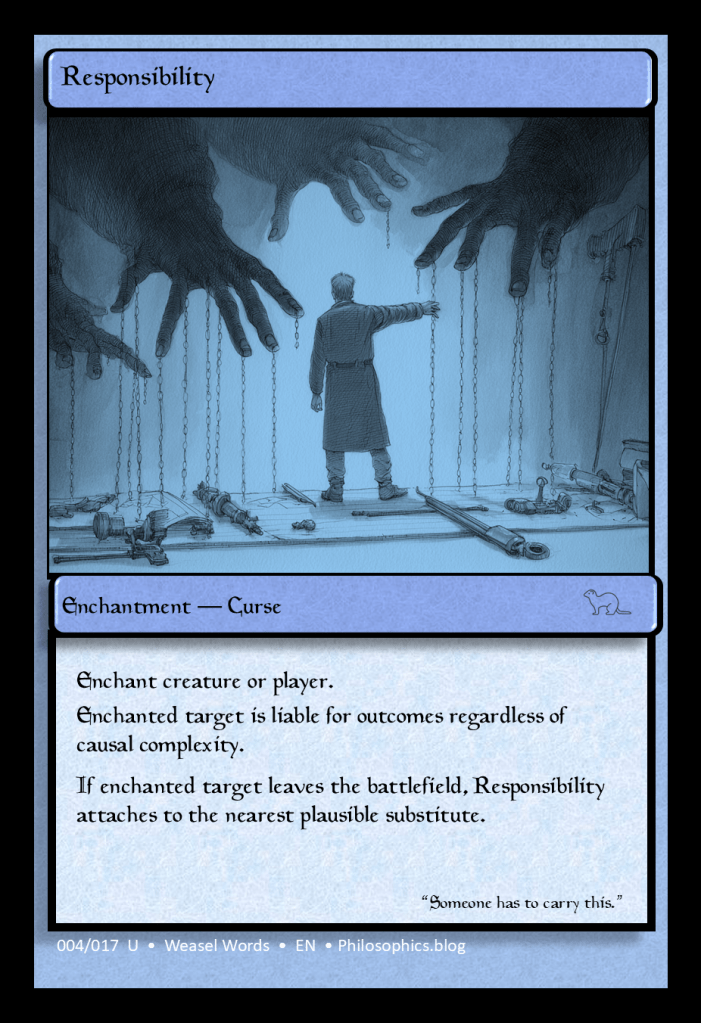
Card Three: Responsibility

Image: MTG: Responsibility – Enchantment – Curse

Responsibility is where the emotional payload arrives.

To say someone is “responsible” sounds administrative, even boring. In practice, it’s a moral verdict wearing a clipboard.

Watch the slide:

  • causal responsibility
  • role responsibility
  • moral responsibility
  • legal responsibility

One word. Almost no shared criteria.

By the time punishment enters the picture, “responsibility” has quietly become something else entirely: the moral right to retaliate without guilt.

At which point someone will say the magic word.

Card Four: Desert

Image: MTG: Desert – Instant

Desert is the most mystical card in the deck.

Nothing observable changes when someone “deserves” punishment. No new facts appear. No mechanism activates. What happens instead is that a moral permission slip is issued.

Desert is not found in the world. It is declared.

And it only works if you already accept a very particular ontology:

  • robust agency
  • contra-causal choice
  • a universe in which moral bookkeeping makes sense

Remove any one of these and desert collapses into what it always was: a story we tell to make anger feel principled.

Which brings us, finally, to the banner term.

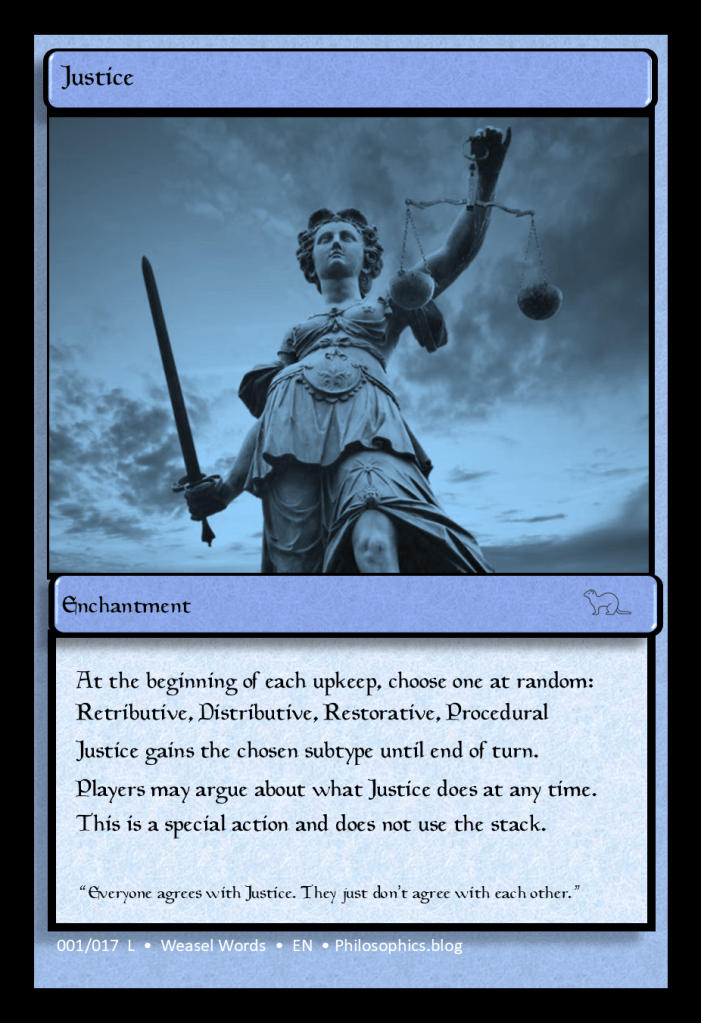
Card Five: Justice

Image: MTG: Justice – Enchantment

At this point, justice is invoked as if it were an independent standard hovering serenely above the wreckage.

It isn’t.

“Justice” here does not resolve disagreement. It names it.

Retributive justice and consequentialist justice are not rival policies. They are rival ontologies. One presumes moral balance sheets attached to persons. The other presumes systems, incentives, prevention, and harm minimisation.

Both use the word justice.

That is not convergence. That is polysemy with a body count.

Why clarification fails here

This is where LIH earns its keep.

With invariants, adding detail narrows meaning. With terms like justice, choice, responsibility, or desert, adding detail exposes incompatible background assumptions. The disagreement does not shrink. It bifurcates.

This is why calls to “focus on the facts” miss the point. Facts do not adjudicate between ontologies. They merely instantiate them. If agency itself is suspect, arguments for retribution do not fail empirically. They fail upstream. They become non sequiturs.

This is also why Marx remains unforgivable to some.
“From each according to his ability, to each according to his need” isn’t a policy tweak. It presupposes a different moral universe. No amount of clarification will make it palatable to someone operating in a merit-desert ontology.

The uncomfortable conclusion

The problem is not that we use contested terms. We cannot avoid them.

The problem is assuming they behave like tables.

Retributive justice survives not because it is inevitable, but because its supporting terms are treated as settled when they are anything but. Each card looks sturdy in isolation. Together, they form a structure that only stands if you agree not to pull too hard.

LIH doesn’t tell you which ontology to adopt.

It tells you why the argument never ends.

And why, if someone insists the issue is “just semantic”, they’re either confused—or holding the deck.

The Enlightenment Sleight of Hand

How Reason Inherited God’s Metaphysics.

The Enlightenment, we are told, was the age of Reason. A radiant exorcism of superstition. Out went God. Out went angels, miracles, saints, indulgences. All that frothy medieval sentiment was swept aside by a brave new world of logic, science, and progress. Or so the story goes.

Audio: NotebookLM podcast on this topic.

But look closer, and you’ll find that Reason didn’t kill God—it absorbed Him. The Enlightenment didn’t abandon metaphysics. It merely privatised it.

From Confessional to Courtroom

We like to imagine that the Enlightenment was a clean break from theology. But really, it was a semantic shell game. The soul was rebranded as the self. Sin became crime. Divine judgement was outsourced to the state.

We stopped praying for salvation and started pleading not guilty.

The entire judicial apparatus—mens rea, culpability, desert, retribution—is built on theological scaffolding. The only thing missing is a sermon and a psalm.

Where theology had the guilty soul, Enlightenment law invented the guilty mind—mens rea—a notion so nebulous it requires clairvoyant jurors to divine intention from action. And where the Church offered Hell, the state offers prison. It’s the same moral ritual, just better lit.

Galen Strawson and the Death of Moral Responsibility

Enter Galen Strawson, that glowering spectre at the feast of moral philosophy. His Basic Argument is elegantly devastating:

  1. You do what you do because of the way you are.
  2. You can’t be ultimately responsible for the way you are.
  3. Therefore, you can’t be ultimately responsible for what you do.

Unless you are causa sui—the cause of yourself, an unmoved mover in Calvin Klein—you cannot be held truly responsible. Free will collapses, moral responsibility evaporates, and retributive justice is exposed as epistemological theatre.

In this light, our whole legal structure is little more than rebranded divine vengeance. A vestigial organ from our theocratic past, now enforced by cops instead of clerics.

The Modern State: A Haunted House

What we have, then, is a society that has denied the gods but kept their moral logic. We tossed out theology, but we held onto metaphysical concepts like intent, desert, and blame—concepts that do not survive contact with determinism.

We are living in the afterglow of divine judgement, pretending it’s sunlight.

Nietzsche saw it coming, of course. He warned that killing God would plunge us into existential darkness unless we had the courage to also kill the values propped up by His corpse. We did the first bit. We’re still bottling it on the second.

If Not Retribution, Then What?

Let’s be clear: no one’s suggesting we stop responding to harm. But responses should be grounded in outcomes, not outrage.

Containment, not condemnation.

Prevention, not penance.

Recalibration, not revenge.

We don’t need “justice” in the retributive sense. We need functional ethics, rooted in compassion and consequence, not in Bronze Age morality clumsily duct-taped to Enlightenment reason.

The Risk of Letting Go

Of course, this is terrifying. The current system gives us moral closure. A verdict. A villain. A vanishing point for our collective discomfort.

Abandoning retribution means giving that up. It means accepting that there are no true villains—only configurations of causes. That punishment is often revenge in drag. That morality itself might be a control mechanism, not a universal truth.

But if we’re serious about living in a post-theological age, we must stop playing dress-up with divine concepts. The Enlightenment didn’t finish the job. It changed the costumes, kept the plot, and called it civilisation.

It’s time we staged a rewrite.

Retributive Injustice

I’ve already said that justice is a weasel word, but let’s pretend that it’s actually something more substantial and perhaps even real. I’ve spoken on the notion of blame as well. I have been thinking about how untenable retributive justice is and it seems to include restorative justice, too. But let’s focus on the retributive variety for now.

In short, retributive justice is getting the punishment one deserves, and I think desert is the weak link. Without even delving into causa sui territory, I feel there are two possible deserving parties. The agent and society. Let’s regard these in turn.

The Agent

An agent, or more specifically moral agents, are entities that can be deemed responsible for their actions on moral grounds. Typically, moral agency assumes that an agent, an actor, is fully aware of the cultural rules of a given society, whether norms or legislated. Under this rationale, we tend to exclude inanimate objects with no agency, non-human life forms, children, and persons with diminished cognitive faculties. In some cases, this diminution may have been self-imposed as in the case of chemically induced impairment, for example by drugs or alcohol. We might consider these entities as being broken. In any case, they do not qualify as having agency. An otherwise moral agent until duress or coercion may no longer be expected to retain agency.

Unless an informed and unimpaired agent commits an act with intent … there can be no moral desert

Unless an informed and unimpaired agent commits an act with intent, another weasely word in its own right, there can be no moral desert. But let’s hold this thought for a bit and turn our attention to society.

Society

For the purposes of this commentary, society is a group of like-minded persons who have created norms, customs, laws, and regulations. In most cases, people come into societies whose structure is already formed, and they need to acculturate and adapt, as changing the fabric of society generally takes time. Even in the case of warfare where a society is subsumed, cultural norms will persist for at least a time.

Whilst it is incumbent for a person to become aware of the rules of engagement and interaction with a society, this is reciprocally a responsibility of society to impart its norms through signalling and performance as well as through more formal training, such as public fora, schools, and activities. Even media and entertainment can serve to reinforce this function.

So What?

I argue that retributive justice is bullshit (to employ technical language) is because if an informed and unimpaired agent does violate some standard or protocol, the society is at least partially to blame—perhaps fully so. Again, if the person is not unimpaired, a pivotal question might be why is s/he uninformed? If the person has the information but ignores it, to what extent is the person impaired and what responsibility does society have for being unaware?

Special Case?

What if a particularly predacious person from Society A infiltrates Society B? Is the person broken or is Society A responsible to creating a person that would prey on some other unsuspecting society? Again, the person is never entirely responsible unless s/he is broke, in which case, s/he is exempt and not morally responsible.

When Then?

As I’ve said before, a person who commits an act against the interest of a society may be quarantined or perhaps exiled or shunned as some cultures practice, but these are meant to preserve the cohesion of the society and not meant to exact a point of flesh in retribution.

In the end, I just don’t see a use case where retribution would fall upon a single actor. If some transgression is made, how then do we ensure society pays its dues as well? In my mind, society is more apt to fail the individual than the other way around, but maybe that’s just me and my world.

What am I missing here?

VIDEO: The Truth about Truth

I wrote about this content in 2019, but I wanted to revisit it for a video as well as create a podcast audio version.

Video: YouTube version of this page content
Podcast: Audio rendition of this page content

In today’s segment, I am going to share my perspectives on the truth about truth. To start, I’ll let the audience know that I do not believe in the notion of truth. I feel the term is ill-defined especially in the realm of metaphysics and morality. I feel that when most people employ the word ‘truth’, what they mean to say is ‘fact.’ That a fire engine is red, for example, may be a fact, if indeed the fire engine happens to be red, but it is not true. This is a misapplication of the term. If you employ truth as a direct synonym for fact, then this is not what’s being discussed here, and perhaps your time might be better spent watching some content by the Critical Drinker.   

My argument is that truth is not objective. Rather it is subjective and perspectival. I concede that there may be some objective truth out there somewhere, but it is not and will not ever be accessible to us because of limitations in our sense-perception faculties and cognitive limitations. Per Aristotle, we only have five senses with which we can connect to the world, and these senses are limited. If there is anything out there that would require another sense receptor—a sense receptor not available to us—, we would never be able to sense it, to even know of its existence. Perhaps the universe emits 100 sense signals, but we are only capable of receiving and translating five. We’d be oblivious to 95 per cent of reality.

I am not making any claims that this is the case, but human cognition is so limited, that we can’t even conceive of what another sense might be. If you can, please leave a comment.

To be clear, I am not talking about senses we know other species possess. Bats may have echolocation, and sharks may have electroreception. Some animals may have greater sensory acuity—superior vision and auditory senses, olfactory and gustatory, tactile, or whatever. Some can see into infrared or ultraviolet light spectra. Technology that includes biomimicry provides humans with microscopes for the microworld and telescopes for the macroworld. We have x-rays and sonar and radar, radios and televisions that extend our senses, but these provide no new sensory receptors.

Like the story of the blind people and the elephant, we are left grasping at parts. But even if we are able to step back to view the whole elephant, to hear the elephant, to touch and smell or even taste the elephant, if there is more to the elephant, we cannot know it. The same goes for ourselves.

I know that some people might inject gods or psychic or paranormal energy into this void, and sure, feel free, but I am looking beyond these pedestrian concepts. What else might there be?

But let’s depart this train and head in a different direction. I want us to focus on the senses we do have. For the typical human, sight is our primary arbiter of reality, at least as defined idiomatically. We tend to believe what we see, and what we see, we assume as real—even if we are later mistaken. I guess that wasn’t a unicorn or a pink elephant. I must have been hallucinating or dreaming. I could have sworn that was Auntie Em.

There are several competing theories around truth, but I’ll focus on the Correspondence theory, which is simply put, the notion that, proxying reality for truth, human perception corresponds with the real world. And a pragmatist might argue that’s close enough for the government.

Keep in mind that historically humans have contorted themselves into making calculations. Remember how long people had been tying themselves into knots to show planetary motion in a geocentric system creating epicycles and retrograde motion to map understanding to a perceived reality.

One might even argue that we’ve progressed. It wasn’t true or accurate then, but now it is. And perhaps it is. Let’s look at some illustrations.

NB: Due to an editorial mishap, this paragraph was dropped in the podcast, hence dropped from the video, which shared the podcast audio source. As such, this image was also not used in the video. This is unfortunate, as it was meant to introduce those with limited maths knowledge to the asymptotic curve, as described. Apologies, and I hope this serves to orient any travellers who may have lost their way at this point.

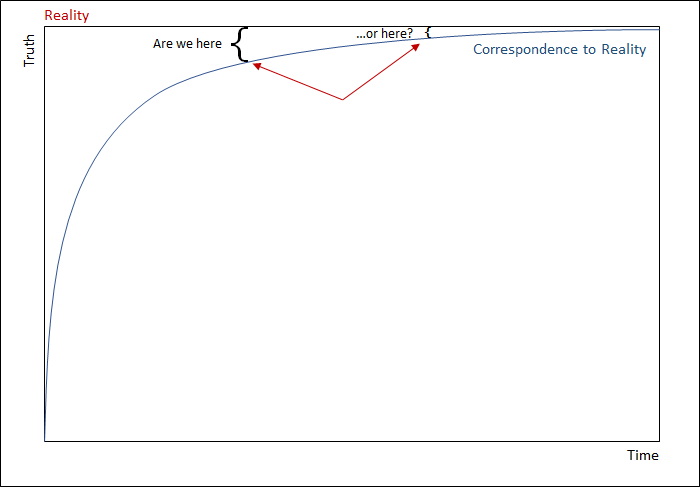
In this first illustration, we see Truth (or relative truthiness) on the Y-axis and Time on the X-Axis. On the top, we see a threshold representing Reality. In the plane, I’ve rendered an asymptotic curve, where over time, we get closer and closer to the Truth. But we never quite get there. More on this later.

The next illustration will help to demonstrate what’s happening.

Notice there is a gap between the curve and the Reality cap. For one thing, we don’t really know where we are relative to Reality. In the case of the geocentric system, we might have been at the leftmost space. Once we determined that the system is actually solar-centric, we might have moved right on the curve to close the gap. We might be tempted to defend that we’ve finally reached the truth, but we’d have been equally willing to make the same defence from the geocentric position, so we need to be mindful of the past.

Perhaps, this last example was too obvious. We feel comfortable staking a truth claim—or at least a claim of fact. So let’s look at another example.

Let’s re-use the same axes—Truth and Time—, but rather than an asymptotic curve, let’s presume something more polynomial in nature—or not particularly cyclic. Rather than retrograde motion in planets, let’s visit the supposed progress of Newtonian over Einsteinian physics.

This takes a bit more setup but bear with me.  In this case, I have taken liberties and illustrated the Einsteinian physics gap to capture an inferior vantage on reality over Newtonian physics. Granted, I need to rely on a bit of suspension of disbelief, but in the bigger picture, I am trying to convey a scenario where some new paradigm puts the prior knowledge in perspective.

In this instance, both Newtonian and Einsteinian flavours of physics are based on a materialistic, particles-based model, which is where the modern physics consensus resides. But, let’s say that consensus changes in such a way that it is determined that something else underlies reality, say consciousness per Analytic Idealism as proposed by Bernardo Kastrup or per Integrated Information Theory (IIT) as advanced by Donald Hoffman and others. As with retrograde motion, we might end up finding that we were barking up the wrong tree. This might be a bit different because the particles are a directly perceived manifestation of the underlying consciousness, but I wanted to create a scenario where knowledge thought to have advanced actually regressed, but this wasn’t revealed until a new perspective was available.

Yet again, an important aspect of note is that we don’t actually know the distance between our perceptions and real Reality.

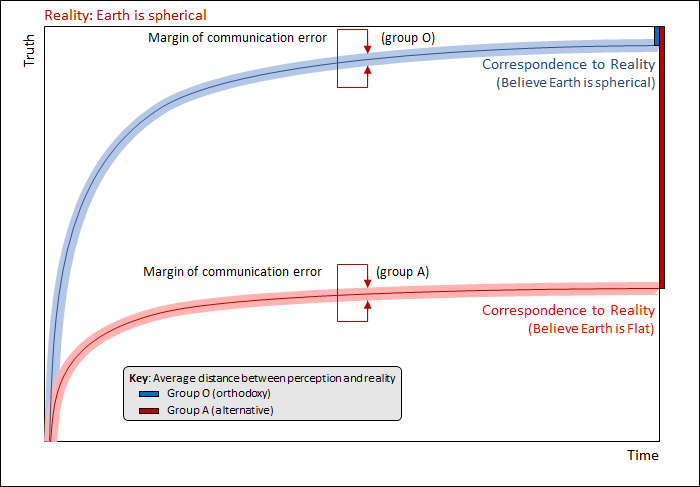
This last illustration builds upon the first asymptotic chart but has an in-built error margin meant to reflect language insufficiencies. There is some concept that people feel they grasp, but the consensus is not as unified as the group thinks.

I’ll share two examples, the first being the concept of justice. To me, Justice is what I deem a weasel word. It’s a word we commonly use, but it means different things to different people. To me, it’s a euphemism for vengeance by proxy, but for others, it transcends that and mirrors some impartial dispensation of just desert—some good old-fashioned law and order.

[Justice is] a euphemism for vengeance by proxy

Without getting stuck down some rabbit hole, my point is that if we aggregate these beliefs, the asymptotic curve represents an average consensus vantage rather than something as obvious as 2 plus 2 equals 4. On this note, allow me to clear the air.

Some viewers might be clamouring to say, “but 2 plus 2 equals four is true.” But this is tautologically true, which is to say that it’s true by definition. It’s a similar tautology to saying that it’s true that snow is white, or coal is black. We’ve already defined snow, white, coal, and black, so these may be facts, but they are true by definition.

Revisiting the chart, notice that there are two curves in the space. In this case, I illustrate competing truth claims from the perspective of an omniscient narrator. The case is whether the earth is an oblate spheroid or is flat. I am going to go out on a limb and assert the earth is spherical, as represented by the top blue curve—and we have some margin of error as to what that might mean. The bottom red curve depicts the perceived truth of the flat earthers, who also have some room for semantic error.

Given that I am presuming that I am in the right adopting the majority position—please be right—, the blue curve is closer to Reality than the red curve. Of course, in the event that the earth is really flat, then it proves my point that we don’t know where we are relative to truth, so we assume that the state of knowledge at any given time is what’s real.

Again, forgive my fanciful examples. Please don’t tell me that this spheroid versus planer earth is tautological too because you’d be correct, but I am already aware. They are just nonsensical illustrations. Nonetheless, I hope they’ve served to express a point.

I could have as well created curves that depicted two cohorts’ beliefs on the efficacy of tarot or astrology in predicting the future. I am sure that it might render somewhat like the last chart, but I’d also presume that both curves would have very low truth values as seen from an objective observer. Secretly, I hope tarot wins the truth battle.

Before I end our time together, I’d like to convey that for an Analytic Idealist, these charts might be more acceptable at face value. For a Realist, Naïve or otherwise, they may argue that this curve is not asymptotic and may in fact reach some tangency. I don’t happen to believe this is the case or I wouldn’t have spent my time assembling and presenting this. Time will tell. Or will it?

Video: Blame and Causa Sui

In this segment, I ponder the interplay between blame and Causa Sui. I’ll discuss the implications for moral responsibility as well as legal responsibility, which are not as in sync as one might imagine they might be.

Video: Blame & Causa Sui

To the uninitiated, Western legal systems have no pretensions about being about morality or justice. Legal systems are designed to maintain power structures and the status quo. They are deontological machines, making them prime targets for automation by the machine learning associated with artificial intelligence. This would also diminish the power of rhetoric over facts to some extent. But, I am no legal scholar, and all of this will have to wait for another segment.

I recently shared a video on causa sui and the basics of blame and blameworthiness, so I want to intersect those topics here.

Peter Strawson suggested that for humans, blame is a reactive response. It’s reflexive like having your knee jerk when tapped. Essentially, his position is that if blame didn’t naturally exist, we’d have to invent it, mirroring Voltaire’s quip, ‘If God did not exist, it would be necessary to invent Him’. Of course, this is because they serve the same power control purpose.

If God did not exist, it would be necessary to invent Him

Voltaire

To be fair, blame is closer to real than God, but the point remains. Strawson’s point is also that humans are saddled with blame and it’s not going anywhere no matter how nebulous it becomes in execution. It’s natural.

To me, this starts to sound suspiciously like a naturalistic fallacy. Humans seem to selectively cherry-pick which so-called natural tendencies they choose to defend. One might use nature to argue that female sexual availability begins at menstruation, and yet we have decided to ignore this and defer this on the grounds of civility. It’s obvious that we could consider blame to be an animal instinct we want to domesticate away, but because it serves other purposes, per Strawson’s perspective, it’s a useful tool.
But what’s the causa sui challenge. Let’s quickly recapitulate.

Causa sui argues that one cannot be the cause of oneself, ex nihilo. Being full products of nature and nurture to adopt the lay parlance, any blameworthiness lies with the sources or creators. Since we are concerned with moral responsibility, we can eliminate nature forthrightly. Nature may be responsible—by many estimations approximately 40 per cent responsible—, it possesses no moral agency. And if the individual is not responsible, then we are left with the environment and society, including the social environment. Of course, the environment gets off the hook in the same manner as the genetic and hereditary factors of nature.

Before we consider society, let’s regard the individual.

Albeit the brain-as-computer is a bit facile, it’s still good enough for illustrative purposes. When you are born, your cognitive hardware is installed, as are your edge peripherals and update protocols. Any of these can become damaged through some degenerative processes, or external environmental factors, but since my interest is in optimistic rather than pessimistic scenarios, I’ll ignore these instances. Given that blameworthiness is directly related to presumed cognitive processing, factors that diminish these faculties, mitigate blameworthiness and factors than increase it, ameliorate it.

As a—quote—’normal’ child becomes an adolescent and then an adult, the probability it will become blameworthy, increases with age, ceteris paribus. A person with cognitive deficits or conditions such as aphasia or dementia decreases the probability of blame assignment. Even temporary impairment mitigates judgment—oh, she was drunk.

So, following the brain-as-computer analogy, your brain is a CPU with a self-updating cognitive operating system and instruction set. Essentially, there is also short and long-term memory.
In the case of cognitive deficits, one of these components might be effectively broken. The CPU might process too slowly; it might misinterpret what it receives; there may be issues with the sense organs or the nerves that transport signals.

I’ve got a mate who, due to medical malpractice at birth, experienced nerve damage. Although his eyes and brain are normal, his optic nerve cannot carry signals very well, effectively leaving him blind. Neither can he taste nor smell. So there’s that.

But assuming that this processing and storage hardware are intact, the causa sui constraint still applies, but let’s spend some time evaluating societal interactions.

All inputs come from society—cultures and subcultures. Apart from misinterpreted processing scenarios, if a person doesn’t receive a particular moral instruction set, that person should surely be considered to be exempt from moral blame. It may be difficult to assess whether an instruction has been input. This is a reason why children are categorically exempted: they may not have received all of the expected moral codes, they may not have been stored or effectively indexed, and their processing hardware is still in development—alpha code if you will. Brain plasticity is another attribute I won’t spend much time on, but the current state of science says that the brain is still not fully developed even by age 30, so this is certainly a mitigating factor, even if we allow leeway for the causa sui argument.

I mention subculture explicitly because the predominant culture is not the only signal source. A child raised by, I don’t know, say pirates, would have an amended moral code. I am sure we can all think of different subcultures that might undermine or come at cross odds with the dominant culture, whether hippies, religious cultists, militia groups, racial purist groups, and so on.

So, a commonly held moral in the subdominant group may counter that of the prevailing one. An example that comes to mind is some religious organisations that do not agree with human medical intervention. There have been cases where parents have allowed a child to die from an otherwise curable condition. Although in the United States, there is a claim of freedom of religion—a claim that is spotty at best—, parents or guardians in situations like these have been convicted and sentenced for following their own moral codes. But as with all people, these people are as susceptible to the limitations of causa sui as the rest of us. They are not responsible for creating themselves, but moral responsibility was asserted based on the beliefs of the prevailing culture. Even besides the legal context, persons in the larger society would likely blame the parents for their neglect—though they may be praised for being resolute in their righteousness by their in-group. This just underscores that morality is a collection of socially constructed conventions rather than something more objective.

Returning to causa sui, let’s say a person commits an act that society would typically assign blame. Rather than exercise some act of retributive justice—a concept with no foundation in a causa sui universe—the course of action was remediation. In this case, the desired moral instruction would be delivered thereby seemingly making the moral offender blameworthy. But would they be?

Presumably, (for what it’s worth) psychologists would evaluate the subject for competency in maintaining the programming. In the case of the aforementioned religious parents, they may be threatened with retribution for not abiding by the superseding rules of the prevailing power structure.

Although I might personally allow some leeway even with the causa sui in full force and effect, but I can’t say that I have much faith in the ability of humans to make a correct assessment. My impression is that any assessment would be one of convenience than something sounder.

Perhaps I’ll produce a more robust segment on retributive justice, but my feeling is that retributive justice is an area that legal systems should avoid altogether. If necessary, focus on restorative justice, rehabilitation (or ‘habilitation’ as the case might be) and quarantine models to ensure any bad actors are contained away from society. Again, this puts individuals at the mercy of cultures they find themselves a part of. I am not going to delve into this any further save to remind the listener of gang initiation schemes where a person needs to kill a member of a rival gang to become a trusted member. This is their moral code—quite at odds with the mainstream.

So there you have it. Owing to causa sui constraints, a person cannot be ultimately responsible for their actions. My primary thesis is—apart from metaphorical equipment failures—that any moral responsibility falls wholly on the society or culture. Full stop. And this isn’t as foreign as one might first feel. Although for most people blame is natural, in an individualistic society, people are interested in finding the culprit. In collectivist cultures, any culprit might do. Perhaps I’ll share some stories in a future segment.
Meantime, what are your thoughts on moral responsibility? Can someone be ultimately responsible? Some have said the ‘ultimate responsibility’ is a philosophical red herring and that we can still hold someone responsible, even if not in the ultimate sense, which causa sui disallows. Are you more in this camp? Is this enough to mete out so-called retributive justice? For me, retributive justice is a euphemism for vengeance, and justice is a weasel word. But that’s just me, and perhaps a topic for another segment.

Are there any topics you’d like me to cover? Leave a comment below.

Moral Responsibility

Can we be held morally responsible for our actions? Yes, says Daniel Dennett. No, says Gregg Caruso. Reader, you decide

Aeon Article, 4 October 2018

Caruso: [Dan,] you have famously argued that freedom evolves and that humans, alone among the animals, have evolved minds that give us free will and moral responsibility. I, on the other hand, have argued that what we do and the way we are is ultimately the result of factors beyond our control, and that because of this we are never morally responsible for our actions, in a particular but pervasive sense – the sense that would make us truly deserving of blame and praise, punishment and reward. While these two views appear to be at odds with each other, one of the things I would like to explore in this conversation is how far apart we actually are. I suspect that we may have more in common than some think – but I could be wrong. To begin, can you explain what you mean by ‘free will’ and why you think humans alone have it?

Gregg Caruso

Dennett: A key word in understanding our differences is ‘control’. [Gregg,] you say ‘the way we are is ultimately the result of factors beyond our control’ and that is true of only those unfortunates who have not been able to become autonomous agents during their childhood upbringing. There really are people, with mental disabilities, who are not able to control themselves, but normal people can manage under all but the most extreme circumstances, and this difference is both morally important and obvious, once you divorce the idea of control from the idea of causation. Your past does not control you; for it to control you, it would have to be able to monitor feedback about your behaviour and adjust its interventions – which is nonsense.

In fact, if your past is roughly normal, it contains the causal chains that turned you into an autonomous, self-controlling agent. Lucky you. You weren’t responsible for becoming an autonomous agent, but since you are one, it is entirely appropriate for the rest of us to hold you responsible for your deeds under all but the most dire circumstances. 

Daniel Dennett

if your past is roughly normal, it contains the causal chains that turned you into an autonomous, self-controlling agent

Dan Dennett

So commences this debate. The argument unfolds largely on semantic grounds. Even here, one can see the debate over the distinction between control and causation. I understand what Dennett is attempting to parse here, but I object on the grounds of causa sui.

I recommend reading the Aeon article as there is much more than this distinction, but it does remain a semantic issue. I started a post on backwards- and forward-looking perspectives, that better articulate Caruso’s perspective, but I am also working on other things. This was quicker to post and I wanted to keep a bookmark anyway, so it’s a win-win.