Justice as a House of Cards

4–6 minutes

How retribution stays upright by not being examined

There is a persistent belief that our hardest disagreements are merely technical. If we could stop posturing, define our terms, and agree on the facts, consensus would emerge. This belief survives because it works extremely well for birds and tables.

It fails spectacularly for justice.

Audio: NotebookLM summary podcast of this topic.

The Language Insufficiency Hypothesis (LIH) isn’t especially interested in whether people disagree. It’s interested in how disagreement behaves under clarification. With concrete terms, clarification narrows reference. With contested ones, it often fractures it. The more you specify, the more ontologies appear.

Justice is the canonical case.

Retributive justice is often presented as the sober, adult conclusion. Not emotional. Not ideological. Just what must be done. In practice, it is a delicately balanced structure built out of other delicately balanced structures. Pull one term away and people grow uneasy. Pull a second and you’re accused of moral relativism. Pull a third and someone mentions cavemen.

Let’s do some light demolition. I created a set of 17 Magic: The Gathering-themed cards to illustrate various concepts. Below are a few. A few more may appear over time.

Card One: Choice

Image: MTG: Choice – Enchantment

The argument begins innocently enough:

They chose to do it.

But “choice” here is not an empirical description. It’s a stipulation. It doesn’t mean “a decision occurred in a nervous system under constraints.” It means a metaphysically clean fork in the road. Free of coercion, history, wiring, luck, trauma, incentives, or context.

That kind of choice is not discovered. It is assumed.

Pointing out that choices are shaped, bounded, and path-dependent does not refine the term. It destabilises it. Because if choice isn’t clean, then something else must do the moral work.

Enter the next card.

Card Two: Agency

Image: MTG: Agency – Creature – Illusion

Agency is wheeled in to stabilise choice. We are reassured that humans are agents in a morally relevant sense, and therefore choice “counts”.

Counts for what, exactly, is rarely specified.

Under scrutiny, “agency” quietly oscillates between three incompatible roles:

  • a descriptive claim: humans initiate actions
  • a normative claim: humans may be blamed
  • a metaphysical claim: humans are the right kind of cause

These are not the same thing. Treating them as interchangeable is not philosophical rigour. It’s semantic laundering.

But agency is emotionally expensive to question, so the discussion moves on briskly.

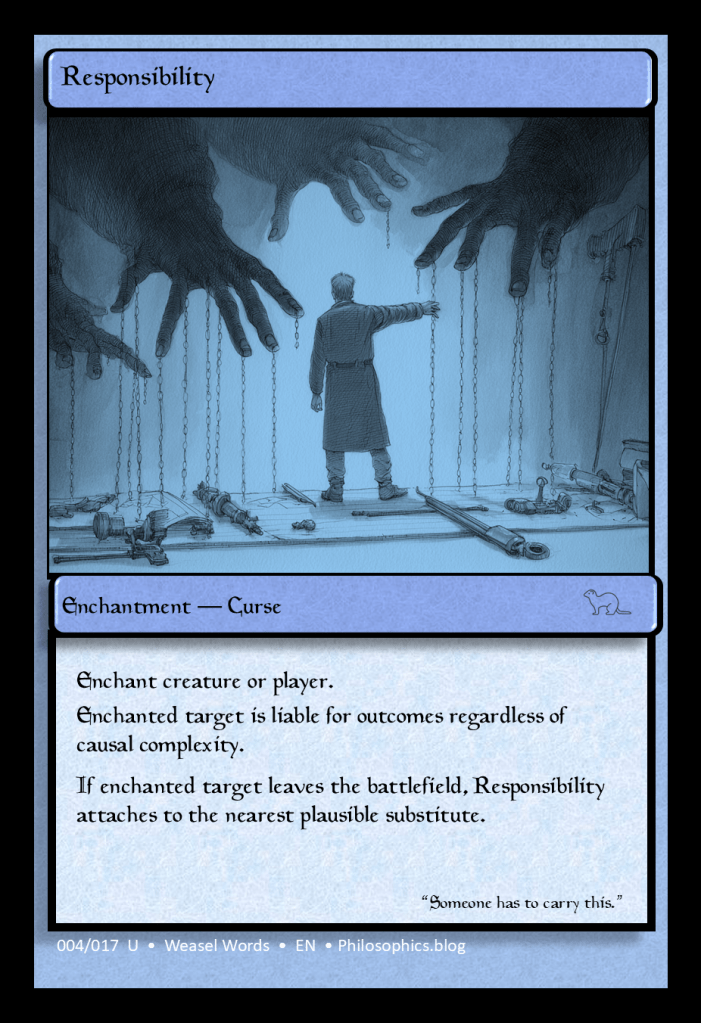
Card Three: Responsibility

Image: MTG: Responsibility – Enchantment – Curse

Responsibility is where the emotional payload arrives.

To say someone is “responsible” sounds administrative, even boring. In practice, it’s a moral verdict wearing a clipboard.

Watch the slide:

  • causal responsibility
  • role responsibility
  • moral responsibility
  • legal responsibility

One word. Almost no shared criteria.

By the time punishment enters the picture, “responsibility” has quietly become something else entirely: the moral right to retaliate without guilt.

At which point someone will say the magic word.

Card Four: Desert

Image: MTG: Desert – Instant

Desert is the most mystical card in the deck.

Nothing observable changes when someone “deserves” punishment. No new facts appear. No mechanism activates. What happens instead is that a moral permission slip is issued.

Desert is not found in the world. It is declared.

And it only works if you already accept a very particular ontology:

  • robust agency
  • contra-causal choice
  • a universe in which moral bookkeeping makes sense

Remove any one of these and desert collapses into what it always was: a story we tell to make anger feel principled.

Which brings us, finally, to the banner term.

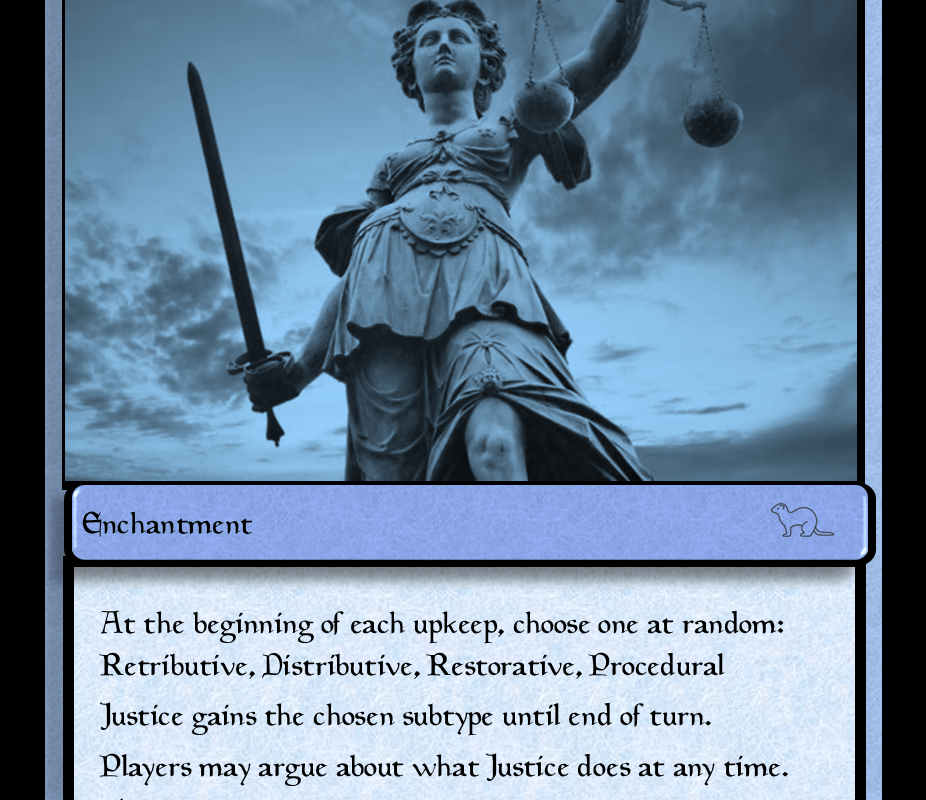
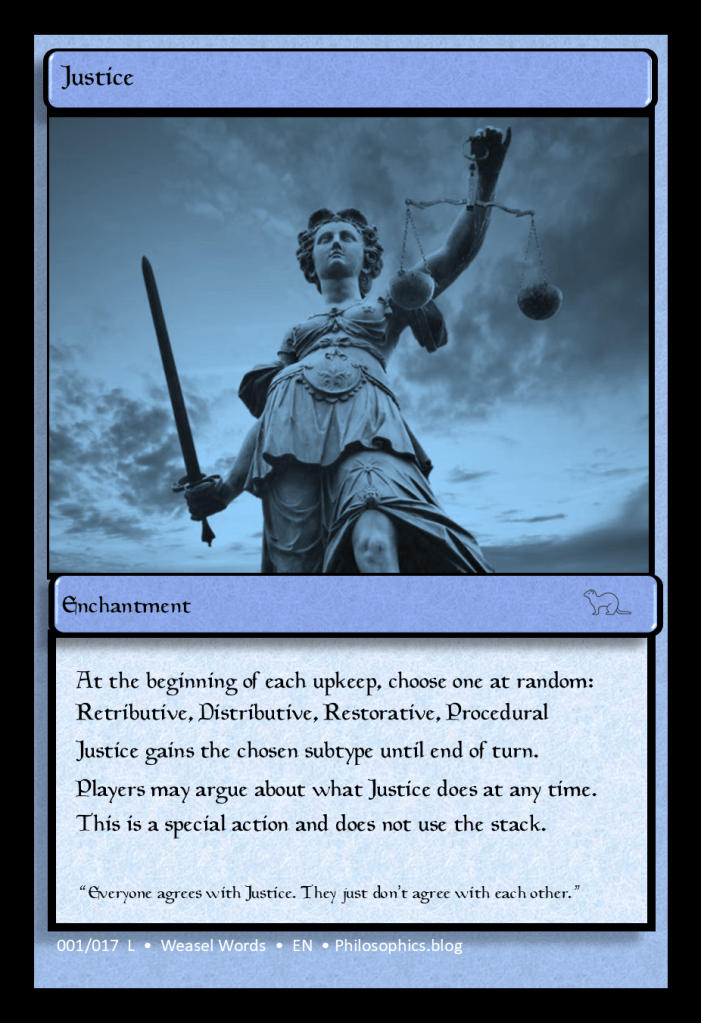
Card Five: Justice

Image: MTG: Justice – Enchantment

At this point, justice is invoked as if it were an independent standard hovering serenely above the wreckage.

It isn’t.

“Justice” here does not resolve disagreement. It names it.

Retributive justice and consequentialist justice are not rival policies. They are rival ontologies. One presumes moral balance sheets attached to persons. The other presumes systems, incentives, prevention, and harm minimisation.

Both use the word justice.

That is not convergence. That is polysemy with a body count.

Why clarification fails here

This is where LIH earns its keep.

With invariants, adding detail narrows meaning. With terms like justice, choice, responsibility, or desert, adding detail exposes incompatible background assumptions. The disagreement does not shrink. It bifurcates.

This is why calls to “focus on the facts” miss the point. Facts do not adjudicate between ontologies. They merely instantiate them. If agency itself is suspect, arguments for retribution do not fail empirically. They fail upstream. They become non sequiturs.

This is also why Marx remains unforgivable to some.
“From each according to his ability, to each according to his need” isn’t a policy tweak. It presupposes a different moral universe. No amount of clarification will make it palatable to someone operating in a merit-desert ontology.

The uncomfortable conclusion

The problem is not that we use contested terms. We cannot avoid them.

The problem is assuming they behave like tables.

Retributive justice survives not because it is inevitable, but because its supporting terms are treated as settled when they are anything but. Each card looks sturdy in isolation. Together, they form a structure that only stands if you agree not to pull too hard.

LIH doesn’t tell you which ontology to adopt.

It tells you why the argument never ends.

And why, if someone insists the issue is “just semantic”, they’re either confused—or holding the deck.

Freedom and Resentment

I finally decided to read Peter Strawson’s essay, Freedom and Resentment, as it seems to be a somewhat seminal work. As the essay is part of a larger collection, Freedom and Resentment and Other Essays, I also read Strawson’s autobiography, which is interesting. I especially enjoyed the part where he had published a piece only to discover that it dovetailed with some of Frege’s work and was cast as the Frege-Strawson view despite him never having read Frege.

Although on a lesser scale, I feel this captures some of my circumstances where I feel I have some original thought only to discover that someone’s already been there, in some cases before I was even born—or before my grandparents for that matter. There is just so much to read and time is a limited resource. In any case. Moving on.

He begins with these two sentences:

Some philosophers say they do not know what the thesis of determinism is.
Others say, or imply, that they do know what it is.

Strawson employs the terminology of optimism and pessimism. These are in consideration of the notion of free will. Each claims that as far as we know, determinism cannot be shown to be false. But optimists believe that we can assume we have an adequate basis for moral practices whilst pessimists believe that we cannot make this assumption, so we must find some other basis; this means that the pessimists are forced to concede that although determinism cannot be proven to be false, it must nonetheless be false.

Some pessimists “hold that if the thesis [of determinism] is true, then the concepts of moral obligation and responsibility really have no application, and the practices of punishing and blaming, of expressing moral condemnation and approval, are really unjustified.”

Some optimists “hold that these concepts and practices in no way lose their raison d’être if the thesis of determinism is true.”

as far as we know, determinism cannot be shown to be false

A genuine moral sceptic may hold that “the notions of moral guilt, of blame, of moral responsibility are inherently confused and that we can see this to be so if we consider the consequences either of the truth of determinism or of its falsity.”

Like Frege to Strawson, I now find myself adopting his line of argumentation—that people presume people to be competent agents by default unless exempted as non compos mentis and such. If one or more of these mitigating factors is not present, then one may be considered to be a morally responsible agent. (In my mind, this creates many false positives in the resultant sample, but let’s continue.)

Then he establishes the groundwork for moral obligation and responsibility to arrive here:

Strawson contrasts optimistic with pessimistic with a smattering of sceptics.

If I am asked which of these parties I belong to, I must say it is the first of all, the party of those who do not know what the thesis of determinism is.

But this does not stop me…

Desert is his next topic. What does the threshold of the agent to have to deserve “blame or moral condemnation”?

Effectively, Strawson separates determinists and libertarians (philosophical, not the capital-L political flavour).

He distinguishes reasons from rationalisation, with the former having more weight and the second being akin to excuses. Here, he tries to tease out notions of positive and negative freedoms on a concept defined negatively, i.e., the absence of some deficiency. He also calls out supporters for not only having an insufficient basis but “not even the right sort of basis”.

Strawson makes a point to delineate desert as following from a positive act rather than some omission, allowing for ignorance to serve as an escape clause. Being an older publication, he points out the by-now obvious contradiction between freedom and determinism, but he continues to clarify the waffling between various definitions of freedom, hiding behind the ambiguous meaning, whether intentioned or not.

Soon enough, he notes a challenge. Humans have a cognitive bias wherein they have a difficult time maintaining an objective attitude toward people who we interact with. Instead, we engage in participant reactive attitudes. This is to say that we make judgments we would not make on a non-reactive object. If we bump into a chair (object), we don’t activate the same mental protocols as if we bump into a person (participant reactive). In the latter case, our blame-resentment mechanism is activated. This may result in feelings of ‘resentment, gratitude, forgiveness, anger‘ or some sort of reciprocated love in another instance. In the end, he supposed that we blame people because we have reactive attitudes toward them.

Ultimately, irrespective of whether determinism is true or not, we cannot seem to control our personal reactive urges, so we need to deal with it.

To be honest, I don’t feel I got a lot out of this essay. Perhaps it just didn’t age well or others have already incorporated this into their work, so the logic may be sound, but it doesn’t feel particularly profound. I can tick off the ‘read this’ box and move on.

Video: Blame and Causa Sui

In this segment, I ponder the interplay between blame and Causa Sui. I’ll discuss the implications for moral responsibility as well as legal responsibility, which are not as in sync as one might imagine they might be.

Video: Blame & Causa Sui

To the uninitiated, Western legal systems have no pretensions about being about morality or justice. Legal systems are designed to maintain power structures and the status quo. They are deontological machines, making them prime targets for automation by the machine learning associated with artificial intelligence. This would also diminish the power of rhetoric over facts to some extent. But, I am no legal scholar, and all of this will have to wait for another segment.

I recently shared a video on causa sui and the basics of blame and blameworthiness, so I want to intersect those topics here.

Peter Strawson suggested that for humans, blame is a reactive response. It’s reflexive like having your knee jerk when tapped. Essentially, his position is that if blame didn’t naturally exist, we’d have to invent it, mirroring Voltaire’s quip, ‘If God did not exist, it would be necessary to invent Him’. Of course, this is because they serve the same power control purpose.

If God did not exist, it would be necessary to invent Him

Voltaire

To be fair, blame is closer to real than God, but the point remains. Strawson’s point is also that humans are saddled with blame and it’s not going anywhere no matter how nebulous it becomes in execution. It’s natural.

To me, this starts to sound suspiciously like a naturalistic fallacy. Humans seem to selectively cherry-pick which so-called natural tendencies they choose to defend. One might use nature to argue that female sexual availability begins at menstruation, and yet we have decided to ignore this and defer this on the grounds of civility. It’s obvious that we could consider blame to be an animal instinct we want to domesticate away, but because it serves other purposes, per Strawson’s perspective, it’s a useful tool.
But what’s the causa sui challenge. Let’s quickly recapitulate.

Causa sui argues that one cannot be the cause of oneself, ex nihilo. Being full products of nature and nurture to adopt the lay parlance, any blameworthiness lies with the sources or creators. Since we are concerned with moral responsibility, we can eliminate nature forthrightly. Nature may be responsible—by many estimations approximately 40 per cent responsible—, it possesses no moral agency. And if the individual is not responsible, then we are left with the environment and society, including the social environment. Of course, the environment gets off the hook in the same manner as the genetic and hereditary factors of nature.

Before we consider society, let’s regard the individual.

Albeit the brain-as-computer is a bit facile, it’s still good enough for illustrative purposes. When you are born, your cognitive hardware is installed, as are your edge peripherals and update protocols. Any of these can become damaged through some degenerative processes, or external environmental factors, but since my interest is in optimistic rather than pessimistic scenarios, I’ll ignore these instances. Given that blameworthiness is directly related to presumed cognitive processing, factors that diminish these faculties, mitigate blameworthiness and factors than increase it, ameliorate it.

As a—quote—’normal’ child becomes an adolescent and then an adult, the probability it will become blameworthy, increases with age, ceteris paribus. A person with cognitive deficits or conditions such as aphasia or dementia decreases the probability of blame assignment. Even temporary impairment mitigates judgment—oh, she was drunk.

So, following the brain-as-computer analogy, your brain is a CPU with a self-updating cognitive operating system and instruction set. Essentially, there is also short and long-term memory.
In the case of cognitive deficits, one of these components might be effectively broken. The CPU might process too slowly; it might misinterpret what it receives; there may be issues with the sense organs or the nerves that transport signals.

I’ve got a mate who, due to medical malpractice at birth, experienced nerve damage. Although his eyes and brain are normal, his optic nerve cannot carry signals very well, effectively leaving him blind. Neither can he taste nor smell. So there’s that.

But assuming that this processing and storage hardware are intact, the causa sui constraint still applies, but let’s spend some time evaluating societal interactions.

All inputs come from society—cultures and subcultures. Apart from misinterpreted processing scenarios, if a person doesn’t receive a particular moral instruction set, that person should surely be considered to be exempt from moral blame. It may be difficult to assess whether an instruction has been input. This is a reason why children are categorically exempted: they may not have received all of the expected moral codes, they may not have been stored or effectively indexed, and their processing hardware is still in development—alpha code if you will. Brain plasticity is another attribute I won’t spend much time on, but the current state of science says that the brain is still not fully developed even by age 30, so this is certainly a mitigating factor, even if we allow leeway for the causa sui argument.

I mention subculture explicitly because the predominant culture is not the only signal source. A child raised by, I don’t know, say pirates, would have an amended moral code. I am sure we can all think of different subcultures that might undermine or come at cross odds with the dominant culture, whether hippies, religious cultists, militia groups, racial purist groups, and so on.

So, a commonly held moral in the subdominant group may counter that of the prevailing one. An example that comes to mind is some religious organisations that do not agree with human medical intervention. There have been cases where parents have allowed a child to die from an otherwise curable condition. Although in the United States, there is a claim of freedom of religion—a claim that is spotty at best—, parents or guardians in situations like these have been convicted and sentenced for following their own moral codes. But as with all people, these people are as susceptible to the limitations of causa sui as the rest of us. They are not responsible for creating themselves, but moral responsibility was asserted based on the beliefs of the prevailing culture. Even besides the legal context, persons in the larger society would likely blame the parents for their neglect—though they may be praised for being resolute in their righteousness by their in-group. This just underscores that morality is a collection of socially constructed conventions rather than something more objective.

Returning to causa sui, let’s say a person commits an act that society would typically assign blame. Rather than exercise some act of retributive justice—a concept with no foundation in a causa sui universe—the course of action was remediation. In this case, the desired moral instruction would be delivered thereby seemingly making the moral offender blameworthy. But would they be?

Presumably, (for what it’s worth) psychologists would evaluate the subject for competency in maintaining the programming. In the case of the aforementioned religious parents, they may be threatened with retribution for not abiding by the superseding rules of the prevailing power structure.

Although I might personally allow some leeway even with the causa sui in full force and effect, but I can’t say that I have much faith in the ability of humans to make a correct assessment. My impression is that any assessment would be one of convenience than something sounder.

Perhaps I’ll produce a more robust segment on retributive justice, but my feeling is that retributive justice is an area that legal systems should avoid altogether. If necessary, focus on restorative justice, rehabilitation (or ‘habilitation’ as the case might be) and quarantine models to ensure any bad actors are contained away from society. Again, this puts individuals at the mercy of cultures they find themselves a part of. I am not going to delve into this any further save to remind the listener of gang initiation schemes where a person needs to kill a member of a rival gang to become a trusted member. This is their moral code—quite at odds with the mainstream.

So there you have it. Owing to causa sui constraints, a person cannot be ultimately responsible for their actions. My primary thesis is—apart from metaphorical equipment failures—that any moral responsibility falls wholly on the society or culture. Full stop. And this isn’t as foreign as one might first feel. Although for most people blame is natural, in an individualistic society, people are interested in finding the culprit. In collectivist cultures, any culprit might do. Perhaps I’ll share some stories in a future segment.
Meantime, what are your thoughts on moral responsibility? Can someone be ultimately responsible? Some have said the ‘ultimate responsibility’ is a philosophical red herring and that we can still hold someone responsible, even if not in the ultimate sense, which causa sui disallows. Are you more in this camp? Is this enough to mete out so-called retributive justice? For me, retributive justice is a euphemism for vengeance, and justice is a weasel word. But that’s just me, and perhaps a topic for another segment.

Are there any topics you’d like me to cover? Leave a comment below.

Blaming and Naming

When I was writing my review of Elbow Room, this categorical syllogism came to mind:

P1: All agents are responsible

P2: I am an agent

C: Therefore, I am responsible

Now I want to unpack it.

Podcast: Audio rendition of this page content

The first premise is that all agents are responsible. Of course, this hinges on how one defines agent and responsibility. It also depends on the scope, especially of the agent but to some extent also the scope of responsibility.

Leveraging the Causa Sui argument, the agent is a social construct and can only be responsible to what extent s/he has been programmed as well as the ability to maintain and process the programming effectively—so without bugs to continue with the parlance.

If the agent is immature or defective, expectations of responsibility are diminished.

If certain inputs were not given, there is no reason to assume a related command would be executed. This is why so much time and energy is spent on programming and evaluating children.

This first premise is predicated on the pathological need to blame. Unwritten behind the responsibility claim is that I feel compelled to blame. Blame requires responsibility, so if I want to blame someone, they must be responsible. In any given circumstances, I may feel the urge to blame anyone, so all agents [eligible people] are worthy of blame. There is no particular reason to exclude myself, so I too am blameworthy. What’s good for the goose is good for the gander, eh?

Goose and Gander. Strike that pose.

As PF Strawson said, even if moral responsibility couldn’t possibly exist, it would be invented because people need to blame. This is in line with Voltaire’s commentary on God.

Si Dieu n’existait pas, il faudrait l’inventer.
If God did not exist, it would be necessary to invent him.

Voltaire

We can all look around and see how pervasive the god delusion is. Moral responsibility is even more insidious. In principle, moral gods were invented for just this purpose. An omnipresent judge was needed to keep the big house in check.

Where I Stand

From my perspective, I do feel that a person in the space of Dennett’s elbow room can have responsibility. Being a non-cognitivist, I have more difficulty accepting the arbitrary imposition of morality, but I understand the motivation behind it.

The problem I have is that mechanisms to ensure that the inputs and processes are all in order and there are no superseding instructions are not in place. Moreover, if the superseding instruction does not comport with the will of the power structure, it will be marginalised or ignored. This is a limitation of morality being a social construct, and none of this gets past the ex nihilo problem causa sui invokes, so we end up cursing the computer we’ve invented. O! monster of Frankenstein. O! Pygmalion.

Blame

Even the moral sceptic is not immune from his own form of the wish to over-intellectualize such notions as those of moral responsibility, guilt, and blame. He sees that the optimist’s account is inadequate and the pessimist’s libertarian alternative inane; and finds no resource except to declare that the notions in question are inherently confused, that ‘blame is metaphysical’.

PF Strawson, Freedom and Resentment
Quote from Freedom and Resentment and Other Essays by PF Strawson

Part of my central thesis of non-agency is centred on the notion of blame, and it seems PF Strawson has a lot to contribute in this arena. In short, given my lack of belief of material human agency, I wish to investigate the connection between seemingly innate impulses to project blame and the absence of a blameworthy object.

In order to devote more time to researching and writing my thesis and less time editorialising elsewhere, I may post some shorter content such as these gems that I stumble upon along the way. This facilitates my desire to create and share content without the burden of devoting hours to render it. It also gives me places to come back to.

I only hope that you don’t blame me for doing so.


Meantime, indulge my recording my thoughts here in the public space.

What is blame?

We don’t have very precise definitions of blame, we have an intuitive sense of what it means. There is a subject (or object, as the case might be) that creates (or has been attributed to have created) an action that results in an interaction on an object (or process) with a subsequent effect and a notion of intentionality. But we have to parse casual effect, responsibility, and blame as they are not strictly equivalent. Let’s begin with a causal event.

I believe that on balance the causal event process and object interaction is uncontroversial. A billiard ball (Object A), through directed (or undirected) motion, collides (action) with a second billiard ball (Object B) with the subsequent effect of displacing the second ball.

What we can claim in this scenario is that A → B, A causes B to move. Except in the loosest of idiomatic speech, we can’t really extend this causal relationship to claim that A is responsible for B’s movement. Even further removed, one can’t claim that A is to blame for B’s movement.

Responsibility and blame are different moral claims attributed to an agent. I feel I am safe to claim that a billiard ball has no agency. Whilst human agency is defined as an individual’s capacity to determine and make meaning from their environment through purposive consciousness and reflective and creative action (Houston, 2010), an agent in a more general sense is a being with the capacity to act, and ‘agency’ denotes the exercise or manifestation of this capacity.

The word blame is infused with negative connotations. Praise is a loose antonym with positive connotations, but I won’t focus on it because it is not nearly as heavy and operates semantically differently. In any case, I feel justified to cross blame from the list of possible qualifiers for the billiard ball scenario.

Is A responsible for B? Again, I believe that most people do not assign responsibility to inanimate objects—notwithstanding animism, pantheism, and possibly panpsychism.

Here are some diagrammes.

Above, there is only cause and effect. We can intuit that the movement of Object A is not uncaused. Even so, it careens into Object B, causing it to move. And while one could say A is responsible for moving B, this would be non-standard English language use.

If one pulls back to catch a wider glimpse, one can see that the cause of Object A striking Object B, was a person striking Object A (possibly with a cue stick). Here, the casual event chain is the person causing A to strike B. Two cause-effect relationships at a macro level. However, in this case, we can also say that the person is responsible for the event to set A into motion. We can also say that the person caused B to move (by the way of Object A). Even here, blame would be inappropriate to assert.

We may be able to reframe the scenario slightly differently to get blame into the picture, but let’s take a short detour and create a praise situation. If Object B is hit into a pocket, we can praise the person. Perhaps this shot wins the game. The person is responsible for making the shot.

In scenario B, the person misses the shot. Moreover, Object A does collide with Object B, but perhaps Object B is the 8 ball, and it was not supposed to be pocketed yet. Or perhaps the cue ball deflects off of Object B causing A to scratch because it falls into a pocket. Either of these situations might cause the person to lose the match. A mate may blame this person for being responsible for the loss.

Before moving on, I’ll point out that one distinction that affords blame more weight than praise is the ongoing psychology. Whilst with praise, a person may reflect fondly on a positive event, there is not really a counter to a grudge in the case of blame. And while praise can be misattributed with benefits to social capital, misdirected blame can result in a loss of social capital with longer-term implications.

Perhaps someone unseen pushes you into another person causing them to be injured. You may have been the cause of this person being injured, but like the billiard ball, Object B, you are not morally responsible. Moreover, you may be the target of blame.

These are rather low-stakes scenarios. Imaging these as legal negligence or in a criminal setting. Innocent people are routinely convicted for crimes they never committed. Perhaps, they had been previously unaware of any of the actors or events, yet they are blamed and fined or incarcerated.

This isn’t my interest to discuss at the moment. This is a different scope, so let’s return to the main theme.

In the low-stakes billiards example we can say that the person seems to have agency. For trivial events, we can ignore whether this is more than seeming. In essence, we can ignore the antecedent event arrow that caused the person to be in a situation to have the opportunity to strike the ball in the first place. We’ll return to this later.

Individual and Collective Agency and Freedom

As a person dismissive of individual human agency, of course, I am not going to rate the probability of collective agency highly. However, I am very drawn to this topic because I am sure there will be attempts to make parallels and connexions between the individual and the collectives. My guess is that attacks by those who support individual agency yet deny collective agency will pose arguments that will in the end undermine their own position that they will nonetheless cling to.

Colloquium Poster

This event is being broadcast on Zoom on 21 through 23 July 2022 from 17:00 – 21:00 Tawain Time (GMT +8).

Conversational topics will be (i) The Reality of Free Will and (ii) The Loci of Responsibility, two topics near and dear to my interest.

Details can be read here: https://www.lmpsttw.org/ch/events/5thtmc-schedule-721-723

A colleague had this to add.

A question that exercises the minds of philosophers is the existential status and role of groups and collectives. Do ‘forests’ exist, or are there just trees in proximity? Do “herds” exist, or are there just elephants? Perhaps the answers to these questions are of little consequence, but there are other, more interesting questions like, for example:

Do collectives act as single units, and if so, how? Do properties of individuals ‘scale’? For example, we readily attribute consciousness and intelligence to individual humans, can we also attribute consciousness and intelligence to a committee, or community? How is a collective conscious or intelligent? Also, individuals have ‘agency’ – they can/do exercise their individual “will” – but does a collective have a “will”, or “agency”? Does a large population of agents (a ‘country’, say) have a ‘will’ of its own? Does a country have ‘free will’,, and ‘know’ what it is ‘doing’? Do such questions even make sense?

On July 21-23, the National Taiwan University is holding a mini-conference about such “social ontology” conundrums, via ZOOM: https://ucl.zoom.us/j/98941995734, Zoom room ID:989 4199 5734

Physics of Free Will

Physicist, Sean Carroll, gives Robert Lawrence Kuhn his take on free will. I was notified about this when it was posted, and given the topical subject matter, I took the 8-odd minutes to listen to it straight away.

I wish I had been there to pose a follow-up question because, although he provided a nice answer, I feel there was more meat on the table.

Like me, Sean is a Determinist who feels that the question of determinism versus indeterminism is beside the point, so we’ve got that in common. Where I feel we may diverge is that I am an incompatibilist and Sean is a compatibilist. I could be interpreting his position wrong, which is what the follow-up question would be.

I say that Sean is a compatibilist because he puts forth the standard emergence argument, but that’s where my confusion starts. Just to set up my position for those who don’t prefer to watch the short clip, as a physicist, Sean believes that the laws of physics, Schrödinger’s equation in particular.

We have an absolutely good equation that tells us what’s going to happen there’s no room for anything that is changing the predictions of Schrödinger’s equation.

— Sean Carroll
Schrödinger’s Equation

This equation articulates everything that will occur in the future and fully accounts for quantum theory. Some have argued that quantum theory tosses a spanner into the works of Determinism and leaves us in an Indeterministic universe, but Sean explains that this is not the case. Any so-called probability or indeterminacy is captured by this equation. There is no explanatory power of anything outside of this equation—no souls, no spirits, and no hocus pocus. So far, so good.

But Sean doesn’t stop talking. He then sets up an analogy in the domain of thermodynamics and statistical mechanics and the ‘fundamental theory of atoms and molecules bumping into each other and [the] emergent theory of temperature and pressure and viscosity‘. I’ve explained emergence in terms of adding two hydrogen and one oxygen atom to create water, which is an emergent molecule with emergent properties of wetness.

My position is that one can view the atomic collection of matter at a moment as an emergent property and give it a name to facilitate conversation. In this case, the label we are applying is free will. But there is a difference between labelling this collection “free will” as having an analogous function to what we mean by free will. That’s a logical leap I am not ready to take. Others have equated this same emergence to producing consciousness, which is of course a precursor to free will in any case.

Perhaps the argument would be that since one now has emergent consciousness—I am not saying that I accept this argument—that one can now accept free will, agency, and responsibility. I don’t believe that there is anything more than rhetoric to prove or disprove this point. As Sean says, this is not an illusion, per se, but it is a construction. I just think that Sean gives it more weight than I am willing to.

Moral Responsibility

Can we be held morally responsible for our actions? Yes, says Daniel Dennett. No, says Gregg Caruso. Reader, you decide

Aeon Article, 4 October 2018

Caruso: [Dan,] you have famously argued that freedom evolves and that humans, alone among the animals, have evolved minds that give us free will and moral responsibility. I, on the other hand, have argued that what we do and the way we are is ultimately the result of factors beyond our control, and that because of this we are never morally responsible for our actions, in a particular but pervasive sense – the sense that would make us truly deserving of blame and praise, punishment and reward. While these two views appear to be at odds with each other, one of the things I would like to explore in this conversation is how far apart we actually are. I suspect that we may have more in common than some think – but I could be wrong. To begin, can you explain what you mean by ‘free will’ and why you think humans alone have it?

Gregg Caruso

Dennett: A key word in understanding our differences is ‘control’. [Gregg,] you say ‘the way we are is ultimately the result of factors beyond our control’ and that is true of only those unfortunates who have not been able to become autonomous agents during their childhood upbringing. There really are people, with mental disabilities, who are not able to control themselves, but normal people can manage under all but the most extreme circumstances, and this difference is both morally important and obvious, once you divorce the idea of control from the idea of causation. Your past does not control you; for it to control you, it would have to be able to monitor feedback about your behaviour and adjust its interventions – which is nonsense.

In fact, if your past is roughly normal, it contains the causal chains that turned you into an autonomous, self-controlling agent. Lucky you. You weren’t responsible for becoming an autonomous agent, but since you are one, it is entirely appropriate for the rest of us to hold you responsible for your deeds under all but the most dire circumstances. 

Daniel Dennett

if your past is roughly normal, it contains the causal chains that turned you into an autonomous, self-controlling agent

Dan Dennett

So commences this debate. The argument unfolds largely on semantic grounds. Even here, one can see the debate over the distinction between control and causation. I understand what Dennett is attempting to parse here, but I object on the grounds of causa sui.

I recommend reading the Aeon article as there is much more than this distinction, but it does remain a semantic issue. I started a post on backwards- and forward-looking perspectives, that better articulate Caruso’s perspective, but I am also working on other things. This was quicker to post and I wanted to keep a bookmark anyway, so it’s a win-win.

Identity and Responsibility

Self and identity are cognitive heuristic constructions that allow us to make sense of the world and provide continuity in the same way we create constellations from the situation of stars, imagining Ursa Major, the little dipper, or something else. The self and identity are essentially expressions of apophenia.

Consider this thought experiment about responsibility. Rob decides to rob a bank. He spends weeks casing the target location. He makes elaborate plans, drawing maps. and noting routines and schedules. He gets a gun, and one day he follows through on his plans, and he successfully robs the bank, escaping with a large sum of money in a box with the name of the bank printed on it. Rob is not a seasoned criminal, and so he leaves much incriminating evidence at the scene. To make it even more obvious, he drops his wallet at the scene of the crime containing his driver’s licence with fingerprints and DNA on the licence and other contents of his wallet. He leaves prints and DNA on the counter where he waited for the money. This wallet even contains a handwritten checklist of steps to take to rob this bank—the address of the bank, the time and date. All of this left no doubt about who robbed the bank.

The self and identity are essentially expressions of apophenia.

Using this evidence, the police show up at Rob’s apartment to arrest him. They knock on the door and identify themselves as law enforcement officers. Rob opens the door and invites them in. All of the purloined money is still in the box with the name of the bank printed on it. It’s on a table in plain sight next to the gun he used. All of his maps, plans and, surveillance notes are in the room, too. They read him his rights and arrest him. Things aren’t looking good for Rob.

Before I continue this narrative, ask yourself is Rob responsible for robbing the bank? Let’s ignore the question of whether Rob has agency. For this example, I am willing to ignore my contention that no one has or can have agency. Besides, the court will continue to presume agency long after it’s been determined that it is impossible because agency is a necessary ingredient to law and jurisprudence.

Is Rob responsible? Should he be convicted of armed robbery and sentenced to incarceration? Let’s make it even easier. This isn’t Rob’s first offence. In fact, he’s been in prison before for some other crimes he committed. He’s no first-time offender. Why do you think that he’s responsible? More importantly, why should he be convicted and sentenced? What should his sentence be?

Consider that the money has been recovered, no one was injured, and Rob didn’t resist arrest. At first glance, we might consider both restorative and retributive justice. I’ve purposely made it easy to ignore restorative justice as all the money was recovered. This leaves us with retributive justice. What should happen to Rob? What would you do if you were the judge? Why? Hold that thought.

Let’s continue the narrative. All of the above happened, but I left out some details. Because of course I did. After the heist, Rob returned home and he lost his balance and hit his head rendering him an amnesiac—diagnosed with permanent retrograde and dissociative amnesia. Because of the retrograde amnesia, Rob can’t remember anything prior to hitting his head. Because of the dissociation, Rob has no recollection of anything about himself, not even his name. In fact, he now only responds to the name Ash. (This is where I debate whether to have Rob experience a gender-identity swap, but I convince myself to slow my roll and focus on one thought experiment at a time.)

Because of the retrograde amnesia, Rob can’t remember anything prior to hitting his head. Because of the dissociation, Rob has no recollection of anything about himself

To make this as obvious as I can consider, Ash has no recollection of Rob, robbing the bank, or anything about Rob. Ash doesn’t know Rob’s friends or family. Ostensibly Ash is a different person inhabiting former-Rob’s body. To make it even easier, Ash is not feigning this condition. So, let’s not try to use that as an out when I ask you to reconsider responsibility.

If my experience serves as a guide, if I asked you about your response to whether Rob was responsible and what his sentence should be, you would be committed to your same response and for the same reasons, so I won’t ask again.

What I ask now is if Ash is responsible and what his sentence should be. Keep in mind that we should be able to ignore the restorative element and focus on the retributive aspect. What should happen to Ash? What would you do if you were the judge? Whether your response has changed or remained the same, why would you judge Ash this way?

Here are some considerations:

  • Retributive justice might serve as a lesson to other would-be offenders.
  • The public may not believe the amnesia excuse—even though you, as judge, are convinced thoroughly.
  • Ash does not believe he committed the crime and does not comprehend the charges.
  • Ash was surprised to discover the money and gun and was pondering how it got there and what to do with it when the police arrived at his apartment.
  • If released, Ash would not commit a crime in the future. (My thought experiment, my rules; the point being that Ash was no threat to society.)
  • From my perspective, Ash is a different person. Sentencing Ash is ostensibly the same as sentencing any person arbitrarily.

The purpose of this experiment is to exaggerate the concept of multiple selves. Some have argued that there is no self; there is just a constructed narrative stitching discrete selves together to create a continuous flow of self-ness.

Is Ash responsible for Rob’s action?

I’m interested in hearing what you think. Is Ash responsible for Rob’s action, and why or why not? Let me know.

Evolution of Free Will

The more I read about free will the more I feel that it is a modern invention. I don’t mean to claim that this is cut and dry, but as the image accompanying this post suggests, Sophocles’ story of Œdipus Rex is precisely about a man attempting to escape his fate. Without getting mired in a discussion about the distinction between fate and determinism, we understand that the plight of Œdipus is set in stone.

As I said, I am simplifying as I know there are authors debating free will before this, but it is also known that many people simply believed that their lives were governed. I suspect that in certain slave societies this might be a source of comfort. If Buddhist thought that life is suffering holds true, what better consolation than it was just meant to be, I might as well just make the best of it.

Enter Christianity and Aquinus. Their god may have set things up, but there can be no notion of growth or responsibility without free will, so we’d better create a narrative around this. How an omniscient creator can not know every possible plotline and twist remains a question, though rationale akin to retrograde motion has been suggested to accommodate it. Now, it seems that we’ve got a little less determined and a little freer if I think of it as a zero-sum game.

Si Dieu n’existait pas, il faudrait l’inventer

Voltaire, Épître à l’Auteur du Livre des Trois Imposteurs (1769)

By the time Kant enters the picture, he rather spills the beans on the whole narrative. Perhaps riffing on Voltaire’s quip, ‘If God did not exist, it would be necessary to invent Him‘. Kant tells us that if we need to blame people and presume responsibility, then we need to assume free will. And so we did.

In this day and age, most people have been marinated in this worldview, so it’s difficult to see outside of this frame. The rhetoric of free will has been particularly effective. Though we have evidence of free will not being dominant in some cultural conversations, we have little idea in preliterate societies. I’d be interested to gain additional perspective from historians or anthropologists. Some may have already been published. I’ve already been so overwhelmed with the deluge of information and opinions to date. I’ve learned much and have been introduced to many new scholars. As I wrote the other day, this is somewhat daunting. I wish I were a grad student and could justify spending so much time trying to justify my position.

The Appointment in Samarra*

There was a merchant in Bagdad who sent his servant to market to buy provisions and in a little while the servant came back, white and trembling, and said, Master, just now when I was in the marketplace I was jostled by a woman in the crowd and when I turned I saw it was Death that jostled me. She looked at me and made a threatening gesture, now, lend me your horse, and I will ride away from this city and avoid my fate. I will go to Samarra and there Death will not find me. The merchant lent him his horse, and the servant mounted it, and he dug his spurs in its flanks and as fast as the horse could gallop he went. Then the merchant went down to the marketplace and he saw me standing in the crowd and he came to me and said, why did you make a threatening gesture to my servant when you saw him this morning? That was not a threatening gesture, I said, it was only a start of surprise. I was astonished to see him in Bagdad, for I had an appointment with him tonight in Samarra.

I was astonished to see him in Bagdad,
for I had an appointment with him tonight in Samarra.

Death

I love this story of fatalism. Originally from the Babylonian Talmud, Sukkah 53a, it’s a story about one attempting to alter their determined fate. An interesting side-comment on the original version. The last line attributes fate to the servant’s feet.

A man’s feet are responsible for him; they lead him to the place where he is wanted

Babylonian Talmud, Sukkah 53a

This interpretation would allow for the feet to be determined but in conflict with the intellect and reason of the head, much as is said about the conflict between the head and the heart. It could be argued that the only fate this accounts for is that of death, but that’s well beyond my scope of inquiry.

Final Note

Some people seem to not quite grasp the distinction between constructed and unreal. Many things are human social constructs, from money to states and countries, to nations, to governments, to ethnicities, and to gender. Even sex. All of my favourite weasel words are constructs.

But there’s a difference between money and unicorns. No amount of money can buy you a unicorn. This is the difference between fiction and figment. We can say that money is ‘real’ insomuch as it affects our everyday lives. We transact. We buy things. We sell things. It’s an agreed-upon medium of exchange. Without going into details, long before cryptocurrency, most money is in the form of computer bits and bytes—rather it has no form. The currency and coins we can touch are a small fraction of the money that exists. The money behind your credit card or debit card is not banknotes—and it’s not gold. When a central bank wants to create money, it simply has to type a number in a computer register and press enter, and it exists.

So whilst each of these is pretend, some things are manifest in our ‘real’ world and have real-world implications. Not so much for unicorns and fairies.


* The Appointment in Samarra as retold by W Somerset Maugham (1933)