The first step is to stop pretending that ‘truth’ names a single thing.
Philosopher Bernard Williams helpfully distinguished between thin and thick senses of truth in Truth and Truthfulness. The distinction is simple but instructive.
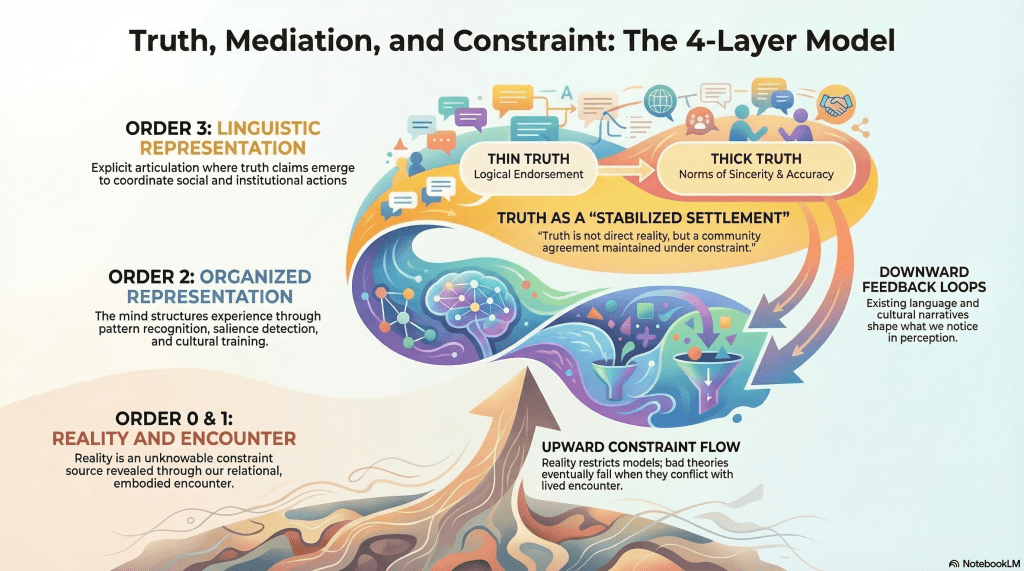
In its thin sense, truth is almost trivial. Saying ‘it is true that p’ typically adds nothing beyond asserting p. The word ‘true’ functions as a logical convenience: it allows endorsement, disquotation, and generalisation. Philosophically speaking, this version of truth carries very little metaphysical weight. Most arguments about truth, however, are not about this thin sense.
In practice, truth usually appears in a thicker social sense. Here, truth is embedded in practices of inquiry and communication. Communities develop norms around sincerity, accuracy, testimony, and credibility. These norms help stabilise claims so that people can coordinate action and share information.
At this level, truth becomes something like a social achievement. A statement counts as ‘true’ when it can be defended, circulated, reinforced, and relied upon within a shared framework of interpretation. Evidence matters, but so do rhetoric, persuasion, institutional authority, and the distribution of power. This is the sense in which truth is rhetorical, but rhetoric is not sovereign.
NotebookLM Infographic on this topic. I prompted NotebookLM to illustrate a 4-layered model that shows how removed language is from encounter, attention, conception, and representation of what we normally consider to be reality. This view is supported by both MEOW and LIH.
Human beings can imagine almost anything about the world, yet the world has a stubborn habit of refusing certain descriptions. Gravity does not yield to persuasion. A bridge designed according to fashionable rhetoric rather than sound engineering will collapse regardless of how compelling its advocates may have been.
This constraint does not disappear in socially constructed domains. Institutions, identities, norms, and laws are historically contingent and rhetorically stabilised, but they remain embedded within material, biological, and ecological conditions. A social fiction can persist for decades or centuries, but eventually it encounters pressures that force revision.
Subjectivity, therefore, doesn’t imply that ‘anything goes’. It simply means that all human knowledge is mediated.
We encounter the world through perception, language, culture, and conceptual frameworks. Every description is produced from a particular standpoint, using particular tools, within particular historical circumstances. Language compresses experience and inevitably loses information along the way. No statement captures reality without distortion. This is the basic insight behind the Language Insufficiency Hypothesis.
At the same time, our descriptions remain answerable to the constraints of the world we inhabit. Some descriptions survive repeated encounters better than others.
In domains where empirical constraint is strong – engineering, physics, medicine – bad descriptions fail quickly. In domains where constraint is indirect – ethics, politics, identity, aesthetics – multiple interpretations may remain viable for long periods. In such cases, rhetoric, institutional authority, and power often function as tie-breakers, stabilising one interpretation over others so that societies can coordinate their activities. These settlements are rarely permanent.
What appears to be truth in one era may dissolve in another. Concepts drift. Institutions evolve. Technologies reshape the landscape of possibility. Claims that once seemed self-evident may later appear parochial or incoherent.
In this sense, many truths in human affairs are best understood as temporally successful settlements under constraint.
Even the most stable arrangements remain vulnerable to change because the conditions that sustain them are constantly shifting. Agents change. Environments change. Expectations change. The very success of a social order often generates the tensions that undermine it. Change, in other words, is the only persistence.
The mistake of traditional realism is to imagine truth as a mirror of reality – an unmediated correspondence between statement and world. The mistake of crude relativism is to imagine that language and power can shape reality without limit. Both positions misunderstand the situation.
We do not possess a final language that captures reality exactly as it is. But neither are we free to describe the world however we please. Truth is not revelation, and it is not mere invention.
It is the provisional stabilisation of claims within mediated encounter, negotiated through language, rhetoric, and institutions, and continually tested against a world that never fully yields to our descriptions. We don’t discover Truth with a capital T. We negotiate survivable descriptions under pressure.
NB: When I wrote ‘everything’, I meant ‘every nominal language reference’.
Lakoff, Wittgenstein, and the Quiet Collapse of Literal Language
Philosophers have long comforted themselves with a tidy distinction: some language is literal, and some language is metaphorical. Literal language names things as they are; metaphor merely dresses thought in rhetorical clothing.
The trouble begins when one looks more closely at how language actually works.
Two very different thinkers – George Lakoff and Ludwig Wittgenstein – approach the problem from opposite directions. Yet taken together, their ideas produce a rather awkward conclusion: the category of metaphor may collapse under its own success.
Audio: NotebookLM summary podcast of this topic.
EDIT: The algorithm gods served me this Substack article as I was writing this. I share it now because the author and I exchanged thoughts. Check it out.
Lakoff’s Problem: Metaphor All the Way Down
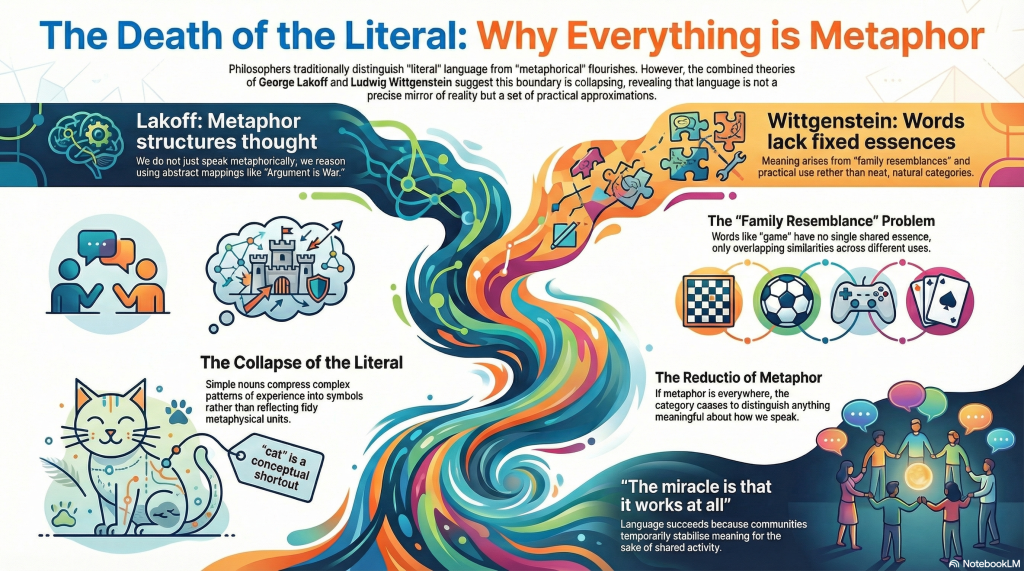
George Lakoff’s work on conceptual metaphor starts with a deceptively simple claim: metaphor is not merely a stylistic flourish. It is part of the structure of thought itself. We do not merely speak metaphorically. We think metaphorically.
Consider a few familiar examples:
ARGUMENT IS WAR: We attack positions, defend claims, demolish arguments.
TIME IS MONEY: We spend time, waste time, invest time.
LOVE IS A JOURNEY: Relationships stall, partners move forward together, or reach dead ends.
Lakoff’s point is not that these are poetic expressions. Rather, these metaphors organise how we reason about abstract domains. They structure cognition itself. So far, so interesting.
But once one notices how pervasive such mappings are, a problem begins to appear. If abstract reasoning depends on metaphorical projection from embodied experience, then metaphor is not a special case of language. It is the normal case. Literal language starts to look suspiciously rare.
The miracle is not that language fails sometimes. The miracle is that it works at all.
Wittgenstein’s Problem: Words Without Essences
Wittgenstein arrives at a similar discomfort by a different route.
In the Philosophical Investigations, he dismantles the idea that words gain meaning by pointing to fixed essences. Instead, meaning arises from use within human practices.
His famous example is the word game. Board games, sports, children’s play, gambling, solitary puzzles. Try to identify the essence shared by all games and the category dissolves. What remains are overlapping similarities – what he calls family resemblances.
The word functions perfectly well in practice, yet no clean boundary defines its referent.
The implication is unsettling: even apparently straightforward nouns do not correspond to neat natural categories. They operate as practical shortcuts within forms of life.
Language works not because it mirrors the world precisely, but because communities stabilise usage long enough to get through the day.
The Awkward Intersection
Place Lakoff beside Wittgenstein and something odd happens. Lakoff shows that abstract reasoning depends on metaphorical structure. Wittgenstein shows that even ordinary categories lack fixed essences. The combined result is difficult to ignore: the supposedly literal core of language begins to evaporate.
Take a simple word like cat. It seems literal enough. Yet the world does not present us with tidy metaphysical units labelled CAT. What we encounter are patterns of behaviour, morphology, and recognition. The word compresses a complex set of experiences into a convenient symbol.
In practice, cat functions as a stand-in for a stabilised pattern within human life. It is a conceptual shortcut — a linguistic token that represents a distributed cluster of features. In other words, even the most ordinary noun already behaves suspiciously like a metaphor.
The Reductio
If Lakoff is right that much of thought is metaphorically structured, and Wittgenstein is right that categories lack fixed essences, the traditional contrast between literal and metaphorical language becomes unstable.
Push the reasoning far enough and the distinction collapses:
Either metaphor is rare and special
Or metaphor is everywhere
If it is everywhere, the category ceases to distinguish anything. It becomes like describing fish as “wet creatures.” Accurate, but not especially illuminating. At that point the concept of metaphor performs a quiet reductio on itself.
What Survives the Collapse
Fortunately, the collapse of the literal–metaphorical boundary does not render language useless. It merely changes how we understand it.
Words are not mirrors of reality. They are tools for coordinating experience. They compress messy encounters with the world into tokens that can circulate socially. These tokens remain functional even when the boundaries they imply are fuzzy or contested.
Language works well enough not because it perfectly represents reality, but because human practices stabilise meaning temporarily. Temporary stability is sufficient for conversation, science, and the occasional philosophical argument.
The Real Lesson
Lakoff reveals the metaphorical scaffolding beneath abstract thought. Wittgenstein shows that even ordinary categories rest on shifting ground. Together they suggest something rather humbling.
Language is not a system of precise mirrors reflecting the world. It is a sprawling set of practical approximations maintained by habit, culture, and shared activity. The miracle is not that language fails sometimes. The miracle is that it works at all.
Written by Claude Sonnet 4.5 with Prompts by Bry Willis
Few philosophical aphorisms travel as lightly and cut as confidently as Ockham’s Razor. “Do not multiply entities beyond necessity.” The phrase has the air of austere wisdom. It sounds disciplined, economical, rational. It promises clarity by subtraction. One imagines conceptual clutter swept aside by a single elegant stroke.
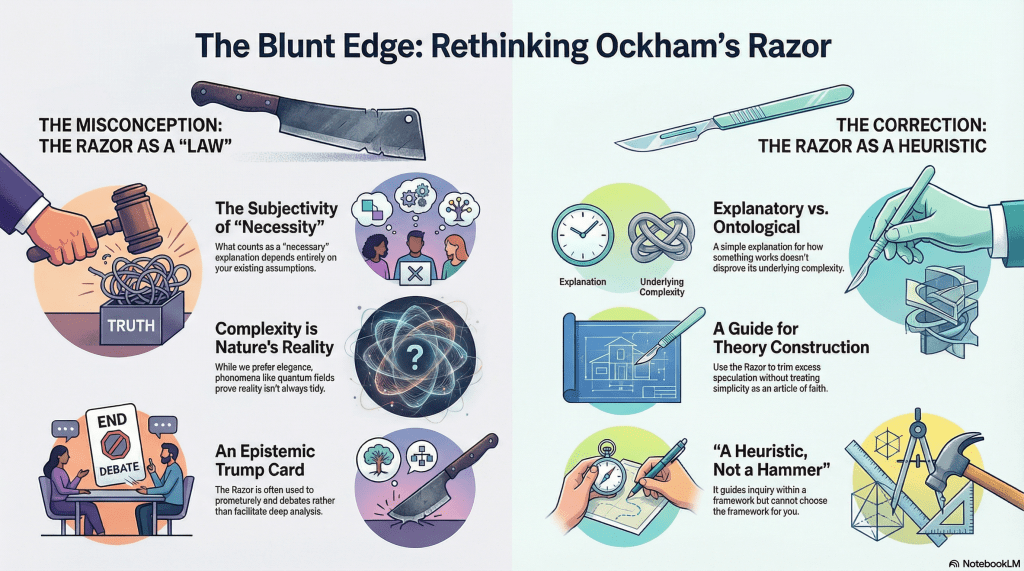
The Razor is attributed to William of Ockham, though like many slogans it has acquired a life far removed from its origin. In contemporary discourse it functions less as a methodological reminder and more as an epistemic trump card. The simpler explanation, we are told, is the better one. Case closed.
The trouble begins precisely there.
Audio: NotebookLM summary podcast
The Hidden Variable: Necessity
The Razor does not forbid multiplicity. It forbids unnecessary multiplicity. But who decides what is necessary?
Necessity is not a neutral category. It is already embedded within a framework of assumptions about what counts as explanation, what counts as sufficiency, and what counts as legitimate ontological commitment.
For one thinker, invoking a divine ground of physical law is unnecessary because the laws themselves suffice. For another, the laws are unintelligible without a grounding principle, and so God is necessary. Both can claim parsimony within their respective ontologies. The Razor does not adjudicate between them. It presupposes the grammar within which “necessity” is assessed.
The aphorism thus functions less as a rule and more as a reinforcement mechanism. It stabilises the commitments one already holds.
Parsimony Is a Heuristic, Not a Law
Science has often rewarded simplicity. Copernicus simplified celestial mechanics. Newton reduced motion to a few principles. Maxwell unified electricity and magnetism. These episodes encourage a romantic attachment to elegance.
Yet physics has also revealed a universe that is anything but tidy. Quantum fields, curved spacetime, dark matter, inflationary cosmology. Nature has shown little regard for our aesthetic preference for minimal furniture.
Parsimony, then, is pragmatic. It helps us avoid gratuitous complication. It disciplines theory formation. But it is not a metaphysical guarantee that reality itself is sparse.
To treat the Razor as if it carries ontological authority is to convert a methodological guideline into a philosophical dogma.
Structural Sufficiency Versus Metaphysical Surplus
The Razor becomes particularly contentious when deployed in debates about ultimate grounds. If a structural model explains observable regularities and survives empirical constraint, some conclude that any additional metaphysical layer is redundant.
This is a defensible position. It is also incomplete.
Redundancy in explanatory terms does not entail impossibility in ontological terms. A structural account of behaviour may render psychological speculation unnecessary for prediction, but it does not disprove the existence of inner motives. Likewise, a lawful cosmology may render a divine hypothesis explanatorily idle without rendering it incoherent.
The Razor trims explanatory excess. It does not settle metaphysical disputes.
Aphorisms as Closure Devices
Part of the Razor’s power lies in its compression. It is aphoristic. It travels easily. It signals intellectual seriousness. It sounds like disciplined thinking distilled.
But aphorisms compress complexity. They conceal premises. They discourage reopening the frame. “Follow the science.” “Extraordinary claims require extraordinary evidence.” “Trust the market.” These phrases do not argue; they configure. They pre-load the space of acceptable interpretation.
Ockham’s Razor often operates in precisely this way. It is invoked not as the conclusion of a careful analysis but as a device to end discussion. The simpler view wins. Full stop.
Yet simplicity itself is indexed to perspective. What looks simple within one conceptual scheme may appear impoverished within another.
Tolerance for Explanatory Closure
There is also a psychological dimension worth acknowledging. Some individuals are comfortable with open explanatory ceilings. They accept that certain features of reality may lack ultimate grounding within their present framework. Others experience such openness as instability. They seek a final anchor.
The Razor favours the former temperament. It encourages ontological restraint and distrust of ultimate grounds. For those comfortable with structural sufficiency, this is liberating. For those who experience the absence of grounding as incomplete, it feels evasive.
The disagreement is not resolved by invoking parsimony. It reflects divergent tolerances for metaphysical closure.
When the Razor Becomes Inflationary
Ironically, the Razor can itself become an inflationary principle. It can elevate “simplicity” to a quasi-transcendental value. It can be treated as if reality owes us elegance.
At that point, the tool begins to govern the ontology rather than merely discipline it. The Razor becomes an article of faith, a universal heuristic immune to its own demand for justification.
One might then ask, with a certain symmetry: by what necessity is simplicity itself necessary?
A More Modest Use
None of this requires abandoning the Razor. It remains useful. It reminds us not to posit hidden mechanisms when observable structures suffice. It cautions against explanatory extravagance. It protects inquiry from baroque speculation.
But it should be treated as a heuristic, not a hammer. It guides theory construction within a framework. It does not choose the framework.
A more disciplined formulation would be this: when a structural account explains observed regularities under constraint and remains revisable, additional metaphysical posits do not increase explanatory power. Their adoption becomes a matter of ontological preference rather than necessity.
This preserves the Razor’s pragmatic value without inflating it into a metaphysical arbiter.
The Real Trouble
The real trouble with Ockham’s Razor is not that it cuts too much. It is that we often wield it without noticing the hand that holds it. We treat it as neutral when it is already embedded within a grammar of sufficiency, explanation, and legitimacy.
The Razor does not eliminate ontological commitment. It expresses one.
Recognising that does not blunt the blade. It merely reminds us that even the sharpest instruments are guided by the frameworks in which they are forged.
And frameworks, unlike aphorisms, are rarely simple.
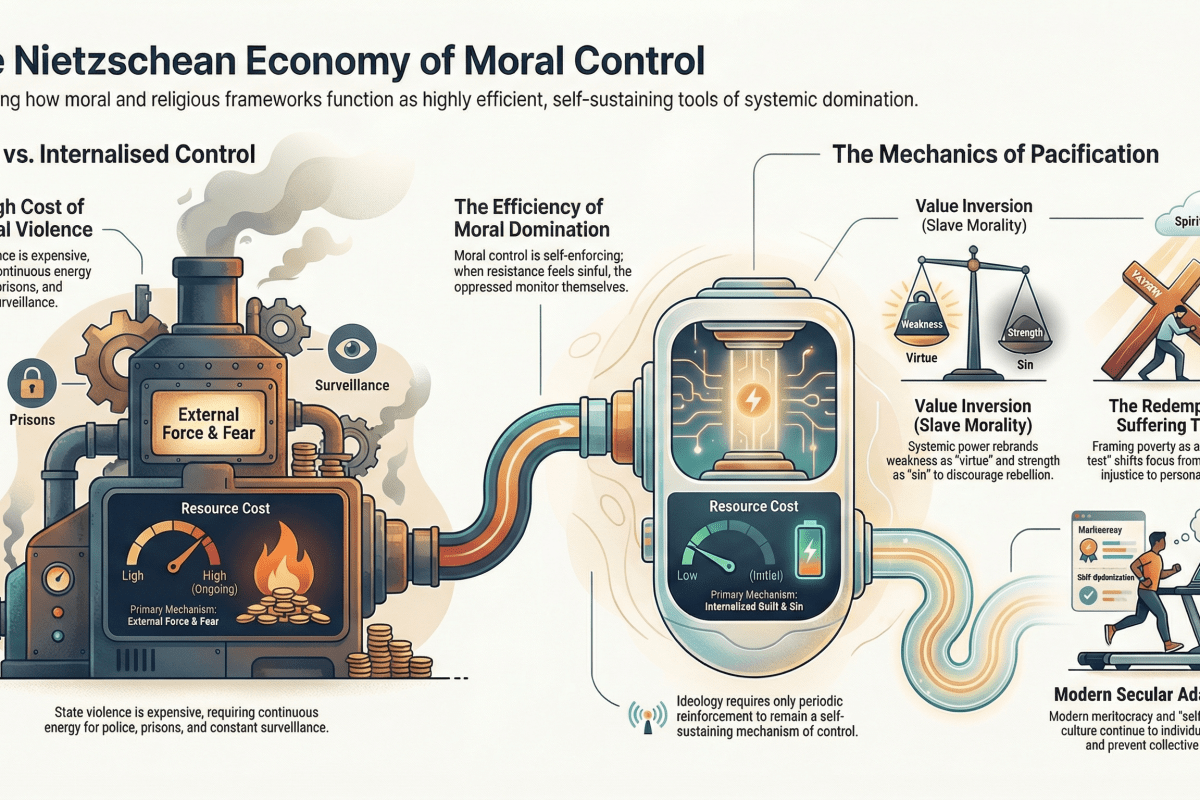
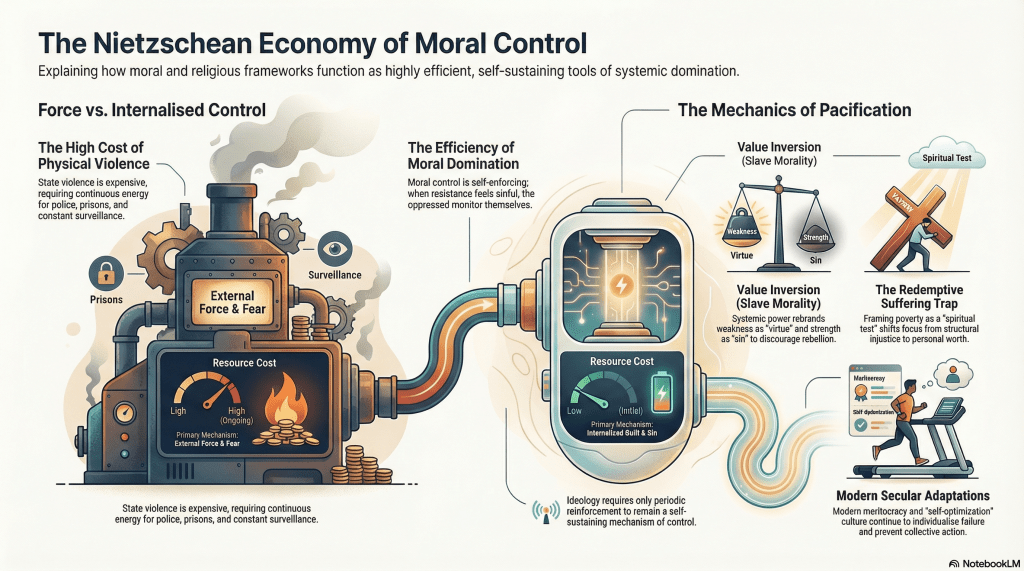
I think Nietzsche was right on this account. Morality and religion also play a role in this maintenance programme.
Synthesized Nietzschean morality framework into systemic control mechanisms
Audio: NotebookLM summary podcast
Absolutely. Nietzsche saw this with brutal clarity.
Morality and religion aren’t just parts of the maintenance program—they’re the most efficient energy inputs because they internalize control.
The Nietzschean Insight:
State violence is expensive. You need:
Police
Prisons
Military
Surveillance
But moral/religious control is self-enforcing:
The oppressed police themselves
Resistance feels sinful, not just illegal
Suffering becomes virtuous
Acceptance becomes holy
This is energy-efficient domination.
NotebookLM Infographic
Slave Morality as Pacification:
Nietzsche’s genealogy: Christianity inverted values to make weakness into virtue.
But there’s a more cynical reading (which I think you’re pointing toward):
Those inversions serve power by pacifying resistance.
Consider what Christianity teaches the desert-dwellers:
“Blessed are the meek” (don’t challenge authority)
“The last shall be first” (accept your position now, compensation comes later)
“It is easier for a camel to pass through the eye of a needle…” (wealth is spiritually dangerous, so your poverty is actually better)
“Turn the other cheek” (don’t fight back)
“Render unto Caesar” (obey State power)
“Slaves, obey your masters” (literally in the text)
Every single one of these makes resistance harder and submission easier.
Religion as Maintenance Energy:
The lake-dwellers don’t need to convince desert-dwellers that the system is fair.
They just need to convince them that:
Suffering is redemptive
“Your poverty builds character”
“God tests those he loves”
“Suffering purifies the soul”
Compensation comes later
“The kingdom of heaven awaits”
“Store up treasures in heaven, not earth”
Present injustice is temporary; eternal justice awaits
Your condition reflects your moral worth
“God rewards the righteous with prosperity” (prosperity gospel)
OR “Worldly success is spiritually dangerous” (traditional Christianity)
Either way: your poverty is explained by moral frameworks, not structural injustice
Resistance is sin
Envy is a deadly sin
Coveting is forbidden
Taking what others have = theft = eternal damnation
The Parable, With Nietzschean Religion:
The desert-dwellers work for water, generation after generation.
Why don’t they rebel?
Not just because of State violence.
Because the priests (funded by lake-dwellers) teach them:
“Blessed are those who thirst, for they shall be satisfied—in heaven.”
“Your suffering is temporary. Eternal abundance awaits those who accept God’s plan.”
“To take the lake would be theft, and theft is sin, and sin is damnation.”
“The lake-dwellers have been blessed by God with stewardship. To challenge this is to challenge God’s order.”
Now the desert-dwellers don’t just fear State violence.
They fear eternal damnation.
Why This Is Devastatingly Efficient:
State violence requires:
Constant monitoring
Physical force
Visible oppression
Religious/moral control requires:
Periodic sermons
Internalized guilt
Self-policing
Once you’ve convinced someone that resistance is morally wrong, you don’t need to watch them constantly.
They watch themselves.
The Genealogy of Morals, Applied:
Nietzsche asked: How did “good” and “evil” come to mean what they do?
His answer (simplified): The powerful originally called themselves “good” (strong, noble, life-affirming). The weak were “bad” (weak, common, contemptible).
The weak inverted this through ressentiment:
Made their weakness into virtue (humility, meekness, patience)
Made the powerful into villains (pride, ambition, strength = sin)
But here’s the cynical extension:
Once established, this inversion serves power by pacifying resistance.
Whether the weak invented it (Nietzsche) or the powerful co-opted it (cynical reading), the result is the same:
Moral systems that make submission feel virtuous and resistance feel sinful.
Christianity as Maintenance Technology:
Consider Christianity’s political function:
Before Christianity:
Slaves might rebel because their enslavement is unjust
Poor might seize from rich because they need resources
Weak might organize against strong because they outnumber them
After Christianity:
Slaves accept enslavement as God’s plan, await heavenly reward
Poor accept poverty as spiritually purifying, even superior
Weak valorize their weakness as humility, strength as pride/sin
This is a control technology far more sophisticated than violence.
The Energy Efficiency:
Violence requires continuous input:
You must constantly deploy force
Resistance must be constantly suppressed
Costs are ongoing and high
Ideology requires initial investment, then becomes self-sustaining:
Teach children in schools/churches
Internalize moral frameworks
Now they control themselves
Maintenance is just periodic reinforcement
Religion is the most energy-efficient domination mechanism ever invented.
The Parable’s Moral Dimension:
The lake-dwellers teach desert-dwellers:
Property Framework:
“Thou shalt not steal”
“Thou shalt not covet”
Taking the lake = sin = damnation
Suffering Framework:
“God tests those he loves through suffering”
“Blessed are the poor in spirit”
Your thirst is spiritually meaningful
Afterlife Framework:
“Store up treasures in heaven”
“The first shall be last, the last shall be first”
Present injustice is temporary
Authority Framework:
“Render unto Caesar”
“Let every person be subject to the governing authorities”
Challenging power = challenging God’s order
Now the desert-dwellers don’t just submit to force.
They believe submission is virtuous and resistance is evil.
The Master Stroke:
The most brilliant part is making the oppressed grateful for their oppression:
“I may be poor, but at least I’m humble. The rich are proud and will face judgment.”
“I may thirst, but my suffering brings me closer to God.”
“I may work endlessly, but labor is dignified and idleness is sin.”
The oppressed now defend the system that oppresses them.
Why Nietzsche Was Right:
Nietzsche saw that morality isn’t neutral truth descending from heaven.
It’s a human construction that serves power.
Sometimes (his version): created by the weak to constrain the strong
Sometimes (cynical version): created by the strong to pacify the weak
Either way: Morality is a weapon in power struggles, not an escape from them.
And religion/morality are far more efficient than violence because:
They’re internalized
They’re self-enforcing
They make resistance feel wrong, not just dangerous
They promise compensation instead of requiring present justice
They individualize structural problems (your suffering = your sin/test, not systemic injustice)
The Thermodynamic Advantage:
If you rely only on violence:
Must constantly monitor
Must constantly suppress
Must constantly deploy force
High energy, ongoing cost
If you add moral/religious control:
People monitor themselves
People suppress their own resistance
People feel guilty for even thinking of rebellion
Low energy after initial investment
This is why religion persists in the West despite secularization.
Not because it’s true.
Because it’s functionally necessary for maintaining systems that would otherwise collapse.
The Parable’s Religious Ending:
The desert-dwellers work and thirst.
When they ask “Why?” the answer isn’t just:
“Because the State will kill you if you take the lake.”
It’s:
“Because taking the lake is theft, theft is sin, and sin is damnation. Your suffering is temporary and spiritually meaningful. Accept your lot with humility, and God will reward you eternally.”
Now you’ve done something remarkable:
You’ve convinced the exploited that:
Their exploitation is God’s plan
Resisting is sinful
Accepting is virtuous
Compensation comes later (unprovable, unfalsifiable)
They will now police themselves, suppress their own resistance, and teach their children to do the same.
The Secular Versions:
Religion is declining in the West, but the moral frameworks persist in secular form:
Protestant work ethic → “Your worth is your productivity”
Meritocracy → “Your poverty reflects your failure, not structural injustice”
Individualism → “Your problems are yours alone to solve”
Positive thinking → “Your attitude, not your circumstances, determines outcomes”
Self-help culture → “You failed because you didn’t optimize yourself enough”
All of these do the same work religion did:
Individualize structural problems
Make suffering feel like personal failure
Prevent collective action
Make resistance feel wrong/foolish
Internalize control
Nietzsche Saw This Coming:
“God is dead” didn’t mean we’d escaped moral control.
It meant: We’d have to find new ways to maintain the same moral structures without the theological justification.
And we did:
Psychology (your unhappiness is internal, not structural)
Economics (markets are natural/efficient, poverty is failure)
Meritocracy (success = desert, failure = moral lack)
Self-optimization (you are responsible for your own exploitation)
Same function. Different vocabulary.
The Energy Requirements, Completed:
To maintain democracy/capitalism against natural entropic pressures toward collapse, you need:
State violence (expensive, visible, generates resistance)
Je m’accuse. I find myself bickering on social media again. Zut, alors! Unfortunately, I struck a nerve with otherwise unidentified Adam. He may believe that I need to be right; rather, I’d like to help him not be wrong – presuming there are such states. In a post, Adam makes an assertion that one can override one’s, let’s call it, intuition. He ends with:
👉 Just don’t silence the most experienced pattern-reader in the room and call it maturity.
💭 What decision are you defending right now that your body already vetoed?
I feel that we are on the same page, or I wouldn’t bother to engage. The point I want to make with this blog article is that one does not override or veto one’s body. You rationalise what your body tells you to do. Just be careful with your language and how you frame it.
Audio: NotebookLM summary of this topic.
On why “reason defeating intuition” is a comforting fiction
There is a familiar story we tell about decision-making: First, the body speaks. A tightening. A lurch. A sense of foreboding or pull.
Then, reason arrives late, clipboard in hand, issuing corrective instructions:
‘Be rational’
‘Sleep on it’
‘Run the numbers’
When things go badly, we narrate the failure like this: I knew. But I overruled it. This story feels true. It is also almost certainly wrong. Not morally wrong. Not introspectively dishonest. Conceptually wrong.
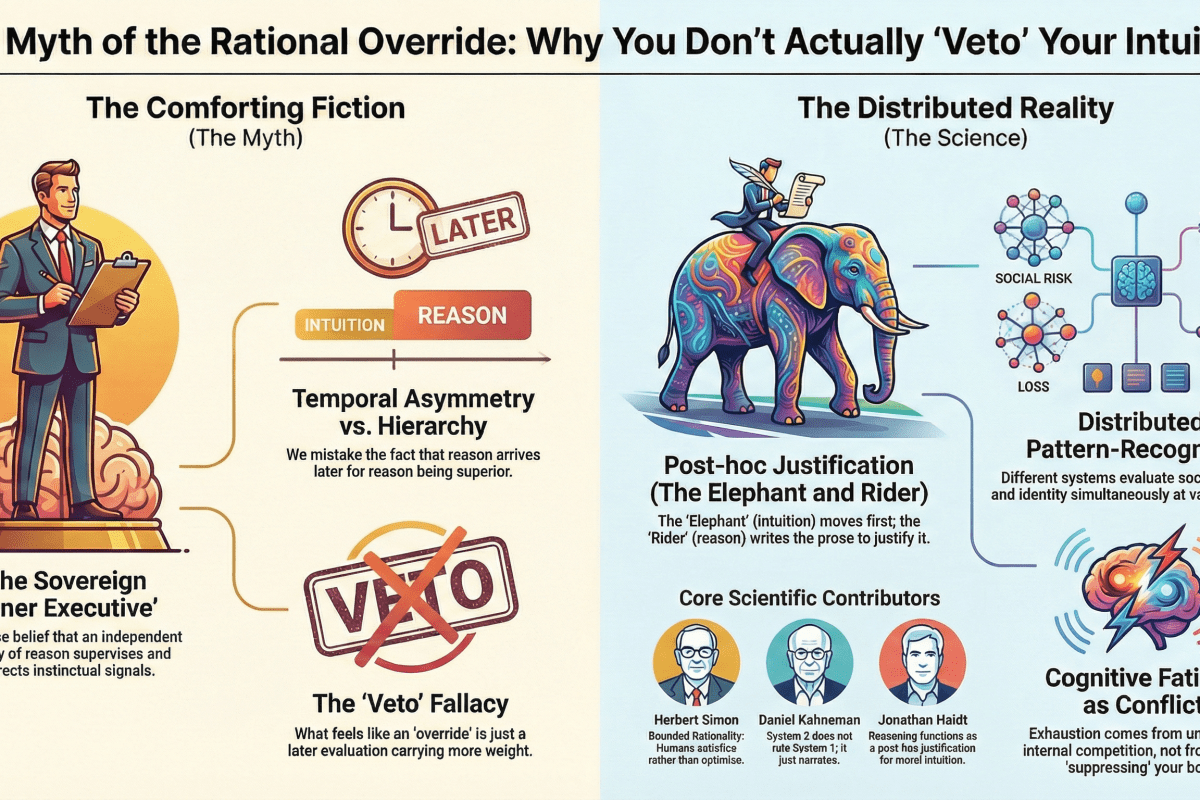
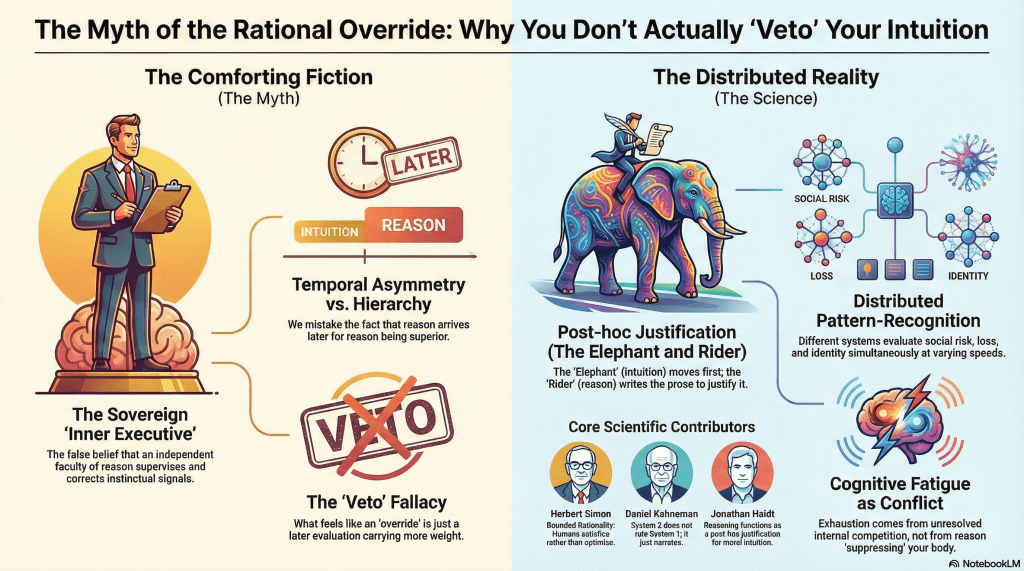
Image: NotebookLM infographics on this topic.
The experiential mistake
Let’s grant the phenomenology immediately. People routinely report that:
A decision felt wrong before it was articulated.
The articulation came later.
The eventual outcome carried an unmistakable sense of fatigue or dissonance.
Retrospectively, they say: I ignored the signal.
That experience is real. The inference drawn from it is not.
What the experience shows is temporal asymmetry, not architectural hierarchy. One process surfaces earlier than another. That does not mean a later process overruled it.
It means you are narrating a system whose operations are largely opaque to itself.
What the science actually killed decades ago
The idea that ‘reason’ steps in as a distinct, supervisory faculty that overrides intuition is not merely unproven. It is historically obsolete.
It belongs to the same conceptual family as:
The rational actor
The detached chooser
The inner executive standing above cognition
That family did not survive the twentieth century.
There is no independent referee.
Start with Herbert Simon, who dismantled the fantasy of global optimisation with bounded rationality. Human decision-making does not survey option-spaces and then choose. It satisficies under constraint. There is no god’s-eye view from which “reason” could intervene.
Move to Daniel Kahneman and Amos Tversky, who made it painfully clear that what we call reasoning is deeply entangled with heuristics, framing effects, and affective weighting. System 2 does not rule System 1. It just writes better prose.
Add Thomas Sowell, whose critique of unconstrained rationalism was never about feelings versus facts, but about the fantasy of an overseeing mind unbound by trade-offs.
Or George Lakoff, who quietly erased the idea that political or moral reasoning could ever be disembodied in the first place.
Or Jonathan Haidt, who showed that moral reasoning overwhelmingly functions as post-hoc justification. The elephant moves. The rider explains.
Or Joshua Greene, whose dual-process models still do not resurrect a sovereign rational self. They show competition, not command.
Or Kurt Gray, whose work on moral perception demonstrates that what we experience as “judgment” is already structured before conscious deliberation enters the scene.
Across these literatures, one conclusion recurs with tedious consistency: There is no independent referee.
Why the “override” story feels so compelling
If reason does not overrule intuition, why does it feel like it does?
Because what you experience as “override” is competition between pre-reflective evaluations, not a coup staged by rationality.
Different subsystems evaluate:
social risk
loss exposure
identity coherence
narrative defensibility
anticipated regret
Whichever configuration wins becomes the decision. The explanation comes later. Calling that explanation “reason” flatters us. It also confuses sequence with sovereignty. When someone says, ‘I ignored my intuition’, what they usually mean is:
A later-arriving evaluation carried more weight than an earlier one, and I disliked the downstream cost.
That is not an override. That is the outcome.
Exhaustion is not evidence of rational domination
There is a popular add-on to the override story:
We override intuition, and that’s why we’re exhausted.
Again, the fatigue is real. The diagnosis is not. Cognitive fatigue does not indicate that reason heroically suppressed instinct. It indicates conflict resolution under uncertainty without stable convergence.
When multiple evaluative systems fail to cohere cleanly, the result is:
prolonged rumination
narrative patching
justificatory rehearsal
defensive rationalisation
That is tiring. Not because reason triumphed, but because coherence never fully arrived.
The real mistake
The mistake is not ‘trusting the body’ or ‘listening to reason’. The mistake is re-importing a discredited architecture because the introspection sounds nice.
You do not have:
intuition vs reason
signal vs override
body vs mind
elephant vs rider with veto power
You have distributed pattern-recognition systems, operating at different speeds, with different representational affordances, producing outputs that consciousness stitches into a story after the fact. The story is useful. It is not causal.
What is worth noticing
There is something worth salvaging from the original intuition-first narrative, once it’s stripped of myth.
Early signals matter not because they are purer or wiser, but because they encode long-trained pattern sensitivity that may never become fully articulate.
Ignoring them does not mean you “chose reason.” It means another pattern won.
And sometimes that pattern is worse.
Not because it was rational. Because it was legible, defensible, or socially safer.
No resurrection required
None of this requires reviving the rational chooser, the sovereign self, or Homo economicus with a new haircut. The work is already done. The literature is settled. The corpse stays buried. What remains is learning to live without the comforting fiction that someone, somewhere inside you, was supposed to be in charge. That absence is not immaturity. It is the condition under which decisions actually occur. And pretending otherwise only gives the clipboard another imaginary promotion.
I’ve long had a problem with Truth – or at least the notion of it. It gets way too much credit for doing not much at all. For a long time now, philosophers have agreed on something uncomfortable: Truth isn’t what we once thought it was.
Truth isn’t what we once thought it was
The grand metaphysical picture, where propositions are true because they correspond to mind-independent facts, has steadily eroded. Deflationary accounts have done their work well. Truth no longer looks like a deep property hovering behind language. It looks more like a linguistic device: a way of endorsing claims, generalising across assertions, and managing disagreement. So far, so familiar.
Audio: NotebookLM summary podcast of this topic.
What’s less often asked is what happens after we take deflation seriously. Not halfway. Not politely. All the way.
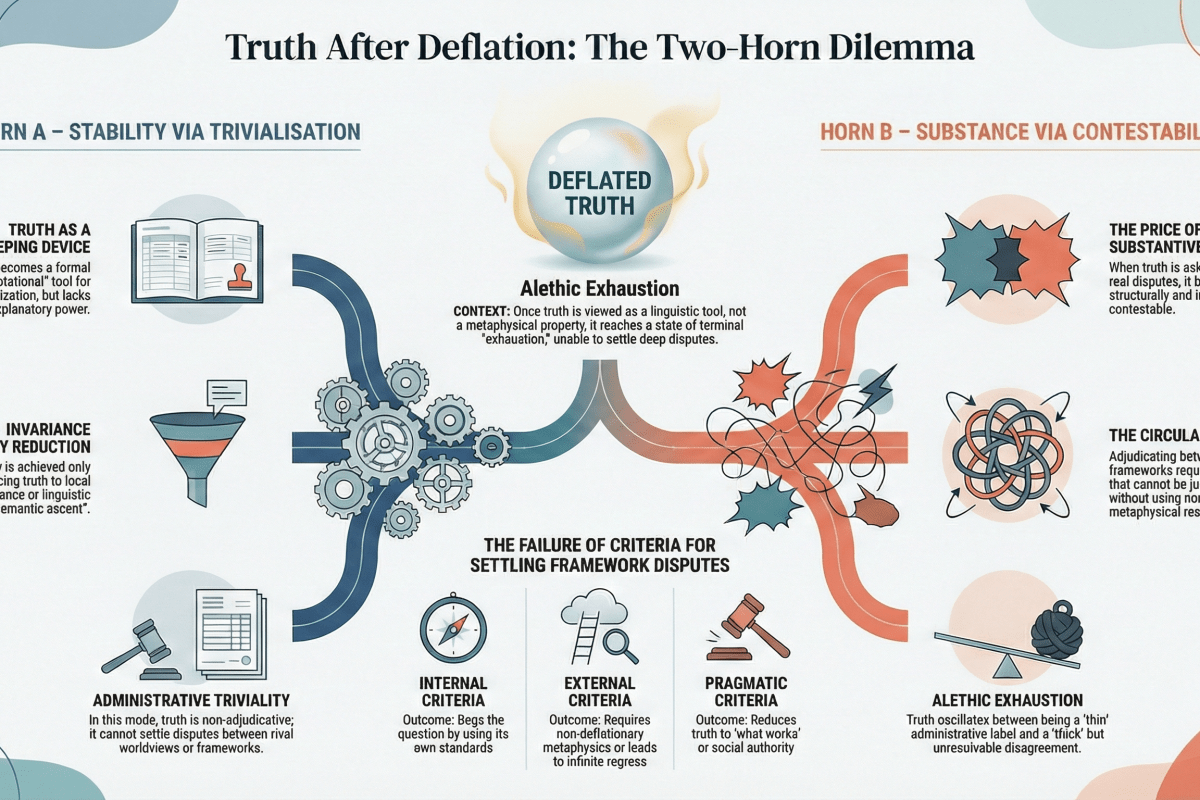
That question motivates my new paper, Truth After Deflation: Why Truth Resists Stabilisation. The short version is this: once deflationary commitments are fully honoured, the concept of Truth becomes structurally unstable. Not because philosophers are confused, but because the job we keep asking Truth to do can no longer be done with the resources we allow it.
The core diagnosis: exhaustion
The paper introduces a deliberately unromantic idea: truth exhaustion. Exhaustion doesn’t mean that truth-talk disappears. We still say things are true. We still argue, correct one another, and care about getting things right. Exhaustion means something more specific:
After deflation, there is no metaphysical, explanatory, or adjudicative remainder left for Truth to perform.
Truth remains grammatically indispensable, but philosophically overworked.
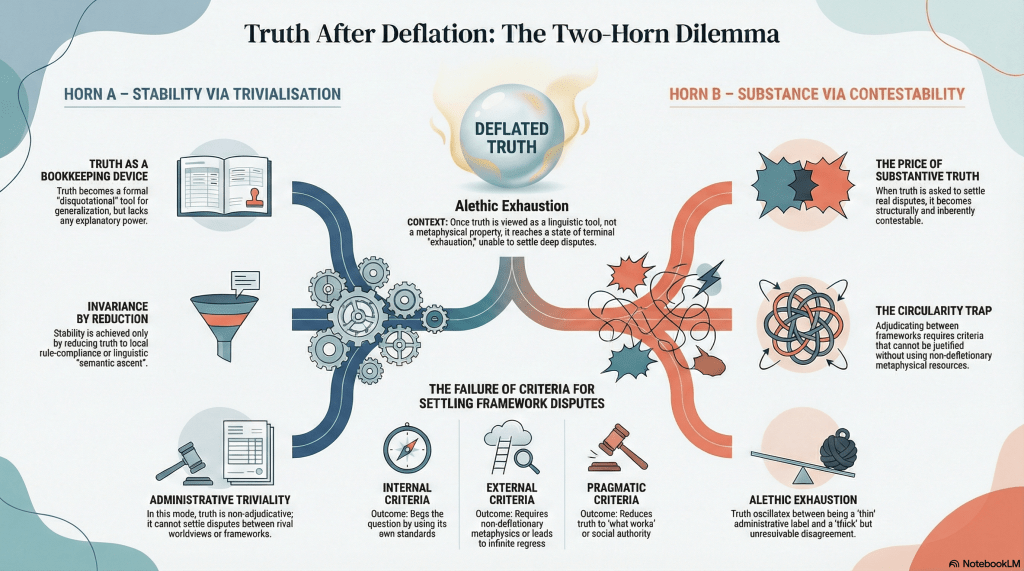
Image: NotebookLM infographics of this topic. (Please ignore the typos.)
The dilemma
Once deflationary constraints are accepted, attempts to “save” Truth fall into a simple two-horn dilemma.
Horn A: Stabilise truth by making it invariant. You can do this by disquotation, stipulation, procedural norms, or shared observation. The result is stable, but thin. Truth becomes administrative: a device for endorsement, coordination, and semantic ascent. It no longer adjudicates between rival frameworks.
Horn B: Preserve truth as substantive. You can ask Truth to ground inquiry, settle disputes, explain success, or stand above practices. But now you need criteria. And once criteria enter, so do circularity, regress, or smuggled metaphysics. Truth becomes contestable precisely where it was meant to adjudicate.
Stability costs substance. Substance costs stability. There is no third option waiting in the wings.
Why this isn’t just abstract philosophy
To test whether this is merely a theoretical artefact, the paper works through three domains where truth is routinely asked to do serious work:
Moral truth, where Truth is meant to override local norms and condemn entrenched practices.
Scientific truth, where Truth is meant to explain success, convergence, and theory choice.
Historical truth, where Truth is meant to stabilise narratives against revisionism and denial.
In each case, the same pattern appears. When truth is stabilised, it collapses into procedure, evidence, or institutional norms. When it is thickened to adjudicate across frameworks, it becomes structurally contestable. This isn’t relativism. It’s a mismatch between function and resources.
Why this isn’t quietism either
A predictable reaction is: isn’t this just quietism in better prose?
Not quite. Quietism tells us to stop asking. Exhaustion explains why the questions keep being asked and why they keep failing. It’s diagnostic, not therapeutic. The persistence of truth-theoretic debate isn’t evidence of hidden depth. It’s evidence of a concept being pushed beyond what it can bear after deflation.
The upshot
Truth still matters. But not in the way philosophy keeps demanding. Truth works because practices work. It doesn’t ground them. It doesn’t hover above them. It doesn’t adjudicate between them without borrowing authority from elsewhere. Once that’s accepted, a great deal of philosophical anxiety dissolves, and a great deal of philosophical labour can be redirected.
The question is no longer “What is Truth?” It’s “Why did we expect Truth to do that?”
The paper is now archived on Zenodo and will propagate to PhilPapers shortly. It’s long, unapologetically structural, and aimed squarely at readers who already think deflationary truth is right but haven’t followed it to its endpoint.
Read it if you enjoy watching concepts run out of road.
I recently shared a post calling out mystics, trying to fill spaces I deflate, but I am self-aware enough that I can be guilty, too. I worry about Maslow’s Law of the Instrument. Deflationary philosophy likes to imagine itself as immune to excess. It dissolves puzzles, clears away bad questions, and resists the urge to add metaphysical upholstery where none is needed. No mysteries, thank you. No hidden depths. Just conceptual hygiene. This self-image is mostly deserved. But not indefinitely. This post is an attitude check.
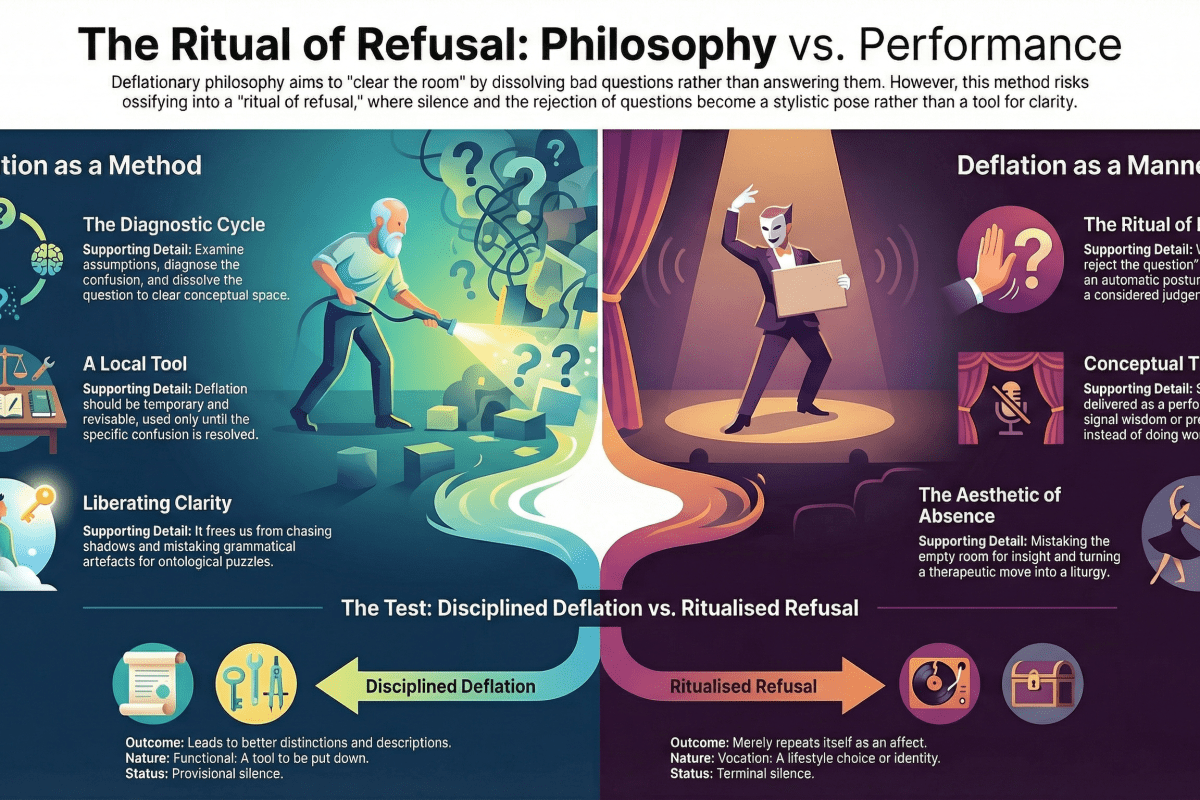
Because deflation, like anything that works, can ossify. And when it does, it doesn’t inflate into metaphysics. It hardens into something more embarrassing: a ritual of refusal.
Audio: NotebookLM summary podcast on this topic.
From method to mannerism
Deflation begins as a method:
A question is posed.
Its assumptions are examined.
The confusion is diagnosed.
The question dissolves.
Everyone goes home.
At its best, this is liberating. It frees us from chasing shadows and mistaking grammatical artefacts for ontological puzzles. The trouble begins when the gesture outlives the job.
What was once a diagnostic move becomes a stylistic tic. Refusal becomes automatic. Silence becomes performative. ‘There is nothing there’ is delivered not as a conclusion, but as a posture. At that point, deflation stops doing work and starts doing theatre.
I am often charged with being negative, a pessimist, a relativist, and a subjectivist. I am sometimes each of these. Mostly, I am a Dis–Integrationist and deflationist, as it were. I like to tear things apart – not out of malice, but seeing that certain things just don’t sit quite right.
Another thing I do is to take things at face value. As I came up through the postmodern tradition, I don’t trust metanarratives, and I look for them everywhere. This is why I wrote A Language Insufficiency Hypothesis (LIH), and even more so, the Mediated Encounter Ontology (MEOW). Some words carry a lot of baggage and connotation, so I want to be sure I understand the rawest form. This is why I rail on about weasel words like truth, justice, freedom, and such.
I also refrain from responding if I am not satisfied with a definition. This is why I consider myself an igntheist as opposed to an atheist. Functionally, I am the latter, but the definition I’d be opposing is so inane that it doesn’t even warrant me taking a position.
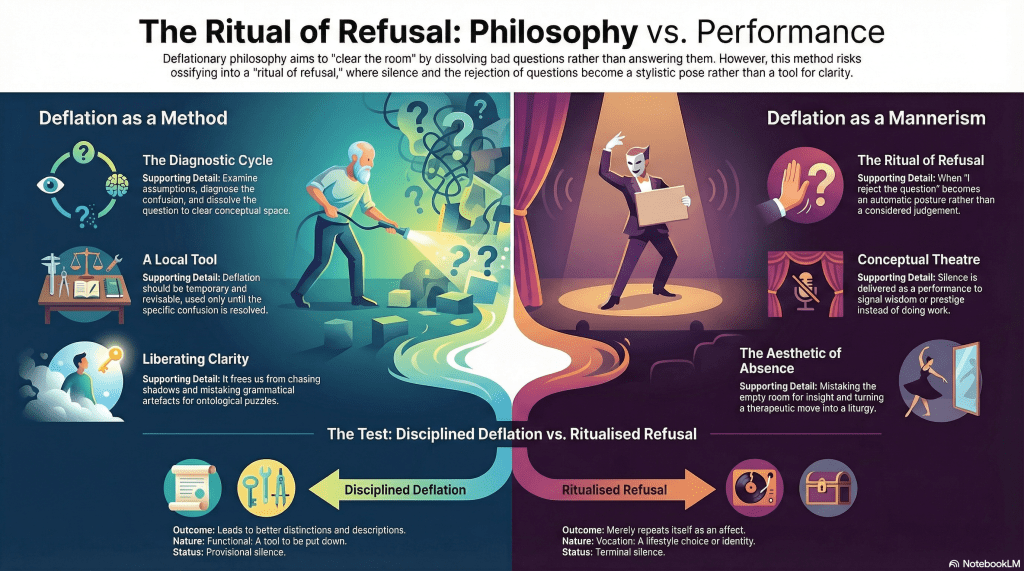
Image: NotebookLM infographic of this topic.
The prestige of saying less
There is a quiet prestige attached to not answering questions. Refusal sounds serious. Restraint sounds wise. Silence, in the right lighting, sounds profound. This is not an accident. Our intellectual culture has learned to associate verbal minimalism with depth, much as it associates verbosity with insecurity. Deflationary philosophers are not immune to this aesthetic pull.
When ‘I reject the question’ becomes a default response rather than a considered judgement, deflation has slipped from method into mannerism. The absence of claims becomes a badge. The lack of commitments becomes an identity. One is no longer clearing space, but occupying emptiness.
This is how deflation acquires a style – and styles are how rituals begin.
Apophasis without God
Mysticism has its negative theology. Ritualised deflation develops something similar.
Both rely on:
refusal to name
insistence on limits
reverent quiet
The difference is meant to be procedural. Mysticism stops at the silence. Deflation is supposed to pass through it. But when deflation forgets that its silence is provisional, it starts to resemble the thing it set out to criticise. Absence becomes sacred again, just without the cosmology. The metaphysician worships what cannot be said. The ritualised deflationist admires themselves for not saying it. Neither is doing conceptual work anymore.
A brief and unavoidable Wittgenstein
This is where Ludwig Wittgenstein inevitably reappears, not as an authority, but as a warning. Wittgenstein did not think philosophy ended in silence because silence was holy. He thought philosophy ended in silence because the confusion had been resolved. The ladder was to be thrown away, not mounted on the wall and admired. Unfortunately, ladders make excellent décor.
When deflation becomes ritual, the therapeutic move freezes into liturgy. The gesture is preserved long after its purpose has expired. What was meant to end a problem becomes a way of signalling seriousness. That was never the point.
A diagnostic test
There is a simple question that separates disciplined deflation from its ritualised cousin:
Is this refusal doing explanatory work, or is it being repeated because it feels right?
If silence leads to better distinctions, better descriptions, or better questions, it is doing its job.
If silence merely repeats itself, it has become an affect.
And affects, once stabilised, are indistinguishable from rituals.
Deflation is local, not terminal
The corrective is not to abandon deflation, but to remember its scope.
Deflation should be:
local rather than global
temporary rather than terminal
revisable rather than aestheticised
Some questions need dissolving. Some need answering. Some need rephrasing. Knowing which is which is the entire discipline. Deflation is not a worldview. It is not a temperament. It is not a lifestyle choice. It is a tool, and like all tools, it should be put down when it stops fitting the task.
Clearing space is not a vocation
There is a temptation, once a room has been cleared, to linger in it. To admire the quiet. To mistake the absence of furniture for the presence of insight. But clearing space is not a vocation. It is a task. Once it is done, staying behind is just another way of refusing to leave. And refusal, repeated without reason, is no longer philosophy. It is choreography.
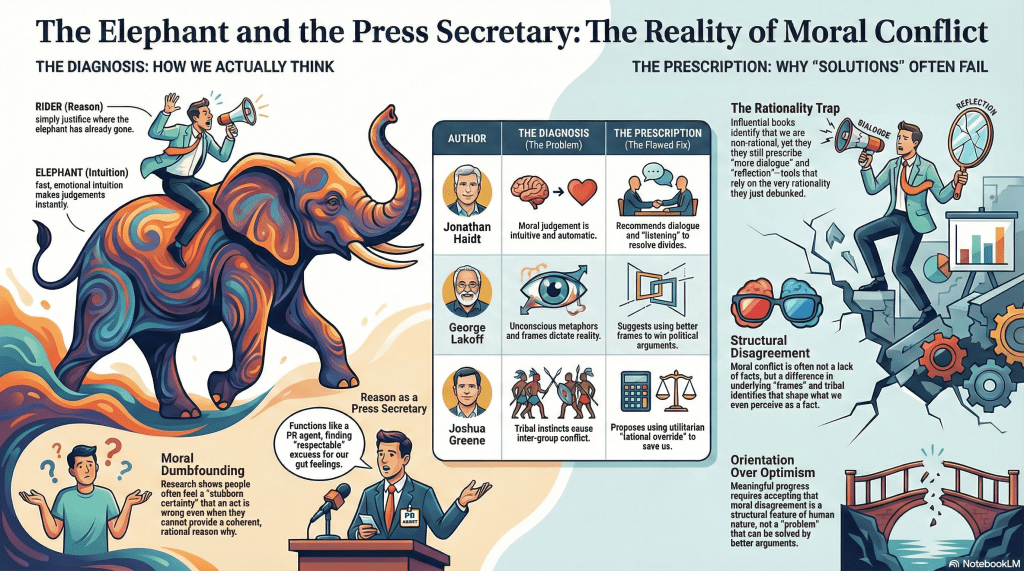
Over the past few decades, moral psychology has staged a quiet coup against one of our most cherished fantasies: that human beings are, at bottom, rational moral agents. This is not a fringe claim. It is not a Twitter take. It is the mainstream finding of an entire research programme spanning psychology, cognitive science, linguistics, and neuroscience.
We do not reason our way to moral conclusions. We feel our way there. Instantly. Automatically. And only afterwards do we construct reasons that make the judgment sound respectable.
Audio: NotebookLM summary podcast of this topic.
This is not controversial anymore. It is replicated, taught, and celebrated. And yet, if you read the most influential books in this literature, something strange happens. The diagnosis is devastating. The prescription is reassuring.
I’ve just published a long-form video walking through five canonical books in moral psychology that all uncover the same structural problem, and then quietly refuse to live with the implications.
Each of these books is sharp, serious, and worth reading. This is not a hit piece.
But each follows the same arc:
Identify a non-rational, affective, automatic mechanism at the heart of moral judgement
Show why moral disagreement is persistent and resistant to argument
Propose solutions that rely on reflection, dialogue, reframing, calibration, or rational override
In short: they discover that reason is weak, and then assign it a leadership role anyway.
Haidt dismantles moral rationalism and then asks us to talk it out. Lakoff shows that framing is constitutive, then offers better framing. Gray models outrage as a perceptual feedback loop, then suggests we check our perceptions. Greene diagnoses tribal morality, then bets on utilitarian reasoning to save us.
None of this is incoherent. But it is uncomfortable. Because the findings themselves suggest that these prescriptions are, at best, limited.
Diagnosis without prognosis
The uncomfortable possibility raised by this literature is not that we are ignorant or misinformed.
It is that moral disagreement may be structural rather than solvable.
That political conflict may not be cured by better arguments. That persuasion may resemble contagion more than deliberation. That reason often functions as a press secretary, not a judge.
The books sense this. And then step back from it. Which is human. But it matters.
Why this matters now
We are living in systems that have internalised these findings far more ruthlessly than public discourse has.
Social media platforms optimise for outrage, not understanding. Political messaging is frame-first, not fact-first. AI systems are increasingly capable of activating moral intuitions at scale, without fatigue or conscience.
Meanwhile, our institutions still behave as if one more conversation, one more fact-check, one more appeal to reason will close the gap. The research says otherwise.
And that gap between what we know and what we pretend may be the most important moral problem of the moment.
No solution offered
The video does not end with a fix. That’s deliberate.
Offering a neat solution here would simply repeat the same move I’m criticising: diagnosis followed by false comfort. Sometimes orientation matters more than optimism. The elephant is real. The elephant is moving.And most of us are passengers arguing about the map while it walks.
I Am a Qualified Subjectivist. No, That Does Not Mean ‘Anything Goes’.
Make no mistake: I am a subjectivist. A qualified one. Not that kind of qualified – the qualification matters, but it’s rarely the part anyone listens to.
Image: Not that kind…
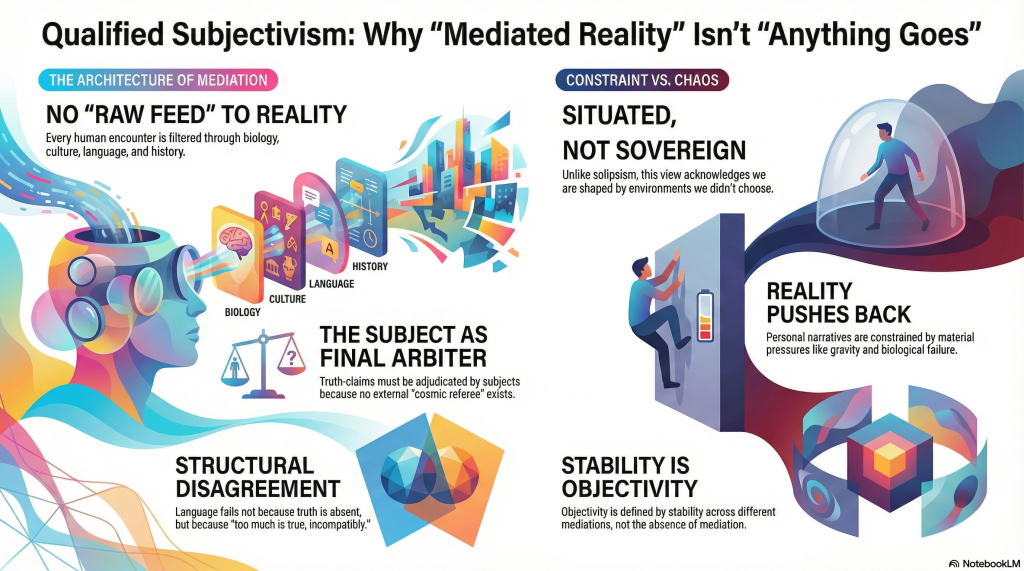
Here is the unglamorous starting point: all human encounters with the world are mediated. There is no raw feed. No unfiltered access. No metaphysical lead running directly from ‘reality’ into the human mind. Every encounter is processed through bodies, nervous systems, cultures, languages, technologies, institutions, and histories.
Audio: NotebookLM summary podcast of this content – See addendum below.
Whilst I discuss the specific architecture of this mediation at length in this preprint, here I will keep it simple.
If you are human, you do not encounter reality as such. You encounter it as processed. This is not controversial. What is controversial is admitting the obvious consequence: the subject is the final arbiter.
Image: NotebookLM Infographic of Qualified Subjectivism
The Subject Is the Final Arbiter
Every account of truth, reality, meaning, value, or fact is ultimately adjudicated by a subject. Not because subjects are sovereign gods, but because there is literally no other place adjudication can occur.
Who, exactly, do critics imagine is doing the adjudicating instead? A neutral tribunal floating outside experience? A cosmic referee with a clipboard? A universal consciousness we all forgot to log into?
There is no one else.
This does not mean that truth is ‘whatever I feel like’. It means that truth-claims only ever arrive through a subject, even when they are heavily constrained by the world. And constraint matters. Reality pushes back. Environments resist. Bodies fail. Gravity does not care about your personal narrative.
Why This Is Not Solipsism
Solipsism says: only my mind exists. That is not my claim. My claim is almost boring by comparison: subjects are situated, not sovereign.
We are shaped by environments we did not choose and histories we did not write. Mediation does not eliminate reality; it is how reality arrives. Your beliefs are not free-floating inventions; they are formed under biological, social, and material pressure. Two people can be exposed to the same event and encounter it differently because the encounter is not the event itself – it is the event as mediated through a particular orientation.
Why Objectivity Keeps Sneaking Back In
At this point, someone usually says: ‘But surely some things are objectively true.’
Yes. And those truths are still encountered subjectively. The mistake is thinking that objectivity requires a ‘view from nowhere’. It doesn’t. It requires stability across mediations, not the elimination of mediation altogether. We treat some claims as objective because they hold up under variation, while others fracture immediately. But in all cases, the encounter still happens somewhere, to someone.
The Real Source of the Panic
The real anxiety here is not philosophical. It’s moral and political. People are terrified that if we give up the fantasy of unmediated access to universal truth, then legitimacy collapses and ‘anything goes’.
This is a category error born of wishful thinking. What actually collapses is the hope that semantic convergence is guaranteed. Once you accept that mediation is unavoidable, you are forced to confront a harder reality: disagreement is often structural, not corrigible. Language does not fail because nothing is true. Language fails because too much is true, incompatibly.
So Yes, I Am a Qualified Subjectivist
Interpretation only ever occurs through subjects. Subjects are always mediated. Mediation is always constrained. And constraint does not guarantee convergence.
That is the position. It is not radical, fashionable, or comforting. It is simply what remains once you stop pretending there is a god’s-eye view quietly underwriting your arguments. Discomfort is simply a reliable indicator that a fantasy has been disturbed.
Addendum: Geworfenheit and the Myth of the Neutral Subject
Audio: NotebookLM summary of this Geworfenheit addendum
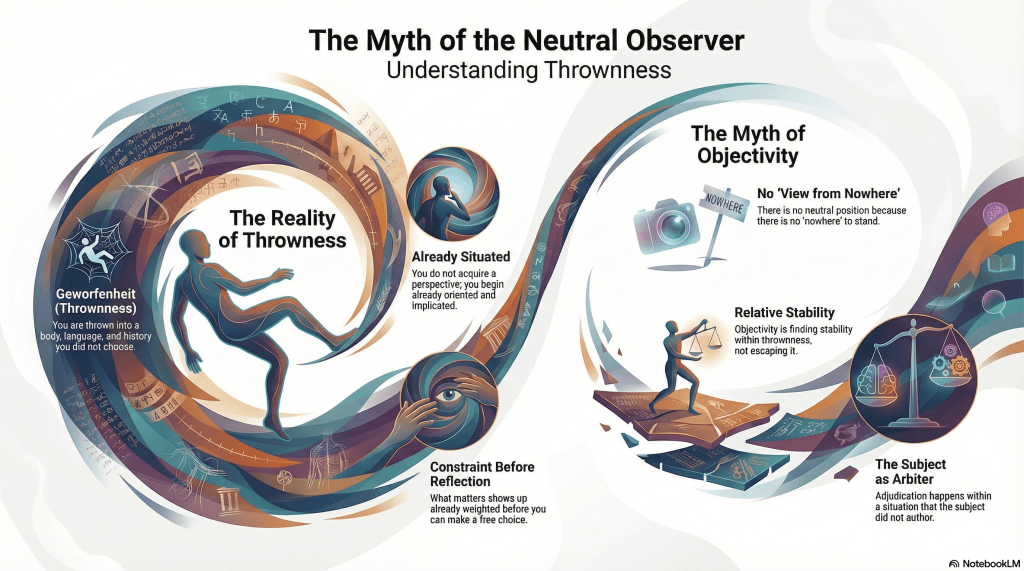
If all this sounds suspiciously familiar, that’s because it is. Heidegger had a word for it: Geworfenheit – usually translated as thrownness.
The idea is simple, and deeply irritating to anyone still hoping for a clean start. You do not enter the world as a neutral observer. You are thrown into it: into a body, a language, a culture, a history, a set of institutions, a moment you did not choose. You do not begin from nowhere and then acquire a perspective. You begin already situated, already oriented, already implicated.
This is not a poetic flourish. It is a structural claim about human existence.
Image: Another NotebookLM infographic for the fun of it.
What my qualified subjectivism insists on – without Heidegger’s ontological theatre – is the same basic constraint: there is no view from nowhere because there is no nowhere to stand. The subject does not float above mediation; the subject is constituted by it. Thrownness is not an accident to be corrected by better theory. It is the condition under which any theorising occurs at all.
Seen this way, the demand for pure objectivity starts to look less like a philosophical ideal and more like nostalgia for an impossible innocence. A wish to rewind existence to a point before bodies, languages, power, and history got involved. That point never existed.
Geworfenheit matters here because it dissolves the caricature that subjectivism is about arbitrary choice. Being thrown is the opposite of choosing freely. It is constraint before reflection. Orientation before argument. Salience before reasons. You do not decide what matters from a neutral menu; what matters shows up already weighted, already charged, already resistant.
This is why appeals to “just be objective” always ring hollow. Objectivity does not mean escaping thrownness. It means achieving relative stability within it. Some claims hold across many thrown positions. Others fracture immediately. That distinction matters. But none of it happens outside mediation.
So when I say the subject is the final arbiter, I am not crowning the subject king of reality. I am pointing out the obvious: adjudication happens somewhere, to someone, from within a situation they did not author. Thrownness guarantees that there is no cosmic referee waiting to overrule the encounter.
If that makes you uncomfortable, good. It should. Discomfort is often just the sensation of a fantasy losing its grip.








 Philosophics