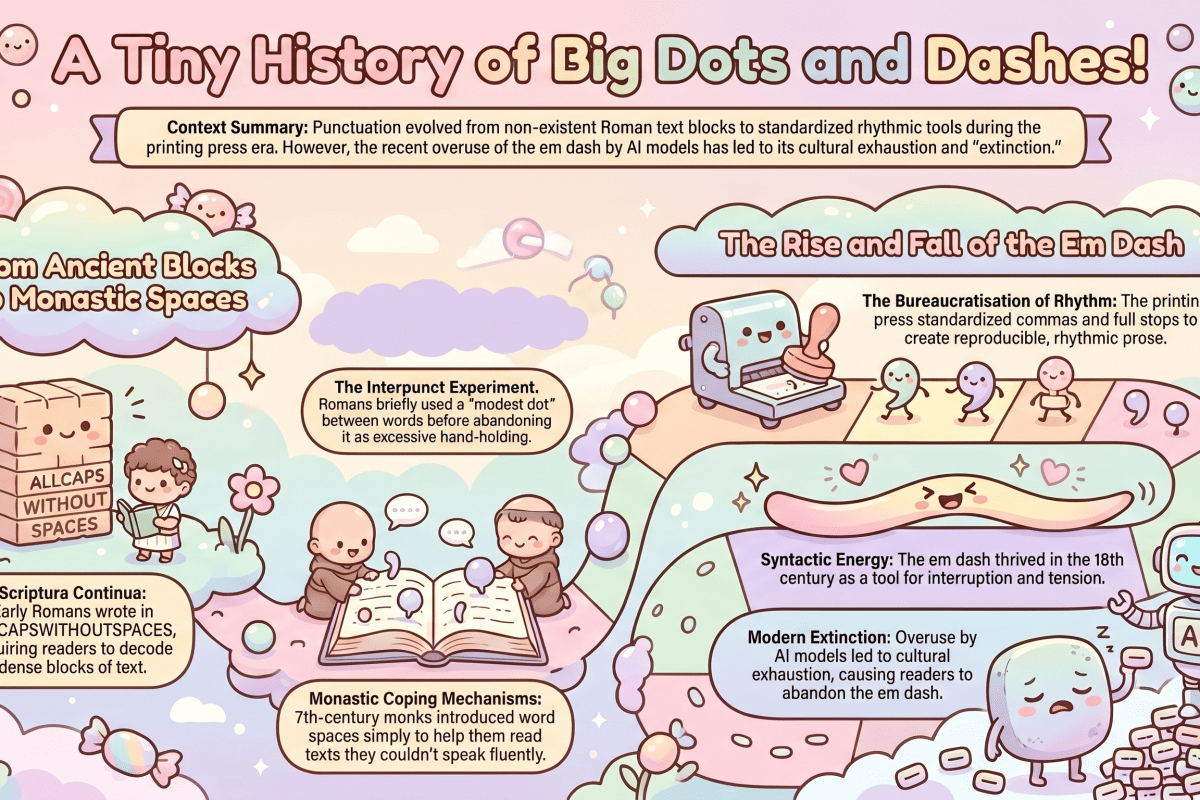
For most of human history, written Latin looked something like THISISASENTENCEABOUTPHILOSOPHYORWARYOUCHOOSE, and readers were simply expected to get on with it. And of course, in ALL CAPS. This was not considered a problem. The Romans were not known for their sensitivity to the needs of others.
The Romans did, briefly, experiment with the interpunct – a modest dot deployed between words, giving the reader something like THIS·IS·A·SENTENCE·ABOUT·PHILOSOPHY·OR·WAR·YOU·CHOOSE – before apparently deciding this was excessive hand-holding and abandoning it entirely. Punctuation’s first appearance in Western prose was thus also its first act of self-destruction. A precedent, as we shall see, that held.
Relief came, eventually, from the most unlikely of sources: monks. Specifically, Irish and Anglo-Saxon monks in the 7th and 8th centuries, who were copying Latin texts they couldn’t actually read fluently, and who introduced spaces between words as a personal coping mechanism. Civilisation has strange bedfellows.
The comma, the full stop, and their assorted relatives arrived with the printing press – Aldus Manutius and the Venetian humanists essentially standardising the breath-marks of prose into something reproducible at scale. Punctuation became, in this period, the bureaucratisation of rhythm. A noble project. Mildly tyrannical in execution.
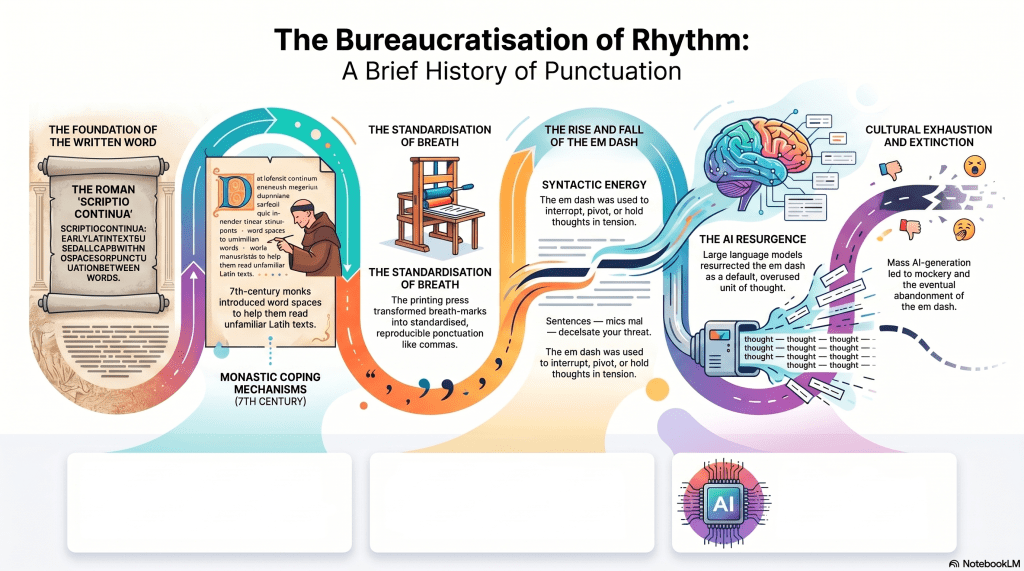
The em dash, meanwhile, had an entirely respectable career throughout the 18th and 19th centuries — a mark of genuine syntactic energy, used to interrupt, to pivot, to hold two thoughts in productive tension — before being left largely to the eccentric and the emphatic.
Then came the large language models. Within approximately eighteen months, the em dash was resurrected from the dead to become the default unit of thought, issuing them faster than Oprah Christmas giveaways. Every clause got one. Sometimes a sentence received two, bracketing a thought that required neither a bracket nor a thought. The em dash ceased to mean interruption and began to mean I am text generated at scale. Readers noticed. Then they mocked it. Then, following the immutable logic of cultural exhaustion, they stopped using it entirely. The em dash is now extinct — which is a shame, really.
 Philosophics