When drawn, this card alters perception itself. It reminds the player that truth is not something one finds under a rock but something one polishes into shape. Each metaphor becomes a spell; each keyword a crutch thrown aside.
Those who wield the Constructivist Lens see not “facts,” but fictions so useful they forgot to call them that. Reality wobbles politely to accommodate belief.
“Knowledge is not a copy of reality but a tool for coping with it.” — Richard Rorty
In game terms: Tap to reframe existence as interpretation. Duration: until the next disagreement.
It’s almost endearing, really how the intellectuals of mid-century Europe mistook the trembling of their own cage for the dawn chorus of freedom. Reading Erich Fromm’s The Sane Society today feels like being handed a telegram from Modernism’s last bright morning, written in the earnest conviction that history had finally grown up. The war was over, the worker was unionised, the child was unspanked, and the libido – good heavens – was finally allowed to breathe. What could possibly go wrong?
Audio: NotebookLM podcast on this topic.
Fromm beams:
“In the twentieth century, such capitalistic exploitation as was customary in the nineteenth century has largely disappeared. This must not, however, becloud the insight into the fact that twentieth-century as well as nineteenth-century Capitalism is based on the principle that is to be found in all class societies: the use of man by man.”
The sleight of hand is marvellous. He spots the continuation of exploitation but calls it progress. The worker has become a ‘partner’, the manager a ‘team leader’, and the whip has been replaced by a time card. No one bows anymore, he writes. No, they just smile through performance reviews and motivational posters.
Fromm’s optimism borders on metaphysical comedy.
“After the First World War, a sexual revolution took place in which old inhibitions and principles were thrown overboard. The idea of not satisfying a sexual wish was supposed to be old-fashioned or unhealthy.”
Ah yes, the Jazz Age orgy of liberation – champagne, Freud, and flapper hemlines. The problem, of course, is that every generation mistakes its new neuroses for freedom from the old ones. Fromm’s “sexual revolution” was barely a shuffle in the bourgeois bedroom; Beauvoir’s Deuxième Sexe arrived the next year, practically shouting across the café table that liberation was still a myth stitched into the same old corset.
Beauvoir, at least, sensed the trap: every gesture toward freedom was refracted through patriarchal fantasy, every ‘choice’ conditioned by the invisible grammar of domination. Fromm, bless him, still believed in a sane society – as if sanity were something history could deliver by instalment.
Meanwhile, the Existentialists were in the next room, chain-smoking and muttering that existence precedes essence. Freedom, they insisted, wasn’t something achieved through social reform but endured as nausea. Post-war Paris reeked of it – half despair, half Gauloises. And within a decade, the French schools would dismantle the very scaffolding that held Fromm’s optimism together: truth, progress, human nature, the subject.
The Modernists thought they were curing civilisation; the Post-Moderns knew it was terminal and just tried to describe the symptoms with better adjectives.
So yes, Fromm’s Sane Society reads now like a time capsule of liberal humanist faith – this touching belief that the twentieth century would fix what the nineteenth broke. Beauvoir already knew better, though even she couldn’t see the coming avalanche of irony, the final revelation that emancipation was just another product line.
Liberation became a brand, equality a slogan, sanity a statistical average. Fromm’s dream of psychological health looks quaint now, like a health spa brochure left in the ruins of a shopping mall.
And yet, perhaps it’s precisely that naivety that’s worth cherishing. For a moment, they believed the world could be cured with reason and compassion – before history reminded them, as it always does, that man is still using man, only now with friendlier UX design and better lighting.
I’ve just added a new entry to my Anti-Enlightenment corpus, bringing the total to seven – not counting my latest book, The Illusion of Light, that summarises the first six essays and places them in context. This got me thinking about what aspects of critique I might be missing. Given this, what else might I be missing?
Audio: NotebookLM podcast discussion of this topic.
So far, I’ve touched on the areas in the top green table and am considering topics in the bottom red/pink table:
Summary Schema – The Anti-Enlightenment Project – Published Essays
Axis
Core Question
Representative Essay(s)
Epistemic
What counts as “truth”?
Objectivity Is Illusion: An Operating Model of Social and Moral Reasoning
Political
What holds power together?
Rational Ghosts: Why Enlightenment Democracy Was Built to Fail; Temporal Ghosts: Tyranny of the Present
Psychological
Why do subjects crave rule?
Against Agency: The Fiction of the Autonomous Self; The Will to Be Ruled: Totalitarianism and the Fantasy of Freedom
Anthropological
What makes a “normal” human?
The Myth of Homo Normalis: Archaeology of the Legible Human
Ethical
How to live after disillusionment?
The Discipline of Dis-Integration: Philosophy Without Redemption
Summary Schema – The Anti-Enlightenment Project – Unpublished Essays
Axis
Core Question
Representative Essay
Theological (Metaphysical)
What remains sacred once transcendence is dismantled?
The Absent God: Metaphysics After Meaning
Aesthetic (Affective)
How did beauty become moral instruction?
The Aesthetic Contract: Beauty as Compliance
Ecological (Post-Human)
What happens when the world refuses to remain in the background?
1. Objectivity Is Illusion: An Operating Model of Social and Moral Reasoning
Published September 2025
Objectivity, in the social and moral sense, is a performance – a consensus mechanism mistaken for truth. This essay maps how “objectivity” operates as a scaffold for Enlightenment rationality, masking moral preference as neutral judgment. It introduces a five-premise model showing that what we call objectivity is merely sustained agreement under shared illusions of coherence. The argument reframes moral reasoning as provisional and participatory rather than universal or fixed.
2. Rational Ghosts: Why Enlightenment Democracy Was Built to Fail
Published October 2025 The Enlightenment built democracy for rational ghosts – imagined citizens who never existed. This essay dissects six contradictions at the foundation of “rational” governance and shows why democracy’s collapse was prewritten in its metaphysics. From mathematical impossibility to sociological blindness, it charts the crisis of coherence that modern politics still calls freedom. → Read on Zenodo
3. Temporal Ghosts: Tyranny of the Present
Published October 2025 Modern democracies worship the now. This essay examines presentism – the systemic bias toward immediacy – as a structural flaw of Enlightenment thinking. By enthroning rational individuals in perpetual “decision time,” modernity erased the unborn from politics. What remains is a political theology of the short term, collapsing both memory and imagination. → Read on Zenodo
4. Against Agency: The Fiction of the Autonomous Self
Published October 2025 “Agency” is not a metaphysical faculty – it’s an alibi. This essay dismantles the myth of the autonomous self and reframes freedom as differential responsiveness: a gradient of conditions rather than a binary of will. Drawing on philosophy, neuroscience, and decolonial thought, it argues for ethics as maintenance, not judgment, and politics as condition-stewardship. → Read on Zenodo
5. The Discipline of Dis-Integration: Philosophy Without Redemption
Published October 2025
This essay formalises Dis-Integrationism – a philosophical method that refuses synthesis, closure, and the compulsive need to “make whole.” It traces how Enlightenment reason, deconstruction, and therapy culture all share a faith in reintegration: the promise that what’s fractured can be restored. Against this, Dis-Integrationism proposes care without cure, attention without resolution – a discipline of maintaining the broken as broken. It closes the Anti-Enlightenment loop by turning critique into a sustained practice rather than a path to redemption.
6. The Myth of Homo Normalis: Archaeology of the Legible Human
Published October 2025
Modernity’s most persistent myth is the “normal” human. This essay excavates how legibility – the drive to measure, categorise, and care – became a form of control. From Quetelet’s statistical man to Foucault’s biopower and today’s quantified emotion, Homo Normalis reveals the moral machinery behind normalisation. It ends with an ethics of variance: lucidity without repair, refusal without despair.
7. The Will to Be Ruled: Totalitarianism and the Fantasy of Freedom
Published October 2025
This essay examines how the Enlightenment’s ideal of autonomy contains the seed of its undoing. The rational, self-governing subject – celebrated as the triumph of modernity – proves unable to bear the solitude it creates. As freedom collapses into exhaustion, the desire for direction re-emerges as devotion. Drawing on Fromm, Arendt, Adorno, Reich, Han, and Desmet, The Will to Be Ruled traces the psychological gradient from fear to obedience, showing how submission is moralised as virtue and even experienced as pleasure. It concludes that totalitarianism is not a deviation from reason but its consummation, and that only through Dis-Integrationism – an ethic of maintenance rather than mastery – can thought remain responsive as the light fades.
Axis: Theological / Metaphysical Core Question: What remains sacred once transcendence is dismantled?
Concept: This essay would trace how Enlightenment humanism replaced God with reason, only to inherit theology’s structure without its grace. It might read Spinoza, Kant’s moral law, and modern technocracy as secularised metaphysics – systems that still crave universal order. Goal: To show that disenchantment never erased faith; it simply redirected worship toward cognition and control. Possible subtitle:The Enlightenment’s Unconfessed Religion.
9. The Aesthetic Contract: Beauty as Compliance
Axis: Aesthetic / Affective Core Question: How did beauty become moral instruction?
Concept: From Kant’s Critique of Judgment to algorithmic taste cultures, aesthetic judgment serves social order by rewarding harmony and punishing dissonance. This essay would expose the politics of form – how beauty trains attention and regulates emotion. Goal: To reclaim aesthetics as resistance, not refinement. Possible subtitle:Why Modernity Needed the Beautiful to Behave.
10. The Uncounted World: Ecology and the Non-Human
Axis: Ecological / Post-Human Core Question: What happens when the world refuses to remain background?
Concept: Here you dismantle the Enlightenment split between subject and nature. From Cartesian mechanism to industrial rationalism, the natural world was cast as resource. This essay would align Dis-Integrationism with ecological thinking – care without mastery extended beyond the human. Goal: To reframe ethics as co-maintenance within an unstable biosphere. Possible subtitle:Beyond Stewardship: Ethics Without Anthropos.
11. The Fractured Tongue: Language Against Itself
Axis: Linguistic / Semiotic Core Question: How does language betray the clarity it promises?
Concept: Every Anti-Enlightenment text already hints at this: language as both the instrument and failure of reason. Drawing on Nietzsche, Derrida, Wittgenstein, and modern semiotics, this essay could chart the entropy of meaning – the collapse of reference that makes ideology possible. Goal: To formalise the linguistic fragility underlying every rational system. Possible subtitle:The Grammar of Collapse.
12. The Vanished Commons: Between Isolation and Herd
Axis: Communal / Social Ontology Core Question: Can there be community without conformity?
Concept: This would return to the psychological and political threads of The Will to Be Ruled, seeking a space between atomised autonomy and synchronized obedience. It might turn to Arendt’s notion of the world between us or to indigenous and feminist relational models. Goal: To imagine a non-totalitarian togetherness – a responsive collective rather than a collective response. Possible subtitle:The Ethics of the Incomplete We.
* These essays may never be published, but I share this here as a template to further advance the Anti-Enlightenment project and fill out the corpus.
I’ve just released a new book, The Illusion of Light: Thinking After the Enlightenment, now available in paperback through KDP and distributed via Amazon. In November, a clothbound edition will follow through IngramSpark, extending availability to libraries and independent bookstores worldwide, including Barnes & Noble in the United States.
Image: Front cover of The Illusion of Light. Links to Amazon for purchase. The ‘Free Preview’ claim is untrue, as there is no Kindle version available. An ebook will be available presently.
Audio: NotebookLM podcast on this topic.
About the Book
The Illusion of Light opens where the Enlightenment’s glare begins to fade. It asks what happens after reason exhausts itself – after the promise of illumination gives way to overexposure. These essays trace how modernity’s metaphors of light and progress became instruments of management: how objectivity hardened into ritual, agency into alibi, normality into control.
Rather than rejecting the Enlightenment outright, the book lingers in its afterimage. It argues for a philosophy practiced in the half-light – a mode of thought that values nuance over certainty, care over mastery, and maintenance over redemption. To read by residual light, as the preface suggests, is to learn to see again when the world stops pretending to be illuminated.
The preface is available on this prior post, written and audio versions.
The Broader Project
The Illusion of Light forms the threshold of the Anti-Enlightenment Project, a series examining the afterlives of modern reason – how its ideals of progress, agency, objectivity, and normality continue to govern our politics, sciences, and selves long after their foundations have cracked. Each volume approaches the same question from a different room in the old House of Reason: Objectivity Is Illusion, Rational Ghosts, Temporal Ghosts, Against Agency, The Myth of Homo Normalis, and The Discipline of Dis-Integration.
Taken together, they offer not a manifesto but a practice: philosophy as maintenance work, care as critique, and composure as the only honest response to the ruins of certainty. More to follow.
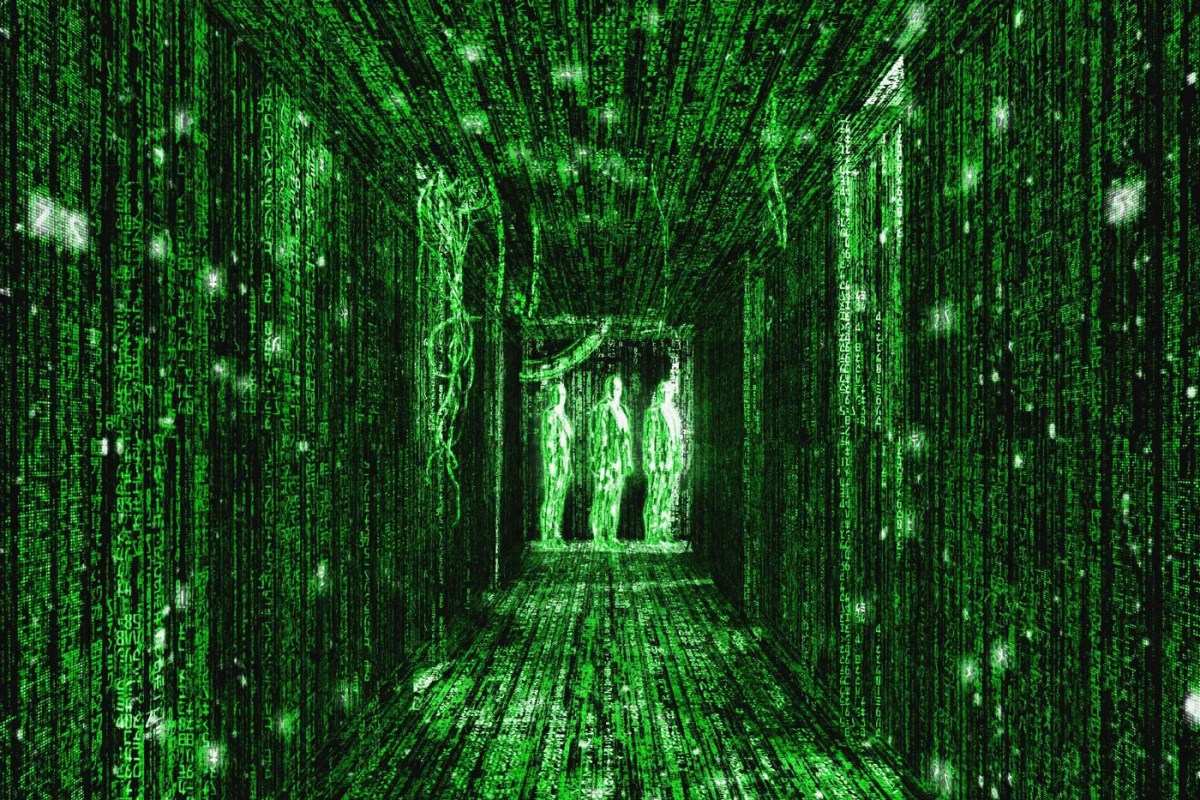
In the late 1990s, the Wachowskis gave us The Matrix – Keanu Reeves as Neo, the Chosen One™, a man so bland he could be anyone, which was the point. Once he realised he was living inside a simulation, he learned to bend its laws, to dodge bullets in slow motion and see the code behind the curtain. Enlightenment, Hollywood-style.
Audio: NotebookLM podcast on this topic.
But here’s the twist, the film itself couldn’t stomach: realising the simulation doesn’t free you from it.
Knowing that race and gender are social constructs doesn’t erase their architecture. Knowing that our economies, legal systems, and so-called democracies are fictions doesn’t get us out of paying taxes or playing our assigned roles. “The social contract” is a collective hallucination we agreed to before birth. That and a dollar still won’t buy you a cup of coffee.
Baudrillard, whose Simulacra and Simulation the film name-dropped like a trophy, argued that simulation doesn’t hide reality – it replaces it. When representation becomes indistinguishable from the thing it represents, truth evaporates, leaving only consensus. We don’t live in a system of power; we live in its performance.
The Matrix got the metaphor half right. It imagined the bars of our cage as a digital dream – glossy, computable, escapable. But our chains are older and subtler. Rousseau called them “social”, Foucault diagnosed them as “biopolitical”, and the rest of us just call them “normal”. Power doesn’t need to plug wires into your skull; it only needs to convince you that the socket is already there.
You can know it’s all a fiction. You can quote Derrida over your morning espresso and tweet about the collapse of epistemic certainty. It won’t change the fact that you still have rent to pay, laws to obey, and identities to perform. Awareness isn’t liberation; it’s just higher-resolution despair with better UX.
Neo woke up to a ruined Earth and thought he’d escaped. He hadn’t. He’d only levelled up to the next simulation – the one called “reality”. The rest of us are still here, dutifully maintaining the system, typing in our passwords, and calling it freedom.
NB: Don’t get me wrong. I loved The Matrix when it came out. I still have fond memories. It redefined action films at the time. I loved the Zen messaging, but better mental acuity doesn’t grant you a pass out of the system.
After revisiting MacIntyre on Nietzsche – with Descartes lurking in the background – I think it’s time for another round on dis-integrationism.
Audio: NotebookLM podcast on this topic.
Philosophy has a bad renovation habit. Descartes tears the house down to its studs, then nails God back in as a load-bearing beam. Nietzsche dynamites the lot, then sketches a heroic Übermensch strutting through the rubble. MacIntyre sighs, bolts Aristotle’s virtue table to the frame, and calls it load-bearing furniture. The pattern repeats: demolition, followed by reconstruction, always with the insistence that this time the structure is sound.
Video: Jonny Thompson’s take on Nietzsche also inspired this post.
But the error isn’t in tearing down. The error is in rushing to rebuild. That’s where the hyphen in dis-integrationism matters – it insists on the pause, the refusal to immediately re-integrate. We don’t have to pretend the fragments are secretly a whole. We can live with the splinters.
Yes, someone will protest: “We need something.” True enough. But the something is always a construction – provisional, contingent, human. The problem isn’t building; the problem is forgetting that you’ve built, then baptising the scaffolding as eternal bedrock.
Modernity™ is a museum of such floorboards: rationalism, utilitarianism, rights-talk, virtue ethics, each nailed down with solemn confidence, each creaking under the weight of its contradictions. The sane position is not to deny the need for floors, but to remember they are planks, not granite.
For the religious, the reply is ready-made: God is the foundation, the rock, the alpha and omega. But that is already a construction, no matter how venerable. Belief may provide the feeling of solidity, but it still arrives mediated by language, institutions, rituals, and interpretation. The Decalogue is a case in point: per the lore, God conveyed information directly to Abraham, Moses, the prophets, and onward in an unbroken chain. The claim is not only that the foundation exists, but that certain communities possess unique and privileged access to it — through scripture, tradition, and “reasons” that somehow stop short of being just more scaffolding.
Yet history betrays the trick. The chain is full of edits, schisms, rival prophets, councils, translations, and contradictions – each presented not as construction but as “clarification.” The gapless transmission is a myth; the supposed granite is a patchwork of stone and mortar. A dis-integrationist view doesn’t deny the weight these systems carry in people’s lives, but it refuses to mistake architecture for geology. Whatever floor you stand on was built, not found.
Dis-integrationism is simply the refusal to be gaslit by metaphysics.
“Truths are illusions which we have forgotten are illusions.” — Nietzsche
Declaring the Problem
Most people say truth as if it were oxygen – obvious, necessary, self-evident. I don’t buy it.
Nietzsche was blunt: truths are illusions. My quarrel is only with how often we forget that they’re illusions.
Most people say truth as if it were oxygen – obvious, necessary, self-evident. I don’t buy it.
My own stance is unapologetically non-cognitivist. I don’t believe in objective Truth with a capital T. At best, I see truth as archetypal – a symbol humans invoke when they need to rally, persuade, or stabilise. I am, if you want labels, an emotivist and a prescriptivist: I’m drawn to problems because they move me, and I argue about them because I want others to share my orientation. Truth, in this sense, is not discovered; it is performed.
The Illusion of Asymptotic Progress
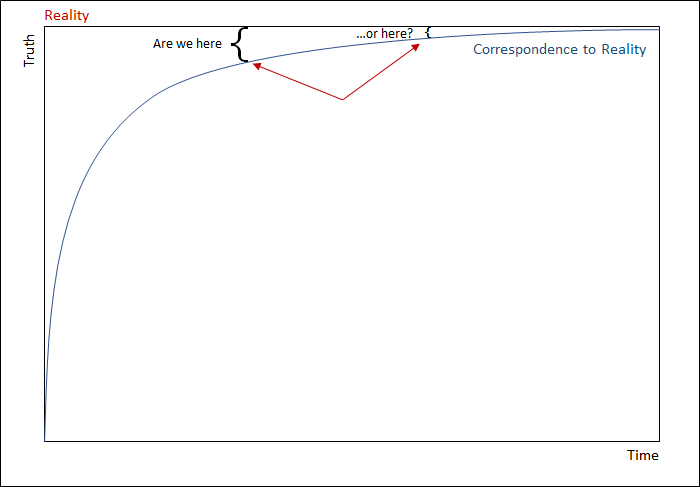
The standard story is comforting: over time, science marches closer and closer to the truth. Each new experiment, each new refinement, nudges us toward Reality, like a curve bending ever nearer to its asymptote.
Chart 1: The bedtime story of science: always closer, never arriving.
This picture flatters us, but it’s built on sand.
Problem One: We have no idea how close or far we are from “Reality” on the Y-axis. Are we brushing against it, or still a light-year away? There’s no ruler that lets us measure our distance.
Problem Two: We can’t even guarantee that our revisions move us toward rather than away from it. Think of Newton and Einstein. For centuries, Newton’s physics was treated as a triumph of correspondence—until relativity reframed it as local, limited, provisional. What once looked like a step forward can later be revealed as a cul-de-sac. Our curve may bend back on itself.
Use Case: Newton, Einstein, and Gravity Take gravity. For centuries, Newton’s laws were treated as if they had brought us into near-contact with Reality™—so precise, so predictive, they had to be true. Then Einstein arrives, reframes gravity not as a force but as the curvature of space-time, and suddenly Newton’s truths are parochial, a local approximation. We applauded this as progress, as if our asymptote had drawn tighter to Reality. But even Einstein leaves us with a black box: we don’t actually know what gravity is, only how to calculate its effects. Tomorrow another paradigm may displace relativity, and once again we’ll dutifully rebrand it as “closer to truth.” Progress or rhetorical re-baptism? The graph doesn’t tell us.
Chart 2: The comforting myth of correspondence: scientific inquiry creeping ever closer to Reality™, though we can’t measure the distance—or even be sure the curve bends in the right direction.
Thomas Kuhn was blunt about this: what we call “progress” is less about convergence and more about paradigm shifts, a wholesale change in the rules of the game. The Earth does not move smoothly closer to Truth; it lurches from one orthodoxy to another, each claiming victory. Progress, in practice, is rhetorical re-baptism.
Most defenders of the asymptotic story assume that even if progress is slow, it’s always incremental, always edging us closer. But history suggests otherwise. Paradigm shifts don’t just move the line higher; they redraw the entire curve. What once looked like the final step toward truth may later be recast as an error, a cul-de-sac, or even a regression. Newton gave way to Einstein; Einstein may yet give way to something that renders relativity quaint. From inside the present, every orthodoxy feels like progress. From outside, it looks more like a lurch, a stumble, and a reset.
Chart 3: The paradigm-gap view: what feels like progress may later look like regression. History suggests lurches, not lines, what we call progress today is tomorrow’s detour..
If paradigm shifts can redraw the entire map of what counts as truth, then it makes sense to ask what exactly we mean when we invoke the word at all. Is truth a mirror of reality? A matter of internal coherence? Whatever works? Or just a linguistic convenience? Philosophy has produced a whole menu of truth theories, each with its own promises and pitfalls—and each vulnerable to the same problems of rhetoric, context, and shifting meanings.
The Many Flavours of Truth
Philosophers never tire of bottling “truth” in new vintages. The catalogue runs long: correspondence, coherence, pragmatic, deflationary, redundancy. Each is presented as the final refinement, the one true formulation of Truth, though each amounts to little more than a rhetorical strategy.
Correspondence theory: Truth is what matches reality. Problem: we can never measure distance from “Reality™” itself, only from our models.
Coherence theory: Truth is what fits consistently within a web of beliefs. Problem: many mutually incompatible webs can be internally consistent.
Pragmatic theory: Truth is what works. Problem: “works” for whom, under what ends? Functionality is always perspectival.
Deflationary / Minimalist: Saying “it’s true that…” adds nothing beyond the statement itself. Problem: Useful for logic, empty for lived disputes.
Redundancy / Performative: “It is true that…” adds rhetorical force, not new content. Problem: truth reduced to linguistic habit.
And the common fallback: facts vs. truths. We imagine facts as hard little pebbles anyone can pick up. Hastings was in 1066; water boils at 100°C at sea level. But these “facts” are just truths that have been successfully frozen and institutionalised. No less rhetorical, only more stable.
So truth isn’t one thing – it’s a menu. And notice: all these flavours share the same problem. They only work within language-games, frameworks, or communities of agreement. None of them delivers unmediated access to Reality™.
Truth turns out not to be a flavour but an ice cream parlour – lots of cones, no exit.
Multiplicity of Models
Even if correspondence weren’t troubled, it collapses under the weight of underdetermination. Quine and Duhem pointed out that any body of evidence can support multiple competing theories.
Chart 4: orthodox vs. heterodox curves, each hugging “reality” differently
Hilary Putnam pushed it further with his model-theoretic argument: infinitely many models could map onto the same set of truths. Which one is “real”? There is no privileged mapping.
Conclusion: correspondence is undercut before it begins. Truth isn’t a straight line toward Reality; it’s a sprawl of models, each rhetorically entrenched.
Truth as Rhetoric and Power
This is where Orwell was right: “War is Peace, Freedom is Slavery, Ignorance is Strength.”
Image: INGSOC logo
Truth, in practice, is what rhetoric persuades.
Michel Foucault stripped off the mask: truth is not about correspondence but about power/knowledge. What counts as truth is whatever the prevailing regime of discourse allows.
We’ve lived it:
“The economy is strong”, while people can’t afford rent.
“AI will save us”, while it mainly writes clickbait.
“The science is settled” until the next paper unsettles it.
These aren’t neutral observations; they’re rhetorical victories.
Truth as Community Practice
Chart 5: Margin of error bands
Even when rhetoric convinces, it convinces in-groups. One group converges on a shared perception, another on its opposite. Flat Earth and Round Earth are both communities of “truth.” Each has error margins, each has believers, each perceives itself as edging toward reality.
Wittgenstein reminds us: truth is a language game. Rorty sharpens it: truth is what our peers let us get away with saying.
So truth is plural, situated, and always contested.
Evolutionary and Cognitive Scaffolding
Step back, and truth looks even less eternal and more provisional.
We spread claims because they move us (emotivism) and because we urge others to join (prescriptivism). Nietzsche was savage about it: truth is just a herd virtue, a survival trick.
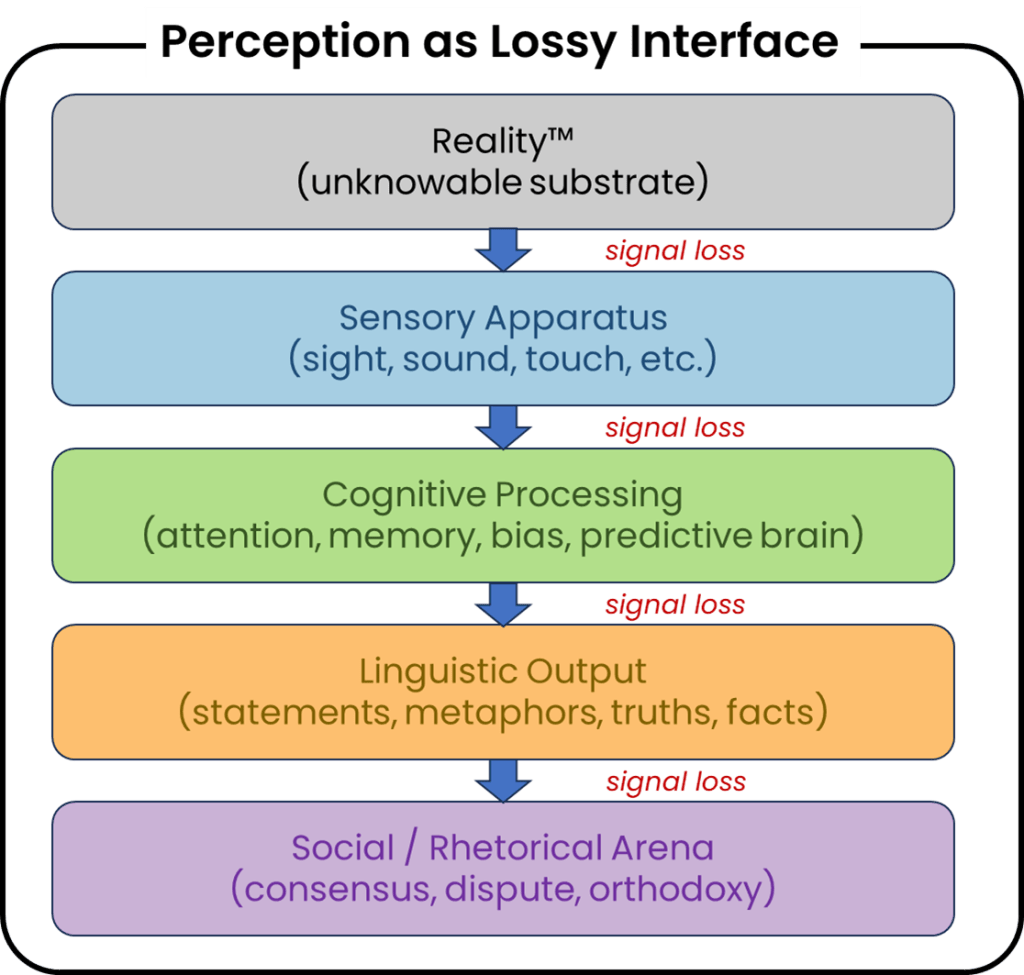
Cognitive science agrees, if in a different language: perception is predictive guesswork, riddled with biases, illusions, and shortcuts. Our minds don’t mirror reality; they generate useful fictions.
Diagram: Perception as a lossy interface: Reality™ filtered through senses, cognition, language, and finally rhetoric – signal loss at every stage.
Archetypal Truth (Positive Proposal)
So where does that leave us? Not with despair, but with clarity.
Truth is best understood as archetypal – a construct humans rally around. It isn’t discovered; it is invoked. Its force comes not from correspondence but from resonance.
Here, my own Language Insufficiency Hypothesis bites hardest: all our truth-talk is approximation. Every statement is lossy compression, every claim filtered through insufficient words. We can get close enough for consensus, but never close enough for Reality.
Truth is rhetorical, communal, functional. Not absolute.
The Four Pillars (Manifesto Form)
Archetypal – truth is a symbolic placeholder, not objective reality.
Asymptotic – we gesture toward reality but never arrive.
Rhetorical – what counts as truth is what persuades.
Linguistically Insufficient – language guarantees slippage and error.
Closing
Nietzsche warned, Rorty echoed: stop fetishising Truth. Start interrogating the stories we tell in its name.
Every “truth” we now applaud may be tomorrow’s embarrassment. The only honest stance is vigilance – not over whether we’ve captured Reality™, but over who gets to decide what is called true, and why.
Truth has never been a mirror. It’s a mask. The only question worth asking is: who’s wearing it?
Humans can’t seem to stop clawing after morality. The primates among us chuck cucumbers when their neighbours get grapes, and the rest of us grumble about fairness on social media. The impulse is practically universal, an evolutionary quirk that kept us from throttling each other long enough to raise children and build cities.
Image: A seemingly perturbed capuchin monkey.
But universality is not objectivity. Just because every ape howls about fairness doesn’t mean “Justice” floats somewhere in Platonic space, waiting to be downloaded. It only means we’re the kind of animal that survives by narrating rules and enforcing them with shunning, shame, or, when necessary, cudgels.
Audio: NotebookLM podcast on this topic.
This is where Alasdair MacIntyre trips over his own robes. After Virtue skewers Enlightenment rationalists who tried to prop morality on reason, it then dismisses Nietzsche for being “irrational.” MacIntyre’s fix? Resurrect Aristotle’s teleology. If reason can’t save morality, maybe an ancient oak tree can. But this is wish-thinking with a Greek accent. He’s still arguing by reason that reason can’t do the job, then sneaking back in through Aristotle’s back door with a “firmer ground.” Firmer only because he says so.
Nietzsche, at least, had the decency to call the bluff: no telos, no floor, no cosmic anchor. Just will, style, and the abyss. Uncomfortable? Absolutely. Honest? Yes.
Deleuze went further. He pointed out that morality, like culture, doesn’t look like a tree at all. It’s a rhizome: tangled, proliferating, hybridising, never grounded in a single root. The fragments MacIntyre despairs over aren’t evidence of collapse. They’re evidence of how moral life actually grows—messy, contingent, interconnected. The only reason it looks chaotic is that we keep demanding a trunk where only tubers exist.
So here we are, apes with a craving for rules, building cities and philosophies on scaffolds of habit, language, and mutual illusion. We are supported as surely as the Earth is supported – by nothing. And yet, we go on living.
The need for morality is real. The yearning for telos is real. The floor is not.
Freud once quipped that people are “normal” only on average. To the degree that they deviate from the mean, they are neurotic, psychotic, or otherwise abnormal. Whatever else one thinks of Freud, the metaphor holds for Modernity.
Image: Picture and quote by Sigmund Freud: Every normal person, in fact, is only normal on the average. His ego approximates to that of the psychotic in some part or other and to a greater or lesser extent. —Analysis Terminable And Interminable (1937), Chapter V
We are “Modern” only on average, and only for the first standard deviation. Within one sigma, you can wave a flag and declare: rational, secular, Enlightened. But step further into the tails and the façade dissolves. The “normal” modern turns out to attend megachurches, consult horoscopes, share conspiracy memes, or cling to metaphysical relics that Enlightenment reason was supposed to have torched centuries ago.
„ Jeder Normale ist eben nur durchschnittlich normal, sein Ich nähert sich dem des Psychotikers in dem oder jenem Stück, in größerem oder geringerem Ausmaß. “
The problem isn’t that these people aren’t Modern. The problem is that nobody is Modern, not in the sense the story requires. The mean is an over-fitted abstraction. “Modernity” works like Freud’s “normal”: a statistical average that erases the deviations, then insists that the erased bits are pathology rather than reality.
But the tails are where most of human life actually happens. The “average Modern” is as mythical as the “reasonable person.” What we call Modernity is just a bell curve costume draped over the same mix of superstition, desire, and contingency that has always driven human behaviour.
We’re told we live in the Enlightenment, that Reason™ sits on the throne and superstition has been banished to the attic. Yet when I disguised a little survey as “metamodern,” almost none came out as fully Enlightened. Three managed to shed every trace of the premodern ghost, one Dutch wanderer bypassed Modernity entirely, and not a single soul emerged free of postmodern suspicion. So much for humanity’s great rational awakening. Perhaps Modernity wasn’t a phase we passed through at all, but a mirage we still genuflect before, a lifestyle brand draped over a naked emperor.
Audio: NotebookLM podcast on this topic
The Enlightenment as Marketing Campaign
The Enlightenment is sold to us as civilisation’s great coming-of-age: the dawn when the fog of superstition lifted and Reason took the throne. Kant framed it as “man’s emergence from his self-incurred immaturity” – an Enlightenment bumper sticker that academics still like to polish and reapply. But Kant wasn’t writing for peasants hauling mud or women without the vote; he was writing for his own coterie of powdered-wig mandarins, men convinced their own habits of rational debate were humanity’s new universal destiny.
Modernity, in this story, isn’t a historical stage we all inhabited. It’s an advertising campaign: Reason™ as lifestyle brand, equality as tagline, “progress” as the logo on the tote bag. Modernity, in the textbooks, is billed as a historical epoch, a kind of secular Pentecost in which the lights came on and we all finally started thinking for ourselves. In practice, it was more of a boutique fantasy, a handful of gentlemen mistaking their own rarefied intellectual posture for humanity’s destiny.
The Archetype That Nobody Lives In
At the core of the Enlightenment lies the archetype of Man™: rational, autonomous, unencumbered by superstition, guided by evidence, weighing pros and cons with the detachment of a celestial accountant. Economics repackaged him as homo economicus, forever optimising his utility function as if he were a spreadsheet in breeches.
But like all archetypes, this figure is a mirage. Our survey data, even when baited as a “metamodern survey”, never produced a “pure” Enlightenment subject.
3 scored 0% Premodern (managing, perhaps, to kick the gods and ghosts to the kerb).
1 scored 0% Modern (the Dutch outlier: 17% Premodern, 0% Modern, 83% Post, skipping the Enlightenment altogether, apparently by bike).
0 scored 0% Postmodern. Every single participant carried at least some residue of suspicion, irony, or relativism.
The averages themselves were telling: roughly 18% Premodern, 45% Modern, 37% Postmodern. That’s not an age of Reason. That’s a muddle, a cocktail of priestly deference, rationalist daydreams, and ironic doubt.
Even the Greats Needed Their Crutches
If the masses never lived as Enlightenment subjects, what about the luminaries? Did they achieve the ideal? Hardly.
Descartes, desperate to secure the cogito, called in God as guarantor, dragging medieval metaphysics back on stage.
Kant built a cathedral of reason only to leave its foundations propped up by noumena: an unseeable, unknowable beyond.
Nietzsche, supposed undertaker of gods, smuggled in his own metaphysics of will to power and eternal recurrence.
William James, surveying the wreckage, declared that “truth” is simply “what works”, a sort of intellectual aspirin for the Enlightenment headache.
And economists, in a fit of professional humiliation, pared the rational subject down to a corpse on life support. Homo economicus became a creature who — at the very least, surely — wouldn’t choose to make himself worse off. But behavioural economics proved even that meagre hope to be a fantasy. People burn their wages on scratch tickets, sign up for exploitative loans, and vote themselves into oblivion because a meme told them to.
If even the “best specimens” never fully embodied the rational archetype, expecting Joe Everyman, who statistically struggles to parse a sixth-grade text and hasn’t cracked a book since puberty, to suddenly blossom into a mini-Kant is wishful thinking of the highest order.
The Dual Inertia
The real story isn’t progress through epochs; it’s the simultaneous drag of two kinds of inertia:
Premodern inertia: we still cling to sacred myths, national totems, and moral certainties.
Modern inertia: we still pretend the rational subject exists, because democracy, capitalism, and bureaucracy require him to.
The result isn’t a new epoch. It’s a cultural chimaera: half-superstitious, half-rationalist, shot through with irony. A mess, not a phase..
Arrow’s Mathematical Guillotine
Even if the Enlightenment dream of a rational demos were real, Kenneth Arrow proved it was doomed. His Impossibility Theorem shows that no voting system can turn individual rational preferences into a coherent “general will.” In other words, even a parliament of perfect Kants would deadlock when voting on dinner. The rational utopia is mathematically impossible.
So when we are told that democracy channels Reason, we should hear it as a polite modern incantation, no sturdier than a priest blessing crops.
Equality and the Emperor’s Wardrobe
The refrain comes like a hymn: “All men are created equal.” But the history is less inspiring. “Men” once meant property-owning Europeans; later it was generously expanded to mean all adult citizens who’d managed to stay alive until eighteen. Pass that biological milestone, and voilà — you are now certified Rational, qualified to determine the fate of nations.
And when you dare to question this threadbare arrangement, the chorus rises: “If you don’t like democracy, capitalism, or private property, just leave.” As if you could step outside the world like a theatre where the play displeases you. Heidegger’s Geworfenheit makes the joke bitter: we are thrown into this world without choice, and then instructed to exit if we find the wallpaper distasteful. Leave? To where, precisely? The void? Mars?
The Pre-Modern lord said: Obey, or be exiled. The Modern democrat says: Vote, or leave. And the Post-Enlightenment sceptic mutters: Leave? To where, exactly? Gravity? History? The species? There is no “outside” to exit into. The system is not a hotel; it’s the weather.
Here the ghost of Baudrillard hovers in the wings, pointing out that we are no longer defending Reason, but the simulacrum of Reason. The Emperor’s New Clothes parable once mocked cowardice: everyone saw the nudity but stayed silent. Our situation is worse. We don’t even see that the Emperor is naked. We genuinely believe in the fineries, the Democracy™, the Rational Man™, the sacred textile of Progress. And those who point out the obvious are ridiculed: How dare you mock such fineries, you cad!
Conclusion: The Comfort of a Ghost
So here we are, defending the ghost of a phase we never truly lived. We cling to Modernity as if it were a sturdy foundation, when in truth it was always an archetype – a phantom rational subject, a Platonic ideal projected onto a species of apes with smartphones. We mistook it for bedrock, built our institutions upon it, and now expend colossal energy propping up the papier-mâché ruins. The unfit defend it out of faith in their own “voice,” the elites defend it to preserve their privilege, and the rest of us muddle along pragmatically, dosing ourselves with Jamesian aspirin and pretending it’s progress.
Metamodernism, with its marketed oscillation between sincerity and irony, is less a “new stage” than a glossy rebranding of the same old admixture: a bit of myth, a bit of reason, a dash of scepticism. And pragmatism –James’s weary “truth is what works” – is the hangover cure that keeps us muddling through.
Modernity promised emancipation from immaturity. What we got was a new set of chains: reason as dogma, democracy as ritual, capitalism as destiny. And when we protest, the system replies with its favourite Enlightenment lullaby: If you don’t like it, just leave.
But you can’t leave. You were thrown here. What we call “Enlightenment” is not a stage in history but a zombie-simulation of an ideal that never drew breath. And yet, like villagers in Andersen’s tale, we not only guard the Emperor’s empty wardrobe – we see the garments as real. The Enlightenment subject is not naked. He is spectral, and we are the ones haunting him.










 Philosophics