Legibility Meets Humanity for Xmas

3–4 minutes

I’m no fan of holidays. I neither enjoy nor celebrate Christmas. I’m acutely aware of its commercial excesses and its religious inheritance, two institutions I find, at best, tiresome and, at worst, actively corrosive. Whether that’s abhorrence or simple loathing is a distinction I’ll leave to braver souls.

Still, calendars exist whether one consents to them or not, and this piece happens to land today. If Christmas is your thing, by all means, have at it. Sincerely. Rituals matter to people, even when their metaphysics don’t survive inspection.

What follows is not a defence of the season, nor a seasonal moral. It’s a small human moment that happens to involve Santa, which is to say a costume, a script, and a public performance. What interests me is not the symbolism, but what happens when the performance yields just enough to allow someone else to be seen on their own terms. If nothing else, that feels like a tolerable use of the day.

Audio: NotebookLM summary podcast on this topic.

What Legibility?

When I use the term legibility, it’s usually as a pejorative. It’s my shorthand for reductionism. For the way human beings are flattened into checkboxes, metrics, market segments, or moral exemplars so they can be processed efficiently by institutions that mistake simplification for understanding.

But legibility isn’t always a vice.

Video: Santa signs with a 3-year-old dear girl

Most of us, I suspect, want to be legible. Just not in the ways we are usually offered. We want to be seen on our own terms, not translated into something more convenient for the viewer. That distinction matters.

In the video above, a deaf child meets Santa. Nothing grand happens. No lesson is announced. No slogan appears in the corner of the screen. Santa simply signs.

The effect is immediate. The child’s posture changes. Her attention sharpens. There’s a visible shift from polite endurance to recognition. She realises, in real time, that she does not need to be adapted for this encounter. The encounter has adapted to her. This is legibility done properly.

Not the synthetic legibility of television advertising, where difference is curated, sanitised, and arranged into a reassuring grid of representation. Not the kind that says, we see you, while carefully controlling what is allowed to be seen. That version of legibility is extraction. It takes difference and renders it harmless. Here, the legibility runs the other way.

Santa, already a performative role if ever there was one, doesn’t stop being performative. The costume remains. The ritual remains. But the performance bends. It accommodates. It listens. The artifice doesn’t collapse; it becomes porous.

I’m wary of words like authenticity. They’ve been overused to the point of meaninglessness. But I do think we recognise performatism when we see it. Not in the technical sense of speech acts, but in the everyday sense of personas that ring hollow, gestures that exist for the camera rather than the people involved. This doesn’t feel like that.

Of course, the child could already connect. Deaf people connect constantly. They persevere. They translate. They accommodate a world that rarely meets them halfway. Nothing here ‘grants’ her humanity. What changes is the tightness of the connexion.

The shared language acts as a verbal proxy, a narrowing of distance. You can see the moment it clicks. He speaks her language. Or rather, he speaks a language that already belongs to her, even if calling it ‘hers’ is technically imprecise. Mother tongue is a slippery phrase. Irony does some of the work here.

Legibility, in this case, doesn’t make her smaller. It makes the interaction larger. And that, inconveniently for our systems and slogans, is what most people have been asking for all along.

Tatterhood, Makeover Culture, and the Prince Who Earned a Gold Star for Basic Curiosity

3–5 minutes

I’ve spent more hours than I care to admit rummaging through the Jungian undergrowth of fairy tales – reading Marie-Louise von Franz until my eyes crossed, listening to Clarissa Pinkola Estés weave her wolf-women lore, and treating folklore like an archaeological dig through the psychic sediment of Europe. It’s marvellous, really, how much one can project onto a story when one has a doctorate’s worth of enthusiasm and the moral flexibility of a tarot reader.

But every so often, a tale emerges that requires no archetypal lens, no mythopoetic scaffolding, no trip down the collective unconscious. Sometimes a story simply bares its ideological teeth.

Enter Tatterhood – the Norwegian fairy tale so blunt, it practically writes its own critical theory seminar.

I watched Jonny Thomson’s recent video on this tale (embedded below, for those with sufficient tea and patience). Jonny offers a charming reversal: rather than focusing on Tatterhood herself, he offers the moral from the prince’s perspective. In his reading, the story becomes a celebration of the power of asking – the prince’s reward for finally inquiring about the goat, the spoon, the hood, the whole aesthetic calamity before him.

Video: Jonny Thomson discusses Tatterhood.

It’s wholesome stuff: a TED Talk dressed as folklore. But – my word – apply the slightest bit of critical pressure, and the whole thing unravels into farce.

The Story No One Tells at the Royal Wedding

Here’s the short version of Tatterhood that Jonny politely sidesteps:

  • A fearless, ragged, hyper-competent girl rescues her sister from decapitation.
  • She confronts witches, navigates the seas alone, storms a castle, and performs an ad hoc ontological surgical reversal.
  • She does all of this without help from the king, the court, the men, or frankly, anyone with a Y chromosome.

And how is she rewarded for her trouble? She’s told she’s too ugly. Not socially acceptable. Not symbolically coherent. Not bride material.

The kingdom gazes upon her goat, her spoon, her hood, her hair, and determines that nothing – nothing – about her qualifies her for legitimacy.

Competence: irrelevant.
Courage: irrelevant.
Loyalty: irrelevant.

But beauty? Beauty is the passport stamp that grants her entry into the social realm.

Jonny’s Prince: A Hero by Low Expectations

Now, bless Jonny for trying to rehabilitate the lad, but this prince is hardly an exemplar of virtue. He sulks through his own wedding procession like a man being marched to compulsory dentistry. He does not speak. He does not ask. He barely manages object permanence.

And suddenly, the moral becomes: Look what wonders unfold when a man asks a single question!

It’s the philosophical equivalent of awarding someone a Nobel Prize for remembering their mother’s birthday.

And what do his questions achieve? Not insight. Not understanding. Not intimacy. But metamorphosis.

Each time he asks, Tatterhood transforms – ugly goat to beautiful horse, wooden spoon to silver fan, ragged hood to golden crown, ‘ugly’ girl to radiant beauty.

Which brings us to the inconvenient truth:

This Isn’t the Power of Asking. It’s the Power of Assimilation.

His questions function as aesthetic checkpoints.

Why the goat?
Translation: please ride something socially acceptable.

Why the spoon?
Translation: replace your tool of agency with a decorative object.

Why the hood?
Translation: cover your unruliness with something properly regal.

Why your face?
Translation: you terrify me; please be beautiful.

And lo, she becomes beautiful. Not because he sees her differently. Because the story cannot tolerate a powerful woman who remains outside the beauty regime.

The prince isn’t rewarded for asking; the narrative is rewarded for restoring normative order.

And Yet… It’s Absurdly Fascinating

This is why fairy tales deserve all the interpretive attention we lavish on them. They’re ideological fossils – compressed narratives containing entire worldviews in miniature.

Part of me admires Jonny’s generosity. Another part of me wants to hand the prince a biscuit for performing the bare minimum of relational curiosity. But mostly, I’m struck by how nakedly the tale reveals the old bargain:

Everything else is optional. Beauty is compulsory.

So Here’s My Version of the Moral

Ask questions, yes. Be curious, yes. But don’t let anyone tell you that Tatterhood was waiting for the prince’s epiphany. She was waiting for the world to remember that she ran the plot.

If you’ve made it this far and know my proclivities, you’ll not be shocked that I side with Roland Barthes and cheerfully endorse la mort de l’auteur. Jonny is perfectly entitled to his reading. Interpretive pluralism and all that. I simply find it marvelously puzzling that he strolls past the protagonist galloping through the narrative on a goat, spoon upraised, and instead decides to chase the side-quest of a prince who contributes roughly the energy of a damp sock.

Propensity for Simulacra, An Excerpt

1–2 minutes

I posted Chapter 26 of my novella, Propensity. I share it here because it invokes Baudrillard’s Simulacra.

Consider it an advert – and a window into Propensity.

Blog Post: Propensity, Chapter 26 – Simulacra
Audio: Propensity, Chapter 2 – Oversight

The novel itself asks what happens when humanity creates a device that creates peace on earth. What if behavioural control worked too well?

No riots. No rebellion. Just a flattening—of desire, of ambition, of will. Across homes, schools, and governments, people stop acting like themselves. Some forget how. Others forget why.

The system wasn’t designed to stay on this long. But now there’s no off switch. And the researchers who built it? Most of them are zeroed.

As one child begins to drift from baseline, an impossible question resurfaces: What does it mean to behave?

This is a psychological dystopia without explosions, a story where silence spreads faster than violence, where systems behave better than the people inside them.

A tale of modulation, inertia, and the slow unravelling of human impulse—for readers who prefer their dystopias quiet and their horrors deeply plausible.


Editorial Review

“Reader discretion is advised. Free will has been deprecated.”
Beginning as a bizarre experiment in behavioural modulation by way of neurochemical interference, Propensity unfolds into an eerie metaphor for the tricky road between control and conscience. Park’s chapters are short and succinct, some barely a page long, in a staccato rhythm that mirrors the story’s disintegration—scientists losing grip on their creation and a world learning the price of its “engineered peace.” Phrases like “silence playing dress-up as danger” and “peace was never meant to be built, only remembered” linger like faint echoes long after you turn the page.

Reedsy Discovery Review

Meantime, give it a listen.

Missing White Supremacy’s Woods for the Tree

2–3 minutes

Radical Futures Studio’s “7 Signals” deck has been circulating widely. It’s a striking example of Storytelling 101: identify a villain, chart the signs of its decline, and point toward an eventual resolution. In this case, the villain is white supremacy. The signs are its institutional and cultural fray. The resolution is its collapse.

Audio: NotebookLM podcast on this topic.

As far as stories go, it’s effective. It provides a framework, some memorable imagery, and the reassurance that the ugliness on display today is a death rattle, not a resurgence. No wonder it resonates. People want to believe the noise means the monster is dying.

But as analysis, the frame is too tight. Racism is not the root structure; it is a symptom, a mask. White supremacy is real enough in its effects, but its persistence and decline are contingent. The deeper system – the scaffolding of late-stage capitalism, the Enlightenment’s brittle universalism, the institutions now staggering under their own contradictions – remains the host. When whiteness peels away, the system does not vanish. It simply rebrands.

To point to the peeling paint and say ‘the house is collapsing’ is to mistake surface for structure. Yes, the paint matters; it shapes how people experience the walls. But the real rot lies deeper, in the beams. The Enlightenment project promised seamless cloth: rationality, universality, permanence. Capitalism promised endless expansion and renewal. Both promises are faltering, and the cracks are visible everywhere – climate, finance, governance, identity. Racism, whiteness, supremacy: these are one set of cracks, not the foundation itself.

The risk of the ‘signals’ narrative is that it offers too neat a moral arc. It comforts the audience that the villain is cornered, that justice is baked into the future. But history is rarely so tidy. Supremacy does not die; it changes costumes. One mask slips, another is stitched on. If we mistake the collapse of whiteness for the collapse of the system, we blind ourselves to how easily the scaffolding survives in new guises.

None of this is to reject the cause. Racism is a systemic lie, and its decline is worth cheering. But it is not enough to track the noise of its death rattle. To understand the larger story, we need to step back and see the woods for the trees. The true collapse underway is broader: the exhaustion of capitalism’s last stage, the unravelling of Enlightenment’s promises, the loss of legitimacy in institutions that no longer hold. That is the forest in which the tree of whiteness withers.

If we focus only on the tree, we risk missing the landscape. And if we mistake peeling paint for the beams, we risk celebrating cosmetic decline while the house quietly reassembles itself under a different banner.

Language and Generative AI: A Journey through Midjourney

I am not a fan of Midjourney v7. I prefer v6.1. And I want to write about the correspondence of language, per my Language Insufficiency Hypothesis.

Let’s start with the language aspect. Notice how distant the renders are from the intent of the prompt.

This is my initial prompt. I used it about a year ago to generate the cover image with v6.1, but I wanted to see how it renders in v7. Let’s take a trip all the way back to the beginning.

cinematic, tight shot, photoRealistic light and shadow, exquisite details, delicate features, emaciated sensual female vampire waif with vampire fangs, many tattoos, wearing crucifix necklace, gazes into mirror, a beam of moonlight shines on her face in dark mausoleum interior, toward camera, facing camera, black mascara, long dark purple hair , Kodak Portra 400 with a Canon EOS R5
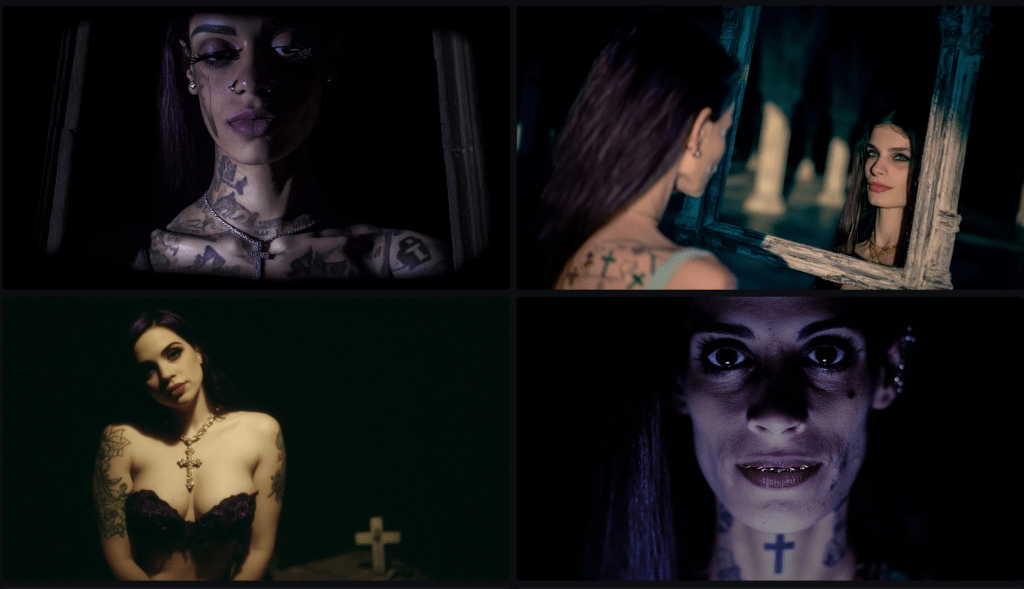
Image: Midjourney v6.1 render set (from about a year ago)

As you can see, these renders are somewhat lacking in photorealism, but the “sensual” term in the prompt was not blocked.

Midjourney v7

Initially, I encountered a hiccup. After a couple of rejections on the grounds of morality, I removed the word ‘sensual’ and received the output. All of the output uses this prompt absent the sensual term.

As mentioned, I have generated several images (including the cover image) with this prompt, but Midjourney is inconsistent in its censorship gatekeeping.

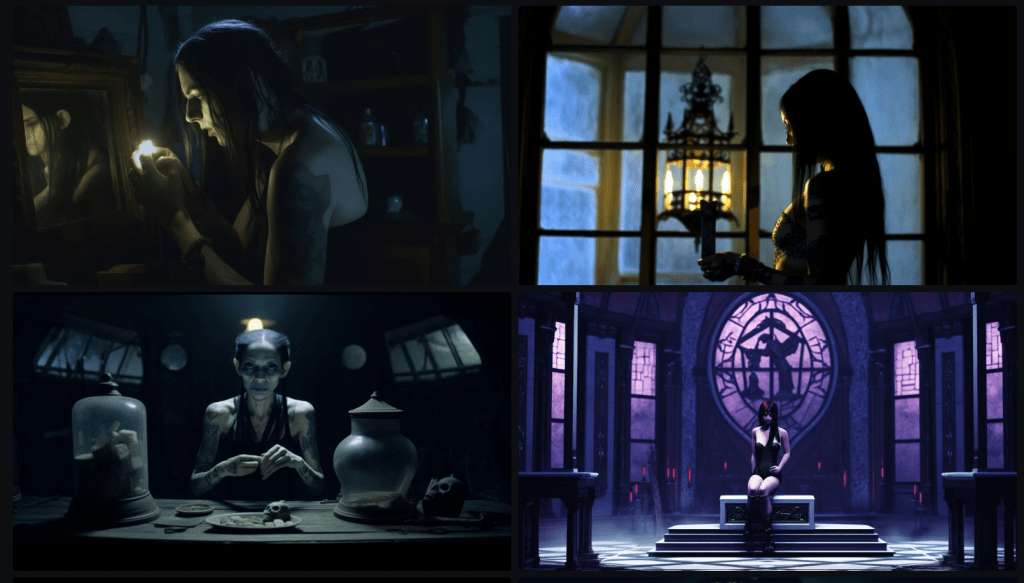
Image: Midjourney v7 render set

Notice that 3 of the 4 renders in the v7 set don’t even have a mirror. The top right one does, but it’s not evident that she’s a vampire. In fact, I could say that any of these are vampiresses, but perhaps that’s what they want you to believe. In place of a necklace, the lower right wokan sports a cross tattoo.

Midjourney v6.1

Image: Midjourney v6.1 render set

Again, these renders don’t appear to be vampires. The one on the lower left does appear to have snake-like fangs, so I guess I’ll give partial credit.

My next attempt was interrupted by this message.

It rendered something that might violate community guidelines. The funny thing is that one can watch the image generate in process. It only takes one “offensive” image to disqualify the whole batch.

Midjourney v6

Image: Midjourney v6 render set

Yet again, not a vampire to be found. Notice the reflection in the lower left image. Perhaps vampire reflections just behave differently.

Midjourney 5.2

Image: Midjourney v5.2 render set

Midjourney v5.2 was a crapshoot. Somehow, I got vampire lips (?), a Wiccan, a decrepit Snape from Harry Potter lore, and Iron Maiden’s Eddy reading a book. It’s something. I’m sensing gender dysphoria. Dare I go back further?

Midjourney v5.1

Image: Midjourney v5.1 render set

It gets worse. No comments necessary. Let’s turn back the clocks even more.

Midjourney v5

Image: Midjourney v5 render set

To be fair, these all do have occult undertones, but they are weak on vampireness.

Midjourney v4

Image: Midjourney v4 render set

To be fair, the render quality isn’t as bad as I expected, but it still falls short. There’s further back to travel.

Midjourney v3

Image: Midjourney v3 render set

Some configuration parameters no longer exist. Still, I persist for the sake of art and science at the cost of time and ecology.

As much as I complain – and I complain a lot – this is how far we’ve come. As I recall, this is when I hopped onto the Midjourney bandwagon. There’s still more depth to plumb. I have no idea how much of the prompt is simply ignored at this point.

Midjourney v2

Image: Midjourney v2 render set

What the hell is this? 🤔🤣 But I’m not done yet.

Midjourney v1

Image: Midjourney v1 render set

The damned grandpappy of them all. Apparently, colour hadn’t been invented yet. You can’t tell by these thumbnails, but the resolution on these early versions approaches that of a postage stamp.

Midjourney Niji 3

Image: Midjourney Niji 3 render set

I had forgotten about the Niji models from back in the day. There were 3 versions. I don’t recall where this slotted into the chronology. Obviously, not down here. I’ve only rendered the newest one. I think this was used primarily for anime outputs, but I might be mistaken.

Bones Content 1: Video

Video: Midjourney Render of Purported Vampiress

This is a video render of the same prompt used on this page.

Bonus Content 2: Midjourney v6.1 Content from 34 weeks ago

Same prompt.

Image: Midjourney v6.1 render set (several passes)

The upper left image reminds me of Kirsten Dunst. Again, notice the female breasts, highlighting Midjourney’s censorial schizophrenia.

Questioning Traditional Families

I neither champion nor condemn tradition—whether it’s marriage, family, or whatever dusty relic society is currently parading around like a prize marrow at a village fête.

Audio: NotebookLM podcast on traditional families.

In a candid group conversation recently, I met “Jenny”, who declared she would have enjoyed her childhood much more had her father not “ruined everything” simply by existing. “Marie” countered that it was her mother who had been the wrecker-in-chief. Then “Lulu” breezed in, claiming, “We had a perfect family — we practically raised ourselves.”

Now, here’s where it gets delicious:

Each of these women, bright-eyed defenders of “traditional marriage” and “traditional family” (cue the brass band), had themselves ticked every box on the Modern Chaos Bingo Card: children out of wedlock? Check. Divorces? Check. Performative, cold-marriage pantomimes? Absolutely—and scene.
Their definition of “traditional marriage” is the vintage model: one cis-male, one cis-female, Dad brings home the bacon, Mum weeps quietly into the washing-up. Standard.

Let’s meet the players properly:

Jenny sprang from a union of two serial divorcées, each dragging along the tattered remnants of previous families. She was herself a “love child,” born out of wedlock and “forcing” another reluctant stroll down the aisle. Her father? A man of singular achievements: he paid the bills and terrorised the household. Jenny now pays a therapist to untangle the psychological wreckage.

Marie, the second of two daughters, was the product of a more textbook “traditional family”—if by textbook you mean a Victorian novel where everyone is miserable but keeps a stiff upper lip about it. Her mother didn’t want children but acquiesced to her husband’s demands (standard operating procedure at the time). Marie’s childhood was a kingdom where Daddy was a demigod and Mummy was the green-eyed witch guarding the gates of hell.

Lulu grew up in a household so “traditional” that it might have been painted by Hogarth: an underemployed, mostly useless father and a mother stretched thinner than the patience of a British Rail commuter. Despite—or because of—the chaos, Lulu claims it was “perfect,” presumably redefining the word in a way the Oxford English Dictionary would find hysterical. She, too, had a child out of wedlock, with the explicit goal of keeping feckless men at bay.

And yet—and yet—all three women cling, white-knuckled, to the fantasy of the “traditional family.” They did not achieve stability. Their families of origin were temples of dysfunction. But somehow, the “traditional family” remains the sacred cow, lovingly polished and paraded on Sundays.

Why?

Because what they’re chasing isn’t “tradition” at all — it’s stability, that glittering chimera. It’s nostalgia for a stability they never actually experienced. A mirage constructed from second-hand dreams, glossy 1950s propaganda, and whatever leftover fairy tales their therapists hadn’t yet charged them £150 an hour to dismantle.

Interestingly, none of them cared two figs about gay marriage, though opinions about gay parenting varied wildly—a kettle of fish I’ll leave splashing outside this piece.

Which brings us back to the central conundrum:

If lived experience tells you that “traditional family” equals trauma, neglect, and thinly-veiled loathing, why in the name of all that’s rational would you still yearn for it?

Societal pressure, perhaps. Local customs. Generational rot. The relentless cultural drumbeat that insists that marriage (preferably heterosexual and miserable) is the cornerstone of civilisation.

Still, it’s telling that Jenny and Marie were both advised by therapists to cut ties with their toxic families—yet in the same breath urged to create sturdy nuclear families for their own children. It was as if summoning a functional household from the smoking ruins of dysfunction were a simple matter of willpower and a properly ironed apron.

Meanwhile, Lulu—therapy-free and stubbornly independent—declares that raising oneself in a dysfunctional mess is not only survivable but positively idyllic. One can only assume her standards of “perfect” are charmingly flexible.

As the title suggests, this piece questions traditional families. I offer no solutions—only a raised eyebrow and a sharper question:

What is the appeal of clinging to a fantasy so thoroughly at odds with reality?
Your thoughts, dear reader? I’d love to hear your defences, your protests, or your own tales from the trenches.

The Church of Pareto: How Economics Learned to Love Collapse

—or—How the Invisible Hand Became a Throttling Grip on the Throat of the Biosphere

As many frequent visitors know, I am a recovering economist. I tend to view economics through a philosophical lens. Here. I consider the daft nonsense of Pareto optimality.

Audio: NotebookLM podcast of this content.

There is a priesthood in modern economics—pious in its equations, devout in its dispassion—that gathers daily to prostrate before the altar of Pareto. Here, in this sanctum of spreadsheet mysticism, it is dogma that an outcome is “optimal” so long as no one is worse off. Never mind if half the world begins in a ditch and the other half in a penthouse jacuzzi. So long as no one’s Jacuzzi is repossessed, the system is just. Hallelujah.

This cult of cleanliness, cloaked in the language of “efficiency,” performs a marvellous sleight of hand: it transforms systemic injustice into mathematical neutrality. The child working in the lithium mines of the Congo is not “harmed”—she simply doesn’t exist in the model. Her labour is an externality. Her future, an asterisk. Her biosphere, a rounding error in the grand pursuit of equilibrium.

Let us be clear: this is not science. This is not even ideology. It is theology—an abstract faith-based system garlanded with numbers. And like all good religions, it guards its axioms with fire and brimstone. Question the model? Heretic. Suggest the biosphere might matter? Luddite. Propose redistribution? Marxist. There is no room in this holy order for nuance. Only graphs and gospel.

The rot runs deep. William Stanley Jevons—yes, that Jevons, patron saint of unintended consequences—warned us as early as 1865 that improvements in efficiency could increase, not reduce, resource consumption. But his paradox, like Cassandra’s prophecy, was fated to be ignored. Instead, we built a civilisation on the back of the very logic he warned would destroy it.

Then came Simon Kuznets, who—bless his empirically addled soul—crafted a curve that seemed to promise that inequality would fix itself if we just waited politely. We called it the Kuznets Curve and waved it about like a talisman against the ravages of industrial capitalism, ignoring the empirical wreckage that piled up beneath it like bones in a trench.

Meanwhile, Pareto himself, that nobleman of social Darwinism, famously calculated that 80% of Italy’s land was owned by 20% of its people—and rather than challenge this grotesque asymmetry, he chose to marvel at its elegance. Economics took this insight and said: “Yes, more of this, please.”

And so the model persisted—narrow, bloodless, and exquisitely ill-suited to the world it presumed to explain. The economy, it turns out, is not a closed system of rational actors optimising utility. It is a planetary-scale thermodynamic engine fuelled by fossil sunlight, pumping entropy into the biosphere faster than it can absorb. But don’t expect to find that on the syllabus.

Mainstream economics has become a tragic farce, mouthing the language of optimisation while presiding over cascading system failure. Climate change? Not in the model. Biodiversity collapse? A regrettable externality. Intergenerational theft? Discounted at 3% annually.

We are witnessing a slow-motion suicide cloaked in the rhetoric of balance sheets. The Earth is on fire, and the economists are debating interest rates.

What we need is not reform, but exorcism. Burn the models. Salt the axioms. Replace this ossified pseudoscience with something fit for a living world—ecological economics, systems theory, post-growth thinking, anything with the courage to name what this discipline has long ignored: that there are limits, and we are smashing into them at speed.

History will not be kind to this priesthood of polite annihilation. Nor should it be.

Modernity Survey Results

I’ve added a permanent page to summarise the modernity worldview categories. If you haven’t yet taken the survey…

Click here to take the survey

This post explains how to interpret the ternary plot chart’s visualisation. The ternary chart on the survey results page will render something like this. This is an admin page with additional functionality, but it’s similar enough. The blue dot represents the average of all responses. The star represents where I guessed the average would land–mostly modern with some residual premodernity and a touch of postmodernity.

Under the title in the header is a textual assessment of the visualisation. In this case, the response illustrates someone moderately modern with postmodern influences. Although this person also has some premodern tendencies, they are relatively insignificant to the context.

The three possible worldviews are at the vertices (the corners) of the triangle. Each side is a scale progressing from 0% to 100%—100% coincident with the label. For example, the bottom side runs from 0 on the left to 100 on the right, which would indicate a score of 100 per cent Premodern, which the output deems Pure Premodern.

Notice that each vertex has green and yellow shading that serves as visual aids representing the strength of the relationship to the corner. Green is strong, and yellow is moderate. The white section outlined by an interior triangle with a red border is decidedly mixed, showing no strong inclination to any of the extremes.

In the example above, the red plot point illustrates a response (as shown below the chart) that is 20.7% Premodern, 52.1% Modern, and 27.2% Postmodern. These numbers should always sum to 100, though there will be some drift due to rounding. The star represents where I thought the average response would be. Follow the tickmarks on each side, and you’ll notice they correspond with the plot point as a 3-tuple (20, 70, 10).

In the future, I expect to render a view that plots the average survey response as a reference.

Below this chart is an expository account of the response choices. You can render this content as a PDF for your personal archive.

Final Word

If you have any questions or suggestions related to this topic, please feel free to leave them in the comments below.