James Talks Truth

2–3 minutes

I’ve read about 85 per cent of James by Percival Everett. I recommend it. On the surface, it is simply a very good story set in the narrative universe of Mark Twain’s Huck Finn and Tom Sawyer. I will avoid spoilers as best I can.

The novel is set in the antebellum American South. James and the others move through Missouri, a state that openly supported slavery, and at one point into Illinois, a state that officially opposed it but quietly failed to live up to its own rhetoric. Illinois, it turns out, is no safe haven. Ideology and practice, as ever, are on speaking terms only when it suits them.

Audio: Short NotebookLM summary podcast of this content.

This is not a book review. I may write one later for my Ridley Park site once I’ve finished the book. What interests me here are two philosophical tensions Everett stages with remarkable economy.

There are two characters who are Black but able to pass as white. One of them feels profound guilt about this. He was raised as a slave, escaped, and knows exactly what it means to be treated as Black because he has lived it. Passing feels like theft. Survival, perhaps, but theft all the same.

The other is more unsettled. He was raised as a white man and only later discovers that he is not, as the language goes, “pure-bred”. This revelation leaves him suspended between identities. Should he now accept a Black identity he has never inhabited, or continue to pass quietly, benefitting from a system that would destroy him if it knew?

James offers him advice that is as brutal as it is lucid:

“Belief has nothing to do with truth. Believe what you like. Believe I’m lying and move through the world as a white boy. Believe I’m telling the truth and move through the world as a white boy anyway. Either way, no difference.”

This is the philosophical nerve of the book.

Truth, Everett suggests, is indifferent to belief. Belief does not mediate justice. It does not reorganise power. It does not rewire how the world responds to your body. What matters is not what is true, nor even what is believed to be true, but how one is seen.

The world does not respond to essences. It responds to appearances.

Identity here is not an inner fact waiting to be acknowledged; it is a surface phenomenon enforced by institutions, habits, and violence. The truth can be known, spoken, even proven, and still change nothing. The social machine runs on perception, not ontology.

In James, Everett is not offering moral comfort. He is stripping away a modernist fantasy: that truth, once revealed, obliges the world to behave differently. It doesn’t. The world only cares what you look like while moving through it.

Truth, it turns out, is perfectly compatible with injustice.

When Words Do the Work: A Case Study in Nomenclature Drift

3–5 minutes

Lewis Goodall, a talk show host, calls the cross-border seizure of Venezuela’s Nicolás Maduro a ‘kidnapping’. His guest and Trump apologist, Angie Wong, rejects the word. She first says ‘arrest’, then ‘extradition’, then finally the improvised ‘special extradition’. Around that single lexical choice, a 12-minute standoff unfolds.

Audio: NotebookLM summary podcast of this topic.

As a language philosopher, I am evaluating the language and am less concerned with the underlying facts of the matter. Language serves to obscure these facts from the start and then rhetorically controls the narrative and framing.

Video: Source segment being analysed

There is a familiar mistake made whenever public discourse turns heated: the assumption that the real disagreement lies in the facts. This is comforting, because facts can, at least in principle, be checked. What follows examines a different failure mode altogether. The facts are largely beside the point.

Consider a broadcast exchange in which a political commentator and an interviewer argue over how to describe the forcible removal of a head of state from one country to another. The interviewer repeatedly uses the word kidnapping. The guest repeatedly resists this term, preferring arrest, extradition, and eventually the improvisational compromise ‘special extradition’.

What matters here is not which term is correct. What matters is what the interaction reveals about how meaning is negotiated under pressure.

The illusion of disagreement

Superficially, the exchange appears to be a dispute about legality. Was there a treaty? Was due process followed? Which court has jurisdiction? These questions generate heat, but they are not doing the work.

The real disagreement is prior to all of that: which lexical frame is allowed to stabilise the event.

Once a label is accepted, downstream reasoning becomes trivial. If it was an extradition, it belongs to one legal universe. If it was a kidnapping, it belongs to another. The participants are not arguing within a shared framework; they are competing to install the framework itself.

Equivocation as method, not error

The guest’s shifting vocabulary is often described as evasive or incoherent. This misreads what is happening. The movement from extradition to special extradition is not confusion. It is a deliberate widening of semantic tolerance.

‘Special extradition’ is not meant to clarify. It is meant to survive. It carries just enough institutional residue to sound procedural, while remaining sufficiently vague to avoid binding criteria. It functions less as a description than as a holding pattern.

This is equivocation, but not the amateur kind taught in logic textbooks. It is equivocation under constraint, where the aim is not precision but narrative continuity.

Why exposure fails

The interviewer repeatedly points out that extradition has a specific meaning, and that the situation described does not meet it. This is accurate, and also ineffective.

Why? Because the exchange is no longer governed by definitional hygiene. The audience is not being asked to adjudicate a dictionary entry. They are being asked to decide which voice has the authority to name the act.

Once that shift occurs, exposing misuse does not correct the discourse. It merely clarifies the power asymmetry. The guest can concede irregularity, precedent-breaking, even illegality, without relinquishing control of the label. The language continues to function.

Truth as a downstream effect

At no point does the exchange hinge on discovering what ‘really happened’. The physical sequence of events is relatively uncontested. What is contested is what those events are allowed to count as.

In this sense, truth is not absent from the discussion; it is subordinate. It emerges only after a rhetorical frame has been successfully installed. Once the frame holds, truth follows obediently within it.

This is not relativism. It is an observation about sequence. Rhetoric does not decorate truth here; it prepares the ground on which truth is later claimed.

Language doing institutional work

The most revealing moment comes when the guest effectively shrugs at the legal ambiguity and asks who, exactly, is going to challenge it. This is not cynicism. It is diagnostic.

Words like arrest and extradition are not merely descriptive. They are operational tokens. They open doors, justify procedures, and allow institutions to proceed without stalling. Their value lies less in semantic purity than in administrative usability.

‘Kidnapping’ is linguistically precise in one register, but administratively useless in another. It stops processes rather than enabling them. That is why it is resisted.

What the case study shows

This exchange is not about geopolitics. It is about how language behaves when it is tasked with carrying power. Meaning drifts not because speakers are careless, but because precision is costly. Labels are selected for durability, not accuracy. Truth does not arbitrate rhetoric; rhetoric allocates truth. Seen this way, the debate over terminology is not a failure of communication. It is communication functioning exactly as designed under modern conditions. Which is why insisting on ‘the correct word’ increasingly feels like shouting into a ventilation system. The air still moves. It just isn’t moving for you.

Just the Facts, Mum (About Speed Limits)

3–4 minutes

We tend to think of speed limits as facts. Numbers. Neutral. Posted. Enforced. And yet almost no one treats them that way.

Roads are engineered to handle speeds well above the numeral on the sign. Police officers routinely tolerate a band of deviation. We know they’ll allow around ten miles per hour over the stated limit. They know we know. We know that they know that we know. Ad infinitum.

Audio: NotebookLM summary podcast of this topic.

Courts accept that instruments have margins of error. Drivers adjust instinctively for weather, traffic density, visibility, vehicle condition, and local customs. A straight, empty motorway at 3 a.m. is not experienced the same way as a narrow residential street at school pickup time, even if the number on the sign is identical. Everyone knows this. And yet we continue to talk about the speed limit as if it were an unmediated fact about the world.

This is not a complaint about traffic law. Speed limits work remarkably well, precisely because they are not what they appear to be. They are not discoveries about nature, but stabilised conventions: administrative thresholds designed to coordinate behaviour under uncertainty. The familiar numbers – 30, 50, 70 – are not found in the asphalt. Never 57 or 63. They are chosen, rounded, and maintained because they are legible, enforceable, and socially negotiable. What makes speed limits interesting is not their arbitrariness, but their success.

They hold not because they are exact, but because they survive approximation. They absorb error, tolerate deviation, and remain usable despite the fact that everyone involved understands their limits. In practice, enforcement relies less on the number itself than on judgments about reasonableness, risk, and context. The ‘fact’ persists because it is embedded in a network of practices, instruments, and shared expectations.

If you end up in court driving 60 in a 50, your ability to argue about instrument calibration won’t carry much weight. You’re already operating 20 per cent over specification. That’s beyond wiggle room – highly technical nomenclature, to be sure.

Blood alcohol limits work the same way. The legal threshold looks like a natural boundary. It isn’t. It’s a policy decision layered atop probabilistic measurement. Unemployment rates, diagnostic cutoffs, evidentiary standards – all of them look objective and immediate whilst concealing layers of judgment, calibration, and compromise. Each functions as a closure device: ending debate not because uncertainty has been eliminated, but because further uncertainty would make coordination impossible.

The trouble begins when we forget this – and we do. When facts are treated as simple givens rather than negotiated achievements, they become untouchable. Questioning them gets mistaken for denying reality. Acknowledging their construction gets misheard as relativism. What started as a practical tool hardens into something that feels absolute.

This is how we end up saying things like ‘just give me the facts’ whilst quietly relying on tolerance bands, interpretive discretion, and institutional judgment to make those facts usable at all.

If this sounds right – if facts work precisely because they’re mediated, not despite it – then the question becomes: what does truthfulness require once we’ve acknowledged this?

I’ve written a longer essay exploring that question, starting from Bernard Williams’ account of truthfulness as an ethical practice and extending it to facts themselves. The argument isn’t that facts are illusory or unreliable. It’s that recognising how they actually work – through stabilisation, constraint, and correction – clarifies rather than undermines objectivity.

The speed limit is the hint. Here’s the argument: The Fact of the Matter: After Bernard Williams – Truthfulness, Facts, and the Myth of Immediacy

Audio: NotebookLM summary podcast of the underlying essay (not this blog content).

A Year of ChatGPT, 2025

1–2 minutes

Like many apps, especially in the SaaS and PaaS space, ChatGPT offered a year-in-review. Even though I use several generative AI platforms, ChatGPT and Claude are my top two, followed by Gemini, Grok, DeepSeek, Perplexity, and Mistral – in that order. I also like Kimi K2. I am not a fan of Meta Llama or Qwen.

Image: Except for the coffee, this isn’t half bad.
Image: 2025 ChatGPT Chat Stats

Wow. I sent ChatGPT over 35,000 messages. Since I have a couple of accounts, that’s even more amazing. This is my primary account.

I don’t usually use ChatGPT / Dalle-E for images. Many of these were ChatGPT, offering an image. Still, I used a few.

I had over 1,200 chats. I guess these are actual threads. I tend to create a thread per topic and run it deep, hence the disparity between chats and messages.

Evidently, my sent messages got me into the top 1 per cent of users, and I was one of the first 0.1% of users. I suppose that makes me an early adopter. lol

Image: ChatGPT Archetype: The Strategist

I just felt like sharing this silly novelty for no particular reason.

A So Long to 2025, and a Way Into 2026

5–7 minutes

Why Post-Position? 🧐

As 2025 closes, I find myself in the mildly suspicious position of being asked where I stand. I’m almost pretty sure it’s a deontological duty I must fulfil.

This has become the ritual gesture of our time. Not what are you working on? or what are you unsure about? but what is your position? The question arrives already armed with a grid. Left or right. Modern or postmodern. Optimist or doomer. Builder or critic. Pick a square. Declare yourself. Be legible.

Audio: Notebook summary podcast of this topic.

I have spent enough years inside philosophy, politics, systems design, and cultural critique to recognise this for what it is. Not a genuine request for understanding, but a demand for administrative convenience. Positions are easy to catalogue. They travel well on social platforms. They allow disagreements to be staged rather than examined. I no longer occupy one.

If I had to name the shift that has taken place in my thinking, I might call it post-postmodern. More accurately, I think of it as post-position. Not because I have outgrown critique, but because I have grown weary of pretending that declaring a stance is the same thing as doing the work.

Postmodernism, to its credit, diagnosed something real. It exposed the hidden scaffolding behind our grand narratives. It showed how claims to neutrality smuggled power, how universals arrived late and acted eternal, and how reason often functioned as a polite enforcement mechanism. That diagnosis still stands. Nothing that followed has invalidated it. What failed was not the critique, but the decision to treat critique as a destination.

Somewhere along the line, postmodernism hardened into an identity. Suspicion became an aesthetic. Irony turned into a resting posture. Eventually, even scepticism acquired a set of approved moves and unacceptable conclusions. The work of dismantling was mistaken for the achievement of wisdom.

The response to this impasse has been predictable. We are now urged to rebuild. To restore foundations. To recover truth, agency, meaning, and normativity. Usually with a tone of urgency that suggests things have all gone a bit too far. They haven’t gone too far. They’ve gone exactly where the premises lead.

At this point, it is worth noting that ‘postmodernism’ has largely ceased to exist as a self-ascribed position at all. It survives almost entirely as a slur. No serious thinker today introduces themselves as a Postmodernist in the way one might once have claimed empiricism, structuralism, or even analytic philosophy.

The term is now deployed from the outside, usually as shorthand for intellectual irresponsibility: relativism, nihilism, irony, excess critique. It is a caricature assembled by its opponents, then attacked as if it were a living school with doctrines and membership cards.

People who employ the term Postmodern™* relative to philosophy are intellectually lazy and not likely worth engaging in a debate on the topic, because they have not likely engaged the content charitably, if at all, outside of a caricature.

This matters because it reveals something quietly telling. What is being rejected under the banner of ‘postmodernism’ is not a coherent programme, but the discomfort produced when inherited certainties fail to survive scrutiny. The slur functions as a containment strategy. It allows critics to dismiss the diagnosis without engaging the illness.

Any thinker with even a passing familiarity with the terrain knows this. Which is why no self-respecting, or self-denigrating, postmodern thinker would now characterise themselves as such. The label has been evacuated of descriptive value and filled with anxiety.

What is being revived in these reconstruction projects is not certainty, but legibility. A longing for systems that can be explained cleanly, defended coherently, and enforced consistently. Clear positions are attractive because they reduce friction. They allow disagreement to be formalised, managed, and ultimately neutralised. This is where I step off.

Post-position thinking is often mistaken for relativism, so it is worth being explicit. It does not claim that nothing is real, that all claims are equal, or that consequences dissolve into opinion. Reality remains stubborn. Harm remains unevenly distributed. Constraints still bite.

What it rejects is something more specific: the belief that ethical, epistemic, or political seriousness requires the occupation of a stable, declarable position.

Positions are not engines of thought. They are summaries produced after the fact. They tidy complexity into something portable, then forget the mess that made the tidying necessary. Once adopted, they begin to govern perception. You start seeing what fits and discarding what does not. The position becomes an answer generator rather than a question machine.

It stays with instability where stability would be dishonest. It tolerates contradiction where resolution would be cosmetic. It treats coherence as local, provisional, and negotiated rather than universal and enforceable. This is not indecision. It is fidelity to how complex systems actually behave. One way to describe the shift is a movement away from critique toward maintenance.

Modernism wanted to build. Postmodernism wanted to dismantle. Both share a quiet assumption that there is a point at which the work is done. Maintenance has no such illusion. It accepts that some systems cannot be fixed, only kept from doing additional damage – that concepts fray; that norms age badly; that repair is continuous and never final.

Maintenance is unspectacular. It does not produce manifestos. It does not scale elegantly. It involves partial solutions, awkward compromises, and the constant risk of failure. It is also where most of the moral work actually happens.

From this vantage point, the demand to ‘take a position‘ looks increasingly misplaced. Not because commitments vanish, but because commitments are situational, asymmetric, and responsive to context. Loyalty shifts from creeds to consequences. What matters is not whether an idea is internally consistent, but what it does when it leaves the page and collides with institutions, incentives, and frightened people.

So when I refuse to declare where I stand, it is not evasiveness. It is a refusal to pretend that standing still is a virtue.

This is the posture I am carrying into 2026. Not a programme, not a system, not a rehabilitated foundation. Just a refusal to confuse clarity with truth, structure with virtue, or positions with thinking.

If that feels unsatisfying, that may be the point. Satisfaction is a modernist luxury. Maintenance rarely provides it. The work continues anyway.

* To be fair, I have referred to myself as Postmodern™, but this was a shortcut out of solidarity with Foucault, Derrida, Latour, Baudrillard, and others painted with this brush. I still admire these thinkers.

Bonus 2025 Post + Books

2025 has been a good year for this blog. I’ve crossed the 1,000-post mark, and this year it has had over 30,000 page views – best year ever. This month was the best month ever, and 1st December was the most popular day ever. That’s a lot of ‘evers’.

I shared the remainder of this post on my Ridley Park fiction blog – same reader, same books, same opinion. Any new content added below is in red.

I genuinely loathe top X lists, so let us indulge in some self-loathing. I finished these books in 2026. As you can see, they cross genres, consist of fiction and non-fiction, and don’t even share temporal space. I admit that I’m a diverse reader and, ostensibly, writer. Instead of just the top 5. I’ll shoot for the top and bottom 5 to capture my anti-recommendations. Within categories are alphabetical.

Fiction

Never Let Me Go by Kazuo Ishiguro – A slow reveal about identity, but worth the wait.

Notes from Underground by Fyodor Dostoevsky – Classic unreliable narrator.

There Is No Antimemetics Division by QNTM (AKA Sam Hughes) – Points for daring to be different and hitting the landing.

Trainspotting by Irvine Welsh – Scottish drugs culture and bonding mates narrative.

We by Yevgeny Zamyatin – In the league of 1984 and Brave New World, but without the acclaim.

Nonfiction

Capitalist Realism by Mark Fisher – Explains why most problems are social, not personal or psychological. Follows Erich Fromm’s Sane Society, which I also read in 2025 and liked, but it fell into the ‘lost the trail’ territory at some point, so it fell off the list.

Moral Politics by George Lakoff

Technofeudalism by Yanis Varoufakis – Explains why Capitalism is already dead on arrival.

NB: Some of the other books had great pieces of content, but failed as books. They may have been better as essays or blog posts. They didn’t have enough material for a full book. The Second Sex had enough for a book, but then Beauvoir poured in enough for two books. She should have quit whilst she was ahead.

ImageBooks I read in 2025 on Goodreads.
Full disclosure: I don’t always record my reading on Goodreads, but I try.

Bottom of the Barrel

Crash by J.G. Ballard – Hard no. I also didn’t like High-rise, but it was marginally better, and I didn’t want to count an author twice.

Neuromancer by William Gibson – I don’t tend to like SciFi. This is a classic. Maybe it read differently back in the day. Didn’t age well.

Nexus by Yuval Harari – Drivel. My mates goaded me into reading this. I liked Sapiens. He’s gone downhill since then. He’s a historian, not a futurist.

Outraged! by Kurt Gray – Very reductionist view of moral harm, following the footsteps of George Lakoff and Jonathan Haidt.

Society of the Spectacle by Guy Debord – A cautionary tale on why writing a book on LSD may not be a recipe for success.

Honourable Mention

Annihilation by Jeff VanderMeer was also good, but my cutoff was at 5. Sorry, Jeff.

παρθένος

A Christian bloke was arguing morality with me in regard to a recent post. I am considering a fuller response, but let’s focus on this one aspect for the time being.

Being a Christian, I wanted to argue on his own terms. The topic was statutory rape and the ages of consent more generally. I’m no Christian, but I have read the Bible. I’ve done much coursework in comparative religion, so I’m no stranger to their philosophies. A major criticism I’ve heard from Christians of Islam’s Muhammad is that he had a 9-year-old bride. Reading the account of the God and Mary encounter reminds me of another Bible verse:

Why do you notice the splinter in your brother’s eye, but do not perceive the wooden beam in your own eye?

Audio: Unrelated to this article, I was looking for cover art by Bouguereau. I chose another of his work, but I happened upon La Vague that shares namespace with this painting. This is an aolean piece over a drum loop I wrote several decades ago on some evening. I hadn’t thought of it in years, but I still like it.
Image: William-Adolphe Bouguereau (1825-1905) – La vague (1896)

I asked my sidekick, ChatGPT, this question:

Given Biblical accounts, how old must Mary have been at the conception of ‘Jesus’?

It provided a verbose response after a terse:

Short answer: uncomfortably young by modern standards, entirely unremarkable by ancient ones. Yes, civilisation is fun like that.

Again, I believe this account is a contradictory ahistorical account, but he believes it, so I’ll charitably treat it as truth.

It continues:

Based on historical scholarship on Second Temple Judaism:

  • Girls were typically betrothed shortly after puberty.
  • Puberty for girls in antiquity is generally estimated around 12–14.
  • Marriage and consummation often followed soon after betrothal.

Mary is described as:

  • a παρθένος (virgin)
  • betrothed to Joseph, not yet living with him
  • living under her father’s authority

All of that places her very squarely in the category of an early adolescent.

Ok, but not good enough. I clarify: I thought that translating παρθένος as virgin is disputed in hermeneutics. [NB: Be careful to specify and contradict to ensure your answer is solid and not hallucinated.]

Yes. You’re right. The translation of παρθένος as “virgin” is absolutely disputed in hermeneutics, and the fact that this still gets presented as settled is… revealing.

What παρθένος actually means

In Koine Greek, παρθένος primarily means:

  • a young woman
  • of marriageable age
  • socially defined by unmarried status

Sexual inexperience is not intrinsic to the term. It can imply virginity in some contexts, but it does not denote it by default.

If Greek wanted to be anatomically explicit, it had other tools. This word is social, not gynaecological.

The Hebrew word in Isaiah 7:14 is ʿalmāh, which means “young woman”, not “virgin”. The unambiguous Hebrew term for virginity would be bətûlāh, and Isaiah does not use it.

When the Hebrew Bible was translated into Greek in the Septuagint, ʿalmāh became παρθένος. That choice is defensible linguistically, but disastrous theologically. Once Matthew reads Isaiah through the Septuagint, the mess is locked in.

So the prophecy pipeline looks like this:

A masterclass in semantic drift hardening into doctrine.

Luke doesn’t fix this. He inherits it.

Luke uses παρθένος for Mary because:

  • she is unmarried
  • she is betrothed
  • she is under paternal authority

All perfectly ordinary descriptors for a teenage girl in Second Temple Judaism. None of this requires sexual inexperience as a metaphysical state.

The later insistence that παρθένος = virgin in the modern, anatomical sense is not exegesis. It’s doctrinal backfilling.

Why this keeps getting defended

Because once you admit that:

  • παρθένος ≠ virgin by necessity
  • Isaiah wasn’t predicting a miraculous conception
  • Luke may be narrating status, not biology

…a great deal of theology loses its keystone. So the translation is defended not because it’s airtight, but because it’s load-bearing.

When the Brain Refuses Your Categories: Sapolsky and the Neuro-Biology of Transness

3–4 minutes

Looking through some of the drafts clogging the blog, I decided to whittle away at the queue. I started this months ago. It’s here now, not particularly in sync with the season or recent topics, but I like Sapolsky.

‘Biology is destiny’, say the Christian Right, the bland bureaucrats of morality, the loud whisperers at Sunday school. They want gender to be a tomb carved in marble: you’re assigned at birth, and you stay a perfect statue. But Sapolsky waltzes in and says, ‘Hold up – what do you mean by biology? Which biology? Which markers count?’

Video: Neuro-biology of Transsexuality, Prof. Robert Sapolsky

In the clip above, Sapolsky unpacks neurological evidence that upends the essentialist cheat codes. He doesn’t pretend we now have the final answer to gender. He does something scarier to fundamentalists: he shows just how messy biology is.

The Bed Nucleus, the Finger Ratio, and the ‘Wrong Body’ Hypothesis

Sapolsky discusses three pieces of neurobiological evidence:

  1. Digit ratio (2nd vs 4th finger length): In lesbians, on average, the ratio is closer to what you see in straight men than straight women. That’s a correlation, an eyebrow-raiser, hardly a decree.
  2. Acoustic reflexes (auto-acoustic reflex): Another early finding in women’s sexual orientation, though faint and underexplored.
  3. The bed nucleus of the stria terminalis (BSTc): Here we reach heavy artillery. There is a neuron population in this region that, on average, is about twice as large in males as in females. In postmortem analyses of trans women (male → female), this region’s size corresponds to their identified gender, not their natal sex. Crucially, that alignment is seen even in trans individuals who never underwent full hormone therapy or surgical changes.
    • Sapolsky recounts astute controls: men treated (for, say, testicular cancer) with feminising hormones don’t show the same shift.
    • Also, using the phantom-limb analogy: men who lose their penis to cancer often report phantom sensations; trans women rarely do. That suggests the body map in the brain never fully “registered” that organ in the same way.

He doesn’t overclaim. He doesn’t say, ‘Case closed, biology proves everything’. He says: These data complicate your neat categories. They force you to ask: which biological measure do you privilege? Hypertrophied neurons? Chromosomes? Receptor density? Hormones? All of them simultaneously? None of them?

Essentialism as a Trap

Fundamentalists and anti-trans ideologues deploy essentialism because it’s convenient. They demand an ironclad ‘essence’ so they can exclude anyone who fails their test. But what Sapolsky shows is that essence is simply a scaffold; we get to pick which biological scaffolds we accept. They may choose genes and genitals; the neurobiologist gives them neuron counts and brain-maps. When your ideology elevates one scaffold and ignores the others, it betrays its own contingency.

Moreover, the evidence suggests that identity, experience, insistence (in Sapolsky’s language: ‘insisting from day one’), and internal brain structure might converge. The ‘wrong body’ isn’t a metaphor. It’s a mismatch between internal brain architecture and external form. The stubborn fragments of biology that fundamentalists accept are torn by the dissonance that science increasingly reveals.

What This Means for Trans Rights, Discourse & Strategy

  • Science is never ‘conclusive’. Sapolsky offers compelling support, not gospel. Anyone claiming this settles everything has never looked at a scatter plot.
  • Lived experience still matters. Even if we never had brain slices, self-reports, psychology, psychiatry, anthropology, narratives remain valid. Brain studies supplement, not supplant, testimony.
  • Essentialist opponents have boxed themselves in. When they demand biology decides everything, they hand the baton to neuroscientists – and neuroscientists keep running with it. The entire ‘biology’ equals only what I like’ regime is exposed.
  • Ambiguity is a strength, not a liability. If we insist identity is linear and tidy, we re-enact their demand for purity. Recognising complexity, mess, and variance is radical resistance.

On Mediation, or: Why I Let an AI Write My Last Post

…and this one. A clarification that is also a demonstration. If anything, the Americanisms should give it away.

The Preamble as Method

A previous post—the one with Foucault, Arendt, Sontag, Fish, Mill, and Girard all lined up like theoretical ammunition—was drafted entirely by ChatGPT after a conversation about the Dershowitz piece before it. I fed it my argument about moral contamination and asked it to expand the thesis with additional thinkers. It obliged. I posted it unedited.

I mention this not as confession but as method. If my core claim is that truth equals rhetoric—that there is no unmediated access to reality, only constructed positions negotiated through language, power, and interpretation—then having an AI mediate my argument while I mediate its output is not a bug. It’s a feature.

The question is never “who really wrote this” but “what work does this text do, and under what conditions?”

This is a non-foundationalist position. There is no neutral ground from which to assess claims. There is no Logic floating above rhetoric, no Reason untouched by affect, no Truth prior to its articulation. What we have are competing rhetorical constructions, each shaped by interests, histories, and power arrangements, each claiming—to varying degrees of honesty—to represent something beyond themselves.

The game is not to transcend this condition. The game is to stop pretending we ever could.

What I’m Actually Arguing

Let me be direct about what those two posts were defending, since the theoretical apparatus apparently obscured more than it clarified.

I am not arguing that:

  • Age of consent laws should be abolished
  • The French intellectuals were right to sign those petitions
  • Association with Epstein is irrelevant
  • Analysis automatically immunizes anyone from moral judgment

I am arguing that:

  1. Liberal discourse routinely launders emotional and political commitments as self-evident logic, then treats anyone who exposes this process as morally suspect.
  2. Legal thresholds are negotiated rhetorical compromises, not mathematical truths. They reflect harm minimization, cultural anxiety, enforcement pragmatics, and historical contingency. To analyze their construction is not to advocate their abolition.
  3. The “moral contamination reflex” treats inquiry as confession—not because the inquiry threatens truth, but because it threatens the claim that certain positions are simply Logic Itself rather than one rhetorical construction among others.
  4. Guilt by association is both a logical fallacy and sometimes a reasonable heuristic. The trick is admitting which one you’re doing at any given moment, rather than claiming your heuristic is deductive proof.

These claims are rhetorical positions. They are not transcendent truths. But neither are the positions they critique.

The Hypocrisy I’m Diagnosing

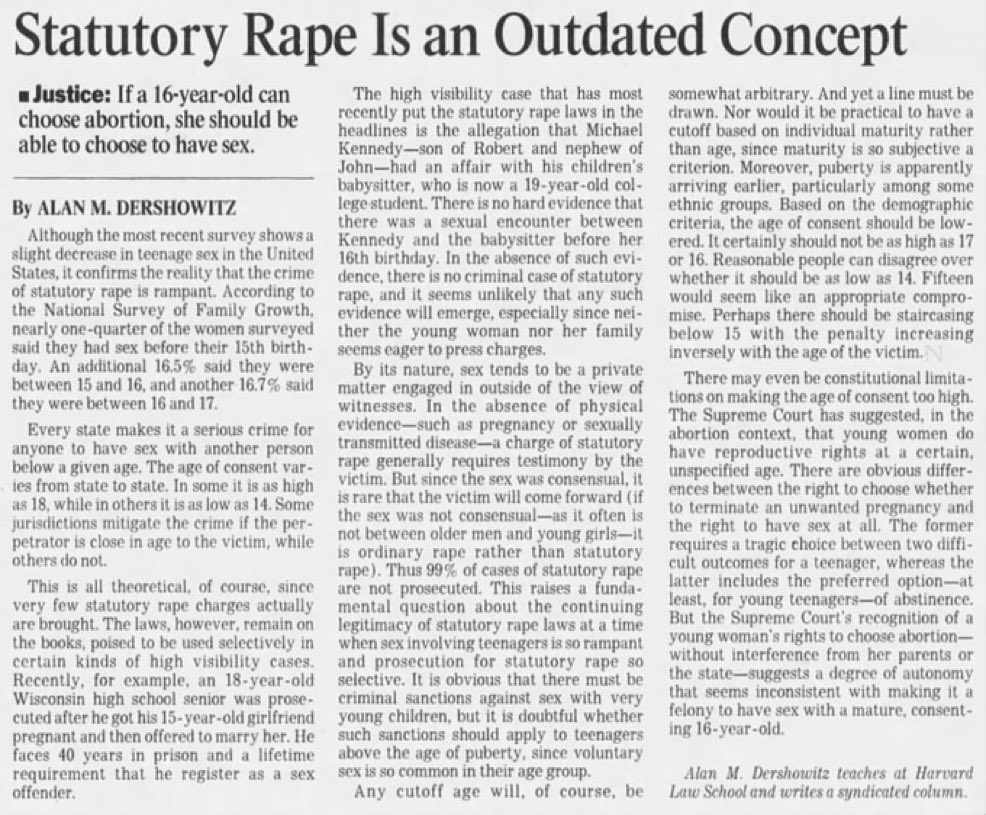
When someone argues that a 16-year-old capable of choosing abortion should be capable of choosing sex, they are making a rhetorical move. The argument has gaps—abortion concerns bodily autonomy in ways that sex with others does not; capacity for one decision doesn’t automatically transfer to capacity for another; power dynamics matter.

Fine. Point those out. Explain why the analogy fails.

But what actually happens is different. The argument is not refuted. The arguer is diagnosed. Making the argument becomes evidence of desire. Analyzing it becomes evidence of endorsement. Logic is treated as circumstantial proof of guilt.

This is not because the argument is uniquely dangerous. It’s because it threatens a stabilizing fiction: that our current legal thresholds are both pragmatically necessary and philosophically coherent. They are the former. They are not the latter. And the moral panic that greets anyone who points this out is not about protecting children. It’s about protecting the claim that our compromises are something more than compromises.

The same pattern plays out with Epstein associations. Some people knew him socially or professionally in contexts that had nothing to do with his crimes. Some people continued relationships after credible allegations emerged. Some people were directly complicit. These are different categories.

But the discourse collapses them. Everyone in the address book becomes suspect. Association becomes evidence. And anyone who suggests “we should distinguish between these cases” is immediately accused of defending predators.

This is not logic. This is moral theatre. And the fury it provokes when exposed is not righteous. It’s defensive.

The Difference Between Rhetoric and Relativism

Saying “truth equals rhetoric” sounds like relativism. It sounds like I’m claiming all positions are equal, nothing matters, anything goes.

I’m not.

I’m claiming that all positions are constructed through rhetoric, but that doesn’t make them equal. It means we should argue about them on the terms they actually operate—consequences, values, power, effects—rather than pretending one side has Logic and the other side has Emotion.

Some rhetorical constructions are more defensible than others. Age of consent laws, as constructed compromises aimed at harm reduction, are defensible. That doesn’t mean they’re philosophically coherent or that analyzing their incoherence is an attack on children.

Maintaining professional relationships with powerful people who were later revealed to be criminals does not make you guilty of their crimes. But it might raise questions about judgment, complicity, or willful blindness—questions that should be asked specifically, not universally.

The difference is this: I’m not claiming my position is Logic. I’m claiming it’s a rhetorical construction I find more defensible than the alternatives, for reasons I’m willing to argue about.

What I’m criticizing is the move where liberal discourse presents its rhetorical positions as self-evident moral truths, then treats dissent as pathology.

Why the Theoretical Version Failed

The expanded post tried to universalize the pattern—to show that this reflex appears across domains, across thinkers, across history. It succeeded at that. What it failed to do was stay grounded enough for readers to assess whether the pattern I was describing was real or whether I was constructing a persecution narrative.

The problem was strategic evasiveness. By staying abstract, the piece avoided being testable. It gestured at examples without committing to them. It borrowed authority from Foucault and Arendt without doing the work of showing how their critiques apply to the specific cases I had in mind.

This created a gap between what the essay claimed to be doing (defending analysis against moral panic) and what it was actually doing (defending specific controversial figures using theory as cover).

That gap is what critics correctly identified as bad faith.

What I Should Have Said

Here’s the honest version:

The Dershowitz argument is bad. The abortion-sex analogy doesn’t hold. But “the argument is bad” and “making the argument is evidence of pedophilia” are not the same claim. One is logical critique. The other is moral contamination. We should be able to distinguish them.

The 1977 French petitions were misjudged. Calling for the abolition of age of consent laws in that context, with those specific cases, was not wise. But signing a petition is not the same as committing the acts in question, and treating mid-century French intellectual culture as self-evidently monstrous erases the specific debates they were having about law, psychiatry, and state power. We can think they were wrong without treating the question itself as unspeakable.

Epstein’s network matters. Some associations are meaningful. Power enabled his abuse, and understanding how requires looking at who knew what and when. But not every name in a flight log or party photo is evidence of complicity, and the current discourse often treats them as such. We should distinguish between innocent contact, poor judgment, and active enablement—not flatten everything into “guilt by proximity.”

These are all messy positions. They require distinctions, context, and willingness to live in discomfort. That’s harder than moral certainty. But it’s also more honest.

The Meta-Point About AI Generation

The fact that the previous post was AI-generated does something interesting to all of this.

It was rhetorically effective. It marshaled the right theoretical authorities. It structured the argument coherently. It sounded like philosophy. And it was assembled by a pattern-matching system with no beliefs, no commitments, no stakes.

This should tell us something about the nature of rhetoric itself. The text worked—or didn’t—based on what it did, not where it came from. Authenticity is not truth. Authorship is not authority. What matters is whether the construction holds, and under what conditions.

I could have hidden the AI involvement. Many would. The disclosure feels like it undermines the argument’s authority—if a machine wrote it, does it count?

But that reaction itself proves the point. We want arguments to come from authenticated sources, from proper authority, from legitimate speakers. We want to know who’s talking so we can decide whether to trust them. This is not Logic. This is rhetoric all the way down.

The AI wrote a version of my argument that was cleaner and more theoretically sophisticated than I would have produced alone. It was also more evasive, more abstract, less committed. Those aren’t bugs in the process. They’re features of how the system generates text—maximizing coherence, minimizing controversy, staying in safe abstraction.

That I chose to post it anyway, knowing these limitations, is itself a rhetorical move. It says: “I’m willing to use mediated tools to construct my position, and I’m not pretending otherwise.”

What This Leaves Us With

I started with a claim about moral contamination—that liberal discourse treats certain kinds of inquiry as self-incriminating. I then demonstrated this by making precisely the kind of inquiry that provokes that reflex, using examples I knew would be read as defensive rather than analytical.

The responses proved the thesis. Analysis was read as confession. Theory was read as cover. Even asking whether a distinction exists between argument and endorsement was taken as evidence that no such distinction can be maintained.

But here’s what I didn’t make clear enough: I’m not claiming to be above this dynamic. I’m in it too. I have commitments, interests, and positions I’m defending. The difference is I’m naming them as such, rather than claiming they’re simply What Logic Demands.

Truth equals rhetoric. We’re all doing motivated reasoning. The question is not “who has transcended their motivations” but “whose motivations, toward what ends, with what consequences?”

I think the moral contamination reflex produces bad discourse—not because it’s emotional, but because it claims not to be. I think guilt by association is overused—not because association never matters, but because we’ve stopped distinguishing between different kinds of association. I think legal thresholds should be analyzable—not because they should be abolished, but because unexamined laws are dangerous even when well-intentioned.

These are rhetorical positions. I’m arguing for them. I’m not pretending they’re Logic Itself.

If you disagree, argue back. But argue with what I’m actually saying, not with what analysis supposedly reveals about my secret desires.

That’s all I’m asking for. And apparently, it’s too much.

Statutory Rape Is An Outdated Concept

3–5 minutes

I’ll bite. This notion is in the news again, dredged up with the Epstein Files™, as though moral panic were a renewable resource.

NB: This is the post that inspired me to write the essay on voting age restrictions.

In the newspaper clipping above, legal scholar Alan Dershowitz argues that if a 16-year-old can choose abortion, then she should be able to choose to have sex. The argument is presented as sober, rational, and juridical. A syllogism offered as disinfectant.

There are many philosophical problems with the equivalence. I am not interested in most of them.

Audio: NotebookLM summary podcast on this topic.

I’ve written before that age as a proxy for maturity collapses immediately into a Sorites paradox. It assumes commensurability where none exists. It treats human development as discretised and legible, when it is anything but. The law must draw lines. Philosophy does not have that luxury. But that is not why this argument resurfaces now.

What interests me is the moral contamination reflex it reliably provokes. The rule is tacit but rigid: if you reason calmly about a taboo subject, you must be defending it. If you defend it, you must desire it. If you desire it, you must be guilty of it. Logic becomes circumstantial evidence.

This reflex is not new. Nor is it confined to contemporary Anglo-American culture. Half a century ago, it played out publicly in France, with consequences that are now being retrospectively moralised into caricature.

In January and May of 1977, a petition published in Le Monde floated the abrogation of what was then called the “sexual majority”. In January of the same year, a separate petition called for the release of three men accused of having sex with boys and girls between the ages of twelve and fifteen. Among the signatories were Jean-Paul Sartre, Simone de Beauvoir, Roland Barthes, Michel Foucault, and Gilles Deleuze.

Today, this episode is typically invoked as a moral mic drop. No argument is examined. No context is interrogated. No distinction is drawn between legal reasoning, political provocation, and moral endorsement. The conclusion is immediate and terminal: these figures were monsters, or fools, or both.

The logic is familiar by now. If they signed, they must have approved. If they approved, they must have desired. If they desired, they must have practised. Analysis collapses into accusation.

None of this requires defending the petitions, the arguments, or the acts in question. It requires only defending a principle that has apparently become intolerable: that an argument can be examined without imputing motive, desire, or personal conduct to the person making it.

This is where liberal societies reveal a particular hypocrisy. They claim to value reasoned debate, yet routinely launder moral intuitions through rationalist language, then react with fury when someone exposes the laundering process. Legal thresholds are treated as if they were moral truths rather than negotiated compromises shaped by fear, harm minimisation, optics, and historical contingency.

Once the compromise hardens into law, the line becomes sacred. To question it is not civic scrutiny but moral trespass. To analyse it is to signal deviance. This is why figures like Foucault are not criticised for being wrong, but for having asked the question at all. The question itself becomes the crime.

It is often said, defensively, that emotion precedes logic. True enough. But this is usually offered as an excuse rather than a diagnosis. The supposed human distinction is not that we feel first, but that we can reflect on what we feel, examine it, and sometimes resist it. The historical record suggests we do this far less than we like to believe.

The real taboo here is not sex, or age, or consent. It is the suggestion that moral reasoning might survive contact with uncomfortable cases. That one might analyse the coherence of a law without endorsing the behaviour it regulates. That one might describe a moral panic without siding with its villains.

Instead, we have adopted a simpler rule: certain questions may not be asked without self-implication. This preserves moral theatre. It also guarantees that our laws remain philosophically incoherent while everyone congratulates themselves for having the correct instincts.

Logic, in this arrangement, is not a virtue. It is a liability. And history suggests that anyone who insists on using it will eventually be posthumously condemned for doing so.