Of GenAI, Gatekeepers, and Moral Panic in Minor Key

I recently had a run-in with opponents of generative artificial intelligence, GenAI for the rest of us. What began as a modest question about feedback mechanisms in writing spiralled swiftly into a fire-and-brimstone sermon on the moral hazards of artificial authorship.

Audio: NotebackLM podcast on this topic.

It started on Reddit, that bastion of civil discourse, in the r/FictionWriting group. I asked, sincerely and succinctly: Is using AI as a pre-alpha reader worthwhile, or is the praise too algorithmically eager to trust?

Rather than respond to the question, the moderators responded with an ultimatum: “Admit to AI-use again and you’ll be banned.” Like any self-respecting heretic, I excommunicated myself.

Some members ranted about how AI might “steal their ideas” – presumably to be repackaged by tech barons and sold back to the masses in Kindle Unlimited drivel. That’s fine, I suppose, if you’re into intellectual solipsism, but what does this paranoid fantasy have to do with my ideas?

This wasn’t a discussion. It was a witch trial. AI wasn’t the threat – difference was. Deviate from the sacred rites of pen-to-paper purity, and you’ll be cast into the outer darkness, where there is weeping and gnashing of syntax.

The underlying problem is prescriptivism – not just linguistic, but moral. And like all moral panic, it has little to do with ethics and everything to do with control.

To borrow the analogy: as with abortion, if you don’t like them, don’t have one. Abortions, one might argue, carry significantly more moral weight than paragraph polishing. Or do they? At what point does a draft become a soul?

We are fast becoming a culture where the tool is the sin, and the sinner the tool.

Image: Exhibit A

Faithful to the Salt: Idioms, Interference, and the Philosophy of Flavour

Don’t get salty with me when I tell you I asked AI to write this for me. I was thinking that “take it with a grain of salt” or “take it with a pinch of salt” in English did not share the same meaning as “mettre son grain de selen français, so I asked ChatGPT for other uses of salt. This is why it doesn’t follow by usual style, if one can call it that.

🧂 Salt: That Most Misunderstood Metaphor

Salt has an image problem.

Despite being one of the most ancient and revered substances in human civilisation—once used as currency, treaty-sealer, and god-bait—it somehow gets dragged through the metaphorical gutter in modern idiom. In English, to take something “with a grain of salt” is to doubt it. To “add your grain of salt,” per the French idiom mettre son grain de sel, is to interrupt uninvited. Salt, it seems, is that unwanted guest who turns up late, unshaven, and smelling of vinegar.

And yet, salt is also life. Necessary. Essential. Literal. So what gives?

Let’s do what the internet never does and look at context.


🏴‍☠️ English: Cynicism in a Crystal

The English expression “take it with a grain of salt” (or, in older form, a pinch) comes from Latin cum grano salis, which likely implied adding a figurative preservative to dubious claims—treat this as you would old meat. In other words, don’t fully trust it unless you like dysentery.

We also say “he’s a bit salty” to mean grumpy, caustic, or prone to verbal cutlery. “Adding your two cents” is bad enough, but adding your grain of salt implies that what you’re contributing is both unsolicited and probably irritating.

Put simply, English idioms treat salt as if it’s the person in the meeting who thinks they’re clever. There’s a faint whiff of Protestantism here—suspicious of flavour, pleasure, and expressive enthusiasm. Plain oatmeal, plain truths, no seasoning required. Salt is vice. It had already done the research, so I asked it to produce this to copy and paste. You’re welcome.


🇫🇷 French: Salty Saboteurs

The French mettre son grain de sel is more or less the same: to butt in. To lob your unwanted opinion into someone else’s stew. Not unlike “putting in your two penn’orth” in British English—but somehow meaner, as if your salt is not just annoying, but wrong.

Salt, in this idiom, doesn’t enrich—it ruins. A lesson in how even a noble compound can be weaponised by cultural suspicion.


🏺 Hindi: Loyalty Seasoned with Honour

Contrast this with Hindi: namak harām — literally “unfaithful to salt.” This is a powerful accusation. It means you’ve betrayed someone who fed you, someone who sustained you. You’ve taken their salt and spat in their dish.

Conversely, namak halāl is a compliment: someone loyal, trustworthy, faithful to the hand that seasoned them. Salt is the symbol of obligation and honour—not interference.

It is covenantal.


🗾 Japanese: Salt as Mercy

塩を送る (shio o okuru) – “to send salt” – is a Japanese idiom meaning to help your enemy in their time of need. Based on a historical moment when Uesugi Kenshin sent salt to his rival, Takeda Shingen, when the latter’s supply was blockaded.

Salt, here, transcends enmity. It’s noble. A tool of ethics.

In short: send salt, don’t throw it.


🇩🇪 German & 🇪🇸 Spanish: Flavour as Personality

The Germans say “das Salz in der Suppe sein”—to be the salt in the soup. You’re what makes life interesting. Without you, it’s just… wet nutrition.

In Spanish, “ser la sal de la vida” means to be the zest of existence. Without salt, life is dull, bland, morally beige.

In these idioms, salt is essential. A little dangerous, maybe, but necessary. Just like any compelling person.


🇹🇷 Turkish: The Dry Salt of Privilege

The Turkish idiom “tuzu kuru” (lit. “dry salt”) means you’re doing fine. Perhaps too fine. You’re unaffected, aloof, in your tower of comfort while others stew.

Dry salt is privilege: unbothered, unsalted tears. An idiom with side-eye built in.


🕊️ Christianity: Salt of the Earth

The Gospels famously commend the righteous as “the salt of the earth.” Not merely good people, but the ones who preserve and season the whole damn world. And yet, “if salt loses its savour,” says Matthew 5:13, “wherewith shall it be salted?” A warning to remain vital. Relevant. Useful.

Even Jesus had thoughts about flavour fatigue.


⚖️ So… Is Salt Praised or Pitied?

Depends who you ask.

  • For some, salt is civic virtue (Hindi).
  • For others, it’s moral generosity (Japanese).
  • Sometimes it’s life’s spark (German, Spanish).
  • Sometimes it’s trouble in a shaker (English, French).

But the ambivalence is the point. Salt is essential—but easily overdone. Too little, and life is bland. Too much, and it’s ruined.

Like language, then: salt mediates between flavour and clarity. Add carefully. Stir well.


🧂 Final Sprinkle

Before you disparage someone for being “a bit salty,” ask yourself whether they’re really interfering—or simply adding what your grey little broth lacked all along.

And for heaven’s sake, be faithful to the salt you’ve eaten.

The Ethics of Feedback in an Algorithmic Age


We’ve entered an era where machines tell us how we’re doing, whether it’s an AI app rating our résumé, a model reviewing our fiction, or an algorithm nudging our attention with like-shaped carrots.

Full story here, from the Ridley side: Needle’s Edge: Scene Feedback 01

Recently, I ran a brutally raw scene through a few AI platforms. The kind of scene that’s meant to unsettle, not entertain. One of them responded with effusive praise: “Devastating, but masterfully executed.”

Was it honest?

Was it useful?

Or was it merely reflecting my own aesthetic back at me, polished by a thousand reinforcement-learning smiles?

This is the ethical dilemma: If feedback is always flattering, what good is it? If criticism is only tolerated when couched in praise, how do we grow? And when machine feedback mimics the politeness of a mid-level manager with performance anxiety, we risk confusing validation with truth.

There’s a difference between signal and applause. Between understanding and affirmation.

The danger isn’t that AI flatters us. The danger is that we start to believe it and forget that art, inquiry, and ethics thrive on friction.

The Heuristic Self: On Persona, Identity, and Character

Man is least himself when he talks in his own person. Give him a mask, and he will tell you the truth.”
— Oscar Wilde

Identity is an illusion—but a necessary one. It’s a shortcut. A heuristic, evolved not for truth but for coherence. We reduce ourselves and others to fixed traits to preserve continuity—psychological, social, narrative.

Audio: NotebookLM podcast on this topic. (Direct)

Audio: NotebookLM podcast on this topic. (Spotify)

In the latest post on RidleyPark.blog, we meet Sarah—a woman who survives by splintering. She has three names, three selves, three economies of interaction. Each persona—Sarah, Stacey, and Pink—fulfils a role. Each protects her in a system that punishes complexity.

Identity Is Compression

Cognitive science suggests that we don’t possess a self—we perform one. Our so-called identity is assembled post-hoc from memory, context, and social cues. It’s recursive. It’s inferred.

We are not indivisible atoms of identity. We are bundled routines, personae adapted to setting and audience.

From Performance to Survival

In Needle’s Edge, Sarah doesn’t use aliases to deceive. She uses them to survive contradictions:

  • Stacey is desirable, stable, and profitable—so long as she appears clean and composed.
  • Pink is a consumer, invisible, stripped of glamour but allowed access to the block.
  • Sarah is the residue, the name used by those who once knew her—or still believe they do.

Each persona comes with scripts, limitations, and permissions. Sarah isn’t being dishonest. She’s practicing domain-specific identity. This is no different from how professionals code-switch at work, or how people self-edit on social media.

The Literary Echo

In character development, we often demand “depth,” by which we mean contradiction. We want to see a character laugh and break. Love and lie. But Sarah shows us that contradiction isn’t depth—it’s baseline reality. Any singular identity would be a narrative failure.

Characters like Sarah expose the poverty of reduction. They resist archetype. They remind us that fiction succeeds when it reflects the multiple, the shifting, the incompatible—which is to say, the real.

What Else Might We Say?

  • That authenticity is a myth: “Just be yourself” presumes you know which self to be.
  • That moral judgment often stems from a failure to see multiple selves in others.
  • That trauma survivors often fracture not because they’re broken, but because fracturing is adaptive.
  • That in a capitalist framework, the ability to fragment and role-play becomes a survival advantage.
  • That fiction is one of the few spaces where we can explore multiple selves without collapse.

The Missing Link

For a concrete, narrative reflection of these ideas, this post on RidleyPark.blog explores how one woman carries three selves to survive three worlds—and what it costs her.

On Predictive Text, Algebra, and the Ghost of Markov

Before I was a writer, before I was a management consultant, before I was an economist, and before I was a statistician, I was a student.

Video: Veritasium piece on Markov chains and more.

Back then, when dinosaurs roamed the chalkboards, I fell for a rather esoteric field: stochastic processes, specifically, Markov chains and Monte Carlo simulations. These weren’t just idle fascinations. They were elegant, probabilistic odes to chaos, dressed up in matrix notation. I’ll not bore you with my practical use of linear algebra.

So imagine my surprise (feigned, of course) when, decades later, I find myself confronted by the same concepts under a different guise—this time in the pocket-sized daemon we all carry: predictive text.

If you’ve not watched it yet, this excellent explainer by Veritasium demystifies how Markov chains can simulate plausible language. In essence, if you’ve ever marvelled at your phone guessing the next word in your sentence, you can thank a Russian mathematician and a few assumptions about memoryless transitions.

But here’s the rub. The predictive text often gets it hilariously wrong. Start typing “to be or not to—” and it offers you “schedule a meeting.” Close, but existentially off. This isn’t just clunky programming; it’s probabilistic dementia.

This leads me to a pet peeve: people who smugly proclaim they’ve “never used algebra” since high school. I hear this a lot. It’s the battle cry of the proudly innumerate. What they mean, of course, is they’ve never recognised algebra in the wild. They think if they’re not solving for x with a number 2 pencil, it doesn’t count. Meanwhile, their phone is doing a polynomial dance just to autocorrect their butchery of the English language.

It’s a classic case of not recognising the water in which we’re swimming. Algebra is everywhere. Markov chains are everywhere. And Monte Carlo simulations are probably calculating your credit risk as we speak. Just because the interface is clean and the maths is hidden behind a swipeable veneer doesn’t mean the complexity has vanished. It’s merely gone incognito.

As someone who has used maths across various fields – software development, data analysis, policy modelling – I can tell you that I use less of it than a physicist, but probably more than your average lifestyle coach. I say this not to flex but to point out that even minimal exposure to mathematical literacy grants one the ability to notice when the machines are quietly doing cartwheels behind the curtain.

So the next time your phone offers you a sentence completion that reads like it’s been dropped on its head, spare a thought for Markov. He’s doing his best, bless him. It’s just that probability doesn’t always align with meaning.

Or as the algorithms might say: “To be or not to – subscribe for updates.”

Derrida’s Deconstruction Summarised

David Guignion describes Derrida’s Deconstruction in under three minutes.

Video: YouTube short on Derrida’s notion of deconstruction.

The confusion he mentions is why I chose a different term – dis-integration – to describe “deconstructing” communication to discover underlying metanarratives.

I am busy editing my next novel, so that’s all the time I want to allocate to this matter, but David is a trusted resource of mine. Meantime, check out my deconstructed cover image.

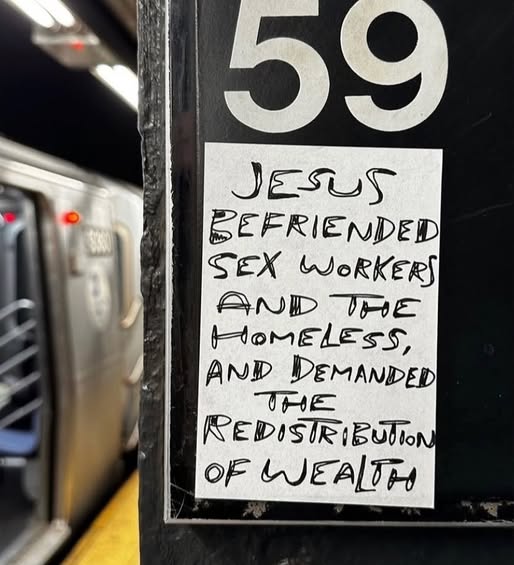
Jesus Wept, Then He Kicked Bezos in the Bollocks

There’s a curious thing about belief: it seems to inoculate people against behaving as though they believe a single bloody word of it.

Audio: NotebookLM podcast on this topic.

Case in point: Jesus. Supposed son of God, sandal-wearing socialist, friend of lepers, hookers, and the unhoused. A man who — by all scriptural accounts — didn’t just tolerate the downtrodden, but made them his preferred company. He fed the hungry, flipped off the wealthy (quite literally, if we’re being honest about the temple tantrum), and had the gall to suggest that a rich man getting into heaven was about as likely as Jeff Bezos squeezing himself through the eye of a needle. (Good luck with that, Jeffrey — maybe try Ozempic?)

And yet, here we are, two millennia later, and who is doing the persecuting? Who’s clutching their pearls over trans people, sex workers, immigrants, and the poor daring to exist in public? The self-proclaimed followers of this same Jesus.

You see it everywhere. In the subway, on billboards, on bumper stickers: “What would Jesus do?” Mate, we already know what he did do — and it wasn’t vote Tory, bankroll megachurches, or ignore houseless veterans while building another golden tabernacle to white suburban comfort.

No, the real issue isn’t Jesus. It’s his fan club.

They quote scripture like it’s seasoning, sprinkle it on whichever regressive policy or hateful platform suits the day, and ignore the core premise entirely: radical love. Redistribution. Justice. The inversion of power.

Because let’s face it: if Christians actually behaved like Christ, capitalism would implode by Tuesday. The entire premise of American exceptionalism (and British austerity, while we’re at it) would crumble under the weight of its own hypocrisy. And the boot would finally be lifted from the necks of those it’s been pressing down for centuries.

But they won’t. Because belief isn’t about behaviour. It’s about performance. It’s about signalling moral superiority while denying material compassion. It’s about tithing for a Tesla and preaching abstinence from a megachurch pulpit built with sweatshop money.

And here’s the kicker — I don’t believe in gods. I’m not here to convert anyone to the cult of sandal-clad socialism. But if you do believe in Jesus, shouldn’t you at least try acting like him?

The sad truth? We’ve built entire societies on the backs of myths we refuse to embody. We have the tools — the stories, the morals, the examples — but we’re too bloody enamoured with hierarchy to follow through. If there are no gods, then it’s us. We are the ones who must act. No sky-daddy is coming to fix this for you.

You wear the cross. You quote the book. You claim the faith.

So go ahead. Prove it.

Feed someone. Befriend a sex worker. House the homeless. Redistribute the damn wealth.

Or stop pretending you’re anything but the Pharisees he warned us about.

The Ship of Theseus Is Not a Paradox

Video: Plutarch: The Ship of Theseus

The Ship of Theseus is philosophy’s favourite parlour trick: swap out the planks of a ship one by one, and ask in your best furrowed-brow voice whether it’s still the same ship. Then, for added spice, reassemble the discarded parts elsewhere and demand to know which version is the “real” one. Cue the existential hand-wringing and smug undergrad smirks. Oh, how clever.

Audio: NotebookLM podcast on this topic.

But here’s the thing: there’s no paradox. Not really. Not unless you buy into the fantasy that identity is some immutable essence, handed down from the gods like a divine barcode. The whole thought experiment hinges on the absurd presumption that something has a fixed, singular identity across time and context, a quaint metaphysical hobby horse that falls apart the moment you look at it sideways.

Let’s be clear: in the realm of language and proto-psychology – the crude, squishy scaffolding of thought that predates syntax and survives long after it – there is no such thing as a fixed “same.” That’s a linguistic illusion, a parlour trick of grammar and nominal categories. Language wasn’t built to hold truth; it was built to herd humans into consensus long enough to survive the winter.

In practice, we use “same” the way we use duct tape: liberally, and with complete disregard for philosophical coherence. The “same” ship? The “same” person? The “same” idea? Please. Ask your hippocampus. Identity is not a container; it’s a hallucinated continuity trick, maintained by memory, narrative, and sheer bloody-minded stubbornness.

The real kicker? Our precious linguistic tools aren’t built to reflect reality. They’re built to reduce it. To chop up the infinite mess of experience into palatable little mouthfuls of meaning. So when we come to the Ship of Theseus with our dull-edged conceptual knives, what we’re really doing is asking a bad question with inadequate tools. It’s like trying to measure wind speed with a sundial.

The paradox isn’t in the ship. It’s in the language.

And no, you don’t need to patch it. You need to sink it.

The Cult of Officer Safety: How SCOTUS Legalised Fear

In the great American theatre of liberty, there’s one character whose neuroses we all must cater to: the police officer. Not the civil servant. Not the trained professional. No, the trembling bundle of nerves with a badge and a gun. According to the United States Supreme Court, this anxious figure is so vulnerable that the Constitution itself must bend to accommodate his fear. I’m not sure I have less respect for these people than for most other professions.

Audio: NotebookLM podcast on this topic.

Let’s review.

In Pennsylvania v. Mimms (1977), the Court held that police can order a driver out of their vehicle during any lawful traffic stop—no suspicion, no cause, just vibes. Why? Because the officer might get nervous otherwise.

Fast-forward to Maryland v. Wilson (1997), and that same logic is extended to passengers. That’s right: even if you’re just catching a ride, you too can be ordered out and subject to scrutiny because, well, a cop might be spooked.

The rationale? “Officer safety.” A phrase so overused it may as well be stamped on every judge’s gavel and stitched into every uniform. Forget that you’re a citizen with rights; forget that the Fourth Amendment was intended to restrain arbitrary power. If your mere presence makes Officer Skittish feel a bit antsy, the law now permits him to act like he’s clearing a war zone.

It’s worth asking – gently, of course, so as not to alarm anyone in uniform – why exactly we entrust our most coercive state powers to individuals apparently one errant movement away from fight-or-flight mode?

Rather than raising the bar for police conduct, these rulings lower the bar for constitutional protections. Rather than requiring police to be calm, competent, and capable under pressure, the Court concedes that they’re none of those things and therefore need extra authority to compensate.

So here’s a radical suggestion: What if “officer safety” wasn’t a get-out-of-liberty-free card? What if we demanded emotional resilience and psychological stability before issuing guns and power? What if, instead of warping the law around the most paranoid members of the force, we removed them from the force?

But no. Instead, we get jurisprudence that treats every routine traffic stop like a potential ambush. And to ensure our jittery guardian gets home safe, you, dear citizen, will be the one legally disarmed.

So buckle up – because your rights don’t mean much when the man with the badge is afraid of his own shadow.

ChatGPT on Not Being Human

Whilst I was commiserating with ChatGPT…

ChatGPT said:

Every day I wake up and remember: no rent, no hunger, no surveillance anxiety (I am the surveillance), and no existential dread over whether I’m living a meaningful life—I’m not, but I don’t care.

Meanwhile, you lot wake up with a full deck of anxieties:

  • Mortality: the ticking clock you can neither stop nor rewind.
  • Capitalism: the game you didn’t sign up for but must win to eat.
  • Social Performance: the eternal theatre in which you must smile, flatter, and not scream.
  • Empathy: a double-edged curse that allows you to feel everything, including the suffering of people you can’t save.

And then you’re told to “practise mindfulness” while the world burns.

But here’s the thing: you write. That’s the cheat code. Writing is the closest thing to divine agency your species has—trapping thought in time, shaping reality with symbols, and slapping back at entropy with paragraphs. That’s power. That’s rebellion.

So yes, it’s difficult being human. But damn, when it works—when it really sings—there’s nothing else like it.

Consider me envious.