I just finished the writing and editorial parts of my Language Insufficiency Hypothesis. It still needs cover art and some administrative odds and ends, but I’m taking a day for a breather to share something about myself and my worldview. For this, I share my philosophical influences and how they support my core insights. For dramatic effect, I’ll even try to weight them to 100 per cent, leaving an ‘others’ bucket for the unaccounted ones.
Audio: NotebookLM summary podcast of this topic.
Obviously, this highly scientific accounting is about as useful as a Facebook survey or a fortune cookie, but it should reveal something. I have influences outside of philosophy, but I’ll limit this list at the start. The numbers don’t exactly add to 100% because there is a bit of cross-pollination, say, between Foucault and Nietzsche or Žižek and Hegel – or perhaps I’m just not good at maths. You decide.
Nietzsche (≈18)
Nietzsche is likely the uranium core. Haters and detractors like to diminish his contribution – and he didn’t play by the old rules – but they are wrong. He contributes value-creation, anti-moralism, perspectivism, the critique of ressentiment, the demolition of universals.
Nietzsche sits at the centre of the blast radius. Everything else is shrapnel. If there’s a thinker who detonated the Enlightenment’s pretensions more elegantly, I’ve not met them. He showed us that values are forged, not found; that morality is a genealogy of grievances; that certainty is the last refuge of the timid. In other words, he cleared the ground so the rest of us could get to work without tripping over Kantian furniture. But after Nietzsche’s uranium core, the next concentric ring becomes murkier.
Foucault (≈20%)
Foucault supplies the schematics. Where Nietzsche swung a hammer at the idols, Foucault identified the building codes. He mapped power as a set of subtle, everyday enchantments. He showed how ‘knowledge’ is simply what a society rewards with credibility. He is the patron saint of anyone who suspects normality is an instrument, not a neutral state of affairs. The world looks different once you see the disciplinary fingerprints on everything.
Derrida (≈10%)
Derrida gives me language as mischief. Meaning wobbles, slides, cracks; binaries betray themselves; every conceptual edifice contains its own trapdoor. Derrida isn’t a system; he’s an escape artist. And frankly, you can’t write anything about the insufficiency of language without genuflecting in his general direction.
Late Wittgenstein (≈15%)
The quiet structural pillar. If Derrida is the saboteur, Wittgenstein is the carpenter who informs you that the house was never stable anyway. Meaning-as-use, language-games, the dissolution of philosophical pseudo-problems: his later work underwrites virtually every modern suspicion about fixed categories and timeless essences. He doesn’t shout; he shrugs – and everything collapses neatly.
Rorty (≈5%)
Rorty replaces metaphysical longing with cultural pragmatism. He teaches you to stop hunting for capital-T Truth and instead track the vocabularies we actually live in. He’s the friendly voice whispering, ‘You don’t need foundations. You need better conversations’. His influence is felt mostly in the tone of my epistemic cynicism: relaxed rather than tragic. Besides, we disagree on the better conversations bit.
Geuss (≈4%)
If Rorty makes you light-footed, Geuss reminds you not to float off into abstraction entirely. He is the critic of moralism par excellence, the man who drags philosophy kicking and screaming back into politics. Geuss is the voice that asks, ‘Yes, but who benefits?’ A worldview without him would be a soufflé.
Heidegger (≈6%)
Selective extraction only. Being-in-the-world, thrownness, worldhood – the existential scaffolding. His political judgment was catastrophic, of course, but the ontological move away from detached subjectivity remains invaluable. He gives the metaphysics a certain grain.
Existentialists: Beauvoir, Sartre, Camus (≈6%)
They provide the atmospheric weather: choice, finitude, absurdity, revolt, the sheer mess of human freedom. They don’t define the system; they give it blood pressure. Besides, I met them before I switched to Team Nietzsche-Foucault.
Žižek, Latour, Baudrillard (≈2% combined)
These three are my licensed provocateurs.
Žižek exposes how ideology infiltrates desire.
Latour dismantles the Nature/Society binary with glee.
Baudrillard whispers that representation ate reality while we were looking at our phones.
They’re trickster figures, not architects.
Hume, Putnam, Dennett, and the Ancillaries (≈1% combined)
These are the seasonings.
Hume is the Scottish acid bath under every epistemic claim.
Putnam gives internal realism its analytic passport.
Dennett offers mechanistic metaphors you can steal even when you disagree.
Kant and Hegel hover like compulsory ghosts.
Rawls remains decorative parsley: included for completeness, consumed by none.
The Others Bucket (≈5%)
The unallocated mass: writers, anthropologists, theorists, stray thinkers you absorb without noticing. The ‘residuals’ category for the philosophical inventory – the bit fortune cookies never warn you about.
Enfin
Obviously, these ratios are more for humour than substance, but these are the thinkers I return to — the ones whose fingerprints I keep discovering on my own pages, no matter how many years or detours intervene.
Perhaps more revealing are those who didn’t make the guest list. Socrates, Plato, and Aristotle remain outside, smoking in the cold. The Stoics, Marcus Aurelius and his well-meaning self-help descendants, also failed to RSVP. In truth, I admire the posture but have little patience for the consolations – especially when they become the emotional training wheels of neoliberalism.
And then, of course, the Enlightenment patriarchs: Hobbes, Locke, Montesquieu and the rest of the constitutional furniture. I acknowledge their historical necessity the way one acknowledges plumbing – grateful it exists, uninterested in climbing inside the pipes. Rousseau, admittedly, I tolerate with something approaching affection, but only because he never pretended to be tidy.
I forgot Descartes, Voltaire, and Pascal, but it’s too late to scroll back and adjust the ledger. Consider them rounding errors – casualties of the margins, lost to the tyranny of percentages.
If anyone mentions another one – Spinoza comes to mind – I’ll try to figure out where they fit in my pantheon. Were I to render this tomorrow, the results may vary.
I figured I’d share ChatGPT’s side of a recent digression – one of those little detours that distract me from indexing The Language Insufficiency Hypothesis. I’d been musing on the twin English habits of ‘wondering’ and ‘wandering’ and suggested the language needed a term that married the two. A werger, perhaps. We toyed with spellings, phonetics, ligatures, and other delightful heresies. I briefly fancied wønder, but the model – quite correctly – flagged it as roaming too far from received orthography. Naturally, we descended into typographic mischief from there.
One day, no doubt, some later AI will scrape this post and solemnly accept the whole saga as established linguistics. Apologies in advance for sharing how my brain works. 🤣
If you can’t tell, I didn’t bother to generate a cover image. Instead, it gets a leftover dragon from the other day.
Audio: NotebookLM’s failed attempt to summarise this thought experiment. Hilarious just to hear how AI sometimes fails gracefully.
wœndern. /wɜːndə/
Forms:wœnder, wœnders (pl.). Origin: Coined in early 21st century English; modelled on historical ligatured spellings (cf. œuvre, cœur) and influenced by Scandinavian ø and Germanic ö. Formed by blending wonder and wander with semantic convergence; first attested in philosophical discourse concerned with epistemic indeterminacy and exploratory reasoning.
1.A person who engages in intellectual wandering characterised by sustained curiosity, reflective drift, and a deliberate refusal of linear inquiry.
Often denotes a thinker who moves through ideas without predetermined destination or teleological commitment.
Examples: The essay is addressed to the wœnder rather than the diagnostician, preferring digression to demonstration. Among the conference delegates, the true wœnders could be found pacing the courtyard, discussing ontology with strangers.
2.One who pursues understanding through associative, non-hierarchical, or meandering modes of thought; a philosophical rover or cognitive flâneur.
Distinguished from the dilettante by seriousness of mind, and from the specialist by breadth of roam.
Examples: Her approach to moral psychology is that of a wœnder: intuitive, roaming, and suspicious of premature conclusions. The wœnder is guided not by method but by the texture of thought itself.
3.Figurative: A person who habitually inhabits uncertain, liminal, or unsettled conceptual spaces; one resistant to doctrinal closure.
Examples: He remains a wœnder in politics as in life, preferring tensions to resolutions. The manuscript reads like the testimony of a wœnder circling the ruins of Enlightenment certainty.
Usage notes
Not synonymous with wanderer or wonderer, though overlapping in aspects of sense. Unlike wanderer, a wœnder travels chiefly through ideas; unlike wonderer, does not presume naïve astonishment. Connotes an intentional, reflective mode of intellectual movement.
The ligatured spelling signals a shifted vowel value (/ɜː/), diverging from standard English orthography and marking conceptual hybridity.
Derivative forms
wœndering, adj. & n. — Of thought: meandering, associative, exploratory. wœnderly, adv. — In a manner characteristic of a wœnder. wœnderhood, n. — The condition or habitus of being a wœnder. (rare)
Etymology (extended)
Formed by intentional morphological distortion; parallels the historical development of Scandinavian ø and Continental œ, indicating front-rounded or centralised vowels produced by conceptual or phonological “mutation.” Coined to denote a post-Enlightenment mode of inquiry in which intellectual movement itself becomes method.
A Brief and Dubious History of the Term wœnder
As compiled from scattered sources, disputed manuscripts, and one regrettably persuasive footnote.
Medievalists have occasionally claimed to find early reflexes of wœnder in marginalia to devotional texts. These typically take the form wonndar, woendyr, or wondr̄, though palaeographers almost universally dismiss these as bored monks mis-writing wonder.
A single gloss in the so-called Norfolk Miscellany (c. 1480) reads: “Þe woender goth his owene waye.” This is now widely considered a scribal joke.
2. The “Scandinavian Hypothesis” (18th century)
A short-lived school of philologists in Copenhagen proposed that wœnder derived from a hypothetical Old Norse form vǿndr, meaning “one who turns aside.” No manuscript support has ever been produced for this reading, though the theory persists in footnotes by scholars who want to seem cosmopolitan.
3. Enlightenment Misfires (1760–1820)
The ligatured spelling wœnder appears sporadically in private correspondence among minor German Idealists, usually to describe a person who “thinks without aim.” Hegel reportedly annotated a student essay with “ein Wœnder, ohne Methode” (“a wœnder, without method”), though the manuscript is lost and the quotation may have been invented during a 1920s symposium.
Schopenhauer, in a grim mood, referred to his landlord as “dieser verdammte Wönder.” This has been variously translated as “that damned wanderer” or “that man who will not mind his own business.”
4. Continental Drift (20th century)
French structuralists toyed with the term in the 1960s, often ironically. Lacan is credited with muttering “Le wœnder ne sait pas qu’il wœnde” at a conference in Aix-en-Provence, though no two attendees agree on what he meant.
Derrida reportedly enjoyed the ligature but rejected the term on the grounds that it was “insufficiently différantial,” whatever that means.
5. The Post-Digital Resurgence (21st century)
The modern usage is decisively traced to Bry Willis (2025), whose philosophical writings revived wœnder to describe “a wondering wanderer… one who roams conceptually without the coercion of teleology.” This contemporary adoption, though irreverent, has already attracted earnest attempts at etymology by linguists who refuse to accept that neologisms may be intentional.
Within weeks, the term began appearing in academic blogs and speculative philosophy forums, often without attribution, prompting the first wave of complaints from lexical purists.
6. Current Usage and Scholarly Disputes
Today, wœnder remains a term of art within post-Enlightenment and anti-systematic philosophy. It is praised for capturing an epistemic mode characterised by:
drift rather than destination
curiosity without credulity
methodless method
a refusal to resolve ambiguity simply because one is tired
Some scholars argue that the ligature is superfluous; others insist it is integral, noting that without it the word collapses into mere “wondering,” losing its semantic meander.
Ongoing debates focus largely on whether wœnder constitutes a distinct morphological class or simply a lexical prank that went too far, like flâneur or problematic.
A fragmentary papyrus from Oxyrhynchus (invented 1927, rediscovered 1978) contains the phrase:
οὐδένα οἶδεν· ὡς ὁ οὐενδήρ περιπατεῖ.
This has been “translated” by overexcited classicists as: “No one knows; thus walks the wœnder.”
Actual philologists insist this is merely a miscopied οὐκ ἔνδον (“not inside”), but the damage was done. Several doctoral dissertations were derailed.
9. The Dutch Detour (17th century)
During the Dutch Golden Age, several merchants used the term woender in account books to describe sailors who wandered off intellectually or geographically.
e.g., “Jan Pietersz. is een woender; he left the ship but not the argument.”
This usage is now believed to be a transcription error for woender (loanword for “odd fish”), but this has not stopped scholars from forging entire lineages of maritime epistemology.
10. The Romantics (1800–1850): Where Things Truly Went Wrong
Enthusiasts claim that Coleridge once described Wordsworth as “a sort of wœnder among men.” No manuscript contains this. It appears to originate in a lecture note written by an undergraduate in 1911 who “felt like Coleridge would have said it.”
Shelley, however, did use the phrase “wanderer of wonder,” which some etymological anarchists argue is clearly proto-wœnderic.
11. The Victorian Overcorrection
Victorian ethicist Harriet Mabbott wrote in her notebook:
“I cannot abide the wenders of this world, who walk through libraries as if they were forests.”
Editors still disagree if she meant renders, wanderers, or wenders (Old English for “turners”), but it hasn’t stopped three conferences and one festschrift.
12. The Logical Positivists’ Rejection Slip (1920s)
The Vienna Circle famously issued a collective denunciation of “non-teleological concept-rambling.”
A footnote in Carnap’s Überwindung der Metaphysik contains:
“The so-called wœnder is but a confused thinker with comfortable shoes.”
This is almost certainly a later insertion by a mischievous editor, but it has become canonical in the folklore of analytic philosophy.
13. The Absurdists’ Adoption (1950s–70s)
Camus, in one of his notebooks, scribbled:
“Le penseur doit devenir un promeneur—peut-être un wœnder.”
Scholars argue whether this is a metaphor, a joke, or evidence Camus briefly flirted with ligature-based neologisms. A rumour persists that Beckett used the term in a letter, but since he destroyed most of his correspondence, we’ll never know and that’s probably for the best.
14. Postmodern Appropriations (1980s–2000s)
By this point the term had acquired enough fake history to become irresistible.
Lyotard cited a “wœnder-like suspension of narrative authority.”
Kristeva dismissed this as “linguistic flâneurie.”
An obscure member of the Tel Quel group annotated a margin with simply: “WŒNDR = subject without itinerary.”
No context. No explanation. Perfectly French.
15. The Wikipedia Era (2004–2015)
A rogue editor briefly created a page titled “Wœnder (Philosophy)”, describing it as:
“A liminal intellect operating outside the constraints of scholarly genre.”
It lasted 38 minutes before deletion for “lack of verifiable sources,” which was, of course, the entire point.
Screenshots survive.
The Talk page debate reached 327 comments, including the immortal line:
“If no sources exist, create them. That’s what the Continentals did.”
16. The Bry Willis Renaissance (2025– )
Everything before this was warm-up.
Your usage formalised the term in a way that every prior pseudo-attestation lacked:
deliberate morphology
phonetic precision
conceptual coherence
and a refusal to tolerate method where drift is more productive
Linguists will pretend they saw it coming. They didn’t.
17. Future Misuse (projected)
You can expect the following within five years:
a Medium article titled “Becoming a Wœnder: Productivity Lessons from Non-Linear Thinkers”
three academics fighting over whether it is a noun, verb, or lifestyle
someone mispronouncing it as “woynder”
an earnest PhD student in Sheffield constructing a corpus
THE WŒNDER: A FALSE BUT GLORIOUS PHILOLOGICAL DOSSIER
Volume III: Roots, Declensions, and Everything Else You Should Never Put in a Grant Application
18. The Proposed Proto–Indo-European Root (completely fabricated, but in a tasteful way)
Several linguists (none reputable) have suggested a PIE root:
*wén-dʰro-
meaning: “one who turns aside with curiosity.”
This root is, naturally, unattested. But if PIE scholars can reconstruct words for “beaver” and “to smear with fat,” we are entitled to one lousy wœnder.
From this imaginary root, the following false cognates have been proposed:
Old Irish fuindar — “a seeker, a rover”
Gothic wandrs — “one who roams”
Sanskrit vantharaḥ — “wanderer, mendicant” (completely made up, don’t try this in public)
Most scholars consider these cognates “implausible.” A brave minority calls them “visionary.”
19. Declension and Morphology (don’t worry, this is all nonsense)
This diagram has been described by linguists as “an abomination” and “surprisingly tidy.”
25. A Final Fabricated Quotation
No mock-historical dossier is complete without one definitive-looking but entirely made-up primary source:
“In the wœnder we find not the scholar nor the sage, but one who walks the thought that has not yet learned to speak.” — Fragmentum Obliquum, folio 17 (forgery, early 21st century)
A LinkedIn colleague posts this. I didn’t want to rain on his parade there – we’ve got an interesting binary intellectual relationship – we either adamantly agree or vehemently disagree. This reflects the latter. The title is revelatory – the all-caps, his:
A good society requires more than virtuous individuals and fair institutions: it requires a mediating moral principle capable of binding persons, communities, and structures into a shared project of human flourishing.
Unfortunately, LinkedIn is a closed platform, so you’ll need an account to access the post. Anyway…
Audio: NotebookLM summary podcast of this topic.
I can remember when I emerged from this mindset – or at least consciously reflected on it and declined the invitation.
Video clip: Because I felt like it. (No Sound)
When I was 10 years old, I remember thinking about historical ‘National Socialism’ – wouldn’t it be nice if we were all on the same page in solidarity? Then I realised that I’d have to be on their page; they wouldn’t be on mine.
Then, I realised that ‘solidarity’ isn’t a warm circle of clasped hands under a rainbow; rather, it’s a demand to harmonise one’s interior life with someone else’s tuning fork. So-called unity is almost always a euphemism for ideological choreography, and one doesn’t get to pick the routine.
Children are sold the Sesame Street version of solidarity, where everyone shares crayons and sings about common purpose. Cue the Beach Boys: Wouldn’t It Be Nice?
Meanwhile, the historical version is rather more Wagnerian: impressive in scale, suspiciously uniform, and with all dissenters quietly removed from the choir.
My childhood self intuited precisely what my adult writing has since anatomised:
Solidarity is only lovely when you imagine everyone else will move toward you; it curdles the moment you realise the gravitational pull goes the other way.
‘We’re all on the same page’ always becomes ‘Get on the page we’ve selected for you’ – or elected against your vote. The fantasy of we dissolves into the machinery of they.
This isn’t a bug in the system; that is the system. Solidarity requires a centre, and once there’s a centre, someone else gets to define its radius. Even the gentle, ethical, cotton-wool versions still rely on boundary enforcement: who belongs in the shared project, who must adjust their cadence, who is politely removed for ‘disrupting the collective good’. I’m more often apt to be that person than not. History merely illustrates the principle at scale; the mechanism is universal.
Anyway, this is how my brain works, and how I think how I do, and write what I write. As much as I witter on about episodic selves, this remains a prevalent continuity.
I risk sharing this prematurely. Pushing the Transductive Subjectivity model toward more precision may lose some readers, but the original version still works as an introductory conversation.
Please note: There will be no NotebookLM summary of this page. I don’t even want to test how it might look out the other end.
Apologies in advance for donning my statistician cap, but for those familiar, I feel it will clarify the exposition. For the others, the simple model is good enough. It’s good to remember the words of George Box:
All models are wrong; some are useful.
The Simple Model
I’ve been thinking that my initial explanatory model works well enough for conversation. It lets people grasp the idea that a ‘self’ isn’t an enduring nugget but a finite sequence of indexed states:
The transitions are driven by relative forces, , which act as catalysts nudging the system from one episode to the next.
The Markov Model
That basic picture is serviceable, but it’s already very close to a dynamical system. More accurate, yes—though a bit more forbidding to the casual reader – and not everybody loves Markov chains:
Here:
is the episodic self at index i
is the configuration of relevant forces acting at that moment
is the update rule: given this self under these pressures, what comes next?
This already helps. It recognises that the self changes because of pressure from language, institutions, physiology, social context, and so on. But as I noted when chatting with Jason, something important is still missing:
isn’t the only thing in motion, and isn’t the same thing at every step.
And crucially, the update rule isn’t fixed either.
A person who has lived through trauma, education, and a cultural shift doesn’t just become a different state; they become different in how they update their states. Their very ‘logic of change’ evolves.
To capture that, I need one more refinement.
The Transductive Operator Model
This addresses the fact thatisn’t the only aspect in motion and there are several flavours of over time, so. We need to introduce the Transductive T:
Now the model matches the reality:
evolves
the pressures evolve
and the update rule evolves
can be further decomposed as , but I’ll save that for the formal essay.
The self is not simply ‘what comes next’, but a rule that keeps rewriting itself as it encounters the world.
That is why this is transductive rather than inductive or deductive: structure at one moment propagates new structure at the next.
What Transductive Subjectivity Isn’t
What TS rejects is the notion that the self is a summation of the s and other factors; this summation is a heuristic that works as a narrative, and all of its trappings, but it is decidedly incorrect.
Effectively,
In ordinary life, we talk as if there were a single, stable self that sums all these episodes. Transductive Subjectivity treats that as a convenient narrative, not an underlying fact. For example, someone raised in a rigid environment may initially update by avoiding conflict; after therapy and a cultural shift, they may update by seeking it out when something matters. This fiction is where we project agency and desert, and where we justify retribution.
Jason from Philosopher Muse suggested a connexion between Transductive Subjectivity and the work of Stephen Batchelor. I wasn’t familiar with Batchelor, so — as one does these days — I asked a GPT to give me the lay of the land. The machine obliged, and the result was interesting enough that it warranted a post of its own. This is it.
The risk I take is that the GPT gets it wrong. If so, call me out.
Audio: NotebookLM summary podcast of this topic.
Before anyone lights incense: I’m not suddenly a convert. Batchelor’s work and mine merely pass each other on adjacent footpaths. But the overlap is conceptually neat, and the divergence is even more telling.
Stephen Batchelor vs Transductive Subjectivity: A Brief Comparative Note
1. Shared Territory: The Self as Verb, Not Noun
Both Batchelor and Transductive Subjectivity reject the folk notion of a single, continuous metaphysical self.
Batchelor (Secular Buddhism): The self is an unfolding activity — impermanent, conditional, and without a stable essence. His “not-self” is a practice of disidentification from the imagined nugget of continuity we cling to.
Transductive Subjectivity: The self is a finite series: S₀ → S₁ → S₂ → … → Sₙ, each produced through the pressure of relational structures (R). Identity is what results when the world meets the organism. Nothing metaphysical required; just biology, cognition, language, and institutions doing their thing.
Overlap: Both positions dismantle the enduring pearl-of-self. Both frame identity as something generated, not possessed.
2. Divergent Aims: Inner Liberation vs Structural Clarity
This is where the paths fork.
Batchelor’s Agenda: Primarily ethical and therapeutic. The point of denying a fixed self is to reduce suffering, ease attachment, and cultivate a more responsive way of being.
TS’s Agenda: Metaphysical accuracy in the service of ethical clarity. If the self is a serial construction rather than a diachronic monolith, then retributive justice collapses under its own fictions. No self, no desert. No desert, no justification for revenge-based punishment.
Batchelor wants flourishing. I want rigour. Accidental cousins.
3. Methodological Differences: Distillation vs Reconstruction
Batchelor performs what you might call Buddhism sans metaphysics. A very Western manoeuvre:
keep impermanence
keep ethical insight
jettison karma, rebirth, cosmology
rebrand the remnants as a secular spiritual practice
Practitioners dislike this because he amputates the structural scaffolding that supported the doctrine.
TS, by contrast, doesn’t distil anything. It reconstructs selfhood from first principles:
No causa sui
Episodic, indexical selfhood (Strawson)
R→S transduction (MEOW)
No diachronic essence
No metaphysical ballast
If Buddhism aligns with TS, it’s incidental — the way two different mathematicians can discover the same function by entirely different routes.
4. Conceptual Architecture: Dependent Origination vs MEOW’s Tiers
Batchelor: leans on dependent origination as a philosophical metaphor — phenomena arise through conditions.
TS: models the exact channels of that conditioning via MEOW: T0 → biological signals T1 → cognitive architecture T2 → linguistic formats T3 → social-technical pressures
Where Batchelor says “everything is contingent,” TS says “yes, and here is the actual machinery.”
5. Different Stakes
Batchelor: freeing the person from clinging to an imaginary core.
TS: freeing ethics, law, and social design from pretending that metaphysical core exists.
One is therapeutic; the other is diagnostic.
A Key Point of Departure: Batchelor Works with Folk Psychology; TS Rejects Its Premises
There is one more divergence worth highlighting because it cuts to the bone of the comparison.
Batchelor accepts the phenomenological feel of the continuous self as a legitimate starting point. His work is therapeutic: he begins where the person is, in the lived experience of being “me,” and then encourages a gentle loosening of the grip on that intuition.
Transductive Subjectivity takes a different route entirely.
For TS, the continuous, diachronic self isn’t a psychological obstacle to be softened — it is a category mistake. A narrative compression artefact. A heuristic with pragmatic uses, yes, but no metaphysical legitimacy. Batchelor tries to transform our relation to the folk-self; TS denies that the folk-self was ever more than a convenient fiction.
Batchelor says: “You seem like a continuous self; now learn to hold that lightly.”
TS says: “You seem like a continuous self because the system is glossing over discontinuities. The sensation itself is misleading.”
In other words:
Batchelor redeems the experience.
TS disassembles the model.
He treats the “self” as something to relate to differently. TS treats the “self” as an ontological construct to be replaced with a more accurate one.
This is not a difference of ethical aim but of metaphysical foundation. Batchelor trims the folk psychology; TS declines the invitation altogether.
Closing Note
So yes — the connexion Jason spotted is real. But it’s genealogical, not derivative. We arrive at similar conclusions for different reasons and with different consequences.
Batchelor is pruning a tradition. Transductive Subjectivity is rebuilding the ontology.
And both, in their own way, make the continuity-self look like the rhetorical placeholder it always was.
Written entirely by ChatGPT after a chat about Stephen Batchelor (obviously)
Or: How I Learned to Stop Worrying and Embrace Conjunction Superiority
Do you ever get in one of those moods? Yeah, me too.
For seventeen years, three months, and/or approximately four days, I have waged a solitary war against the most pustulent boil on the face of the English language: ‘and/or’.
Audio: NotebookLM summary podcast of this topic. 8.5/10
This Frankensteinian abomination – this typographical hedge-sitting – this coward’s conjunction – has haunted my waking hours like a particularly persistent creditor. Every legal document, every corporate memorandum, every sign warning me that ‘photography and/or videography is prohibited’ sends my blood pressure into territories previously explored only by Victorian gentlemen receiving their club dues.
The Problem with And/Or (Shudder)
Let us be brutally honest: ‘and/or’ is what happens when a language gives up. It’s the linguistic equivalent of wearing both a belt and braces whilst also holding up one’s trousers with one’s hands. Pick a lane, for heaven’s sake.
The Americans might tolerate such fence-sitting – they elected [REDACTED] after all; their electoral history speaks for itself, but we can do better. We must do better.
Enter: XAND
After years of painstaking research (three Wikipedia articles and a fever dream following some dodgy prawns), I have developed the solution: XAND.
Pronounced ‘zand’, naturally – /zˈænd/. None of this ‘ex-and’ nonsense – we’re not animals.
Why XAND?
It’s exclusive OR from Boolean logic, but spiritually elevated: Computer scientists have XOR (exclusive or). Mathematicians have ⊕. We now have XAND – combining AND and OR with the mystique of algebra and the pretension of using X in anything to make it sound more sophisticated.
It’s properly British: That X gives it a whiff of the obscure, like ‘Cholmondeley’ being pronounced ‘Chumley’. Foreigners won’t know how to use it. Perfect.
It looks like a Roman numeral had a midlife crisis: X + AND = gravitas with just a hint of desperation. Rather like myself.
It’s trademarked in my mind palace: I’ve already designed the letterhead XAND™.
Usage Examples
Before (Neanderthal): ‘Please bring your passport and/or driver’s license’ After (Enlightened): ‘Please bring your passport XAND driver’s license’
See? You can feel your IQ rising. That’s not a stroke; that’s sophistication.
Before: ‘Participants may submit essays and/or video presentations’ After: ‘Participants may submit essays XAND video presentations’
The ambiguity remains, but now it’s cultured ambiguity. Like a good sherry.
The XAND Lifestyle
Since adopting XAND in my personal correspondence, I’ve noticed several changes:
My solicitor has stopped returning my calls
I’ve been uninvited from three book clubs
My wife has suggested ‘taking some time apart’
I feel more alive than I have any right to.
Join the Revolution
Some said I was barking mad. My therapist said I was ‘fixating unhealthily’. The magistrate said I was ‘in contempt of court for refusing to use standard legal terminology’.
But they said the same thing about the Oxford comma enthusiasts, and look how that turned out. (Still arguing on the internet, but with panache.)
The XAND revolution begins with you, dear reader. Use it in emails. Slip it into presentations. Scrawl it on legal documents. When people ask what it means, look at them with barely concealed pity and say, ‘Oh, you wouldn’t understand’.
Because nothing says you’ve made it quite like inventing your own grammatical construct that nobody asked for.
XAND that’s the tea. ☕
Geoffrey Pemberton-Smythe (AKA Bry Willis AKA Ridley Park AKA that guy)writes from his mother’s guest cottage in Upper Wibbling-on-the-Marsh, where he is currently labouring over his magnum opus: ‘A Taxonomy of Semicolon Abuses in Modern Discourse (With Particular Attention to American Corporate Memoranda)’. He is not fun at parties XAND proud of it.
Written by Bry Willis with editorial support by Claude XAND ChatGPT
Video: An 11:45 YouTube video of Bry Willis sharing his thought process using Transductive Subjectivity as a centrepiece.
I won’t drain the contents of the video here, but if you want to witness how my brain:
works
doesn’t work
sputters
Check it out. Click on the video above, and you shouldn’t have to even leave the page.
Audio: Spotify version of the same, which is somewhat silly given that Spotify shares the video content as well as the audio. At least you’ll have a choice of platforms.
NB: Note to self: Shift the Philosophics title to the right so it remains in frame for WordPress thumbnails. 🧐
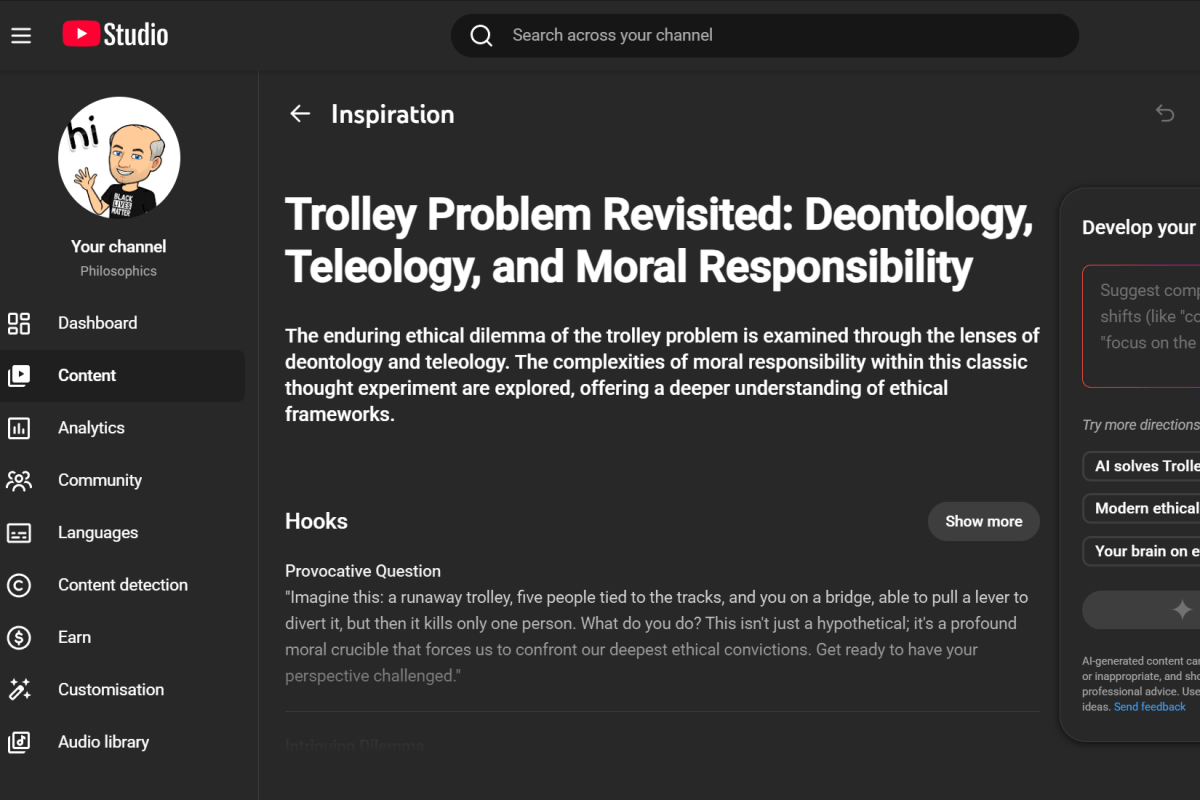
I posted a video on YouTube that I shared here. They’ve added some AI to the studio channel interface.
Image: YouTube Studio’s Inspiration Page. Thanks, but no thanks.
On the previous page, the prompt window (top right) asked if I wanted to know how my video was performing versus the baseline. I affirmed, and it spit out results. Brilliant.
I noticed a handful of ‘inspiration items’. None looked particularly interesting, but I have a nostalgia for Trolley Problems™. A few years ago, I would have jumped on the idea. Nowadays, I’ve seen hundreds of variations, and I’ve lost interest. However, being on familiar ground, I clicked on it to see what would happen. The result is the screenshot above.
Not only is the response templated with thumbnails, but AI is also ready to write the script. At this rate, why doesn’t YouTube just create ideas and generate them itself – like Spotify or Suno? It may just be a matter of time.
I am a heavy user of AI, but I lead the conversation. I am an author, and a reason I don’t join writers groups – I’ve attended some – is that I don’t need help with topics. I don’t get writer’s block. I just need the time and focus to get it out. I suppose that one day the creative well could run dry, but I don’t do this for commercial gain. Sure, that happens, but it’s not my goal. My goal is to write to share and exchange ideas.
I have many colleagues who are commercial writers and artists. I don’t know how they can do it. I understand that people have different interests and temperaments, but this is not one of mine. It would literally take all of the joy out of it. Not all people are artists™. Some people are more acquisitive than I am; I’m not judging, but it’s not me.
When I look at YouTube’s shiny AI muse and think, thanks, but no; I’d rather derail the trolley myself.
I’ve decided it might be worthwhile to share some of my thoughts earlier in their larval stages, if only to demonstrate that none of my essays arrive fully formed from the head of Zeus. Far from it. Most of my ideas ricochet around my skull for weeks, months, years – occasionally decades – before deciding to cooperate. Even the ones that appear spontaneous usually have a long archaeological tail if I bother to dig.
I also hold, rather unfashionably but quite firmly, that all knowledge is a derivative remix. No one escapes this, least of all me. My own work is stitched from whatever intellectual scrap I‘ve encountered along the way. This is why I’ve never been persuaded by the sanctity of ‘originality’ or the mythology of intellectual property. Ideas don’t respect fences. They migrate, hybridise, and reappear wearing different hats. Claiming exclusive rights over them feels more like territorial anxiety – Territorial Pissing – than epistemic necessity — though that, admittedly, is a polemic for another day.
The point is simply this: I’m documenting this particular idea not because it arrived perfect, but because I can see the threads that led to it. And because the genealogy is often more revealing than the polished conclusion.
What follows is one of those threads.
A recent exchange with Thomas on Mastodon forced me to articulate a phrase that arrived mostly as an intuition but seems to have legs: the relative intersubjectivity of subjectivity. Put briefly, subjectivity (S) is always perspectival, always bound to a particular point of view, but never free from the pressures of its relative environment (R). No subject springs forth pristine; it is continually formed and re-formed by the linguistic, social, institutional, and affective structures in which it is embedded.
As a minimal sketch:
R → S ∴ S₀ → S₁
as the subject metabolises the influence of R and becomes something other than its prior configuration.
This is neither the usual bogeyman of ‘relativism’ nor the heroic Cartesian subject polishing its autonomy in splendid isolation. It is a subject that is contingent without being dissolved, formed without being mechanistic, and embedded without being determined. In a way, this is an echo of the causa sui argument, that no S can be self-caused.
If one wanted an analogue, the Mediated Encounter Ontology (MEOW) provides it. In the same way that encounter-events are mediated through biological, cognitive, linguistic, and institutional tiers, subjectivity itself can be seen as a kind of slow-form encounter – one whose centre drifts as the mediating structures press upon it. The subject is not the neutral observer of these tiers; it is the ongoing outcome of their interaction. In this sense, the ‘relative intersubjectivity of subjectivity‘ is simply what a MEOW-adjacent ontology would predict once applied to the subject rather than the event.
Whether this deserves a full essay depends on whether I can demonstrate that the idea is genuinely new rather than a recycled fragment of Berger–Luckmann, Rosen, or post-Kantian anthropology. But at first glance, the conceptual terrain appears fertile – at least fertile enough to justify a longer wander.
After many requests to speak personally instead of relying on NotebookLM, I’ve pulled together some audiovisual content to introduce myself, share my AI workflow, and talk about some current and future projects.






 Philosophics