NB: This is the first of a parable triptych. Read part 2, The Tunnel.
Two valleys diverged in a mountain range, And sorry I could not travel both And be one traveller, long I stood And looked down one as far as I could To where it bent in the undergrowth of reeds and optimism;
Then took the other, just as fair, And having perhaps the better claim, Because it was sandy and wanted wear— Though as for that, the passing there Had worn them really about the same,
And both that morning equally lay In fog no step had trodden black. Oh, I kept the first for another day! Yet knowing how way leads on to way, I doubted if I should ever come back.
—Except I did come back. And I met someone coming the other way. And we stood there in the clouds like a pair of idiots trying to explain our respective valleys using the same words for completely different things.
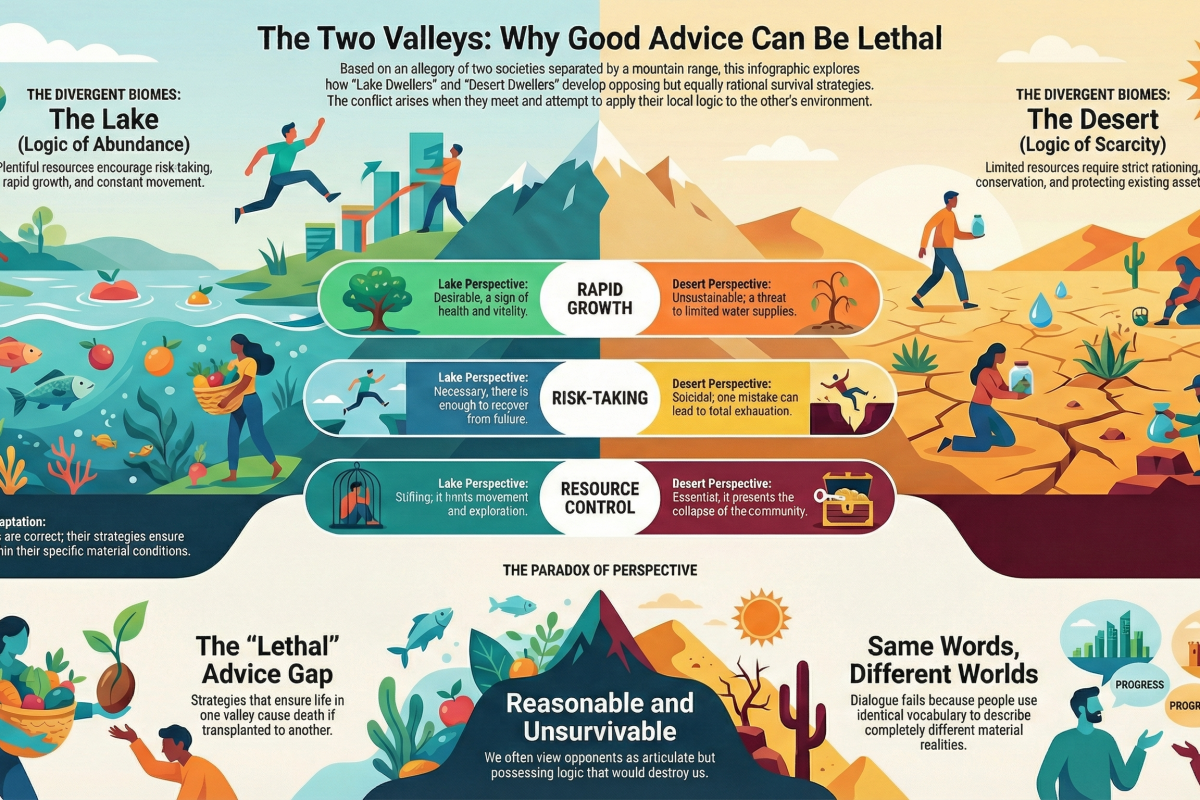
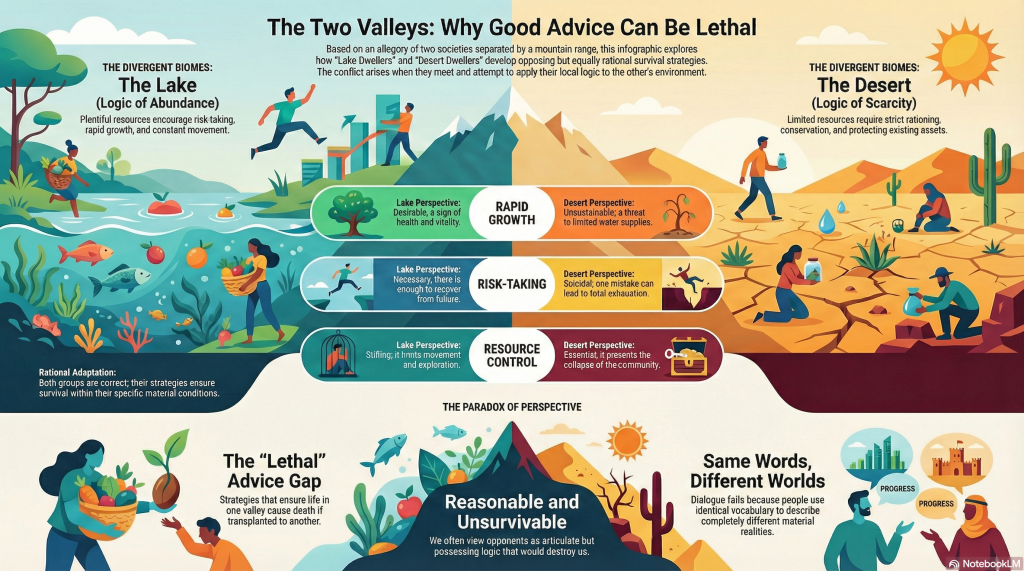
Audio: NotebookLM summary podcast of this topic.Image: NotebookLM infographic of this topic.
Here’s what they don’t tell you about Frost’s poem: the two paths were “really about the same.” He says it right there in the text. The divergence happens retroactively, in the telling, when he sighs and claims “that has made all the difference.”
But he doesn’t know that yet. He can’t know that. The paths only diverge in memory, once he’s committed to one and cannot check the other.
Here’s what they don’t tell you about political disagreement: it works the same way.
Video essay of this topic. Another NotebookLM experience.
The Actual Story (Minus the Versification)
Once upon a time—and I’m going to need you to suspend your allergy to fairy tales for about eight minutes—there was one settlement. One people. One language. One lake with drinkable water and fish that cooperated by swimming in schools.
Then mountains happened. Slowly. No dramatic rupture, no war, no evil king. Just tectonics doing what tectonics does, which is ruin everyone’s commute.
The people on one side kept the lake. The people on the other side got a rain shadow and a lot of bloody sand.
Both sides adapted. Rationally. Reasonably. Like competent humans responding to actual material conditions.
Desert people: “There is definitely not enough water. Let’s ration. Let’s stay put. Let’s not waste things.”
Neither wrong. Neither irrational. Just oriented differently because the ground beneath them had literal different moisture content.
The Bit Where It Gets Interesting
Centuries later, two people—one from each side—decide to climb the mountains and meet at the top.
Why? I don’t know. Curiosity. Stupidity. The desire to write a tedious blog post about epistemology.
They meet in the fog. They speak the same language. Grammar intact. Vocabulary functional. Syntax cooperative.
And then one tries to explain “reeds.”
“Right, so we have these plants that grow really fast near the water, and we have to cut them back because otherwise they take over—”
“Sorry, cut them back? You have too much plant?”
“Well, yes, they grow quite quickly—”
“Why would a plant grow quickly? That sounds unsustainable.”
Meanwhile, the other one tries to explain “cactus.”
“We have these plants with spines that store water inside for months—”
“Store water for months? Why doesn’t the plant just… drink when it’s thirsty?”
“Because there’s no water to drink.”
“But you just said the plant is full of water.”
“Yes. Which it stored. Previously. When there was water. Which there no longer is.”
“Right. So… hoarding?”
You see the problem.
Not stupidity. Not bad faith. Not even—and this is the part that will annoy people—framing.
They can both see perfectly well. The fog prevents them from seeing each other’s valleys, but that’s almost beside the point. Even if the fog lifted, even if they could point and gesture and show each other their respective biomes, the fundamental issue remains:
A cactus is a good solution to a problem the lake-dweller doesn’t have.
A reed is a good solution to a problem the desert-dweller doesn’t have.
Both are correct. Both are adaptive. Both would be lethal if transplanted.
The Retreat (Wherein Nothing Is Learned)
They part amicably. No shouting. No recriminations. Both feel they explained themselves rather well, actually.
As they descend back into their respective valleys, each carries the same thought:
“The other person seemed reasonable. Articulate, even. But their world is completely unworkable and if we adopted their practices here, people would die.”
Not hyperbole. Actual environmental prediction.
If the lake people adopted desert-logic—ration everything, control movement, assume scarcity—they would strangle their own adaptability in a context where adaptability is the whole point.
If the desert people adopted lake-logic—explore freely, trust abundance, move without restraint—they would exhaust their resources in a context where resources are the whole point.
The Bit Where I Connect This to Politics (Because Subtlety Is Dead)
So when someone tells you that political disagreement is just a matter of perspective, just a failure of empathy, just a problem of framing—
Ask them this:
Do the two valleys become the same valley if both sides squint really hard?
Does the desert get wetter if you reframe scarcity as “efficiency”?
Does the lake dry up if you reframe abundance as “waste”?
No?
Then perhaps the problem is not that people are choosing the wrong lens.
Perhaps the problem is that they are standing in different material conditions, have adapted rational survival strategies to those conditions, and are now shouting advice at each other that would be lethal if followed.
The lake-dweller says: “Take risks! Explore! There’s enough!”
True. In a lake biome. Suicidal in a desert.
The desert-dweller says: “Conserve! Protect! Ration!”
True. In a desert biome. Suffocating near a lake.
Same words. Different worlds. No amount of dialogue makes water appear in sand.
The Frostian Coda (With Apologies to New England)
I shall be telling this with a sigh Somewhere ages and ages hence: Two valleys diverged on a mountainside, and I— I stood in the fog and tried to explain reeds to someone who only knew cactus, And that has made… well, no difference at all, actually.
We’re still shouting across the mountains.
We still think the other side would be fine if only they’d listen.
We still use the same words for utterly different referents.
And we still confuse “I explained it clearly” with “explanation bridges material conditions.”
Frost was right about one thing: way leads on to way.
The valleys keep diverging.
The fog doesn’t lift.
And knowing how mountains work, I doubt we’ll meet again.
Moral: If your political metaphor doesn’t account for actual rivers, actual deserts, and actual fog, it’s not a metaphor. It’s a fairy tale. And unlike fairy tales, this one doesn’t end with reunion.
It ends with two people walking home, each convinced the other is perfectly reasonable and completely unsurvivable.
Which, if you think about it, is far more terrifying than simple disagreement.
A surprising number of people have been using the MEOW GPT I released into the wild. Naturally, I can’t see how anyone is actually using it, which is probably for the best. If you hand someone a relational ontology and they treat it like a BuzzFeed quiz, that’s on them. Still, I haven’t received any direct feedback, positive or catastrophic, which leaves me wondering whether users understand the results or are simply nodding like priests reciting Latin they don’t believe.
Audio: NotebookLM summary podcast of this topic.
The truth is uncomfortable: if you haven’t grasped the Mediated Encounter Ontology (of the World), the outputs may feel like a philosophical brick to the face. They’re meant to; mediation has consequences. I’m even considering adding a warning label:
If you hold an unwavering commitment to a concept with any philosophical weight, perhaps don’t input it. There is a non-zero chance the illusion will shatter.
Below is a sampling of the concepts I tested while inspecting the system’s behaviour. I’m withholding the outputs, partly to avoid influencing new users and partly to preserve your dignity, such as it is.
authenticity
anattā (Buddhist)
character (in Aristotle’s virtue-ethical sense)
consciousness
dignity
freedom
hózhó (Navajo)
justice
karma
love
progress
ren ( 仁 )
table
tree
truth
I may have tried others, depending on how irritated I was with the world at the time.
(Now that I think of it, I entered my full name and witnessed it nearly have an aneurysm.)
My purpose in trying these is (obviously) to test the GPT. As part of the test, I wanted to test terms I already considered to be weasel words. I also wanted to test common terms (table) and terms outside of Western modalities. I learned something about the engine in each case.
Tables & Trees
One of the first surprises was the humble ‘table’ which, according to the engine, apparently moonlights across half of civilisation’s conceptual landscape. If you input ‘table’, you get everything from dinner tables to data tables to parliamentary procedure. The model does exactly what it should: it presents the full encounter-space and waits for you to specify which world you meant to inhabit.
The lesson: if you mean a table you eat dinner on, say so. Don’t assume the universe is built around your implied furniture.
‘Tree’ behaves similarly. Does the user mean a birch in a forest? A branching data structure? A phylogenetic diagram? MEOW GPT won’t decide that for you; nor should it. Precision is your job.
This is precisely why I tested ‘character (in Aristotle’s virtue-ethical sense)’ rather than tossing ‘character’ in like a confused undergraduate hoping for luck.
Non-Western Concepts
I also tested concepts well outside the Western philosophical sandbox. This is where the model revealed its real strength.
Enter ‘karma’: it promptly explained that the Western reduction is a cultural oversimplification and – quite rightly – flagged that different Eastern traditions use the term differently. Translation: specify your flavour.
Enter ‘anattā’: the model demonstrated that Western interpretations often reduce the concept to a caricature. Which, frankly, they do.
Enter ‘hózhó’: the Navajo term survives mostly in the anthropological imagination, and the model openly described it as nearly ineffable – especially to those raised in cultures that specialise in bulldozing subtlety. On that score, no notes.
Across the board, I was trying to see whether MEOW GPT would implode when confronted with concepts that resist neat Western categorisation. It didn’t. It was annoyingly robust.
Closing Notes
If you do try the MEOW GPT and find its results surprising, illuminating, or mildly offensive to your metaphysical sensibilities, let me know – and tell me why. It helps me understand what the engine does well and what illusions it quietly pops along the way. Your feedback may even keep me from adding further warning labels, though I wouldn’t count on it.
What followed was a case study in how not to communicate.
LinkedIn, that self-parody of professional virtue signalling, is essentially a digital networking séance: a place where narcissism wears a tie. So I expected a reaction – just not one quite so unintentionally revealing.
Audio: NotebookLM podcast on this topic.
But First…
Before I get too engaged, I want to share one of my favourite interactions: After I informed a commenter that I was a trained economist who taught undergraduate economics for the better part of a decade and had read many seminal economic books and journals firsthand, he replied, ‘No wonder you don’t know anything about economics’.
It reminded me of Oscar Wilde’s quip:
Education is an admirable thing, but it is well to remember from time to time that nothing that is worth knowing can be taught.
— Oscar Wilde
I think he may have taken this point too far.
The Post
I posted this:
Capitalism doesn’t kill with guns or gulags. It kills with forms, policy, and plausible deniability. The machine is efficient precisely because no one feels responsible. When an insurance executive cuts ‘unprofitable’ coverage, it’s not an atrocity – it’s ‘cost optimisation’.
Four assertions that, if anything, were restrained. And yet, of roughly 6,600 impressions, 150 people commented – and only ten actually clicked through to read the article itself. Two, perhaps, reached the source post.
So, fewer than one-tenth of one per cent engaged with the argument. The rest engaged with their projections.
The Anatomy of Reaction
From this data set, one can discern a familiar pattern – social media’s endemic form of discourse dementia. People no longer respond to content, but to keywords. They hear ‘capitalism’ and proceed to recite preloaded scripts from whichever Cold War memory palace they inhabit.
Their replies fall neatly into categories.
1. The Purists and Apologists
These are the theologians of the market. They defend a sacred true capitalism – pure, fair, competitive – untainted by corruption or collusion. Every failure is blamed on heresy: ‘That’s not capitalism, that’s bureaucracy’.
This is theology masquerading as economics. The purity argument is its own circular proof: if capitalism fails, it was never real capitalism to begin with.
I eventually replied with a meme that captured the absurdity perfectly:
« Yeah, bruh! Cancer is not the problem. The problem is stage 4 cancer. What we need is stage 2 cancer. »
Image: Mentioned Meme
That’s the logic of ‘real capitalism’. A belief that malignancy can be cured by downgrading it.
2. The Cold Warriors and Whatabouters
When all else fails, shout Stalin. ‘Move to Cuba’, they say, as if the modern world were still divided between the Berlin Wall and McDonald’s.
These people argue from the long-term memory of the twentieth century because their short-term memory has been erased by ideology. The result is political dementia – functioning recall of ghosts, total blindness to the present.
3. The Moral Traditionalists
‘Capitalism created the highest living standards in history’, they proclaim, ignoring that the same sentence could be said of feudalism by a duke.
They confuse correlation for causation: prosperity under capitalism equals prosperity because of capitalism. It’s a comforting fable that erases the costs – colonialism, exploitation, environmental collapse—folded into that narrative of progress.
4. The Diagnosticians and Dismissers
When all argument fails, the fallback is pathology: ‘You’re confused,’ ‘You’re a cancer’, ‘Take this nonsense to Bluesky‘.
Ad hominem is the last refuge of the intellectually cornered. It converts disagreement into diagnosis. It’s a defence mechanism masquerading as discourse.
5. The Bureaucracy Confusionists
This group misread ‘forms and policy’ as an attack on government, not markets. For them, only the state can be bureaucratic. They cannot conceive of corporate violence without a uniform.
That’s precisely the blindness the post was about – the quiet procedural cruelty embedded in systems so efficient no one feels responsible.
6. The Realists and Partial Allies
A handful of commenters admitted the system was broken – just not fatally. ‘Capitalism has gone astray’, they said. ‘It’s not capitalism; it’s profiteering’.
This is capitalism’s soft apologetics: acknowledging illness while refusing to name the disease. These are the reformists still rearranging chairs on the Titanic.
7. The Human-Nature Essentialists
‘The problem isn’t capitalism – it’s people’.
Ah yes, anthropology as absolution. The rhetorical sleight of hand that converts design flaws into human nature. It’s a comforting determinism: greed is eternal, therefore systems are blameless.
This, too, proves the thesis. Capitalism’s most effective mechanism is the internalisation of guilt. You blame yourself, not the structure.
8. The Paranoids and Projectionists
For these, critique equals conspiracy. ‘The Marxists are oppressing your freedom’. ‘Bank accounts frozen in Canada’. ‘Social credit scores!’
They live in a world where any question of fairness is a plot to install a totalitarian state. Their fear is algorithmic; it needs no source.
9. The Systemic Observers
A few – precious few – saw the argument clearly. They understood that capitalism’s violence is procedural, not personal. That its atrocities come with signatures, not bullets. That the “cost optimisation” logic of insurance or healthcare is not an aberration – it’s the system functioning as designed.
These voices are proof that rational discourse isn’t extinct – merely endangered.
Discourse Dementia
What this episode reveals is not a failure of capitalism so much as a failure of cognition. The audience no longer hears arguments; it hears triggers. People don’t read – hey recognise.
The reflexive replies, the off-topic tangents, the moral panic – all of it is capitalism in miniature: fast, efficient, transactional, and devoid of empathy.
Social media has become the bureaucratic form of thought itself – automated, unaccountable, and self-reinforcing. Nobody reads because reading doesn’t scale. Nobody engages because attention is a commodity.
Capitalism doesn’t just kill with forms. It kills with feeds.
Coda: The Light That Blinds
The Enlightenment promised clarity – the clean line between reason and superstition, order and chaos, subject and object. Yet, from that same light emerged the bureaucrat, the executive, and the algorithm: three perfect children of reason, each killing with increasing efficiency and decreasing intent.
Capitalism is merely the administrative arm of this lineage – the economic expression of the Enlightenment’s original sin: mistaking quantification for understanding. When discourse itself becomes procedural, when conversation turns into cost-benefit analysis, thought ceases to be an act of care and becomes an act of compliance.
The tragedy isn’t that we’ve lost meaning. It’s that we’ve automated it. The machine hums on, self-justifying, self-optimising, self-absolving.
Your post is a confession that anti-capitalism kills with guns and gulags. Give me capitalism over socialism any day.
Well, you should move to Cuba or any other socialist paradise… end of issue.
How can you be taken seriously when you conflate an entire economic system with health insurance? And for someone to say that overt murder, a la Stalin, is “decency”? That speaks for itself.
That is not capitalism. That is bureaucracy.
Healthcare isn’t free and everyone has the same right to make or not to make money.
Sounds more like socialism. Do it our way or we will freeze your bank account, take your job, and make sure you get nothing till you comply (proof was during covid)
Capitalism has made us the desired destination for those living in socialistic societies
BEURACRACY. The word your looking for is BEURACRACY not capitalism. There is no form of government more beurocratic than communism, except socialism. If you wonder why that is, communism doesn’t have to hide it’s authoritarianism like socialism does.
Socialism/Communism killed over 100 million the last century the old fashioned way;: bullets, starvation, torture, etc. Capitalism lifted 1 billion people out of poverty
Pathetic – misleading statement. Yes there are many problems, and mistakes that should be corrected. But as a physician, can guarantee before this medical system starting to ignore viruses, far more people were killed yearly under socialist or communist medical systems than capitalism. Wake up – care was not denied because many procedures and higher levels of care were unreachable to most!!!
How is the Government any different? You get what they say you get without the option of voting with your feet/checkbook. I’ll take my chances in the free market EVERY TIME.
This post is fiction from the start. Capitalism does NOT kill. Communism/Socialism does though.
Are you implying the ponderous inactivity of the socialist apparat is not worse than what we encounter with capitalistic motivated organizations? Learn the facts.
Capitalism works well enough–better than any other alternatives. It degrades when government sticks its nose into private transactions to provide cover for lethargy and inefficiency. Responsibility moves from the person with whom one deals to a great nothingness of indifference. [truncated for brevity]
Private insurance has its faults but so does government insurance they are different but just as challenging
Any business that deals directly with Human tragedy (Casualty, Medical, Health, et al) should be held to both a different and higher standard in “cost optimization” than other businesses. To say that someone’s chemo should be spreadsheeted in the same columns as someone’s second home 80 feet from the beach is proof that capitalism is dead and scorched earth profiteering is now the new normal.
The argument should not be about capitalism vs. communism, but rather about human beings. Are humans creative/gifted enough to take care of themselves and produce surplus for the helpless few, or helpless sheep, majority to be fed and controlled by elites? But for your edification Bry, as you are critic of capitalism, try communism for a season, to balance your critique.
Bry WILLIS how long have you been this confused about basic economics and government policy?
Most people stop using the “I know you are, but what am I” basis for their arguments by the age of seven or eight. But it appears to still be your basis for discourse.
I wish you better luck seeing and understanding things for what they actually are vice how you wish they were.
The rules come from a socialist regime. The Marxists are oppressing your freedom. Not rhe FREE market and free enrerprises. What are you talking about….
That is is not capitalism. that is CRONY capitalism when feather merchants spread so much hoo-ha that nobody can get anything done.
Bry WILLIS look up social credit. Bank accounts under this government in Canada, have already been frozen, for dare disagreeing with them
This man feels our health insurance system represents capitalism? We better have a more in depth talk about how American health insurance works.
This has nothing to do with “capitalism”. If you choose to use the English language to communicate, understand the intended meanings of the words. We use contract law in our country regarding insurance coverage. It has little to do with capitalism. In fact, Obamacare stripped any semblance of capitalism from the process and replaced it with pricing manipulation, regulations, subsidies and other such “adjustments” to what used to be a capitalistic system. Blame the regulations, and lack of government enforcement, not “capitalism”. No winder NYC elected Momdani.
Ask those in China, N. Korea, and Russia how socialism/communism works for them.
Next you will have Gen AI and Agentic AI declining claims so that management can just point to the AI and no one has to feel bad for cutting off life saving care.
You’re a cancer. Capitalism created the best living standards the world ever seen. The socialist show up and corrupt it with all these social programs that don’t work and that’s where we’re at. You’re killing the future. You’re an idealist that never had to live in the real work and built anything and you’ll be the one who’s bitching when you’re on relief.
The only system that placed people in gulags was socialism all under the banner of democracy.
This is pure nonsense. Take stuff like this on Bluesky
As I’ve said 4,000 times before, Capitalism requires robust competition in the market and zero collusion, price fixing, and market manipulation in order for it to function in its truest form and most beneficial economic impact to society as a whole (instead of 2%) and to be truly considered superior to other forms. None of those conditions exists in today’s capitalism (as practiced) and it has devolved into scorched earth profiteering which has a totally different definition and is practiced in a different way. Today’s profiteering by Corporations, which includes actions and behaviors that are counter-productive to capitalism, and that they hide under the guise of capitalism, acts as a malignant cancer on true capitalism and its inevitable result is, over time, a greater demand by society for socialist response as a counter measure. If Capitalism were working as it should, (and it’s not) that demand by society for socialist action would be highly diminished instead of enhanced.
Capitalism is not the “marriage of business and government” — that’s called oligarchy or, as the WEF calls it, “stakeholder capitalism”, also known as aristocracy. This is the current operating model of Canada, for example, wherein regulation and subsidy and tax”relief” is used to protect monopolies they are favorable to the sitting government.
Before we go any further, please share your definition of capitalism.
Such bureaucracy is worse with socialism, with even less individual freedom because the almighty centralized state maintains tight control over everything.
Another socialist complaining about tainted money. Bry, the money “taint” yours to spend. It belongs to those who earned it.
More like government bureaucracy
Notes and References
1.The Procedural Violence of Systems. David Graeber’s The Utopia of Rules (2015) and Bullshit Jobs (2018) remain essential on the bureaucratic face of modern capitalism — where compliance replaces conscience and inefficiency becomes profitable.
2.Markets as Mythology. Karl Polanyi’s The Great Transformation (1944) describes how “self-regulating” markets were never natural phenomena but products of state violence and enclosure. What contemporary defenders call “real capitalism” is, in Polanyi’s terms, a historical fiction maintained through continuous coercion.
3.The Logic of the Machine. Bernard Stiegler’s Technics and Time (1994–2001) and Automatic Society (2015) provide the philosophical frame for capitalism’s algorithmic mutation: automation not just of production, but of attention and thought.
4.Bureaucracy and Death. Max Weber’s early insight into rationalisation—the conversion of moral action into procedural necessity—reaches its necropolitical extreme in Achille Mbembe’s Necropolitics (2003), where the administration of life and death becomes a managerial function.
5.Language, Responsibility, and the Loss of Agency. Hannah Arendt’s Eichmann in Jerusalem (1963) diagnosed “the banality of evil” as precisely the condition described in the post: atrocity performed through paperwork, not passion. The executive who denies coverage is merely performing policy.
6.Attention as Commodity. Guy Debord’s Society of the Spectacle (1967) and Byung-Chul Han’s In the Swarm (2017) both chart the transformation of discourse into spectacle, and thought into metrics — the perfect capitalist apotheosis: outrage without substance, visibility without understanding.
7.On Reflex and Recognition. Friedrich Nietzsche’s Genealogy of Morals (1887) prefigures this pathology in his account of herd morality and ressentiment — a collective psychology where reaction replaces reflection.
Further Reading / Contextual Essays
The Ethics of Maintenance: Against the Myth of Natural Purpose A dismantling of the Enlightenment’s faith in progress. Maintenance, not innovation, becomes the moral task once teleology collapses. This essay lays the groundwork for understanding capitalism as an entropy accelerator disguised as improvement.
Against Agency: The Fiction of the Autonomous Self Explores how neoliberal ideology weaponises Enlightenment individualism. The myth of “self-made” success functions as capitalism’s moral camouflage — the narrative counterpart to plausible deniability.
The Illusion of Light: Thinking After the Enlightenment The core text of the Anti-Enlightenment corpus. A philosophical excavation of modernity’s central delusion: that illumination equals truth. Traces the lineage from Cartesian clarity to algorithmic opacity.
Objectivity Is Illusion (The Language Insufficiency Hypothesis) An inquiry into the failure of language as a medium for truth claims. Introduces the Effectiveness–Complexity Gradient, showing how every human system — political, linguistic, economic — eventually collapses under the weight of its own abstractions.
The Discipline of Dis-Integration A philosophy of maintenance over progress. Argues that dis-assembly — not construction — is the proper epistemic gesture in an age of exhaustion.
Propensity(Ridley Park, 2024) The fictional mirror to these essays. A speculative novel examining the behavioural mechanics of optimisation, obedience, and systemic cruelty — a narrative form of “cost-optimisation ethics.”
Everyone knows the line: cogito ergo sum. Descartes’ great party trick. A man alone in his study, fretting about demons, announces that because he’s doubting, he must exist. Ta-da! Curtain call. Except, of course, it’s less of a revelation than a conjuring trick: he pulls an I out of a hat that was never proved to be there in the first place. Thinking is happening, indeed – but who invited the “thinker”?
Video: David Guignion talks about Descartes’ Cogito.
And let’s not forget the dramatis personae Descartes smuggles in for atmosphere. A malicious demon, a benevolent God, both necessary props to justify his paranoia and his certainty. Philosophy as melodrama: cue organ music, lightning strike.
Audio: NotebookLM podcast on this topic.
Enter the Critics
Spinoza rolls his eyes. Doubt isn’t some heroic starting point, he says – it’s just ignorance, a lack of adequate ideas. To elevate doubt into method is like treating vertigo as a navigational tool. Error isn’t demonic trickery; it’s our own confusion.
Kant arrives next, shaking his head. Descartes thinks he’s proven a substantial “I,” but all he’s actually shown is the form of subjectivity – the empty requirement that experiences hang together. The “I think” is a necessary placeholder, not a discovery. A grammatical “you are here” arrow, not a metaphysical treasure chest.
Hegel, of course, can’t resist upping the disdain. Descartes’ I is an empty abstraction, a hollow balloon floating above reality. The self isn’t given in some solitary moment of doubt; it emerges through process – social, historical, dialectical. The cogito is the philosophical equivalent of a selfie: lots of certainty, zero depth.
The Insufficiency Twist
And yet, maybe all of them are still dancing to the same fiddler. Because here’s the real suspicion: what if the whole problem is a trick of language? English, with its bossy Indo-European grammar, refuses to let verbs stand alone. “Thinking” must have a “thinker,” “seeing” a “seer.” Grammar insists on a subject; ontology obediently provides one.
Other languages don’t always play this game. Sanskrit or Pali can shrug and say simply, “it is seen.” Japanese leaves subjects implied, floating like ghosts. Some Indigenous languages describe perception as relational events – “seeing-with-the-tree occurs” – no heroic subject required. So perhaps the real villain here isn’t Descartes or even metaphysics, but syntax itself, conscripting us into a subject-shaped theatre.
Now, I don’t want to come off like a one-trick pony, forever waving the flag of “language insufficiency” like some tired philosopher’s catchphrase. But we should be suspicious when our limited grammar keeps painting us into corners, insisting on perceivers where maybe there are only perceptions, conjuring selves because our verbs can’t tolerate dangling.
Curtain Call
So in the end, Descartes’ famous “I” might be no more than a grammatical fiction, a casting error in the great play of philosophy. The cogito isn’t the foundation of modern thought; it’s the world’s most influential typo.
They say no one escapes the Spectacle. Guy Debord made sure of that. His vision was airtight, his diagnosis terminal: we are all spectators now, alienated from our labour, our time, our own damn lives. It was a metaphysical mugging—existence held hostage by images, by commodities dressed in drag. The future was a feedback loop, and we were all doomed to applaud.
Audio: NotebookLM podcast on this topic. Apologies in advance for the narrators’ mangling of the pronunciation of ‘Guy Debord’.
But what if the loop could be hacked? What if the infinitely halved distances of motionless critique—Zeno’s Paradox by way of Marx—could finally be crossed?
Enter: Yanis Varoufakis. Economist, ex-finance minister, techno-cassandra with a motorbike and a vendetta. Where Debord filmed the catastrophe in black-and-white, Varoufakis showed up with the source code.
Debord’s Limbo
Debord saw it all coming. The substitution of reality with its photogenic simulacrum. The slow death of agency beneath the floodlights of consumption. But like Zeno’s paradox, he could only gesture toward the end without ever reaching it. Each critique halved the distance to liberation but never arrived. The Spectacle remained intact, omnipresent, and self-replicating—like an ontological screensaver.
He gave us no path forward, only a beautiful, ruinous analysis. A Parisian shrug of doom.
Varoufakis’ Shortcut
But then comes Varoufakis, breaking through the digital labyrinth not by philosophising the Spectacle, but by naming its successor: Technofeudalism.
See, Debord was chasing a moving target—a capitalism that morphed from industrial to financial to semiotic faster than his prose could crystallise. But Varoufakis caught it mid-mutation. He pinned it to the slab and sliced it open. What spilled out wasn’t capital anymore—it was rent. Platform rent. Algorithmic tolls. Behavioural taxes disguised as convenience. This isn’t the market gone mad—it’s the market dissolved, replaced by code-based fiefdoms.
The paradox is resolved not by reaching utopia, but by realising we’ve already crossed the line—we just weren’t told. The market isn’t dying; it’s already dead, and we’re still paying funeral costs in monthly subscriptions and attention metrics.
From Spectacle to Subjugation
Debord wanted to unmask the performance. Varoufakis realised the theatre had been demolished and replaced with a server farm.
You don’t watch the Spectacle anymore. It watches you. It optimises you. It learns your keystrokes, your pulse rate, your browsing history. Welcome to feudal recursion, where Amazon is your landlord, Google your priest, and Meta your confessor.
Solving Zeno the Varoufakis Way
So how does one cross the infinite regress of alienation? Simple. You call it what it is. You reclassify the terrain.
“This is not capitalism,” Varoufakis says, in the tone of a man pulling a mask off a Scooby-Doo villain. “It’s technofeudalism. Capital didn’t win. It went feudal. Again.”
By doing so, he bypasses the academic ballet that has critics forever inching closer to the truth without touching it. He calls the system new, not to sell books, but to make strategy possible. Because naming a beast is the first step in slaying it.
In Conclusion: Debord Dreamed, Varoufakis Drives
Debord haunts the museum. Varoufakis raids the server room. Both are essential. But only one gives us a new map.
The Spectacle hypnotised us. Technofeudalism enslaves us. And if there’s a way out, it won’t be through slogans spray-painted on Parisian walls. It will be built in code, deployed across decentralised networks, and carried forward by those who remember what it meant to be not watched.
Let Debord whisper. Let Varoufakis roar. And let the rest of us sharpen our blades.
I died in March 2023 — or so the rumour mill would have you believe.
Of course, given that I’m still here, hammering away at this keyboard, it must be said that I didn’t technically die. We don’t bring people back. Death, real death, doesn’t work on a “return to sender” basis. Once you’re gone, you’re gone, and the only thing bringing you back is a heavily fictionalised Netflix series.
Audio: NotebookLM podcast of this content.
No, this is a semantic cock-up, yet another stinking exhibit in the crumbling Museum of Language Insufficiency. “I died,” people say, usually while slurping a Pumpkin Spice Latte and live-streaming their trauma to 53 followers. What they mean is that they flirted with death, clumsily, like a drunk uncle at a wedding. No consummation, just a lot of embarrassing groping at the pearly gates.
And since we’re clarifying terms: there was no tunnel of light, no angels, no celestial choir belting out Coldplay covers. No bearded codgers in slippers. No 72 virgins. (Or, more plausibly, 72 incels whining about their lack of Wi-Fi reception.)
There was, in fact, nothing. Nothing but the slow, undignified realisation that the body, that traitorous meat vessel, was shutting down — and the only gates I was approaching belonged to A&E, with its flickering fluorescent lights and a faint smell of overcooked cabbage.
To be fair, it’s called a near-death experience (NDE) for a reason. Language, coward that it is, hedges its bets. “Near-death” means you dipped a toe into the abyss and then screamed for your mummy. You didn’t die. You loitered. You loitered in the existential equivalent of an airport Wetherspoons, clutching your boarding pass and wondering why the flight to Oblivion was delayed.
As the stories go, people waft into the next world and are yanked back with stirring tales of unicorns, long-dead relatives, and furniture catalogues made of clouds. I, an atheist to my scorched and shrivelled soul, expected none of that — and was therefore not disappointed.
What I do recall, before the curtain wobbled, was struggling for breath, thinking, “Pick a side. In or out. But for pity’s sake, no more dithering.” In a last act of rational agency, I asked an ER nurse — a bored-looking Athena in scrubs — to intubate me. She responded with the rousing medical affirmation, “We may have to,” which roughly translates to, “Stop making a scene, love. We’ve got fifteen others ahead of you.”
After that, nothing. I was out. Like a light. Like a minor character in a Dickens novel whose death is so insignificant it happens between paragraphs.
I woke up the next day: groggy, sliced open, a tube rammed down my throat, and absolutely no closer to solving the cosmic riddle of it all. Not exactly the triumphant return of Odysseus. Not even a second-rate Ulysses.
Here’s the reality: There is no coming back from death. You can’t “visit” death, any more than you can spend the afternoon being non-existent and return with a suntan.
Those near-death visions? Oxygen-starved brains farting out fever dreams. Cerebral cortexes short-circuiting like Poundland fairy lights. Hallucinations, not heralds. A final, frantic light show performed for an audience of none.
Epicurus, that cheerful nihilist, said, “When we are, death is not. When death is, we are not.” He forgot to mention that, in between, people would invent entire publishing industries peddling twaddle about journeys beyond the veil — and charging $29.99 for the paperback edition.
No angels. No harps. No antechamber to the divine. Just the damp whirr of hospital machinery and the faint beep-beep of capitalism, patiently billing you for your own demise.
If there’s a soundtrack to death, it’s not choirs of the blessed. It’s a disgruntled junior surgeon muttering, “Where the hell’s the anaesthetist?” while pawing desperately through a drawer full of out-of-date latex gloves.
And thus, reader, I lived. But only in the most vulgar, anticlimactic, and utterly mortal sense.
There will be no afterlife memoir. No second chance to settle the score. No sequel. Just this: breath, blood, occasional barbed words — and then silence.



 Philosophics