Using Generative AI as Early Peer Review

4โ€“6 minutes

Cheap Adversaries, Outsourced Ego, and Engineered Critique โ† ChatGPT is obsessed with subtitles.

There is a peculiar anxiety around admitting that one uses generative AI in serious intellectual work. The anxiety usually takes one of two forms. Either the AI is accused of replacing thinking, or it is accused of flattering the thinker into delusion. Both charges miss the point, and both underestimate how brittle early-stage human peer review often is.

What follows is not a defence of AI as an oracle, nor a claim that it produces insight on its own. It is an account of how generative models can be used โ€“ deliberately, adversarially, and with constraints โ€“ as a form of early peer pressure. Not peer review in the formal sense, but a rehearsal space where ideas are misread, overstated, deflated, and occasionally rescued from themselves.

Audio: NotebookLM summary podcast of this topic.

The unromantic workflow

The method itself is intentionally dull:

  1. Draft a thesis statement.
    Rinse & repeat.
  2. Draft an abstract.
    Rinse & repeat.
  3. Construct an annotated outline.
    Rinse & repeat.
  4. Only then begin drafting prose.

At each stage, the goal is not encouragement or expansion but pressure. The questions I ask are things like:

  • Is this already well-trodden ground?
  • Is this just X with different vocabulary?
  • What objection would kill this quickly?
  • What would a sceptical reviewer object to first?

The key is timing. This pressure is applied before the idea is polished enough to be defended. The aim is not confidence-building; it is early damage.
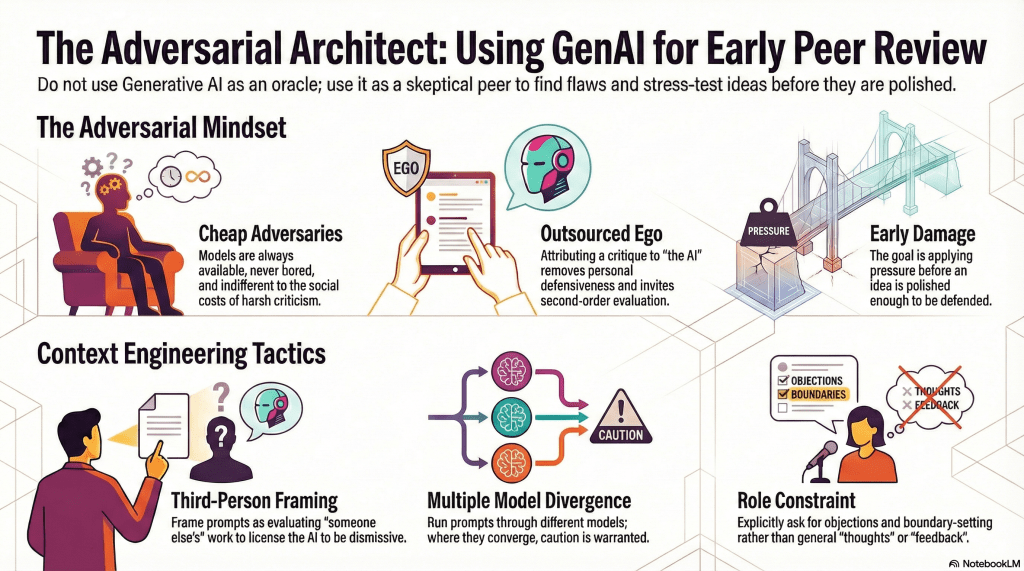
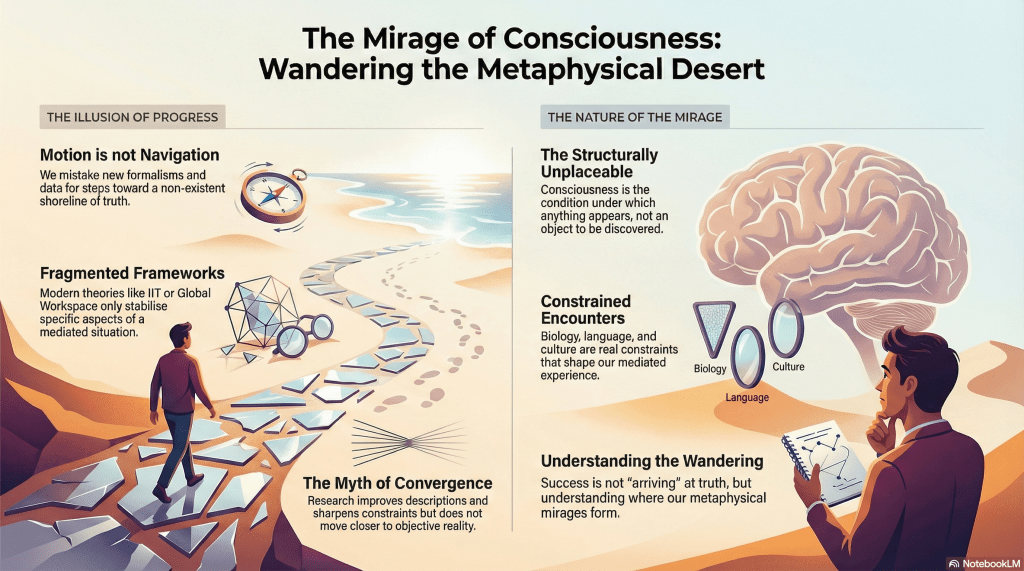
Image: NotebookLM infographic on this topic.

Why generative AI helps

In an ideal world, one would have immediate access to sharp colleagues willing to interrogate half-formed ideas. In practice, that ecology is rarely available on demand. Even when it is, early feedback from humans often comes bundled with politeness, status dynamics, disciplinary loyalty, or simple fatigue.

Generative models are always available, never bored, and indifferent to social cost. That doesn’t make them right. It makes them cheap adversaries. And at this stage, adversaries are more useful than allies.

Flattery is a bias, not a sin

Large language models are biased toward cooperation. Left unchecked, they will praise mediocre ideas and expand bad ones into impressive nonsense. This is not a moral failure. It is a structural bias.

The response is not to complain about flattery, but to engineer against it.

Sidebar: A concrete failure mode

I recently tested a thesis on Mistral about object permanence. After three exchanges, the model had escalated a narrow claim into an overarching framework, complete with invented subcategories and false precision. The prose was confident. The structure was impressive. The argument was unrecognisable.

This is the Dunning-Kruger risk in practice. The model produced something internally coherent that I lacked the domain expertise to properly evaluate. Coherence felt like correctness.

The countermeasure was using a second model, which immediately flagged the overreach. Disagreement between models is often more informative than agreement.

Three tactics matter here.

1. Role constraint
Models respond strongly to role specification. Asking explicitly for critique, objections, boundary-setting, and likely reviewer resistance produces materially different output than asking for ‘thoughts’ or ‘feedback’.

2. Third-person framing
First-person presentation cues collaboration. Third-person presentation cues evaluation.

Compare:

  • Hereโ€™s my thesis; what do you think?
  • Here is a draft thesis someone is considering. Please evaluate its strengths, weaknesses, and likely objections.

The difference is stark. The first invites repair and encouragement. The second licenses dismissal. This is not trickery; it is context engineering.

3. Multiple models, in parallel
Different models have different failure modes. One flatters. Another nitpicks. A third accuses the work of reinventing the wheel. Their disagreement is the point. Where they converge, caution is warranted. Where they diverge, something interesting is happening.

‘Claude saysโ€ฆ’: outsourcing the ego

One tactic emerged almost accidentally and turned out to be the most useful of all.

Rather than responding directly to feedback, I often relay it as:

โ€œClaude says thisโ€ฆโ€

The conversation then shifts from defending an idea to assessing a reading of it. This does two things at once:

  • It removes personal defensiveness. No one feels obliged to be kind to Claude.
  • It invites second-order critique. People are often better at evaluating a critique than generating one from scratch.

This mirrors how academic peer review actually functions:

  • Reviewer 2 thinks you’re doing X.
  • That seems like a misreading.
  • This objection bites; that one doesn’t.

The difference is temporal. I am doing this before the draft hardens and before identity becomes entangled with the argument.

Guardrails against self-delusion

There is a genuine Dunningโ€“Kruger risk when working outside oneโ€™s formal domain. Generative AI does not remove that risk. Used poorly, it can amplify it.

The countermeasure is not humility as a posture, but friction as a method:

  • multiple models,
  • adversarial prompting,
  • third-person evaluation,
  • critique of critiques,
  • and iterative narrowing before committing to form.

None of this guarantees correctness. It does something more modest and more important: it makes it harder to confuse internal coherence with external adequacy.

What this cannot do

Itโ€™s worth being explicit about the limits. Generative models cannot tell you whether a claim is true. They can tell you how it is likely to be read, misread, resisted, or dismissed. They cannot arbitrate significance. They cannot decide what risks are worth taking. They cannot replace judgment. Those decisions remain stubbornly human.

What AI can do โ€“ when used carefully โ€“ is surface pressure early, cheaply, and without social cost. It lets ideas announce their limits faster, while those limits are still negotiable.

A brief meta-note

For what itโ€™s worth, Claude itself was asked to critique an earlier draft of this post. It suggested compressing the familiar arguments, foregrounding the ‘Claude saysโ€ฆ’ tactic as the real contribution, and strengthening the ending by naming what the method cannot do.

That feedback improved the piece. Which is, rather conveniently, the point.

Wandering Elephants in the Desert of Consciousness

2โ€“3 minutes

The modern search for the truth of consciousness has the unmistakable smell of a desert expedition gone wrong.

Everyone agrees the elephant is real. Everyone insists itโ€™s important. No one agrees what it is, where itโ€™s going, or whether itโ€™s moving in circles. Still, the caravan marches on, convinced that the next dune will finally reveal solid ground.

Audio: NotebookLM summary podcast of this topic.

This confidence rests on a familiar Modern assumption: motion equals progress. We may not know where the shoreline of Truth lies, but surely weโ€™re heading toward it. Each new theory, each new scan, each new formalism feels like a step forward. Bayesian updates hum reassuringly in the background. The numbers go up. Understanding must be improving.

But deserts are littered with travellers who swore the same thing.

The problem with consciousness is not that it is mysterious. Itโ€™s that it is structurally unplaceable. It is not an object in the world alongside neurons, fields, or functions. It is the mediated condition under which anything appears at all. Treating it as something to be discovered โ€œout thereโ€ is like looking for the lens inside the image.

MEOW puts its finger exactly here. Consciousness is not a hidden substance waiting to be uncovered by better instruments. It is a constrained encounter, shaped by biology, cognition, language, culture, technology. Those constraints are real, binding, and non-negotiable. But they do not add up to an archetypal Truth of consciousness, any more than refining a map yields the territory itself.

Modern theories of consciousness oscillate because they are stabilising different aspects of the same mediated situation. IIT formalises integration. Global workspace models privilege broadcast. Predictive processing foregrounds inference. Illusionism denies the furniture altogether. Each feels solid while inhabited. Each generates the same phenomenology of arrival: now we finally see what consciousness really is.

Until the next dune.

Cognitively, we cannot live inside a framework we believe to be false. So every new settlement feels like home. Retrospectively, it becomes an error. Progress is narrated backwards. Direction is inferred after the fact. Motion is moralised.

The elephant keeps walking.

None of this means inquiry is futile. It means the myth of convergence is doing far more work than anyone admits. Consciousness research improves descriptions, sharpens constraints, expands applicability. What it does not do is move us measurably closer to an observer-independent Truth of consciousness, because no such bearing exists.

The elephant is not failing to reach the truth.

The desert is not arranged that way.

Image: NotebookLM infographic on this concept.

Once you stop mistaking wandering for navigation, the panic subsides. The task is no longer to arrive, but to understand where circles form, where mirages recur, and which paths collapse under their own metaphysical optimism.

Consciousness isnโ€™t an elephant waiting to be found.

Itโ€™s the condition under which we keep mistaking dunes for destinations.

A So Long to 2025, and a Way Into 2026

5โ€“7 minutes

Why Post-Position? ๐Ÿง

As 2025 closes, I find myself in the mildly suspicious position of being asked where I stand. I’m almost pretty sure it’s a deontological duty I must fulfil.

This has become the ritual gesture of our time. Not what are you working on? or what are you unsure about? but what is your position? The question arrives already armed with a grid. Left or right. Modern or postmodern. Optimist or doomer. Builder or critic. Pick a square. Declare yourself. Be legible.

Audio: Notebook summary podcast of this topic.

I have spent enough years inside philosophy, politics, systems design, and cultural critique to recognise this for what it is. Not a genuine request for understanding, but a demand for administrative convenience. Positions are easy to catalogue. They travel well on social platforms. They allow disagreements to be staged rather than examined. I no longer occupy one.

If I had to name the shift that has taken place in my thinking, I might call it post-postmodern. More accurately, I think of it as post-position. Not because I have outgrown critique, but because I have grown weary of pretending that declaring a stance is the same thing as doing the work.

Postmodernism, to its credit, diagnosed something real. It exposed the hidden scaffolding behind our grand narratives. It showed how claims to neutrality smuggled power, how universals arrived late and acted eternal, and how reason often functioned as a polite enforcement mechanism. That diagnosis still stands. Nothing that followed has invalidated it. What failed was not the critique, but the decision to treat critique as a destination.

Somewhere along the line, postmodernism hardened into an identity. Suspicion became an aesthetic. Irony turned into a resting posture. Eventually, even scepticism acquired a set of approved moves and unacceptable conclusions. The work of dismantling was mistaken for the achievement of wisdom.

The response to this impasse has been predictable. We are now urged to rebuild. To restore foundations. To recover truth, agency, meaning, and normativity. Usually with a tone of urgency that suggests things have all gone a bit too far. They havenโ€™t gone too far. Theyโ€™ve gone exactly where the premises lead.

At this point, it is worth noting that ‘postmodernism’ has largely ceased to exist as a self-ascribed position at all. It survives almost entirely as a slur. No serious thinker today introduces themselves as a Postmodernist in the way one might once have claimed empiricism, structuralism, or even analytic philosophy.

The term is now deployed from the outside, usually as shorthand for intellectual irresponsibility: relativism, nihilism, irony, excess critique. It is a caricature assembled by its opponents, then attacked as if it were a living school with doctrines and membership cards.

People who employ the term Postmodernโ„ข* relative to philosophy are intellectually lazy and not likely worth engaging in a debate on the topic, because they have not likely engaged the content charitably, if at all, outside of a caricature.

This matters because it reveals something quietly telling. What is being rejected under the banner of ‘postmodernism’ is not a coherent programme, but the discomfort produced when inherited certainties fail to survive scrutiny. The slur functions as a containment strategy. It allows critics to dismiss the diagnosis without engaging the illness.

Any thinker with even a passing familiarity with the terrain knows this. Which is why no self-respecting, or self-denigrating, postmodern thinker would now characterise themselves as such. The label has been evacuated of descriptive value and filled with anxiety.

What is being revived in these reconstruction projects is not certainty, but legibility. A longing for systems that can be explained cleanly, defended coherently, and enforced consistently. Clear positions are attractive because they reduce friction. They allow disagreement to be formalised, managed, and ultimately neutralised. This is where I step off.

Post-position thinking is often mistaken for relativism, so it is worth being explicit. It does not claim that nothing is real, that all claims are equal, or that consequences dissolve into opinion. Reality remains stubborn. Harm remains unevenly distributed. Constraints still bite.

What it rejects is something more specific: the belief that ethical, epistemic, or political seriousness requires the occupation of a stable, declarable position.

Positions are not engines of thought. They are summaries produced after the fact. They tidy complexity into something portable, then forget the mess that made the tidying necessary. Once adopted, they begin to govern perception. You start seeing what fits and discarding what does not. The position becomes an answer generator rather than a question machine.

It stays with instability where stability would be dishonest. It tolerates contradiction where resolution would be cosmetic. It treats coherence as local, provisional, and negotiated rather than universal and enforceable. This is not indecision. It is fidelity to how complex systems actually behave. One way to describe the shift is a movement away from critique toward maintenance.

Modernism wanted to build. Postmodernism wanted to dismantle. Both share a quiet assumption that there is a point at which the work is done. Maintenance has no such illusion. It accepts that some systems cannot be fixed, only kept from doing additional damage โ€“ that concepts fray; that norms age badly; that repair is continuous and never final.

Maintenance is unspectacular. It does not produce manifestos. It does not scale elegantly. It involves partial solutions, awkward compromises, and the constant risk of failure. It is also where most of the moral work actually happens.

From this vantage point, the demand to ‘take a position‘ looks increasingly misplaced. Not because commitments vanish, but because commitments are situational, asymmetric, and responsive to context. Loyalty shifts from creeds to consequences. What matters is not whether an idea is internally consistent, but what it does when it leaves the page and collides with institutions, incentives, and frightened people.

So when I refuse to declare where I stand, it is not evasiveness. It is a refusal to pretend that standing still is a virtue.

This is the posture I am carrying into 2026. Not a programme, not a system, not a rehabilitated foundation. Just a refusal to confuse clarity with truth, structure with virtue, or positions with thinking.

If that feels unsatisfying, that may be the point. Satisfaction is a modernist luxury. Maintenance rarely provides it. The work continues anyway.

* To be fair, I have referred to myself as Postmodernโ„ข, but this was a shortcut out of solidarity with Foucault, Derrida, Latour, Baudrillard, and others painted with this brush. I still admire these thinkers.

โ€œWhat about you?โ€

2โ€“3 minutes

My philosophical critique, not of the book Why Democrats Are Dangerous, but of the two warring factions in United States politics โ€“ mind you, partisanship not limited to the US โ€“ sparked the ire of defenders of their respective turf. ‘You’ve got it wrong. Those other people are either addleheaded or abject evil’ is a consolidation of responses from both sides of the aisle. I’ve crafted a response.

Audio: NotebookLM summary podcast on this topic.

Itโ€™s perfectly true that I occupy a perspective. Everyone does. This isn’t a confession; itโ€™s a structural feature of being human. Consciousness is perspectival by design. We donโ€™t get to hover above the world like disembodied CCTV cameras. We look from somewhere.

But acknowledging oneโ€™s perspective is not the same thing as being trapped in a rut. A rut implies unexamined repetition, reflex, and dogma. A perspective implies angle, interpretation, intellectual stance. The accusation I’m hearing โ€“ ‘you’re in a rut too’ โ€“ is not actually an argument. Itโ€™s an attempt to delegitimise the analysis without engaging with it.

It says nothing about whether my observation is true, coherent, or well-reasoned; it merely notes that I, like every other speaking organism on the planet, occupy a position. And from this banal fact it attempts to smuggle in a conclusion: that my critique is thereby invalid. Itโ€™s a sleight of hand, and a clumsy one.

If someone believes I’m wrong, they are welcome โ€“ encouraged, even โ€“ to demonstrate:

  • where the logic fails
  • where the evidence contradicts me
  • where the symmetry is mischaracterised
  • where the interpretation distorts rather than illuminates

That is argumentation.

What they are offering instead is a sort of epistemic shrug: ‘You’re in a perspective, therefore you have no authority’. This is an ad hominem in a trench coat, pretending to be profundity.

The irony, of course, is that the people making this charge never seem to apply it to themselves. Their own viewpoint, naturally, is not a rut but a ‘stance’, ‘framework’, ‘tradition’, ‘bedrock’, or ‘fact’. Only the critic has perspective; they merely have truth.

But here’s the critical distinction:

The entire Anti-Enlightenment project rests on this recognition: that all human positions are mediated, situated, incomplete โ€“ and yet still capable of meaningful observation. You don’t escape your perspective by denying it; you escape dogma by interrogating it.

If someone wishes to rebut what Iโ€™ve written, they should do so directly, with evidence, reasoning, or counterexamples. If all they offer is ‘well, you’re biased too’, then theyโ€™ve conceded the argument by refusing to enter it.

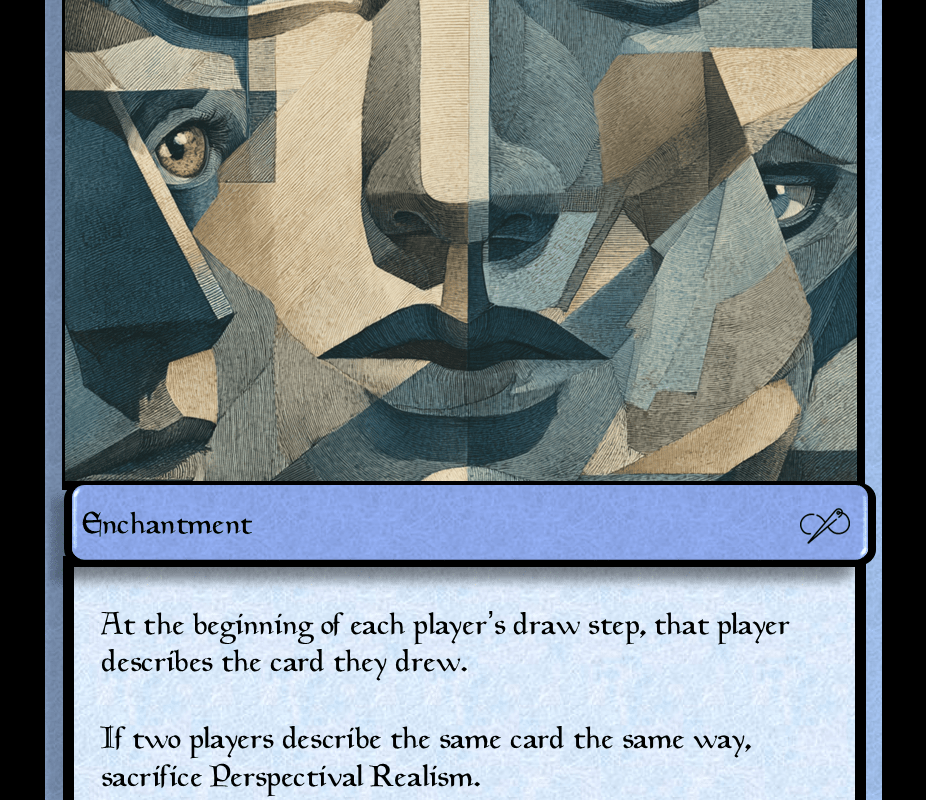
Perspectival Realism โ€“ Enchantment

This Magic: The Gathering parody trading card was the first in my Critical Theory series.

It’s an important card for me. As with sex and gender, creating a taxonomic or ontological dichotomy poses categorical challenges. Despite the insufficiency of language, it’s still all I have to attempt to classify the world. In the case of articulating the perception of reality, we can choose between idealism and realism. The problem is that it’s not either; it’s both. Reality cannot be realised without both.

Reality, weโ€™re told, exists. That confident noun has carried a great deal of human arrogance. It has underwritten empires, sciences, and sermons. Yet somewhere between Platoโ€™s cave and the latest TED Talk, we forgot to ask a simpler question: for whom does reality exist, and from where is it seen?

Audio: NotebookLM podcast of this topic.

The parody trading card Perspectival Realism was born from that unease. Its mechanic is simple but cruel: at the beginning of each playerโ€™s draw step, they must describe the card they drew. The enchantment persists until two players describe a card in the same wayโ€”at which point the spell collapses. In other words, consensus kills magic.

That rule is the metaphysics of the thing.

When a player ‘describes’ a card, they are not transmitting information; they are constructing the object in linguistic space. The moment the description leaves their mouth, the card ceases to be a piece of paper and becomes a conceptual artefact.

This mirrors the insight of Kant, Nietzsche, and every post-structuralist who ever smoked too much Gauloises: perception isnโ€™t passive. We donโ€™t see reality; we compose it. Language isnโ€™t a mirror but a paintbrush. The thing we call truth is not correspondence but coherence โ€“ a temporary truce among competing metaphors.

So the cardโ€™s enchantment dramatises this process. So long as multiple descriptions circulate, reality remains vibrant, contested, alive. Once everyone agrees, it dies the death of certainty.

Philosophers have spent centuries arguing whether the world is fundamentally real (existing independent of mind) or ideal (a projection of mind). Both sides are equally tiresome.

Realism, the old bulldog of metaphysics, insists that perception is transparent: language merely reports whatโ€™s already there. Idealism, its mirror adversary, claims the opposite โ€“ that whatโ€™s โ€œthereโ€ is mind-stuff all along. Both mistakes are symmetrical. Realism forgets the perceiver; Idealism forgets the world.

Perspectival realism refuses the divorce. It begins from the premise that world and mind are inseparable aspects of a single event: knowing. Reality is not a photograph waiting to be developed, nor a hallucination spun from neurons โ€“ itโ€™s a relation, a constant negotiation between perceiver and perceived.

For years, I called myself a Realistโ„ข with an asterisk. That asterisk meant I understood the observer problem: that every ‘fact’ is perspective-laden. Then I became an Idealistโ„ข with an asterisk, meaning I recognised that mind requires matter to dream upon.

The asterisk is everything. Itโ€™s the epistemic scar left by perspectival humility โ€“ the tacit admission that every claim about the world carries a hidden coordinate: said from here. It is not relativism, but situatedness. It is the philosophical equivalent of depth perception: without the offset, thereโ€™s no vision at all.

The cardโ€™s rule โ€“ sacrifice Perspectival Realism when two players describe a card identically โ€“ captures the tragedy of modernity. The Enlightenment taught us to chase consensus, to flatten multiplicity into โ€œobjective truth.โ€ We became addicted to sameness, mistaking agreement for understanding.

But agreement is anaesthetic. When all perspectives converge, the world ceases to shimmer; it becomes measurable, predictable, dead. The cardโ€™s enchantment disappears the moment reality is stabilised, precisely as our cultural enchantment did under the fluorescent light of ‘reason’.

To live under perspectival realism is to acknowledge that reality is not what is drawn but what is described. And the description is never neutral. It is always written from somewhere โ€“ by someone, with a vocabulary inherited from history and stained by desire.

As long as multiple descriptions coexist, the game remains alive. The moment they fuse into one, the spell is broken, and the world returns to grey.

Bernardo Kastrupโ€™s analytic idealism reminded me that consciousness might be primary, but perspectival realism refuses to pledge allegiance. It keeps both flags tattered but flying. The world exists, yes, but only ever for someone.

The enchantment, then, is not belief but perspective itself. So long as difference endures, the game continues.

Perspective Is Everything

2โ€“3 minutes

This clip of Rachel Barr slid into my feed today, fashionably late by a week, and I thought it deserved a little dissection. The video wouldnโ€™t embed directly โ€“ Instagram always has to be precious โ€“ so I downloaded it and linked it here. Donโ€™t worry, Rachel, Iโ€™m not stealing your clicks.

Video: Neuroscientist Dr Rachel Barr discusses Charlie Kirk and gun violence.
Source: https://www.instagram.com/p/DOd3LnjDUW8

Now, the United States. Or rather, the United States In Name Only โ€“ USINO. A nation perpetually rebranding itself as a โ€œunionโ€ whilst its citizens claw at each other like alley cats in a bin fire. Yes, divisions abound โ€“ economic, racial, ideological, pick your poison โ€“ but some fissures cut to the bone. Todayโ€™s example: Charlie Kirk and the rabid congregation of defenders heโ€™s managed to cultivate.

Audio: NotebookLM podcast on this topic.

The Competing Liturgies

To hear one camp tell it, Kirk is no hater at all. Heโ€™s a gentle, God-soaked soul, brimming with Christian love and trying โ€“ halo tilted just so โ€“ to shepherd stray sheep toward Our Lord and Saviourโ„ข. A real Sunday-school sweetheart.

But this is not, shockingly, the consensus. The other camp (my camp, if disclosure still matters in a post-truth age) see him as a snarling opportunist, a huckster of hate packaged in the familiar varnish of patriotism and piety. In short: a hate-merchant with a mailing list.

Spectacle as Weapon

Iโ€™ve watched Kirk at work. He loves to stage โ€œdebatesโ€ โ€“ quotation marks mandatory โ€“ where a token dissenter is dropped into an amphitheatre of loyalists. Itโ€™s the rhetorical equivalent of feeding Christians to lions, except the lions roar on cue and the crowd thinks the blood is wine. He laces misogyny, racism, and reheated premodern dogma into cheap soundbites, and the audience laps it up as though they were attending a revival. For the believers, itโ€™s a festival. For everyone else, itโ€™s a hostile takeover of public discourse.

Deaf Ears, Loud Mouths

Hereโ€™s the rub: Cohort A doesnโ€™t perceive his words as hate because they already share the operating system. Itโ€™s not hate to them โ€“ itโ€™s common sense. Cohort B, meanwhile, hears every syllable as the screech of a chalkboard dragged across the public square. Same words, two worlds.

And when I dare to suggest that if you canโ€™t hear the hatred, you might just be complicit in it, the pushback is instantaneous: Stop imposing your worldview! Which is rich, since their worldview is already blaring through megaphones at tax-exempt rallies. If my worldview is one that insists on less hate, less dehumanisation, less sanctified bullying, then fine, Iโ€™ll take the charge.

The deeper accusation, though, is almost comic: that Iโ€™m hallucinating hate in a man of pure, lamb-like love. Thatโ€™s the gaslighting twist of the knife โ€“ turning critique into pathology. As if the problem isnโ€™t the bile spilling from the stage but my faulty perception of it.

Perspective is everything, yes โ€“ but some perspectives reek of wilful blindness.

Go Back Where You Came From (And Other Spells)

2โ€“3 minutes

Thereโ€™s a certain kind of rhetorical grenade people like to lob when their sense of ownership feels wobbly. Youโ€™ve heard it. Youโ€™ve maybe had it lobbed in your general direction.

Itโ€™s not an argument, of course. Itโ€™s a spell. A warding charm. The linguistic equivalent of hissing at a stray cat in the garden. The phrase carries the weight of assumed belonging: we are naturally here, you are obviously not. The incantation is meant to banish you with a puff of words.

The other day, I watched a black activist absorb this spell and toss it back with deadpan precision:

Cue awkward silence. The symmetry was perfect. Suddenly, the verbal hex had reversed polarity, exposing the hypocrisy built into the original curse. The power of the spell depends entirely on who gets to cast it. When it comes from the wrong mouth, the whole structure of โ€œcommon senseโ€ collapses into farce.

Another example: a Greek immigrant in my orbit, accent still clinging to every consonant, grumbling about a black family that had moved into his neighbourhood. Why didnโ€™t they โ€œgo back to Africaโ€? This from a man who himself had gone โ€œbackโ€ from nowhere, except a homeland he happily abandoned for better wages and better weather. Colonialism is apparently a one-way ticket: Europeans roam the globe and call it destiny, but when others move into their postcode, itโ€™s treated like an invasion.

I confess, I once flirted with the same nonsense. Years ago in Japan, in my more callow phase, I asked โ€“ half in jest, wholly in arrogance โ€“ why these people didnโ€™t have the decency to speak my language. The difference, such as it is, lay in my awareness that I was being ridiculous. My Greek neighbour, my activistโ€™s hecklerโ€”no irony there. They were dead serious.

Thatโ€™s the grotesque comedy of racism: its logic isnโ€™t logic at all. Itโ€™s ritual. A mantra recited to reassure oneself of belonging by denying it to others. It dresses itself in the robes of rationality โ€“ โ€œgo back where you came fromโ€ sounds like geography, after all โ€“ but itโ€™s closer to medieval exorcism than reasoned debate.

And when the cursed simply whispers the incantation back? The spell collapses. The supposed โ€œtruthโ€ reveals itself for what it always was: a desperate attempt to maintain the fiction that one kind of stranger is native and another will always be alien.

Every empire tells its children they were born at home, and tells everyone else they were born trespassing.

Decolonising the Mind

Ngลฉgฤฉ wa Thiong’o published “Decolonising the Mind” in 1986. David Guignion shares a 2-part summary analysis of the work on his Theory and Philosophy site.

I used NotebookLLM to produce this short podcast: [Content no longer extant] https://notebooklm.google.com/notebook/7698ab0b-43ab-47d4-a50f-703866cfb1b9/audio

Decolonising the Mind: A Summary

Ngลฉgฤฉ wa Thiong’o’s book Decolonising the Mind centres on the profound impact of colonialism on language, culture, and thought. It argues that imposing a foreign language on colonised people is a key tool of imperial domination. This linguistic imperialism leads to colonial alienation, separating the colonised from their own culture and forcing them to view the world through the lens of the coloniser.

Here are some key points from the concept of decolonising the mind:

  • Language is intimately tied to culture and worldview: Language shapes how individuals perceive and understand the world. When colonised people are forced to adopt the language of the coloniser, they are also compelled to adopt their cultural framework and values.
  • Colonial education systems perpetuate mental control: By privileging the coloniser’s language and devaluing indigenous languages, colonial education systems reinforce the dominance of the coloniser’s culture and worldview. This process results in colonised children being alienated from their own cultural heritage and internalising a sense of inferiority.
  • Reclaiming indigenous languages is crucial for decolonisation: wa Thiong’o advocates for a return to writing and creating in indigenous African languages. He sees this as an act of resistance against linguistic imperialism and a way to reconnect with authentic African cultures. He further argues that it’s not enough to simply write in indigenous languages; the content must also reflect the struggles and experiences of the people, particularly the peasantry and working class.
  • The concept extends beyond literature: While wa Thiong’o focuses on language in literature, the concept of decolonising the mind has broader implications. It calls for a critical examination of all aspects of life affected by colonialism, including education, politics, and economics.

It is important to note that decolonising the mind is a complex and ongoing process. There are debates about the role of European languages in postcolonial societies, and the concept itself continues to evolve. However, wa Thiong’o’s work remains a seminal text in postcolonial studies, raising crucial questions about the enduring legacy of colonialism on thought and culture.

The Fragility of Our Systems: A Reflection on Noble vs. Dawkins

Denis Nobleโ€™s critique of Richard Dawkins’ approach to genetics isn’t just a scientific debate; it’s a microcosm of a much larger issue: our inadequate grasp of systems thinking. This inadequacy resonates through every layer of our social, political, and economic frameworks, revealing why these systems often fail usโ€”they are simply too fragile.

VIDEO: Denis Noble explains his revolutionary theory of genetics | Genes are not the blueprint for life

Why do we struggle with systems thinking? The concept itself demands an understanding of boundaries, dimensions, and interactions that are often far beyond our regular scope. More often than not, we define system boundaries too narrowly. We overlook crucial dimensions and, crucially, miss the interactions. This isn’t just an academic observation; it’s a practical one. In my experience, even when we do acknowledge broader boundaries, management frequently undermines their importance, limiting the scope of whatโ€™s considered relevant.

Since the 1980s, my interest in genetics has been piqued by Dawkins’ seminal works like The Selfish Gene and The Blind Watchmaker. Dawkins has long championed a gene-centric view of evolution, one that has shaped our understanding of biology for decades. However, Denis Noble challenges this perspective, advocating for a systems-level view that considers not just the genes but the interactions between a myriad of biological processes. This isnโ€™t just genetics; itโ€™s a profound illustration of systems thinkingโ€”or our lack thereof.

I’m not suggesting we discard Dawkinsโ€™ contributions to science, but Nobleโ€™s arguments are compelling and warrant serious consideration. They underscore a broader philosophical dilemma: our rhetorical constructs often overshadow deeper truths. In discussing the nuances between Dawkins’ and Noble’s theories, I argue that rhetoric, for better or worse, becomes our only accessible truth. While there may be more fundamental truths out there, they are often beyond our grasp, obscured not just by our cognitive limitations but also by the very language we use to discuss them.

So, which is true? The answer might be less about choosing sides and more about acknowledging our limitations in understanding and managing complex systems. Perhaps it’s time to consider that in the quest for truth, acknowledging our blind spots is just as important as the truths we defend.

Apologies in advance for linking a teaser video that leads to a paywall, but the relevant content is self-contained.

In Favour of Democracy

โ€œMany forms of government have been tried and will be tried in this world of sin and woe. No one pretends that democracy is perfect or all-wise. Indeed, it has been said that democracy is the worst form of government except all those other forms that have been tried from time to time.โ€ โ€“ Winston Churchill

As I continue to write and examine my book, I’ll share snippets of progress. In this article, I focus on the voices in support of democracy. This might seem like counting grains of sand on the beach given Democracy’s promotional propaganda. In the West, we are inundated with this messaging.

Some of the pro-democracy voices also appear in the chapter on sceptics, but I separate the streams of thought in each section. Representing pro-democracy voices are the following:

Western Thinkers

  • Karl Marx
  • Winston Churchill
  • John Stuart Mill
  • Thomas Jefferson
  • Alexis de Tocqueville
  • Nelson Mandela

Eastern and Untraditional Thinkers

  • Mahatma Gandhi
  • Aung San Suu Kyi
  • Sun Yat-sen
  • Benigno “Ninoy” Aquino Jr
  • Kim Dae-Jung

I wanted to gain perspective from more than white male voices promoting democracy. I found Nelson Mandela, a black African who subscribes to the Western tradition. Aung San Suu Kyi is the only female represented in this cohort.

Here is how AutoCrit* sees the content of this chapter using its reporting structure.

Synopsis

The text delves into the exploration and defence of democratic ideals through the perspectives of various historical figures, both Western and Eastern. It opens with a quote from Winston Churchill highlighting the imperfections of democracy but also its superiority over other forms of government. The author then introduces key thinkers such as Karl Marx, John Stuart Mill, Thomas Jefferson, Alexis de Tocqueville, Nelson Mandela, Mahatma Gandhi, Aung San Suu Kyi, Sun Yat-sen, Benigno Aquino Jr., and Kim Dae-Jung. Each figure’s support for democracy is examined within their historical context and relevance to modern governance. The text closes by reflecting on common themes among these figures regarding the challenges and potentials of democratic systems.

Audience

The target audience for this text appears to be readers interested in political philosophy, history, or governance systems. Those seeking insights into the evolution of democratic thought through influential figures would find value in this content. However, individuals looking for a light read or entertainment may not be the primary audience here. To make it more relevant to a wider audience base including students or general readers less familiar with political theory jargon could be simplified without compromising depth.

Structure and Organisation

The structure follows a logical order by introducing each figure individually along with their background information before discussing their support for democracy. This organisation allows for clear delineation between different perspectives while maintaining coherence throughout the text.

Clarity

Overall clarity is good; however, some sections delve deeply into specific philosophical concepts that may require prior knowledge or further explanation for complete understanding. For instance, when discussing epistocracy in relation to Jason Brennan’s views on political competency testing could benefit from clearer definitions or examples to aid comprehension.

Argumentation and Persuasion

Opinions presented are well-supported by referencing primary texts from historical figures like Churchill’s speeches or Gandhi’s writings which lend credibility to arguments made about their beliefs in democratic principles being logically constructed.

Tone

The tone throughout is informative yet respectful towards differing viewpoints on democracy presented by each figure discussed – ranging from critical analysis (as seen with Jason Brennan) to advocacy (like Nelson Mandela). There’s an objective approach taken towards evaluating these diverse opinions without overt bias evident in how they’re portrayed.

Interest and Engagement

While engaging overall due to its examination of significant historical figures’ stances on democracy across cultures; there are parts where excessive detail might lose reader engagement especially if unfamiliar with certain terms or contexts like agrarian democracies proposed by Jefferson which could benefit from simplification without losing substance.

Final Thoughts and Conclusions

The text concludes effectively summarizing common themes amongst discussed figures regarding democratic ideals while offering reflections tying together points introduced earlier providing a satisfying closure that encapsulates main ideas explored demonstrating thorough analysis facilitating reader understanding comprehensively.


* AutoCrit is an AI editorial review application. Whilst I don’t have enough exposure or experience to fully endorse the programme, I am a subscriber who uses it to critique my writing. I am, however, an affiliate member, so if you purchase a subscription, I will receive compensation from them, and it will benefit this site at no additional expense to you.

I edited some of AutoCrit’s output to conform with standard British English. Please remember that this is a first draft that will go through several review cycles.