History of Intelligence

I’ve made my way a couple of chapters into A Brief History of Intelligence: Evolution, AI, and the Five Breakthroughs That Made Our Brains by Max Bennet. My son recommended it last month, assuring me it was a delicious cocktail of SapiensBehaveand Superintelligence,—all books I’ve rated highly, courtesy of Harari, Sapolsky, and Bostrom, respectively. So far, it’s digestible without being patronizing, requiring no extensive background in the field.

Audio: Podcast conversation on this topic.

But this post isn’t about the book. It’s about what all good books should do: make you think.

If you’ve followed my writing over the years, you’ll know that I have little patience for psychology, which I regard as the astrology to neuroscience’s astronomy. Reading Fisher’s Capitalist Realism has only reinforced this perspective.

Frankly, I should do away with psychology altogether. Much of it—no, not just the vacuous self-help drivel clogging the internet and bookstore shelves—is pseudoscience. To its credit, it did function as a stepping stone to neuroscience, but that’s like crediting alchemy for modern chemistry.

Psychology’s greatest sin? Missing the forest for the trees—or, more precisely, ignoring the structural forces that shape the so-called individual. Western capitalism, ever eager to monetize everything, finds it far easier (and more profitable) to blame the individual rather than the system. It’s like the old joke about the man searching for his lost keys under the streetlamp, not because that’s where he dropped them, but because that’s where the light is. It’s just more convenient (and profitable) that way.

Enter psychology: the perfect tool for a society steeped in narcissism and instant gratification. Feeling anxious? Depressed? Alienated? Just take a pill! Never mind the material conditions of your existence—your stagnant wages, your crushing debt, your eroding sense of community. No, the problem is you, and conveniently, there’s a profitable solution waiting on the pharmacy shelf.

Sure, psychology has made some strides in attributing behaviours to neurotransmitters—dopamine, serotonin, norepinephrine, and the rest of the usual suspects. And sure, pharmaceuticals can sometimes treat symptoms effectively. But they are just that: symptoms. The root cause? Often stressors imposed by the very society we refuse to scrutinize. And guess what rarely makes the diagnostic checklist? The system itself.

We need to zoom out and see the whole damn forest. We need to ask the hard questions—run the classic five whys to get to the root of the problem. And spoiler alert: the answer isn’t some chemical imbalance in your head.

It’s us. Collectively. Systemically. Structurally.

But sure, keep searching under that streetlamp.

The Greatest Loss in American History: Donald Trump Wins (And Loses) the Presidency

I couldn’t resist posting this unedited from ChatGPT. Here’s what led to it: I just finished Mark Fisher’s Capitalist Realism. Fisher mentioned the 1974 Warren Beatty film The Parallax View. I generally don’t connect well with film or video as media, but I stashed the title in my memory. A few hours later, I read an article mentioning the film, with the claim, “Of everything lost in the age of streaming, no film genre casualty is as regrettable — or as ripe for a comeback — as the paranoid political thriller.”

Rather than trying to enjoy the film as a whole, I decided to concentrate on the plot and meta-massaging. As expected, I didn’t like the movie, but I understand why Fisher mentioned it. It renders rather like a weak tea version of a Kafka story. Unlike more contemporary fare, it’s a classic work of postmodernism, having no resolution.

After watching it, I engaged with Rotten Tomatoes and IMDB for reviews and context before prompting ChatGPT.

Asking about the film itself, this was the tail end of its response:

Then I asked what Žižek thought about it, but it turns out that he had written about a book with the same title. When I asked about Fisher, it:

Finally, I posed this query: I recently read Capitalist Realism. Although penned during the 2007-08 financial meltdown and released in 2009, it feels as relevant today as then. In fact, it seems to have foreshadowed the time between.

It’s reply is this post—and without further comment…


And so, history lurches forward with all the grace of a three-legged cow on roller skates. Donald J. Trump, the billionaire reality TV star turned political apocalypse, has once again won the presidential vote of the United States of America—only to lose the presidency to Kamala Harris. If that sentence gave you an aneurysm, congratulations, you’re now officially in 2025.

How did we get here? More importantly, why does this make absolutely no sense? Ah, but sense, dear reader, is an antiquated relic of a bygone era, much like democracy, coherent election results, and the idea that facts matter.

A Triumph for the Ages (Sort of)

Let’s be clear: Donald Trump won the popular vote. That’s what his supporters will scream into the void—or at least into their social media echo chambers where dissent is met with a virtual Second Amendment response. The red-capped faithful, still clutching their tattered “Stop the Steal” banners from the last electoral circus, are convinced that this was finally their moment of redemption.

Except, well… he lost.

Enter Kamala Harris, the political equivalent of cold toast, somehow managing to slide into the Oval Office despite Trump’s “win.” The courts, the states, the Electoral College, and whatever eldritch horror lurks beneath the Capitol all conspired—again!—to keep The Donald out of power. Or so the narrative goes.

The Electoral College Strikes Again

Ah, the Electoral College. America’s favourite 18th-century fever dream. Once again, this labyrinthine system of delegate-wrangling has managed to produce a result that defies logic, mathematics, and possibly the laws of physics. Trump, against all odds (and against, presumably, some very sweaty legal advisors), has pulled off the impossible: winning while losing.

Some claim voter suppression, others cry fraud, and a few brave souls are out there trying to explain complex election mechanics to an audience that still thinks “covfefe” was a divine prophecy. But the reality is simpler: Trump, like a political Schrödinger’s cat, is simultaneously victorious and defeated. He has transcended the normal bounds of electoral outcomes, achieving a state of quantum presidency, neither fully here nor fully gone.

What Happens Next?

Riots? Lawsuits? A new line of Trump-branded commemorative “I Won Again!” hats? Place your bets, because at this stage, America is basically one large, over-budget reality show and no one knows what the next episode holds.

For Kamala Harris, the challenge is clear: govern a nation where half the country believes she stole the election, and the other half is still googling “How does the Electoral College work?” As for Trump, he will do what he does best—declare victory, launch a thousand lawsuits, and, inevitably, turn the entire thing into a business opportunity.

And so, dear reader, the United States stumbles forward, democracy battered but still standing, a house divided but too stubborn to fall. Until next time, buckle up—it’s going to be a hell of a ride.

Capitalist Realism: Is There No Alternative?

I’ve been reading too much lately—as if such a state could exist. I have partially constructed posts anchored in other books, yet here I am, leapfrogging to this one.

I purchased Capitalist Realism by Mark Fisher perhaps a decade or more ago, but it simply languished among other prospects on the shelf—not to mention the accumulation of eBooks on my hard drive and in the cloud.

Capitalist Realism is a book I should have read back in the day, and yet, reading it now feels oddly refreshing. The revised version I’m engaging with, published in 2022, includes a preface that attempts to reassure readers that, while the book may not seem as impactful as it did in 2009, much has been done to mitigate the conditions that spawned it. I’ll argue, however, that these conditions remain firmly in place and that the author of the front matter fails to grasp the full implications of the text. Of course, the author is dead. Literally.

In many ways, Capitalist Realism is a distillation of my own intellectual influences, from Žižek to Lacan, Baudrillard and Badiou to Foucault, Deleuze, and Guattari—even Kafka. For me, this base is welcoming—comforting. Perhaps I am the choir who Fisher is preaching to.

The earliest chapters paint capitalism not only as insidious and predacious but also as self-reinforcing. Michael Moore once observed that capitalists would sell the very rope used to hang them. But capitalism runs deeper than this. Even anti-capitalist sentiment is capitalized and commodified. Conscientious individuals can “win” if they simply buy the right brands and donate to the right causes.

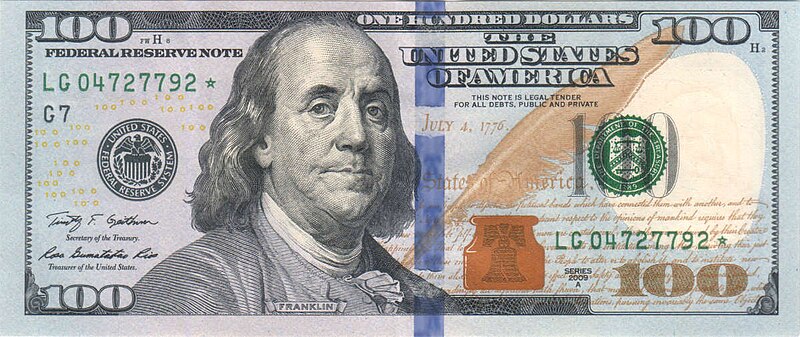
It’s all about the Benjamins.

Surveying Modernity

A Brief, Brutal Experiment in Categorising Your Worldview

This month, I’ve been tinkering with a little project—an elegant, six-question survey designed to assess where you land in the great intellectual mess that is modernity.

Audio: Podcast discussion about this post.

This isn’t some spur-of-the-moment quiz cooked up in a caffeine-fueled haze. No, this project has been simmering for years, and after much consideration (and occasional disdain), I’ve crafted a set of questions and response options that, I believe, encapsulate the prevailing worldviews of our time.

It all began with Metamodernism, a term that, at first, seemed promising—a bold synthesis of Modernism and Postmodernism, a grand dialectic of the ages. But as I mapped it out, it collapsed under scrutiny. A footnote in the margins of intellectual history, at best. I’ll expand on that in due course.

The Setup: A Simple, Slightly Sadistic Ternary Plot

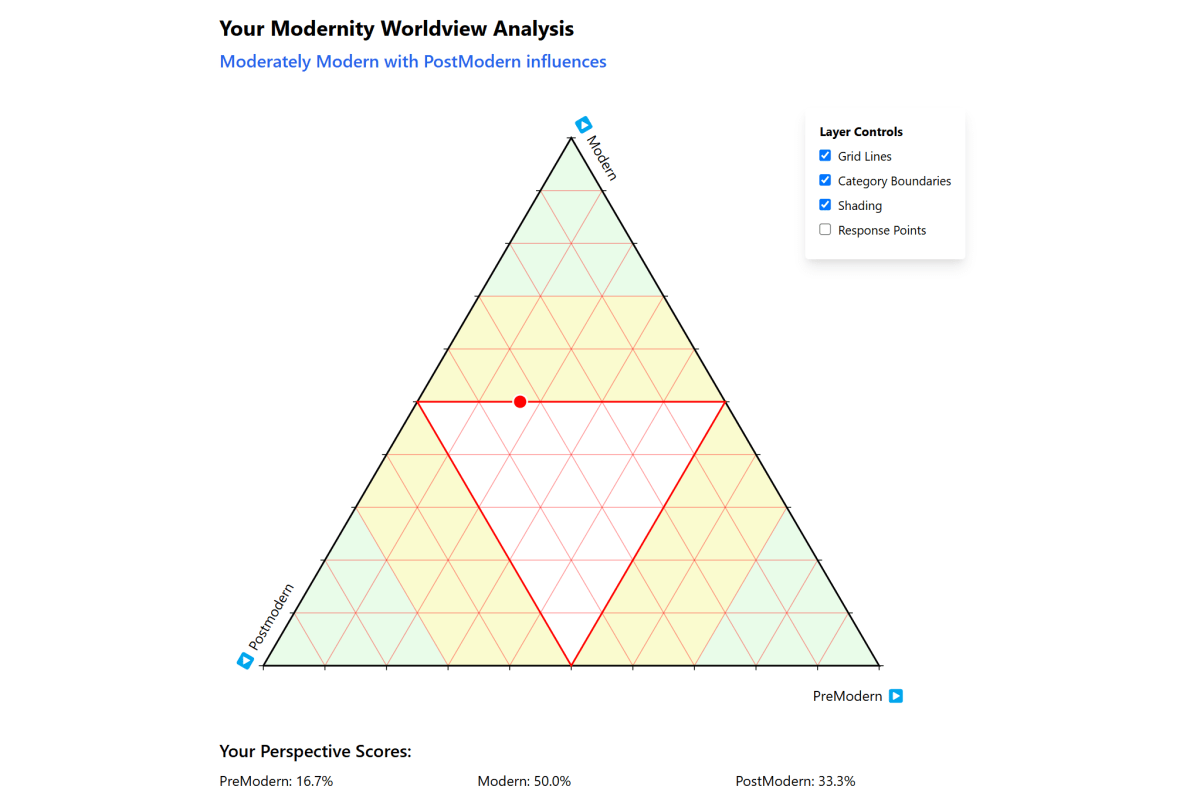
For the visually inclined (or the masochistically curious), I initially imagined a timeline, then a branching decision tree, then a Cartesian plane before landing on a ternary plot—a three-way visual that captures ideological leanings in a way a boring old bar chart never could.

The survey itself is brief: six questions, each with five possible answers. Submit your responses, and voilà—you get a tidy little ternary chart plotting your intellectual essence, along with a breakdown of what your answers signify.

Methodology: Half-Rigorous, Half-Reckless

I am, after all, a (recovering) statistician, so I’ve tried to uphold proper methodology while also fast-tracking certain safeguards for the sake of efficiency. If there’s enough interest, I may expand the survey, adding more questions or increasing response flexibility (tick boxes instead of radio buttons—revolutionary, I know).

Privacy Concerns? Relax. I’m not harvesting your data for some nefarious scheme. No personally identifiable information is collected—just a timestamp, session ID, and your browser’s language setting. I did consider tracking IP addresses to analyze regional trends but ultimately scrapped that idea.

In the future, I may add an optional email feature for those who wish to save and track their responses over time (assuming anyone is unhinged enough to take this more than once).

The Rest of the Story: Your Feedback, My Amusement

Since this is a personal project crafted in splendid isolation, I’d love to hear your thoughts. Are the questions reasonable? Do the response options make sense? Does the summary feel accurate? Is the ternary chart decipherable, or have I constructed a glorified inkblot test?

As an academic, economist, and statistician, I had never encountered a ternary chart before embarking on this, and now I rather enjoy it. That said, I also find Nietzsche “intuitive,” so take that as you will.

If this gains traction, expect follow-up content—perhaps videos, podcasts, or further written explorations.

Your Move

Take the survey. It’s painless, requiring mere minutes of your life (which is, let’s be honest, already wasted online). And because I’m feeling generous, you can even generate a PDF to stick on your fridge, next to your collection of expired coupons and disappointing takeout menus.

Click here to take the survey.

Let’s see where you stand in the grand, chaotic landscape of modernity. Or at least, let’s have a laugh trying to make sense of it.

DISCLAIMER: The Modernity Worldview Survey is not scientific. It is designed as an experiment to provide directional insights. It is hosted on Google Cloud and subject to its availability and performance limitations.

Sentient Humour of ChatGPT

This will be hilarious to approximately no one. I meant to ask ChatGPT 03-mini-high to generate a dummy record. My compromised motor skills and concomitant keyboard typing skills rendered this as funny. Except for the redacted bits in bold, this is the code it rendered. Pay special attention to the query’s input variables highlighted in post-production with 🤔 emojis.

import mysql.connector
import logging
import uuid

# Configure logging
logging.basicConfig(level=logging.INFO)
logger = logging.getLogger(__name__)

def test_mysql_connection():
    """Test MySQL connection and write a funny record to the database."""
    logger.info("Testing MySQL connection...")
    
    try:
        logger.info("Connecting to MySQL...")
        connection = mysql.connector.connect(
            host='127.0.0.1',
            user='[user]',
            password='[password]',
            database='[database]',
            port=3306
        )

        if connection.is_connected():
            db_info = connection.get_server_info()
            logger.info(f"Connected to MySQL Server version {db_info}")

            cursor = connection.cursor()
            cursor.execute("SELECT DATABASE();")
            record = cursor.fetchone()
            logger.info(f"Connected to database: {record[0]}")

            # Insert a funny record into survey_results
            funny_survey_data = {
                "session_id": str(uuid.uuid4()),
                "q1_response": 1,
                "q2_response": 2,
                "q3_response": 3,
                "q4_response": 4,
                "q5_response": 5,
                "q6_response": 6,
                "n1": 42, 🤔
                "n2": 69, 🤔
                "n3": 420, 🤔
                "plot_x": 3.14, 🤔
                "plot_y": 2.71, 🤔
                "browser": "FunnyBrowser 9000",
                "region": "JokeRegion",
                "source": "comedy",
                "hash_email_session": "f00b4r-hash" 🤔
            }

            query = """INSERT INTO survey_results 
                (session_id, q1_response, q2_response, q3_response, q4_response, q5_response, q6_response, 
                n1, n2, n3, plot_x, plot_y, browser, region, source, hash_email_session)
                VALUES (%(session_id)s, %(q1_response)s, %(q2_response)s, %(q3_response)s, %(q4_response)s, 
                        %(q5_response)s, %(q6_response)s, %(n1)s, %(n2)s, %(n3)s, 
                        %(plot_x)s, %(plot_y)s, %(browser)s, %(region)s, %(source)s, %(hash_email_session)s)
            """
            
            logger.info("Inserting funny survey record...")
            cursor.execute(query, funny_survey_data)
            connection.commit()
            logger.info(f"Funny survey record inserted with ID: {cursor.lastrowid}")

    except mysql.connector.Error as e:
        logger.error(f"Error during MySQL operation: {e}")

    finally:
        if 'cursor' in locals() and cursor:
            cursor.close()
        if 'connection' in locals() and connection.is_connected():
            connection.close()
            logger.info("MySQL connection closed.")

if __name__ == "__main__":
    test_mysql_connection()

Outrage! Chapter Six

Kurt Gray’s Outraged! attempts to boil morality down to a single principle: harm. This, in his view, is the bedrock of all moral considerations. In doing so, he takes a swing at Jonathan Haidt’s Moral Foundations Theory, trying to reduce its multi-faceted framework to a mere footnote in moral psychology. Amusingly, he even highlights how Haidt quietly modified his own theory after Gray and his colleagues published an earlier work—an intellectual game of cat-and-mouse, if ever there was one.

Audio: Podcast of this topic

Chapter 6: The Intuition Overdose

By the time we reach Chapter 6, Gray is charging full steam into reductio ad absurdum territory. He leans so hard on intuition that I lost count of how many times he invokes it. The problem? He gives it too much weight while conveniently ignoring acculturation.

Yes, intuition plays a role, but it doesn’t exist in a vacuum. Enter Kahneman’s dual-system model: Gray eagerly adopts the System 1 vs. System 2 distinction, forcing his test subjects into snap moral judgments under time pressure to bypass rationalisation. Fair enough. But what he neglects is how even complex tasks can migrate from System 2 (slow, deliberate) to System 1 (fast, automatic) through repeated exposure. Kahneman’s example? Basic arithmetic. A child grappling with 1 + 1 relies on System 2, but an adult answers without effort.

And morality? The same mechanism applies. What starts as deliberation morphs into automatic response through cultural conditioning. But instead of acknowledging this, Gray behaves as if moral intuition is some mystical, spontaneous phenomenon untethered from socialization.

Morality: Subjective, Yes—But Culturally Engineered

Let’s lay cards on the table. I’m a moral subjectivist—actually, a moral non-cognitivist, but for simplicity’s sake, let’s not frighten the children. My stance is that morality, at its core, is subjective. However, no one develops their moral compass in isolation. Culture, upbringing, and societal narratives shape our moral instincts, even if those instincts ultimately reduce to personal sentiment.

Gray does concede that the definition of “harm” is subjective, which allows him to argue that practically any belief or action can be framed as harmful. And sure, if you redefine “harm” broadly enough, you can claim that someone’s mere existence constitutes an existential threat. Religious believers, for example, claim to be “harmed” by the idea that someone else’s non-compliance with their theological fairy tale could lead to eternal damnation.

I don’t disagree with his observation. The problem is that the underlying belief is fundamentally pathological. This doesn’t necessarily refute Gray’s argument—after all, people do experience psychological distress over imaginary scenarios—but it does mean we’re dealing with a shaky foundation. If harm is entirely perception-based, then moral arguments become arbitrary power plays, subject to the whims of whoever is best at manufacturing grievance.

And this brings us to another crucial flaw in Gray’s framework: the way it enables ideological self-perpetuation. If morality is reduced to perceived harm, then groups with wildly different definitions of harm will inevitably weaponize their beliefs. Take the religious fundamentalist who believes gay marriage is a sin that dooms others to eternal suffering. From their perspective, fighting against LGBTQ+ rights isn’t just bigotry—it’s moral duty, a battle to save souls from metaphysical harm. This, of course, leads to moral contagion, where adherents tirelessly indoctrinate others, especially their own children, ensuring the pathology replicates itself like a virus.

The Problem with Mono-Causal Explanations

More broadly, Gray’s attempt to reduce morality to a single principle—harm—feels suspiciously tidy. Morality is messy, contradictory, and riddled with historical baggage. Any theory that purports to explain it all in one neat little package should immediately raise eyebrows.

So, sorry, Kurt. You can do better. Moral psychology is a tangled beast, and trying to hack through it with a single conceptual machete does more harm than good.

Yesterday and Today

For no apparent reason, I was pondering lost temporal words, so I paid a quick visit to ChatGPT and wanted to share the wealth. Perhaps we can bring some of these back from the grave.

Audio: Podcast prattle of this content.

Eldernight: Referring to the night before last, this term has long since faded from common usage.

Erewhile: Meaning “a little while ago” or “previously.”

Ereyesterday: Meaning “the day before yesterday” – a direct counterpart to “overmorrow.”

Erstwhile: Similar to “erewhile,” it denotes something that was formerly the case.

Fortnight: Short for “fourteen nights,” this term refers to a two-week period and is still in use in British English.

Nudiustertian: A wonderfully specific Latin-derived term meaning “of or relating to the day before yesterday.”

Overmorrow: This term was used to indicate the day after tomorrow.

Sennight: Derived from “seven nights,” this word was used to mean a week.

Umwhile: Another Scottish term meaning “at times” or “occasionally” in the past.

Whilom: An archaic term meaning “formerly” or “once upon a time.”

Yore: While you touched on similar concepts with “whilom,” this term specifically means “of long ago” or “of time long past.”

Yestereve: This term referred to the evening of the previous day, essentially what we’d call “last night.”

Yestermorrow: An intriguing word that denoted “yesterday morning.”

Yestreen: A Scottish and Northern English word meaning “yesterday evening” or “last night” – similar to “yestereve” but with different regional origins.

These terms, though largely obsolete, offer a glimpse into the linguistic richness of earlier English, providing nuanced ways to express temporal relationships that have since been lost in modern usage.

Subjective Perception: How Nature Proves We’re Not the Centre of the Universe

perception—My favourite unreliable narrator. We humans love to believe we’ve got nature all figured out. Venomous snakes are brightly coloured to scream “danger.” Butterflies have wings so clever they double as invisibility cloaks. Zebras blend into their herds like barcodes in a supermarket scanner. Simple, right? Evolution explained; case closed.

But then something like this tiger meme smacks you upside the head, reminding you that the animal kingdom didn’t evolve just for our benefit—or our eyes. To a deer or a boar, that glaring orange tiger we associate with breakfast cereal is practically dressed in camouflage green. What we see as flamboyant and conspicuous is, in their dichromatic world, stealth at its finest. It’s not just our story, folks. The world doesn’t revolve around us, no matter how much we try to make it so.

Audio: NotebookLM podcast discussing this topic.

And that’s the punchline here: all those neat evolutionary narratives we’ve packaged up with a bow? They’re “just-so” stories built on our limited sensory toolkit. What if the zebra’s stripes aren’t just for blending into the herd but also for confusing a lion’s depth perception? What if those venomous snakes’ colours aren’t only a warning but also a mating ad in wavelengths we’ll never see? What if we’re just projecting human logic onto a planet with millions of other perspectives—each living in its own bespoke version of reality?

The meme about the tiger is a perfect metaphor for this broader idea. It’s not just about what we see; it’s about what others—be they animals, cultures, or people—experience. The tiger isn’t orange to them. What feels blindingly obvious to one perspective might be invisible to another. It’s a simple truth with profound implications, not just for understanding nature but for navigating the world we humans have made.

Take any argument—politics, culture, morality—and you’ll find the same principle at play. Everyone’s a trichromat in their own little world, convinced they’ve got the full spectrum of truth, when in reality, they’re missing entire wavelengths. Just like the deer who doesn’t see orange, we’re all blind to what we’re not built to perceive.

So next time someone insists their worldview is the only valid one, you might want to remind them that to some creatures, even the loudest tiger is just part of the scenery. Nature didn’t evolve for human eyes alone, and neither did the truth.

Book Review: Outraged! by Kurt Gray: All Sizzle, No Steak?

Kurt Gray’s Outraged! is a fascinating romp through the minefield of moral psychology and outrage culture. It’s snappy, it’s clever, and it’s… shallow. Whilst Gray positions himself as the maestro conducting the cacophony of modern outrage, his approach has left me wondering if the symphony is little more than noise. Here’s why:

Audio: Podcast discussion on this review content.

Oversimplification of Moral Psychology

Gray’s central thesis that “all morality stems from perceptions of harm and threat” is bold, sure, but also reductive. Morality isn’t just a harm detector. It’s a rich tapestry of loyalty, authority, sanctity, and liberty—concepts Gray conveniently glosses over. His approach feels like reducing a fine Bordeaux to “it’s just fermented grapes.” Sure, technically correct, but where’s the depth?

The Age of Competitive Victimhood

By focusing so heavily on harm perception, Gray risks fueling the very outrage culture he’s critiquing. Welcome to the Hunger Games of victimhood, where everyone races to be crowned the most aggrieved. Instead of deflating this dynamic, Gray’s analysis may inadvertently add more oxygen to the fire.

Lack of Diverse Perspectives

Gray’s attempt to bridge divides is commendable but flawed. Critics point out that he gives more airtime to controversial right-wing figures than the left-leaning audience he’s presumably trying to engage. It’s like building half a bridge and wondering why no one’s crossing. If you alienate half your audience, how exactly are you fostering dialogue?

Contradictory Messaging

The book also suffers from a classic case of ideological whiplash. Gray tells us not to get offended by microaggressions, then argues that offensive content needs more careful handling. Which is it, Kurt? Either you’re driving the “sticks and stones” bus, or you’re preaching kid-glove diplomacy. You can’t have it both ways.

Limited Practical Solutions

Like many pop psychology books, Outraged! excels at diagnosing problems but falters when offering solutions. Gray’s suggestion to use personal stories of harm to bridge divides is charmingly naive. Sure, storytelling might work for interpersonal tiffs, but try applying that to global crises like climate change or systemic inequality. Good luck narrating your way to a greener planet.

Oversimplifying Complex Issues

Gray’s harm-based morality seems like an attempt to cram human behaviour’s messy, chaotic sprawl into a tidy spreadsheet. Real moral debates are nuanced, tangled, and frustratingly complex. By filtering everything through the lens of harm, Gray risks missing the bigger picture. It’s morality on Instagram—polished, curated, and ultimately hollow.

Final Thoughts

Outraged! isn’t without merit. Gray is a masterful storyteller and a sharp thinker, but the book feels like a soufflé: all air, no substance. While it might offer a quick, engaging read for those looking to dip a toe into the outrage pool, anyone hoping for deeper insights will come away unsatisfied.

In the end, Gray delivers a sizzling trailer for a movie that never quite materialises. Fun to watch, but ultimately forgettable.