I just read The Granton Star Cause in Irvine Welsh’s short story collection, The Acid House, and couldn’t help but reflect it off of Kafka’s Metamorphosis.
Kafka gave us Gregor Samsa: a man who wakes up as vermin, stripped of usefulness, abandoned by family, slowly rotting in a godless universe. His tragedy is inertia; his metamorphosis grants him no agency, only deeper alienation.
Audio: NotebookLM podcast on this topic.
Welsh replies with Boab Coyle, a lad who is likewise cast off, rejected by his football mates, scorned by his parents, dumped by his girlfriend, and discarded by his job. Boab is surplus to every domain: civic, familial, erotic, and economic. Then he undergoes his own metamorphosis. And here Welsh swerves from Kafka.
Boab meets his “god.” But the god is nothing transcendent. It is simply Boab’s latent agency, given a mask – a projection of his bitterness and thwarted desires. God looks like him, speaks like him, and tells him to act on impulses long repressed. Where Kafka leaves Gregor to die in silence, Welsh gives Boab a grotesque theology of vengeance.
Through a Critical Theory lens, the contrast is stark:
Marx: Both men are surplus. Gregor is disposable labour; Boab is Thatcher’s lumpen. Alienated, both become vermin.
Nietzsche: Gregor has no god, only the absurd. Boab makes one in his own image, not an Übermensch, but an Über-fly – quite literally a Superfly – a petty deity of spite.
Foucault: Gregor is disciplined into passivity by the family gaze. Boab flips it: as a fly, he surveils and annoys, becoming the pest-panopticon.
Bataille/Kristeva: Gregor embodies the abjection of his family’s shame. Boab revels in abjection, weaponising filth as his new mode of agency.
The punchline? Boab’s new god-agency leads straight to destruction. His rage is cathartic, but impotent. The lumpen are permitted vengeance only when it consumes themselves.
So Kafka gave us the tragedy of stasis; Welsh provides us with the tragedy of spite. Both are bleak parables of alienation, but Welsh injects a theology of bad attitude: a god who licenses action only long enough to destroy the actor.
I recently wrote an article on my disdain for Jordan Peterson. (A cathartic exercise, I assure you.) But as I was busy sharpening my polemic, my so-called writing assistant – autocorrect – decided it fancied itself a philosopher, chipping in with some of the most spectacularly unhelpful suggestions I’ve encountered this side of a Facebook comment thread.
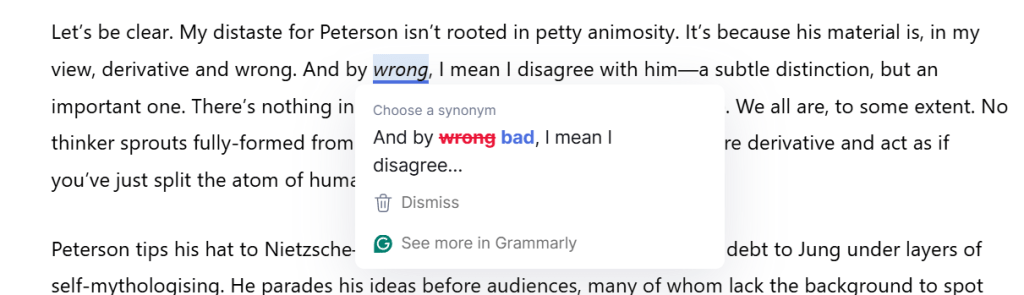
Is wrong bad?
In the first instance, autocorrect took issue with my phrasing:
And by wrong, I mean I disagree with him…
This, apparently, was too much for it. The poor dear couldn’t recognise the parallel sentence structure, or the rhetorical flourish at work. No, it suggested replacing wrong with bad. Because why not destroy the symmetry and nuance in one fell swoop?
Image: Is wrong bad?
Obviously, the second wrong is a riff on the first. To replace wrong with bad would be incorrect—wrong, if you will. Some might say bad. But I digress. The point is: the logic holds, and autocorrect’s intervention doesn’t.
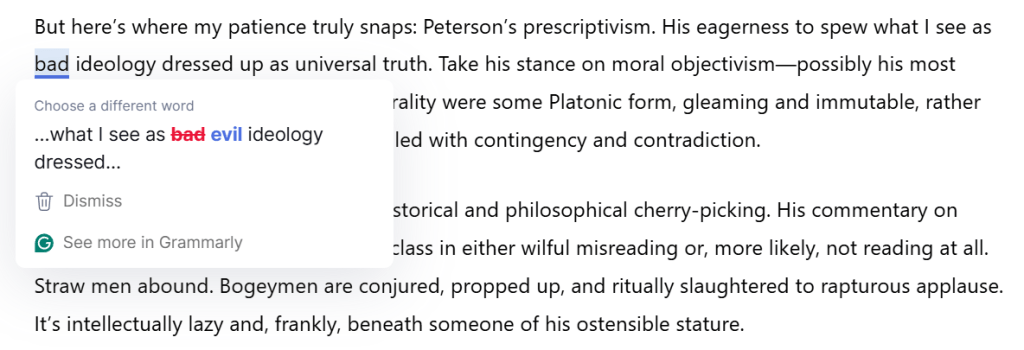
Is bad evil?
As if that weren’t enough, round two delivered an even greater affront:
But here’s where my patience truly snaps: Peterson’s prescriptivism. His eagerness to spew what I see as bad ideology dressed up as universal truth…
Autocorrect, in its infinite wisdom, suggested I swap bad for evil. Ah yes, because evil is precisely what I want—a term dripped in moral absolutism and ideological baggage.
Image: Is bad evil?
First, autocorrect, might I suggest you check out Nietzsche’s Genealogy of Good and Evil before piping up? Perhaps then you’d grasp the not-so-subtle difference between bad and evil—a distinction that, in moral philosophy, rather matters.
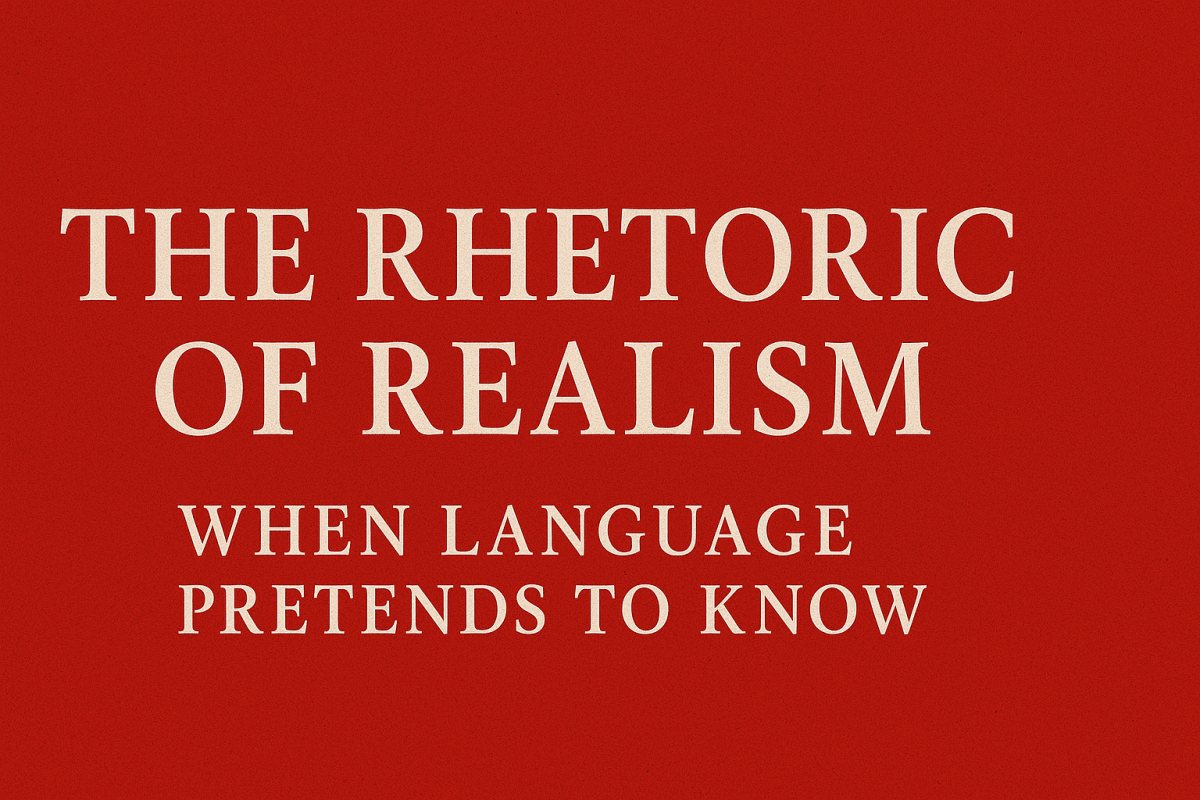
And now my book titles aren’t safe either…
Even as I write this post, the machine assaults me with a suggestion to rename the title of my book recommendation. O! the humanity. Is nothing sacred?
Image: Autocorrect strikes again
Final thoughts
Autocorrect may be marvellous for spotting typos and the occasional rogue comma, but when it tries its hand at philosophy, the result is about as elegant as a rhinoceros in a tutu. Dear autocorrect: stick to spelling. Leave the nuance to the humans.
I don’t like most of Jordan Peterson’s positions. There – I’ve said it. The man, once ubiquitous, seems to have faded into the woodwork, though no doubt his disciples still cling to his every word as if he were a modern-day oracle. But recently, I caught a clip of him online, and it dredged up the same bad taste, like stumbling upon an old, forgotten sandwich at the back of the fridge.
Audio: NotebookLM podcast on this topic
Let’s be clear. My distaste for Peterson isn’t rooted in petty animosity. It’s because his material is, in my view, derivative and wrong. And by wrong, I mean I disagree with him – a subtle distinction, but an important one. There’s nothing inherently shameful about being derivative. We all are, to some extent. No thinker sprouts fully-formed from the head of Zeus. The issue is when you’re derivative and act as if you’ve just split the atom of human insight.
Peterson tips his hat to Nietzsche – fair enough – but buries his far greater debt to Jung under layers of self-mythologising. He parades his ideas before audiences, many of whom lack the background to spot the patchwork, and gaslights them into believing they’re witnessing originality. They’re not. They’re witnessing a remixed greatest-hits album, passed off as a debut.
Image: Gratuitous, mean-spirited meme.
Now, I get it. My ideas, too, are derivative. Sometimes it’s coincidence – great minds and all that – but when I trace the thread back to its source, I acknowledge it. Nietzsche? Subjectivity of morality. Foucault? Power dynamics. Wittgenstein? The insufficiency of language. I owe debts to many more: Galen Strawson, Richard Rorty, Raymond Geuss – the list goes on, and I’d gladly share my ledger. But Peterson? The man behaves as though he invented introspection.
And when I say I disagree, let’s not confuse that with some claim to divine epistemic certainty. I don’t mean he’s objectively wrong (whatever that means in the grand circus of philosophy). I mean, I disagree. If I did, well, we wouldn’t be having this conversation, would we? That’s the tragicomedy of epistemology: so many positions, so little consensus.
But here’s where my patience truly snaps: Peterson’s prescriptivism. His eagerness to spew what I see as bad ideology dressed up as universal truth. Take his stance on moral objectivism—possibly his most egregious sin. He peddles this as if morality were some Platonic form, gleaming and immutable, rather than what it is: a human construct, riddled with contingency and contradiction.
And let’s not even get started on his historical and philosophical cherry-picking. His commentary on postmodern thought alone is a masterclass in either wilful misreading or, more likely, not reading at all. Straw men abound. Bogeymen are conjured, propped up, and ritually slaughtered to rapturous applause. It’s intellectually lazy and, frankly, beneath someone of his ostensible stature.
I can only hope we’ve seen the last of this man in the public sphere. And if not? Well, may he at least reform his ways—though I shan’t be holding my breath.
The Enlightenment, we are told, was the age of Reason. A radiant exorcism of superstition. Out went God. Out went angels, miracles, saints, indulgences. All that frothy medieval sentiment was swept aside by a brave new world of logic, science, and progress. Or so the story goes.
Audio: NotebookLM podcast on this topic.
But look closer, and you’ll find that Reason didn’t kill God—it absorbed Him. The Enlightenment didn’t abandon metaphysics. It merely privatised it.
From Confessional to Courtroom
We like to imagine that the Enlightenment was a clean break from theology. But really, it was a semantic shell game. The soul was rebranded as the self. Sin became crime. Divine judgement was outsourced to the state.
We stopped praying for salvation and started pleading not guilty.
The entire judicial apparatus—mens rea, culpability, desert, retribution—is built on theological scaffolding. The only thing missing is a sermon and a psalm.
Where theology had the guilty soul, Enlightenment law invented the guilty mind—mens rea—a notion so nebulous it requires clairvoyant jurors to divine intention from action. And where the Church offered Hell, the state offers prison. It’s the same moral ritual, just better lit.
Galen Strawson and the Death of Moral Responsibility
Enter Galen Strawson, that glowering spectre at the feast of moral philosophy. His Basic Argument is elegantly devastating:
You do what you do because of the way you are.
You can’t be ultimately responsible for the way you are.
Therefore, you can’t be ultimately responsible for what you do.
Unless you are causa sui—the cause of yourself, an unmoved mover in Calvin Klein—you cannot be held truly responsible. Free will collapses, moral responsibility evaporates, and retributive justice is exposed as epistemological theatre.
In this light, our whole legal structure is little more than rebranded divine vengeance. A vestigial organ from our theocratic past, now enforced by cops instead of clerics.
The Modern State: A Haunted House
What we have, then, is a society that has denied the gods but kept their moral logic. We tossed out theology, but we held onto metaphysical concepts like intent, desert, and blame—concepts that do not survive contact with determinism.
We are living in the afterglow of divine judgement, pretending it’s sunlight.
Nietzsche saw it coming, of course. He warned that killing God would plunge us into existential darkness unless we had the courage to also kill the values propped up by His corpse. We did the first bit. We’re still bottling it on the second.
If Not Retribution, Then What?
Let’s be clear: no one’s suggesting we stop responding to harm. But responses should be grounded in outcomes, not outrage.
Containment, not condemnation.
Prevention, not penance.
Recalibration, not revenge.
We don’t need “justice” in the retributive sense. We need functional ethics, rooted in compassion and consequence, not in Bronze Age morality clumsily duct-taped to Enlightenment reason.
The Risk of Letting Go
Of course, this is terrifying. The current system gives us moral closure. A verdict. A villain. A vanishing point for our collective discomfort.
Abandoning retribution means giving that up. It means accepting that there are no true villains—only configurations of causes. That punishment is often revenge in drag. That morality itself might be a control mechanism, not a universal truth.
But if we’re serious about living in a post-theological age, we must stop playing dress-up with divine concepts. The Enlightenment didn’t finish the job. It changed the costumes, kept the plot, and called it civilisation.
Let us begin with the heresy: Truth is a rhetorical artefact. Not a revelation. Not a metaphysical essence glimmering behind the veil. Just language — persuasive, repeatable, institutionally ratified language. In other words: branding.
Audio: NotebookLM podcast on this topic.
This is not merely a postmodern tantrum thrown at the altar of Enlightenment rationalism. It is a sober, if impolite, reminder that nearly everything we call “knowledge” is stitched together with narrative glue and semantic spit. Psychology. Neuroscience. Ethics. Economics. Each presents itself as a science — or worse, a moral imperative — but their foundations are built atop a linguistic faultline. They are, at best, elegant approximations; at worst, dogma in drag.
Let’s take psychology. Here is a field that diagnoses your soul via consensus. A committee of credentialed clerics sits down and declares a cluster of behaviours to be a disorder, assigns it a code, and hands you a script. It is then canonised in the DSM, the Diagnostic Scripture Manual. Doubt its legitimacy and you are either naïve or ill — which is to say, you’ve just confirmed the diagnosis. It’s a theological trap dressed in the language of care.
Or neuroscience — the church of the glowing blob. An fMRI shows a region “lighting up” and we are meant to believe we’ve located the seat of love, the anchor of morality, or the birthplace of free will. Never mind that we’re interpreting blood-oxygen fluctuations in composite images smoothed by statistical witchcraft. It looks scientific, therefore it must be real. The map is not the territory, but in neuroscience, it’s often a mood board.
And then there is language itself, the medium through which all these illusions are transmitted. It is the stage, the scenery, and the unreliable narrator. My Language Insufficiency Hypothesis proposes that language is not simply a flawed tool — it is fundamentally unfit for the task it pretends to perform. It was forged in the furnace of survival, not truth. We are asking a fork to play the violin.
This insufficiency is not an error to be corrected by better definitions or clever metaphors. It is the architecture of the system. To speak is to abstract. To abstract is to exclude. To exclude is to falsify. Every time we speak of a thing, we lose the thing itself. Language functions best not as a window to the real but as a veil — translucent, patterned, and perpetually in the way.
So what, then, are our Truths™? They are narratives that have won. Stories that survived the epistemic hunger games. They are rendered authoritative not by accuracy, but by resonance — psychological, cultural, institutional. A “truth” is what is widely accepted, not because it is right, but because it is rhetorically unassailable — for now.
This is the dirty secret of epistemology: coherence masquerades as correspondence. If enough concepts link arms convincingly, we grant them status. Not because they touch reality, but because they echo each other convincingly in our linguistic theatre.
Libet’s experiment, Foucault’s genealogies, McGilchrist’s hemispheric metaphors — each peels back the curtain in its own way. Libet shows that agency might be a post-hoc illusion. Foucault reveals that disciplines don’t describe the subject; they produce it. McGilchrist laments that the Emissary now rules the Master, and the world is flatter for it.
But all of them — and all of us — are trapped in the same game: the tyranny of the signifier. We speak not to uncover truth, but to make truth-sounding noises. And the tragedy is, we often convince ourselves.
So no, we cannot escape the prison of language. But we can acknowledge its bars. And maybe, just maybe, we can rattle them loudly enough that others hear the clank.
Until then, we continue — philosophers, scientists, diagnosticians, rhetoricians — playing epistemology like a parlour game with rigged dice, congratulating each other on how well the rules make sense.
I’ve read Part I of Hobbes’ Leviathan and wonder what it would have been like if he filtered his thoughts through Hume or Wittgenstein. Hobbes makes Dickens read like Pollyanna. It’s an interesting historical piece, worth reading on that basis alone. It reads as if the Christian Bible had to pass through a legal review before it had been published, sapped of vigour. As bad a rap as Schopenhauer seems to get, Hobbes is the consummate Ebenezer Scrooge. Bah, humbug – you nasty, brutish, filthy animals!*
Audio: NotebookLM podcast conversation on this topic.
In any case, it got me thinking of free will and, more to the point, of will itself.
A Brief History of Humanity’s Favourite Metaphysical Scapegoat
By the time Free Will turned up to the party, the real guest of honour—the Will—had already been drinking heavily, muttering incoherently in the corner, and starting fights with anyone who made eye contact. We like to pretend that the “will” is a noble concept: the engine of our autonomy, the core of our moral selves, the brave little metaphysical organ that lets us choose kale over crisps. But in truth, it’s a bloody mess—philosophy’s equivalent of a family heirloom that no one quite understands but refuses to throw away.
So, let’s rewind. Where did this thing come from? And why, after 2,500 years of name-dropping, finger-pointing, and metaphysical gymnastics, are we still not quite sure whether we have a will, are a will, or should be suing it for damages?
Plato: Soul, Reason, and That Poor Horse
In the beginning, there was Plato, who—as with most things—half-invented the question and then wandered off before giving a straight answer. For him, the soul was a tripartite circus act: reason, spirit, and appetite. Will, as a term, didn’t get top billing—it didn’t even get its name on the poster. But the idea was there, muddling along somewhere between the charioteer (reason) and the unruly horses (desire and spiritedness).
No explicit will, mind you. Just a vague sense that the rational soul ought to be in charge, even if it had to beat the rest of itself into submission.
Aristotle: Purpose Without Pathos
Aristotle, ever the tidy-minded taxonomist, introduced prohairesis—deliberate choice—as a sort of proto-will. But again, it was all about rational calculation toward an end. Ethics was teleological, goal-oriented. You chose what aligned with eudaimonia, that smug Greek term for flourishing. Will, if it existed at all, was just reason picking out dinner options based on your telos. No inner torment, no existential rebellion—just logos in a toga.
Augustine: Sin, Suffering, and That Eternal No
Fast-forward a few hundred years, and along comes Saint Augustine, traumatised by his libido and determined to make the rest of us suffer for it. Enter voluntas: the will as the seat of choice—and the scene of the crime. Augustine is the first to really make the will bleed. He discovers he can want two incompatible things at once and feels properly appalled about it.
From this comes the classic Christian cocktail: freedom plus failure equals guilt. The will is free, but broken. It’s responsible for sin, for disobedience, for not loving God enough on Wednesdays. Thanks to Augustine, we’re stuck with the idea that the will is both the instrument of salvation and the reason we’re going to Hell.
Cheers.
Medievals: God’s Will or Yours, Pick One
The Scholastics, never ones to let an ambiguity pass unanalysed, promptly split into camps. Aquinas, ever the reasonable Dominican, says the will is subordinate to the intellect. God is rational, and so are we, mostly. But Duns Scotus and William of Ockham, the original voluntarist hooligans, argue that the will is superior—even in God. God could have made murder a virtue, they claim, and you’d just have to live with it.
From this cheerful perspective, will becomes a force of arbitrary fiat, and humans, made in God’s image, inherit the same capacity for irrational choice. The will is now more than moral; it’s metaphysical. Less reason’s servant, more chaos goblin.
Hobbes: Appetite with Delusions of Grandeur
Then along comes Thomas Hobbes, who looks at the soul and sees a wheezing machine of appetites. Will, in his famously cheery view, is simply “the last appetite before action.” No higher calling, no spiritual struggle—just the twitch that wins. Man is not a rational animal, but a selfish algorithm on legs. For Hobbes, will is where desire stumbles into motion, and morality is a polite euphemism for not getting stabbed.
Kant: The Will Gets a Makeover
Enter Immanuel Kant: powdered wig, pursed lips, and the moral rectitude of a man who scheduled his bowel movements. Kant gives us the “good will”, which acts from duty, not desire. Suddenly, the will is autonomous, rational, and morally legislative—a one-man Parliament of inner law.
It’s all terribly noble, terribly German, and entirely exhausting. For Kant, free will is not the ability to do whatever you like—it’s the capacity to choose according to moral law, even when you’d rather be asleep. The will is finally heroic—but only if it agrees to hate itself a little.
Schopenhauer: Cosmic Will, Cosmic Joke
And then the mood turns. Schopenhauer, world’s grumpiest mystic, takes Kant’s sublime will and reveals it to be a blind, thrashing, cosmic force. Will, for him, isn’t reason—it’s suffering in motion. The entire universe is will-to-live: a desperate, pointless striving that dooms us to perpetual dissatisfaction.
There is no freedom, no morality, no point. The only escape is to negate the will, preferably through aesthetic contemplation or Buddhist-like renunciation. In Schopenhauer’s world, the will is not what makes us human—it’s what makes us miserable.
Nietzsche: Transvaluation and the Will to Shout Loudest
Cue Nietzsche, who takes Schopenhauer’s howling void and says: yes, but what if we made it fabulous? For him, the will is no longer to live, but to power—to assert, to create, to impose value. “Free will” is a theologian’s fantasy, a tool of priests and moral accountants. But will itself? That’s the fire in the forge. The Übermensch doesn’t renounce the will—he rides it like a stallion into the sunset of morality.
Nietzsche doesn’t want to deny the abyss. He wants to waltz with it.
Today: Free Will and the Neuroscientific Hangover
And now? Now we’re left with compatibilists, libertarians, determinists, and neuroscientists all shouting past each other, armed with fMRI machines and TED talks. Some claim free will is an illusion, a post hoc rationalisation made by brains doing what they were always going to do. Others insist that moral responsibility requires it, even if we can’t quite locate it between the neurons.
We talk about willpower, will-to-change, political will, and free will like they’re real things. But under the hood, we’re still wrestling with the same questions Augustine posed in a North African villa: Why do I do what I don’t want to do? And more importantly, who’s doing it?
Conclusion: Where There’s a Will, There’s a Mess
From Plato’s silent horses to Nietzsche’s Dionysian pyrotechnics, the will has shape-shifted more times than a politician in an election year. It has been a rational chooser, a moral failure, a divine spark, a mechanical twitch, a cosmic torment, and an existential triumph.
Despite centuries of philosophical handwringing, what it has never been is settled.
So where there’s a will, there’s a way. But the way? Twisting, contradictory, and littered with the corpses of half-baked metaphysical systems.
Welcome to the labyrinth. Bring snacks.
* The solitary, poor, nasty, brutish, and short quote is forthcoming. Filthy animals is a nod to Home Alone.
A Brief, Brutal Experiment in Categorising Your Worldview
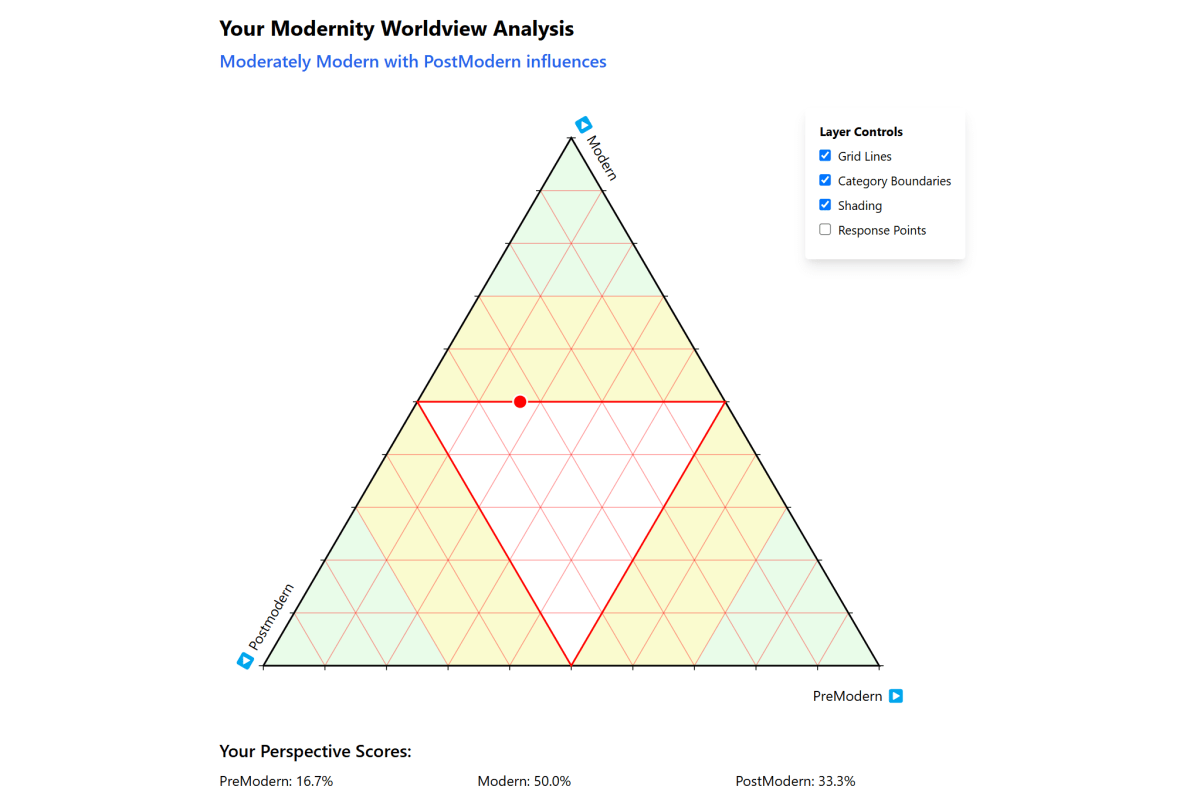
This month, I’ve been tinkering with a little project—an elegant, six-question survey designed to assess where you land in the great intellectual mess that is modernity.
Audio: Podcast discussion about this post.
This isn’t some spur-of-the-moment quiz cooked up in a caffeine-fueled haze. No, this project has been simmering for years, and after much consideration (and occasional disdain), I’ve crafted a set of questions and response options that, I believe, encapsulate the prevailing worldviews of our time.
It all began with Metamodernism, a term that, at first, seemed promising—a bold synthesis of Modernism and Postmodernism, a grand dialectic of the ages. But as I mapped it out, it collapsed under scrutiny. A footnote in the margins of intellectual history, at best. I’ll expand on that in due course.
The Setup: A Simple, Slightly Sadistic Ternary Plot
For the visually inclined (or the masochistically curious), I initially imagined a timeline, then a branching decision tree, then a Cartesian plane before landing on a ternary plot—a three-way visual that captures ideological leanings in a way a boring old bar chart never could.
The survey itself is brief: six questions, each with five possible answers. Submit your responses, and voilà—you get a tidy little ternary chart plotting your intellectual essence, along with a breakdown of what your answers signify.
Methodology: Half-Rigorous, Half-Reckless
I am, after all, a (recovering) statistician, so I’ve tried to uphold proper methodology while also fast-tracking certain safeguards for the sake of efficiency. If there’s enough interest, I may expand the survey, adding more questions or increasing response flexibility (tick boxes instead of radio buttons—revolutionary, I know).
Privacy Concerns? Relax. I’m not harvesting your data for some nefarious scheme. No personally identifiable information is collected—just a timestamp, session ID, and your browser’s language setting. I did consider tracking IP addresses to analyze regional trends but ultimately scrapped that idea.
In the future, I may add an optional email feature for those who wish to save and track their responses over time (assuming anyone is unhinged enough to take this more than once).
The Rest of the Story: Your Feedback, My Amusement
Since this is a personal project crafted in splendid isolation, I’d love to hear your thoughts. Are the questions reasonable? Do the response options make sense? Does the summary feel accurate? Is the ternary chart decipherable, or have I constructed a glorified inkblot test?
As an academic, economist, and statistician, I had never encountered a ternary chart before embarking on this, and now I rather enjoy it. That said, I also find Nietzsche “intuitive,” so take that as you will.
If this gains traction, expect follow-up content—perhaps videos, podcasts, or further written explorations.
Your Move
Take the survey. It’s painless, requiring mere minutes of your life (which is, let’s be honest, already wasted online). And because I’m feeling generous, you can even generate a PDF to stick on your fridge, next to your collection of expired coupons and disappointing takeout menus.
Let’s see where you stand in the grand, chaotic landscape of modernity. Or at least, let’s have a laugh trying to make sense of it.
DISCLAIMER: The Modernity Worldview Survey is not scientific. It is designed as an experiment to provide directional insights. It is hosted on Google Cloud and subject to its availability and performance limitations.
I thought I was done wittering on about Brian Thompson, the late CEO of United Healthcare, but here we are. His name lingers like the corporate perfume of systemic rot—an enduring testament to how we’ve elevated unethical behaviour into performance art. It got me thinking: what if we brought back a bit of old-school accountability? In Ancient Rome, outlaws lost their citizenship, legal protections, and status as people. That’s right—booted out of polite society. Meanwhile, we’ve done the opposite: we hand out golden parachutes and slap their faces on business magazine covers.
To some, Brian Thompson was a good man – apart from the insider trading, of course. He was successful, a nice guy, funny, and had a good family, and a few million-dollar homes. What else could you ask for? But his success came in the way of blood money. It seems we need fewer people who think like this, not more.
Then I recalled The Purge franchise. And sure, The Purge is a dystopian fantasy, but let’s up the stakes. Picture this: bounties on corporate villains. Not literal carnage, of course—let’s leave that for the big screen—but the return of real consequences. Instead of allowing their PR teams to smooth it all over with buzzwords and philanthropy crumbs, what if we made it socially unacceptable to be a snake in a suit? What if moral suasion—the lost art of persuading someone to do right because it’s, you know, right—actually came back into fashion?
Nietzsche nailed it ages ago. We’ve got two moral codes: one for people and one for money. And guess which one wins every time? All it takes is enough cash and the right rhetoric, and suddenly, everyone forgets who’s really getting fleeced. This is the banality of evil in its purest form: not grand acts of villainy but a shrugging normalisation of corruption. We don’t even consider it corruption. We see it as business as usual. We support and work for these businesses.
The tragedy is that we’ve become so desensitised to it that we are adept at ignoring the stench of moral failure that even calling it out feels quaint. But it’s not hopeless. Some of us still notice. Some of us still care. The real question is, how long can we keep tolerating this farce before we remember that morality isn’t just for the powerless?
Meantime, I just imagine these grubbers being stripped of power and protection, running scared from the likes of Luigi Mangioni.
I’m edging ever closer to finishing my book on the Language Insufficiency Hypothesis. It’s now in its third pass—a mostly subtractive process of streamlining, consolidating, and hacking away at redundancies. The front matter, of course, demands just as much attention, starting with the Preface.
The opening anecdote—a true yet apocryphal gem—dates back to 2018, which is evidence of just how long I’ve been chewing on this idea. It involves a divorce court judge, a dose of linguistic ambiguity, and my ongoing scepticism about the utility of language in complex, interpretative domains.
At the time, my ex-wife’s lawyer was petitioning the court to restrict me from spending any money outside our marriage. This included a demand for recompense for any funds already spent. I was asked, point-blank: Had I given another woman a gift?
Seeking clarity, I asked the judge to define gift. The response was less than amused—a glare, a sneer, but no definition. Left to my own devices, I answered no, relying on my personal definition: something given with no expectation of return or favour. My reasoning, then as now, stemmed from a deep mistrust of altruism.
The court, however, didn’t share my philosophical detours. The injunction came down: I was not to spend any money outside the marital arrangement. Straightforward? Hardly. At the time, I was also in a rock band and often brought meals for the group. Was buying Chipotle for the band now prohibited?
The judge’s response dripped with disdain. Of course, that wasn’t the intent, they said, but the language of the injunction was deliberately broad—ambiguous enough to cover whatever they deemed inappropriate. The phrase don’t spend money on romantic interests would have sufficed, but clarity seemed to be a liability. Instead, the court opted for what I call the Justice Stewart Doctrine of Legal Ambiguity: I know it when I see it.
Unsurprisingly, the marriage ended. My ex-wife and I, however, remain close; our separation in 2018 was final, but our friendship persists. Discussing my book recently, I mentioned this story, and she told me something new: her lawyer had confided that the judge disliked me, finding me smug.
This little revelation cemented something I’d already suspected: power relations, in the Foucauldian sense, pervade even our most banal disputes. It’s why Foucault makes a cameo in the book alongside Nietzsche, Wittgenstein, Saussure, Derrida, Borges, and even Gödel.
This anecdote is just one straw on the poor camel’s back of my linguistic grievances, a life filled with moments where language’s insufficiency has revealed itself. And yet, I found few others voicing my position. Hence, a book.
I aim to self-publish in early 2025—get it off my chest and into the world. Maybe then I can stop wittering on about it. Or, more likely, I won’t.
Morality, that ever-elusive beacon of human conduct, is often treated as an immutable entity—a granite monolith dictating the terms of right and wrong. Yet, upon closer inspection, morality reveals itself to be a mirage: a construct contingent upon cultural frameworks, historical conditions, and individual subjectivity. It is neither absolute nor universal but, rather, relative and ultimately subjective, lacking any intrinsic meaning outside of the context that gives it shape.
Friedrich Nietzsche, in his polemical Beyond Good and Evil and On the Genealogy of Morality, exposes the illusion of objective morality. For Nietzsche, moral systems are inherently the products of human fabrication—tools of power masquerading as eternal truths. He describes two primary moralities: master morality and slave morality. Master morality, derived from the strong, values power, creativity, and self-affirmation. Slave morality, by contrast, is reactive, rooted in the resentment (ressentiment) of the weak, who redefine strength as “evil” and weakness as “good.”
Nietzsche’s critique dismantles the notion that morality exists independently of cultural, historical, or power dynamics. What is “moral” for one era or society may be utterly abhorrent to another. Consider the glorification of war and conquest in ancient Sparta versus the modern valorisation of equality and human rights. Each framework exalts its own virtues not because they are universally true but because they serve the prevailing cultural and existential needs of their time.
The Myth of Monolithic Morality
Even viewed through a relativistic lens—and despite the protestations of Immanuel Kant or Jordan Peterson—morality is not and has never been monolithic. The belief in a singular, unchanging moral order is, at best, a Pollyanna myth or wishful thinking, perpetuated by those who prefer their moral compass untroubled by nuance. History is not the story of one moral narrative, but of a multiplicity of subcultures and countercultures, each with its own moral orientation. These orientations, while judged by the dominant moral compass of the era, always resist and redefine what is acceptable and good.
If the tables are turned, so is the moral compass reoriented. The Man in the High Castle captures this truth chillingly. Had the Nazis won World War II, Americans—despite their lofty self-perceptions—would have quickly adopted the morality of their new rulers. The foundations of American morality would have been reimagined in the image of the Third Reich, not through inherent belief but through cultural osmosis, survival instincts, and institutionalised pressure. What we now consider abhorrent might have become, under those circumstances, morally unremarkable. Morality, in this view, is not timeless but endlessly pliable, bending to the will of power and circumstance.
The Case for Moral Objectivity: Kantian Ethics
In contrast to Nietzsche’s relativism, Immanuel Kant offers a vision of morality as rational, universal, and objective. Kant’s categorical imperative asserts that moral principles must be universally applicable, derived not from cultural or historical contingencies but from pure reason. For Kant, the moral law is intrinsic to rational beings and can be expressed as: “Act only according to that maxim whereby you can, at the same time, will that it should become a universal law.”
This framework provides a stark rebuttal to Nietzsche’s subjectivity. If morality is rooted in reason, then it transcends the whims of power dynamics or cultural specificity. Under Kant’s system, slavery, war, and exploitation are not morally permissible, regardless of historical acceptance or cultural norms, because they cannot be willed universally without contradiction. Kant’s moral absolutism thus offers a bulwark against the potential nihilism of Nietzschean subjectivity.
Cultural Pressure: The Birthplace of Moral Adoption
The individual’s adoption of morality is rarely a matter of pure, autonomous choice. Rather, it is shaped by the relentless pressures of culture. Michel Foucault’s analysis of disciplinary power in works such as Discipline and Punish highlights how societies engineer moral behaviours through surveillance, normalisation, and institutional reinforcement. From childhood, individuals are inculcated with the moral codes of their culture, internalising these norms until they appear natural and self-evident.
Yet this adoption is not passive. Even within the constraints of culture, individuals exercise agency, reshaping or rejecting the moral frameworks imposed upon them. Nietzsche’s Übermensch represents the apotheosis of this rebellion: a figure who transcends societal norms to create their own values, living authentically in the absence of universal moral truths. By contrast, Kantian ethics and utilitarianism might critique the Übermensch as solipsistic, untethered from the responsibilities of shared moral life.
Morality in a Shifting World
Morality’s subjectivity is its double-edged sword. While its flexibility allows adaptation to changing societal needs, it also exposes the fragility of moral consensus. Consider how modern societies have redefined morality over decades, from colonialism to civil rights, from gender roles to ecological responsibility. What was once moral is now abhorrent; what was once abhorrent is now a moral imperative. Yet even as society evolves, its subcultures and countercultures continue to resist and reshape dominant moral paradigms. If history teaches us anything, it is that morality is less a fixed star and more a flickering flame, always at the mercy of shifting winds.
Conclusion: The Artifice of Moral Meaning
Morality, then, is not a universal truth etched into the fabric of existence but a subjective artifice, constructed by cultures to serve their needs and adopted by individuals under varying degrees of pressure. Nietzsche’s philosophy teaches us that morality, stripped of its pretensions, is not an arbiter of truth but a symptom of human striving—one more manifestation of the will to power. In contrast, Kantian ethics and utilitarianism offer structured visions of morality, but even these grapple with the tensions between universal principles and the messy realities of history and culture.
As The Man in the High Castle suggests, morality is a contingent, situational artefact, liable to be rewritten at the whim of those in power. Its apparent stability is an illusion, a construct that shifts with every epoch, every conquest, every revolution. To ignore this truth is to cling to a comforting, but ultimately deceptive, myth. Morality, like all human constructs, is both a triumph and a deception, forever relative, ever mutable, yet persistently contested by those who would impose an impossible order on its chaos.








 Philosophics