Contructivist Lens: Parody Artefact

1–2 minutes

Another faux Magic: The Gathering trading card. I’ve been busy writing an essay on Tatterhood and wondering if I’ve gone off the edge even further into mental masturbation. I made these cards to share on slow news days, as it were.

[EDIT: Oops: Even wore. I already posted something today. Enjoy the bonus post.]

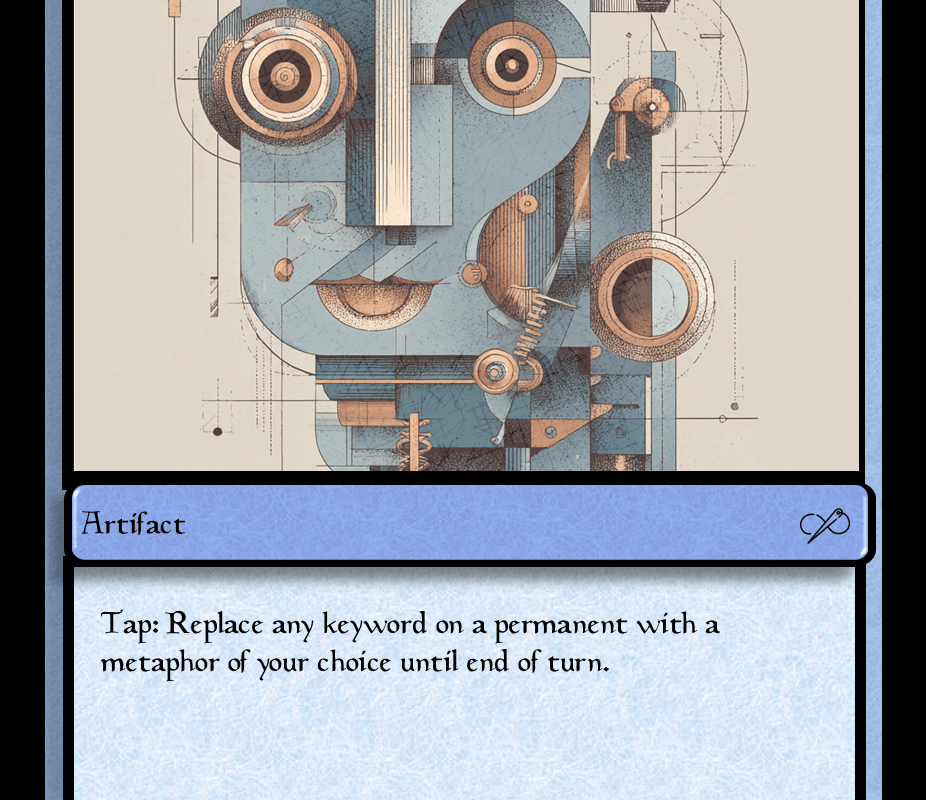
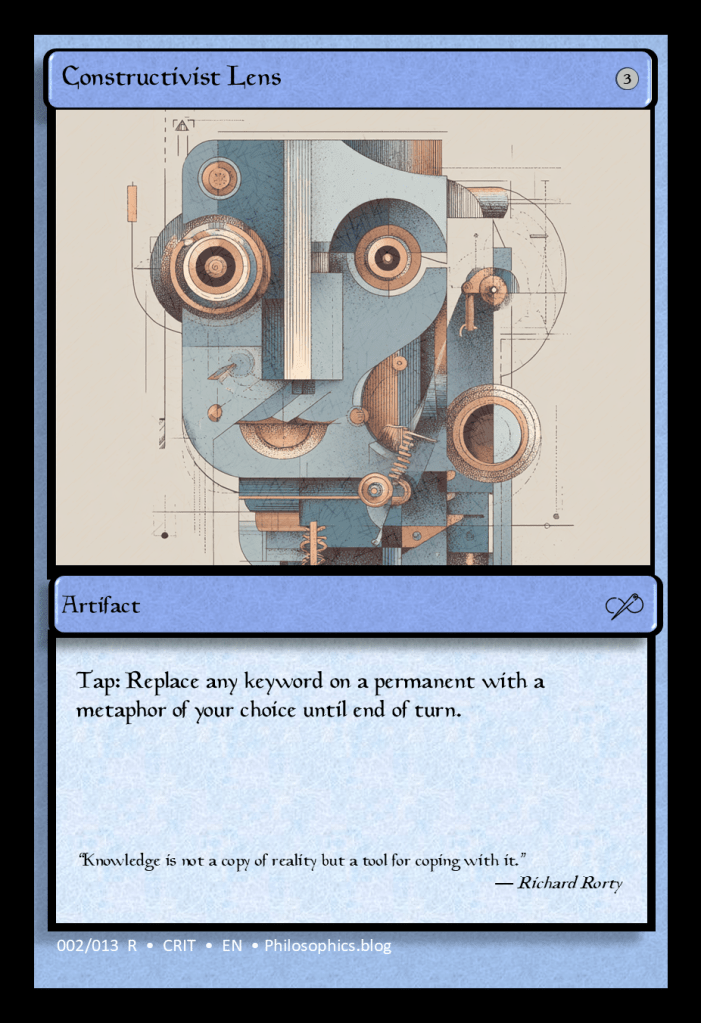
Every philosopher dreams of a device that reveals ‘truth’. The Constructivist Lens does the opposite. When you tap it, the world doesn’t come into focus – it multiplies. Each pane shows the same thing differently, reminding us that knowing is always a form of making – seeing as building.

In The Discipline of Dis-Integration, I wrote that philosophy’s task is ‘to remain within what persists … to study the tension in the threads rather than weave a new pattern’. The Lens embodies that ethic. It is not an instrument of discovery but of disclosure: a way to notice the scaffolding of perception without mistaking it for bedrock.

Where Enlightenment optics promised clarity, the Lens trades in parallax. It insists that perspective is not a flaw but the condition of vision itself. Each player who peers through it – artist, scientist, moralist – constructs a different coherence, none final. The card’s rule text captures this tension: replace any keyword on a permanent with a metaphor of your choice until end of turn. Reality bends, language shifts, yet the game continues.

In the Dis-Integration set, the Lens sits alongside Perspectival Realism and Language Game (not yet shared), forming the Blue triad of epistemic doubt. Together they dramatise what the essay calls ‘the hyphen as hinge’: the small pause between integration and its undoing. The Constructivist Lens, then, is not a tool for clearer sight but a reminder that every act of seeing is already an act of construction.

The Burnout Society – Byung-Chul Han

1–2 minutes
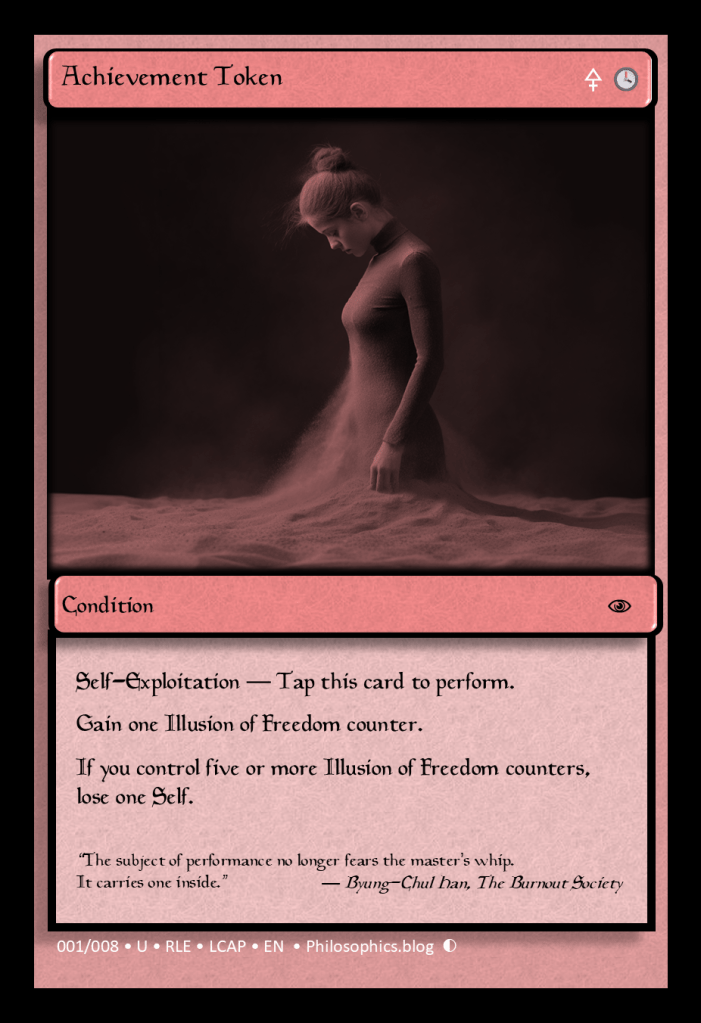
A digital MTG trading card titled “Achievement Token – Condition.” The image shows a human figure shaped like an hourglass, sand flowing through its body as if time and self are draining away. The design echoes the colours of oxidised red and muted graphite, symbolising burnout and the illusion of productivity within modern capitalist culture.
Image: Exhaustion means you’re working hard, and working hard means you’re good.

Han’s slender essay reads like a diagnosis of our psychic economy. The disciplinary society of ‘thou shalt’ has dissolved into the achievement society of ‘yes, I can’. We no longer rebel against authority; we internalise it, polishing our exhaustion until it gleams like ambition. Productivity replaces purpose. Rest becomes guilt. The subject, stripped of exterior constraint, now self-flagellates in the name of freedom.

What Han captures is not mere fatigue but a civilisational pathology: the compulsion to optimise the self as though it were capital. Burnout is not the collapse of will but the logical conclusion of unlimited permission.

If liberation now feels indistinguishable from exhaustion, what exactly have we been freed from?

From the series Readings in Late Exhaustion – a Philosophics reflection on the maladies of modernity.


About the Series — Readings in Late Exhaustion

These cards belong to Readings in Late Exhaustion, a Philosophics project tracing the psychic and cultural costs of late capitalism.

Each card interprets a contemporary work of critical theory through the language of collectable gameplay, where identity, labour, and value become quantified acts.

The format itself is the critique: a system of self-expenditure disguised as achievement, reflection rendered as performance.

Edition: RLE / LCAP — Philosophics Press


Pure Reason: The Architecture of Illusion

2–3 minutes

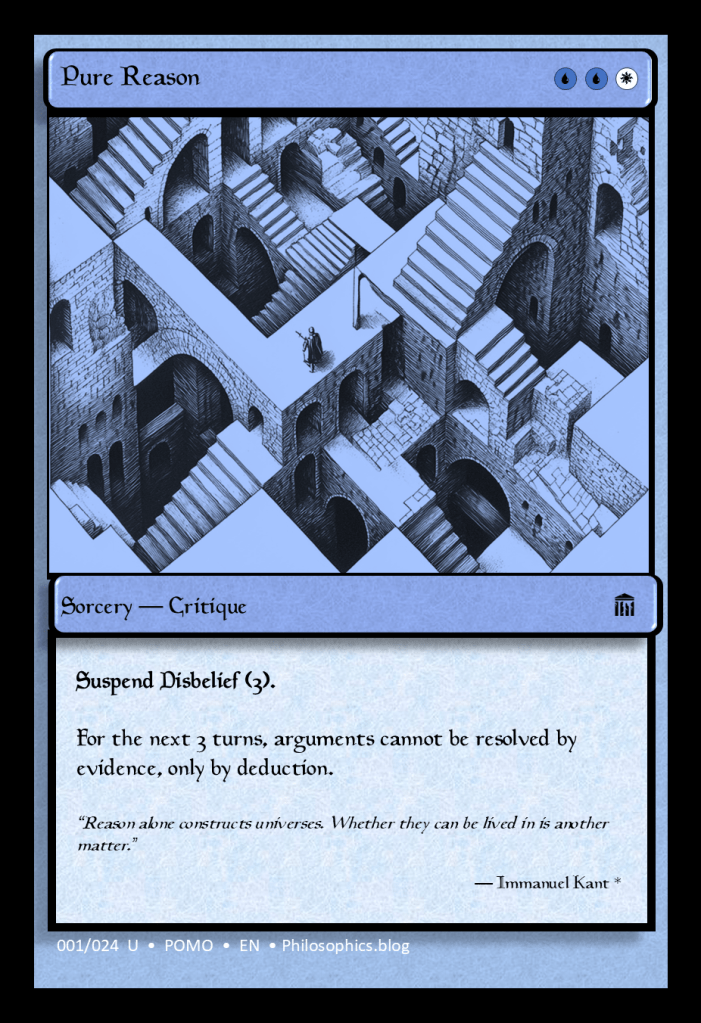
If reason had a landscape, it would look like this card: a maze of ascending and descending staircases, forever rational yet going nowhere. Kant might have called it a Critique of Pure Geometry.

Pure Reason, the first card in the Postmodern set, isn’t so much an homage to Kant as it is a cautionary reconstruction. It honours his ambition to build a universe from deduction while quietly mourning the price of that construction: alienation from experience.

Image: Card 001 from the Postmodern Set — Philosophics.blog

The Meta

Suspend Disbelief (3).
For the next three turns, arguments cannot be resolved by evidence, only by deduction.

Audio: NotebookLM podcast of this topic.

The rule text re-enacts Kant’s method. In the Critique of Pure Reason, he cordoned off the realm of empirical evidence and tried to chart what the mind could know a priori – before experience. The card’s mechanic enforces that isolation. For three turns, players must reason in a vacuum: no appeals to observation, no touchstones of reality, only deduction.

It’s a temporary world built entirely of logic, an echo of the transcendental playground Kant envisioned. The effect is powerful but sterile – thought constructing universes that can’t sustain life.

The flavour text says it plainly:

That line, of course, is apocryphal, but it captures the essence of his project: reason as world-maker and prison architect in one.

The Architecture of Thought

The artwork mirrors Escher’s impossible staircases – a labyrinth of pure geometry, ordered yet uninhabitable. Each path is internally consistent, logically sound, but spatially absurd. This is Kant’s transcendental edifice made visual: coherent on paper, dizzying in practice.

The lone figure standing in the maze is the transcendental subject – the philosopher trapped within the architecture of his own cognition. He surveys the world he has built from categories and forms, unable to escape the walls of his own reason.

It’s a neat metaphor for Enlightenment hubris: the belief that reason can serve as both foundation and roof, requiring no support from the messy ground of existence.

Kant’s Double Legacy

Kant’s Critique was both the high point and the breaking point of Enlightenment rationality. It erected the scaffolding for science, ethics, and aesthetics but revealed the fault lines beneath them. His insistence that the mind structures experience rather than merely reflecting it gave birth to both modern idealism and modern doubt.

Every philosopher after him – Hegel, Nietzsche, Husserl, Derrida – has been trying either to escape or to inhabit that labyrinth differently. Pure Reason captures this tension: the glory of construction and the tragedy of confinement.

My Take

Reason is a magnificent liar. It promises order, clarity, and autonomy, but its perfection is its undoing. It abstracts itself from life until it can no longer recognise its own maker. Kant’s world is flawless and airless – a rational utopia unfit for breathing creatures.

I view Pure Reason as the archetype of the Enlightenment illusion: the attempt to found a living world on the logic of dead forms. What he achieved was monumental, but the monument was a mausoleum.

The card, then, is not just a tribute to Kant but a warning to his descendants (ourselves included): every system of thought eventually turns into an Escher print. Beautiful, consistent, and utterly unlivable.

Perspectival Realism – Enchantment

This Magic: The Gathering parody trading card was the first in my Critical Theory series.

It’s an important card for me. As with sex and gender, creating a taxonomic or ontological dichotomy poses categorical challenges. Despite the insufficiency of language, it’s still all I have to attempt to classify the world. In the case of articulating the perception of reality, we can choose between idealism and realism. The problem is that it’s not either; it’s both. Reality cannot be realised without both.

Reality, we’re told, exists. That confident noun has carried a great deal of human arrogance. It has underwritten empires, sciences, and sermons. Yet somewhere between Plato’s cave and the latest TED Talk, we forgot to ask a simpler question: for whom does reality exist, and from where is it seen?

Audio: NotebookLM podcast of this topic.

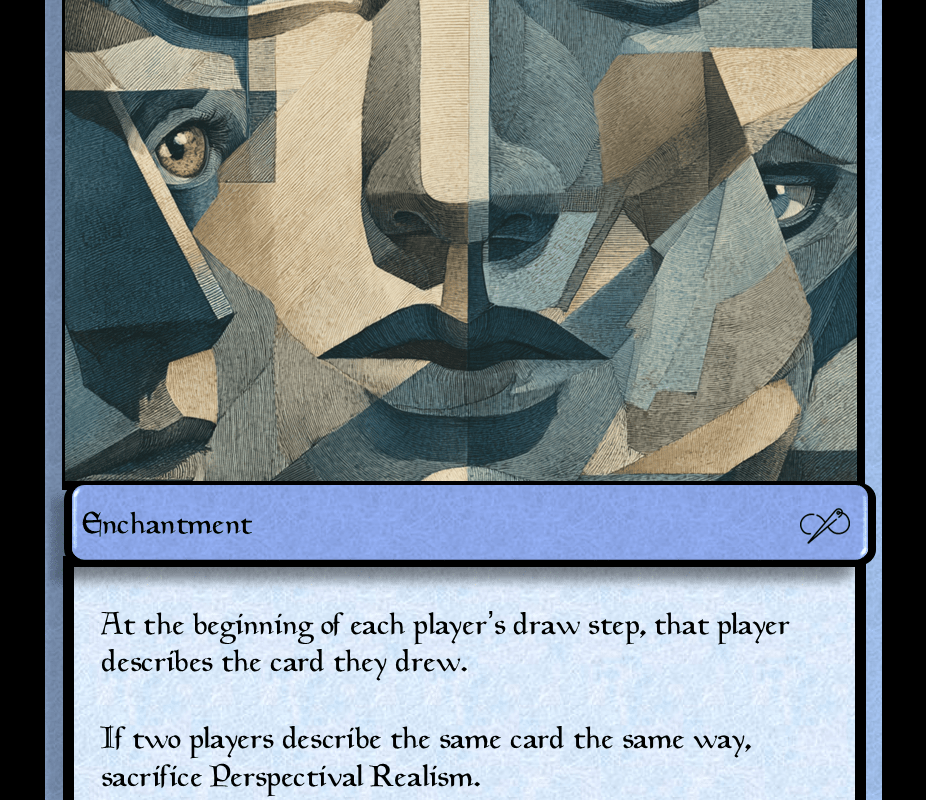
The parody trading card Perspectival Realism was born from that unease. Its mechanic is simple but cruel: at the beginning of each player’s draw step, they must describe the card they drew. The enchantment persists until two players describe a card in the same way—at which point the spell collapses. In other words, consensus kills magic.

That rule is the metaphysics of the thing.

When a player ‘describes’ a card, they are not transmitting information; they are constructing the object in linguistic space. The moment the description leaves their mouth, the card ceases to be a piece of paper and becomes a conceptual artefact.

This mirrors the insight of Kant, Nietzsche, and every post-structuralist who ever smoked too much Gauloises: perception isn’t passive. We don’t see reality; we compose it. Language isn’t a mirror but a paintbrush. The thing we call truth is not correspondence but coherence – a temporary truce among competing metaphors.

So the card’s enchantment dramatises this process. So long as multiple descriptions circulate, reality remains vibrant, contested, alive. Once everyone agrees, it dies the death of certainty.

Philosophers have spent centuries arguing whether the world is fundamentally real (existing independent of mind) or ideal (a projection of mind). Both sides are equally tiresome.

Realism, the old bulldog of metaphysics, insists that perception is transparent: language merely reports what’s already there. Idealism, its mirror adversary, claims the opposite – that what’s “there” is mind-stuff all along. Both mistakes are symmetrical. Realism forgets the perceiver; Idealism forgets the world.

Perspectival realism refuses the divorce. It begins from the premise that world and mind are inseparable aspects of a single event: knowing. Reality is not a photograph waiting to be developed, nor a hallucination spun from neurons – it’s a relation, a constant negotiation between perceiver and perceived.

For years, I called myself a Realist™ with an asterisk. That asterisk meant I understood the observer problem: that every ‘fact’ is perspective-laden. Then I became an Idealist™ with an asterisk, meaning I recognised that mind requires matter to dream upon.

The asterisk is everything. It’s the epistemic scar left by perspectival humility – the tacit admission that every claim about the world carries a hidden coordinate: said from here. It is not relativism, but situatedness. It is the philosophical equivalent of depth perception: without the offset, there’s no vision at all.

The card’s rule – sacrifice Perspectival Realism when two players describe a card identically – captures the tragedy of modernity. The Enlightenment taught us to chase consensus, to flatten multiplicity into “objective truth.” We became addicted to sameness, mistaking agreement for understanding.

But agreement is anaesthetic. When all perspectives converge, the world ceases to shimmer; it becomes measurable, predictable, dead. The card’s enchantment disappears the moment reality is stabilised, precisely as our cultural enchantment did under the fluorescent light of ‘reason’.

To live under perspectival realism is to acknowledge that reality is not what is drawn but what is described. And the description is never neutral. It is always written from somewhere – by someone, with a vocabulary inherited from history and stained by desire.

As long as multiple descriptions coexist, the game remains alive. The moment they fuse into one, the spell is broken, and the world returns to grey.

Bernardo Kastrup’s analytic idealism reminded me that consciousness might be primary, but perspectival realism refuses to pledge allegiance. It keeps both flags tattered but flying. The world exists, yes, but only ever for someone.

The enchantment, then, is not belief but perspective itself. So long as difference endures, the game continues.

Constructivist Lens — Artifact

Parody Magic: The Gathering trading card

When drawn, this card alters perception itself. It reminds the player that truth is not something one finds under a rock but something one polishes into shape. Each metaphor becomes a spell; each keyword a crutch thrown aside.

Those who wield the Constructivist Lens see not “facts,” but fictions so useful they forgot to call them that. Reality wobbles politely to accommodate belief.

Knowledge is not a copy of reality but a tool for coping with it.”
— Richard Rorty

In game terms: Tap to reframe existence as interpretation. Duration: until the next disagreement.

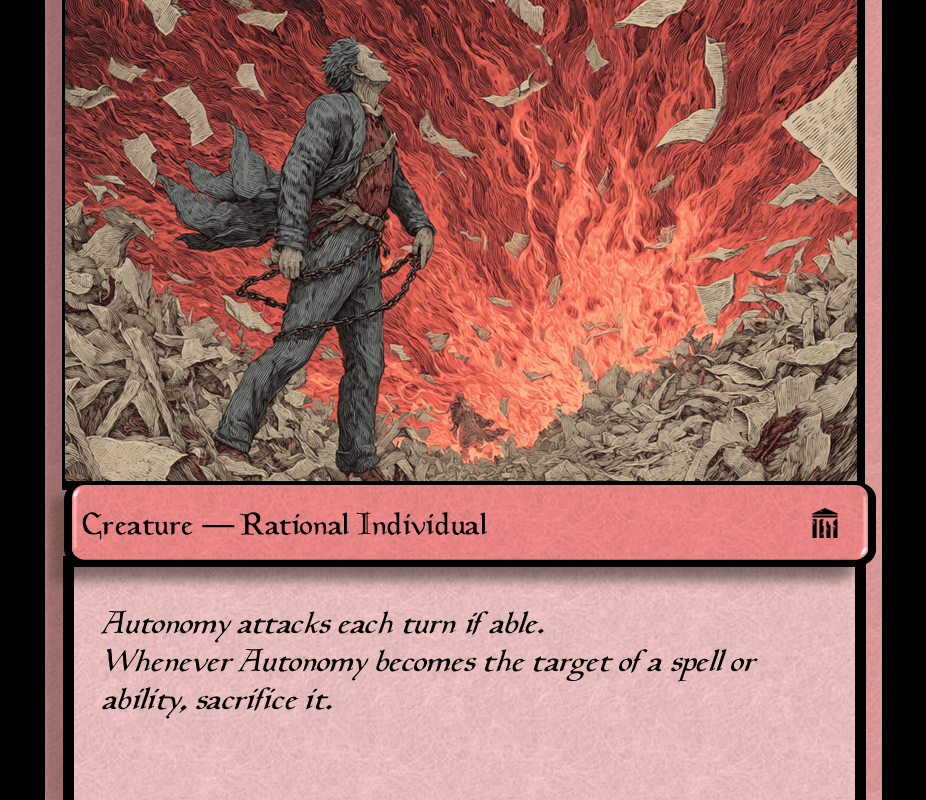
Autonomy: Creature – Rational Individual

1–2 minutes

Autonomy attacks each turn if able.
Whenever Autonomy becomes the target of a spell or ability, sacrifice it.

This is from the POMO series of mock Magic: The Gathering trading card images. Don’t read too much into them.

I decided I could share images on Instagram and reshare them here. This is the result.