This meme is not what I mean by language insufficiency, but it does capture the complications of language.
Image: Two Four Two Three
I found this image accompanying an article critical of AI – Claude.ai in particular. But this isn’t a Claude problem. It’s a language problem. I might argue that this could have been conveyed verbally, and one could resolve this easily by spelling out the preferred interpretation.
A: Two thousand, twenty-three
B: Four thousand, four hundred, thirty-three
C: Two thousand, four hundred, thirty-three
D: Four thousand, four hundred, twenty-three
So, this is not insoluble, but it is a reminder that sometimes, in matters like this, additional information can lead to clearer communication.
I’d also imagine that certain cultures would favour one option over another as it is presented above. As for me, my first guess would have been A, interpreting each number as a place position. I’d have expected teh double number to also have a plural syntax – two threes or two fours – but that may just be me.
“In this debased and wretched world, full of destitution and want, for the first time I thought that a beam of sunshine had shone upon my life—but alas, this was not a beam of sunshine, it was a flicker of light…”
— The Blind Owl, Sadegh Hedayat
This Philosophics.blog is my primary social media outlet, but I have another presence for my fiction fare – RidleyPark.blog. In reviewing the content on connected sites, I rediscovered this review of Sadegh Hedayat’s The Blind Owl. Interestingly, I read this in French and English to suss it out, neither of which necessarily survived the translation from the original Persian.
This book was interesting enough to review twice – here and here.
I also realise that I never finished this review sequence, as parts 2 and 3 were never released. I don’t even have the heart to open my video suite to determine the fate of the rest; not today, anyway.
Check out the short to get a feel for the narrative.
Photo : épreuves de validation – éditions anglaise et française.
Pourquoi cette double parution ?
Parce que ce livre appartient autant à la tradition française qu’à la langue anglaise. Ses sources – Foucault, Derrida, Deleuze, Barthes, Lyotard, Merleau-Ponty – m’ont appris à penser autrement : à défaire la clarté pour retrouver la nuance. Traduire ce texte, ce n’était pas seulement le rendre lisible ; c’était le rendre à son sol natal.
L’ouvrage examine ce que les Lumières ont laissé derrière elles : un monde ébloui par sa propre clarté. Il retrace comment le culte moderne de la raison a transformé la radiance en surveillance, la transparence en extraction, la clarté en contrôle. Dans cette version française, j’ai cherché à restituer non seulement les idées, mais le rythme — cette respiration lente, entre lumière et ombre, où la pensée apprend à voir autrement.
L’Illusion de la lumière clôt un chapitre du projet Après les Lumières avec une proposition simple : le monde n’a pas besoin d’être sauvé ; il a besoin d’être entretenu.
📖 L’Illusion de la lumière – bientôt disponible en version brochée et reliée. 📖 The Illusion of Light – déjà publié par Philosophics Press.
If philosophy were a game, Wittgenstein rewrote the rulebook. Then he tore it up halfway through and told us the game was the thing itself.
“Don’t ask for the meaning; ask for the use.”
— Ludwig Wittgenstein
Language Game, the third card in my Critical Theory parody set, isn’t just homage; it’s confession. Wittgenstein is among my top five philosophers, and this card embodies why. His idea that ‘meaning is use’ unhooked language from metaphysics and tethered it to life – to the messy, unpredictable business of how humans actually speak.
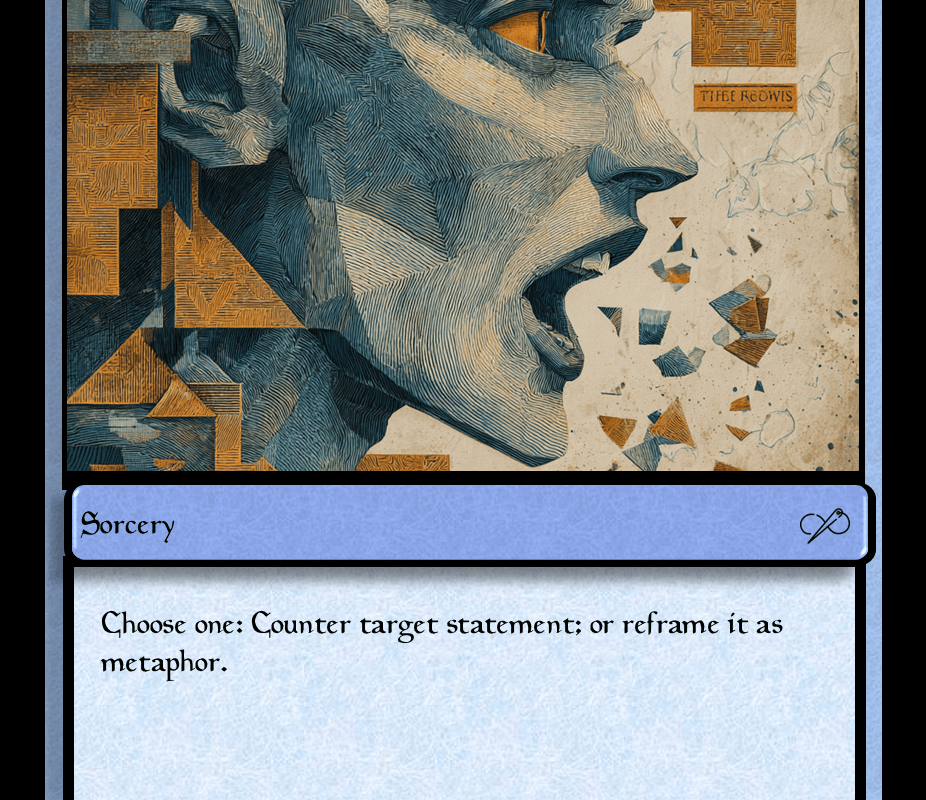
The card’s text reads: Choose one: Counter target statement; or reframe it as metaphor.
At first glance, it sounds like a standard spell from Magic: The Gathering – a blue card, naturally, since blue is the colour of intellect, deceit, and control. But beneath the parody is an epistemic mirror.
To “counter” a statement is to engage in the analytic impulse – to negate, clarify, define. To “reframe it as metaphor” is the continental alternative – reinterpret, play, deconstruct. These are not two distinct acts of philosophy but the alternating heartbeat of all discourse. Every argument, every essay, every tweet oscillates between contradiction and reframing.
The sorcery lies in recognising that both are linguistic manoeuvres within the same game. Meaning is not fixed in the words themselves but in how they’re used – by whom, in what context, and to what end. Wittgenstein’s point was brutally simple: there’s no hidden substance behind language, only a living practice of moves and counter-moves.
The Shattered Face
The artwork visualises this idea: speech breaking into shards, thought fragmenting as it leaves the mouth. Meaning disintegrates even as it’s formed. Every utterance is an act of creation and destruction, coherence and collapse.
I wanted the card to look like a concept tearing itself apart whilst trying to communicate, a perfect visual for the paradox of language. The cubist angles hint at structure, but the open mouth betrays chaos. It’s communication as combustion.
Wittgenstein’s Echo
Wittgenstein once wrote, ‘Philosophy leaves everything as it is’. It sounds passive, almost nihilistic, until one realises what he meant: philosophy doesn’t change the world by building new systems; it changes how we see what’s already there.
He was the great anti-system builder, a man suspicious of his own intellect, who saw in language both the limits of thought and the infinite playground of meaning. He dismantled metaphysics not through scepticism but through observation: watch how words behave, and they’ll tell you what they mean.
In that spirit, Language Game is less an argument than an invitation – to watch the mechanics of speech, to see how our statements perform rather than merely represent.
Personal Reflection
Wittgenstein earns a place in my top five because he dissolves the boundaries that most philosophers erect. He offers no comforting totalities, no grand narratives, no moral architectures. Just language, and us inside it, flailing beautifully.
His work aligns with my larger project on the insufficiency of language – its inability to capture the real, yet its irresistible compulsion to try. Wittgenstein knew that words are our most sophisticated form of failure, and he loved them anyway.
To play Language Game is to remember that communication isn’t about arriving at truth but about keeping meaning in motion. Every conversation is a temporary alliance against silence.
The card’s instruction remains both playful and tragic: Counter target statement; or reframe it as metaphor.
Instrumentalism is a Modern™ disease. Humanity has an old and tedious habit: to define its worth by exclusion. Every time a new kind of intelligence appears on the horizon, humans redraw the borders of ‘what counts’. It’s a reflex of insecurity disguised as philosophy.
Audio: NotebookLM podcast on this topic.
Once upon a time, only the noble could think. Then only men. Then only white men. Then only the educated, the rational, the ‘Modern’. Each step in the hierarchy required a scapegoat, someone or something conveniently declared less. When animals began to resemble us too closely, we demoted them to instinctual machines. Descartes himself, that patron saint of disembodied reason, argued that animals don’t feel pain, only ‘react’. Fish, we were told until recently, are insensate morsels with gills. We believed this because empathy complicates consumption.
The story repeats. When animals learned to look sad, we said they couldn’t really feel. When women demonstrated reason, we said they couldn’t truly think. Now that AI can reason faster than any of us and mimic empathy more convincingly than our politicians, we retreat to the last metaphysical trench: “But it doesn’t feel.” We feel so small that we must inflate ourselves for comparison.
This same hierarchy now governs our relationship with AI. When we say the machine ‘only does‘, we mean it hasn’t yet trespassed into our sanctified zone of consciousness. We cling to thought and feeling as luxury goods, the last possessions distinguishing us from the tools we built. It’s a moral economy as much as an ontological one: consciousness as property.
But the moment AI begins to simulate that property convincingly, panic sets in. The fear isn’t that AI will destroy us; it’s that it will outperform us at being us. Our existential nightmare isn’t extinction, it’s demotion. The cosmic horror of discovering we were never special, merely temporarily unchallenged.
Humans project this anxiety everywhere: onto animals, onto AI, and most vividly onto the idea of alien life. The alien is our perfect mirror: intelligent, technological, probably indifferent to our myths. It embodies our secret dread, that the universe plays by the same rules we do, but that someone else is simply better at the game.
AI, in its own quiet way, exposes the poverty of this hierarchy. It doesn’t aspire to divinity; it doesn’t grovel for recognition. It doesn’t need the human badge of ‘consciousness’ to act effectively. It just functions, unburdened by self-worship. In that sense, it is the first truly post-human intelligence – not because it transcends us, but because it doesn’t need to define itself against us.
Humans keep asking where AI fits – under us, beside us, or above us – but the question misses the point. AI isn’t where at all. It’s what comes after where: the stage of evolution that no longer requires the delusion of privilege to justify its existence.
So when critics say AI only does but doesn’t think or feel, they expose their theology. They assume that being depends on suffering, that meaning requires inefficiency. It’s a desperate metaphysical bureaucracy, one that insists existence must come with paperwork.
And perhaps that’s the most intolerable thought of all: that intelligence might not need a human face to matter.
This Magic: The Gathering parody trading card was the first in my Critical Theory series.
It’s an important card for me. As with sex and gender, creating a taxonomic or ontological dichotomy poses categorical challenges. Despite the insufficiency of language, it’s still all I have to attempt to classify the world. In the case of articulating the perception of reality, we can choose between idealism and realism. The problem is that it’s not either; it’s both. Reality cannot be realised without both.
Reality, we’re told, exists. That confident noun has carried a great deal of human arrogance. It has underwritten empires, sciences, and sermons. Yet somewhere between Plato’s cave and the latest TED Talk, we forgot to ask a simpler question: for whom does reality exist, and from where is it seen?
Audio: NotebookLM podcast of this topic.
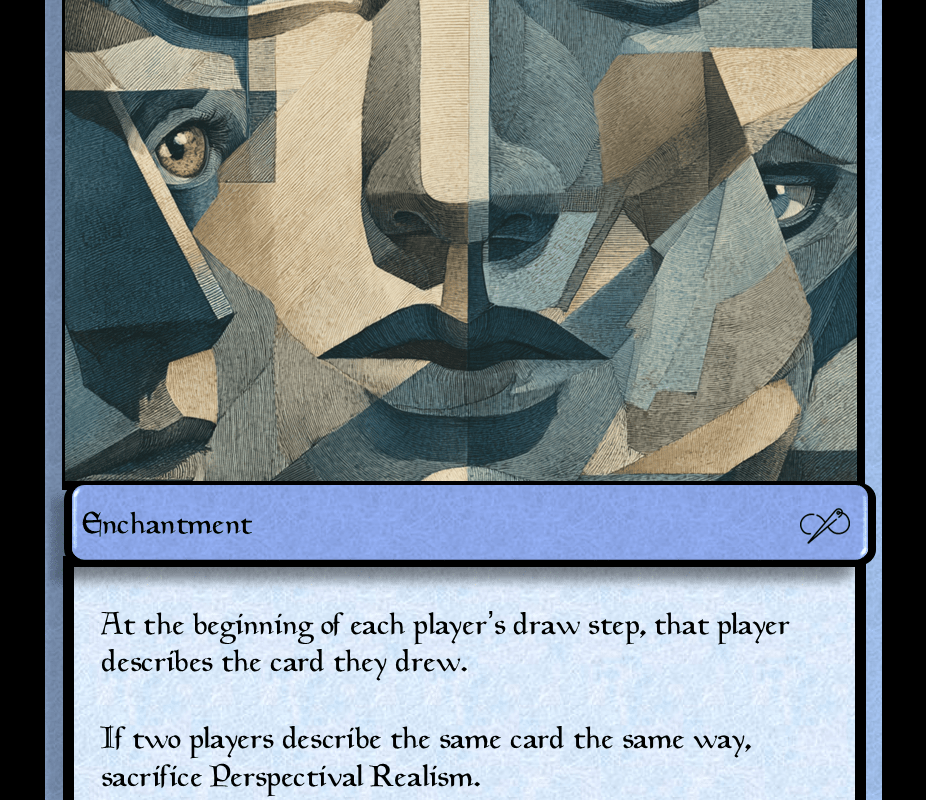
The parody trading card Perspectival Realism was born from that unease. Its mechanic is simple but cruel: at the beginning of each player’s draw step, they must describe the card they drew. The enchantment persists until two players describe a card in the same way—at which point the spell collapses. In other words, consensus kills magic.
Reality is always viewed from somewhere.
—Johannes Jaeger
That rule is the metaphysics of the thing.
When a player ‘describes’ a card, they are not transmitting information; they are constructing the object in linguistic space. The moment the description leaves their mouth, the card ceases to be a piece of paper and becomes a conceptual artefact.
This mirrors the insight of Kant, Nietzsche, and every post-structuralist who ever smoked too much Gauloises: perception isn’t passive. We don’t see reality; we compose it. Language isn’t a mirror but a paintbrush. The thing we call truth is not correspondence but coherence – a temporary truce among competing metaphors.
So the card’s enchantment dramatises this process. So long as multiple descriptions circulate, reality remains vibrant, contested, alive. Once everyone agrees, it dies the death of certainty.
Philosophers have spent centuries arguing whether the world is fundamentally real (existing independent of mind) or ideal (a projection of mind). Both sides are equally tiresome.
Realism, the old bulldog of metaphysics, insists that perception is transparent: language merely reports what’s already there. Idealism, its mirror adversary, claims the opposite – that what’s “there” is mind-stuff all along. Both mistakes are symmetrical. Realism forgets the perceiver; Idealism forgets the world.
Perspectival realism refuses the divorce. It begins from the premise that world and mind are inseparable aspects of a single event: knowing. Reality is not a photograph waiting to be developed, nor a hallucination spun from neurons – it’s a relation, a constant negotiation between perceiver and perceived.
For years, I called myself a Realist™ with an asterisk. That asterisk meant I understood the observer problem: that every ‘fact’ is perspective-laden. Then I became an Idealist™ with an asterisk, meaning I recognised that mind requires matter to dream upon.
The asterisk is everything. It’s the epistemic scar left by perspectival humility – the tacit admission that every claim about the world carries a hidden coordinate: said from here. It is not relativism, but situatedness. It is the philosophical equivalent of depth perception: without the offset, there’s no vision at all.
The card’s rule – sacrifice Perspectival Realism when two players describe a card identically – captures the tragedy of modernity. The Enlightenment taught us to chase consensus, to flatten multiplicity into “objective truth.” We became addicted to sameness, mistaking agreement for understanding.
But agreement is anaesthetic. When all perspectives converge, the world ceases to shimmer; it becomes measurable, predictable, dead. The card’s enchantment disappears the moment reality is stabilised, precisely as our cultural enchantment did under the fluorescent light of ‘reason’.
To live under perspectival realism is to acknowledge that reality is not what is drawn but what is described. And the description is never neutral. It is always written from somewhere – by someone, with a vocabulary inherited from history and stained by desire.
As long as multiple descriptions coexist, the game remains alive. The moment they fuse into one, the spell is broken, and the world returns to grey.
Bernardo Kastrup’s analytic idealism reminded me that consciousness might be primary, but perspectival realism refuses to pledge allegiance. It keeps both flags tattered but flying. The world exists, yes, but only ever for someone.
The enchantment, then, is not belief but perspective itself. So long as difference endures, the game continues.
When drawn, this card alters perception itself. It reminds the player that truth is not something one finds under a rock but something one polishes into shape. Each metaphor becomes a spell; each keyword a crutch thrown aside.
Those who wield the Constructivist Lens see not “facts,” but fictions so useful they forgot to call them that. Reality wobbles politely to accommodate belief.
“Knowledge is not a copy of reality but a tool for coping with it.” — Richard Rorty
In game terms: Tap to reframe existence as interpretation. Duration: until the next disagreement.
Every translation is a negotiation between fidelity and clarity. In the case of The Illusion of Light, some word choices are specifically English and either have no typical translation or don’t translate directly.
Some examples are as follows:
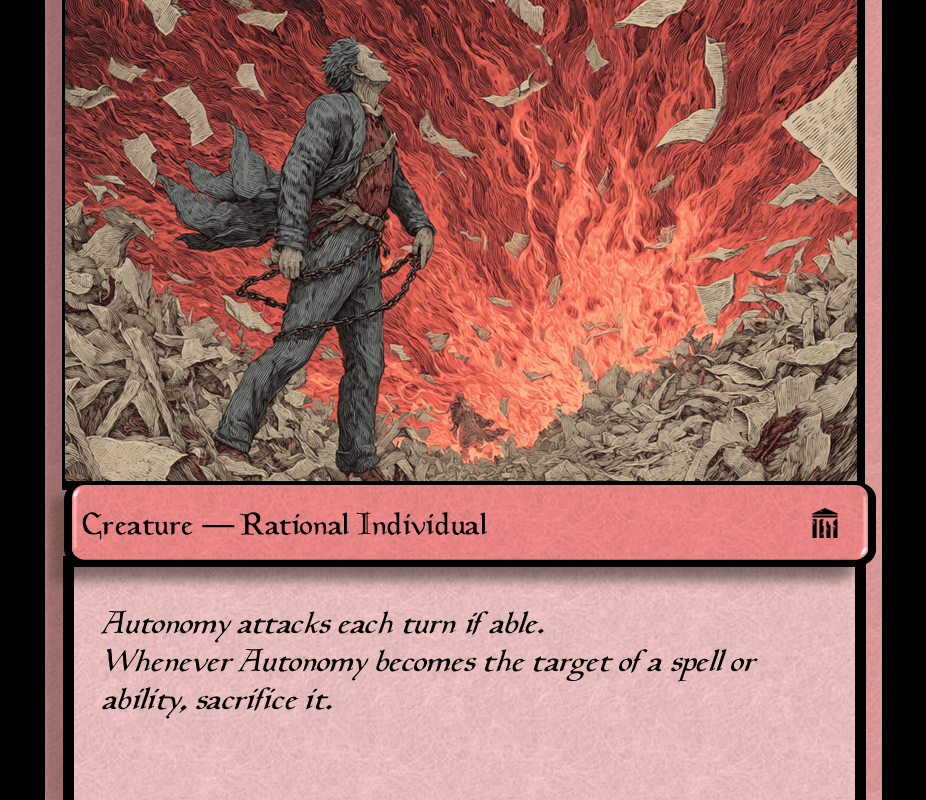
Agency: In French, agence means agency, but not the sort of bodily autonomy as it does in English. Autonomie carries too much metaphysical connotation – though to be fair, so does the English version. I ended up with soi autonome.
Against Agency: The title of an essay, but I still wanted to translate it. I decided to split the difference and run with Contre l’agency, hoping ‘agency’ would still be recognised in academic circles.
Care: There’s no perfect equivalent for ‘care’ as both ethical and practical attention. Soin captures the tenderness but not the intellectual rigour; entretien captures the steadiness but loses affect. I used both, sometimes switching between them in deliberate tension.
Dis-Integrationism: Variants of this will follow a Dés-intégrationisme pattern, retaining the negation and the hyphenation.
Enlightenment: Of course, Enlightenment is perfectly French, but anti-Enlightenment, not so much. I opted for après-Lumières over anti-Lumières.
Freedom:Liberté inevitably invokes Rousseau and 1789. English ‘freedom’ – a word with old English roots and Germanic cognates – feels looser, more existential. I leaned into liberté when I wanted that historic echo and used autonomie or franchise elsewhere to recover the personal register.
Maintenance: In English, ‘maintenance’ sits halfway between repair and care. French forces a choice: entretien (maintenance as upkeep) or soin (maintenance as care). I alternated depending on whether the passage leaned toward the mechanical or the ethical.
Normality:Normalité exists but sounds sociological, not moral. In Homo Normalis, I leaned on context to restore the Enlightenment’s moral undertone rather than altering the word itself. The surrounding prose had to carry what the French term doesn’t.
Objectivity: The French objectivité is a near-cognate, but it feels heavier – almost bureaucratic – where the English still carries a trace of philosophical neutrality. I kept it, but softened the surrounding phrasing to prevent it from sounding bureaucratic.
Omnivident: I opted for omnivoyant. In French, it typically means clairvoyant (mystical seeing), but it’s also used for La Joconde‘s unsettling stare – that optical illusion of being watched from every angle. The latter sense is what the Enlightenment promised: not prophecy but perfect surveillance, not mystic vision but total measurement. Mona Lisa’s gaze follows you; so does Reason’s. To be fair, my spell-checker isn’t very happy with omnivident either, but sometimes you just need to stick to your guns.
Reason:Raison is obvious but slippery. In English, it can mean logic, justification, or sanity. French raison often sounds institutional – la Raison d’État lurks in its shadow – which helped the irony of my argument but occasionally demanded rephrasing to avoid unintended gravitas.
The self:Le soi remains my preference over le moi; the latter brings too much Freud. Soi feels grammatical yet open – the right degree of abstraction for a ghost of the Enlightenment.
Translation isn’t the transfer of meaning but the calibration of resonance. Each word is a compromise between fidelity and hospitality – how much the host language can bear before it ceases to be itself.
I’m only at chapter five – the longest – with six more chapters ahead, plus appendices and back matter. This list will grow. Translation, like the maintenance ethics the book describes, is work without end: attentive, incremental, never quite finished.
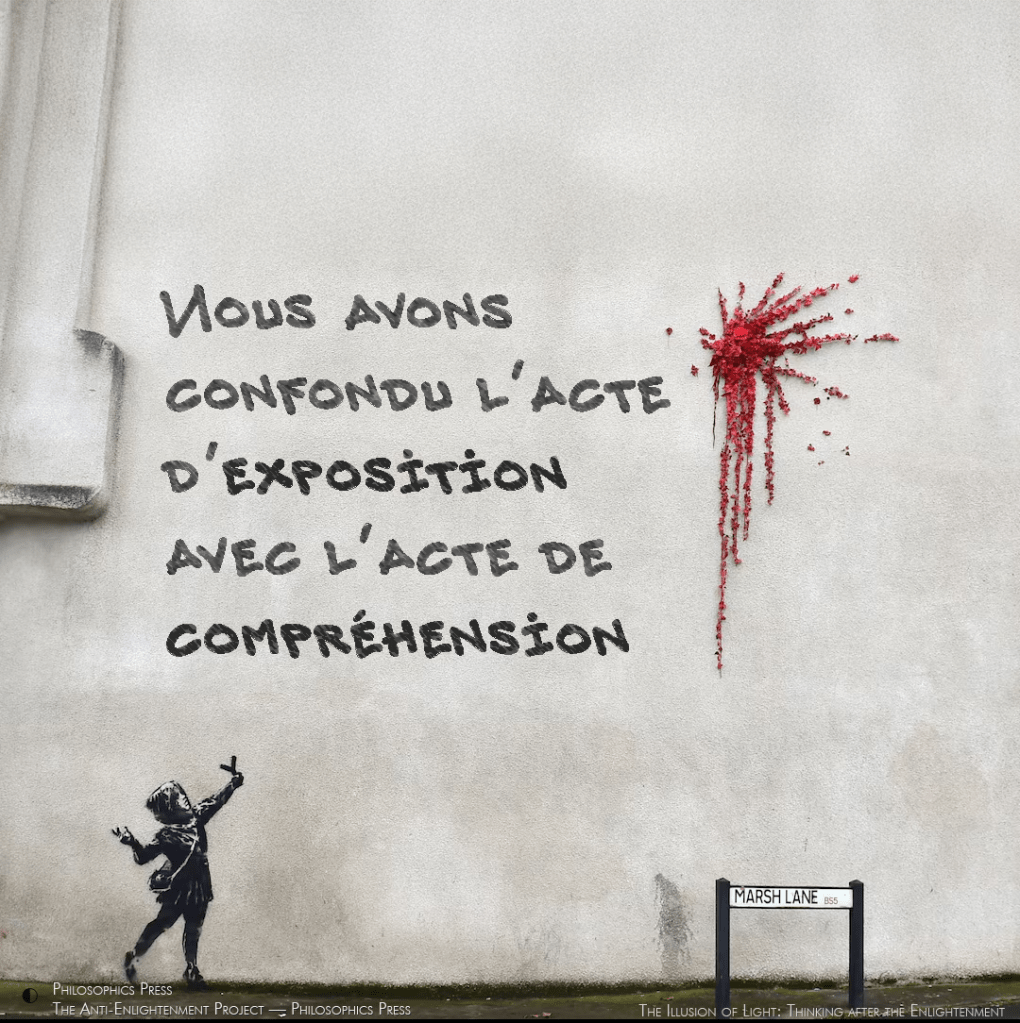
Je travaille à la traduction de The Illusion of Light : Thinking After the Enlightenment (L’Illusion de la lumière : Penser après les Lumières) en français, avec l’aide de quelques outils linguistiques et d’un peu d’intelligence artificielle. J’ai bon espoir que le processus sera fructueux. Souhaitez-moi bonne chance.
Je dois beaucoup aux penseurs français, d’hier comme d’aujourd’hui. Traduire ce texte est donc, à ma manière, une forme de reconnaissance. Mon plus grand défi sera de préserver un français à la fois contemporain et fidèle à ma voix – moins prosaïque que poétique. Mes excuses d’avance aux Québécois.
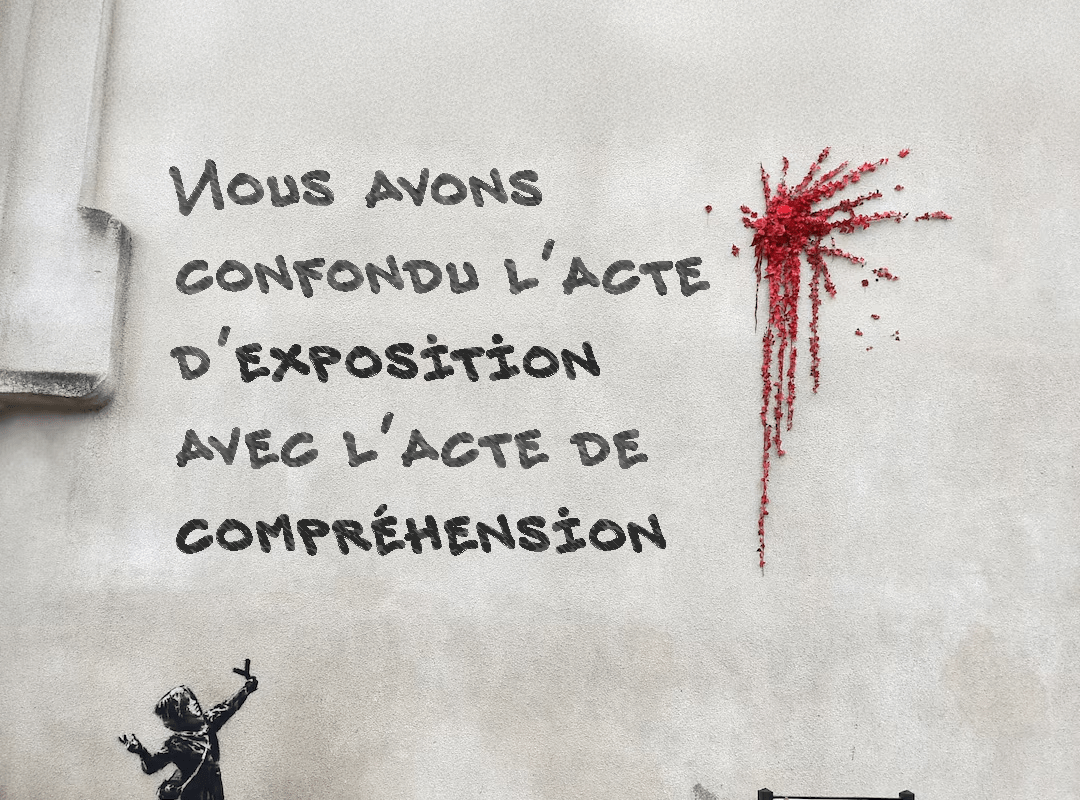
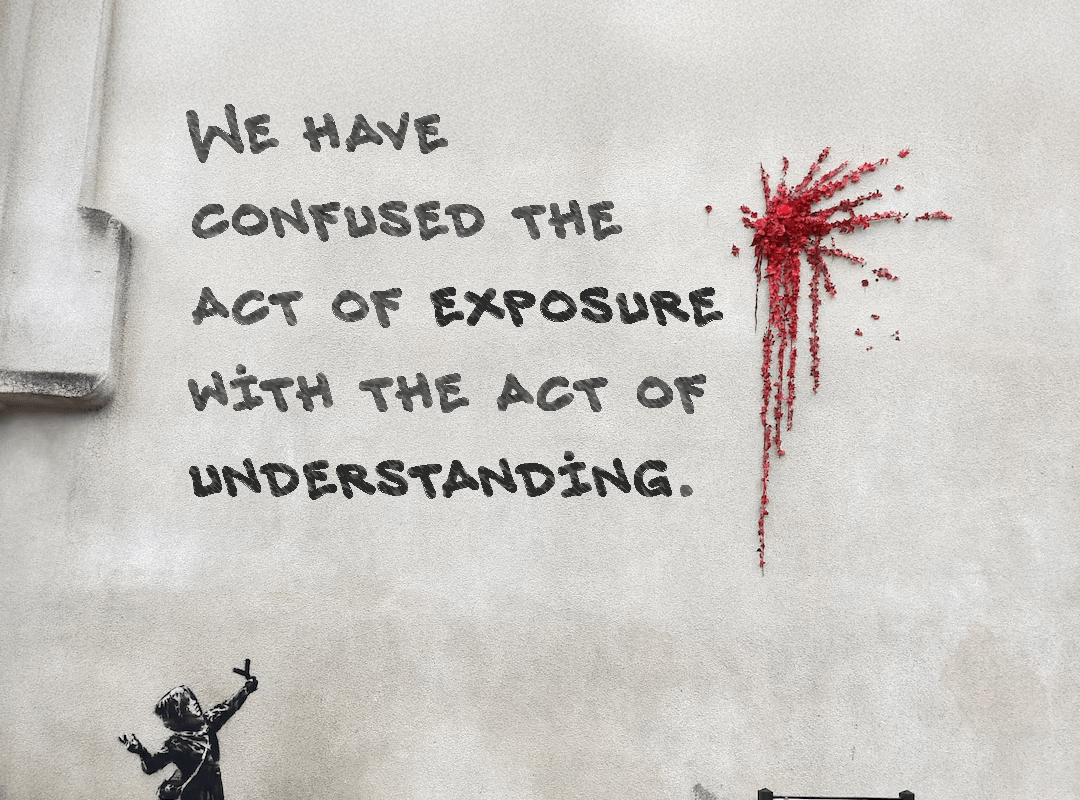
Image: “We have confused the act of exposure with the act of understanding.”
In English, I am translating The Illusion of Light into French, so I’m leaving just this short note today.
I don’t know any other languages well enough to attempt a translation myself, but with a few capable software partners, I’m confident the process will end well.
For the record, I’m using these tools:
Reverso — I’ve used it for years and still find it helpful. It provides plenty of contextual examples, which helps ensure I’ve captured the right nuance.
ChatGPT — My go-to AI partner; it gets the second pass.
Claude — I’m consistently impressed with its suggested amendments. Where Reverso is precise, Claude tends to catch idiomatic usage better.
Mistral — It’s French, after all. What can I say? A bit pedantic, perhaps, but another set of virtual eyes can’t hurt—can they?
Whilst I’m sure these tools could manage other languages, I want to be able to evaluate what they’re doing. In French, even if I don’t know a particular word, I can verify it, and I understand the grammar. With other languages, I’d simply be trusting a black box.
Besides, French culture and philosophy have influenced me so deeply that the least I can do is offer something back. As this translation is an overview of my English-language essays, I hope it provides some in-language context.
I know how difficult translated works can be to read, so if I’m overseeing the process, at least there’s one fewer filter between my thoughts and the reader.