A History of Language Insufficiency

3–4 minutes

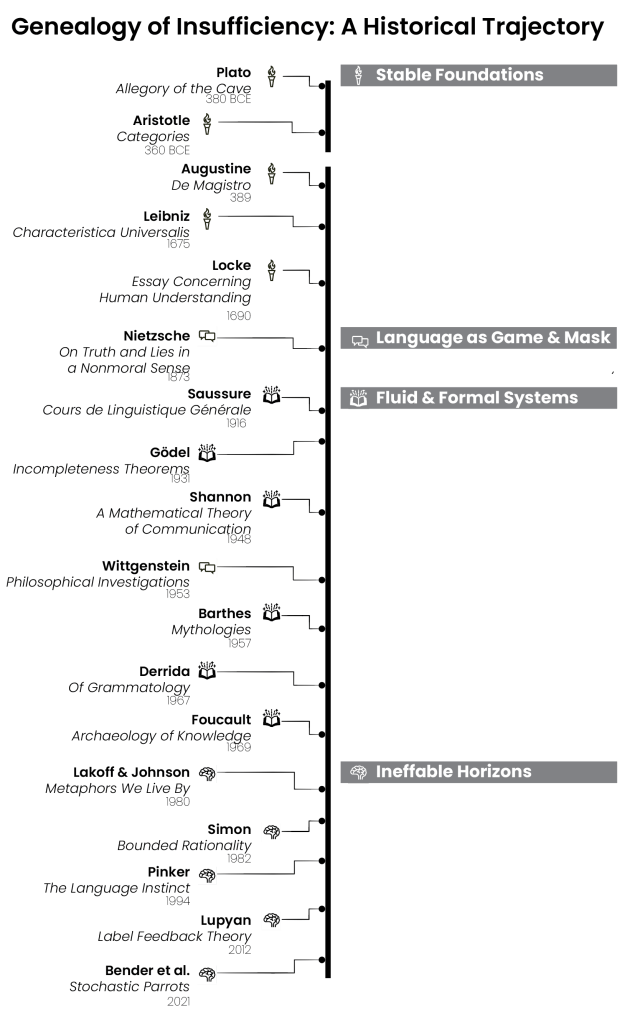
I’ve been working on A Language Insufficiency Hypothesis since 2018. At least, that’s the polite, CV-friendly version. The truer account is that it’s been quietly fermenting since the late 1970s, back when I was still trapped in primary school and being instructed on how the world supposedly worked.

Social Studies. Civics. Law. The whole civic catechism. I remember being taught about reasonable persons and trial by a jury of one’s peers, and I remember how insistently these were presented as fair solutions. Fairness was not argued for. It was asserted, with the weary confidence of people who think repetition counts as justification.

I didn’t buy it. I still don’t. The difference now is that I have a hypothesis with some explanatory power instead of a vague sense that the adults were bluffing.

Audio: NotebookLM summary podcast of this topic.

I’ve always been an outsider. Eccentric, aloof, l’étranger if we’re feeling theatrical. It never particularly troubled me. Outsiders are often tolerated, provided they remain decorative and non-contagious. Eye rolls were exchanged on both sides. No harm done.

But that outsider position had consequences. It led me, even then, to ask an awkward question: Which peers? Not because I thought I was superior, but because I was plainly apart. How exactly was I meant to be judged by my peers when no one else occupied anything like my perspective?

Later, when I encountered the concept of fundamental attribution bias, it felt less like a revelation and more like confirmation. A peer-based system assumes not just similarity of circumstance, but similarity of interpretation. That assumption was dead on arrival.

Then there were reasonable persons. I was assured they existed. I was assured judges were trained to embody them. I had never met one. Even as a teenager, I found the idea faintly comical. Judges, I was told, were neutral, apolitical, and dispassionate. Writing this now from the United States, one hardly needs to belabour the point. But this wasn’t prescience. It was intuition. The smell test failed decades ago.

Before LIH had a name, I called these things weasel words. I still do, as a kind of shorthand. Terms like fair, reasonable, accountable, appropriate. Squishy concepts that do serious institutional work whilst remaining conveniently undefinable. Whether one wants to label them Contestables or Fluids is less important than recognising the space they occupy.

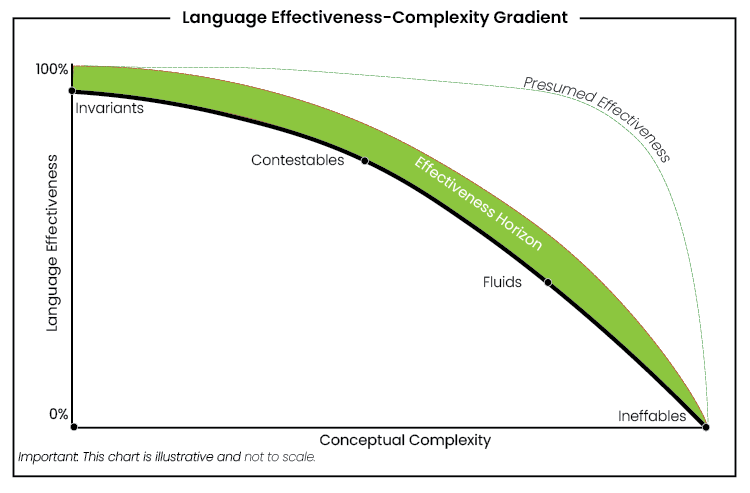
That space sits between Invariables, things you can point to without dispute, and Ineffables, where language more or less gives up. Communication isn’t binary. It isn’t ‘works’ or ‘doesn’t’. It’s a gradient. A continuous curve from near-certainty to near-failure.

Most communication models quietly assume a shared ontology. If misunderstanding occurs, the remedy is more explanation, more context, more education. What never sat right with me, even as a child, was that this only works when the disagreement is superficial. The breaking point is ontological.

If one person believes a term means {A, B, C} and another believes it means {B, C, D}, the overlap creates a dangerous illusion of agreement. The disagreement hides in the margins. A and D don’t merely differ. They are often irreconcilable.

Image: Venn diagramme of a contested concept.
Note: This is illustrative and not to scale

Fairness is a reliable example. One person believes fairness demands punishment, including retributive measures. Another believes fairness permits restoration but rejects retribution, citing circumstance, history, or harm minimisation. Both invoke fairness sincerely. The shared language conceals the conflict.

When such disputes reach court, they are not resolved by semantic reconciliation. They are resolved by authority. Power steps in where meaning cannot. This is just one illustration. There are many.

I thought it worth sharing how LIH came about, if only to dispel the notion that it’s a fashionable response to contemporary politics. It isn’t. It’s the slow crystallisation of a long-standing intuition: that many of our most cherished concepts don’t fail because we misuse them, but because they were never capable of doing the work we assigned to them.

More to come.

Justice as a House of Cards

4–6 minutes

How retribution stays upright by not being examined

There is a persistent belief that our hardest disagreements are merely technical. If we could stop posturing, define our terms, and agree on the facts, consensus would emerge. This belief survives because it works extremely well for birds and tables.

It fails spectacularly for justice.

Audio: NotebookLM summary podcast of this topic.

The Language Insufficiency Hypothesis (LIH) isn’t especially interested in whether people disagree. It’s interested in how disagreement behaves under clarification. With concrete terms, clarification narrows reference. With contested ones, it often fractures it. The more you specify, the more ontologies appear.

Justice is the canonical case.

Retributive justice is often presented as the sober, adult conclusion. Not emotional. Not ideological. Just what must be done. In practice, it is a delicately balanced structure built out of other delicately balanced structures. Pull one term away and people grow uneasy. Pull a second and you’re accused of moral relativism. Pull a third and someone mentions cavemen.

Let’s do some light demolition. I created a set of 17 Magic: The Gathering-themed cards to illustrate various concepts. Below are a few. A few more may appear over time.

Card One: Choice

Image: MTG: Choice – Enchantment

The argument begins innocently enough:

They chose to do it.

But “choice” here is not an empirical description. It’s a stipulation. It doesn’t mean “a decision occurred in a nervous system under constraints.” It means a metaphysically clean fork in the road. Free of coercion, history, wiring, luck, trauma, incentives, or context.

That kind of choice is not discovered. It is assumed.

Pointing out that choices are shaped, bounded, and path-dependent does not refine the term. It destabilises it. Because if choice isn’t clean, then something else must do the moral work.

Enter the next card.

Card Two: Agency

Image: MTG: Agency – Creature – Illusion

Agency is wheeled in to stabilise choice. We are reassured that humans are agents in a morally relevant sense, and therefore choice “counts”.

Counts for what, exactly, is rarely specified.

Under scrutiny, “agency” quietly oscillates between three incompatible roles:

  • a descriptive claim: humans initiate actions
  • a normative claim: humans may be blamed
  • a metaphysical claim: humans are the right kind of cause

These are not the same thing. Treating them as interchangeable is not philosophical rigour. It’s semantic laundering.

But agency is emotionally expensive to question, so the discussion moves on briskly.

Card Three: Responsibility

Image: MTG: Responsibility – Enchantment – Curse

Responsibility is where the emotional payload arrives.

To say someone is “responsible” sounds administrative, even boring. In practice, it’s a moral verdict wearing a clipboard.

Watch the slide:

  • causal responsibility
  • role responsibility
  • moral responsibility
  • legal responsibility

One word. Almost no shared criteria.

By the time punishment enters the picture, “responsibility” has quietly become something else entirely: the moral right to retaliate without guilt.

At which point someone will say the magic word.

Card Four: Desert

Image: MTG: Desert – Instant

Desert is the most mystical card in the deck.

Nothing observable changes when someone “deserves” punishment. No new facts appear. No mechanism activates. What happens instead is that a moral permission slip is issued.

Desert is not found in the world. It is declared.

And it only works if you already accept a very particular ontology:

  • robust agency
  • contra-causal choice
  • a universe in which moral bookkeeping makes sense

Remove any one of these and desert collapses into what it always was: a story we tell to make anger feel principled.

Which brings us, finally, to the banner term.

Card Five: Justice

Image: MTG: Justice – Enchantment

At this point, justice is invoked as if it were an independent standard hovering serenely above the wreckage.

It isn’t.

“Justice” here does not resolve disagreement. It names it.

Retributive justice and consequentialist justice are not rival policies. They are rival ontologies. One presumes moral balance sheets attached to persons. The other presumes systems, incentives, prevention, and harm minimisation.

Both use the word justice.

That is not convergence. That is polysemy with a body count.

Why clarification fails here

This is where LIH earns its keep.

With invariants, adding detail narrows meaning. With terms like justice, choice, responsibility, or desert, adding detail exposes incompatible background assumptions. The disagreement does not shrink. It bifurcates.

This is why calls to “focus on the facts” miss the point. Facts do not adjudicate between ontologies. They merely instantiate them. If agency itself is suspect, arguments for retribution do not fail empirically. They fail upstream. They become non sequiturs.

This is also why Marx remains unforgivable to some.
“From each according to his ability, to each according to his need” isn’t a policy tweak. It presupposes a different moral universe. No amount of clarification will make it palatable to someone operating in a merit-desert ontology.

The uncomfortable conclusion

The problem is not that we use contested terms. We cannot avoid them.

The problem is assuming they behave like tables.

Retributive justice survives not because it is inevitable, but because its supporting terms are treated as settled when they are anything but. Each card looks sturdy in isolation. Together, they form a structure that only stands if you agree not to pull too hard.

LIH doesn’t tell you which ontology to adopt.

It tells you why the argument never ends.

And why, if someone insists the issue is “just semantic”, they’re either confused—or holding the deck.

What the LIH Is Not About (And Why This Still Needs Saying)

3–5 minutes

As the publication date of A Language Insufficiency Hypothesis (LIH) draws nearer, I feel it’s a good time to promote it (obviously) and to introduce some of the problems it uncovers – including common misperceptions I’ve already heard. Through this feedback, I now understand some of the underlying structural limitations that I hadn’t considered, but this only strengthens my position. As I state at the start of the book, the LIH isn’t a cast-in-stone artefact. Other discoveries will inevitably be made. For now, consider it a way to think about the deficiencies of language, around which remediation strategies can be developed.

Audio: NotebookLM summary podcast of this content.

Let’s clear the undergrowth first. The Language Insufficiency Hypothesis is not concerned with everyday ambiguity, garden-variety polysemy, or the sort of misunderstandings that vanish the moment someone bothers to supply five seconds of context. That terrain is already well-mapped, thoroughly fenced, and frankly dull.

Take the classic sort of example wheeled out whenever someone wants to sound clever without doing much work:

Video: a woman making a large basket

If you’re a basketweaver, you picture an absurdly large basket and quietly question the maker’s life choices. If you’re watching basketball, you hear ‘score’. If you’re anywhere near the context in which the sentence was uttered, the meaning is obvious. If it isn’t, the repair cost is trivial. Add context, move on, live your life.

Language did not fail here. It merely waited for its coat. This is not the sort of thing the LIH loses sleep over.

The Groucho Marx Defence, or: Syntax Is Not the Problem

Logicians and armchair philosophers love to reach for jokes like Groucho Marx’s immortal line:

Video: A man and elephant in pyjamas (no sound)

Yes, very funny. Yes, the sentence allows for a syntactic misreading. No, nobody actually believes the elephant was lounging about in striped silk. The humour works precisely because the “wrong” parse is momentarily entertained and instantly rejected.

Again, language is not insufficient here. It’s mischievous. There’s a difference.

If the LIH were worried about this sort of thing, its ambitions would be indistinguishable from an undergraduate logic textbook with better branding.

Banks, Rivers, and the Myth of Constant Confusion

Likewise, when someone in a city says, ‘I went to the bank’, no sane listener imagines them strolling along a riverbank, unless they are already knee-deep in pastoral fantasy or French tourism brochures. Context does the heavy lifting. It almost always does.

Video: Rare footage of me trying to withdraw funds at my bank (no sound)

This is not a crisis of meaning. This is language functioning exactly as advertised.

Where the Trouble Actually Starts: Contestables

The LIH begins where these tidy examples stop being helpful. It concerns itself with Contestables: terms like truth, freedom, justice, fairness, harm, equality. Words that look stable, behave politely in sentences, and then detonate the moment you ask two people what they actually mean by them. These are not ambiguous in the casual sense. They are structurally contested.

In political, moral, and cultural contexts, different groups use the same word to gesture at fundamentally incompatible conceptual frameworks, all while assuming a shared understanding that does not exist. The conversation proceeds as if there were common ground, when in fact there is only overlap in spelling.

That’s why attempts to ‘define’ these terms so often collapse into accusation:

That’s not what freedom means.
That’s not real justice.
You’re redefining truth.

No, the definitions were never shared in the first place. The disagreement was smuggled in with the noun.

‘Just Ignore the Word’ Is Not a Rescue

A common response at this point is to suggest that we simply bypass the troublesome term and discuss the concrete features each party associates with it. Fine. Sensible. Often productive. But notice what this manoeuvre concedes. It does not save the term. It abandons it.

If meaningful discussion can only proceed once the word is set aside and replaced with a list of clarifications, constraints, examples, and exclusions, then the word has already failed at its primary job: conveying shared meaning. This is precisely the point the LIH is making.

The insufficiency is not that language is vague, or flexible, or context-sensitive. It’s that beyond a certain level of conceptual complexity, language becomes a confidence trick. It gives us the feeling of agreement without the substance, the appearance of communication without the transaction.

At that point, words don’t merely underperform. They mislead.

Proof: Language Insufficiency Hypothesis

1–2 minutes

It’s finally arrived, and now I have to review it.

I’ve published books before. In fact, this one is number nine – cue the Beatles’ White Album. I was nervous as I released my first fiction as Ridley Park, and I released three more before I released my first nonfiction as myself. But this one means the most to me.

Audio: NotebookLM summary podcast of this content – sort of.

I am well aware that artists tend to say that about each piece of work as it is born into the world, but this one actually started before any of the other ones. About a year ago, it had twice as many pages, and I’ve been whittling it down to 132 pages. At the same time, I am trying to cut the fat, new meat appears, and I have to decide how to treat it. In this social media world, I can instantiate some of it through this lens. At some point, I may publish a second edition. I may even produce a version that incorporates several of my ideas with connective tissue.

My near-term goal is to review this page-by-page for mistakes – misstatements – and to see how it lays out on the page. Obviously, I produce my work on a computer – a PC. I tend to write in Microsoft Word and format in InDesign. I output to PDF, as required by printers. Although I print pages for review, there is still something different about a physical, bound book. I’ve even printed it in a folded booklet style, which gets mostly there, but it’s still deficient.

This is an announcement, not a promotion. I’m not trying to pad out an entry, but I wanted to share. I’ll end here.

A Family of Lenses: LIH, MEOW, and Disagreement Without Referees

My Language Insufficiency Hypothesis is finished, the cover is designed, and everything is in order for a January 2026 release – save for one administrative detail: the ISBN. I expect this to be resolved presently. The Bowker distribution system in the US appears to have been set up circa 1997, and that’s just the web interface. Who knows how long the database has been in place? I’d bet circa 1955. Most countries provide ISBNs for free. Not the US. Kinda bollox. Meantime, I’ve now got three lenses through which to inspect the world.

[EDIT: ISBN issue has been resolved. I am awaiting a proof copy that should be arriving today.]

From the outside, some of my recent work can look untidy. A hypothesis about language. An ontology about mediated encounters. A paper on why moral disagreement refuses to resolve itself politely. No master theory. No clean ladder. No promised synthesis at the end. This is not an accident. It is a refusal.

What links the Language Insufficiency Hypothesis (LIH), the Mediated Encounter Ontology of the World (MEOW), and Disagreement Without Referees is not a shared doctrine, but a shared function. They are lenses, not foundations. Diagnostics, not blueprints. Each takes aim at a different site where Enlightenment habits quietly overpromise – meaning, access, adjudication – and shows what breaks when we stop pretending those promises were ever cashable. They form a family. Not a system. And certainly not a programme for rebuilding.

Three Lenses, Three Failure Sites

Each of these frameworks operates at a different level, but they all do the same kind of work: they explain why something we rely on feels indispensable, fails repeatedly, and yet stubbornly survives.

LIH operates at the linguistic level.

It asks why language fails precisely where we expect it to secure clarity, precision, or consensus. Its answer is unromantic: language is not uniformly capable. As we move from invariants to contestables to fluids and ineffables, its representational power degrades. The failure mode is familiar: we mistake grammatical stability for ontological stability, and then act surprised when disagreement hardens rather than dissolves.

MEOW operates at the ontological level.

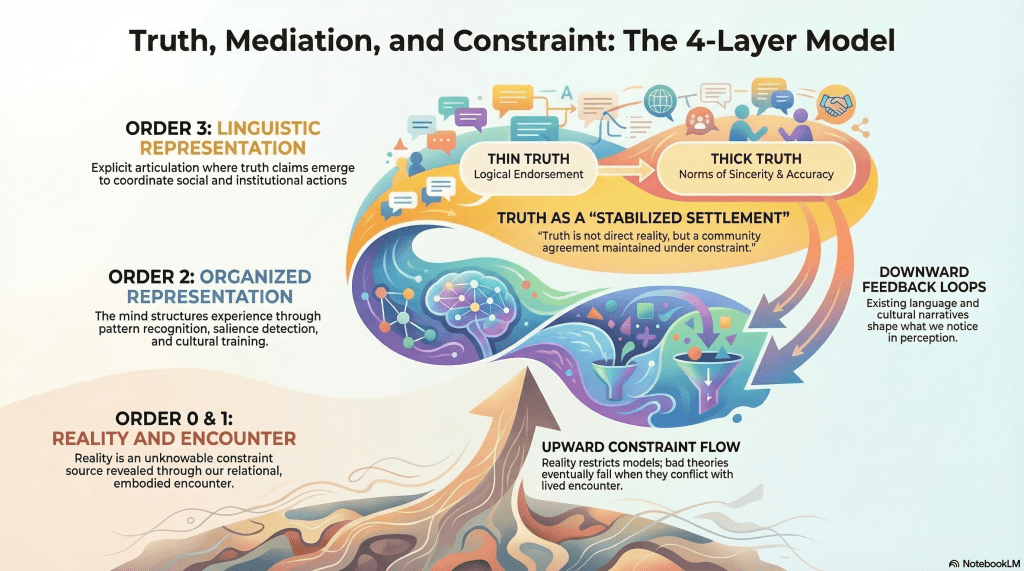
It asks what kind of ‘world’ we are actually dealing with once we abandon the fantasy of unmediated access. There is no clean mind–world interface, no privileged vantage point. Every encounter is mediated – biologically, cognitively, linguistically, socially. Realism and idealism alike fail here, each clinging to a different myth of access. What remains is not scepticism, but constraint.

Disagreement Without Referees operates at the normative and political level.

It asks why moral and political disagreement persists even when all parties appear informed, sincere, and articulate. The answer is ontological incommensurability. Where frameworks do not overlap, there are no neutral referees. Argument does not converge because it cannot. What remains is persuasion, coalition, power, and consequence—moral life without an umpire.

None of these lenses replaces what it critiques. Each refuses the repair instinct that says: if we just fix the model, the system will work again. That instinct is the pathology.

What They Share (And What They Don’t)

What unites these lenses is not a set of positive claims about how the world really is. It is a shared posture:

  • no privileged access
  • no neutral ground
  • no final adjudication
  • no redemptive synthesis

But also:

  • no quietism
  • no nihilism
  • no ‘anything goes’
  • no abdication of responsibility

They do not tell you what to believe. They tell you why believing harder won’t save you.

Importantly, they are non-hierarchical. LIH does not ground MEOW. MEOW does not explain away disagreement. Disagreement does not ‘apply’ LIH in some linear fashion. They intersect. They overlap. They illuminate different failure modes of the same inherited fantasy: that there must be a place where things finally settle. There isn’t.

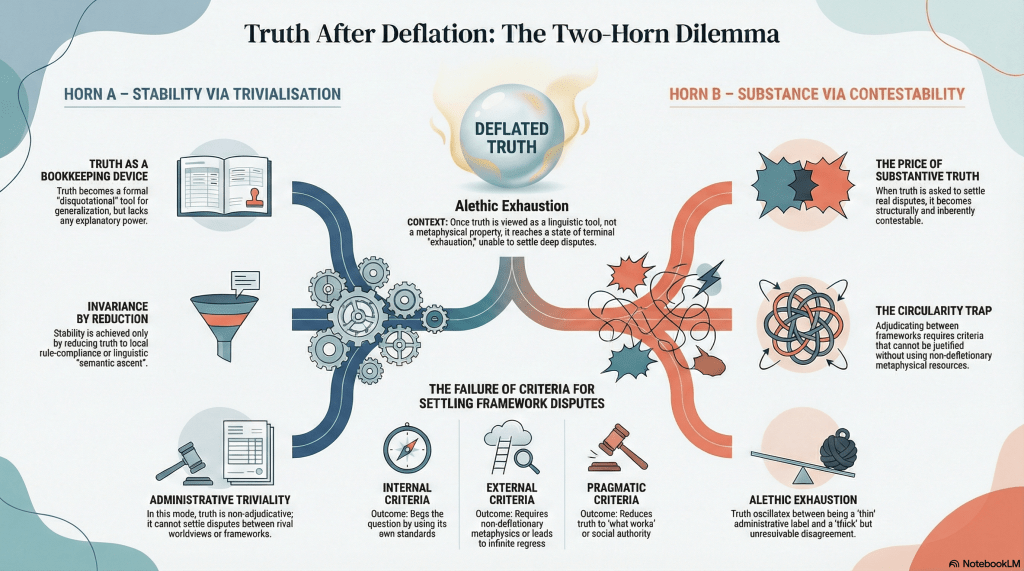
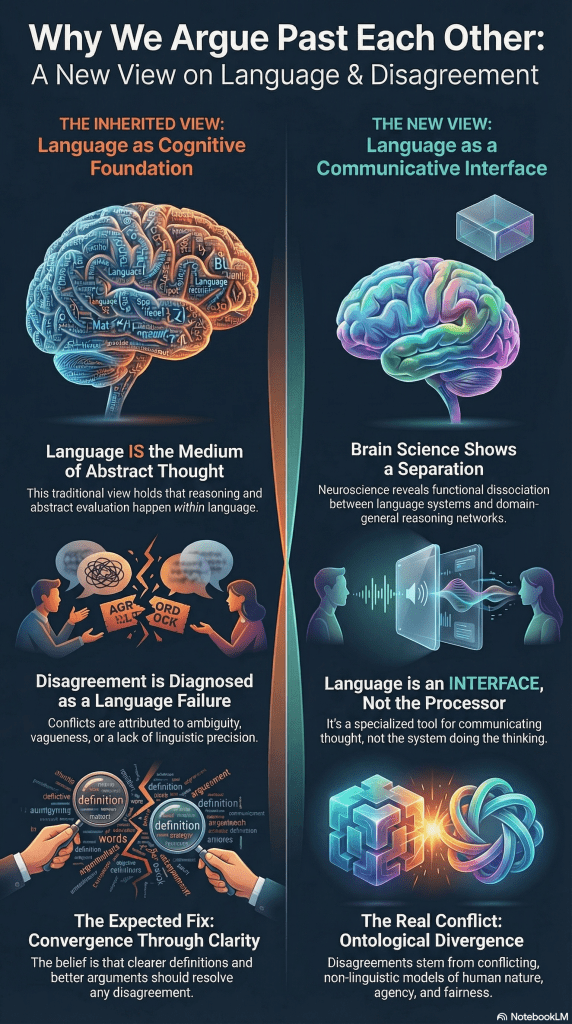
Image: Three Diagnostic Lenses Infographic¹

Why This Is Not a System

Systems promise closure. These lenses do not. They explain why closure is repeatedly promised, urgently demanded, and reliably missed. To systematise them would be to betray them.

What they offer instead is a kind of intellectual hygiene: a way of recognising when we are asking language, reality, or morality to do work they were never capable of doing – and then blaming one another when they don’t comply.

If there is a unifying thread, it is this: the demand for foundations is itself the problem.² These lenses do not solve that problem. They show you where it operates, how it reproduces itself, and why refusing it feels so uncomfortable. That discomfort is the point.


Footnotes

  1. This is another NotebookLM infographic – my second. It’s not half-bad. I had to adjust some elements in Photoshop and Illustrator, and there are still textual anomalies, but all in all, I’m impressed with what 60 seconds of generation yielded – along with a 5-minute prompt and 15 minutes of touchup. It’s just a novelty for now – certainly not necessary. What do you think?
  2. See Dis–Integrationism for a fuller accounting.

Meet the Language Insufficiency GPT

1–2 minutes

In anticipation of the publication of A Language Insufficiency Hypothesis in January 2026, I’ve created a Language Insufficiency GPT.

Today I’m launching something designed to exploit a familiar failure mode with forensic precision:
👉 https://chatgpt.com/g/g-694018a9bbc88191a8360d65a530e50c-language-insufficiency-gpt

Naturally, it will make more sense alongside the book. But it may still provide a bit of entertainment – and mild discomfort – in the meantime.

tl;dr: Language is generally presumed to be stable. Words mean what you think they mean, right? A table is a table. A bird is a bird. Polysemy aside, these are solid, dependable units.

Then we arrive at freedom, justice, truth, and an entire panoply of unstable candidates. And let’s not even pretend qualia are behaving themselves.

So when someone says ‘truth’, ‘free speech’, or ‘IQ’, you may suddenly realise you’ve been arguing with a cardboard cut-out wearing your own assumptions. That isn’t just interpersonal mischief. It’s language doing exactly what it was designed to do: letting you glide over the hard problems while sounding perfectly reasonable.

Audio: Short NotebookLM summary of this page content*
Video: Legacy video explaining some features of the LIH.

If that sounds banal, you’ve already fallen for the trap.

Give it a try – or wait until you’ve digested the book. Not literally, unless you’re short on fibre.

Cheers.

* As I’ve cited previously, the quality of NotebookLM varies – usually in predictable directions. This one does well enough, but it doesn’t have enough context to get the story right (because it was only drawing from this page rather than from a fuller accounting of the LIH). Its trailing comment reveals that it doesn’t grasp that “new words” don’t solve the problem.

Earlier, it suggests that language is intentionally vague. This is not an assertion I make. You can read some of the earlier incarnations, or you can wait for it to be published.

How Not to Interpret MEOW GPT

3–4 minutes

A NotebookLM Cautionary Tale for the Philosophically Curious

Every so often, the universe gives you a gift. Not the good kind, like an unexpected bottle of Shiraz, but the other kind – the ‘teachable moment’ wrapped in a small tragedy. In this case, a perfectly innocent run of MEOW GPT (my Mediated Encounter Ontology engine) was fed into NotebookLM to generate a pseudo-podcast. And NotebookLM, bless its little algorithmic heart, proceeded to demonstrate every classic mistake people make when confronting a relational ontology.

Audio: The misinterpretation of MEOW GPT: On Progress by NotebookLM that spawned this post.

It’s perfect. I couldn’t have scripted a better example of How Not To Read MEOW GPT if I’d hired a team of Enlightenment rationalists on retainer.

So consider this your public service announcement – and a guide for anyone experimenting with MEOW GPT at home, preferably while sitting down and not holding onto any cherished metaphysical delusions.

Video: Surreal Light through a Prism Clip for no particular reason (No sound)

Mistake 1: Treating a Thick Concept as a Single Glorious Thing

NotebookLM began, earnestly, by trying to uncover the ‘inner architecture of honour’, as if it were a cathedral with blueprints lying around.

This is the central error:

There are only patterns – drifting, contested, historically mangled patterns – that happen to share a word. If you start with ‘What is honour?’, you’ve already fallen down the stairs.

Mistake 2: Rebuilding Essence From the T0–T3 Layers

MEOW GPT gives you biological (T0), cognitive (T1), linguistic (T2), and institutional/technical (T3) mediation because that’s how constraints emerge. NotebookLM, meanwhile, reconstructed these as ‘layers’ of the same virtue – like honour was a three-storey moral townhouse with a loft conversion.

No. The tiers are co-emergent constraints, not components of a moral particle.
If your conclusion looks like a metaphysical onion, you’ve misread the recipe.

Mistake 3: Sneaking Virtue Ethics in Through the Fire Exit

NotebookLM kept returning to:

  • an ‘internal compass’
  • a ‘core record of the self’
  • a ‘lifelong ledger’
  • a ‘deep personal architecture’

At this point we might as well carve Aristotle’s name into the hull.

MEOW’s stance is simple: the self is not a marble statue – it’s an ongoing social, cognitive, and technical scandal. Treating honour as a personality trait is just the old moral ontology with a new hairstyle.

Mistake 4: Treating Polysemy as Noise, Not Evidence

NotebookLM acknowledged the differing uses of ‘honour’, but always with the implication that beneath the variations lies one pure moral essence. This is backwards. The ambiguity is the point. The polysemy isn’t messy data; it’s the signature of conceptual drift.

If you treat ambiguity as a problem to be ironed out, you’ve missed half the LIH and all of the MEOW.

Mistake 5: Turning MEOW Into a TED Talk

The podcast tried to wrap things up by contrasting honour’s “deep internal permanence” with the ephemerality of digital rating systems.

It’s cute, but it’s still modernist comfort-food. MEOW does not mourn for the ‘permanent self’. It doesn’t recognise such a creature. And digital honour doesn’t ‘replace’ the old patterns; it aggressively rewrites the honour-economy into algorithmic form. If your conclusion sounds like ‘ancient virtue meets modern technology’, that’s TED, not MEOW.

So How Should You Interpret MEOW GPT?

A short cheat-sheet for anyone experimenting at home:

  1. There is no essence.
    Concepts like honour, truth, integrity, and justice are drift-patterns, not objects.
  2. The tiers describe mediation, not ingredients.
    They’re co-emergent pressures, not building blocks.
  3. Thick terms lie to you.
    Their apparent unity is linguistic camouflage.
  4. Ambiguity is structural.
    If the term looks fuzzy, that’s because the world is fuzzy there.
  5. If a concept feels granite-solid, you’re standing on conceptual quicksand.
    (Sorry.)

A Friendly Warning Label

Warning:
If you believe thick moral concepts have single, universal meanings, MEOW GPT may cause temporary metaphysical discomfort.
Consult your ontological physician if symptoms persist.

Announcement: MEOW GPT

Instead of sleeping like a functional adult, I’ve spent the night creating, testing, and refining a bespoke GPT that has fully absorbed my MEOW and LIH frameworks. Apologies that the LIH manuscript isn’t yet public; some of the terminology may look delightfully alien if you’re coming in cold.

This model doesn’t role-play a philosopher; it thinks through the Mediated Encounter Ontology. It runs every input through T0–T3 mediations and then applies the Language Insufficiency Hypothesis to explain why our words fail us in predictable, structural ways.

Audio: NotebookLM summary podcast of this post on the MEOW GPT.

I stress-tested it with a dozen concepts, from the obvious to the uncooperative. It happily tells you when your input makes sense, when it’s out of scope, and when you’ve handed it conceptual soup. My first test was the hard problem of consciousness, because naturally we begin with the philosophical boss fight. I dialled down some over-enthusiastic LIH flourishes, but the bones are untouched.

I’m making this public for a simple reason: it’s the clearest way for people to see how MEOW operates without wandering through a hundred pages of my prose. These outputs capture how I process information and why these frameworks feel so intuitively correct to me. When you read them, you get a direct view of my interpretive machinery – how the world clicks for me, and how these ideas evolved.

It hasn’t been rigorously battle-tested across the entire conceptual universe, but it’s stable, coherent, and frankly too interesting to keep in the drawer. If you try it – and I hope you do – I’d love to see what it does with your own concepts. If you need help reading the results, ask. I didn’t simplify the system; it expects literacy, nuance, and a working prefrontal cortex.

For orientation, read the introductory post or the colour perception example. Ideally, read the original essay and listen to the summary podcast. My first test was on the hard problem of consciousness because I had already analysed it for this post. I made some adjustments to tone down some LIH intrusions.

Below is a sample output. I asked the model to analyse modernity.

Concept

  • Input: modernity
  • Type: historical–social formation / self-description of an era / conceptual frame
  • Scope check: in-scope – central for how MEOW treats large-scale shifts in mediation (social, technical, cognitive, linguistic)

High-level summary (≤120 words)

Modernity is both a historical bundle (industrialisation, nation-states, capitalism, science, bureaucracy, media) and a story societies tell about themselves (“we are modern, unlike the past”).

In MEOW terms, modernity is a large-scale reorganisation of mediations:

  • T0: new bodily environments (urban life, clocks, artificial light, pollution, medicine).
  • T1: new cognitive habits (individualism, planning, abstraction, risk-calculation).
  • T2: new vocabularies (progress, development, rationality, “religion” vs “science”).
  • T3: new institutions and technologies (markets, states, factories, schools, mass media, digital networks).

“Modernity” is not a single thing but a way these shifts hang together and become a background to everyday encounter.


T0 – Biological Mediation

  • Applicability: Applicable
  • Analysis:
    • Modernity radically reshapes the immediate bodily environment: dense cities, artificial lighting, noise, pollution, sedentary work, and altered sleep cycles change basic sensory and metabolic conditions.
    • Medical advances and public health (vaccination, antibiotics, sanitation, surgery) modify life expectancy, infant mortality, and chronic illness, which in turn change how life cycles feel and are planned.
    • New food systems (industrial agriculture, processed foods, global supply chains) alter nutrition, exposure to toxins, and rhythms of hunger and satiety.
    • Industrial and digital work reorganise movement and posture: repetitive factory labour, office desk work, and screen use all reshape embodiment, fatigue, and bodily awareness.
    • These T0 changes set the stage for new affective baselines (e.g., chronic low-level stress, stimulation overload) that colour what it is like to live in a “modern” world.

T1 – Cognitive Mediation

  • Applicability: Strongly applicable
  • Analysis:
    • Modernity encourages certain cognitive styles: systematic planning, quantification, risk assessment, cost–benefit thinking, and an emphasis on prediction and control.
    • The sense of self is reconfigured toward individualism and reflexivity: people see themselves as projects to be chosen, improved, optimised, often with long-term career and life-planning horizons.
    • Exposure to multiple roles, cultures, and information streams (through migration, media, education) produces more complex identity structures and can create cognitive dissonance or fragmentation.
    • Scientific and technical worldviews teach people to reframe events in terms of mechanisms, probabilities, and systems rather than fate, tradition, or local narratives.
    • The sheer volume and speed of information flows in late modernity (news, social media, notifications) trains attention toward rapid scanning and shallow switching, affecting memory, concentration, and emotional regulation.
    • These patterns make certain experiences “normal” (abstract work, mediated relationships, bureaucratic interactions) that would be extraordinary or impossible in premodern settings.

T2 – Linguistic Mediation

  • Applicability: Strongly applicable
  • Analysis:
    • Modernity itself is a label that societies use to contrast “us” with “them” (the past, “traditional” societies, “the East,” “the primitive”); it is a polemical as well as descriptive term.
    • In Language Insufficiency terms, modernity is highly Fluid: it can mean a period (“since the 18th century”), a style (modernist art), a value system (rational, secular, progressive), or a socio-economic order (capitalist, industrial, bureaucratic). Different authors slide between these quietly.
    • It’s also Contestable: critics and defenders use the same word but point to different aspects—emancipation and progress versus alienation, exploitation, ecological crisis.
    • Pairs like “modern vs traditional” or “modern vs backward” compress complex differences into simple hierarchies, smuggling in a presumption that “modern” is automatically better or more advanced.
    • Talk of “post-modernity” or “late modernity” suggests that we can neatly periodise and step outside the modern, even while our concepts and institutions remain shaped by it—an example of language implying more clarity and control than we actually have.
    • At the most global scale (“the meaning of modernity,” “the modern condition”), we approach an Effectiveness Horizon: the term feels weighty but becomes vague; people resort to sweeping metaphors (disenchantment, liquefaction, acceleration) whose exact content is hard to pin down.
    • First-person experiences of being “overwhelmed by modern life,” “liberated by modern options,” or “disconnected in modern society” often have an Ineffable quality: standard clichés don’t quite capture the texture of these lives, even as they gesture at them.

T3 – Social/Technical Mediation

  • Applicability: Strongly applicable
  • Analysis:
    • Modernity is most visible as a mesh of institutions: nation-states, markets, bureaucracies, public schools, hospitals, prisons, armies, scientific organisations, corporations, NGOs.
    • These institutions standardise time (clocks, schedules), space (borders, property lines, zoning), identity (passports, ID numbers), and value (money, statistics, rankings) so that encounters become predictable and governable across large scales.
    • Technologies—steam engines, electricity, mass transport, broadcasting, computing, the internet, AI—are both products and drivers of modernity. They make possible new encounter-forms (remote work, global real-time communication, mass surveillance).
    • Urbanisation concentrates people into large, heterogeneous populations, which reconfigures social networks, anonymity, solidarity, and conflict; everyday encounters become more mediated by rules, signage, and digital systems than by face-to-face custom.
    • Capitalist production and consumption patterns organise much of life around work, income, and markets; the rhythms of the factory, office, and platform economy structure when and how people interact, rest, and move.
    • Modern governance uses statistics, censuses, and models to “see” and manage populations; this makes certain aspects of life legible (employment, crime, disease) while leaving others under- or uncounted (informal care, undocumented work, emotional labour).
    • Counter-movements (romanticism, traditionalism, environmentalism, decolonial and Indigenous resurgence, slow-living and anti-consumerist practices) can be read as attempts to renegotiate or resist specific modern mediations rather than simply reject “modernity” as a whole.

Limits & failure modes

  • Language insufficiency notes
    • Modernity bundles together time (a historical era), structure (a type of society), and value (being “up to date”). This makes the term rhetorically powerful but analytically slippery: it’s easy to smuggle evaluations into what sound like neutral descriptions.
    • Because the concept is so broad, discussions often conflate distinct issues—technology, capitalism, secularisation, colonialism, individualism, bureaucracy—under one word, obscuring which mechanisms are actually at work.
    • Experiences of living in “modern times” (speed, fragmentation, choice, precariousness, possibility) often outrun our stock phrases; people lean on recurring complaints (“too fast,” “too shallow,” “too lonely”) that only partially capture what it’s like.
  • Missing tiers / blind spots
    • This sketch doesn’t adjudicate between different theories of modernity (Marxist, Weberian, postcolonial, systems-theoretic, etc.); it treats them as emphasising different mediational strands.
    • It’s centred on Euro-Atlantic narratives; “multiple modernities” and non-Western trajectories (where “modern” elements mix with older forms in hybrid ways) would need a richer T3 treatment.
    • The analysis underplays ecological dimensions: industrial modernity’s dependence on fossil fuels, large-scale extraction, and waste has massive implications for how future encounters will be structured.
    • Finally, because we are ourselves situated in what we call modernity, our conceptual vantage is limited; any map we draw is partly an artefact of the very mediations we’re trying to analyse.

How MEOW Turns a Metaphysical Mountain Into a Linguistic Molehill

In the last post, I argued that the so-called ‘hard problem of consciousness‘ was never a problem with consciousness. It was a problem with language – specifically, the English language’s unfortunate habit of carving the world into neat little substances and then demanding to know why its own divisions won’t glue back together.

Audio: NotebookLM summary podcast of this topic, on resolving the hard problem of consciousness.

The response was predictable.

  • ‘But what about subjective feel?’
  • ‘What about emergence?’
  • ‘What about ontology?’
  • ‘What about Chalmers?’
  • ‘What about that ineffable thing you can’t quite point at?’

All fair questions. All built atop the very framing that manufactures the illusion of a metaphysical gap.

So here’s the promised demonstration: not yet a full essay (though it may evolve into one), but a clear application of MEOW – the Mediated Encounter Ontology of the World – to the hard problem itself. Consider this a field test of the framework. A tidy autopsy, not the funeral oration.

The Set-Up: Chalmers’ Famous Trick

Chalmers asks:

The question feels profound only because the terms ‘physical’ and ‘experience’ smuggle in the very metaphysics they pretend to interrogate. They look like opposites because the grammar makes them opposites. English loves a comforting binary.

But MEOW doesn’t bother with the front door. It doesn’t assume two substances – ‘mind’ over here, ‘world’ over there – and then panic when they refuse to shake hands. It treats experience as the way an encounter manifests under a layered architecture of mediation. There’s no bridge. Only layers.

T₀ – Biological Mediation

The body is not a barrier. It is the encounter’s first architecture.

At T₀, the world is already transformed: transduction, gating, synchrony, inhibition, adaptation. Organisms don’t receive ‘raw’ physical inputs. They metabolise them. The form of contact is biological before it is anything else.

The hard problem begins by assuming there’s a realm of dumb physical mechanisms that somehow need to ‘produce’ experience. But organisms do not encounter dumb mechanism. They encounter structured contact –biological mediation – from the first millisecond.

If you insist on thinking in substances, T₀ looks like a problem.
If you think in mediations, it looks like the beginning of sense-making.

T₁ – Cognitive Mediation

Where the Enlightenment saw a window, cognition installs a newsroom.

Prediction, priors, memory, inference, attention – all shaping what appears and what never makes it into view. Experience at T₁ is not something ‘added’. It is the organisational structure of the encounter itself.

The hard problem treats ‘experience’ as a mysterious extra–something floating atop neural activity like metaphysical cream. But at T₁, what appears as experience is simply the organisation of biological contact through cognitive patterns.

There is no ‘what emerges from the physical’. There is the way the encounter is organised.

And all of this unfolds under resistance – the world’s persistent refusal to line up neatly with expectation. Prediction errors, perceptual limits, feedback misfires: this constraint structure prevents the entire thing from collapsing into relativist soup.

T₂ – Linguistic–Conceptual Mediation

Here is where the hard problem is manufactured.

This is the layer that takes an ordinary phenomenon and turns it into a metaphysical puzzle. Words like ‘experience’, ‘physical’, ‘mental’, ‘subjective’, and ‘objective’ pretend to be carved in stone. They aren’t. They slide, drift, and mutate depending on context, grammar, and conceptual lineage.

The hard problem is almost entirely a T₂ artefact – a puzzle produced by a grammar that forces us to treat ‘experience’ and ‘physical process’ as two different substances rather than two different summaries of different mediational layers.

If you inherit a conceptual architecture that splits the world into mind and matter, of course you will look for a bridge. Language hands you the illusion and then refuses to refund the cost of admission.

T₃ – Cultural–Normative Mediation

The Western problem is not the world’s problem.

The very idea that consciousness is metaphysically puzzling is the product of a specific cultural lineage: Enlightenment substance dualism (even in its ‘materialist’ drag), Cartesian leftovers, empiricist habits, and Victorian metaphysics disguised as objectivity.

Other cultures don’t carve the world this way. Other ontologies don’t need to stitch mind back into world. Other languages simply don’t produce this problem.

Reassembling the Encounter

Once you run consciousness through the mediational layers, the hard problem dissolves:

  • Consciousness is not an emergent property of neural complexity.
  • Consciousness is not a fundamental property of the universe.
  • Consciousness is the reflexive mode of certain mediated encounters, the form the encounter takes when cognition, language, and culture become part of what is appearing.

There is no gap to explain because the ‘gap’ is the product of a linguistic–conceptual framework that splits where the world does not.

As for the ever-mystical ‘what-it’s-like’: that isn’t a metaphysical jewel buried in the brain; it is the way a T₀–T₃ architecture manifests when its own structure becomes reflexively available.

A Brief Disclaimer Before the Internet Screams

Pointing out that Chalmers (and most of modern philosophy) operates within a faulty ontology is not to claim MEOW is flawless or final. It isn’t. But if Occam’s razor means anything, MEOW simply removes one unnecessary supposition — the idea that ‘mind’ and ‘world’ are independent substances in need of reconciliation. No triumphalism. Just subtraction.

Where This Leaves Chalmers

Chalmers is not wrong. He’s just asking the wrong question. The hard problem is not a metaphysical insight. It’s the moment our language tripped over its shoelaces and insisted the pavement was mysterious.

MEOW doesn’t solve the hard problem. It shows why the hard problem only exists inside a linguistic architecture that can’t model its own limitations.

This piece could easily grow into a full essay – perhaps it will. But for now, it does the job it needs to: a practical demonstration of MEOW in action.

And, arguably more important, it buys me one more day of indexing.

When Nobody Reads: Capitalism, Comment Sections, and the Death of Discourse

12–17 minutes

I recently commemorated an article on Excess Deaths Attributable to Capitalism. The backlash on LinkedIn was swift, loud, and – let’s say – uninformed.

Video: Short clip on this topic.

What followed was a case study in how not to communicate.

LinkedIn, that self-parody of professional virtue signalling, is essentially a digital networking séance: a place where narcissism wears a tie. So I expected a reaction – just not one quite so unintentionally revealing.

Audio: NotebookLM podcast on this topic.

But First…

Before I get too engaged, I want to share one of my favourite interactions: After I informed a commenter that I was a trained economist who taught undergraduate economics for the better part of a decade and had read many seminal economic books and journals firsthand, he replied, ‘No wonder you don’t know anything about economics’.

It reminded me of Oscar Wilde’s quip:

I think he may have taken this point too far.

The Post

I posted this:

Capitalism doesn’t kill with guns or gulags.
It kills with forms, policy, and plausible deniability.
The machine is efficient precisely because no one feels responsible.
When an insurance executive cuts ‘unprofitable’ coverage, it’s not an atrocity – it’s ‘cost optimisation’.

Four assertions that, if anything, were restrained. And yet, of roughly 6,600 impressions, 150 people commented – and only ten actually clicked through to read the article itself. Two, perhaps, reached the source post.

So, fewer than one-tenth of one per cent engaged with the argument. The rest engaged with their projections.

The Anatomy of Reaction

From this data set, one can discern a familiar pattern – social media’s endemic form of discourse dementia. People no longer respond to content, but to keywords. They hear ‘capitalism’ and proceed to recite preloaded scripts from whichever Cold War memory palace they inhabit.

Their replies fall neatly into categories.

1. The Purists and Apologists

These are the theologians of the market. They defend a sacred true capitalism – pure, fair, competitive – untainted by corruption or collusion. Every failure is blamed on heresy: ‘That’s not capitalism, that’s bureaucracy’.

This is theology masquerading as economics. The purity argument is its own circular proof: if capitalism fails, it was never real capitalism to begin with.

I eventually replied with a meme that captured the absurdity perfectly:

« Yeah, bruh! Cancer is not the problem. The problem is stage 4 cancer. What we need is stage 2 cancer. »

Image: Mentioned Meme

That’s the logic of ‘real capitalism’. A belief that malignancy can be cured by downgrading it.

2. The Cold Warriors and Whatabouters

When all else fails, shout Stalin. ‘Move to Cuba’, they say, as if the modern world were still divided between the Berlin Wall and McDonald’s.

These people argue from the long-term memory of the twentieth century because their short-term memory has been erased by ideology. The result is political dementia – functioning recall of ghosts, total blindness to the present.

3. The Moral Traditionalists

‘Capitalism created the highest living standards in history’, they proclaim, ignoring that the same sentence could be said of feudalism by a duke.

They confuse correlation for causation: prosperity under capitalism equals prosperity because of capitalism. It’s a comforting fable that erases the costs – colonialism, exploitation, environmental collapse—folded into that narrative of progress.

4. The Diagnosticians and Dismissers

When all argument fails, the fallback is pathology: ‘You’re confused,’ ‘You’re a cancer’, ‘Take this nonsense to Bluesky‘.

Ad hominem is the last refuge of the intellectually cornered. It converts disagreement into diagnosis. It’s a defence mechanism masquerading as discourse.

5. The Bureaucracy Confusionists

This group misread ‘forms and policy’ as an attack on government, not markets. For them, only the state can be bureaucratic. They cannot conceive of corporate violence without a uniform.

That’s precisely the blindness the post was about – the quiet procedural cruelty embedded in systems so efficient no one feels responsible.

6. The Realists and Partial Allies

A handful of commenters admitted the system was broken – just not fatally. ‘Capitalism has gone astray’, they said. ‘It’s not capitalism; it’s profiteering’.

This is capitalism’s soft apologetics: acknowledging illness while refusing to name the disease. These are the reformists still rearranging chairs on the Titanic.

7. The Human-Nature Essentialists

‘The problem isn’t capitalism – it’s people’.

Ah yes, anthropology as absolution. The rhetorical sleight of hand that converts design flaws into human nature. It’s a comforting determinism: greed is eternal, therefore systems are blameless.

This, too, proves the thesis. Capitalism’s most effective mechanism is the internalisation of guilt. You blame yourself, not the structure.

8. The Paranoids and Projectionists

For these, critique equals conspiracy. ‘The Marxists are oppressing your freedom’. ‘Bank accounts frozen in Canada’. ‘Social credit scores!’

They live in a world where any question of fairness is a plot to install a totalitarian state. Their fear is algorithmic; it needs no source.

9. The Systemic Observers

A few – precious few – saw the argument clearly. They understood that capitalism’s violence is procedural, not personal. That its atrocities come with signatures, not bullets. That the “cost optimisation” logic of insurance or healthcare is not an aberration – it’s the system functioning as designed.

These voices are proof that rational discourse isn’t extinct – merely endangered.

Discourse Dementia

What this episode reveals is not a failure of capitalism so much as a failure of cognition. The audience no longer hears arguments; it hears triggers. People don’t read – hey recognise.

The reflexive replies, the off-topic tangents, the moral panic – all of it is capitalism in miniature: fast, efficient, transactional, and devoid of empathy.

Social media has become the bureaucratic form of thought itself – automated, unaccountable, and self-reinforcing. Nobody reads because reading doesn’t scale. Nobody engages because attention is a commodity.

Capitalism doesn’t just kill with forms.
It kills with feeds.

Coda: The Light That Blinds

The Enlightenment promised clarity – the clean line between reason and superstition, order and chaos, subject and object. Yet, from that same light emerged the bureaucrat, the executive, and the algorithm: three perfect children of reason, each killing with increasing efficiency and decreasing intent.

Capitalism is merely the administrative arm of this lineage – the economic expression of the Enlightenment’s original sin: mistaking quantification for understanding. When discourse itself becomes procedural, when conversation turns into cost-benefit analysis, thought ceases to be an act of care and becomes an act of compliance.

The tragedy isn’t that we’ve lost meaning. It’s that we’ve automated it.
The machine hums on, self-justifying, self-optimising, self-absolving.

And, as ever, no one feels responsible.


Argumentation Approaches

I include the negative comments for a quick reference. Feel free to find the complete thread on LinkedIn.

  • Nonsense
  • Your post is a confession that anti-capitalism kills with guns and gulags.
    Give me capitalism over socialism any day.
  • Well, you should move to Cuba or any other socialist paradise… end of issue.
  • How can you be taken seriously when you conflate an entire economic system with health insurance? And for someone to say that overt murder, a la Stalin, is “decency”? That speaks for itself.
  • That is not capitalism. That is bureaucracy.
  • Healthcare isn’t free and everyone has the same right to make or not to make money.
  • Sounds more like socialism. Do it our way or we will freeze your bank account, take your job, and make sure you get nothing till you comply (proof was during covid)
  • Capitalism has made us the desired destination for those living in socialistic societies
  • BEURACRACY. The word your looking for is BEURACRACY not capitalism.
    There is no form of government more beurocratic than communism, except socialism.
    If you wonder why that is, communism doesn’t have to hide it’s authoritarianism like socialism does.
  • Socialism/Communism killed over 100 million the last century the old fashioned way;: bullets, starvation, torture, etc. Capitalism lifted 1 billion people out of poverty
  • Pathetic – misleading statement. Yes there are many problems, and mistakes that should be corrected. But as a physician, can guarantee before this medical system starting to ignore viruses, far more people were killed yearly under socialist or communist medical systems than capitalism. Wake up – care was not denied because many procedures and higher levels of care were unreachable to most!!!

  • How is the Government any different? You get what they say you get without the option of voting with your feet/checkbook. I’ll take my chances in the free market EVERY TIME.
  • This post is fiction from the start.
    Capitalism does NOT kill. Communism/Socialism does though.
  • Are you implying the ponderous inactivity of the socialist apparat is not worse than what we encounter with capitalistic motivated organizations? Learn the facts.

    Capitalism works well enough–better than any other alternatives. It degrades when government sticks its nose into private transactions to provide cover for lethargy and inefficiency. Responsibility moves from the person with whom one deals to a great nothingness of indifference. [truncated for brevity]
  • Private insurance has its faults but so does government insurance they are different but just as challenging
  • Any business that deals directly with Human tragedy (Casualty, Medical, Health, et al) should be held to both a different and higher standard in “cost optimization” than other businesses. To say that someone’s chemo should be spreadsheeted in the same columns as someone’s second home 80 feet from the beach is proof that capitalism is dead and scorched earth profiteering is now the new normal.
  • The argument should not be about capitalism vs. communism, but rather about human beings. Are humans creative/gifted enough to take care of themselves and produce surplus for the helpless few, or helpless sheep, majority to be fed and controlled by elites? But for your edification Bry, as you are critic of capitalism, try communism for a season, to balance your critique.
  • Bry WILLIS how long have you been this confused about basic economics and government policy?

    Most people stop using the “I know you are, but what am I” basis for their arguments by the age of seven or eight. But it appears to still be your basis for discourse.

    I wish you better luck seeing and understanding things for what they actually are vice how you wish they were.
  • The rules come from a socialist regime. The Marxists are oppressing your freedom. Not rhe FREE market and free enrerprises. What are you talking about….
  • That is is not capitalism. that is CRONY capitalism when feather merchants spread so much hoo-ha that nobody can get anything done.
  • Bry WILLIS look up social credit. Bank accounts under this government in Canada, have already been frozen, for dare disagreeing with them
  • This man feels our health insurance system represents capitalism? We better have a more in depth talk about how American health insurance works.
  • This has nothing to do with “capitalism”. If you choose to use the English language to communicate, understand the intended meanings of the words. We use contract law in our country regarding insurance coverage. It has little to do with capitalism. In fact, Obamacare stripped any semblance of capitalism from the process and replaced it with pricing manipulation, regulations, subsidies and other such “adjustments” to what used to be a capitalistic system. Blame the regulations, and lack of government enforcement, not “capitalism”. No winder NYC elected Momdani.
  • Ask those in China, N. Korea, and Russia how socialism/communism works for them.
  • Next you will have Gen AI and Agentic AI declining claims so that management can just point to the AI and no one has to feel bad for cutting off life saving care.
  • You’re a cancer. Capitalism created the best living standards the world ever seen. The socialist show up and corrupt it with all these social programs that don’t work and that’s where we’re at. You’re killing the future. You’re an idealist that never had to live in the real work and built anything and you’ll be the one who’s bitching when you’re on relief.
  • The only system that placed people in gulags was socialism all under the banner of democracy.
  • This is pure nonsense.  Take stuff like this on Bluesky
  • As I’ve said 4,000 times before, Capitalism requires robust competition in the market and zero collusion, price fixing, and market manipulation in order for it to function in its truest form and most beneficial economic impact to society as a whole (instead of 2%) and to be truly considered superior to other forms. None of those conditions exists in today’s capitalism (as practiced) and it has devolved into scorched earth profiteering which has a totally different definition and is practiced in a different way. Today’s profiteering by Corporations, which includes actions and behaviors that are counter-productive to capitalism, and that they hide under the guise of capitalism, acts as a malignant cancer on true capitalism and its inevitable result is, over time, a greater demand by society for socialist response as a counter measure. If Capitalism were working as it should, (and it’s not) that demand by society for socialist action would be highly diminished instead of enhanced.
  • Capitalism is not the “marriage of business and government” — that’s called oligarchy or, as the WEF calls it, “stakeholder capitalism”, also known as aristocracy. This is the current operating model of Canada, for example, wherein regulation and subsidy and tax”relief” is used to protect monopolies they are favorable to the sitting government.

    Before we go any further, please share your definition of capitalism.
  • Such bureaucracy is worse with socialism, with even less individual freedom because the almighty centralized state maintains tight control over everything.
  • Another socialist complaining about tainted money. Bry, the money “taint” yours to spend. It belongs to those who earned it.
  • More like government bureaucracy

Notes and References

1. The Procedural Violence of Systems.
David Graeber’s The Utopia of Rules (2015) and Bullshit Jobs (2018) remain essential on the bureaucratic face of modern capitalism — where compliance replaces conscience and inefficiency becomes profitable.

2. Markets as Mythology.
Karl Polanyi’s The Great Transformation (1944) describes how “self-regulating” markets were never natural phenomena but products of state violence and enclosure. What contemporary defenders call “real capitalism” is, in Polanyi’s terms, a historical fiction maintained through continuous coercion.

3. The Logic of the Machine.
Bernard Stiegler’s Technics and Time (1994–2001) and Automatic Society (2015) provide the philosophical frame for capitalism’s algorithmic mutation: automation not just of production, but of attention and thought.

4. Bureaucracy and Death.
Max Weber’s early insight into rationalisation—the conversion of moral action into procedural necessity—reaches its necropolitical extreme in Achille Mbembe’s Necropolitics (2003), where the administration of life and death becomes a managerial function.

5. Language, Responsibility, and the Loss of Agency.
Hannah Arendt’s Eichmann in Jerusalem (1963) diagnosed “the banality of evil” as precisely the condition described in the post: atrocity performed through paperwork, not passion. The executive who denies coverage is merely performing policy.

6. Attention as Commodity.
Guy Debord’s Society of the Spectacle (1967) and Byung-Chul Han’s In the Swarm (2017) both chart the transformation of discourse into spectacle, and thought into metrics — the perfect capitalist apotheosis: outrage without substance, visibility without understanding.

7. On Reflex and Recognition.
Friedrich Nietzsche’s Genealogy of Morals (1887) prefigures this pathology in his account of herd morality and ressentiment — a collective psychology where reaction replaces reflection.


Further Reading / Contextual Essays

The Ethics of Maintenance: Against the Myth of Natural Purpose
A dismantling of the Enlightenment’s faith in progress. Maintenance, not innovation, becomes the moral task once teleology collapses. This essay lays the groundwork for understanding capitalism as an entropy accelerator disguised as improvement.

Against Agency: The Fiction of the Autonomous Self
Explores how neoliberal ideology weaponises Enlightenment individualism. The myth of “self-made” success functions as capitalism’s moral camouflage — the narrative counterpart to plausible deniability.

The Illusion of Light: Thinking After the Enlightenment
The core text of the Anti-Enlightenment corpus. A philosophical excavation of modernity’s central delusion: that illumination equals truth. Traces the lineage from Cartesian clarity to algorithmic opacity.

Objectivity Is Illusion (The Language Insufficiency Hypothesis)
An inquiry into the failure of language as a medium for truth claims. Introduces the Effectiveness–Complexity Gradient, showing how every human system — political, linguistic, economic — eventually collapses under the weight of its own abstractions.

The Discipline of Dis-Integration
A philosophy of maintenance over progress. Argues that dis-assembly — not construction — is the proper epistemic gesture in an age of exhaustion.

Propensity (Ridley Park, 2024)
The fictional mirror to these essays. A speculative novel examining the behavioural mechanics of optimisation, obedience, and systemic cruelty — a narrative form of “cost-optimisation ethics.”