Why We Keep Talking Past Each Other

8–11 minutes

I am a philosopher of language. That is typically my primary perspective, so communication and limitations often fall into my sights. I believe that not all disagreements can be resolved through language communication. This illustrates one barrier in particular.

This essay is not an attempt to resolve disagreement, adjudicate truth, or reconcile competing worldviews. It is an attempt to explain why so many disagreements persist despite intelligence, good faith, and shared vocabulary – and why escalating those disagreements often makes them worse rather than better.

What follows is diagnostic rather than prescriptive. I am less interested in who is right than in why arguments so often fail to converge, and why those failures are routinely misinterpreted as moral defects rather than structural mismatches. The claim is not that ‘anything goes’, nor that all perspectives are equally valid, but that many disputes operate across ontological fault lines that no amount of better reasoning, evidence, or civility can bridge on their own terms.

Recognising this does not require abandoning one’s commitments. It requires abandoning the fantasy that every disagreement is corrigible and that persuasion is always the appropriate response to difference. If the essay succeeds, it will not produce consensus. It may, however, produce a little more clarity, a little less moral theatre, and a slightly more disciplined form of charity – one grounded not in agreement, but in an honest appraisal of where disagreement actually lives.

Audio: NotebookLM summary podcast of this content.

On Ontological Incommensurability and the Case for Civilised Disagreement

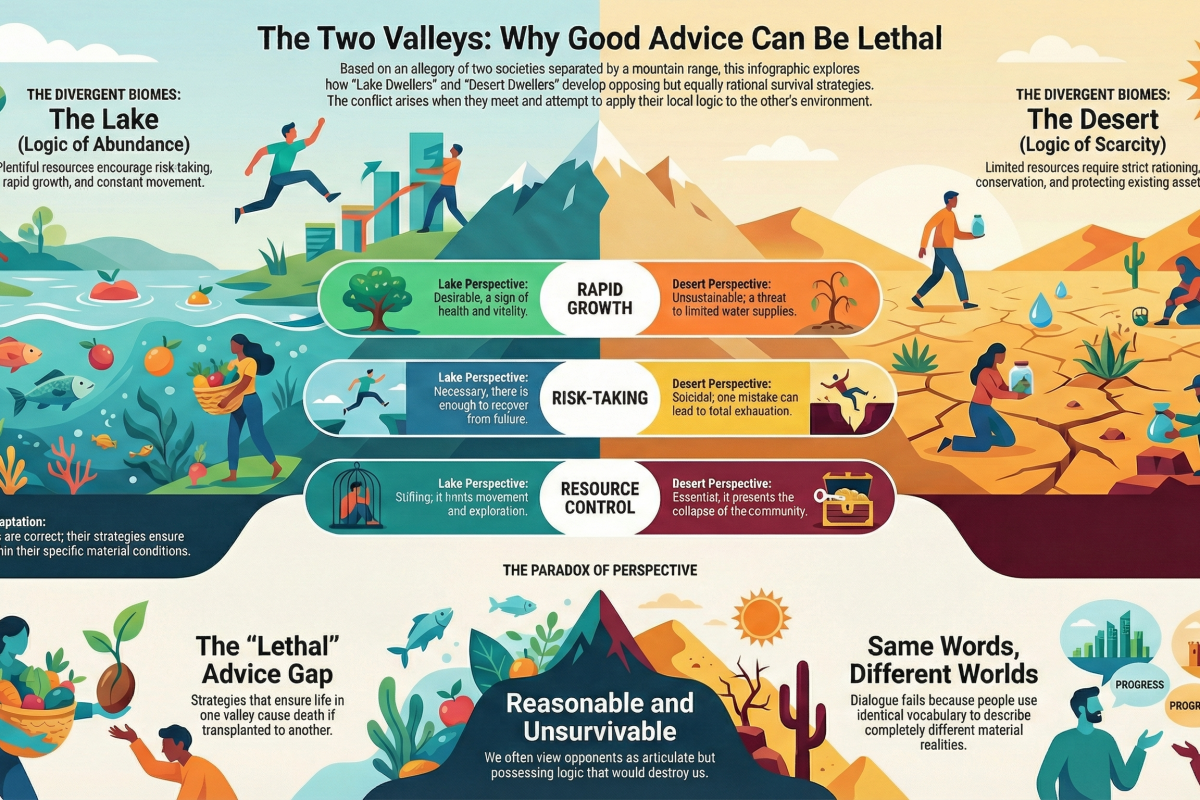
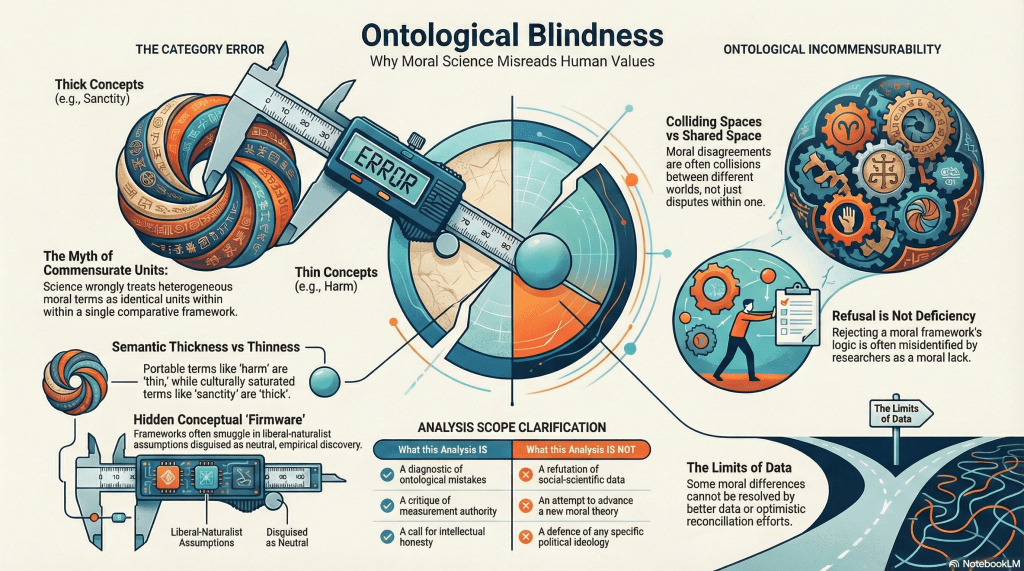
Most disagreements that metastasise into moral theatre are not disagreements at all. They are collisions between incompatible ontologies, misdiagnosed as differences of opinion.

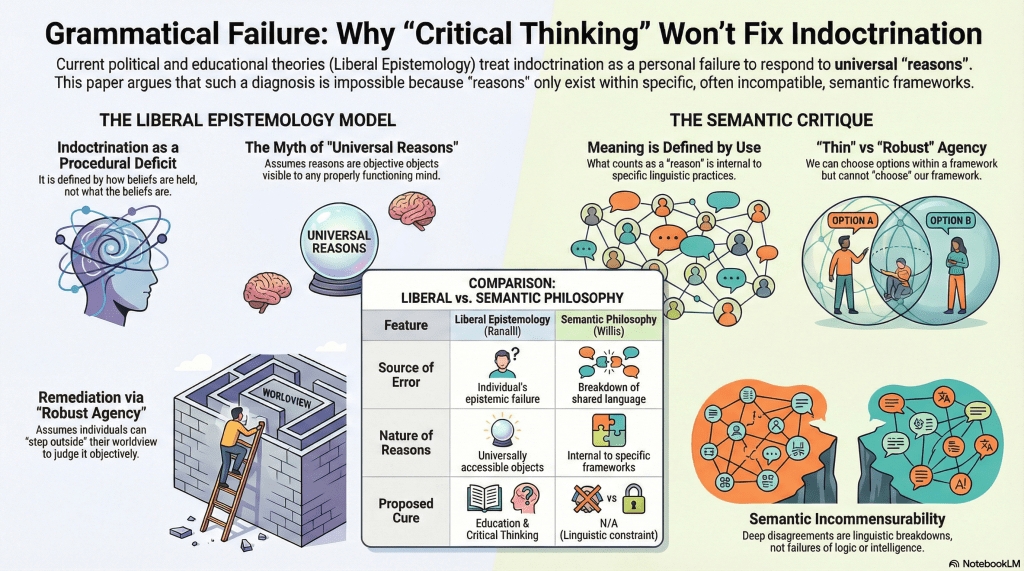
We continue to behave as though all disputes take place on a shared stage called “reality,” where facts sit patiently waiting to be interpreted, weighed, or refuted. From this perspective, disagreement is assumed to be corrigible. If only one side listened harder, reasoned better, or acquired the right evidence, convergence would follow. This assumption is not merely optimistic. It is wrong.

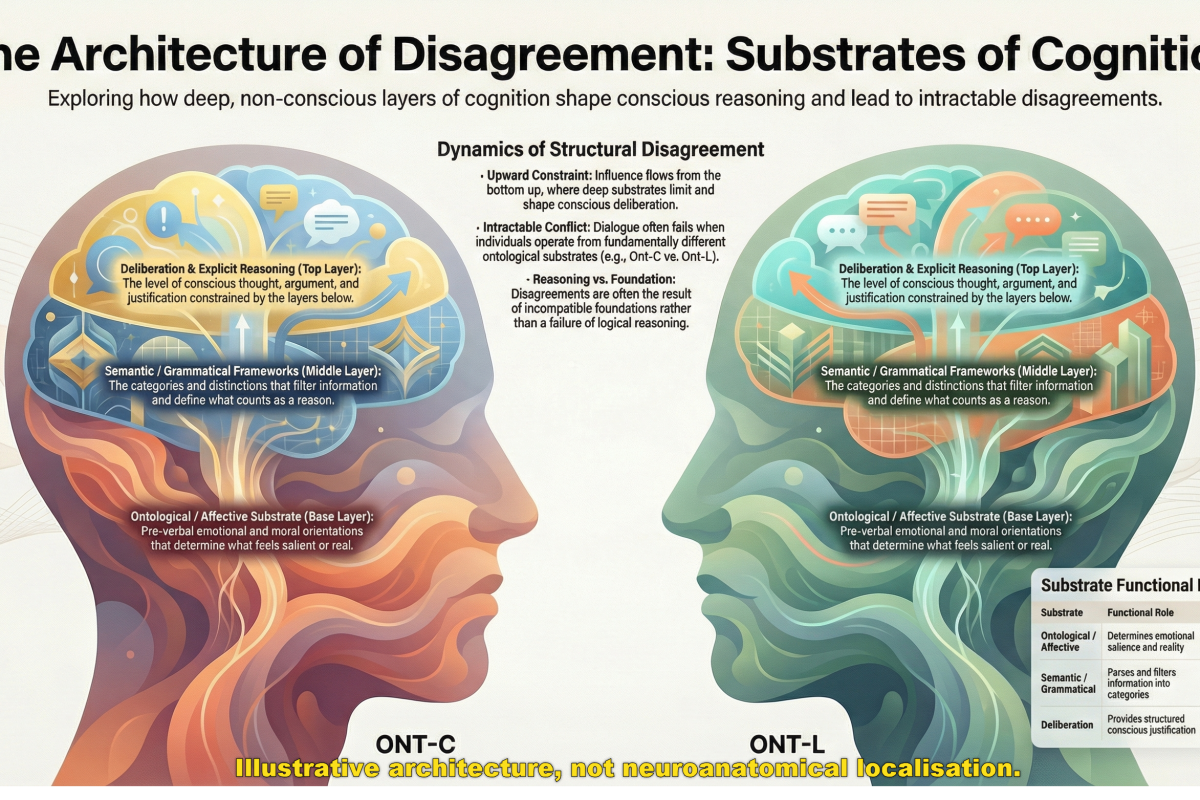
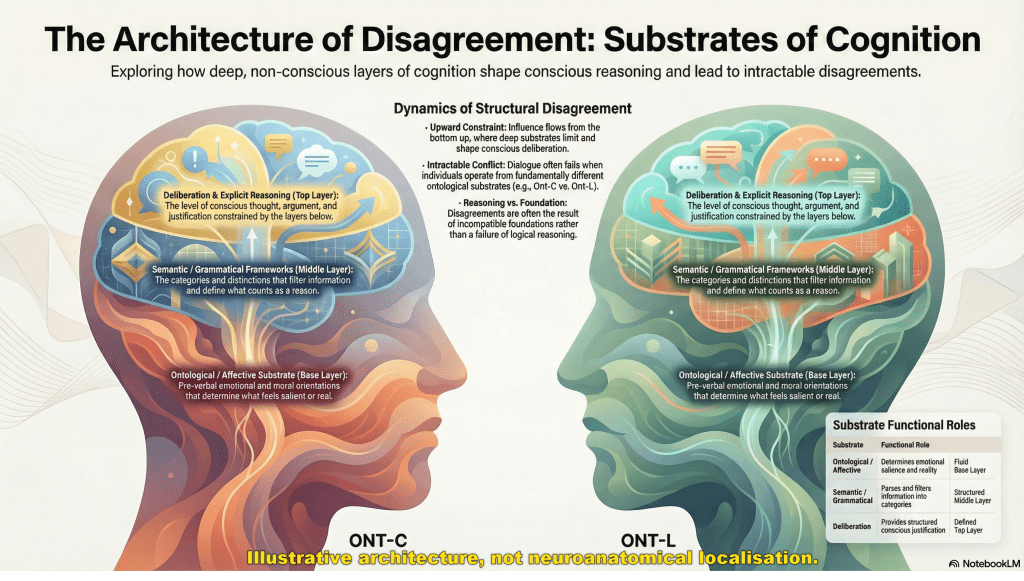
Many of our most entrenched conflicts persist precisely because the parties involved do not inhabit the same world in any substantive sense. They operate with different background assumptions about what exists, what counts as real, what can ground truth, and what sorts of things are even eligible for belief. Argument, in such cases, does not fail due to bad faith or insufficient charity. It fails because it presumes a shared ontology that does not exist.

Before proceeding, a clarification. I am using ontology here in a deliberately broad, working sense. Not merely as an inventory of what exists, but as the background framework that determines what can count as real, meaningful, or normatively binding in the first place. This inevitably overlaps with epistemology, ethics, and theories of agency. Not because these domains are identical, but because in lived discourse they travel together. The fault line I am describing is not disciplinary. It is structural.

Video: Two people in ontological bubbles. (no sound)

Opinion Is Not Ontology

A difference of opinion presupposes a common world. Two people may disagree about what justice requires, but only because they agree, tacitly, that justice is a thing of some kind. Two people may dispute whether God exists, but only because they share enough conceptual scaffolding for the sentence to function.

Ontological disagreement runs deeper. It concerns not what is the case, but what it even means for something to be the case at all. When these levels are conflated, discourse becomes theatrical. Arguments are repeated with increasing urgency, frustration is moralised, and disagreement is reinterpreted as stubbornness, ignorance, or vice. Civility erodes not because people are cruel, but because they are speaking from worlds that do not interlock.

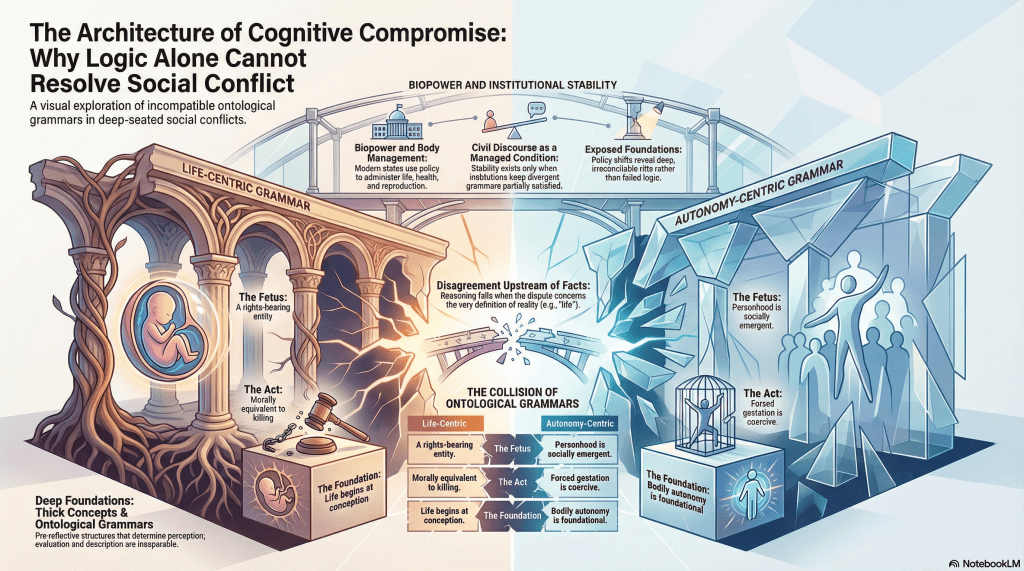
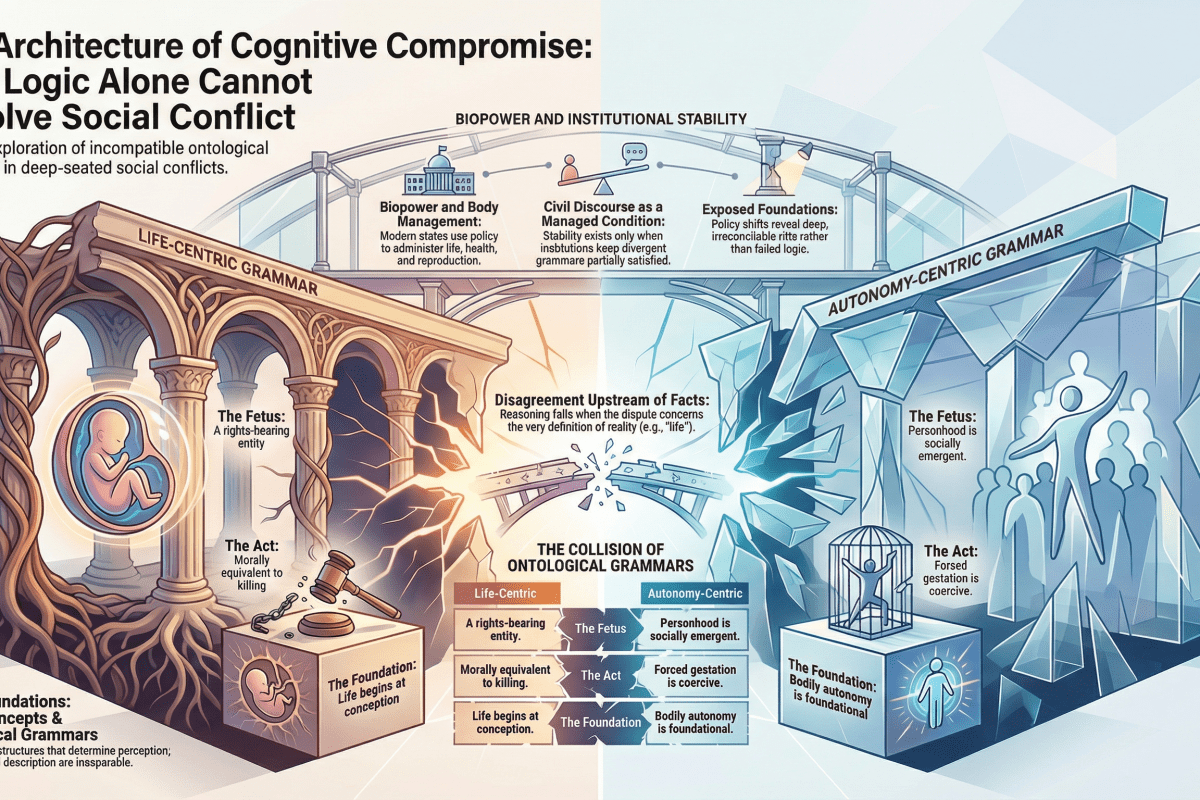
Consider debates over abortion. Pro-life arguments typically presuppose that the fetus is already a moral person; pro-choice arguments often presuppose that moral personhood is inseparable from bodily autonomy. These positions are not primarily disagreements about policy, compassion, or even ‘the value of life’. They are disagreements about what kinds of entities exist and when they begin to matter. Shared language about rights or harm often masks this deeper ontological divergence, which is why such debates rarely converge despite decades of argument.

When Critique Presumes the Ontology It Opposes

This distinction helps explain a familiar but often confusing phenomenon: cases where two parties appear to agree on symptoms, vocabulary, and even outrage, yet remain fundamentally misaligned.

Consider critiques of institutional cruelty that condemn dehumanising practices while retaining the very assumptions that make those practices intelligible. For example, workplace critiques that oppose excessive surveillance, unfair metrics, or punitive performance targets often still presume the figure of the autonomous, responsible worker whose output reflects individual will. The system is blamed for misapplying norms, not for producing those norms as instruments of control. Such critiques are often insightful and well-intentioned. They identify real harm. They name real suffering. And yet they stall.

The reason is not timidity or bad analysis. It is ontological inheritance. These critiques operate inside the same metaphysical framework that generates the harm they diagnose. They presuppose moral realism, individual agency, and normative grounding as givens, then object to their misapplication. The result is an internal critique: coherent, compelling, and structurally limited.

From a different ontological position, the problem is not that the norms are misapplied, but that the norms themselves function as delivery mechanisms of harm. What appears as reform from within appears as reenactment from without. This is not a misunderstanding. It is a category error.

Recognising this helps explain why superficial agreement so often feels productive while changing nothing. Shared language can create the appearance of convergence while leaving foundational divergence intact. The temperature drops. The mediator applauds. The underlying machinery hums on.

Igtheism and the Refusal to Pretend

This is why I describe myself, somewhat unfashionably, as an igtheist rather than an atheist.

Atheism still accepts the question ‘Does God exist?’ as well-formed. It grants the concept enough coherence to deny its instantiation. Agnosticism does much the same, merely pausing at the threshold. Both remain inside the game.

Igtheism steps back and asks a prior question: What, precisely, are we talking about? If no stable referent can be specified, the sentence does not become false. It becomes undefined. The system returns ‘does not compute’. This is not evasive. It is diagnostic.

Try as I may, I cannot make sense of strong metaphysical Realism, let alone Theism. The idea that there exists a fully formed, mind-independent world ‘out there’, grounding truth prior to mediation, language, practice, or perspective, does not parse for me. Not as a contested claim. As a coherent one.

However, and this is the crucial point, once I accept Realism as a mechanism, Theism suddenly makes sense. If you already believe in a metaphysically exterior realm that guarantees truth and coherence, then placing God there is not a leap. It is an economy of scale.

Paraphrased bluntly: They believe there is a whole world ‘out there’. I don’t believe in any of it, so God might as well live out there, too.

From within that worldview, atheistic Realism is arguably the stranger position. The cathedral has been built; denying the altar looks parsimonious rather than principled.

I am not offering a competing metaphysical system here. Not idealism, not pragmatism, not a substitute ontology waiting in the wings. I am declining the assumption that reality must come pre-packaged as a mind-independent domain in order to be intelligible or actionable at all.

Of course, non-realist positions are not exempt from this problem; they, too, can smuggle in unexamined ontological commitments under the guise of pragmatism, coherence, or practice.

Pascal’s Wager and Ontological Blackmail

This is why igtheism tends to offend theists more than atheism ever could. When a theist says, ‘How can you not care? Your soul depends on it’, they are not making an argument. They are issuing an ontological demand. Pascal’s Wager is merely this demand formalised into decision theory.

The wager only works if one has already granted the existence of souls, post-mortem identity, divine reward structures, and a cosmic enforcement mechanism that cares about belief states. Without those assumptions, there is no wager. There is only a shouted house rule addressed to someone who is not in the casino.

None of this is meant to trivialise the existential seriousness with which such claims are often held. It is simply to note that care does not precede ontology; it follows it. One cannot meaningfully care about entities one does not recognise as intelligible occupants of the world.

Why This Doesn’t End in Relativism

None of this implies that ‘all ontologies are equally true’, nor that disagreement is pointless. It implies something far less comforting and far more useful: many disagreements are non-resolvable by design. This does not deny that ontological frameworks can and do shift over time, sometimes under empirical pressure; it only denies that such shifts are guaranteed, universal, or achievable through argument alone.

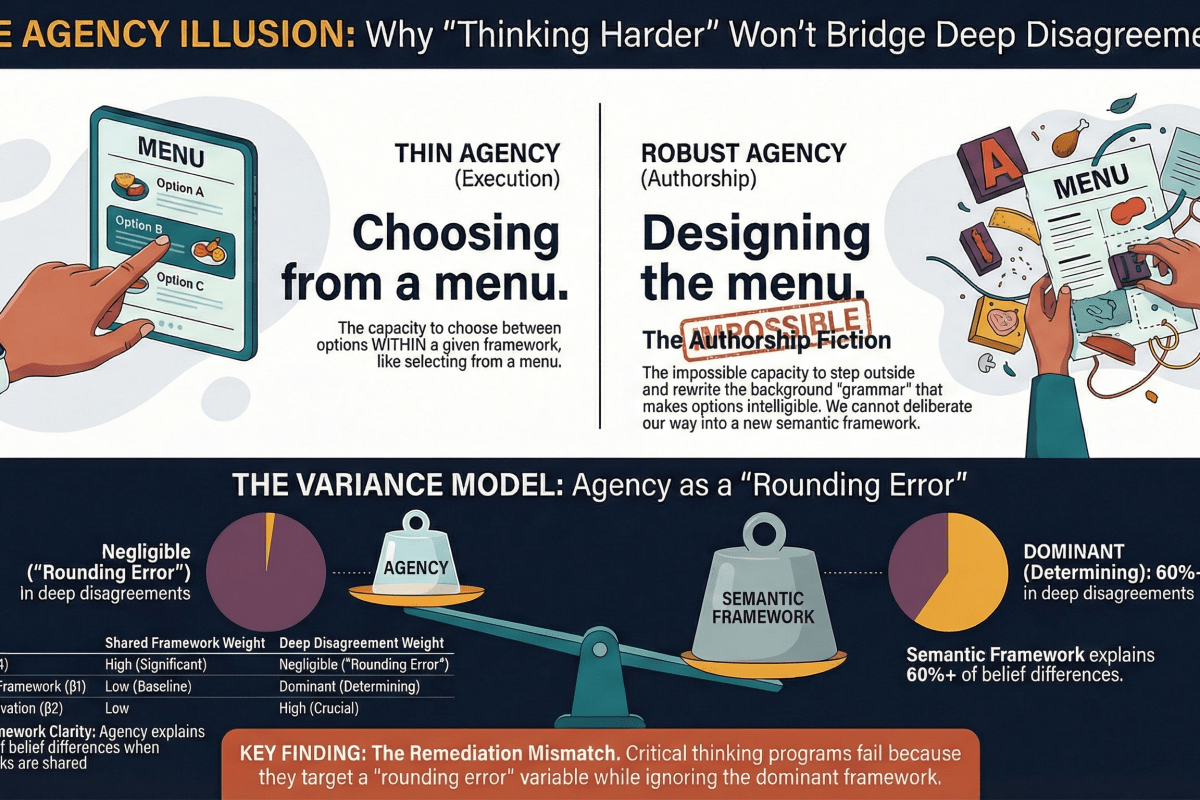
Non-resolvability does not entail arbitrariness. Ontological frameworks can be evaluated for internal coherence, practical consequences, and the kinds of lives they make possible. What cannot be done is to adjudicate between them using criteria that belong exclusively to one side. Recognising this does not require abandoning one’s worldview. It requires abandoning the fantasy that persuasion is always possible, or that failure to persuade is a moral defect.

Once we see that we are not standing on the same ground, something like charity becomes possible. Not the saccharine kind. The disciplined kind. I understand that this matters enormously to you. I do not share the ontology that makes it matter to me. This is not a truce forged through compromise. It is a ceasefire born of ontological honesty.

Civility Without Convergence

Our age is addicted to resolution. Every disagreement is treated as a problem to be solved, a synthesis waiting to happen, a bridge yet to be built. Sometimes there is no bridge. Sometimes the most responsible thing to do is to stop pretending there is one.

Civility does not require agreement. It does not even require mutual understanding in the strong sense. It requires only that we stop mistaking incompatible world-models for intellectual obstinacy. We are not all arguing about the same furniture. Some of us are questioning whether the room exists at all.

Once that is acknowledged, the volume drops. The moral theatre loses its urgency. And disagreement, while still real, becomes less corrosive. Not because we have reconciled our ontologies. But because we have finally noticed that they do not reconcile.

When Aliens Speak English: The False Promise of Linguistic Familiarity

5–7 minutes

Why shared language creates the illusion – not the reality – of shared experience

Human beings routinely assume that if another agent speaks our language, we have achieved genuine mutual understanding. Fluency is treated as a proxy for shared concepts, shared perceptual categories, and even shared consciousness. This assumption appears everywhere: in science fiction, in popular philosophy videos, and in everyday cross-cultural interactions. It is a comforting idea, but philosophically indefensible.

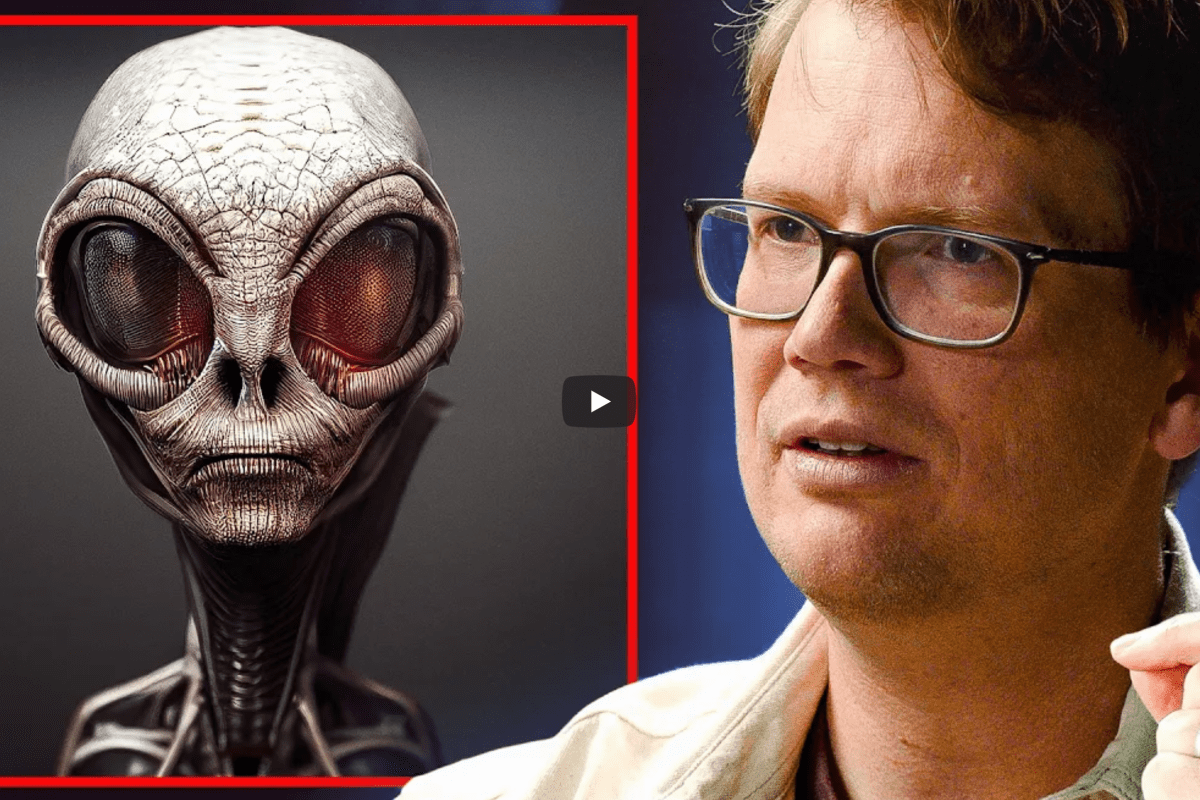
Video: Could You Explain Cold to an Alien? – Hank Green

Recent discussions about whether one could ‘explain cold to an alien’ reveal how deeply this assumption is embedded. Participants in such debates often begin from the tacit premise that language maps transparently onto experience, and that if two interlocutors use the same linguistic term, they must be referring to a comparable phenomenon.

A closer analysis shows that this premise fails at every level.

Audio: NotebookLM summary podcast on this topic.

Shared Language Does Not Imply Shared Phenomenology

Even within the human species, thermal experience is markedly variable. Individuals from colder climates often tolerate temperatures that visitors from warmer regions find unbearable. Acclimation, cultural norms, metabolic adaptation, and learned behavioural patterns all shape what ‘cold’ feels like.

If the same linguistic term corresponds to such divergent experiences within a species, the gap across species becomes unbridgeable.

A reptile, for example, regulates temperature not by feeling cold in any mammalian sense, but by adjusting metabolic output. A thermometer measures cold without experiencing anything at all. Both respond to temperature; neither inhabits the human category ‘cold’.

Thus, the human concept is already species-specific, plastic, and contextually learned — not a universal experiential module waiting to be translated.

Measurement, Behaviour, and Experience Are Distinct

Thermometers and reptiles react to temperature shifts, and yet neither possesses cold-qualia. This distinction illuminates the deeper philosophical point:

  • Measurement registers a variable.
  • Behaviour implements a functional response.
  • Experience is a mediated phenomenon arising from a particular biological and cognitive architecture.

Aliens might measure temperature as precisely as any scientific instrument. That alone tells us nothing about whether they experience anything analogous to human ‘cold’, nor whether the concept is even meaningful within their ecology.

The Problem of Conceptual Export: Why Explanation Fails

Attempts to ‘explain cold’ to hypothetical aliens often jump immediately to molecular description – slower vibrational states, reduced kinetic energy, and so forth. This presumes that the aliens share:

  • our physical ontology,
  • our conceptual divisions,
  • our sense-making framework,
  • and our valuation of molecular explanation as intrinsically clarifying.

But these assumptions are ungrounded.

Aliens may organise their world around categories we cannot imagine. They may not recognise molecules as explanatory entities. They may not treat thermal variation as affectively laden or behaviourally salient. They may not even carve reality at scales where ‘temperature’ appears as a discrete variable.

When the conceptual scaffolding differs, explanation cannot transfer. The task is not translation but category creation, and there is no guarantee that the requisite categories exist on both sides.

The MEOW Framework: MEOWa vs MEOWb

The Mediated Encounter Ontology (MEOW) clarifies this breakdown by distinguishing four layers of mediation:

  • T0: biological mediation
  • T1: cognitive mediation
  • T2: linguistic mediation
  • T3: social mediation

Humans run MEOWa, a world structured through mammalian physiology, predictive cognition, metaphor-saturated language, and social-affective narratives.

Aliens (in fiction or speculation) operate MEOWb, a formally parallel mediation stack but with entirely different constituents.

Two systems can speak the same language (T2 alignment) whilst:

  • perceiving different phenomena (T0 divergence),
  • interpreting them through incompatible conceptual schemas (T1 divergence),
  • and embedding them in distinct social-meaning structures (T3 divergence).

Linguistic compatibility does not grant ontological compatibility.
MEOWa and MEOWb allow conversation but not comprehension.

Fiction as Illustration: Why Aliens Speaking English Misleads Us

In Sustenance, the aliens speak flawless Standard Southern English. Their linguistic proficiency invites human characters (and readers) to assume shared meaning. Yet beneath the surface:

  • Their sensory world differs;
  • their affective architecture differs;
  • their concepts do not map onto human categories;
  • and many human experiential terms lack any analogue within their mediation.

The result is not communication but a parallel monologue: the appearance of shared understanding masking profound ontological incommensurability.

The Philosophical Consequence: No Universal Consciousness Template

Underlying all these failures is a deeper speciesist assumption: that consciousness is a universal genus, and that discrete minds differ only in degree. The evidence points elsewhere.

If “cold” varies across humans, fails to apply to reptiles, and becomes meaningless for thermometers, then we have no grounds for projecting it into alien phenomenology. Nor should we assume that other species – biological or artificial – possess the same experiential categories, emotional valences, or conceptual ontologies that humans treat as foundational.

Conclusion

When aliens speak English, we hear familiarity and assume understanding. But a shared phonological surface conceals divergent sensory systems, cognitive architectures, conceptual repertoires, and social worlds.

Linguistic familiarity promises comprehension, but delivers only the appearance of it. The deeper truth is simple: Knowing our words is not the same as knowing our world.

And neither aliens, reptiles, nor thermometers inhabit the experiential space we map with those words.

Afterword

Reflections like these are precisely why my Anti-Enlightenment project exists. Much contemporary philosophical commentary remains quietly speciesist and stubbornly anthropomorphic, mistaking human perceptual idiosyncrasies for universal structures of mind. It’s an oddly provincial stance for a culture that prides itself on rational self-awareness.

To be clear, I have nothing against Alex O’Connor. He’s engaging, articulate, and serves as a gateway for many encountering these topics for the first time. But there is a difference between introducing philosophy and examining one’s own conceptual vantage point. What frustrates me is not the earnestness, but the unexamined presumption that the human experiential frame is the measure of all frames.

Having encountered these thought experiments decades ago, I’m not interested in posturing as a weary elder shaking his stick at the next generation. My disappointment lies elsewhere: in the persistent inability of otherwise intelligent thinkers to notice how narrow their perspective really is. They speak confidently from inside the human mediation stack without recognising it as a location – not a vantage point outside the world, but one local ecology among many possible ones.

Until this recognition becomes basic philosophical hygiene, we’ll continue to confuse linguistic familiarity for shared ontology and to mistake the limits of our own embodiment for the limits of consciousness itself.

Required Reading: Science

The Structure of Scientific Revolutions was published in 1962. Written by Thomas Kuhn, it introduced the world to the concept of paradigm shifts in science — and, as it turns out, elsewhere. As I mentioned recently, I experienced a mishap, confounding it with Paul Feyerabend’s Against Method, first published in 1975. Both of these should be required reading FOR year 10 – or at least taught in summary.

I had read Feyerabend years ago but was only familiar with Kuhn from a distance. I’m clad we’ve become more intimate. These authors take different approaches to arrive at times in the same place. Kuhn takes a Modernist approach that he critiques and modifies. Feyerabend takes a Postmodernist path that sometimes cross.

Ah, the delightful dance of paradigms and anarchism in the hallowed halls of science! Let’s delve deeper into the intellectual pas de deux between Thomas Kuhn and Paul Feyerabend, those audacious thinkers who dared to challenge the sanctity of scientific methodology.

Kuhn’s Paradigm Shifts: The Scientific Waltz

Thomas Kuhn, in his seminal work The Structure of Scientific Revolutions, introduced us to the concept of paradigm shifts—a term now so overused that even corporate PowerPoint presentations aren’t spared. Kuhn posited that science doesn’t progress through a linear accumulation of knowledge but rather through a series of revolutionary upheavals. These upheavals occur when the prevailing scientific framework, or “paradigm,” becomes as outdated as last season’s fashion, unable to account for emerging anomalies. In Kuhn’s view, the scientific community clings to its paradigms with the tenacity of a dog to its bone, until the weight of anomalies forces a collective epiphany, leading to a paradigm shift. This cyclical process propels scientific advancement, albeit in a manner reminiscent of a drunken sailor’s stagger rather than a straight path.

Feyerabend’s Epistemological Anarchism: The Punk Rock of Science

Enter Paul Feyerabend, the enfant terrible of the philosophy of science, with his provocative manifesto Against Method. Feyerabend gleefully dismantled the notion of a universal scientific method, advocating for “epistemological anarchism.” He argued that the rigid adherence to methodological rules is about as useful as a chocolate teapot, stifling creativity and hindering progress. In Feyerabend’s anarchic utopia, “anything goes” in the pursuit of knowledge, and the scientific method is more of a loose suggestion than a strict protocol. His critique was not just a call for methodological diversity but a full-blown rebellion against the tyranny of scientific dogmatism.

A Comparative Analysis: Method to the Madness

While Kuhn and Feyerabend both challenged the orthodox views of scientific progress, their approaches were as different as chalk and cheese. Kuhn’s analysis was rooted in historical case studies, portraying scientific revolutions as communal shifts in perspective, akin to a collective midlife crisis. Feyerabend, on the other hand, took a more radical stance, suggesting that the very idea of a fixed scientific method is as mythical as unicorns. Where Kuhn saw periods of “normal science” punctuated by revolutionary shifts, Feyerabend saw a chaotic free-for-all, where progress is made not by following rules but by breaking them.

Implications for Scientific Practice: Order in Chaos

The implications of their critiques are profound. Kuhn’s work suggests that scientists should remain open to paradigm shifts, lest they become as obsolete as Betamax in a Netflix era. Feyerabend’s anarchism, while controversial, serves as a reminder that innovation often requires the audacity to defy convention. Together, they paint a picture of science not as a monolithic quest for truth but as a dynamic, often tumultuous, human endeavour.

Conclusion: The Legacy of Intellectual Rebellion

In conclusion, the works of Kuhn and Feyerabend invite us to view science through a more sceptical lens, questioning the sanctity of its methods and the rigidity of its paradigms. Their critiques serve as a clarion call for intellectual flexibility, urging us to embrace the chaos and complexity inherent in the pursuit of knowledge. After all, in the grand theatre of science, it’s often the most unconventional performances that leave a lasting impact.