Why So Negative?

The Travelogue of a Recovering Enlightenment Subject

I’m asked endlessly – usually by people who still believe TED talks are a form of knowledge production – ‘Why are you so negative? Why must you tear things down if you’ve no intention of replacing them?’

It’s adorable, really. Like watching a toddler demand that gravity apologise.

They’ve been trained for years in the managerial catechism:

As if the world were some badly-run workshop in need of a fresh coat of agile methodology.

They might as well say, ‘Don’t tell me I can’t win at Lotto; give me money’.

I, too, would enjoy the spare universe. Or the winning Lotto ticket. And yes, one day I might even buy one. Until then, I’ve embraced the only adult philosophy left: Dis-Integrationism – the fine art of taking things apart without pretending they can be reassembled into anything coherent.

A Little History

My suspicion began early. Secondary school. All those civic fairytales whispered as if they were geology.

The ‘reasonable person’? Bollox.
‘Jury of one’s peers’? What are peers? Whose peers? I have no peers.
‘Impartial judges’? Please. Even as a teenager, I could see those robed magicians palming cards like bored street performers. Everyone else nodded along, grateful for the spectacle. I stared, wondering how the other children hadn’t noticed the emperor’s bare arse.

Later, I watched adults talk past each other with a fluency bordering on performance art. Not disagreement – different universes, cosmetically aligned by grammar.

A Federal mediator once tried to teach me that common ground could be manufactured. Not by clarifying meaning, mind you – that would have required honesty – but by rhetorical pressure and a touch of Jedi mind-trickery. Negotiation was simply controlled hallucination.

University communications classes offered temporary distraction with denotation and connotation, a little semantic drift, the illusion that language might be domesticated with enough theory. Charming. Almost convincing.

Then Gödel and Arrow arrived like two polite assassins and quietly removed the floorboards.

And then – happily, inevitably – Derrida, Foucault, Lyotard. I’d already danced with Beauvoir, Sartre, Camus. I’d ingested the Western canon like every obedient young acolyte: Plato, Aristotle, Hobbes, Locke, Rousseau, Montesquieu, Voltaire. Americans force-feed their citizenry Jefferson and Franklin as moral fibre, as if the republic might otherwise suffer constipation.

It never gelled. Too much myth, too much marketing. The Enlightenment had the energy of a regime insisting on its own benevolence while confiscating your torch. To call oneself ‘enlightened’ should have raised suspicion – but no, the branding stuck.

Whenever les garçons dared tug at the curtain, we were assured they simply didn’t ‘understand’, or worse, they ‘hated civilisation’.
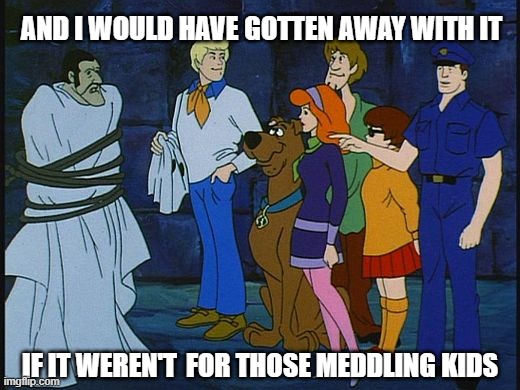
Image: “I would have gotten away with it if it weren’t for those meddling kids.”

Then Came the Internet

The digital age didn’t usher in clarity — it unmasked the whole pantomime.
Like Neo seeing the Matrix code or Roddy Piper slipping on the sunglasses in They Live, one suddenly perceives the circuitry: meaning as glitch, discourse as scaffolding, truth as a shabby stage-set blinking under fluorescent tubes.

Our civilisation speaks in metaphors it mistakes for mechanisms. The Enlightenment gave us the fantasy that language might behave, that concepts were furniture rather than fog. Musicians and artists always knew better. We swim in metaphor; we never expected words to bear weight. But philosophers kept pretending communication was a conveyor belt conveying ‘meaning units’ from A to B.

By 2018, the cracks were gaping. I began taking the notes that would metastasise into A Language Insufficiency Hypothesis – an attempt to map the hollow spaces between our words, the fractures we keep wallpapering with reason.

Half a decade later, the work is ready. Not to save anything – nothing here merits salvation – but to name the debris honestly.

If that sounds negative, good. Someone has to switch off the Enlightenment’s flickering lightbulb before it burns the whole house down.

Where This Road Actually Leads

People imagine negativity is a posture – a sort of philosophical eyeliner, worn for effect. But dismantling the world’s conceptual furniture isn’t a hobby; it’s the only reasonable response once you’ve noticed the screws aren’t actually attached to anything.

The Enlightenment promised us a palace. Step inside and you discover it’s built out of IKEA flatpacks held together with wishful thinking and a prayer to Kant.

Once you’ve seen that, you can’t go back to pretending the furniture is sturdy.

You stop sitting.

You start tapping the beams.

You catalogue the wobble.

This is where Dis–Integrationism enters – not as a manifesto, but as the practice of refusing to live inside collapsing architecture out of sheer politeness. Negativity is simply the weather report.

The Lie We Keep Telling Ourselves

We cling to the fantasy that if we critique something long enough, a solution will crystallise out of the void, like enlightenment through sheer irritation. It’s the Protestant work ethic meets metaphysics: salvation through sufficient grumbling.

But critique is not alchemy. It unmakes. It refuses. It loosens the bolts we pretended were load-bearing.

Once you stop demanding that thought be constructive, you can finally see the world as it is: improvised, rhetorical, and permanently under renovation by people who don’t read the instructions.

The Enlightenment’s heirs keep insisting there must be a blueprint. There isn’t. There never was. We’ve merely been tracing the silhouettes of scaffolding, calling it a cathedral.

And Yet – Here We Still Are

The online age (God help us all) didn’t deepen the crisis; it merely turned the lights on. What Enlightenment rationality hid beneath a tasteful layer of neoclassical varnish, the internet sprayed with fluorescent graffiti.

Turns out, when seven billion people speak at once, meaning doesn’t ’emerge’; it buckles. Our systems weren’t built for this volume of contradiction. Our language wasn’t built for this density of metaphor. Our myths weren’t built for this much empirical evidence against them.

And yet here we are, still demanding coherence from a medium held together by emojis and trauma. If you laugh, it’s only to stop crying. If you critique, it’s only because someone has to keep the fire marshal informed.

The Only Honest Next Step

Having traced the cracks, you’re now in the foyer of the real argument – the one hanging like a neon sign over your entire Anti-Enlightenment project:

Language is insufficient. Agency is a fiction. Objectivity is an etiquette ritual. Democracy is a séance. Progress is a hallucination with better marketing. And yet – life continues. People wake, work, argue, aspire, despair.

Dis-Integrationism isn’t about nihilism; it’s about maintenance. Not repairing the myth, but tending the human who must live among its debris. Not constructing new temples, but learning to see in the half-light once the old gods have gone.

The travelogue becomes a guidebook: Welcome to the ruins. Mind the uneven floor. Here is how we walk without pretending the path is paved.

The Fetish for Solutions

Here is the final indignity of the age: the demand that every critique come bundled with a solution, like some moral warranty card. As if naming the rot weren’t labour enough. As if truth required a customer-service plan.

‘Where is your alternative?’ they ask, clutching Enlightenment logic the way a drowning man clutches a shopping receipt.

But solutions are the real tyranny. They arrive bearing the smile of reason and the posture of progress, and behind both sits the same old imperial instinct: replace ambiguity with order; replace lived complexity with a diagram. A solution is merely a problem wearing a fresh coat of confidence.

Worse, a solution presumes the system is sound, merely in need of adjustment. It imagines the structure holds. It imagines the furniture can be rearranged without collapsing into splinters, and the memory of Kant.

Solutions promise inevitability. They promise teleology. They promise that the mess can be disinfected if only one applies the correct solvent. This is theology masquerading as engineering.

The Violence of the Answer

A solution is a closure – a metaphysical brute force. It slams the window shut so no further interpretation can slip in through the draft. It stabilises the world by amputating everything that wriggles. Answers are how systems defend themselves. They’re the intellectual equivalent of riot police: clean uniforms, straight lines, zero tolerance for nuance.

This is why the world keeps mistaking refusal for chaos. Refusal isn’t chaos. It’s hygiene. It is the simple act of not adding more furniture to a house already bending under its own delusions. When you decline to provide a solution, you aren’t abandoning the world. You’re declining to participate in its coercive optimism.

And So the Travelogue Ends Where It Must

Not in triumph or a bluepirnt, but in composure – the only posture left after the Enlightenment’s glare has dimmed. Negativity isn’t sabotage; it’s sobriety. Dis-Integrationism isn’t cynicism; it’s the refusal to replace one failing mythology with another wearing vegan leather.

A world obsessed with solutions cannot recognise maintenance as wisdom. It can’t tolerate ambiguity without reaching for a hammer. It can’t breathe unless someone somewhere is building a ladder to a future that never arrives.

So no – I won’t provide solutions. I won’t participate in the fantasy that the human condition can be patched with conceptual duct tape. I will not gift the Enlightenment a eulogy that surrenders to its grammar.

What I offer is far smaller and far more honest: Attention. Description. Steady hands in a collapsing house. And the simple dignity of refusing to lie about the architecture.

That, for now, is enough.

Derrida’s Deconstruction Summarised

David Guignion describes Derrida’s Deconstruction in under three minutes.

Video: YouTube short on Derrida’s notion of deconstruction.

The confusion he mentions is why I chose a different term – dis-integration – to describe “deconstructing” communication to discover underlying metanarratives.

I am busy editing my next novel, so that’s all the time I want to allocate to this matter, but David is a trusted resource of mine. Meantime, check out my deconstructed cover image.

Language Insufficiency, Rev 3

I’m edging ever closer to finishing my book on the Language Insufficiency Hypothesis. It’s now in its third pass—a mostly subtractive process of streamlining, consolidating, and hacking away at redundancies. The front matter, of course, demands just as much attention, starting with the Preface.

The opening anecdote—a true yet apocryphal gem—dates back to 2018, which is evidence of just how long I’ve been chewing on this idea. It involves a divorce court judge, a dose of linguistic ambiguity, and my ongoing scepticism about the utility of language in complex, interpretative domains.

At the time, my ex-wife’s lawyer was petitioning the court to restrict me from spending any money outside our marriage. This included a demand for recompense for any funds already spent. I was asked, point-blank: Had I given another woman a gift?

Seeking clarity, I asked the judge to define gift. The response was less than amused—a glare, a sneer, but no definition. Left to my own devices, I answered no, relying on my personal definition: something given with no expectation of return or favour. My reasoning, then as now, stemmed from a deep mistrust of altruism.

The court, however, didn’t share my philosophical detours. The injunction came down: I was not to spend any money outside the marital arrangement. Straightforward? Hardly. At the time, I was also in a rock band and often brought meals for the group. Was buying Chipotle for the band now prohibited?

The judge’s response dripped with disdain. Of course, that wasn’t the intent, they said, but the language of the injunction was deliberately broad—ambiguous enough to cover whatever they deemed inappropriate. The phrase don’t spend money on romantic interests would have sufficed, but clarity seemed to be a liability. Instead, the court opted for what I call the Justice Stewart Doctrine of Legal Ambiguity: I know it when I see it.

Unsurprisingly, the marriage ended. My ex-wife and I, however, remain close; our separation in 2018 was final, but our friendship persists. Discussing my book recently, I mentioned this story, and she told me something new: her lawyer had confided that the judge disliked me, finding me smug.

This little revelation cemented something I’d already suspected: power relations, in the Foucauldian sense, pervade even our most banal disputes. It’s why Foucault makes a cameo in the book alongside Nietzsche, Wittgenstein, Saussure, Derrida, Borges, and even Gödel.

This anecdote is just one straw on the poor camel’s back of my linguistic grievances, a life filled with moments where language’s insufficiency has revealed itself. And yet, I found few others voicing my position. Hence, a book.

I aim to self-publish in early 2025—get it off my chest and into the world. Maybe then I can stop wittering on about it. Or, more likely, I won’t.

Disintegration Street

Riffing on my recent post, I wanted to provide a tab more perspective on my claim that postmodernism serves a purely disintegrative function. Anyone can disintegrate a narrative into constituent parts, but postmodernism provides no grounds for privileged reintegration, as this too can be disintegrated. So, whilst one is free to disintegrate and even to reassemble the parts, one is never in a position to claim that this is how it should be put together because this privileges the subject and another subject can always come along and privilege another perspective. Also, there is no PoMo toolkit available to reassemble the parts that I am aware of.

When I was a child, a neighbour owned and operating a demolition company. He disintegrated buildings. He kept some of the materials and sold some other for scrap. Whilst these materials could be repurposed and used in the construction of another building—or a picnic table—, this was not the function of the demolition company. It’s safe to say that no one was ringing him up under the premise that he had tools, so why won’t he build them a house. He knows houses, right?

This is the same problem we face when deconstructing a narrative with postmodern tools. If we want to construct something, we can, but we should expect that no matter what we do, the next wave can readily knock it down. And though we can rebuild more castles made of sand, they are all subject to the same forces.


* I admit that this title was lent from The Cure’s Fascination Street, which does happen to be on their album Disintegration.

The Cure – Fascination Street video

Discovering Postmodernism

12–18 minutes

Postmodernism seems to have as many definitions as the number of people who encounter it, and that’s just not very useful. It’s less useful still when people with ulterior motives control the narrative. I’d like to take back the narrative and offer a succinct definition or description and offer reasons why some of the competing definitions are fundamentally incorrect. My journey commenced on my Descriptive Postmodernism post.

Each year, I start with a new notion to explore. For 2021, it’s postmodernism. I identify as practicing postmodernist, but it seems to have a nebulous definition, and many people assume it means different things. Some definitions seem to comport and others are curious takes. I am well-aware that some people in this space have opinions at least as strong as mine, and many have deeper and/or broader exposure than I do. Nonetheless, I feel confident that my logic will resonate.

Audio: NotebookLM podcast conversation about this content

As I pursue this definition, I will explore a line of inquiry that I hope will help to frame the issue.

These are my initial questions:

  1. What is the core definition of postmodernism?
  2. Why hate postmoderns?
  3. Why can’t postmodernism be constructive?
  4. Why do postmoderns deny Truth?
  5. When did postmodernism, a critical, dis-integrative concept become identified as being integrative?
  6. How does one parse the theory of postmodernism from the personality who espouses a perspective on it?

Postmodernism can be viewed as a reaction to so-called modernism, but it’s not so cut and dry. Postmodernism as an intellectual pursuit was in full force in the 1970s and 80s. But Modernism was still the main thrust, as is remains today. Post- is likely an overstatement, as it did not supersede. In comparison, post-Enlightenment thought—reason and logic—still competes with pre-Enlightenment thinking—metaphysical and superstition—, but even persons holding post-Enlightenment views still cling to traditional beliefs. Contrarily, people holding modern beliefs are not likely to simultaneously hold postmodern beliefs and vice versa. For moderns, postmodernism is a hot button, trigger item. For this cohort, any association will set them off.

What is the core definition of postmodernism?

From early on, postmodernism has been used as a pejorative term by its detractors. Many academics associated to postmodernism do not identify as postmoderns. They have been categorised as such, as something they have said or written is heretical to the Modern orthodoxy.

These days—if not from the start—postmodernism is nebulous. It has long since lost its brand to detractors, and its definition is undergoing some revisionist history by this cohort. What started as a perspective or lens to disintegrate content and context is now seen by many as possessing a point of view for constructing, for building.

The Condition of Postmodernity
Before defining philosophical postmodernism, let’s first exclude a possible source of confusion: postmodernity. Postmodernity is a periodical distinction, a cultural state where it occurs chronologically subsequent to the period referenced as Modernity.

Postmodernity is a condition or a state of being associated with changes to institutions and conditions and with social and political results and innovations, globally but especially in the West since the 1960s, whereas postmodernism is an aesthetic, literary, political or social philosophy, the cultural and intellectual phenomenon, especially since the 1920’s new movements in the arts and literature.

To be fair, the philosophy of postmodernism is a reaction to the philosophy of Modernism, but there was a diversion of the periodic reference from the philosophical. If we adopt this definition, the only requirement for inclusion is to have been active in this period. Since Feminism and Marxism were coincidentally prevalent phenomena, it would be easy to include these by virtue of chronology, but it doesn’t follow that these fall into the philosophical notion of postmodernism. It may be a simple matter of the ambiguity of language.

Some social theorists and sociologists—Scott Lash, Ulrich Beck, Zygmunt Bauman, and Anthony Giddens—deny that there is a postmodern condition. Instead, they suggest that modernity has simply extended into a state of late or liquid modernity.

Simplifying to the extreme, I define postmodern as incredulity toward meta-narratives.

Jean-Francois Lyotard

To establish a grounding and because he got there first, let’s see how Lyotard defines it in the introduction to his Postmodern Condition:

Simplifying to the extreme, I define postmodern as incredulity toward meta-narratives. This incredulity is undoubtedly a product of progress in the sciences: but that progress in turn presupposes it. To the obsolescence of the metanarrative apparatus of legitimation corresponds, most notably, the crisis of metaphysical philosophy and of the university institution which in the past relied on it. The narrative function is losing its functors, its great hero, its great dangers, its great voyages, its great goal. It is being dispersed in clouds of narrative language elements – narrative, but also denotative, prescriptive, descriptive, and so on. Conveyed within each cloud are pragmatic valencies specific to its kind. Each of us lives at the intersection of many of these. However, we do not necessarily establish stable language combinations, and the properties of the ones we do establish are not necessarily communicable.

The simple definition is captured by the first sentence. The rest is exposition. But let’s rewind for a bit and establish a frame. Admittedly, even at the start this is ‘simplifying to the extreme‘. Moreover, the context is relative to hard sciences. Lyotard admits he was over his head. In fact, he later referred to the book as his worst. But books have lives of their own, a sentiment with which Barthes might agree.

The central point here is to question metanarratives. Period. Full stop. The next task is to ask how a postmodern might accomplish this task and what might be their perspectives and tools?

In Reclaiming a Scientific Anthropology, Lawrence Kuznar claimed that « the primary tenets of the postmodern movement include: (1) an elevation of text and language as the fundamental phenomena of existence, (2) the application of literary analysis to all phenomena, (3) a questioning of reality and representation, (4) a critique of metanarratives, (5) an argument against method and evaluation, (6) a focus upon power relations and hegemony,  and (7) a general critique of Western institutions and knowledge. » [See end note 1]

Postmodernism is a disintegrative system. It disassembles, deconstructs, atomises, and lays bare. It is suspicious of underlying metanarratives—and I’d be willing to argue that it is equally suspicious of stated narratives as well. It questions who is served by a given narrative, who gains and loses power by one interpretation over another.

[tools and systems]

In the end, a reader may disagree with what I am proposing here, and the reader may even be correct in claiming that my definition is too reductive. Perhaps, I should abandon the postmodern label and simply recast my definition as Disintegrationism or some such. Deconstruction is already taken, so why not?

Why hate postmoderns?

One problem I notice is that postmodernism, long being applied as a pejorative term in a similar vein to the use of SJW, is a way to discredit personalities and ideologies they disagree with. We see entire ideologies being besmirched as postmodern theories. We might see Stephen Hicks misrepresent postmodernism and conflate feminism with it. Moderns are by nature traditionalists or conventionalists, so whether postmodernism, feminism, Marxism, and the like, these are unconventional. It may be a simple heuristic trick to paint all of these with a broad brush. Nuance and difference be damned. [See end note 2] Jordan Peterson‘s bete noir is cultural Marxism, that he insists is part of the blight of postmodernist thought.

Many have attempted to conflate social theories with postmodernism, whether Marxism, feminism, identity politics, and so on. But this is inherently wrong. Lyotard provided postmodernism with its original definition in his book, but detractors have been annexing other unpopular concepts to it in order to create a sort of critical mass for the uncritical opposition.

Why can’t postmodernism be constructive?

Postmodernism necessarily can’t be constructive, because after one disintegrates a perspective into its primitive elements, any reconstruction needs another narrative to serve as a foundation. It is true that one may reconstitute a disintegrated narrative through a different lens, as cited above Marxist, and so on, but all this does is to shift perspective, point of view, and creates a new power play.

There is nothing wrong with this approach, but neither is there a reason to privilege this interpretation over the original or some other. A Marxist perspective may resonate better with Marxists, and Feminist perspective with Feminists, but this doesn’t make the interpretation better or more generally applicable. It just brings it into clearer focus for that cohort. As near-sighted lenses help the hyperopic and far-sighted lens aid the myopic, neither is inherently better outside of the defined context. And each solution would create a distortion for a person neither near- or far-sighted. There is no lens that is all things to all people.

On balance, I think it’s fair to say that postmodernism is descriptive and not prescriptive, so whilst one can play at disintegrating and reintegrating, but this is simply to gain a new perspective and new insights. In literature, we might consider, say, Philip K Dick’s, The Man in the High Castle. In this, Dick explores what might have been if the Axis led by Nazi Germany had prevailed. This alternate historical rendering can be evaluated as a postmodern exercise. Dick is not promoting this outcome, he is merely playing what-if—reordering the actors to create speculative new narratives. Although the Amazon.com version takes liberties and injects additional narrative perspective, the reintegration is still evident.

As well, postmodernism cannot be constructive because it would be infinitely recursive. For each construction, there would exist a deconstruction. All that’s occurred is a rearrangement. From the same Lego pieces, we apply a new map—a new narrative. From the position of purpose, one construction may be deemed better or preferred, but this is not likely to persist from another.

Disintegration – Reintegration Cycle

Whilst I am more interested in the philosophical, postmodernism has much application to literature. This might be better defined as poststructuralism.

Why do postmoderns deny Truth?

Some people have argued that postmodern thinkers don’t believe in the notion of Truth.

There are a few things to clarify first: the definition of truth and the context of a truth claim.

There are different and competing theories on what truth is—whether correspondence, coherence, or some other version—but that’s beyond the scope of this content. Some people use ‘truth’ as a synonym for ‘fact’, but in the name of clarity, we should separate the two concepts even if idiomatically the terms can be used interchangeably. [See end note 3] In creating this bond, it’s easy to see how these people might be confused. Virtually no one is proposing that ‘facts’ are not ‘facts’. It may be that postmodernism should have a weak and a strong version.

If the colour red is defined as the reflection by an object having a wavelength between 625 and 700 nanometres and a corresponding frequency between 400 and 480 THz, and a ball as a 3-dimensional object where every point on the surface is the same distance from the centre, and all of the incumbent terms are similarly defined and accepted with concordant definitions, then a sighted person with no colour vision perception deficiencies in an environment with natural full-spectrum lighting, will agree with the fact that the sphere is red. If one prefers to label the correspondence of a red sphere and the perception of the red ball as true, then this trivial relationship is valid.

2-dimensional render of a 3-dimensional red sphere

It may be a correct assessment that some thinkers deny all truth, but it’s more likely that these thinkers are suspicious of the person claiming to know the truth because of the relationship between truth claims and power. Although Lyotard’s commentary was directed at hard science and underlying metanarratives such as progress, most postmoderns are more concerned with claims of moral truths.

This is related to the context of a claim. Per Foucault, if one context gives me power, I am more apt to adopt that perspective in order to manifest that power. I am not going to delve into some political discourse at the moment. Apart from this, Truth—where synonymous with fact—is contextual.

Using a typical example, one can evaluate the moral claim that killing another human is immoral. In fact, many—not all—people may agree with this as a general principle. But when we apply context—say, self-defence, military action, or capital punishment—, we discover that some of the same people now evaluate that killing another human is moral. So, we arrive that this moral assessment is subject to be either true or false depending on the context it’s evaluated in. Myself, being a non-cognitivist, I find moral claims to be lacking truth aptness, but that’s another story.

When did Postmodernism become a constructive rather than decompositional philosophy?

I’ll reserve the option to finish this section later. A quick internet search finds that David Ray Griffin coined the term constructive postmodernism. Griffin appears to have an agenda to return to modernism, particularly, it seems at first glance, Pragmatism.

My initial thought is that it was not thinkers fully invested in postmodernism; rather it was people with ulterior motives. Infusing Christian elements appear to be the most common thread. This line of thought is entirely speculative, so please stand by for an update or retraction. Metamodernism appears to have similar attributes, though perhaps simply metaphysical rather than Christian in nature.

How does one parse the theory of postmodernism from the personality who espouses a perspective on it?

Many people identified as postmoderns don’t self-identify as such. Kuznar labels postmodern anyone whose thinking includes most or all of these elements, but there is a compositional challenge inherent in this claim.

There are several compositional problems. First, one can apply postmodernism to a narrow domain and operate fully as a modern in the rest—perhaps even the majority of situations. Second, one can apply a postmodern lens theoretically, but be more pragmatic in more mundane matters. Third, one might apply a postmodern lens among many lenses, defending each in turn. Fourth, one may have had strong postmodern tendencies at one point in life but not held this perspective at other points.

Taking Foucault as an example—as well as one who eschewed the postmodern label—, he did disintegrate history and did question the underlying narratives, hitting all of Kuznar’s touchpoints. For one, I would categorise him as a postmodern thinker. Moreover, his disintegration led to the discovery of a common power thread throughout. Much of his writing was focused on this power relationship and illustrated how it was manifest.

Foucault was also a vocal Marxist. This is a constructive (integrative) worldview. This perspective gives privilege to Marxism, which is antithetical to postmodernism. As a rational interpreter, Foucault determined that this was a better form of government—but clearly, that’s because he accepted the underlying narrative and historicity proposed by Marx. Does this invalidate his postmodern credentials? Do we revoke his PoMo card?

Disclaimer

Excuse me for occasionally using this space as a scratchpad, but it serves the purpose well. I’ve never delved deeply in to critical theory, though I suppose I suppose that at least some of it resonates with me.

Note that I approach this as a stream of consciousness. It’s not meant to be a robust academic treatment. Although, I do cite source documents in some cases, many of my points are anecdotal or pulled from memory, understanding fallibility and so on. I expect to return to flesh out some details, but I figure I’ll publish my thoughts now and make updates in future. I may even correct spelling, grammar, and redundancies.

My goal at the start was two-fold (at least). First, is to describe the domains of postmodernism from the perspective of a proponent (as opposed to accepting a definition imposed by detractors). Second, is to assess where critical disintegration diverged to an integration theory. It’s obvious that you hold that deconstruction and discourse analysis fall within the domain. They are certainly orthodox post-structural concepts, so I suppose a third goal might be to define the boundaries of poststructuralism relative to postmodernism.


Endnotes

[1] Postmodernism and Its Critics, Daniel Salberg, et al.

[2] This modern cohort has a similar tendency to paint any form of Socialism as Communism, and they see the Soviet Union’s failed experiment of whatever they attempted to do as Communism. Therefore all forms of Socialism are destined to fail. The failure to appreciate nuance and detail is the common thread. I might posit that it’s similar to the phenomenon where, on average, women tend to perceive more colours (or colour names) than men.

[3] Aping logical empiricism, idiomatic language allows for broader definitions of truth and allows it to be synonymous with fact. This is similar to the idiomatic similarity of sex and gender, though this distinction is necessary for technical and academic discussion.

Descriptive Postmodernism

I can’t count the number of times I’ve defended Postmodernism (PoMo) from attack, so I am publishing this, so I can link to it. Perhaps I am not defending PoMo, but my flavour of it, but I’ve read a lot of work published by the usual suspects—some who eschew being lumped into a poorly defined category—or at least a nebulous category.

Before I get too far, I also want to remind the reader to take care to separate the philosophy from the person. One popular attack is the conflating of identity politics and social justice advocacy as PoMo phenomena. In fact, I consider myself to be PoMO—to be defined here in a moment—and a social justice warrior (SJW), this despite contesting the very notion of identity to begin with.

By definition, a summary is a reduction of some thing, but one needs to be careful not not arrive at reductio ad absurdum. Where appropriate, one may also wish to differentiate postmodernism with postructuralism. So as not to create a definition partir de rien, I’ll reference other accessible versions. A critic may disagree with these definitions, but they will serve as the foundation of my position and vantage.

Wikipedia gives us this definition (their reference links retained):

Postmodernism is generally defined by an attitude of scepticismirony, or rejection toward what it describes as the grand narratives and ideologies associated with modernism, often criticizing Enlightenment rationality and focusing on the role of ideology in maintaining political or economic power. 

https://en.wikipedia.org/wiki/Postmodernism

The Stanford Encyclopedia of Philosophy gives us this

That postmodernism is indefinable is a truism. However, it can be described as a set of critical, strategic and rhetorical practices employing concepts such as difference, repetition, the trace, the simulacrum, and hyperreality to destabilize other concepts such as presence, identity, historical progress, epistemic certainty, and the univocity of meaning.

https://plato.stanford.edu/entries/postmodernism/

Notice the commonalities. PoMo is a descriptive, critical activity. It’s descriptive. As language and grammar can be approached descriptively of prescriptively, so can philosophy. Some ‘schools’ do both. PoMo is exclusively descriptive. PoMo was born as a reaction to Modernism, especially the unstated foundations labelled by Lyotard as metanarratives—the grand narratives and underlying ideologies of prevailing beliefs that were uncritically taken for granted, many of which that were formed or catalysed in the Age of Enlightenment.

Jean-François Lyotard defined philosophical postmodernism in The Postmodern Condition, writing “Simplifying to the extreme, I define postmodern as incredulity towards meta narratives….”[4] where what he means by metanarrative is something like a unified, complete, universal, and epistemically certain story about everything that is. Postmodernists reject metanarratives because they reject the concept of truth that metanarratives presuppose. Postmodernist philosophers in general argue that truth is always contingent on historical and social context rather than being absolute and universal and that truth is always partial and “at issue” rather than being complete and certain.[3]

https://en.wikipedia.org/wiki/Postmodern_philosophy

My defence is that PoMo cannot be for social justice or engage in identity, as it has no positive position on these. It functions to critically deconstruct. People unfamiliar with PoMo concepts often misunderstand this notion of deconstruction. All to often, I see people criticise Derrida for his brand of Deconstruction, but that only illustrates the fact that they never read or simply misunderstand what Derrida means by Deconstruction. Perhaps, I’ll elaborate on that in future.

My point is that PoMo is corrosive—like lye. It eats away at ideologies, dissolves them. It is not meant to construct anything. So where does this constructive expectation come from? It derives primarily from two places.

Modernism

Most people casting dispersion are modernists. They need to construct things. To be fair, this perspective has been an evolutionary advantage, but some people can’t allow a bunch of Lego pieces to remain unconstructed. This is fine, but you need another tool to perform this task. It’s not PoMo.

Ad Hominem

The other challenge is the inability to distinguish between the person and the idea. Michel Foucault was very vocal in the political realm and actively promoted Marxism, but, firstly, Foucault was not a self-professed PoMo—and for several reasons, one could come to accord with his assessment; secondly, in his deconstruction of history, he discovered a foundational component—this activity being squarely PoMo—, but he reconstructed historical narratives employing the lens of power. This rebuilding is not PoMo activity.

Parting Shot

Besides—or in addition to—ignorance, some people have an agenda, and they play ad hominem games, so if they can vilify a person and associate that person to an ideology, it can have the tendency of poisoning the well. Uncritical people won’t even notice the sleight of hand and redirect.

never attribute to malice that which is adequately explained by ignorance*

Hanlon’s Razor

A textbook example is Stephen Hick’s attempt in Explaining Postmodernism: Skepticism and Socialism from Rousseau to Foucault to conflate feminism (a positive mechanism) with postmodernism (to reiterate, a negative mechanism). In it he claims that feminists Andrea Dworkin and Catherine Mckinnon are proponents of PoMo thought, but he is apparently unaware that McKinnon has explicitly attacked PoMo as destructive to feminism. A fuller critique of Hicks‘ work can be heard on YouTube. I recommend it highly if you have the better part of an hour to spare. Jordan B Peterson is a celebrity personality whose primary exposure to PoMo is Hicks, so when you understand how off-base Hicks is, you’ll realise why Peterson is so off-base, too.


* Hanlon’s razor is originally cast as “never attribute to malice that which is adequately explained by stupidity“, but I prefer the term ignorance, as it it less value-laden and more broadly applicable. Besides, to be ignorant does not mean to be stupid. Many ignorant people are not stupid. I am ignorant of the Russian language, but I am not stupid.

Fables of the Deconstruction

To some extent or another, humans appear to need order—some more than others. Societies are a manifestation of order, and we’ve got subcultures for those who don’t fit in with the mainstream. Humans are also a story-telling lot, which helps to provide a sense of order. Metanarratives are a sort of origin story with a scintilla of aspiration toward some imagined semblance of progress.

Some people appear to be more predisposed to need to ride this metanarrative as a lifeboat. These people are typically Conservative, authority-bound traditionalists, but even the so-called Progressives need this thread of identity. The problem seems to come down to a sort of tolerance versus intolerance split, a split along the same divide as created by monotheism in the presence of polytheism.

Meet the new boss, same as the old boss.

Won’t Get Fooled Again — The Who

In a polytheistic world, when two cultures collided, their religious pantheons were simply merged. In a blink, a society might go from 70 gods to 130. On this basis, there was a certain tolerance. Monotheism, on the other hand, is intolerant—a winner takes all death match. The tolerant polytheists might say, sure, you’ve got a god? Great. He can sit over there by the elephant dude. Being intolerant like a petulant schoolboy, the monotheists would throw a tantrum at the thought that there might be other gods on the block. Monotheists won’t even allow demigods, though there is the odd saint or two.

This is a battle between absolutism and relativism. The relativist is always in a weaker arguing position because intolerant absolutists are convinced that their way is the only way, yet the tolerant relativists are always at risk of being marginalised. This is what Karl Popper was addressing with the Paradox of Tolerance.

In a functioning society, a majority of the metanarratives are adopted by the majority of its constituent. On balance, these metanarratives are somewhat inviolable and more so by the inclined authoritarians.

A problem is created when a person or group disagrees with the held views. The ones espousing these views—especially the Traditionals—become indignant. What do you mean there are more than two genders? You are either male or female. Can’t you tell by the penis?

I happened to read a tweet by the GOP declaring their stupidity:

America the Stupid

The Vice President, a living anachronism and proxy for the American Midwest Rust Belt superimposed on the Bible Belt, he tells his sheep that “The moment America becomes a socialist country is the moment that America ceases to be America…” Americans as a whole are pretty dim, and it seems to get dimmer the higher one ascends their government. Pence seems very firm in affirming a notion of American identity, but not accepting that identities change. He may become upset if he finds out that George Washington is dead—in fact, there are very few remnants of the original United States aside from some dirt, trees, and a few edifices—and the country is still the county. Some people have a difficult time grasping identity. It makes me wonder if he fails to recognise himself in the mirror after he gets his hair cut.

The idea behind deconstruction is to deconstruct the workings of strong nation-states with powerful immigration policies, to deconstruct the rhetoric of nationalism, the politics of place, the metaphysics of native land and native tongue… The idea is to disarm the bombs… of identity that nation-states build to defend themselves against the stranger, against Jews and Arabs and immigrants…

Jacques Derrida

Interesting to me is how people complain about this and that politically. Most of this is somewhat reflexive and as phatic as a ‘how are you?’, but some is more intentional and actioned. Occasionally, the energy is kinetic instead of potential, but the result is always the same: One power structure is replaced by another.

What you aspire to as revolutionaries is a new master. You will get one

Jacques Lacan

As Lacan noted, as people, we believe ourselves to be democratic, but most of us appear to be finding and then worshipping some authority figures who will promise us what we desire. We desire to have someone else in charge, who can make everything OK, someone who is in a sense an ideal parent. I don’t believe this to be categorical, but I do believe that there is a large contingent of people who require this.

As an aside, I’ve spent a lot of time (let’s call it a social experiment) in the company of social reprobates. What never ceases to amaze me is how these social outcasts seem to have a strong sense of right and wrong and how things should be. Conveniently, they exempt themselves from this scope, so if they steel to buy drugs, it’s OK, but if someone else gets caught, they should get what’s coming to them.

About a year ago I was chatting with a mate, and I shared an observation that the biggest substance abusers in high school—”the Man’s not going hold me down” cohort—are the biggest conservatives. A girl a few houses down from me became a stripper, but her political views are very Conservative, an avid Trump supporter.

One woman I know is a herion-addicted prostitute. In her eyes, she’s fine (sort of—without getting into psychoanalytics); other women are junkie whores. A heavy dose of assuaged cognitive dissonance is the prescription for this, but it confounds me.

Getting back to the original topic, people who need this order are resistant to deconstruction and other hallmark notions of poststructuralism. They need closure. This translates into a need for metanarratives. When confronted with the prospect of no Truth, they immediately need to find a substitute—speculatively, anyway, as denial and escalating commitment will kick into overdrive.

The same problem mentioned above comes into play here. A few years ago, there was an Occupy Wall Street group, and like atheists, there are myriad reasons why people participated. One of the commonest complaints by the power structure and the public at large is if you don’t like the status quo, what status should replace it. None of the above was never an acceptable response.

It doesn’t matter that in this universe we occupy there is more disorder than order, and entropy rules, pareidolia is the palliative. And religion remains an opiate of the masses.


Please ignore my clear misappropriate of the classic R.E.M. album.