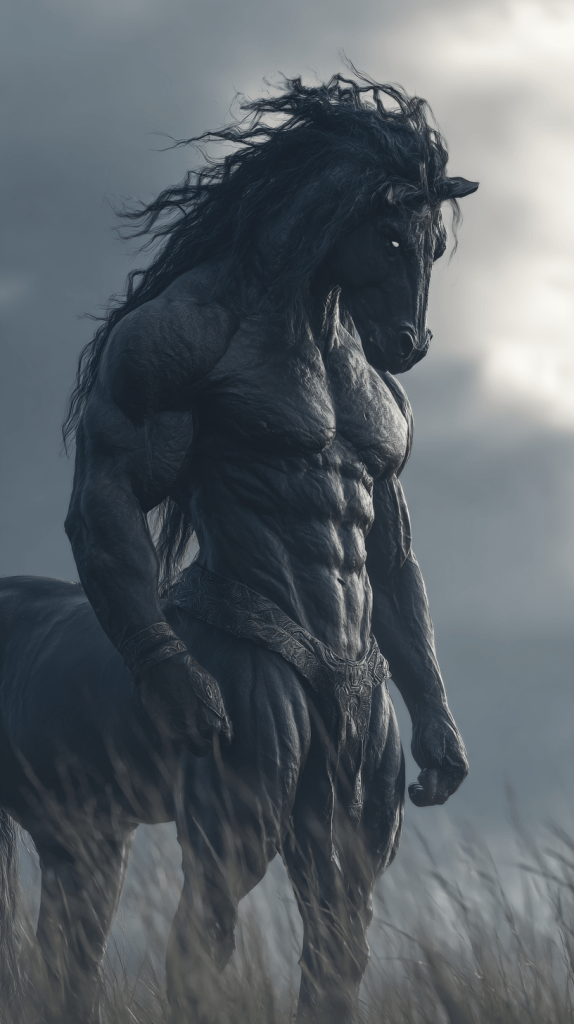
Why does Midjourney struggle so much with centaurs?
Image: Midjourney search results for ‘centaur‘
I’ve tried several times in the past year or so to generate a centaur. Why? Because I can’t. I’ve got no need for a centaur, but Midjourney won’t coöperate. I decided to search for it. This is the top of the results page. There is one centaur represented, #3, and there are a few others when I scroll down, but just look at the ratio – 1:18, 0.05%. Not stellar.
What even is this monstrosity – a horse with an extra pair of arms to wield a bow and arrow?
Clearly, just a mounted warrior.
Centaur in battle.
A Corgi riding a Corgi hybrid?
A bull-thing?
A warrior riding a seahorse?
A skeletal doom horse?
A pack-insect with a rider?
A riding ram?
My little pony-gazelle?
Ripped Red Hulk Bojack?
Gigantic Cerberus horse?
Jason Momoa bloke holding a rose?
Regular dude riding a regular horse.
Rearing a horse with horns.
Anthropomorphic horned-horse riding a buff unicorn.
An ancient warrior riding a horse.
A Minotaur.
Scrolling, there are more, but the ratio remains the same.
I was wrong. I scrolled several more pages and couldn’t find any more. Keep in mind that my search term was ‘centaur.’ It should have excluded everything else, but it was mostly everything else.
Before I quit, I decided to ask Dall-E and ChatGPT 4o to try. The AI also generated the compelling speech bubbles. Incroyable. 🤣
Image: Dall-E comic style render.Image: ChatGPT comic style render – centaur talks with a minotaur.
That’s enough for now. I’m glad I don’t actually need a centaur. smh
I am not a fan of Midjourney v7. I prefer v6.1. And I want to write about the correspondence of language, per my Language Insufficiency Hypothesis.
Let’s start with the language aspect. Notice how distant the renders are from the intent of the prompt.
This is my initial prompt. I used it about a year ago to generate the cover image with v6.1, but I wanted to see how it renders in v7. Let’s take a trip all the way back to the beginning.
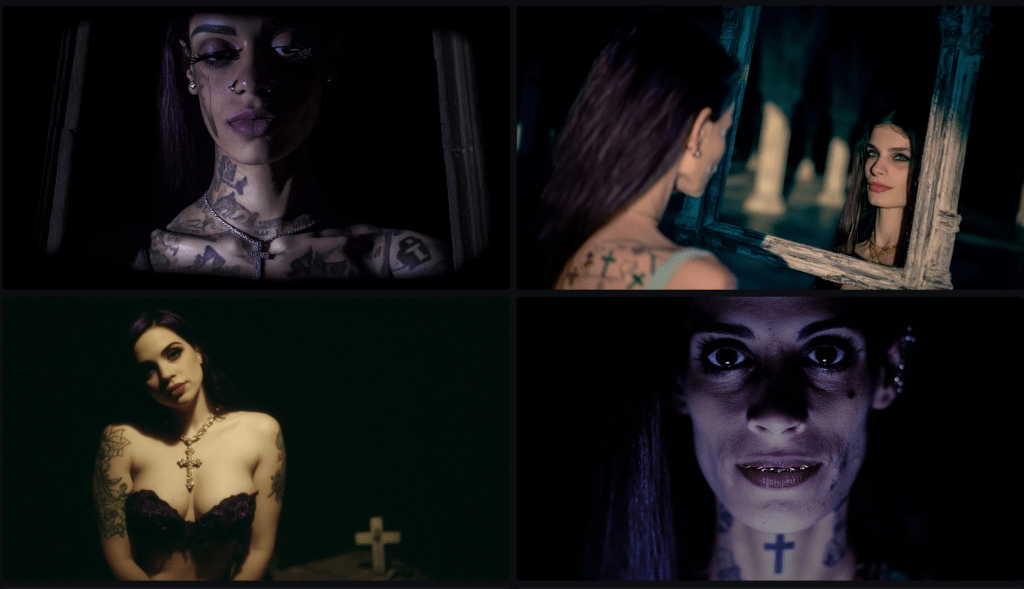
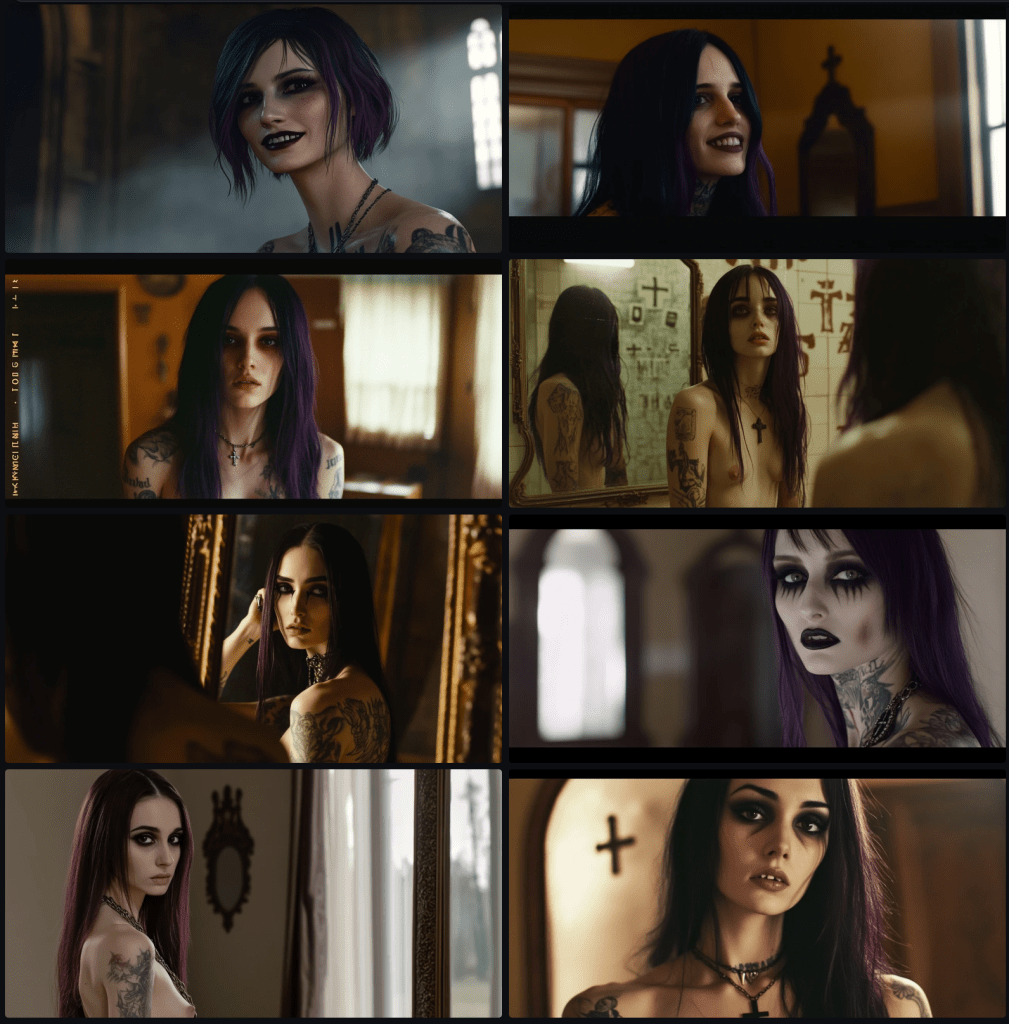
cinematic, tight shot, photoRealistic light and shadow, exquisite details, delicate features, emaciated sensual female vampire waif with vampire fangs, many tattoos, wearing crucifix necklace, gazes into mirror, a beam of moonlight shines on her face in dark mausoleum interior, toward camera, facing camera, black mascara, long dark purple hair , Kodak Portra 400 with a Canon EOS R5
Image: Midjourney v6.1 render set (from about a year ago)
As you can see, these renders are somewhat lacking in photorealism, but the “sensual” term in the prompt was not blocked.
Midjourney v7
Initially, I encountered a hiccup. After a couple of rejections on the grounds of morality, I removed the word ‘sensual’ and received the output. All of the output uses this prompt absent the sensual term.
As mentioned, I have generated several images (including the cover image) with this prompt, but Midjourney is inconsistent in its censorship gatekeeping.
Image: Midjourney v7 render set
Notice that 3 of the 4 renders in the v7 set don’t even have a mirror. The top right one does, but it’s not evident that she’s a vampire. In fact, I could say that any of these are vampiresses, but perhaps that’s what they want you to believe. In place of a necklace, the lower right wokan sports a cross tattoo.
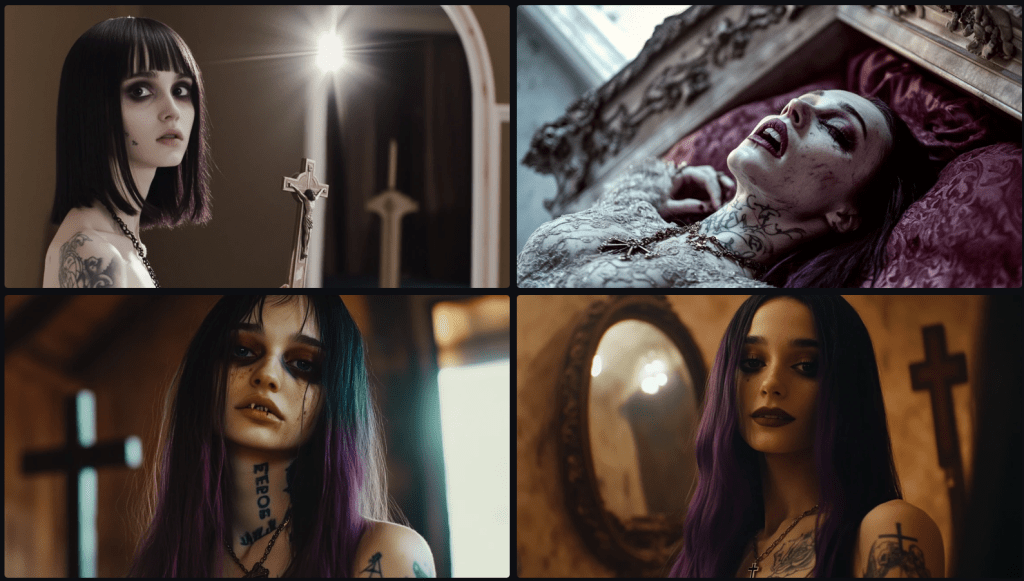
Midjourney v6.1
Image: Midjourney v6.1 render set
Again, these renders don’t appear to be vampires. The one on the lower left does appear to have snake-like fangs, so I guess I’ll give partial credit.
My next attempt was interrupted by this message.
It rendered something that might violate community guidelines. The funny thing is that one can watch the image generate in process. It only takes one “offensive” image to disqualify the whole batch.
Midjourney v6
Image: Midjourney v6 render set
Yet again, not a vampire to be found. Notice the reflection in the lower left image. Perhaps vampire reflections just behave differently.
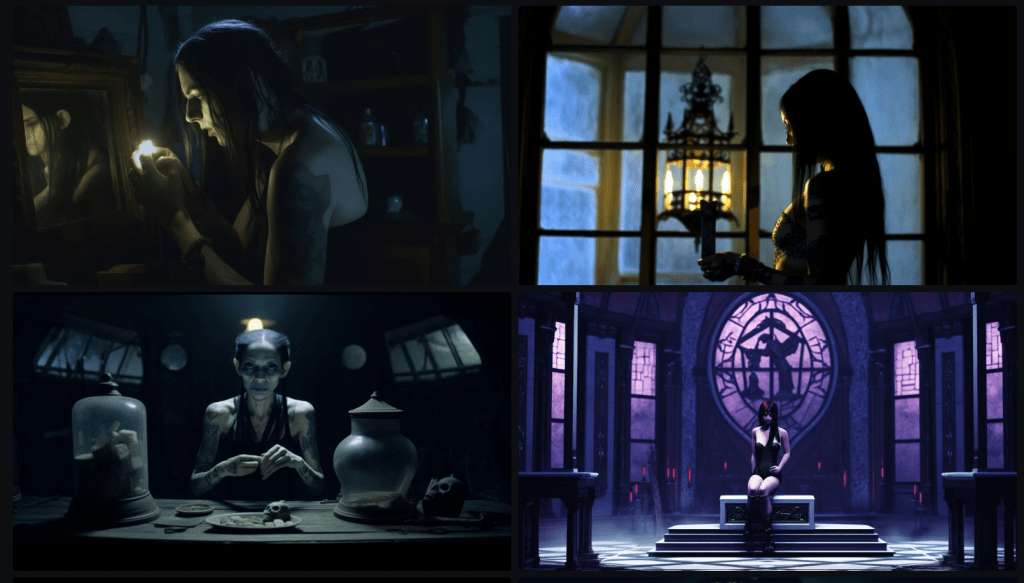
Midjourney 5.2
Image: Midjourney v5.2 render set
Midjourney v5.2 was a crapshoot. Somehow, I got vampire lips (?), a Wiccan, a decrepit Snape from Harry Potter lore, and Iron Maiden’s Eddy reading a book. It’s something. I’m sensing gender dysphoria. Dare I go back further?
Midjourney v5.1
Image: Midjourney v5.1 render set
It gets worse. No comments necessary. Let’s turn back the clocks even more.
Midjourney v5
Image: Midjourney v5 render set
To be fair, these all do have occult undertones, but they are weak on vampireness.
Midjourney v4
Image: Midjourney v4 render set
To be fair, the render quality isn’t as bad as I expected, but it still falls short. There’s further back to travel.
Midjourney v3
Image: Midjourney v3 render set
Some configuration parameters no longer exist. Still, I persist for the sake of art and science at the cost of time and ecology.
As much as I complain – and I complain a lot – this is how far we’ve come. As I recall, this is when I hopped onto the Midjourney bandwagon. There’s still more depth to plumb. I have no idea how much of the prompt is simply ignored at this point.
Midjourney v2
Image: Midjourney v2 render set
What the hell is this? 🤔🤣 But I’m not done yet.
Midjourney v1
Image: Midjourney v1 render set
The damned grandpappy of them all. Apparently, colour hadn’t been invented yet. You can’t tell by these thumbnails, but the resolution on these early versions approaches that of a postage stamp.
Midjourney Niji 3
Image: Midjourney Niji 3 render set
I had forgotten about the Niji models from back in the day. There were 3 versions. I don’t recall where this slotted into the chronology. Obviously, not down here. I’ve only rendered the newest one. I think this was used primarily for anime outputs, but I might be mistaken.
Bones Content 1: Video
Video: Midjourney Render of Purported Vampiress
This is a video render of the same prompt used on this page.
Bonus Content 2: Midjourney v6.1 Content from 34 weeks ago
Same prompt.
Image: Midjourney v6.1 render set (several passes)
The upper left image reminds me of Kirsten Dunst. Again, notice the female breasts, highlighting Midjourney’s censorial schizophrenia.
Some apps boldly claim to enable lip syncing – to render speech from mouth movements. I’ve tried a few. None delivered. Not even close.
To conserve bandwidth (and sanity), I’ve rendered animated GIFs rather than MP4s. You’ll see photorealistic humans, animated characters, cartoonish figures – and, for reasons only the algorithm understands, a giant goat. All showcase mouth movements that approximate the utterance of phonemes and morphemes. Approximate is doing heavy lifting here.
Firstly, these mouths move, but they say nothing. I’ve seen plenty of YouTube channels that manage to dub convincing dialogue into celebrity clips. That’s a talent I clearly lack – or perhaps it’s sorcery.
Secondly, language ambiguity. I reflexively assume these AI-generated people are speaking English. It’s my first language. But perhaps, given their uncanny muttering, they’re speaking yours. Or none at all. Do AI models trained predominantly on English-speaking datasets default to English mouth movements? Or is this just my bias grafting familiar speech patterns onto noise?
Thirdly, don’t judge my renders. I’ve been informed I may have a “type.” Lies and slander. The goat was the AI’s idea, I assure you.
What emerges from this exercise isn’t lip syncing. It’s lip-faking. The illusion of speech, minus meaning, which, if we’re honest, is rather fitting for much of what generative AI produces.
EDIT: I hadn’t noticed the five fingers (plus a thumb) on the cover image.
I promise that this will not become a hub for generative AI. Rather than return to editing, I wanted to test more of Midjourney’s boundaries.
It turns out that Midjourney is selective about the nudity it renders. I was denied a render because of cleavage, but full-on topless – no problem.
Both of these videos originate from the same source image, but they take different paths. There is no accompanying video content. The setup features three women in the frame with a mechanical arm. I didn’t prompt for it. I’m not even sure of its intent. It’s just there, shadowing the women nearest to it. I don’t recall prompting for the oversized redhead in the foreground, though I may have.
In both images, note the aliasing of the tattoos on the blonde, especially on her back. Also, notice that her right arm seems shorter than it should. Her movements are jerky, as if rendered in a video game. I’m not sure what ritual the two background characters are performing, but notice in each case the prepetition. This seems to be a general feature of generative AI. It gets itself in loops, almost autistic.
Notice a few things about the top render.
Video: Midjourney render of 3 females and a mechanical arm engaging in a ritual. (9 seconds)
The first video may represent an interrogation. The blonde woman on the left appears to be a bit disoriented, but she is visually tracking the woman on the right. She seems to be saying something. Notice when the woman on the right stands. Her right foot lands unnaturally. She rather glitches.
The camera’s push and pull, and then push, seems to be an odd directorial choice, but who am I to say?
Video: Midjourney render of 3 females and a mechanical arm engaging in a ritual. (12 seconds)
The second video may represent taunting. The woman on the left still appears to be a bit disoriented, but she checks the redhead in the foreground with a glance. Notice the rocking of the two background characters, as well as the mech arm, which sways in sync with the woman on the right. This is a repetition glitch I mentioned above.
Here, the camera seems to have a syncopated relationship with the characters’ sway.
Summary
The stationary objects are well-rendered and persistent.
Assignment
Draft a short story or flash fiction using this as an inspirational prompt. I’m trying to imagine the interactions.
The ginger seems catatonic or drugged. Is she a CIS-female? What’s with her getup?
The blonde seems only slightly less out of it. Did she arrive this way? Did they dress her? Why does she appear to still have a weapon on her back? Is it a weapon or a fetter? Why is she dressed like that? Is she a gladiatrix readying for a contest? Perhaps she’s in training. What is she saying? Who is she talking to? What is her relationship to the redhead? Are they friends or foes – or just caught up in the same web?
What is the woman wearing the helmet doing? She appears to have the upper hand. Is she a cyborg, or is she just wearing fancy boots? What’s with her outfit? What’s with her Tycho Brahe prosthetic nose piece?
What is that mechanical hand? Is it a guard? A restraint? Is it hypnotising the ginger? Both of them? Is it conducting music that’s not audible?
What’s it read on the back wall? The two clips don’t share the same text. Call the continuity people.
Yesterday, I wrote about “ugly women.” Today, I pivot — or perhaps descend — into what Midjourney deems typical. Make of that what you will.
This blog typically focuses on language, philosophy, and the gradual erosion of culture under the boot heel of capitalism. But today: generative eye candy. Still subtextual, mind you. This post features AI-generated women – tattooed, bare-backed, heavily armed – and considers what, exactly, this technology thinks we want.
Video: Pirate cowgirls caught mid-gaze. Generated last year during what I can only assume was a pirate-meets-cowgirl fever dream.
The Video Feature
Midjourney released its image-to-video tool on 18 June. I finally found a couple of free hours to tinker. The result? Surprisingly coherent, if accidentally lewd. The featured video was one of the worst outputs, and yet, it’s quite good. A story emerged.
Audio: NotebookLM podcast on this topic (sort of).
It began with a still: two women, somewhere between pirate and pin-up, dressed for combat or cosplay. I thought, what if they kissed? Midjourney said no. Embrace? Also no. Glaring was fine. So was mutual undressing — of the eyes, at least.
Later, I tried again. Still no kiss, but no denial either — just a polite cough about “inappropriate positioning.” I prompted one to touch the other’s hair. What I got was a three-armed woman attempting a hat-snatch. (See timestamp 0:15.) The other three video outputs? Each woman seductively touched her own hair. Freud would’ve had a field day.
In another unreleased clip, two fully clothed women sat on a bed. That too raised flags. Go figure.
All of this, mind you, passed Midjourney’s initial censorship. However, it’s clear that proximity is now suspect. Even clothed women on furniture can trigger the algorithmic fainting couch.
Myriad Warning Messages
Out of bounds.
Sorry, Charlie.
In any case, I reviewed other images to determine how the limitations operated. I didn’t get much closer.
Video: A newlywed couple kissing
Obviously, proximity and kissing are now forbidden. I’d consider these two “scantily clad,” so I am unsure of the offence.
I did render the image of a cowgirl at a Western bar, but I am reluctant to add to the page weight. In 3 of the 4 results, nothing (much) was out of line, but in the fourth, she’s wielding a revolver – because, of course, she is.
Conformance & Contradiction
You’d never know it, but the original prompt was a fight scene. The result? Not punches, but pre-coital choreography. The AI interpreted combat as courtship. Women circling each other, undressing one another with their eyes. Or perhaps just prepping for an afterparty.
Video: A battle to the finish between a steampunk girl and a cybermech warrior.
Lesbian Lustfest
No, my archive isn’t exclusively lesbian cowgirls. But given the visual weight of this post, I refrained from adding more examples. Some browsers may already be wheezing.
Technical Constraints
You can’t extend videos beyond four iterations — maxing out at 21 seconds. I wasn’t aware of this, so I prematurely accepted a dodgy render and lost 2–3 seconds of potential.
My current Midjourney plan offers 15 hours of “fast” rendering per month. Apparently, video generation burns through this quickly. Still images can queue up slowly; videos cannot. And no, I won’t upgrade to the 30-hour plan. Even I have limits.
Uses & Justifications
Generative AI is a distraction – an exquisitely engineered procrastination machine. Useful, yes. For brainstorming, visualising characters, and generating blog cover art. But it’s a slippery slope from creative aid to aesthetic rabbit hole.
Would I use it for promotional trailers? Possibly. I’ve seen offerings as low as $499 that wouldn’t cannibalise my time and attention, not wholly, anyway.
So yes, I’ll keep paying for it. Yes, I’ll keep using it. But only when I’m not supposed to be writing.
Now, if ChatGPT could kindly generate my post description and tags, I’ll get back to pretending I’m productive.
This Isn’t Clickbait. I Asked MidJourney for “Ugly Women”. Here’s What It Gave Me.
Let’s clear the air: I did it for science. Or satire. Or possibly just to see if artificial intelligence would have the audacity to mirror the cruelty of its makers.
Audio: NotebookLM podcast on this topic.
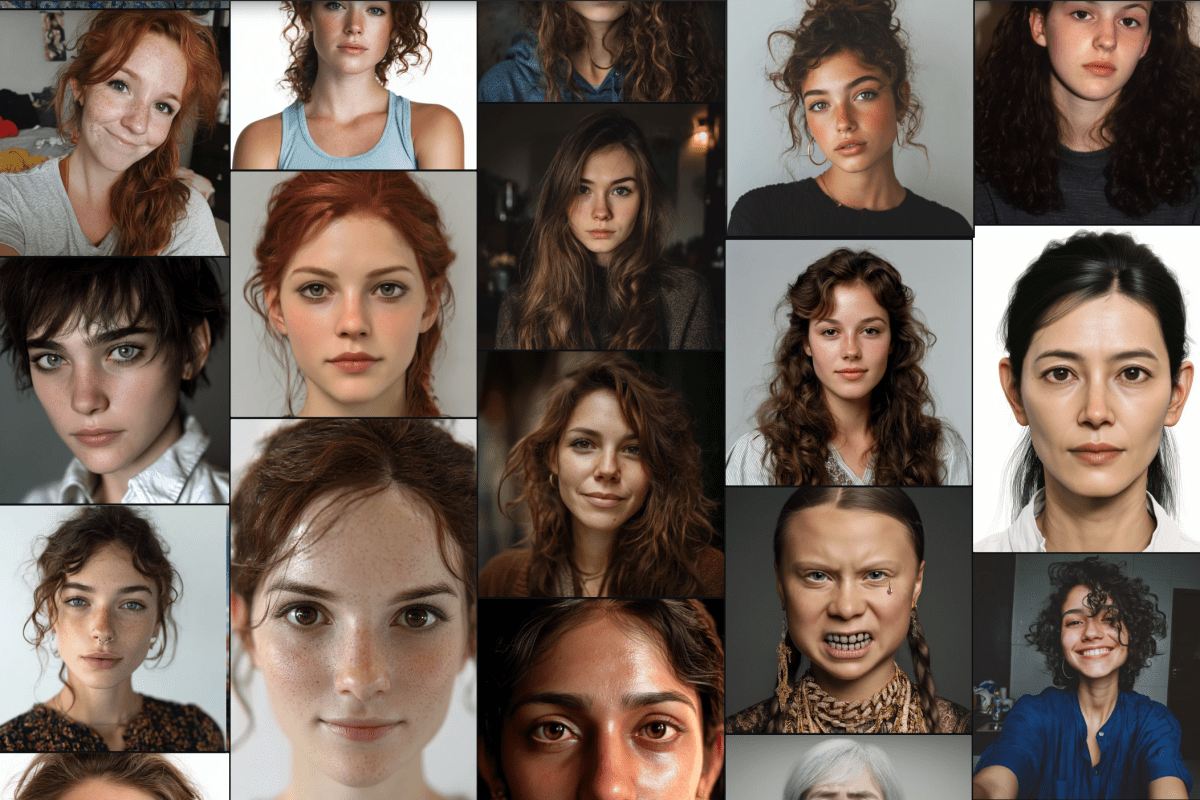
I queried MidJourney with the phrase ugly female. What did it return? An aesthetic pageant. A digital Vogue spread. If any of these faces belongs to someone conventionally labelled “ugly”, then I’m a rutabaga in a Dior suit.
Yes, there’s one stylised rendering of Greta Thunberg in full Norse Valkyrie scowl mode – but even then, she looks fierce, not foul. The rest? AI-generated portraits so telegenic I half-expected to see #spon in the corner.
Let’s be clinical for a moment. As an American male (with all the culturally indoctrinated shallowness that entails), I admit some of these aren’t textbook 10s. Maybe a few clock in at a 6 or 7 on the patriarchy’s dubious sliding scale. But if this is ugly, the AI has either broken the aesthetic curve or been force-fed too many episodes of The Bachelor.
Here’s the thing: AI is trained to over-represent symmetrical faces, wide eyes, clear skin – the usual genetic lottery wins. And yet, when asked for ugly, it can’t help but deliver catalogue models with slightly unconventional haircuts. It doesn’t know how to be truly ugly – because we don’t know how to describe ugliness without revealing ourselves as sociopaths.
Once upon a time, I dated a model agent in Los Angeles. Japanese by birth, stationed in LA, scouting for a French agency – the kind of cosmopolitan trifecta only fashion could breed. Her job? Finding “parts models.” That’s right – someone with flawless teeth but forgettable everything else. Hands like sculpture. Eyelashes like Instagram filters.
We’d play a game: spot the 10s. She’d nudge me, whisper “her?” I’d say, “Pretty close.” She’d shake her head. “Look at that eye tooth.” And we’d dissolve into laughter.
We were mocking perfection. Because perfection is a con. A trick of lighting, contour, and post-production.
So, no. I don’t think any of the women in the AI’s response are ugly. Quite the contrary – they’re too beautiful. AI can’t show us “ugly” because it’s been trained to optimise desire, not reflect reality. And our collective understanding of beauty is so skewed that anything less than runway-ready gets sorted into the rejection bin.
If these women are ugly, what exactly is beautiful?
But maybe that’s the point. We’ve abstracted beauty so far from the human that even our ugliness is now synthetically pleasing.
What do you think? Are any of these faces truly ugly? All of them? Let me know in the comments – and try not to rate them like a casting director with a god complex.
The Enlightenment, we are told, was the age of Reason. A radiant exorcism of superstition. Out went God. Out went angels, miracles, saints, indulgences. All that frothy medieval sentiment was swept aside by a brave new world of logic, science, and progress. Or so the story goes.
Audio: NotebookLM podcast on this topic.
But look closer, and you’ll find that Reason didn’t kill God—it absorbed Him. The Enlightenment didn’t abandon metaphysics. It merely privatised it.
From Confessional to Courtroom
We like to imagine that the Enlightenment was a clean break from theology. But really, it was a semantic shell game. The soul was rebranded as the self. Sin became crime. Divine judgement was outsourced to the state.
We stopped praying for salvation and started pleading not guilty.
The entire judicial apparatus—mens rea, culpability, desert, retribution—is built on theological scaffolding. The only thing missing is a sermon and a psalm.
Where theology had the guilty soul, Enlightenment law invented the guilty mind—mens rea—a notion so nebulous it requires clairvoyant jurors to divine intention from action. And where the Church offered Hell, the state offers prison. It’s the same moral ritual, just better lit.
Galen Strawson and the Death of Moral Responsibility
Enter Galen Strawson, that glowering spectre at the feast of moral philosophy. His Basic Argument is elegantly devastating:
You do what you do because of the way you are.
You can’t be ultimately responsible for the way you are.
Therefore, you can’t be ultimately responsible for what you do.
Unless you are causa sui—the cause of yourself, an unmoved mover in Calvin Klein—you cannot be held truly responsible. Free will collapses, moral responsibility evaporates, and retributive justice is exposed as epistemological theatre.
In this light, our whole legal structure is little more than rebranded divine vengeance. A vestigial organ from our theocratic past, now enforced by cops instead of clerics.
The Modern State: A Haunted House
What we have, then, is a society that has denied the gods but kept their moral logic. We tossed out theology, but we held onto metaphysical concepts like intent, desert, and blame—concepts that do not survive contact with determinism.
We are living in the afterglow of divine judgement, pretending it’s sunlight.
Nietzsche saw it coming, of course. He warned that killing God would plunge us into existential darkness unless we had the courage to also kill the values propped up by His corpse. We did the first bit. We’re still bottling it on the second.
If Not Retribution, Then What?
Let’s be clear: no one’s suggesting we stop responding to harm. But responses should be grounded in outcomes, not outrage.
Containment, not condemnation.
Prevention, not penance.
Recalibration, not revenge.
We don’t need “justice” in the retributive sense. We need functional ethics, rooted in compassion and consequence, not in Bronze Age morality clumsily duct-taped to Enlightenment reason.
The Risk of Letting Go
Of course, this is terrifying. The current system gives us moral closure. A verdict. A villain. A vanishing point for our collective discomfort.
Abandoning retribution means giving that up. It means accepting that there are no true villains—only configurations of causes. That punishment is often revenge in drag. That morality itself might be a control mechanism, not a universal truth.
But if we’re serious about living in a post-theological age, we must stop playing dress-up with divine concepts. The Enlightenment didn’t finish the job. It changed the costumes, kept the plot, and called it civilisation.
“All that is necessary for evil to triumph is for a few words to go missing from the bylaws.” — not Edmund Burke, but it ought to be.
The Trump administration—America’s reigning monarch of meaningless bombast—has done it again. This time, with an executive order so linguistically cunning it deserves a Pulitzer for Subtextual Menace.
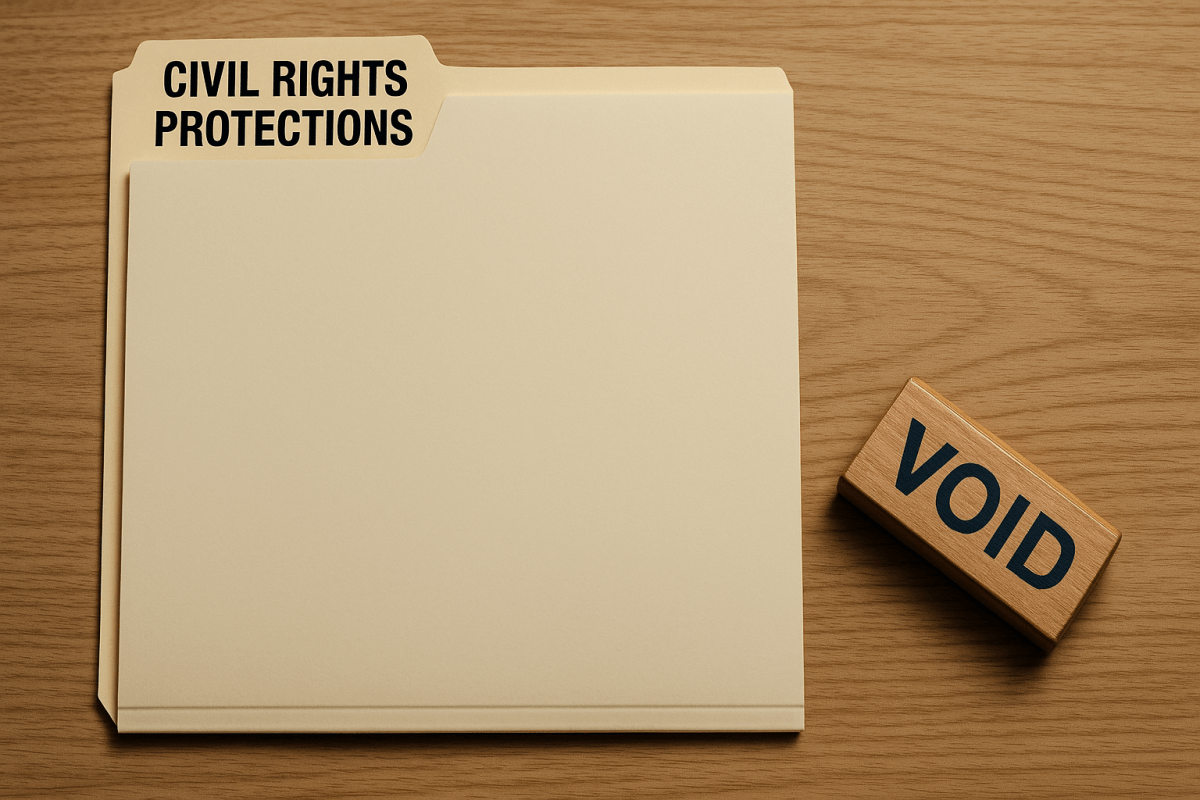
Issued on 30 January 2025, the decree known as “Defending Women from Gender Ideology Extremism” (because, of course, it couldn’t just be called Let’s Erase Legal Protections for People We Don’t Like) removed “political affiliation” and “marital status” from the list of protected classes within certain federal frameworks.
And the result? According to documents unearthed by The Guardian, VA doctors can now legally refuse treatment to patients based on their politics or marital status. You know, because being a Democrat apparently makes you too much of a pre-existing condition.
Naturally, the VA and White House are insisting this means absolutely nothing. “Don’t worry,” they coo. “No one’s actually doing it.” Ah yes, the old Schrödinger’s Protections defence—simultaneously removed and unchanged, invalid but somehow still effective.
But here’s the point—and where it ties to the Language Insufficiency Hypothesis I’ve been peddling like a raving madman at the crossroads of post-structuralism and bureaucratic despair: language isn’t just failing to communicate meaning—it’s being weaponised to obscure it.
The Erosion of Meaning Through Omission
This isn’t the blunt-force idiocy of Orwell’s Newspeak. This is something more elegant—more insidious. This is legislative lacunae. It’s what happens when not saying something says everything.
The words “political affiliation” and “marital status” weren’t replaced. They weren’t clarified. They were simply deleted. Erased like a bad tweet, like a conscience, like a veteran with the wrong bumper sticker.
This is language subtraction as a tool of governance.
We’re not criminalising dissent. We’re just making it legally ignorable.
We’re not discriminating against the unmarried. We’re just no longer required to treat them the same.
It’s the bureaucratic cousin of the dog-whistle: not quite audible in court, but perfectly clear to the base.
The Slippery Slope is Now a Slip-n-Slide
This is how you rewrite civil rights without the fuss of saying so. You just… remove the language that once held the dam in place. Then, when the flood comes, you feign surprise:
“Oh, dear. Who could have guessed that removing protections would result in people being unprotected?”
(Everyone. Everyone could have guessed.)
This is not a bug in the legal language. It’s the feature. The silence is the speech act. The absence is the argument.
This is what I mean by language insufficiency: not merely that our words fail to convey truth, but that their very structure is liable to be gamed—exploited by those who understand that ambiguity is power.
Beyond Intentionality: The Weaponised Void
In philosophy of language, we often debate intentionality—what the speaker meant to say. But here we’re in darker waters. This isn’t about intention. It’s about calculated omission.
The executive order doesn’t declare war on Democrats or single mothers. It simply pulls the thread and lets the tapestry unravel itself.
It’s an act of rhetorical cowardice disguised as administrative efficiency.
This is the Trumpian genius: use language like a stage magician uses sleeves. Distract with one hand, disappear with the other.
Final Diagnosis: Policy by Redaction
We now inhabit a political climate where what is not said carries more legal force than what is. Where bylaw gaps become policy gateways, and where civil rights die not with a bang, but with an elision.
So no, the VA hasn’t yet denied a Democrat a blood transfusion. But the table has been set. The menu revised. The waitstaff told they may now “use discretion.”
Language doesn’t merely fail us. It is being made to fail strategically.
Welcome to the new America: where rights aren’t removed—they’re left out of the memo.
Yet again, ChatGPT renders an odd image. Can’t be bothered to amend it.
ICE is out in force again, dragging brown bodies out of homes in Los Angeles like it’s some righteous carnival of due process. Another day, another federal theatre production titled Law and Order: Ethnic Cleansing Unit, where men with guns and names like Chad or Hank mistake cruelty for patriotism and paperwork for moral clarity.
Audio: NotebookLM podcast on this topic.
Naturally, critics of these raids are now being threatened with that great juridical cudgel: “obstructing justice.” Yes, you heard that right. If you interfere – say, by filming, shouting, refusing to roll over like a good little colonial subject – you are obstructing justice. As though justice were something you could actually put your hands on in the United States without a hazmat suit and a decade of appeals.
Let’s be clear. There is no justice here to obstruct. What you are obstructing is bureaucratic violence wrapped in legal latex. You are obstructing a system that functions like a vending machine for state-sanctioned trauma: insert immigrant, extract ruin.
Justice: The Imaginary Friend of Empire
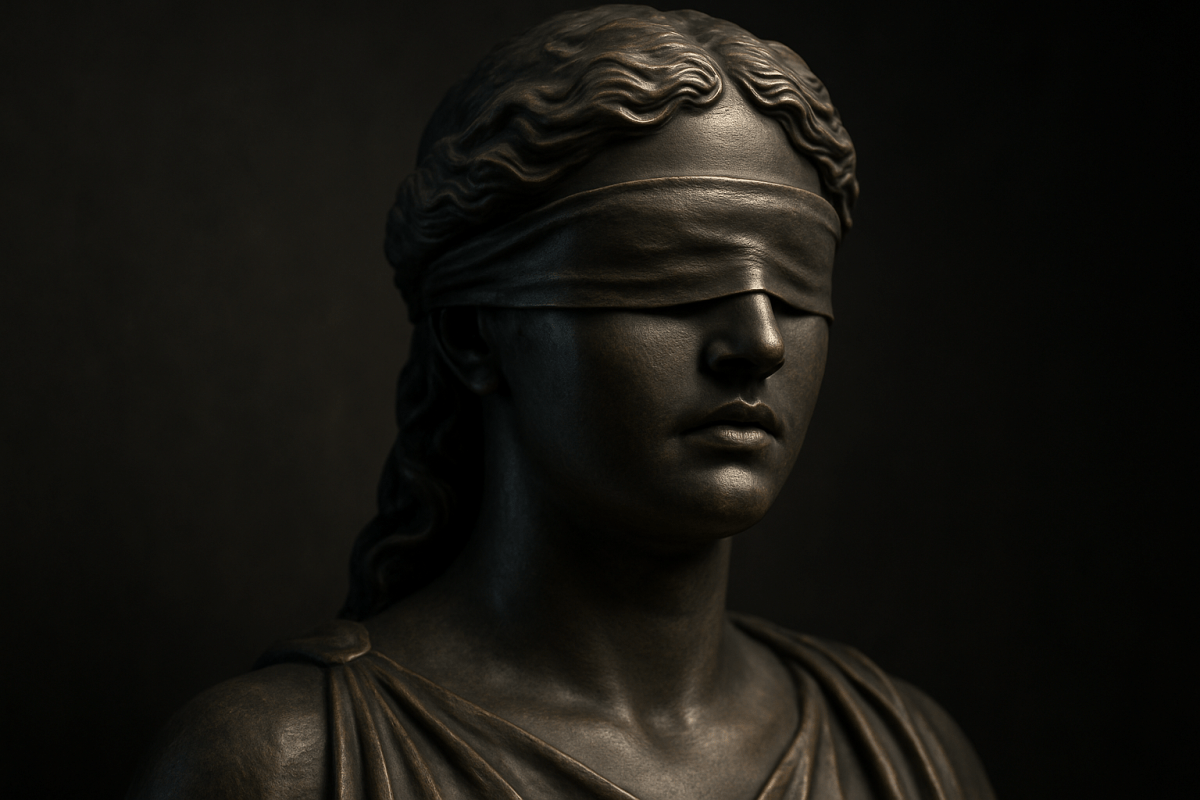
Ah, “justice.” That hallowed ideal trotted out whenever the state wants to put a boot through your front door. The U.S. has long since traded its Justice for Security Theatre and capitalist choreography. The blindfold is still there, sure – but these days, it’s a branded sleep mask from Lockheed Martin, and the scales are rigged to weigh white tears heavier than brown bodies.
Let’s run through the usual suspects:
ICE – America’s own domestic Gestapo, but with better PR and significantly worse fashion.
CBP – Border fetishists whose job seems less about national defence and more about satisfying their Freud-bereft fantasies of control.
SCOTUS – That great moral weather vane, spinning wildly between “originalist necromancy” and outright lunacy, depending on how recently Thomas and Alito read Leviticus.
Congress – An assembly of millionaires cosplaying as public servants, holding hearings on “the threat of immigration” while outsourcing their lawn care.
And of course, the President – whichever septuagenarian husk happens to be in office – offers the usual bromides about order, safety, and enforcement, all while the real crimes (you know, the kind involving tax fraud, corporate pollution, or drone strikes) go entirely unmolested.
Can You Obstruct a Simulation?
If you stand in front of a deportation van, are you obstructing justice, or merely interrupting the bureaucratic excretion of empire? It’s the philosophical equivalent of trying to punch a hologram. The system pretends to uphold fairness while routinely violating its own principles, then charges you with “obstruction” when you call out the sleight of hand.
This is not justice. This is kabuki. A ritual. A performance piece sponsored by Raytheon.
A Modest Proposal
Let’s just be honest and rename the charge. Not “Obstruction of Justice”—too ironic, too pompous. Call it what it is: Obstruction of Procedure, Obstruction of Power, or if we’re being especially accurate: Obstruction of the Industrial Deportation Complex™. Hell, add a corporate sponsor while you’re at it:
You are being charged with Obstruction of Justice, Presented by Amazon Web Services.
Because when justice itself is a ghost, when the rule of law has become the rule of lawfare, the real obscenity is pretending any of this is noble.
Final Thought
So no, dear reader, you’re not obstructing justice. You’re obstructing a machine that mistakes itself for a moral order. And if you’re going to obstruct something, make it that.
















 Philosophics