I Don’t Buy It

1–2 minutes

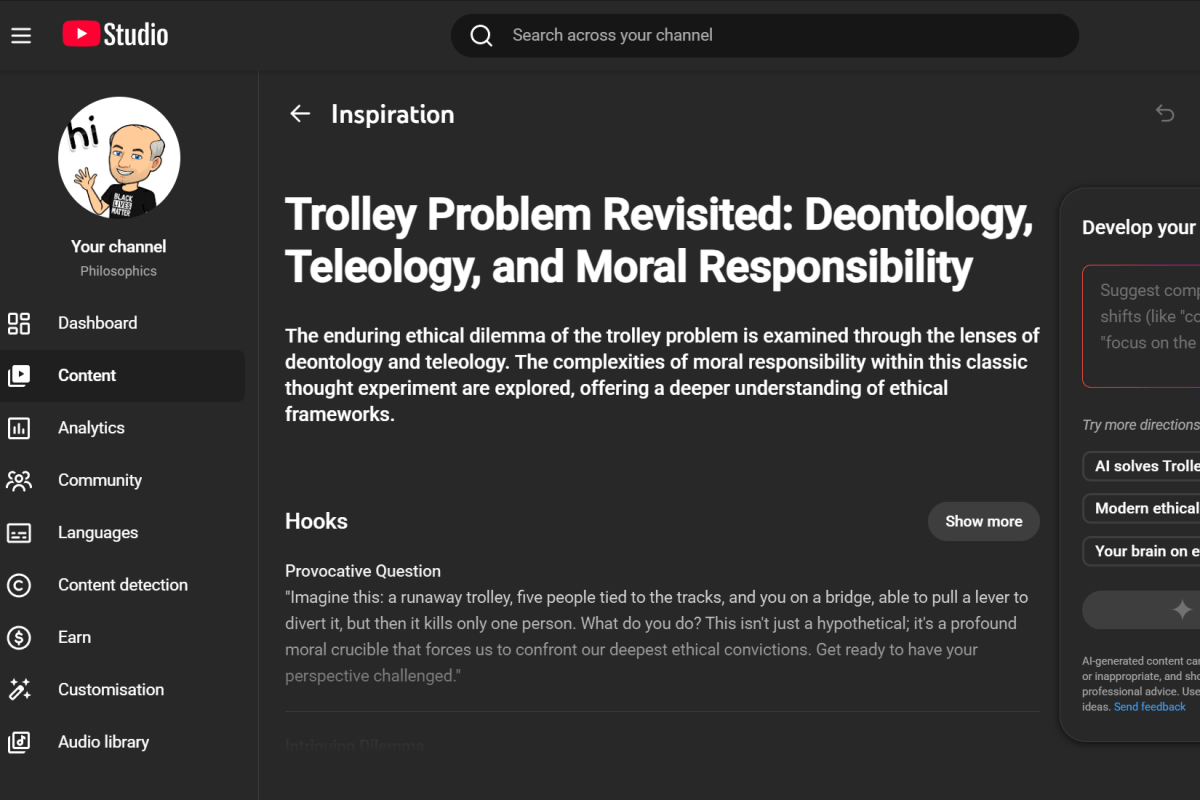
I posted a video on YouTube that I shared here. They’ve added some AI to the studio channel interface.

Image: YouTube Studio’s Inspiration Page. Thanks, but no thanks.

On the previous page, the prompt window (top right) asked if I wanted to know how my video was performing versus the baseline. I affirmed, and it spit out results. Brilliant.

I noticed a handful of ‘inspiration items’. None looked particularly interesting, but I have a nostalgia for Trolley Problems™. A few years ago, I would have jumped on the idea. Nowadays, I’ve seen hundreds of variations, and I’ve lost interest. However, being on familiar ground, I clicked on it to see what would happen. The result is the screenshot above.

Not only is the response templated with thumbnails, but AI is also ready to write the script. At this rate, why doesn’t YouTube just create ideas and generate them itself – like Spotify or Suno? It may just be a matter of time.

I am a heavy user of AI, but I lead the conversation. I am an author, and a reason I don’t join writers groups – I’ve attended some – is that I don’t need help with topics. I don’t get writer’s block. I just need the time and focus to get it out. I suppose that one day the creative well could run dry, but I don’t do this for commercial gain. Sure, that happens, but it’s not my goal. My goal is to write to share and exchange ideas.

I have many colleagues who are commercial writers and artists. I don’t know how they can do it. I understand that people have different interests and temperaments, but this is not one of mine. It would literally take all of the joy out of it. Not all people are artists™. Some people are more acquisitive than I am; I’m not judging, but it’s not me.

When I look at YouTube’s shiny AI muse and think, thanks, but no; I’d rather derail the trolley myself.

Accusations of Writing Whilst Artificial

2–3 minutes

Accusations of writing being AI are becoming more common – an irony so rich it could fund Silicon Valley for another decade. We’ve built machines to detect machines imitating us, and then we congratulate ourselves when they accuse us of being them. It’s biblical in its stupidity.

A year ago, I read an earnest little piece on ‘how to spot AI writing’. The tells? Proper grammar. Logical flow. Parallel structure. Essentially, competence. Imagine that – clarity and coherence as evidence of inhumanity. We’ve spent centuries telling students to write clearly, and now, having finally produced something that does, we call it suspicious.

Audio: NotebookLM podcast on this topic and the next one.

My own prose was recently tried and convicted by Reddit’s self-appointed literati. The charge? Too well-written, apparently. Reddit – where typos go to breed. I pop back there occasionally, against my better judgment, to find the same tribunal of keyboard Calvinists patrolling the comment fields, shouting ‘AI!’ at anything that doesn’t sound like it was composed mid-seizure. The irony, of course, is that most of them wouldn’t recognise good writing unless it came with upvotes attached.

Image: A newspaper entry that may have been generated by an AI with the surname Kahn. 🧐🤣

Now, I’ll admit: my sentences do have a certain mechanical precision. Too many em dashes, too much syntactic symmetry. But that’s not ‘AI’. That’s simply craft. Machines learned from us. They imitate our best habits because we can’t be bothered to keep them ourselves. And yet, here we are, chasing ghosts of our own creation, declaring our children inhuman.

Apparently, there are more diagnostic signs. Incorporating an Alt-26 arrow to represent progress is a telltale infraction → like this. No human, they say, would choose to illustrate A → B that way. Instead, one is faulted for remembering – or at least understanding – that Alt-key combinations exist to reveal a fuller array of options: …, ™, and so on. I’ve used these symbols long before AI Wave 4 hit shore.

Interestingly, I prefer spaced en dashes over em dashes in most cases. The em dash is an Americanism I don’t prefer to adopt, but it does reveal the American bias in the training data. I can consciously adopt a European spin; AI, lacking intent, finds this harder to remember.

I used to use em dashes freely, but now I almost avoid them—if only to sidestep the mass hysteria. Perhaps I’ll start using AI to randomly misspell words and wreck my own grammar. Or maybe I’ll ask it to output everything in AAVE, or some unholy creole of Contemporary English and Chaucer, and call it a stylistic choice. (For the record, the em dashes in this paragraph were injected by the wee-AI gods and left as a badge of shame.)

Meanwhile, I spend half my time wrestling with smaller, dumber AIs – the grammar-checkers and predictive text gremlins who think they know tone but have never felt one. They twitch at ellipses, squirm at irony, and whimper at rhetorical emphasis. They are the hall monitors of prose, the petty bureaucrats of language.

And the final absurdity? These same half-witted algorithms are the ones deputised to decide whether my writing is too good to be human.

Rick Beato, Everything is a Remix

Oh no, not that again. As if we’ve all been composing from scratch, untouched by the grubby hands of history.

Audio: NotebookLM podcast on this topic.

I’m not simping for AI, but let’s have it out, shall we? Rick Beato—bless his fretboard-fingered soul—says AI-generated music sucks. And sure, some of it does. But here’s the punchline: most human-made music sucks too. Always has. Always will. The fact that an algorithm can now churn out mediocrity faster than a caffeinated teenager with GarageBand doesn’t make it less “art.” It just makes it faster.

I’m a bit chuffed that Rick’s channel removed my comment pointing to this response. I didn’t want to copy-paste this content into his comments section.

Video: Rick Beato discusses AI-generated music

The Myth of the Sacred Original

Newsflash: There is no such thing as originality. Not in art. Not in music. Not even in your favourite indie band’s tortured debut EP. Everything we call “creative” is a clever remix of something older. Bach reworked Vivaldi. Dylan borrowed from the blues. Even Bowie—patron saint of artistic reinvention—was a pastiche artist in a glittery jumpsuit.

What AI does is make this painfully obvious. It doesn’t pretend. It doesn’t get drunk in Berlin and write a concept album about urban decay to mask the fact it lifted its sound from Kraftwerk. It just remixes and reinterprets at inhuman speed, without the eyeliner.

Speed Isn’t Theft, It’s Efficiency

So the AI can spit out a passable ambient track in ten seconds. Great. That’s not cheating, it’s progress. Saying “it took me ten years to learn to play like that” is noble, yes, but it’s also beside the point. Horses were noble too, but we built cars.

The question isn’t how long did it take? but does it move you? If the answer is no, fine. Say it sucks. But don’t pretend your human-shaped suffering gives your song a monopoly on meaning. That’s just gatekeeping with a sad sax solo.

The Taste Problem, Not the Tech Problem

Let’s not confuse our distaste for bland music with a distaste for AI. Most of the pop charts are already AI-adjacent—click-optimised, algorithm-fed, and rigorously inoffensive. If you want soul, seek out the obscure, the imperfect, the human, yes. But don’t blame the machine for learning its craft from the sludge we fed it.

AI is only as dull as the data we give it. And guess what?
We gave it Coldplay.

What’s Actually at Stake

What rattles the cage isn’t the mediocrity. It’s the mirror. AI reveals how much of our own “creativity” is pattern recognition, mimicry, and cultural reinforcement. The horror isn’t that AI can make music. It’s that it can make our music. And that it does so with such appalling accuracy.

It exposes the formula.
And once you see the formula, you can’t unsee it.

Long Live the Derivative

So yes, some AI music sucks. But so do most open mic nights. Creativity was never about being wholly original. It was about saying something—anything—with whatever tools you had.

If AI is just another tool, then sharpen it, wield it, and for heaven’s sake, stop whining. The artist isn’t dead. He’s just been asked to share the stage with a faster, tireless, genre-bending freak who doesn’t need bathroom breaks.

Embracing Your Anti-Self

Lessons from Keats on the Art of Self-Creation

I don’t believe in the notions of ‘self’ or identities, but it makes for a nice thought experiment.

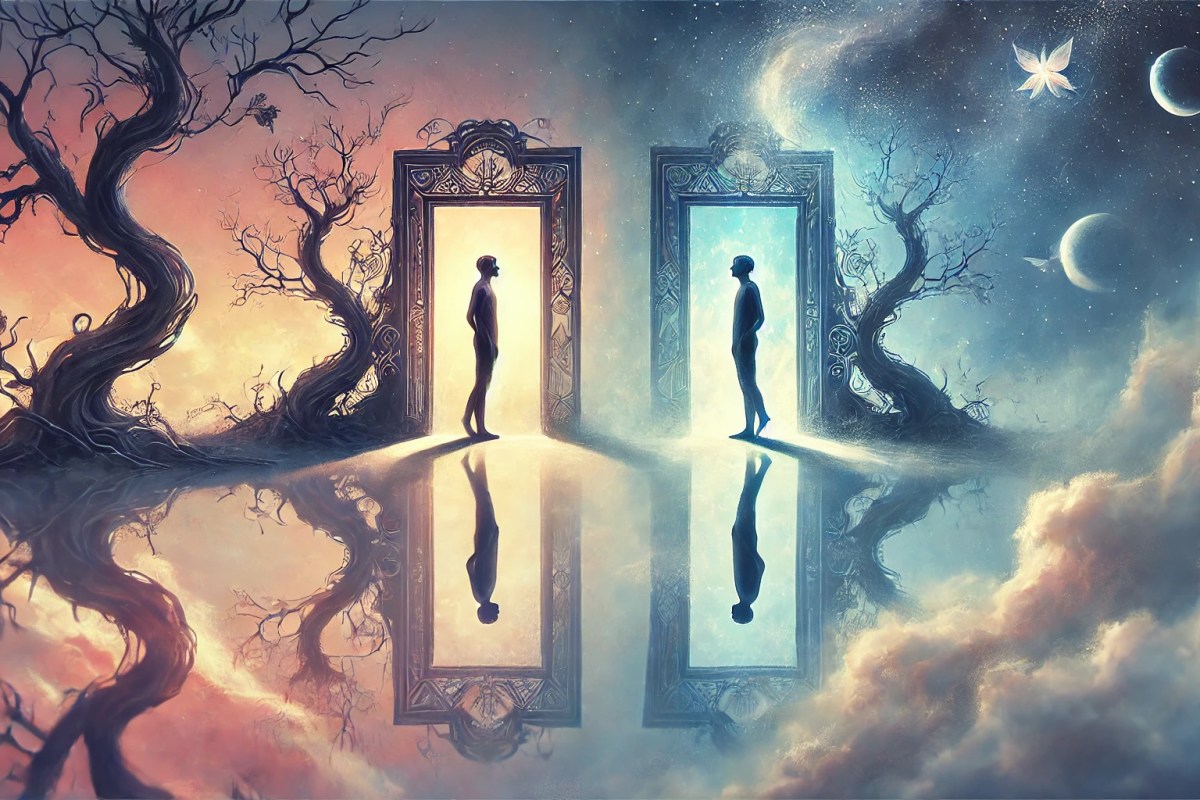
Imagine, just for a moment, that somewhere on this planet, there is someone who is your opposite in every conceivable way. They live as you do not. If you are kind, they are cruel. If you revel in the thrill of running through a rainstorm, they are the kind who sit comfortably by the fire, dreading the mere thought of a brisk step outdoors. If you drink to toast life’s joys, they abstain, unwilling to let a drop pass their lips. They are your anti-self—an inversion of who you are, lacking everything that you have and yet possessing everything that you do not.

As strange as it seems, this image is more than idle speculation. According to the Romantic poet John Keats, holding such an image of your anti-self is an essential part of the process of creating your own identity. The elusive art of true self-creation lies, paradoxically, in our capacity to hold in our minds those lives and feelings that are utterly different from our own. To truly grow, we must encounter the other—whether that other is someone we know or a shadowy, imagined version of who we could have been if only we’d chosen differently. This exercise is more than an intellectual indulgence; it is at the core of what Keats called ‘soul-making.’

Keats believed in the concept of the ‘chameleon poet’—the idea that writers, and indeed all human beings, must cultivate the ability to lose themselves in the perspectives of others. It is not enough to gaze upon the world through the singular lens of our own experience; to truly create, we must dissolve our egos and embrace a kaleidoscope of possibilities. A woman might explore the life of a soldier, writing deeply about a battle she’s never fought. A contented parent might dare to delve into the unimaginable grief of losing a child. Fiction writers, poets, artists—they all do this: they shed their own skin, assume another’s, and, in doing so, broaden the horizons of their own soul.

But Keats’ lesson here isn’t limited to the domain of poets and storytellers; it’s a practice that should extend to all of us. In what he evocatively called ‘the vale of soul-making,’ Keats posited that life offers each of us the raw materials to forge a soul, but we must engage imaginatively with all the lives we might lead, all the people we could be. We must dare to envision every possible road before us, not as a commitment but as an act of creation—enriching ourselves with the essence of each path before deciding which one we wish to tread.

And therein lies the heartbreak of it all. When we choose one possible life, we necessarily burn the others. In the very act of committing, we close other doors. We must set ablaze all our imagined lives just to make room for the one we decide to live. This thought is thrilling but also terrifying. Unlike a poet, who can glide into and out of fictional worlds, we must choose where we stand and stay there. We are not chameleons. We cannot flit endlessly between possibilities. We cannot write a library of books. We must write the one, and we must write it well.

Keats understood that the art of imagining one’s anti-self wasn’t about living vicariously forever in a land of could-have-beens. The exercise is in acknowledging these spectres of other lives, learning from them, and then committing, knowing full well what is lost in the process. Self-creation means being both the builder of one’s house and the one who tears down all the others, brick by potential brick. It means knowing who you could have been and yet, resolutely stepping into who you choose to be.

In a world obsessed with keeping every option open, Keats offers us the wisdom of finality. Burn off your possible lives and focus on writing the best version of the one that remains. Embrace the anti-self, learn from it, and commit once you have glimpsed all the possible worlds you might inhabit.

That is the paradoxical art of soul-making—of becoming whole while knowing you could have been anyone else. The beauty lies in the commitment, not in the drifting dream of endless potentiality. There is a deep satisfaction in choosing, in writing your own story, in saying, ‘This is who I am,’ even though you could have been another. And for that, we have John Keats to thank, the poet who understood that our anti-selves are not merely an idle game of imagination but the fuel for becoming fully human—the forge in which the soul is made.

Right Creativity

The struggle is real. Last night, rather about 3 AM, I awakened with a thousand thoughts. This happens often enough. Some were creative ideas. Some were ideas for topics to write about here. Not just topics, but content as well. Then came the internal debate—whether to wake up and capture these ideas or to hope they’d remain in cache until the morning. All I can say it at least this one did. Well, the topic, at least.

The struggle is whether to lose sleep and risk not falling back to sleep to be able to awaken at a decent hour and not be dragging around the next day from lack of sleep. Or perhaps, at next notice, it would just be time to get up. All these scenarios have occurred at one time or another.

I tend to write a lot, whether for here, for work, for pleasure—whatever. I used to create visual art and certainly wrote a lot of songs or at least musical ideas that I hoped would develop into songs. The struggle was the same. The outcomes were as well.

Having read as much as I have of McGilchrist, it starts to make sense. The right cerebral hemisphere is the font of creativity. It’s also the place for intuition and empathy. The left hemisphere is for symbols and categories. It’s the quarter for intellect. It’s also a bad roommate.

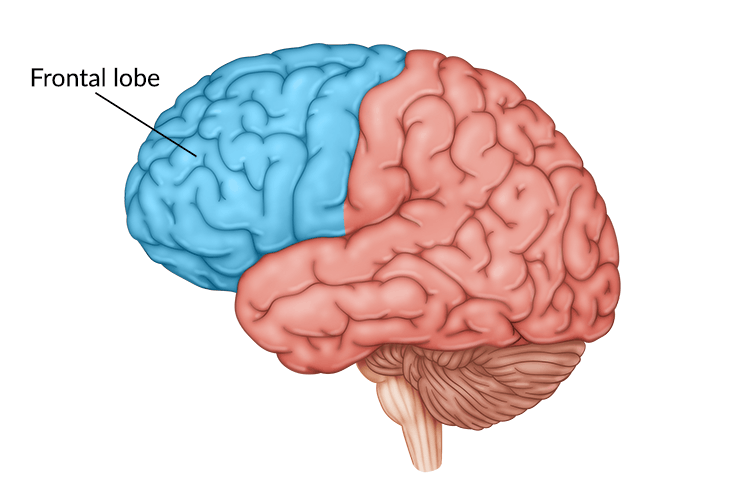
Whether or not one is creative does depend on the right hemisphere. Whether one can create depends on the left. Allow me to explain after laying out a relationship and three possibilities. For my purpose here, I can reduce the brain to three principal actors—the right hemisphere, the left hemisphere, and the frontal lobe.

As mentioned already, the right hemisphere generates creativity; the left hemisphere allows these ideas to be articulated symbolically, as in written and spoken words or art or music notation and so on; the frontal lobe acts as a mediator. Without getting too deep into neurology, a primary function of the frontal lobe is restrictive, which is to say it tells one or the other hemisphere to shut up and mind its business. Unfortunately, the hemispheres have this veto power of their own, so it’s difficult to fully understand the dynamics. This being said, let’s have a look at four scenarios that may illustrate why someone may or may not be able to create—in some cases even if they are otherwise creative.

I’ll start with the situation where the right hemisphere generates the creative ideas, and the other actors perform as expected. This is the brain of the creative person.

In the second scenario, the right hemisphere is simply weak. The person was just born with the bad luck of having a hemisphere that isn’t creative. In this case, there is nothing the left hemisphere or frontal lobe can do to compensate for this deficit. I’d like to think—like, perhaps being the wrong word—that this is where most non-creative people reside. They just don’t have that metaphorical creative gene.

In the third scenario, the right hemisphere generates plenty of creative thoughts, but the left hemisphere won’t “shut up”. If you’ve even had to think in a place with a lot of noise or distraction, you’ll get the gist. This is an imperfect analogy because creativity is precisely about not concentrating. Concentration is the enemy of creativity. So, in the case that the left hemisphere is interfering, it’s because it insists on concentrating, and that interrupts the creative process. In fact, it’s a misnomer to call something s creative process because creativity is precisely a lack of process. Like concentration, process kills creativity.

The right hemisphere is open and divergent.
The left hemisphere is closed and convergent.

In the fourth and last scenario, the right and left hemispheres are each playing their parts swimmingly, but the frontal lobe as moderator is deficient. In this case, the left is being itself and disrupting. Like the parable of the scorpion and the frog, it can’t help itself, but the frontal lobe isn’t telling it to be quiet and wait its turn. That’s the job of the frontal lobe. If you’ve ever witnessed a debate or mediated discussion where the moderator just lets the participants run rampant, you’ll know what I mean. Or perhaps you’ve been in a classroom or a meeting where the teacher or leader has no control of the class or the audience. It’s difficult to get anything accomplished.

Moving on. So, the actors each have their roles, but timing matters. The right hemisphere not only needs to generate thoughts or ideas, but it also needs time for them to incubate. Once they are ripe, only then is it ready to encounter the scrutiny of the left hemisphere and seek moderation for the frontal lobe.

If during the incubation process, the left hemisphere is continually asking, “Are we there yet? Are we there yet?” it’s unlikely one will ever get there.

If you are wondering how this works in the world of business and commerce—or better yet, you have already put together that this can’t possibly work in the realm of business and commerce—, I talk about that next. And I’ve got another segment on cerebral challenges in business in the works.

Creativity cannot be time-boxed. It can’t be summoned on demand. As already mentioned, it is not a process, and it can’t be tamed. Aside from the fickle public, have you ever wondered why so many musical artists are one-hit-wonders—if they have even been that lucky? These people had one idea—that happened to be an idea that would resonate in that moment—, but being told by the label to go generate some more hits is asking for creativity on demand.

Depending on your age and generation, some of you might be asking yourselves, “What about Taylor Swift or Ed Sheeran or the Beatles or Beethoven?” These people are clearly the exceptions. We could as well look at the Vincent van Gough of the world who didn’t experience acceptance until after his death. Clearly, his creativity was unrecognised by his contemporaries. Even in some of these exceptional cases, these people have found a voice and are applying a pattern. An example I like is that of Stephen King, who in an interview admitted that he has only had one good idea in his entire life, and he’s exploited it into a large number of books. So, he’s kept reskinning the same skeleton but with different dressings.

And as far as commerce goes, yes, these people are commercially successful. Some would argue about the actual talent. I’ve seen philosophy classes compare the ‘high art’ of Shakespeare with the ‘low art’ of Matt Groening’s The Simpsons. Certainly, The Simpsons are culturally creative and commercially successful, but how creative is it really? How does one actually measure degrees of creativity?

My point is that these exceptional people are generating output once a year or every few years. In business, so-called creatives may be asked to generate new ‘creative’ content daily, weekly, or perhaps monthly. Creativity doesn’t work like this. Even if you asked Mozart to generate a new piece each week, this mechanical process might yield paydirt, but most would just be a formulaic rehash. In fact, if you talk to any top artist, they’ll tell you that what you see or hear is less than one per cent of their ideas. Most are either partially formed or, upon reflection, just bad. They felt good at the time, but they couldn’t develop into something better, or they turned out to be derivative, which is hardly creative.

So business is a death sentence for creativity. The creative people I know, don’t get their creative jollies from their day jobs. They get it from their side projects, from their passion projects, and whether or not these projects are commercially viable.

In fact, I can also look at someone like Nirvana’s Kurt Cobain who was creative at the start—when they were under the radar—, but once they rose into view, he lost it, and then we lost him.

I hope this gives you a better feeling of how creativity works from the perspective of the brain and why we see so little creativity in the real world and even less in the business world. Do you find this surprising, or are you thinking, “man, this bloke must be dense if he’s just catching on to this now”?

Let me know in the comments.

The Matter with Things: Chapter Eight Summary: Creativity

Index and table of contents

Intro

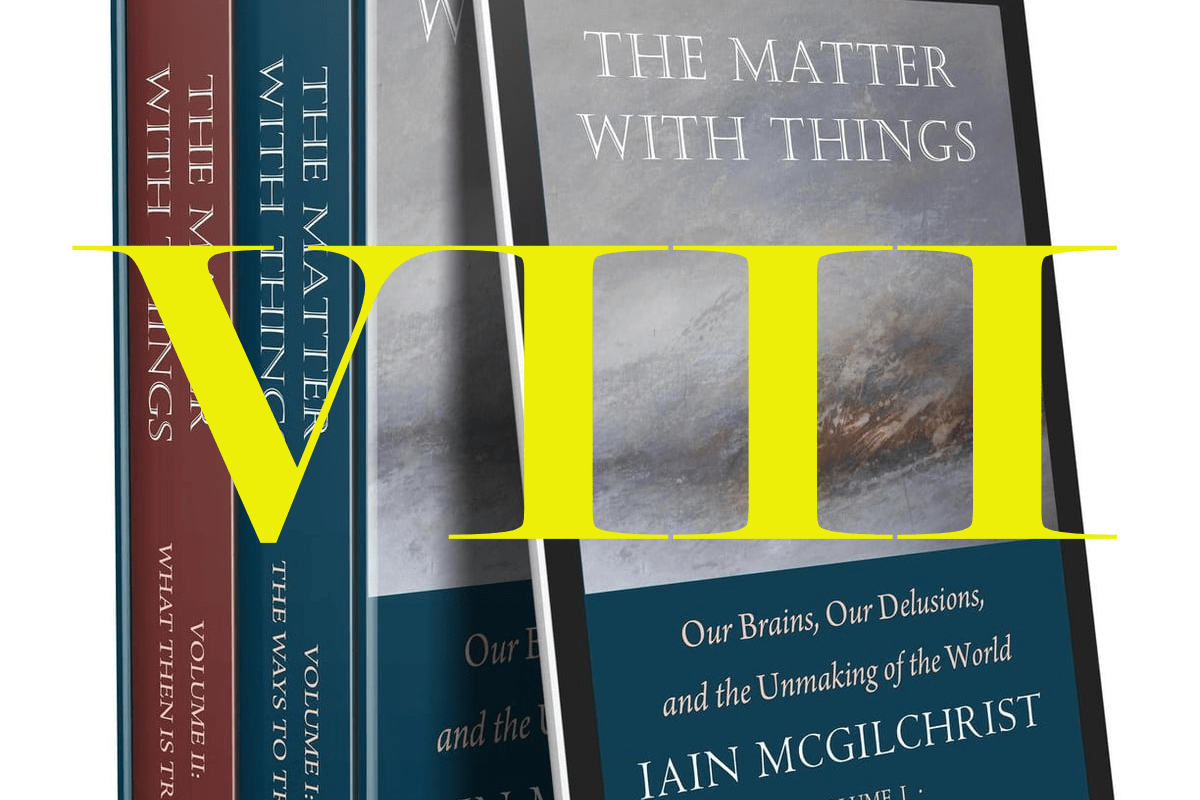
Creativity is the eighth chapter of Iain McGilchrist’s The Matter with Things.

In the last chapters, the topics were about different intelligences. As we’ll see, intelligence is one of the factors for creativity, but there are more. Let’s crack on.

Podcast: Audio rendition of this page content

Content

Creativity is an elusive phenomenon that cannot only not be summoned at will, the very act of trying inhibits it. Unlike left-hemisphere-oriented intelligence, there are no simple tests for creativity because of their very nature. Assessing the left-hemisphere is relatively simple because it is systematic and any tests have definite known solutions—whether calculating some figure, solving a puzzle, choosing analogies, or recounting some trivia. There is no such test for creating something not yet created, but there are some proxies that most people categorically fail.

Psychologist, Colin Martindale, had this to say about the personal characteristics of creativity

Creativity is a rare trait. This is presumably because it requires the simultaneous presence of a number of traits (e.g., intelligence, perseverance, unconventionality, the ability to think in a particular manner). None of these traits is especially rare. What is quite uncommon is to find them all present in the same person.”

— Colin Martindale

Whereas the left hemisphere is analytical, the right hemisphere (hence creativity) is a Gestalt. When given a difficult time-boxed challenge, the left hemisphere dominant individual who does not arrive at the expected response on time will commit to and defend an incorrect response (think escalating commitment), and the right hemisphere dominant individual will simply not commit to a response under the thought that there were still options to be explored.

Effectively, creativity can be broken down into three phases: preparation, incubation, and illumination.

In essence, for the creative individual, the best we can do is to leave well enough alone. Anything but space and permission will kill the creative impulse.

Preparation is simply the accumulation of a particular domain of knowledge. For an artist, it will be to understand, perhaps, colour, shape, texture, form, shadow, media, or so forth; for a musician, it might be to understand melody, harmony, tempo, timbre, dynamics, and so on; for a mathematician, it might be basic arithmetic, theories, proofs, and on and on. It’s also important to note that accumulated information in multiple domains also forms a foundation leveraged by many polymaths.

Incubation is simply waiting for something to grow in the prepared garden. Incubation is an unconscious activity and cannot be controlled or accessed by the conscious mind. In fact, conscious effort and introspection will serve only to impede cultivation. Digging up planted seeds to see how they are growing will only hinder the process.

Illumination is the final phase. Again, this is unwilled. Prepared and incubated flowers bloom. Of course, this is an imperfect metaphor because the ground must already have been fertile at the start. Tossing seeds on fallow ground still yields no blooms no matter how carefully attended.

In essence, for the creative individual, the best we can do is to leave well enough alone. Anything but space and permission will kill the creative impulse.

McGilchrist discusses generative, permissive, and translational requirements.

“The key element in generation seems to be the ability to think of many diverse ideas quickly, demanding breadth, flexibility and analogical thinking – seeing likeness within apparent dissimilarity.” This can be summed up as divergent thinking. This is the openness afforded by the right hemisphere as opposed to the convergent behaviour of the left. As it happens, this is where artificial intelligence falls flat as it is predicated on convergent activity.

The right hemisphere Gestalten surveys the environment and notes otherwise unperceived parallels. It is not a systematic approach. In the words of Oscar Wilde, “Education is an admirable thing. But it is well to remember from time to time that nothing that is worth knowing can be taught.”

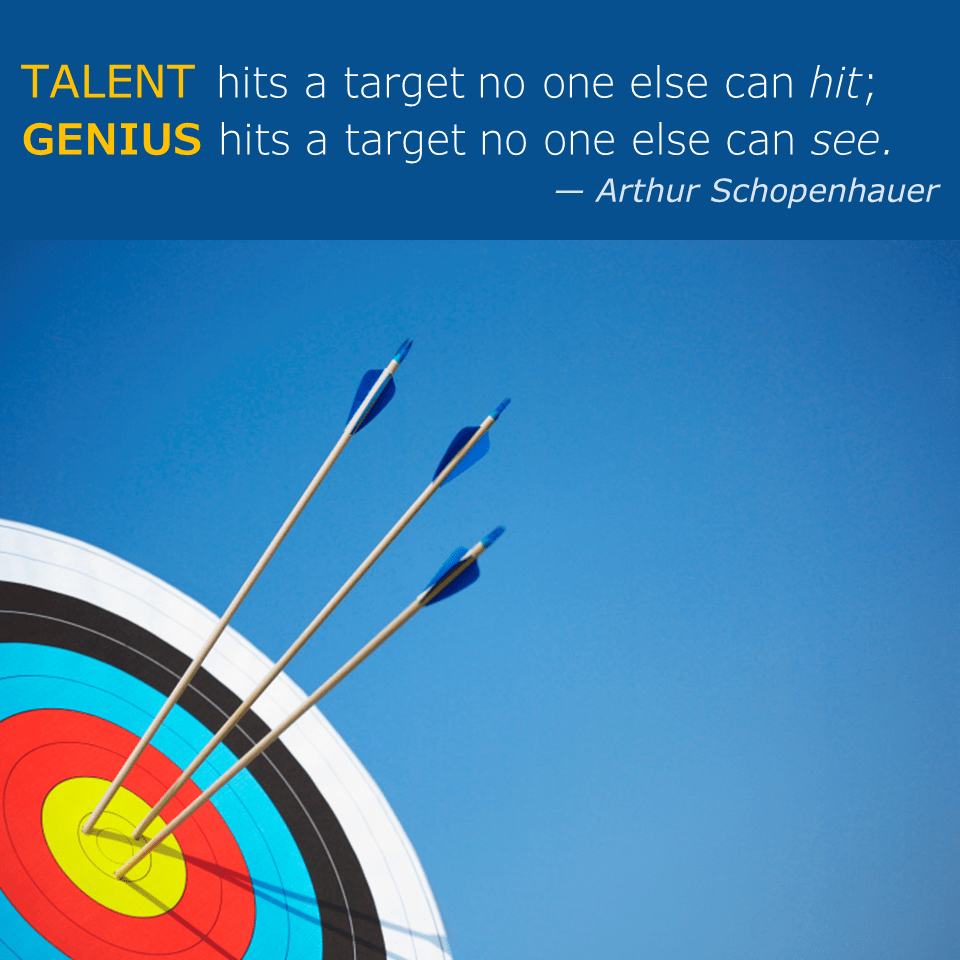
“Talent hits a target no-one else can hit;
genius hits a target no-one else can see”.

Arthur Schopenhauer

Schopenhauer sums it up nicely, “Talent hits a target no-one else can hit; genius hits a target no-one else can see”.

Citing Isaac Asimov writing about Darwin’s insight, he notes that before Darwin, many people had read Malthus and studied species, but they lacked the creative spark that Darwin had.

Steve Jobs noted that

“Creativity is just connecting things. When you ask creative people how they did something, they feel a little guilty because they didn’t really do it, they just saw something. It seemed obvious to them after a while. That’s because they were able to connect experiences they’ve had and synthesize new things … A lot of people in our industry haven’t had very diverse experiences. So, they don’t have enough dots to connect, and they end up with very linear solutions without a broad perspective on the problem. The broader one’s understanding of the human experience, the better design we will have.”

— Steve Jobs

This is a failing of the business world and of specialisation more generally. McGilchrist writes, “Linear approaches and analytic thinking, characteristic of the left hemisphere, are fine in the right context, and may at a subsequent phase take part in creativity by narrowing things down and eliminating some of them, but on their own will not achieve creativity”.

There is a direct link between intelligence and creativity. Ego crushes creativity.

There is a direct link between intelligence and creativity. Ego crushes creativity.

He again cites Asimov:

“My feeling is that as far as creativity is concerned, isolation is required. The creative person is, in any case, continually working at it. His mind is shuffling his information at all times, even when he is not conscious of it …The presence of others can only inhibit this process, since creation is embarrassing.”

— Isaac Asimov

Some people excel at maths, but many are systematic and procedural left-hemisphere types; they apply logic and reason—insert tab A into slot B. The famous mathematicians understand the procedures, but their ideas come from intuition rather than reason. The left hemisphere doesn’t recognise this as a viable vector, and therein lies the rub. “Math is not about following directions; it’s about making new directions,” writes mathematician Paul Lockhart.

This is why we hear so many accounts of aha moments, something coming to one person in a dream or Isaac Newton’s falling apple anecdote.

“These thoughts did not come in any verbal formulation. I very rarely think in words at all.
A thought comes, and I may try to express it in words afterward”

Albert Einstein

Einstein told Max Wertheimer, founder of Gestalt psychology, “These thoughts did not come in any verbal formulation. I very rarely think in words at all. A thought comes, and I may try to express it in words afterward”. Words are a left-hemisphere phenomenon.

Many accomplished musicians hear a piece whole. All they need to do is to compose it to staff paper or perform it. We hear this regularly: “I was driving from here to there and it just came to me. All I needed to do is to remember it long enough to get it down.”

I found McGilchrist’s inclusion of hemispheric damage quite interesting. He provides many examples of artists, composers, and poets, but I’ll only summarise them. For musicians and Artists with right hemisphere damage, those who even retained the urge to create did so at a lower quality level. However, those with left hemisphere damage operated at the same level and oftentimes at a higher level, without the inhibition and censorship of the left hemisphere.

It’s important to note that most people rely on both hemispheres. When I write left hemisphere dominant, I mean to say that either the right hemisphere simply underperforms or that the left hemisphere does not cede control back to the right hemisphere. Generally speaking, both hemispheres experience the world, and a strong right hemisphere will act as air traffic controller, or perhaps have the right of first refusal, but this is a loose metaphor because sometimes the left hemisphere just fields an experience and takes its best guess how to handle it even if it should have been fielded by the right hemisphere and even if the left hemisphere provides the wrong answer. The left hemisphere is the hemisphere of the ego and identity, so it is somewhat relentless and defensive even when it is wrong.

As a side note, I trust that political identity and escalating commitment are left-hemisphere activities and why modern Western politics feel so intractable.

After a strong argument for right hemisphere dominance and divergent thinking being hallmarks of creativity, he offers some counter-evidence and counters some of it.

A paper by Arne Dietrich and Riam Kanso co-authored a book citing instances of convergent thought processes that led to something innovative or creative. At the onset, McGilchrist calls them out for conflating problem-solving with creativity. In the end, the left hemisphere does play a role. He calls this the translational phase. Essentially, this is Mozart having heard his symphony and needing to put his thoughts to paper. Or the poet.

He goes off on a bit of a tangent noting how words pale concepts, and divergence and convergence are no exception. This fits in with my own insufficiency of language theory, but McGilchrist and I have different rationales for our arguments, so I’ll not side-track this summary.

He cites some statistics correlating creativity with mental health disorders and incidences of suicide. This will set the reader up perfectly for the next chapter about schizophrenia and autism.

Perspective

In summary, creativity has got me riled up more than in the previous chapters. This is partially due to how it comports with my own observations. I have always felt that humans are not very creative or innovative despite protests to the contrary. In fact, I’ve often commented when I’ve heard people say something like “artificial intelligence will never create the next…” Fill in the blank: Mozart, Picasso, Michelangelo, Nabokov, Wordsworth. Or Einstein. Of course, neither will a human be the next of these.

All these people are right cerebral hemisphere dominant. AI operates systematically, in the manner of the left hemisphere. None of these people built up systematically. Instead, their ideas were wholly formed, and their creations were reductive rather than additive. Famously, Michelangelo was to have said, “The sculpture is already complete within the marble block before I start my work. It is already there. I just have to chisel away the superfluous material.” He sees the solution first and then builds towards it.

In my professional life, I have been a strategist as a management consultant as well as a business analyst. In each case, I could quickly assess a situation and then spend weeks or months defending my intuition with words, diagrams, and numbers.

As a business analyst, I would offer a recommendation, and this would need to come with an estimate to deliver the recommendation. This figure would come to me in a matter of minutes. Then, per protocol, I would need to enter micro-level details into a pricing model so it could calculate from the ground up. First, this was time-consuming. Second, this would be circulated for review where different people would (almost invariably) reduce the number of hours estimated, typically due to pressure to reduce the cost. Ultimately, a number would be output and tendered to the client or the person footing the bill. Again (almost invariably), the number initially intuited was more accurate and reflective of what was ultimately invoiced. Unfortunately, business is a left-hemisphere endeavour, and that will be its Achilles’ heel and denouement.

This wraps up the chapter on Creativity. The next chapter is “what schizophrenia and autism can tell us”, and is the end of part one of The Matter with Things.

What are your thoughts and experiences with creativity now that you’ve heard McGilchrist’s take?

Leave comments below.