This is a formatted duplicate of a simultaneous Substack post, as Substack doesn’t support certain formatting that WordPress does, namely, tables.
Overview
The history of archetype is a history of relocation. The archetype begins in a realm more real than the world, moves into the mind of God, then into the human mind, the structure of reason and the collective psyche, and ends in the word itself. Its status falls as it travels: from more real than its instances, to regulative ideal, to fiction, to grammatical artefact.
This note traces that movement and reclaims the term in a specific sense: an archetype is a prototype promoted beyond any instance.
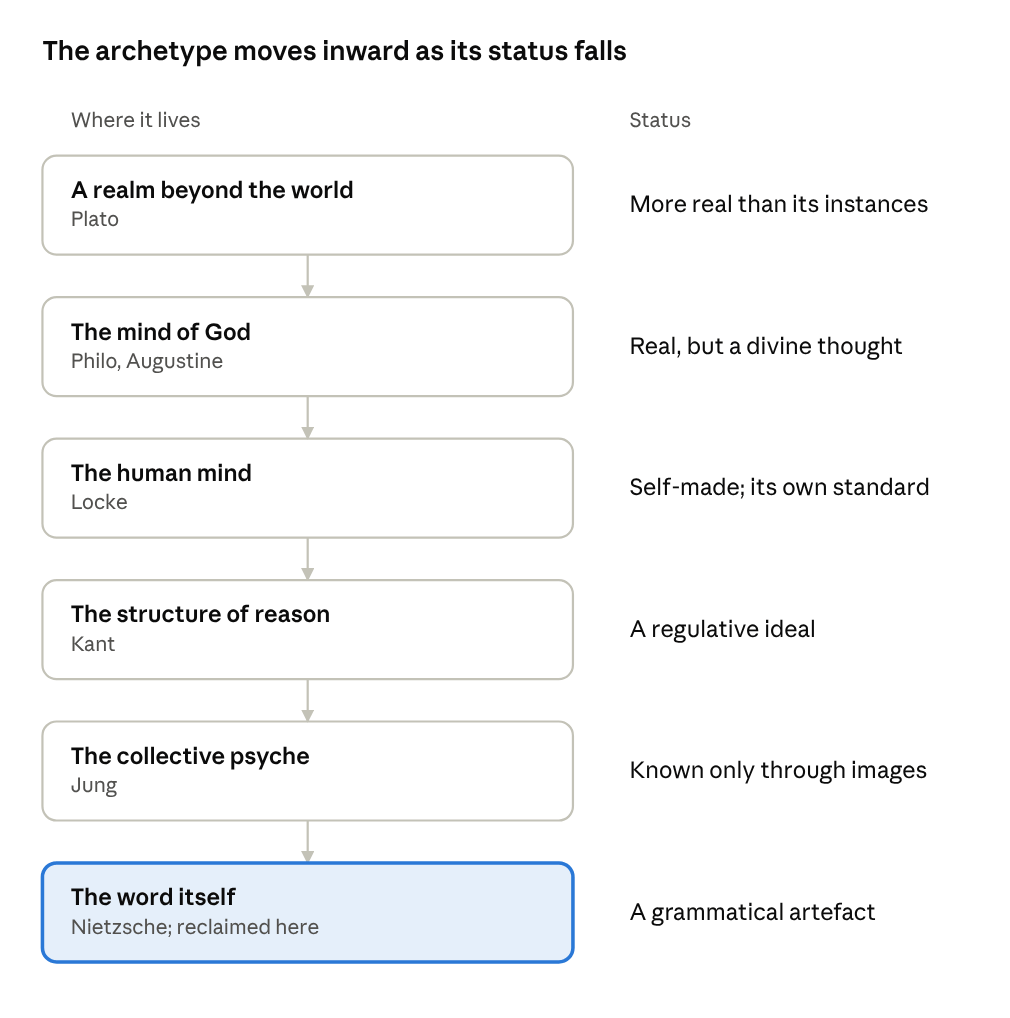
Each relocation lowers the archetype’s standing; the last leaves it in grammar.
Etymology
Greek arkhētypon joins arkhē (origin, first) and typos (a blow, and so the impression a seal leaves). An archetype is the original stamp from which copies are pressed. The image suits the reclaimed use: the archetype is the seal a word appears to carry, the certificate stamped on usage.
Real, divine, made
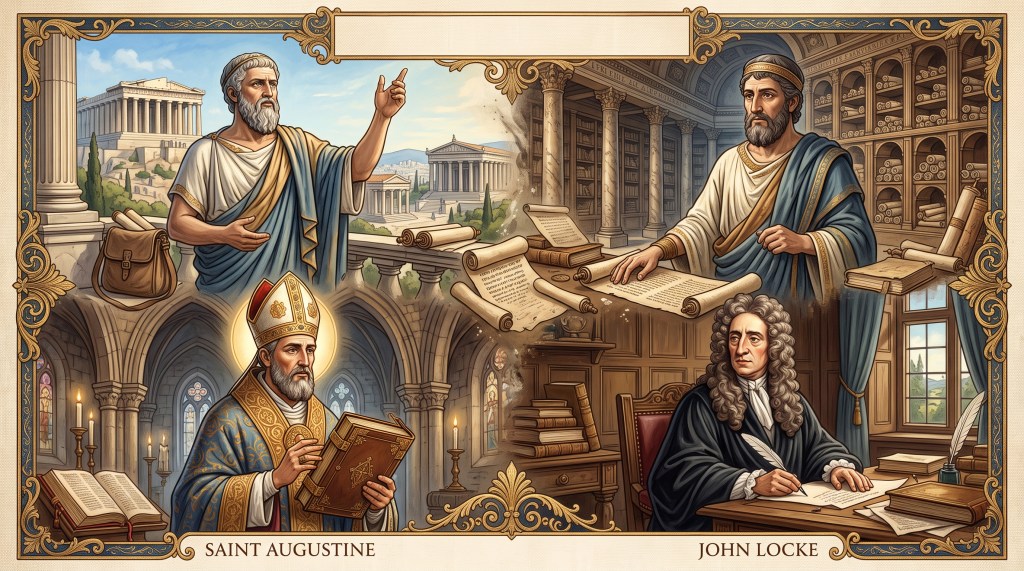
- Plato. Plato’s own term is paradeigma, the model: in the Timaeus the craftsman fashions the cosmos by looking to an eternal pattern. The Forms are more real than their instances, which participate in them imperfectly. Calling the Forms “archetypes” is later Platonist usage.
- Philo and Augustine. Philo of Alexandria uses archetype for the divine image after which humanity was moulded (De opificio mundi 69). Augustine does not use the word, but relocates the Forms as principal ideas contained in the divine understanding. The archetypes remain real and prior, but become divine thoughts rather than free-standing entities.
- Locke. In the Essay (1690), ideas of substances are copies answerable to external things. Complex ideas of modes and relations, moral ideas among them, are “archetypes of the mind’s own making”: nothing outside them must conform. Locke infers that morality is capable of demonstration. The present account accepts his premise, that moral ideas are made rather than found, and reverses his conclusion: being self-made confers no anchor.
Ideal and fiction
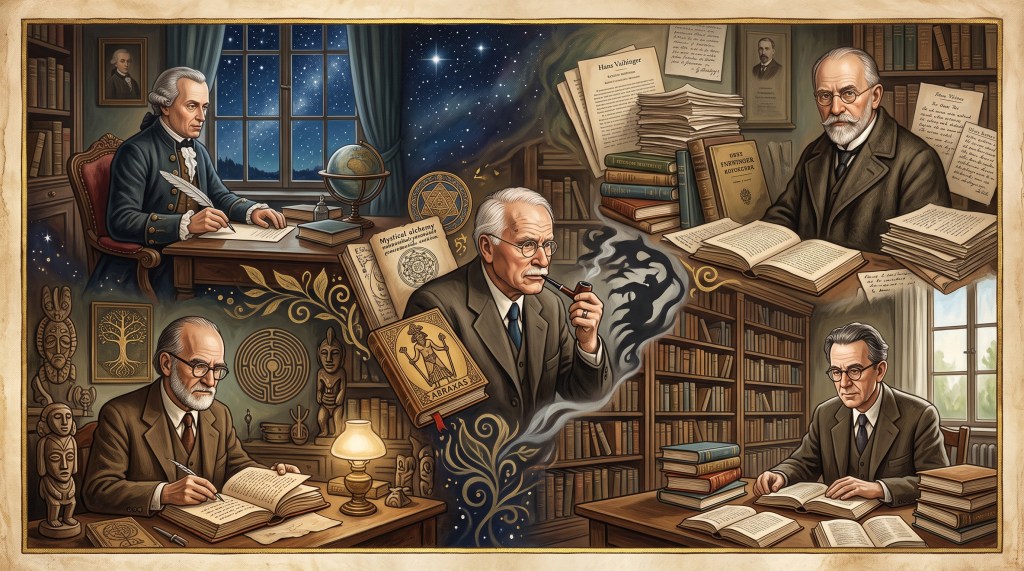
- Kant. The Urbild is an ideal that reason necessarily generates, as in the idea of perfect virtue. Nothing in experience corresponds to it, yet it orients inquiry and conduct. Kant also contrasts our discursive understanding with a hypothetical intellectus archetypus, an intellect whose thinking would produce its objects. The archetype lives in reason’s structure: approachable as a regulative ideal, never reached.
- Vaihinger. In The Philosophy of ‘As If’ (1911), ideal concepts are fictions adopted as though true, known to be false or empty, and retained because practice needs them. The archetype becomes a tool rather than a target.
Psyche and culture
- Jung. From 1919, archetypes are inherited structures of the collective unconscious: the Shadow, the Mother, the Trickster. Jung distinguished the archetype in itself, never directly known, from the archetypal images through which it appears. It is psychological and universal, approachable only through its images.
- Eliade and Frye. For Eliade, archetypes are the sacred models that myth expresses and ritual repeats. For Frye (Anatomy of Criticism, 1957), they are recurring symbols and conventions in literature. Both are cultural and descriptive rather than metaphysical, closer to genre than to essence.
Debunked and dissolved
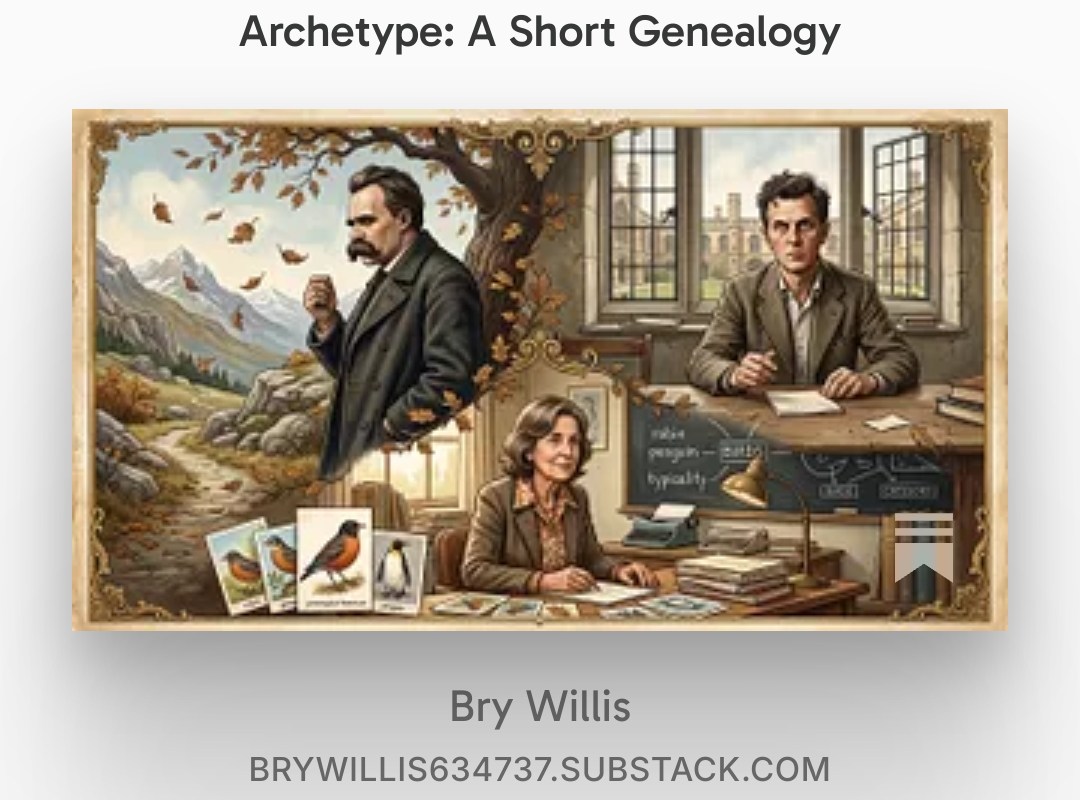
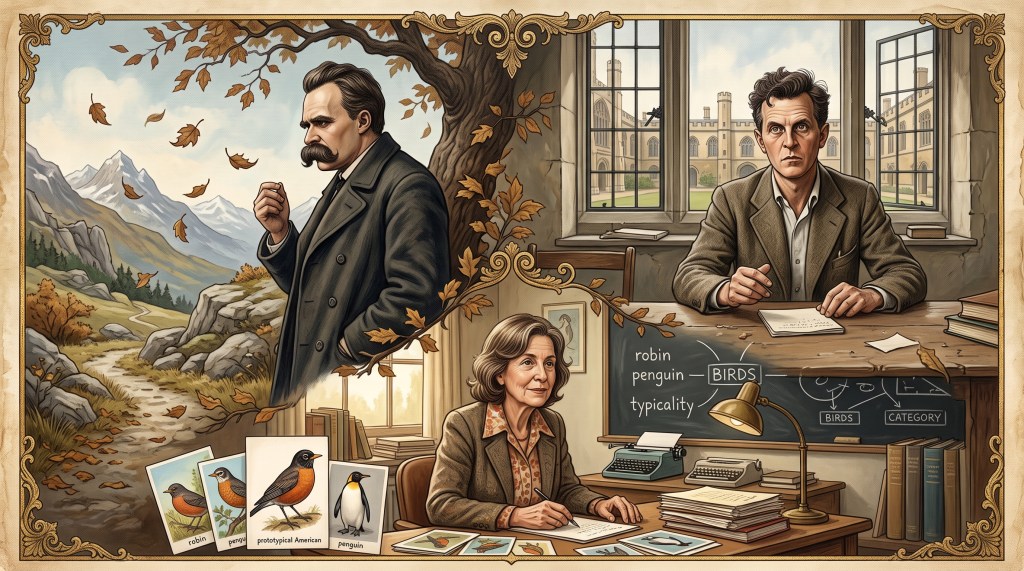
- Nietzsche. He does not use the term but supplies the critique. In “On Truth and Lies in a Nonmoral Sense” (1873), the concept leaf drops every difference between actual leaves and so suggests a primal form, an Urform, after which all leaves were woven. The archetype is an artefact of concept formation, mistaken for its source.
- Wittgenstein. The Philosophical Investigations (§§66–67) goes further: the concept never needed an archetype. Game has no common essence, only overlapping similarities, as among members of a family. Where Nietzsche debunks the archetype, Wittgenstein dissolves it.
- Rosch. Prototype theory (Rosch and Mervis, 1975) turned family resemblance into empirical work. Categories are organised around central exemplars: a robin is a “better” bird than a penguin. The prototype is a statistical centre without essence, located in how judgements cluster.
Archetype, in my sense
The nomenclature is reclaimed. An archetype is a prototype promoted beyond any instance: a centre of usage mistaken for an ideal the usage aims at.
- Against Rosch. A prototype is an exemplar, a real and typical member of its category. An archetype is what no member could be.
- With Wittgenstein. Family-resemblance terms function without a centre; nobody fights over what a game really is. An archetype appears when speakers refuse to let a word be a family-resemblance term. Monadic grammar and institutional authority demand an essence, and the archetype supplies it.
- Two kinds. Idealisations (Triangle; clock time) have a closed definition and no instance, and measurement can approach them asymptotically. Contestables (Truth, Justice, Love, God, wrong) have no closed definition, so there is no fixed limit to approach. “Not even asymptotically approachable” holds of Contestables only.
- Usage. Readers will bring Plato or Jung to the word. Define it early, and write “archetype, in my sense” at first use.
Genealogy or happenstance?
Both, at different levels. The transmission of the word and its problem is genuinely genealogical; the trajectory is a vantage imposed in retrospect.
- Real lineage. Philo and Augustine wrote within Platonism. Kant discusses Plato’s Ideas by name before redefining them as ideas of reason. Jung traced his term to Philo, Irenaeus, the Corpus Hermeticum and pseudo-Dionysius, and to Augustine’s principal ideas. Rosch and Mervis’s founding paper takes its title, “Family Resemblances”, from Wittgenstein.
- Convergence, not descent. Locke’s self-made archetypes are not a step from Augustine to Kant in any direct sense, and nothing suggests Wittgenstein derived family resemblance from Nietzsche’s leaf. Jung himself, having cited his precedents, denied deriving the idea from them. Some neighbours on the line arrived independently.
- The arc is mine. “Inward and downward” is a narrative that happens to end at the present position, which is the shape of a Whig history. Told as progress, it would install the very teleology it diagnoses.
The defensible framing is genealogy in Nietzsche’s and Foucault’s sense: not a pedigree culminating here, but a sequence of reappropriations, each reassigning the word to a new site and a new authority. On that framing the arc is a reading, offered as one, and the reclaimed sense is the latest reappropriation, not the truth the earlier ones were groping towards.
Summary
| Thinker | Where it lives | Status | Approachable? |
|---|---|---|---|
| Plato | A realm beyond the world | More real than its instances | Imperfectly, through participation |
| Philo, Augustine | The mind of God | Real; a divine thought | Through divine illumination (Augustine) |
| Locke | The human mind | Self-made; its own standard | Already reached: it is its own archetype |
| Kant | The structure of reason | Regulative ideal | Approached, never reached |
| Vaihinger | Working assumptions | Useful fiction | Not a target |
| Jung | The collective psyche | Inherited structure | Only through its images |
| Eliade, Frye | Myth and literature | Cultural pattern | Repeated, not approached |
| Nietzsche | The concept | Artefact of concept formation | Nothing to approach |
| Wittgenstein | Nowhere | Unneeded | No archetype to approach |
| Rosch | Clusters of judgement | Prototype: a statistical centre | Instantiated by exemplars |
| Willis | The word | Prototype promoted beyond any instance | Idealisations asymptotically; Contestables not at all |
Sources
Jung’s attributions (Collected Works 9i, ¶5) were checked against secondary sources on 16 October 2026; other attributions are from general knowledge.

