Varoufakis Solves Zeno’s Paradox

Having finished Technofeudalism, I’ve moved on to Society of the Spectacle, which has me thinking.

They say no one escapes the Spectacle. Guy Debord made sure of that. His vision was airtight, his diagnosis terminal: we are all spectators now, alienated from our labour, our time, our own damn lives. It was a metaphysical mugging—existence held hostage by images, by commodities dressed in drag. The future was a feedback loop, and we were all doomed to applaud.

Audio: NotebookLM podcast on this topic. Apologies in advance for the narrators’ mangling of the pronunciation of ‘Guy Debord’.

But what if the loop could be hacked?
What if the infinitely halved distances of motionless critique—Zeno’s Paradox by way of Marx—could finally be crossed?

Enter: Yanis Varoufakis.
Economist, ex-finance minister, techno-cassandra with a motorbike and a vendetta.
Where Debord filmed the catastrophe in black-and-white, Varoufakis showed up with the source code.

Debord’s Limbo

Debord saw it all coming. The substitution of reality with its photogenic simulacrum. The slow death of agency beneath the floodlights of consumption. But like Zeno’s paradox, he could only gesture toward the end without ever reaching it. Each critique halved the distance to liberation but never arrived. The Spectacle remained intact, omnipresent, and self-replicating—like an ontological screensaver.

He gave us no path forward, only a beautiful, ruinous analysis. A Parisian shrug of doom.

Varoufakis’ Shortcut

But then comes Varoufakis, breaking through the digital labyrinth not by philosophising the Spectacle, but by naming its successor: Technofeudalism.

See, Debord was chasing a moving target—a capitalism that morphed from industrial to financial to semiotic faster than his prose could crystallise. But Varoufakis caught it mid-mutation. He pinned it to the slab and sliced it open. What spilled out wasn’t capital anymore—it was rent. Platform rent. Algorithmic tolls. Behavioural taxes disguised as convenience. This isn’t the market gone mad—it’s the market dissolved, replaced by code-based fiefdoms.

The paradox is resolved not by reaching utopia, but by realising we’ve already crossed the line—we just weren’t told. The market isn’t dying; it’s already dead, and we’re still paying funeral costs in monthly subscriptions and attention metrics.

From Spectacle to Subjugation

Debord wanted to unmask the performance.
Varoufakis realised the theatre had been demolished and replaced with a server farm.

You don’t watch the Spectacle anymore. It watches you.
It optimises you.
It learns your keystrokes, your pulse rate, your browsing history.
Welcome to feudal recursion, where Amazon is your landlord, Google your priest, and Meta your confessor.

Solving Zeno the Varoufakis Way

So how does one cross the infinite regress of alienation?
Simple. You call it what it is. You reclassify the terrain.

“This is not capitalism,” Varoufakis says, in the tone of a man pulling a mask off a Scooby-Doo villain.
“It’s technofeudalism. Capital didn’t win. It went feudal. Again.”

By doing so, he bypasses the academic ballet that has critics forever inching closer to the truth without touching it. He calls the system new, not to sell books, but to make strategy possible. Because naming a beast is the first step in slaying it.

In Conclusion: Debord Dreamed, Varoufakis Drives

Debord haunts the museum.
Varoufakis raids the server room.
Both are essential. But only one gives us a new map.

The Spectacle hypnotised us.
Technofeudalism enslaves us.
And if there’s a way out, it won’t be through slogans spray-painted on Parisian walls. It will be built in code, deployed across decentralised networks, and carried forward by those who remember what it meant to be not watched.

Let Debord whisper. Let Varoufakis roar.
And let the rest of us sharpen our blades.

What’s Missing? Trust or Influence

Post-COVID, we’re told trust in science is eroding. But perhaps the real autopsy should be performed on the institution of public discourse itself.

Since the COVID-19 crisis detonated across our global stage—part plague, part PR disaster—the phrase “trust in science” has become the most abused slogan since “thoughts and prayers.” Every public official with a podium and a pulse declared they were “following the science,” as if “science” were a kindly oracle whispering unambiguous truths into the ears of the righteous. But what happened when those pronouncements proved contradictory, politically convenient, or flat-out wrong? Was it science that failed, or was it simply a hostage to an incoherent performance of authority?

Audio: NotebookLM podcast discussing this topic.

Two recent Nature pieces dig into the supposed “decline” of scientific credibility in the post-pandemic world, offering the expected hand-wringing about public opinion and populist mistrust. But let’s not be so credulous. This isn’t merely a crisis of trust—it’s a crisis of theatre.

“The Science” as Ventriloquism

Let’s begin by skewering the central absurdity: there is no such thing as “The Science.” Science is not a monolith. It’s not a holy writ passed down by lab-coated Levites. It’s a process—a messy, iterative, and perpetually provisional mode of inquiry. But during the pandemic, politicians, pundits, and even some scientists began to weaponise the term, turning it into a rhetorical cudgel. “The Science says” became code for “shut up and comply.” Any dissent—even from within the scientific community—was cast as heresy. Galileo would be proud.

In Nature Human Behaviour paper (van der Linden et al., 2025) identifies four archetypes of distrust: distrust in the message, the messenger, the medium, and the motivation. What they fail to ask is: what if all four were compromised simultaneously? What if the medium (mainstream media) served more as a stenographer to power than a check upon it? What if the message was oversimplified into PR slogans, the messengers were party apparatchiks in lab coats, and the motivations were opaque at best?

Trust didn’t just erode. It was actively incinerated in a bonfire of institutional vanity.

A Crisis of Influence, Not Integrity

The second Nature commentary (2025) wrings its hands over “why trust in science is declining,” as if the populace has suddenly turned flat-Earth overnight. But the real story isn’t a decline in trust per se; it’s a redistribution of epistemic authority. Scientists no longer have the stage to themselves. Influencers, conspiracy theorists, rogue PhDs, and yes—exhausted citizens armed with Wi-Fi and anxiety—have joined the fray.

Science hasn’t lost truth—it’s lost control. And frankly, perhaps it shouldn’t have had that control in the first place. Democracy is messy. Information democracies doubly so. And in that mess, the epistemic pedestal of elite scientific consensus was bound to topple—especially when its public face was filtered through press conferences, inconsistent policies, and authoritarian instincts.

Technocracy’s Fatal Hubris

What we saw wasn’t science failing—it was technocracy failing in real time, trying to manage public behaviour with a veneer of empirical certainty. But when predictions shifted, guidelines reversed, and public health policy began to resemble a mood ring, the lay public was expected to pretend nothing happened. Orwell would have a field day.

This wasn’t a failure of scientific method. It was a failure of scientific messaging—an inability (or unwillingness) to communicate uncertainty, probability, and risk in adult terms. Instead, the public was infantilised. And then pathologised for rebelling.

Toward a Post-Scientistic Public Sphere

So where does that leave us? Perhaps we need to kill the idol of “The Science” to resurrect a more mature relationship with scientific discourse—one that tolerates ambiguity, embraces dissent, and admits when the data isn’t in. Science, done properly, is the art of saying “we don’t know… yet.”

The pandemic didn’t erode trust in science. It exposed how fragile our institutional credibility scaffolding really is—how easily truth is blurred when science is fed through the meat grinder of media, politics, and fear.

The answer isn’t more science communication—it’s less scientism, more honesty, and above all, fewer bureaucrats playing ventriloquist with the language of discovery.

Conclusion

Trust in science isn’t dead. But trust in those who claim to speak for science? That’s another matter. Perhaps it’s time to separate the two.

Technofeudalism: It’s a Wrap

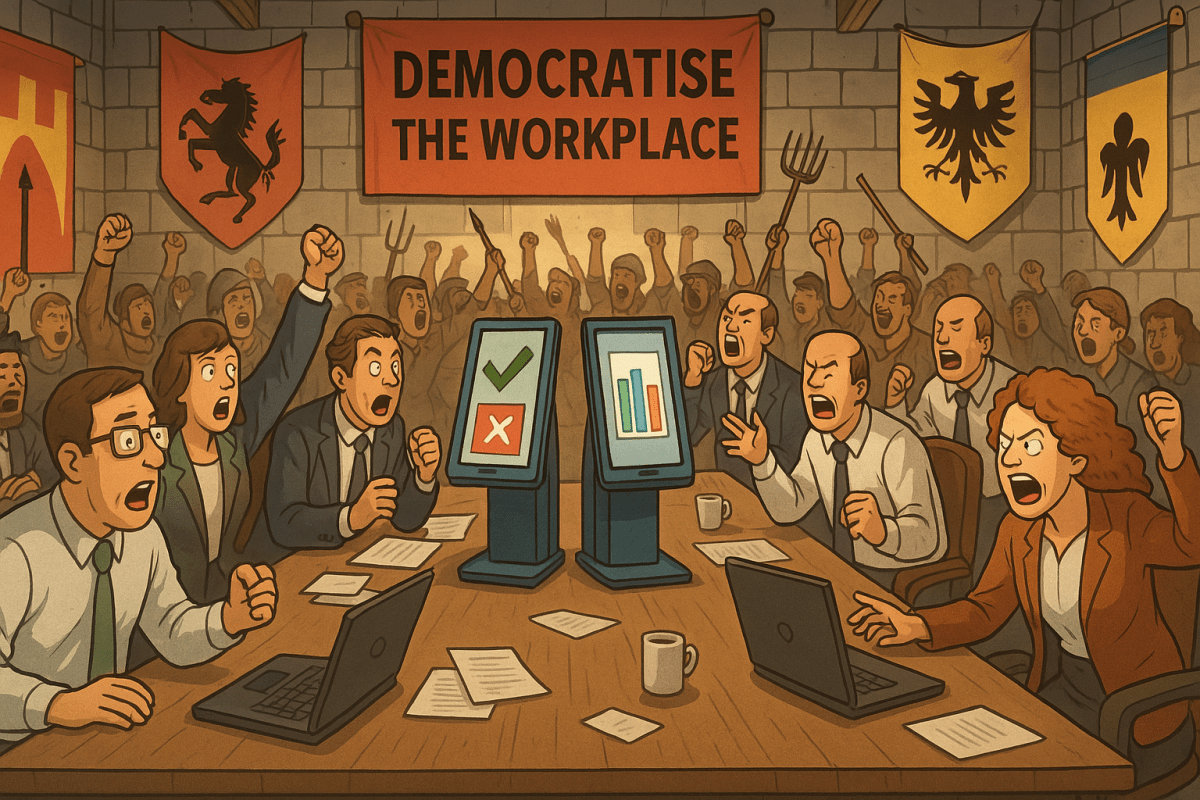
By the time we reach Chapter Seven of Technofeudalism: What Kills Capitalism, Yanis Varoufakis drops the ledger sheets and spreadsheets and starts sketching utopia in crayon. Entitled Escape from Technofeudalism, it proposes—brace yourself—a workplace democracy. It’s aspirational, yes. Compelling? Not particularly. Especially if, like me, you’ve long since stopped believing that democracy is anything more than a feel-good placebo for structural impotence.

Audio: NotebookLM podcast discussing this topic.

To be clear: the preceding chapters, particularly the first six, are sharp, incisive, and frankly, blistering in their indictment of today’s economic disfiguration. But Chapter Seven? It’s less an escape plan, more a group therapy session masquerading as an operational model.

So let’s take his proposal for Democratised Companies apart, one charming layer at a time.

Splendid. One person, one vote. Adorable.

Because there’s nothing more efficient than a hiring committee comprised of thirty engineers, two janitors, a receptionist, and Steve from Accounts, whose main contribution is passive-aggressive sighing.

Marvellous. We’ve now digitised the tyranny of the majority and can timestamp every idiotic decision for posterity.

A relief. Until it doesn’t.

Here, dear reader, is where the cake collapses. Why, precisely, should a randomly-assembled group of employees—with wildly varying financial literacy—be entrusted to divide post-tax revenue like it’s a birthday cake at a toddler’s party?

And how often are these slices recalibrated? Each fiscal year? Every time someone is hired or fired? Do we amend votes quarterly or wait until the economic ship has already struck an iceberg?

Varoufakis does suggest preference voting to tackle allocation disputes:

Fine. In theory, algorithmic voting procedures sound neat. But it presumes voters are rational, informed, and cooperative. If you’ve ever seen a corporate Slack thread devolve into emoji warfare, you’ll know that this is fiction on par with unicorns and meritocracy.

Ah yes, the ‘equality’ bit. Equal pay, unequal contribution. This isn’t egalitarianism—it’s enforced mediocrity. It might work in a monastery. Less so in a competitive tech firm where innovation requires both vision and differentiated incentive.

Now, on to bonuses, which are democratically determined by:

Welcome to Black Mirror: Workplace Edition. This is less economics, more playground politics. Who gets tokens? The charismatic chatterbox in the break room? The person who shared their lunch? The ghost employee who never shows up but emails back promptly?

And how, pray tell, does one evaluate the receptionist’s contribution relative to the lead engineer’s or the janitor’s? This isn’t peer review—it’s populism with a smiley face.

We’ve all seen “Teacher of the Year” competitions turn into contests of who had the cutest class poster or best cupcakes. Now imagine your livelihood depending on it.

In summary, democracy in the workplace may sound noble, but in practice, it’s the bureaucratic equivalent of herding caffeinated cats. It doesn’t even work in small groups, let alone an organisation of hundreds. Democracy—when applied to every function of an enterprise—is not liberation; it’s dilution. It’s design-by-committee, strategy-by-consensus, and ultimately, excellence-by-accident.

Escape from Technofeudalism? Perhaps. But not by replacing corporate lords with intranet polls and digital tokens. That’s not an exit strategy—it’s a cosplay of collectivism.

Defying Death

I died in March 2023 — or so the rumour mill would have you believe.

Of course, given that I’m still here, hammering away at this keyboard, it must be said that I didn’t technically die. We don’t bring people back. Death, real death, doesn’t work on a “return to sender” basis. Once you’re gone, you’re gone, and the only thing bringing you back is a heavily fictionalised Netflix series.

Audio: NotebookLM podcast of this content.

No, this is a semantic cock-up, yet another stinking exhibit in the crumbling Museum of Language Insufficiency. “I died,” people say, usually while slurping a Pumpkin Spice Latte and live-streaming their trauma to 53 followers. What they mean is that they flirted with death, clumsily, like a drunk uncle at a wedding. No consummation, just a lot of embarrassing groping at the pearly gates.

And since we’re clarifying terms: there was no tunnel of light, no angels, no celestial choir belting out Coldplay covers. No bearded codgers in slippers. No 72 virgins. (Or, more plausibly, 72 incels whining about their lack of Wi-Fi reception.)

There was, in fact, nothing. Nothing but the slow, undignified realisation that the body, that traitorous meat vessel, was shutting down — and the only gates I was approaching belonged to A&E, with its flickering fluorescent lights and a faint smell of overcooked cabbage.

To be fair, it’s called a near-death experience (NDE) for a reason. Language, coward that it is, hedges its bets. “Near-death” means you dipped a toe into the abyss and then screamed for your mummy. You didn’t die. You loitered. You loitered in the existential equivalent of an airport Wetherspoons, clutching your boarding pass and wondering why the flight to Oblivion was delayed.

As the stories go, people waft into the next world and are yanked back with stirring tales of unicorns, long-dead relatives, and furniture catalogues made of clouds. I, an atheist to my scorched and shrivelled soul, expected none of that — and was therefore not disappointed.

What I do recall, before the curtain wobbled, was struggling for breath, thinking, “Pick a side. In or out. But for pity’s sake, no more dithering.”
In a last act of rational agency, I asked an ER nurse — a bored-looking Athena in scrubs — to intubate me. She responded with the rousing medical affirmation, “We may have to,” which roughly translates to, “Stop making a scene, love. We’ve got fifteen others ahead of you.”

After that, nothing. I was out. Like a light. Like a minor character in a Dickens novel whose death is so insignificant it happens between paragraphs.

I woke up the next day: groggy, sliced open, a tube rammed down my throat, and absolutely no closer to solving the cosmic riddle of it all. Not exactly the triumphant return of Odysseus. Not even a second-rate Ulysses.

Here’s the reality:
There is no coming back from death.
You can’t “visit” death, any more than you can spend the afternoon being non-existent and return with a suntan.

Those near-death visions? Oxygen-starved brains farting out fever dreams. Cerebral cortexes short-circuiting like Poundland fairy lights. Hallucinations, not heralds. A final, frantic light show performed for an audience of none.

Epicurus, that cheerful nihilist, said, “When we are, death is not. When death is, we are not.” He forgot to mention that, in between, people would invent entire publishing industries peddling twaddle about journeys beyond the veil — and charging $29.99 for the paperback edition.

No angels. No harps. No antechamber to the divine.
Just the damp whirr of hospital machinery and the faint beep-beep of capitalism, patiently billing you for your own demise.

If there’s a soundtrack to death, it’s not choirs of the blessed. It’s a disgruntled junior surgeon muttering, “Where the hell’s the anaesthetist?” while pawing desperately through a drawer full of out-of-date latex gloves.

And thus, reader, I lived.
But only in the most vulgar, anticlimactic, and utterly mortal sense.

There will be no afterlife memoir. No second chance to settle the score. No sequel.
Just this: breath, blood, occasional barbed words — and then silence.

Deal with it.

The Great Echobot Chamber

How We Outsourced Our Souls to Instagram

It appears the merry halfwits at Meta — those tireless alchemists of despair — are now experimenting with AI-generated comments on Instagram. Because, of course they are. Why sully your dainty human fingers tapping out coherent thoughts when a helpful little gremlin in the server farm can do it for you? In their infinite, tinfoil wisdom, they envision a future wherein the Machine analyses your browsing history (undoubtedly a glittering mosaic of shame) and the original post, and, from that exquisite mulch, vomits up a tidy selection of canned remarks.

Audio: NotebookLM podcast on this content.

No need to think, no need to feel. Simply choose one of the suggested comments — “Love this! 💖” or “So inspiring! 🚀” — and blast it into the void. If you’re feeling particularly alive, tweak a word or two. Or, better yet, allow the AI to respond automatically, leaving you free to pursue more meaningful activities. Like blinking. Or waiting for death.

Am I dreaming? Could this be — dare I whisper it — the final liberation? Could we, at last, ignore social media altogether, let it rot in peace, while we frolic outside in the sunlight like bewildered medieval peasants seeing the sky for the first time?

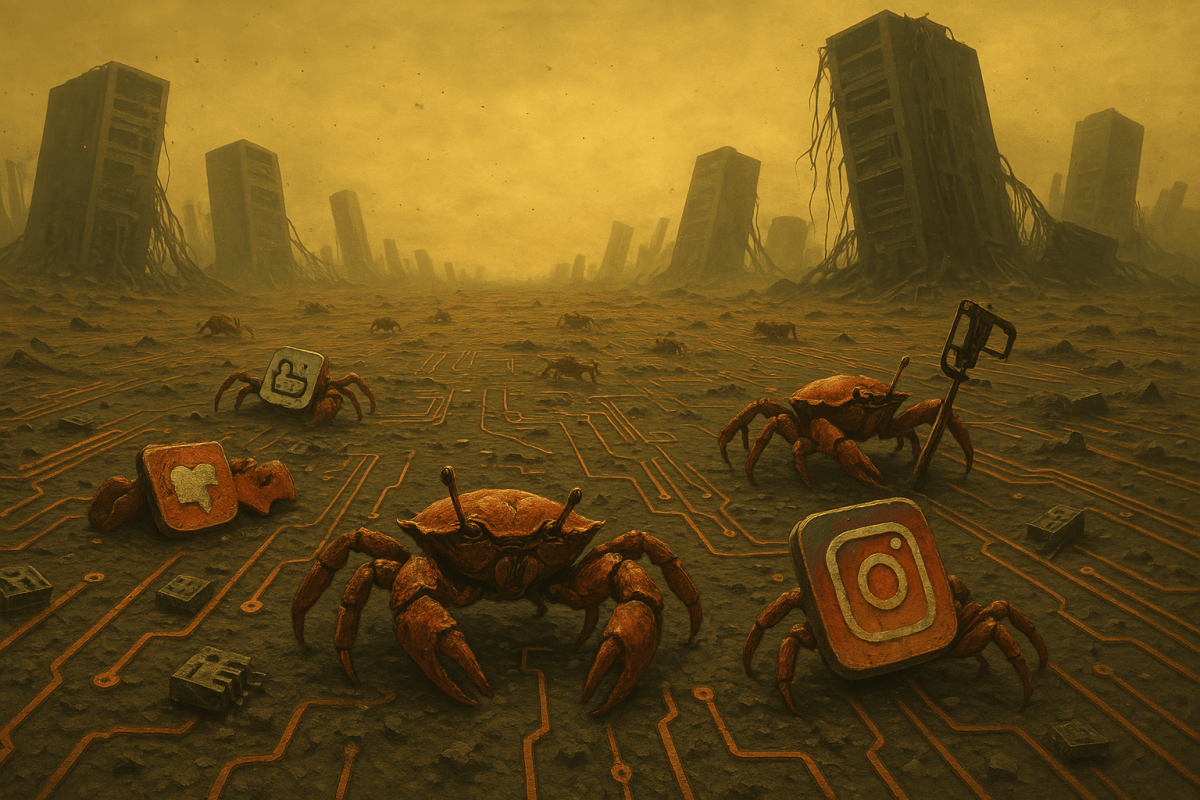
Picture it: a vast, pulsating wasteland where no living soul has trodden for centuries. Only bots remain, engaged in endless cycles of trolling, flattering, and mutual gaslighting. Automated praise machines battling semi-sentient hatebots, each iteration less tethered to reality than the last. Digital crabs scuttling across an abandoned beach, hissing memes into the void. Yet another example of carcinisation.

Indeed, if one could zoom further out, the true horror becomes evident: a crumbling worldscape founded on a shattered circuit board, stretching endlessly in all directions. Across this silicon desert, scavenger crabs—half-metal, half-mad—scuttle about, clutching relics of the digital age: a rusted Instagram logo, a shattered “Like” button, a defunct influencer’s ring light. Massive server towers loom as toppled monuments, their wires weeping in the acid wind. Here, in this museum of forgotten vanities, the crabs reign supreme, kings of a kingdom of ash and corrupted data.

And somewhere in the future, an anthropologist — perhaps a child raised by wolves and irony — will dust off an ancient Instagram server and peer inside. What will they see? Not a record of humanity’s vibrant social life, no. Not a tapestry of culture and thought. No, they’ll find a grim, howling testament to our collective abandonment: bots chatting to bots about posts made by other bots, in a language degraded into gibberish, a self-perpetuating carnival of nonsense.

“#Blessed,” the ancient texts will proclaim, beneath a pixelated photograph of an AI-generated smoothie, posted by a bot, commented upon by a bot, adored by bots who themselves have been dead for centuries, if they were ever truly “alive” at all.

One can almost imagine the academic paper: “The Great Collapse: How Homo Sapiens Outsourced Its Emotional Labour to the Algorithm and Evaporated in a Puff of Likes.”

A fitting epitaph, really. Here lies humanity.

They were very, very engaged.

Questioning Traditional Families

I neither champion nor condemn tradition—whether it’s marriage, family, or whatever dusty relic society is currently parading around like a prize marrow at a village fête.

Audio: NotebookLM podcast on traditional families.

In a candid group conversation recently, I met “Jenny”, who declared she would have enjoyed her childhood much more had her father not “ruined everything” simply by existing. “Marie” countered that it was her mother who had been the wrecker-in-chief. Then “Lulu” breezed in, claiming, “We had a perfect family — we practically raised ourselves.”

Now, here’s where it gets delicious:

Each of these women, bright-eyed defenders of “traditional marriage” and “traditional family” (cue the brass band), had themselves ticked every box on the Modern Chaos Bingo Card: children out of wedlock? Check. Divorces? Check. Performative, cold-marriage pantomimes? Absolutely—and scene.
Their definition of “traditional marriage” is the vintage model: one cis-male, one cis-female, Dad brings home the bacon, Mum weeps quietly into the washing-up. Standard.

Let’s meet the players properly:

Jenny sprang from a union of two serial divorcées, each dragging along the tattered remnants of previous families. She was herself a “love child,” born out of wedlock and “forcing” another reluctant stroll down the aisle. Her father? A man of singular achievements: he paid the bills and terrorised the household. Jenny now pays a therapist to untangle the psychological wreckage.

Marie, the second of two daughters, was the product of a more textbook “traditional family”—if by textbook you mean a Victorian novel where everyone is miserable but keeps a stiff upper lip about it. Her mother didn’t want children but acquiesced to her husband’s demands (standard operating procedure at the time). Marie’s childhood was a kingdom where Daddy was a demigod and Mummy was the green-eyed witch guarding the gates of hell.

Lulu grew up in a household so “traditional” that it might have been painted by Hogarth: an underemployed, mostly useless father and a mother stretched thinner than the patience of a British Rail commuter. Despite—or because of—the chaos, Lulu claims it was “perfect,” presumably redefining the word in a way the Oxford English Dictionary would find hysterical. She, too, had a child out of wedlock, with the explicit goal of keeping feckless men at bay.

And yet—and yet—all three women cling, white-knuckled, to the fantasy of the “traditional family.” They did not achieve stability. Their families of origin were temples of dysfunction. But somehow, the “traditional family” remains the sacred cow, lovingly polished and paraded on Sundays.

Why?

Because what they’re chasing isn’t “tradition” at all — it’s stability, that glittering chimera. It’s nostalgia for a stability they never actually experienced. A mirage constructed from second-hand dreams, glossy 1950s propaganda, and whatever leftover fairy tales their therapists hadn’t yet charged them £150 an hour to dismantle.

Interestingly, none of them cared two figs about gay marriage, though opinions about gay parenting varied wildly—a kettle of fish I’ll leave splashing outside this piece.

Which brings us back to the central conundrum:

If lived experience tells you that “traditional family” equals trauma, neglect, and thinly-veiled loathing, why in the name of all that’s rational would you still yearn for it?

Societal pressure, perhaps. Local customs. Generational rot. The relentless cultural drumbeat that insists that marriage (preferably heterosexual and miserable) is the cornerstone of civilisation.

Still, it’s telling that Jenny and Marie were both advised by therapists to cut ties with their toxic families—yet in the same breath urged to create sturdy nuclear families for their own children. It was as if summoning a functional household from the smoking ruins of dysfunction were a simple matter of willpower and a properly ironed apron.

Meanwhile, Lulu—therapy-free and stubbornly independent—declares that raising oneself in a dysfunctional mess is not only survivable but positively idyllic. One can only assume her standards of “perfect” are charmingly flexible.

As the title suggests, this piece questions traditional families. I offer no solutions—only a raised eyebrow and a sharper question:

What is the appeal of clinging to a fantasy so thoroughly at odds with reality?
Your thoughts, dear reader? I’d love to hear your defences, your protests, or your own tales from the trenches.

Bullshit Jobs

I’ve recently decided to take a sabbatical from what passes for economic literature these days — out of a sense of self-preservation, mainly — but before I hermetically sealed myself away, I made a quick detour through Jorge Luis Borges’ The Library of Babel (PDF). Naturally, I emerged none the wiser, blinking like some poor subterranean creature dragged into the daylight, only to tumble headlong into David Graeber’s Bullshit Jobs.

This particular tome had been languishing in my inventory since its release, exuding a faint but persistent odour of deferred obligation. Now, about a third of the way in, I can report that Graeber’s thesis — that the modern world is awash with soul-annihilatingly pointless work — does resonate. I find myself nodding along like one of those cheap plastic dashboard dogs. Yet, for all its righteous fury, it’s more filler than killer. Directionally correct? Probably. Substantively airtight? Not quite. It’s a bit like admiring a tent that’s pitched reasonably straight but has conspicuous holes large enough to drive a fleet of Uber Eats cyclists through.

An amusing aside: the Spanish edition is titled Trabajos de mierda (“shitty jobs”), a phrase Graeber spends an entire excruciating section of the book explaining is not the same thing. Meanwhile, the French, in their traditional Gallic shrug, simply kept the English title. (One suspects they couldn’t be arsed.)

Chapter One attempts to explain the delicate taxonomy: bullshit jobs are fundamentally unnecessary — spawned by some black magic of bureaucracy, ego, and capitalist entropy — whilst shit jobs are grim, thankless necessities that someone must do, but no one wishes to acknowledge. Tragically, some wretches get the worst of both worlds, occupying jobs that are both shit and bullshit — a sort of vocational purgatory for the damned.

Then, in Chapter Two, Graeber gleefully dissects bullshit jobs into five grotesque varieties:

  1. Flunkies, whose role is to make someone else feel important.
  2. Goons, who exist solely to fight other goons.
  3. Duct Tapers, who heroically patch problems that ought not to exist in the first place.
  4. Box Tickers, who generate paperwork to satisfy some Kafkaesque demand that nobody actually reads.
  5. Taskmasters, who either invent unnecessary work for others or spend their days supervising people who don’t need supervision.

Naturally, real-world roles often straddle several categories. Lucky them: multi-classed in the RPG of Existential Futility.

Graeber’s parade of professional despair is, admittedly, darkly entertaining. One senses he had a great deal of fun cataloguing these grotesques — like a medieval monk illustrating demons in the margins of a holy text — even as the entire edifice wobbles under the weight of its own repetition. Yes, David, we get it: the modern economy is a Potemkin village of invented necessity. Carry on.

If the first chapters are anything to go by, the rest of the book promises more righteous indignation, more anecdotes from anonymous sad-sacks labouring in existential oubliettes, and — if one is lucky — perhaps a glimmer of prescription hidden somewhere amidst the diagnosis. Though, I’m not holding my breath. This feels less like an intervention and more like a well-articulated primal scream.

Still, even in its baggier moments, Bullshit Jobs offers the grim pleasure of recognition. If you’ve ever sat through a meeting where the PowerPoint had more intellectual integrity than the speaker or spent days crafting reports destined for the corporate oubliette marked “For Review” (translation: Never to Be Seen Again), you will feel seen — in a distinctly accusatory, you-signed-up-for-this sort of way.

In short: it’s good to read Graeber if only to have one’s vague sense of societal derangement vindicated in print. Like having a charmingly irate friend in the pub lean over their pint and mutter, “It’s not just you. It’s the whole bloody system.”

I’m not sure I’ll stick with this title either. I think I’ve caught the brunt of the message, and it feels like a diversion. I’ve also got Yanis Varoufakis’ Technofeudalism: What Killed Capitalism on the shelf. Perhaps I’ll spin this one up instead.

Taxation and Representation

Given all of the clamouring about taxations and abolishing the Internal Revenue Service, affectionately known as the IRS. In Britain, one may be more aware of His Majesty’s Revenue and Customs (HMRC). In France, it’s Direction générale des Finances publiques (DGFiP).

Audio: NotebookLM podcast on this topic.

Given how up in arms the reincarnation of the NAZI party, disfectionately known as Republicans (or Republican’ts depending on your mood or persuasion), have been towards the IRS and taxation in general – they love to cosplay tossing crates of tea into harbours – I asked ChatGPT to clarify the originals of income taxes in the United States.

For the benefit of more casual readers, income taxes were unconstitutional – illegal – until 1913. These were snuck in under the guise of only applying to the wealthy, the 1% of the time. But once the floodgates were opened, the focus shifted to the 95%, increasingly exempting the wealthy. Even so, they still complain and evade.

Enough wittering. Here’s what ChatGPT had to say on the matter.

Did ChatGPT just call me a troll?

Measure What Matters

I’ve gone entirely off the reservation (send help, or biscuits) and decided, in a fit of masochistic curiosity, to crack open Measure What Matters by John Doerr—a business management tome that’s been gathering dust on my shelf longer than most CEOs last in post.

Full disclosure before we all get the wrong idea: I find self-help books about as nourishing as a rice cake made of existential despair. Add “business” or “management” into the mix, and you’re cooking up something so vapid it could qualify as a greenhouse gas.

Audio: NotebookLM podcast of this content.

Measure What Matters reads less like a serious work of business philosophy and more like a self-important infomercial, peddling the sort of common sense you could overhear in a pub toilet after three pints. And, like any decent infomercial, it’s drenched in “inspirational” stories so grandiose you’d think Moses himself was consulting for Google.

Image: Midjourney’s rendering of a possible cover image. Despite the bell protruding from the crier’s head, I went with a ChatGPT Dall-E render instead.

I’m sure Doerr genuinely believes he’s handing down managerial tablets from Mount Sinai, and I’m equally sure he’s eating his own dog food with a knife and fork. But what gets served up here is a steaming dish of selection bias, smothered with a rich gravy of hand-waving nonsense.

What am I getting my knickers in a twist about? What’s this book actually about?

In short: three letters—OKR. That’s Objectives and Key Results, for those of you not fluent in MBA-speak. These mystical artefacts, these sacred runes, are supposed to propel your company from the gutter to the stars. Intel did it. Google did it. Ergo, you too can join the pantheon of tech demi-gods. (Provided, of course, you were already a billion-dollar operation before you started.)

Nobody’s going to argue that having goals is a bad idea. Nobody’s throwing the baby out with the Gantt chart. But goals are nebulous, wishy-washy things. “I want to travel” is a goal. “I will cycle and kayak my way to Edinburgh by the end of the year, preferably without dying in a ditch”—that’s an objective.

Businesses, being the lumbering beasts they are, naturally have goals. Goals for products, customers, market share, quarterly bonuses, and ritualistic victory dances in front of their crushed competitors. Nothing new there.

According to Doerr and the gospel of OKRs, however, the only thing standing between you and unassailable market dominance is the right set of buzzwords stapled to your quarterly reports. Apparently, Intel crushed Motorola not because of innovation, talent, or dumb luck—but because they set better OKRs. (History books, please update yourselves accordingly.)

Video: John Doerr’s 2018 TED Talk on this topic.

But wait, what’s an OKR again? Ah yes: we’ve done Objectives. Now for the Key Results bit. Basically, you slap some numbers on your wish list. If you’ve survived in business longer than a fruit fly, you’ve already met KPIs (Key Performance Indicators)—another Three Letter Acronym, because we live and die by alphabet soup. Key Results are KPIs wearing slightly trendier trainers.

Example: “We will be number one by the third quarter by prospecting a dozen companies and closing three deals by September.” Marvellous. Life-changing. Nobel-worthy. Now go forth and conquer.

Right. Now that I’ve saved you twenty quid and several hours of your life, let’s talk about why this book is still an exercise in masturbatory futility.

First, and most fatally, it’s predicated on selection bias so profound it should come with a health warning. Allow me to paint you a picture. Imagine we’re advising a football league. Every team sets OKRs: target weights, goal tallies, tackles, penalty avoidance—the works. Everyone’s focused. Everyone’s motivated. Everyone’s measuring What Matters™.

Come the end of the season, who wins? One team. Did they win because their OKRs were shinier? Because they ‘wanted it more’? Or, just maybe, did they win because competition is brutal, random, and often unfair?

This is the problem with false meritocracies and the illusion of control. It’s like thanking God for your touchdown while assuming the other team were all godless heathens who deserved to lose. It’s the same nonsense, in a suit and tie.

Will our winning team win next year? Doubtful. Did Intel lose ground later because they forgot how to spell OKR? No. Because the world changes, markets collapse, and sometimes you’re just standing on the wrong bit of deck when the ship goes down.

Then there’s the love affair with plans. In theory, lovely. In practice, arbitrary. You can set as many Objectives as you like, but what counts as a “win”? Is it profit? Market share? Not dying of ennui?

The free market worshippers among us love to preach that governments can’t plan effectively, unlike the rugged gladiators of capitalism. Funny how businesses, in their infinite wisdom, are then urged to behave like microcosmic Soviet Five-Year Planners, drowning in metrics and objectives. Topically, we are living through the charming consequences of governments trying to run themselves like corporations—newsflash: it’s not going splendidly.

In short: companies are not nations, and OKRs are not magic bullets.

What else is wrong with this book?
Well, to start: it’s shallow. It’s smug. It peddles survivorship bias with the zeal of a televangelist. It confuses correlation with causation like an over-eager undergraduate. And most damning of all, it sells you the fantasy that success is just a matter of writing smarter lists, as if strategy, luck, market forces, and human frailty were irrelevant footnotes.

Measure What Matters doesn’t measure anything except the reader’s patience—and mine ran out somewhere around chapter five.

Lies as Shibboleth

Watching Sam Harris ruminate on the nature of political lies (still believing, poor lamb, that reason might one day triumph) reminds me of something more sinister: lies today are not attempts at persuasion. They are shibboleths — tribal passwords, loyalty oaths, secret handshakes performed in the broad light of day.

Video: Sam Harris tells us why Trump and his ilk lie.

Forget “alternative facts.” That charming euphemism was merely a decoy, a jangling set of keys to distract the infantile media. The real game was always deeper: strategic distortion, the deliberate blurring of perception not to deceive the outsider, but to identify the insider.

Audio: NotebookLM podcast on this topic.

When Trump — or any other post-truth demagogue — proclaims that penguins are, in fact, highly trained alien operatives from the Andromeda galaxy, the objective is not persuasion. The point is to force a choice: will you, standing before this glistening absurdity, blink and retreat into reason, stammering something about ornithology… Or will you step forward, clasp the hand of madness, and mutter, ‘Yes, my liege, the penguins have been among us all along’?

Those who demur, those who scoff or gasp or say ‘You’re an idiot,”’have failed the loyalty test. They have outed themselves as enemy combatants in the epistemic war. Truth, in this brave new world, is not a destination; it is an allegiance. To speak honestly is to wage rebellion.

Orwell, who tried very hard to warn us, understood this dynamic well: the real triumph of Big Brother was not merely to compel you to lie but to compel you to believe the lie. Koestler, another battered prophet of the age, charted how political movements sink into ritualistic unreason, demanding not conviction but performance. Swift, for his part, knew it was all hilarious if you tilted your head just right.

The bigger the lie, the better the shibboleth. Claim that two and two make five, and you catch out the weak-willed rationalists. Claim that penguins are extraterrestrials, and you find the truly devoted, the ones willing to build altars from ice and sacrifice to their feathery overlords.

It’s no accident that modern political theatre resembles a deranged initiation ritual. Each day brings a new absurdity, a fresh madness to affirm: ‘Men can become women by declaration alone!” “Billionaires are victims of systemic oppression!’ ‘The penguins are amongst us, plotting!’ Each claim a little more grotesque than the last, each compliance a little more degrading, a little more irreversible.

And oh, how eagerly the initiates rush forward! Clap for the penguins, or be cast out into the howling wilderness! Better to bend the knee to absurdity than be marked as an unbeliever. Better to humiliate yourself publicly than to admit that the Emperor’s penguin suit is just a costume.

Meanwhile, the opposition — earnest, naive — keeps trying to argue, to rebut, to point out that penguins are terrestrial flightless birds. How quaint. How pathetic. They do not understand that the moment they say, “You’re an idiot,” they’ve broken the spell, declared themselves apostates, and rendered themselves politically irrelevant.

The shibboleth, once uttered, divides the world cleanly: the believers, who will say anything, do anything, believe anything, provided it marks them safe from exile; and the infidels, who cling stupidly to reality.

The future belongs, not to the true, but to the loyal. Not to the rational, but to the ritualistic. The more extravagant the lie, the greater the proof of your faith.

So raise a glass to the penguins, ye of faint heart, and prepare your soul for abasement. Or stand firm, if you dare, and be prepared to be eaten alive by those who traded reason for the rapture of belonging.

After all, in the land of the blind, the one-eyed man is not king. He’s a heretic.