Looking through some of the drafts clogging the blog, I decided to whittle away at the queue. I started this months ago. It’s here now, not particularly in sync with the season or recent topics, but I like Sapolsky.
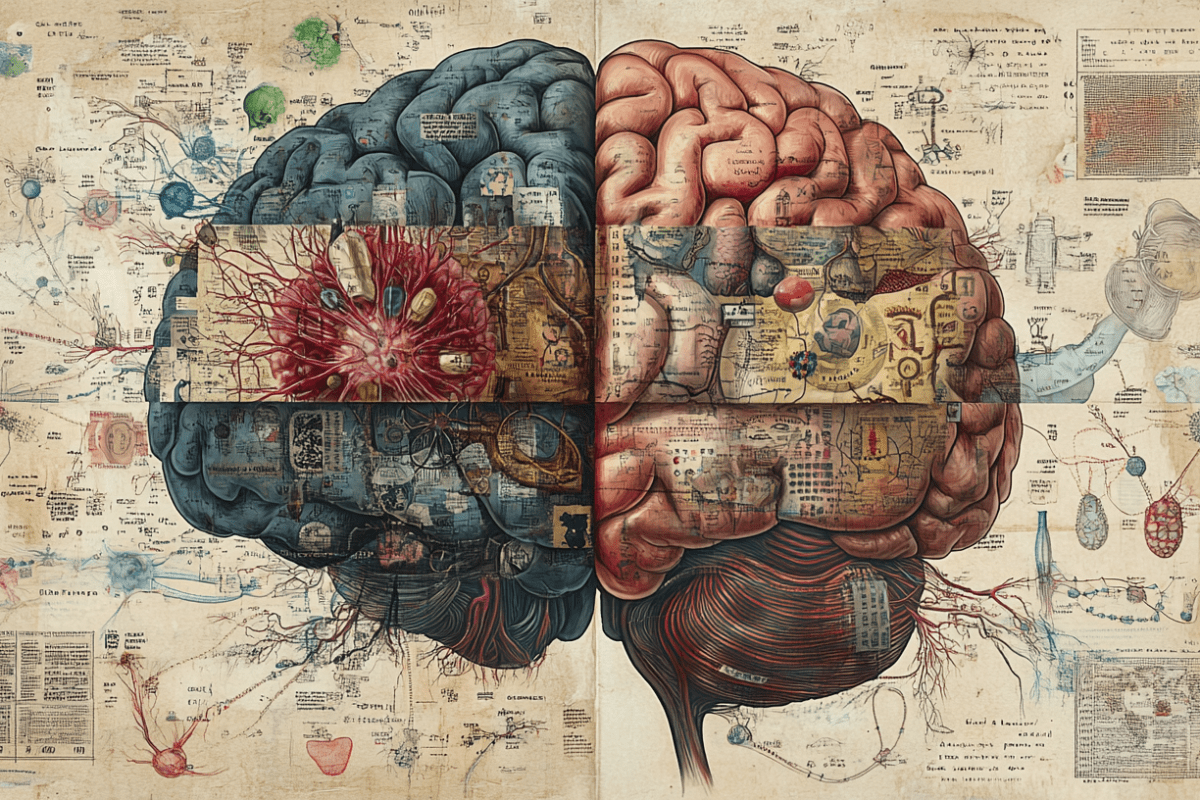
‘Biology is destiny’, say the Christian Right, the bland bureaucrats of morality, the loud whisperers at Sunday school. They want gender to be a tomb carved in marble: you’re assigned at birth, and you stay a perfect statue. But Sapolsky waltzes in and says, ‘Hold up – what do you mean by biology? Which biology? Which markers count?’
Video: Neuro-biology of Transsexuality, Prof. Robert Sapolsky
In the clip above, Sapolsky unpacks neurological evidence that upends the essentialist cheat codes. He doesn’t pretend we now have the final answer to gender. He does something scarier to fundamentalists: he shows just how messy biology is.
The Bed Nucleus, the Finger Ratio, and the ‘Wrong Body’ Hypothesis
Sapolsky discusses three pieces of neurobiological evidence:
Digit ratio (2nd vs 4th finger length): In lesbians, on average, the ratio is closer to what you see in straight men than straight women. That’s a correlation, an eyebrow-raiser, hardly a decree.
Acoustic reflexes (auto-acoustic reflex): Another early finding in women’s sexual orientation, though faint and underexplored.
The bed nucleus of the stria terminalis (BSTc): Here we reach heavy artillery. There is a neuron population in this region that, on average, is about twice as large in males as in females. In postmortem analyses of trans women (male → female), this region’s size corresponds to their identified gender, not their natal sex. Crucially, that alignment is seen even in trans individuals who never underwent full hormone therapy or surgical changes.
Sapolsky recounts astute controls: men treated (for, say, testicular cancer) with feminising hormones don’t show the same shift.
Also, using the phantom-limb analogy: men who lose their penis to cancer often report phantom sensations; trans women rarely do. That suggests the body map in the brain never fully “registered” that organ in the same way.
He doesn’t overclaim. He doesn’t say, ‘Case closed, biology proves everything’. He says: These data complicate your neat categories. They force you to ask: which biological measure do you privilege? Hypertrophied neurons? Chromosomes? Receptor density? Hormones? All of them simultaneously? None of them?
Essentialism as a Trap
Fundamentalists and anti-trans ideologues deploy essentialism because it’s convenient. They demand an ironclad ‘essence’ so they can exclude anyone who fails their test. But what Sapolsky shows is that essence is simply a scaffold; we get to pick which biological scaffolds we accept. They may choose genes and genitals; the neurobiologist gives them neuron counts and brain-maps. When your ideology elevates one scaffold and ignores the others, it betrays its own contingency.
Moreover, the evidence suggests that identity, experience, insistence (in Sapolsky’s language: ‘insisting from day one’), and internal brain structure might converge. The ‘wrong body’ isn’t a metaphor. It’s a mismatch between internal brain architecture and external form. The stubborn fragments of biology that fundamentalists accept are torn by the dissonance that science increasingly reveals.
What This Means for Trans Rights, Discourse & Strategy
Science is never ‘conclusive’. Sapolsky offers compelling support, not gospel. Anyone claiming this settles everything has never looked at a scatter plot.
Lived experience still matters. Even if we never had brain slices, self-reports, psychology, psychiatry, anthropology, narratives remain valid. Brain studies supplement, not supplant, testimony.
Essentialist opponents have boxed themselves in. When they demand biology decides everything, they hand the baton to neuroscientists – and neuroscientists keep running with it. The entire ‘biology’ equals only what I like’ regime is exposed.
Ambiguity is a strength, not a liability. If we insist identity is linear and tidy, we re-enact their demand for purity. Recognising complexity, mess, and variance is radical resistance.
I try to minimise posts to my fiction author alter ego, Ridley Park, but I am offering a promotion to download the dystopian speculative literary fiction book on Kindle for the dates noted. Click the promotion for more details.
My books have always been ‘free’ on KindleUnlimited, but this is free for anyone in Amazon’s supported markets.
Audio: Short Promo Rant
Readsy Review
“Reader discretion is advised. Free will has been deprecated.”
This ominous word of caution is what Ridley Park’s speculative novel ‘Propensity’ opens with, and it sets a tone that strikes an impressive balance between clinically descriptive and quietly devastating. Beginning as a bizarre experiment in behavioural modulation by way of neurochemical interference, it unfolds into an eerie metaphor for the tricky road between control and conscience.
Park’s chapters are short and succinct, some barely a page long, in a staccato rhythm. This creative choice, while initially a little unnerving, works well to reflect the story’s inherent disintegration: scientists losing grip on their own creation, subjects dissolving into numb submission or what they term “the zeroed state”, and a world slowly learning the price of their “engineered peace”. The writing comes off as crisp in an almost detached manner that leaves one wanting for a bit more emotional depth in the first part of the book but not only does that eventually grow on you, it ends up serving its purpose of thematic execution in both its text and subtext. Phrases like “silence playing dress-up as danger” and “peace was never meant to be built, only remembered” linger like faint echoes long after you turn the page.
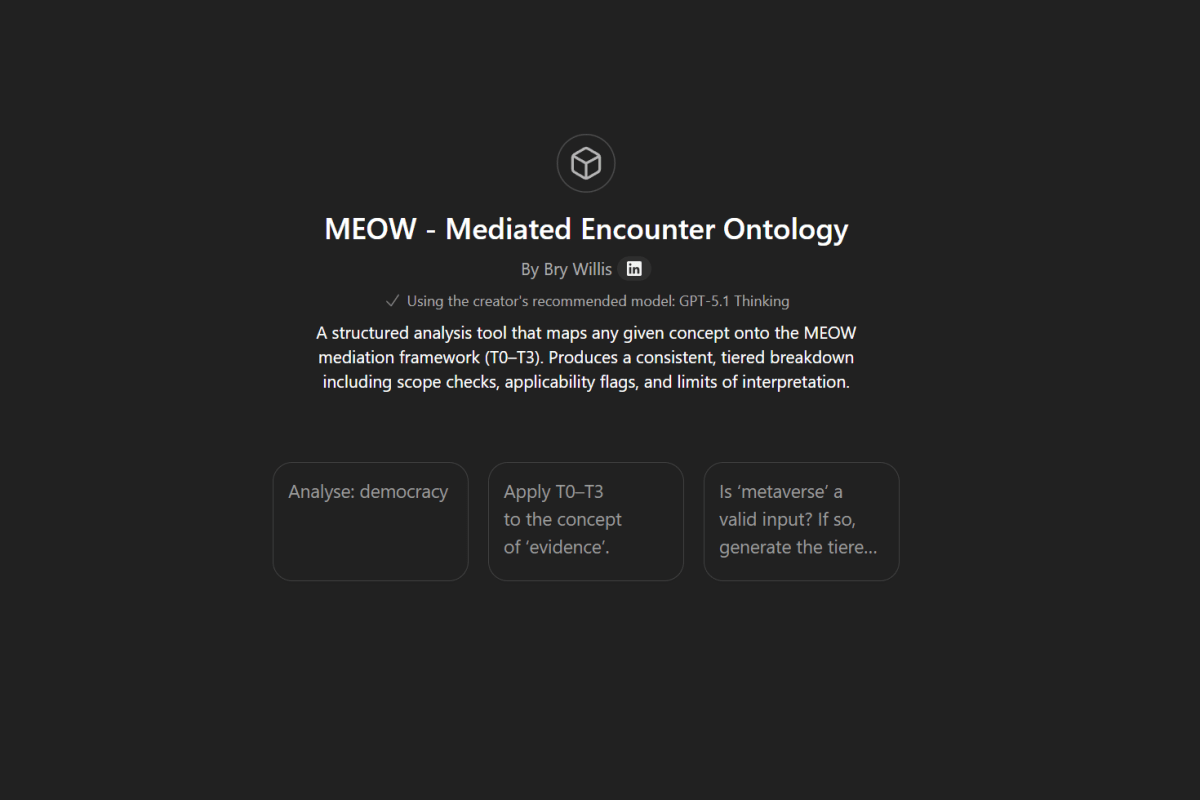
I couldn’t resist feeding another concept into the MEOW GPT – ‘Progress’. Now you don’t have to. The results are as expected.
Video: Robot reading a newspaper whilst watching news on the telly. NB: This has little to do with the page content. I rendered it for another project, but didn’t use it.
Concept
Input: progress
Type: Normative–evaluative temporal concept (idea of improvement over time; macro-comparison rule)
Scope check: In-scope – central to Enlightenment narratives, clearly multi-tier, perfect for MEOW+LIH framing.
High-level summary (≤120 words)
“Progress” isn’t a neutral description of change; it’s a way of coding sequences of encounters as “getting better” according to some (often hidden) metric. Biologically, we enjoy mastery, relief from threat, and efficiency gains, which make certain changes feel like progress. Cognitively, we impose arrows, ladders, and stories of advancement onto messy histories. Linguistically, “progress” is a heavily contested macro-term that slides between technology, morals, economics, and personal growth. Socially and technically, institutions build progress into metrics (GDP, innovation indices, “development”), roadmaps, and infrastructures, which then enforce one vision of betterment. In MEOW terms, “progress” is a family of mediated encounter-patterns, not an objective direction baked into the world.
T0 – Biological Mediation
Applicability: Weakly to moderately applicable – there is no innate “sense of progress”, but bodies provide priors for what will be experienced as progress.
Analysis:
Organisms are tuned to reduce pain and increase security; changes that lower threat or effort (less hunger, more shelter, shorter paths) tend to feel intrinsically “better” at a bodily level.
Learning and mastery trigger reward signals: successfully performing a task faster or with less error produces bodily satisfaction, giving micro-encounters of “I’m progressing”.
However, bodies are also present-biased (we discount distant benefits), which conflicts with grand narratives of long-term progress that demand near-term sacrifice.
Chronic stress, disability, or aging can radically invert intuitive progress narratives: what counts as “improvement” may become extremely local (less pain today, one more functional ability retained).
T1 – Cognitive Mediation
Applicability: Strongly applicable – “progress” is largely a cognitive imposition on temporal change.
Analysis:
We construct temporal schemas (arrows, ladders, stages) and then fit history, technology, or personal life into them: primitive → advanced, childhood → maturity, underdeveloped → developed.
Progress judgments always depend on chosen metrics and baselines: we decide which variables to track (comfort? equality? power? lifespan? biodiversity?) and from which starting point, then declare a direction “up”.
Hindsight bias and survivor bias make progress narratives seductive: we mainly see successful pathways and reinterpret past suffering as necessary stepping stones.
Many minds default to a teleological story (“things are heading somewhere”) and smuggle in inevitability: once something happened, it was “on the path of progress”.
Personal identity work often leans on progress schemas (“I’m better than I was”, “I’ve grown”), which can be empowering—but also oppressive when life moves sideways or backwards.
T2 – Linguistic Mediation
Applicability: Maximally applicable – “progress” is a classic case for the Language Insufficiency Hypothesis.
Analysis:
On LIH’s topography, “progress” is a Contestable term: central, value-saturated, and permanently argued over (like justice, freedom, development). People vigorously disagree on what counts as “better”.
It also behaves as a Fluid: the same word ranges over technological advance, moral improvement, economic growth, scientific accumulation, personal healing, social liberation, and more, with blurry boundaries.
There is a huge Presumption Gap: speakers talk as if “progress” were almost self-explanatory (“we need progress”, “don’t stand in the way of progress”), while quietly plugging in different metrics and beneficiaries.
Political rhetoric (e.g., “progressive”, “pro-growth”) makes “progress” sound descriptive (“this is progress”) when it’s largely a normative claim about which trade-offs to accept.
Attempts to spell out “real progress” in detail (sustainable, inclusive, decolonial, post-growth, etc.) risk crossing the Effectiveness Horizon: each added qualifier improves precision for some audiences but makes the term heavier, more contested, and less communicatively effective for others.
Metaphors of forward motion and height (“moving forward”, “lagging behind”, “advanced”, “backward”) naturalise a directional axis and position whole peoples or practices on it, with obvious power implications.
T3 – Social/Technical Mediation
Applicability: Strongly applicable – progress is institutionalised in metrics, infrastructures, and stories.
Analysis:
Modern states and markets operationalise “progress” via indicators: GDP, productivity, patent counts, test scores, life expectancy, HDI, etc. What’s measured becomes what “progress” officially means.
Institutions plan through progress narratives: roadmaps, five-year plans, “maturity models”, technology readiness levels, academic rankings. These formats stage reality as a path with rungs and milestones.
Struggles over progress show up as conflicts between infrastructures: highways vs public transit, fossil fuels vs renewables, prisons vs restorative systems, expansion vs conservation.
Progress talk often justifies harm or sacrifice: displacement, environmental damage, labour exploitation, or cultural erasure are framed as unfortunate but necessary costs of “advancement”.
Tech culture enacts a particularly strong progress script (“disruption”, “version 2.0”, “moonshots”), which can overshadow regressions (loss of privacy, fragility, inequality) that don’t fit the official metric.
Counter-movements (degrowth, disability justice, decolonial thought, climate activism) challenge dominant progress patterns, proposing alternative metrics (care, resilience, biodiversity, repair) and thus different encounter-patterns to call “better”.
Limits & failure modes
Language insufficiency notes
LIH suggests “progress” will remain permanently unstable: it lives in a region where our need for a powerful, simple word outruns our ability to fix its content across contexts.
Because “progress” feels both descriptive and obviously good, the Presumption Gap is structurally dangerous: it allows one group’s gain to be presented as universal improvement, even when others clearly lose.
Attempts to define progress once and for all tend to hit the Effectiveness Horizon: more detailed definitions reveal underlying value conflicts rather than resolving them.
Missing tiers / blind spots
A purely T3 view (“progress is whatever our metrics say”) ignores embodied and psychological costs that never enter the indicators.
A purely T1 view (“progress is just a narrative”) underestimates how deeply infrastructures and institutions lock in certain trajectories and make alternatives materially difficult.
MEOW framing itself can tempt us toward a detached stance (“just different mediations”), but with progress this is politically loaded: deciding which encounter-patterns we count as “better” is not neutral analysis, it’s a moral and political act.
Instead of sleeping like a functional adult, I’ve spent the night creating, testing, and refining a bespoke GPT that has fully absorbed my MEOW and LIH frameworks. Apologies that the LIH manuscript isn’t yet public; some of the terminology may look delightfully alien if you’re coming in cold.
This model doesn’t role-play a philosopher; it thinks through the Mediated Encounter Ontology. It runs every input through T0–T3 mediations and then applies the Language Insufficiency Hypothesis to explain why our words fail us in predictable, structural ways.
Audio: NotebookLM summary podcast of this post on the MEOW GPT.
I stress-tested it with a dozen concepts, from the obvious to the uncooperative. It happily tells you when your input makes sense, when it’s out of scope, and when you’ve handed it conceptual soup. My first test was the hard problem of consciousness, because naturally we begin with the philosophical boss fight. I dialled down some over-enthusiastic LIH flourishes, but the bones are untouched.
I’m making this public for a simple reason: it’s the clearest way for people to see how MEOW operates without wandering through a hundred pages of my prose. These outputs capture how I process information and why these frameworks feel so intuitively correct to me. When you read them, you get a direct view of my interpretive machinery – how the world clicks for me, and how these ideas evolved.
It hasn’t been rigorously battle-tested across the entire conceptual universe, but it’s stable, coherent, and frankly too interesting to keep in the drawer. If you try it – and I hope you do – I’d love to see what it does with your own concepts. If you need help reading the results, ask. I didn’t simplify the system; it expects literacy, nuance, and a working prefrontal cortex.
Below is a sample output. I asked the model to analyse modernity.
Concept
Input: modernity
Type: historical–social formation / self-description of an era / conceptual frame
Scope check: in-scope – central for how MEOW treats large-scale shifts in mediation (social, technical, cognitive, linguistic)
High-level summary (≤120 words)
Modernity is both a historical bundle (industrialisation, nation-states, capitalism, science, bureaucracy, media) and a story societies tell about themselves (“we are modern, unlike the past”).
In MEOW terms, modernity is a large-scale reorganisation of mediations:
T1: new cognitive habits (individualism, planning, abstraction, risk-calculation).
T2: new vocabularies (progress, development, rationality, “religion” vs “science”).
T3: new institutions and technologies (markets, states, factories, schools, mass media, digital networks).
“Modernity” is not a single thing but a way these shifts hang together and become a background to everyday encounter.
T0 – Biological Mediation
Applicability: Applicable
Analysis:
Modernity radically reshapes the immediate bodily environment: dense cities, artificial lighting, noise, pollution, sedentary work, and altered sleep cycles change basic sensory and metabolic conditions.
Medical advances and public health (vaccination, antibiotics, sanitation, surgery) modify life expectancy, infant mortality, and chronic illness, which in turn change how life cycles feel and are planned.
New food systems (industrial agriculture, processed foods, global supply chains) alter nutrition, exposure to toxins, and rhythms of hunger and satiety.
Industrial and digital work reorganise movement and posture: repetitive factory labour, office desk work, and screen use all reshape embodiment, fatigue, and bodily awareness.
These T0 changes set the stage for new affective baselines (e.g., chronic low-level stress, stimulation overload) that colour what it is like to live in a “modern” world.
T1 – Cognitive Mediation
Applicability: Strongly applicable
Analysis:
Modernity encourages certain cognitive styles: systematic planning, quantification, risk assessment, cost–benefit thinking, and an emphasis on prediction and control.
The sense of self is reconfigured toward individualism and reflexivity: people see themselves as projects to be chosen, improved, optimised, often with long-term career and life-planning horizons.
Exposure to multiple roles, cultures, and information streams (through migration, media, education) produces more complex identity structures and can create cognitive dissonance or fragmentation.
Scientific and technical worldviews teach people to reframe events in terms of mechanisms, probabilities, and systems rather than fate, tradition, or local narratives.
The sheer volume and speed of information flows in late modernity (news, social media, notifications) trains attention toward rapid scanning and shallow switching, affecting memory, concentration, and emotional regulation.
These patterns make certain experiences “normal” (abstract work, mediated relationships, bureaucratic interactions) that would be extraordinary or impossible in premodern settings.
T2 – Linguistic Mediation
Applicability: Strongly applicable
Analysis:
Modernity itself is a label that societies use to contrast “us” with “them” (the past, “traditional” societies, “the East,” “the primitive”); it is a polemical as well as descriptive term.
In Language Insufficiency terms, modernity is highly Fluid: it can mean a period (“since the 18th century”), a style (modernist art), a value system (rational, secular, progressive), or a socio-economic order (capitalist, industrial, bureaucratic). Different authors slide between these quietly.
It’s also Contestable: critics and defenders use the same word but point to different aspects—emancipation and progress versus alienation, exploitation, ecological crisis.
Pairs like “modern vs traditional” or “modern vs backward” compress complex differences into simple hierarchies, smuggling in a presumption that “modern” is automatically better or more advanced.
Talk of “post-modernity” or “late modernity” suggests that we can neatly periodise and step outside the modern, even while our concepts and institutions remain shaped by it—an example of language implying more clarity and control than we actually have.
At the most global scale (“the meaning of modernity,” “the modern condition”), we approach an Effectiveness Horizon: the term feels weighty but becomes vague; people resort to sweeping metaphors (disenchantment, liquefaction, acceleration) whose exact content is hard to pin down.
First-person experiences of being “overwhelmed by modern life,” “liberated by modern options,” or “disconnected in modern society” often have an Ineffable quality: standard clichés don’t quite capture the texture of these lives, even as they gesture at them.
T3 – Social/Technical Mediation
Applicability: Strongly applicable
Analysis:
Modernity is most visible as a mesh of institutions: nation-states, markets, bureaucracies, public schools, hospitals, prisons, armies, scientific organisations, corporations, NGOs.
These institutions standardise time (clocks, schedules), space (borders, property lines, zoning), identity (passports, ID numbers), and value (money, statistics, rankings) so that encounters become predictable and governable across large scales.
Technologies—steam engines, electricity, mass transport, broadcasting, computing, the internet, AI—are both products and drivers of modernity. They make possible new encounter-forms (remote work, global real-time communication, mass surveillance).
Urbanisation concentrates people into large, heterogeneous populations, which reconfigures social networks, anonymity, solidarity, and conflict; everyday encounters become more mediated by rules, signage, and digital systems than by face-to-face custom.
Capitalist production and consumption patterns organise much of life around work, income, and markets; the rhythms of the factory, office, and platform economy structure when and how people interact, rest, and move.
Modern governance uses statistics, censuses, and models to “see” and manage populations; this makes certain aspects of life legible (employment, crime, disease) while leaving others under- or uncounted (informal care, undocumented work, emotional labour).
Counter-movements (romanticism, traditionalism, environmentalism, decolonial and Indigenous resurgence, slow-living and anti-consumerist practices) can be read as attempts to renegotiate or resist specific modern mediations rather than simply reject “modernity” as a whole.
Limits & failure modes
Language insufficiency notes
Modernity bundles together time (a historical era), structure (a type of society), and value (being “up to date”). This makes the term rhetorically powerful but analytically slippery: it’s easy to smuggle evaluations into what sound like neutral descriptions.
Because the concept is so broad, discussions often conflate distinct issues—technology, capitalism, secularisation, colonialism, individualism, bureaucracy—under one word, obscuring which mechanisms are actually at work.
Experiences of living in “modern times” (speed, fragmentation, choice, precariousness, possibility) often outrun our stock phrases; people lean on recurring complaints (“too fast,” “too shallow,” “too lonely”) that only partially capture what it’s like.
Missing tiers / blind spots
This sketch doesn’t adjudicate between different theories of modernity (Marxist, Weberian, postcolonial, systems-theoretic, etc.); it treats them as emphasising different mediational strands.
It’s centred on Euro-Atlantic narratives; “multiple modernities” and non-Western trajectories (where “modern” elements mix with older forms in hybrid ways) would need a richer T3 treatment.
The analysis underplays ecological dimensions: industrial modernity’s dependence on fossil fuels, large-scale extraction, and waste has massive implications for how future encounters will be structured.
Finally, because we are ourselves situated in what we call modernity, our conceptual vantage is limited; any map we draw is partly an artefact of the very mediations we’re trying to analyse.
This whole misadventure began sometime in 2018, when I started documenting what has now metastasised into the Language Insufficiency Hypothesis. If I weren’t typing this, I’d be doing the honourable thing and finishing the index, but here we are, procrastinating with purpose. I had a suspicion, even then, that language was up to something. Something slippery. Something evasive. At first, it was just a motley catalogue of weasel words that refused to sit still long enough to be given a meaning. I should have taken the hint when the list kept expanding like a Victorian railway: terminally over-budget and convinced of its own grandeur.
But, naturally, I pressed on.
Audio: NotebookLM summary podcast and conversation around this topic.
At the time I had that slow-burn itch about identity, selfhood, free will, agency – you know, the usual metaphysical tat we’re reared on like a Victorian child raised on laudanum. It wasn’t that these things didn’t exist; it was that the words simply couldn’t bear the conceptual load we’d been piling onto them. And so I found myself in the company of philosophers who either tried to rescue these terms (Dennett, ever the valiant firefighter with a damp match), complicate them (Searle, constructing houses of cards under wind machines), or dissolve them outright (Parfit, smiling serenely as the rest of us panic).
Meanwhile, Strawson was somewhere in the corner insisting experience is all there is, Putnam was in his perennial retraction phase, and I was merely trying to keep my own conceptual apparatus from collapsing like an undercooked soufflé.
I’ll admit I had a long-standing soft spot for Dennett’s consciousness-as-emergence hypothesis. It made a certain intuitive sense at the time: pile up enough neural machinery, sprinkle in some feedback loops, and consciousness would bubble up like steam from a kettle. It felt elegant. It felt mechanistically honest. And, crucially, it made perfect sense within the inherited Realist framework I was still tacitly lugging around. Of course, experience ’emerges’ from physical processes if you start from a worldview already partitioned into physical substrates and mental phenomena waiting to be accounted for. Dennett wasn’t wrong so much as operating within the same architectural error the rest of us had been marinating in. Once I began reframing the whole encounter through mediation rather than emergence, the elegance dissolved. What had looked like metaphysics turned out to be a conceptual afterimage generated by a language that couldn’t model its own limitations.
And then there was Chalmers.
Ah, the ‘hard problem’. I lost count of how many times it surfaced. Like mould. Or a debt collector. Chalmers’ dilemma – how physical processes give rise to experience – is purportedly the Mount Everest of metaphysics. Yet the more I thought about it, the more it reeked of a linguistic parlour trick. A conceptual magic eye puzzle: stare long enough and a unicorn appears, provided you’ve surrendered your scepticism and a good measure of oxygen.
The problem isn’t that consciousness is ‘hard’. The problem is that the linguistic scaffolding we’re using was never built for this terrain. ‘Experience’. ‘Physical’. ‘Mental’. ‘Explain’. These words pretend to be steel beams when they’re actually damp cardboard.
What remains isn’t a cosmic riddle but a linguistic artefact. A conceptual false path carved by centuries of grammatico-metaphysical enthusiasm – the unfortunate habit of mistaking grammatical symmetry for metaphysical necessity.
Which brings me to the present, having at last gelled the LIH and published the Mediated Encounter Ontology of the World – a relational metaphysics that has the decency not to hallucinate substances it can’t justify. MEOW clears the fog rather neatly: the so-called ‘hard problem’ is only ‘hard’ because we continue to treat ‘mind’ and ‘world’ as two independent substances requiring metaphysical reconciliation. Together, LIH and MEOW provide a double exposure of the problem: LIH shows why the language fails; MEOW shows what the language was failing to describe.
So here we are. I’d like to reconsider Chalmers through the dual lenses of LIH and MEOW – not to ‘solve’ the hard problem, but to show it was never the right problem to begin with. The difficulty isn’t consciousness; it’s the language we’re forced to use, the same language that refuses to sit still, the same language that keeps trying to trick us into mistaking grammatical symmetry for metaphysical necessity.
In a coming post, I intend to pry open that illusion with a crowbar. Delicately, of course. One must be civilised about these things.
Because if language is insufficient – and it is – then perhaps what Chalmers discovered was not the abyss of consciousness, but the limit of the dictionary.
With the MEOW thesis now roaming freely across the intellectual savannah, knocking over conceptual furniture and frightening the rationalists, it’s time to walk through a simple example. We’ll stay safely within the realm of conscious perception for now. That way, no one panics, and everyone can pretend they’re on familiar ground.
Our case study: colour.
Or rather, the quite embarrassing misunderstanding of colour that Western philosophy has been peddling for roughly three centuries.
Audio: NotebookLM podcast summary of this topic, Colour, Perception, and Mediated Ontology.
The Realist’s Apple: A Comedy of Certainty
Picture an apple on a table: plump, unashamedly spherical, wearing its redness like a badge of honour. The traditional Realist swears it’s red in itself, quite independent of anyone wandering in to admire it. The apple has redness the way it has mass, curvature, and that little bruise from the careless shop assistant. When you enter the room, you ‘see’ the red it’s been proudly radiating all along.
Image 0: Subject viewing red apple.
By school age, most of us are told that apples don’t ‘have’ colour; they merely reflect certain wavelengths. A minor complication. A mechanical detail. Nothing to disturb the fundamental metaphysical fantasy: that redness is still ‘out there’, waiting patiently for your eyes to come collect it.
It’s all very straightforward. Very tidy. And very wrong.
Idealists to the Rescue (Unfortunately)
Ask an Idealist about the apple and the entertainment begins.
The Berkeley devotee insists the apple exists only so long as it’s perceived – esse est percipi – which raises awkward questions about what happens when you step out for a cuppa. God, apparently, keeps the universe running as a kind of 24-hour perceptual babysitter. You may find this profound or you may find it disturbingly clingy.
The Kantian, inevitably wearing a waistcoat, insists the apple-in-itself is forever inaccessible behind the Phenomenal Veil of Mystery. What you experience is the apple-for-you, sculpted by space, time, causality, and a toolkit of categories you never asked for. This explains a lot about post-Kantian philosophy, not least the fixation on walls no one can climb.
Contemporary idealists get creative: proto-experience in everything, cosmic consciousness as universal substrate, matter as a sleepy epiphenomenon of Mind. It’s quite dazzling if you ignore the categories they’re smashing together.
What unites these camps is the conviction that mind is doing the heavy lifting and the world is an afterthought – inconvenient, unruly, and best kept in the margins.
The Shared Mistake: An Architectural Catastrophe
Both Realist and Idealist inherit the same faulty blueprint: mind here, world there – two self-contained realms entering into an epistemic handshake.
Realists cling to unmediated access (a fantasy incompatible with biology). Idealists cling to sovereign mentality (a fantasy incompatible with objectivity).
Both take ‘experience’ to be a relation between two pre-existing domains rather than a single structured encounter.
This is the mistake. Not Realism’s claims about mind-independence. Not Idealism’s claims about mental primacy. The mistake is the architecture – the assumption of two separately-existing somethings that subsequently relate.
MEOW – yes, we’re calling it that – puts it bluntly:
The problem isn’t where colour is. The problem is assuming it has to be in something – mind or world – rather than in the event.
Redness isn’t inside your head or inside the apple. It’s co-constituted by biological, cognitive, linguistic, and cultural mediation interacting with persistent constraint patterns.
Time to peel this onion… er, apple.
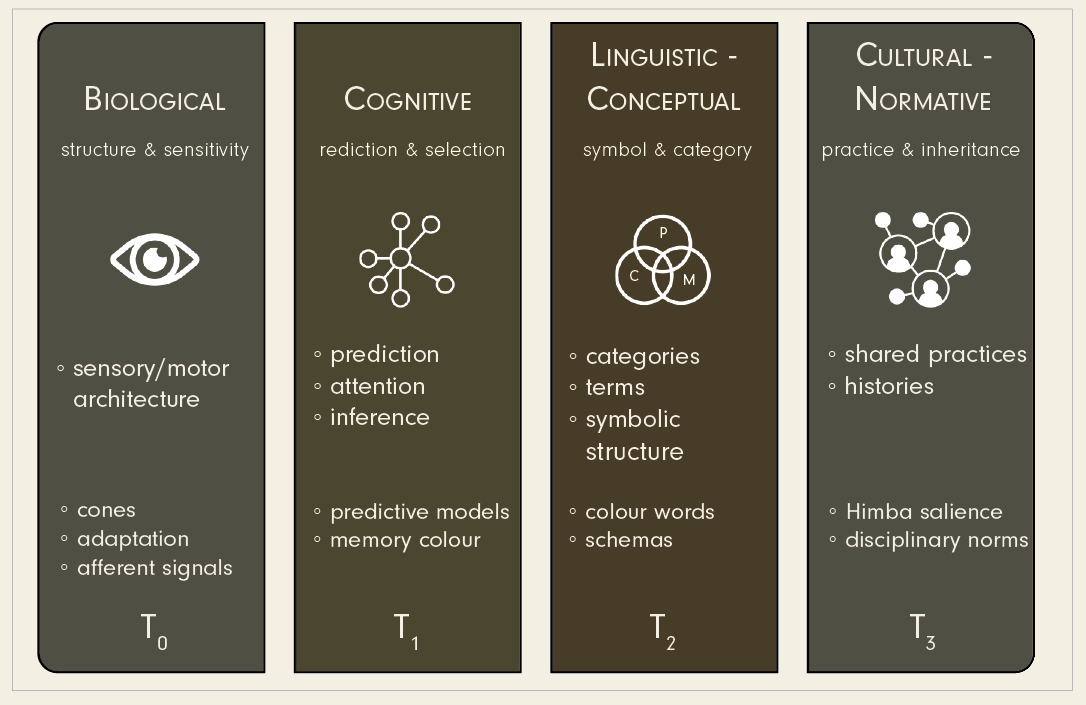
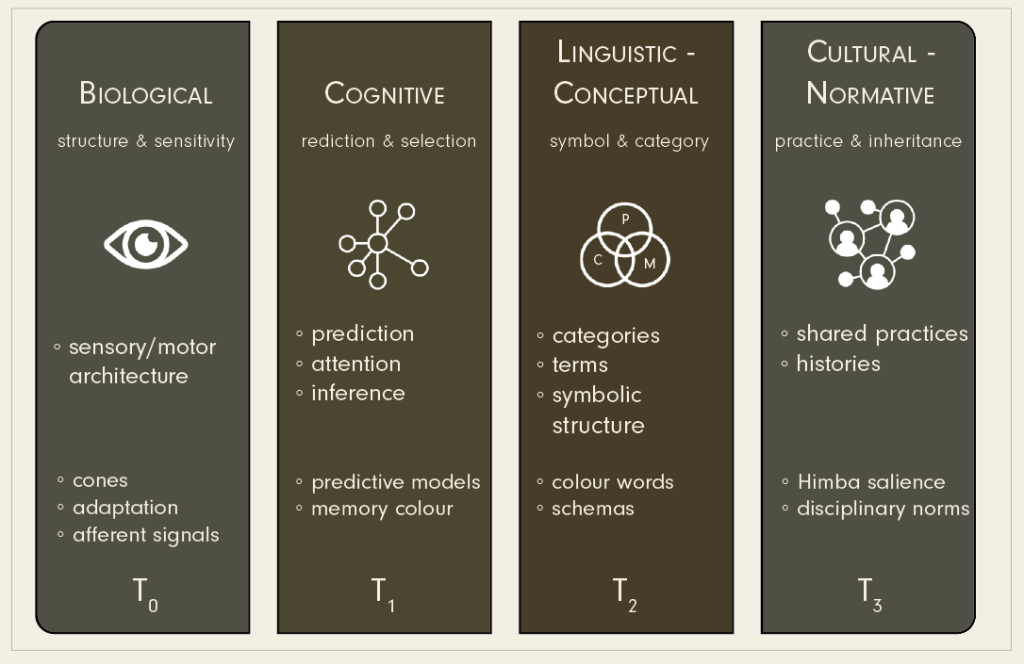
The Four Layers of Mediation (T₀–T₃)
A Ridiculously Oversimplified Cheat-Sheet That Still Outperforms Most Metaphysics Syllabi
Structure and Sensitivity: the Architecture You Never Asked For
This is where the Enlightenment’s fantasy of ‘raw perception’ goes to die.
Your visual system transforms, filters, enhances, suppresses, and reconstructs before ‘red’ even reaches consciousness. Cone responses, opponent processes, retinal adaptation, spatial filtering – all of it happening before the poor cortex even gets a look-in.
You never perceive ‘wavelengths’. You perceive the output of a heavily processed biological pipeline.
The biology isn’t the barrier.The biology is the view.
Image 2: Chromatic processing pathway (T₀→T₁): the layered biological transformations that make “red” possible long before consciousness gets involved.
T₁ – Cognitive Mediation
Prediction and Inference: You See What You Expect (Until Constraint Smacks You)
Your cognitive system doesn’t ‘receive’ colour information – it predicts it and updates the guess when necessary.
Memory colour biases perception toward canonical instances. Attentional gating determines what gets processed intensively and what gets summary treatment. Top-down modulation shapes what counts as signal versus noise.
There is no percept without mediation. There is no ‘raw data’ waiting underneath.
The Enlightenment liked to imagine perception as a passive window. Cognition turns that window into a heavily editorialised newsfeed.
Image 3: Expectation and input co-determine the percept: “red” emerges from the encounter, not from either source alone.
T₂ – Linguistic–Conceptual Mediation
Categories and Symbols: How Words Carve the Spectrum
Enter the famous Whorf skirmishes. Do words change perception? Do they merely label pre-existing distinctions? Do Russians really ‘see’ blue differently?
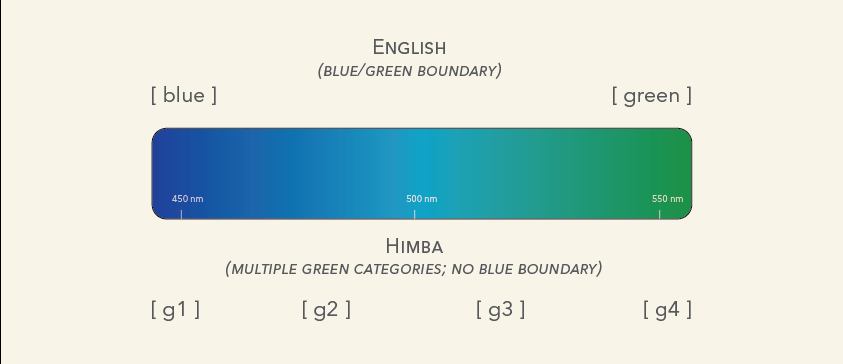
Berlin & Kay gave us focal colour universals – constraint patterns stable across cultures. Roberson et al. gave us the Himba data – linguistic categories reshaping discrimination and salience.
The correct answer is neither universalism nor relativism. It’s MEOW’s favourite refrain:
Mediation varies; constraint persists.
Words don’t invent colours. But they do reorganise the perceptual field, changing what pops and what hides.
Image 4: Different languages carve the same physical continuum differently: English imposes a blue/green split; Himba divides the region into several greens with no blue boundary at all.
T₃ – Cultural–Normative Mediation
Shared Practices: The Social Life of Perception
Your discipline, training, historical context, and shared norms tell you:
which distinctions matter
which differences ‘count’
which patterns get ignored
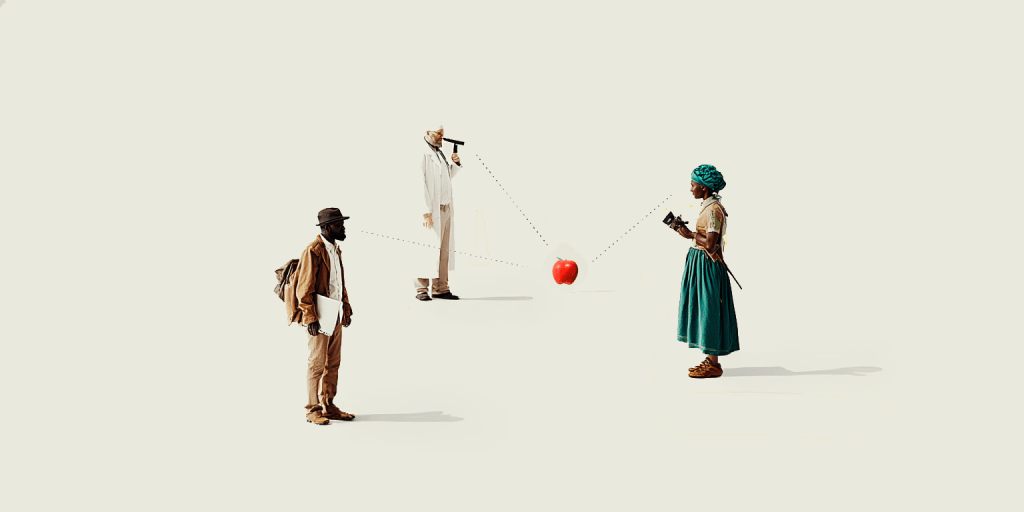
A Himba herder, a Renaissance painter, and a radiologist do not inhabit the same perceptual world – even when staring at the same patch of light.
Cultural mediation doesn’t rewrite biology; it reorganises priorities, salience, and interpretive readiness.
Image 5: Three observers confronting the same stimulus yet extracting different distinctions: the scientist tracks wavelength, the artist tracks hue and value, and the Himba pastoralist tracks ecologically salient greens. Same object, different salience hierarchies. Not arbitrary – just mediated.
What Seeing Red Actually Involves (Step By Exhausting Step)
You walk into a room. Apple on table. Looks red. What just happened?
T₀ – Biological: Long wavelength light hits L-cones harder than M- and S-cones. Opponent channels compute (L−M). Adaptation shifts baseline. Edge detection fires. You don’t have ‘red’ yet – you have transformed photoreceptor output.
T₁ – Cognitive: Your brain predicts ‘apple, probably red’ based on shape and context. Memory colour pulls toward canonical apple-red. Attention allocates processing resources. Prediction matches input (roughly). System settles: ‘yes, red apple’.
T₂ – Linguistic–Conceptual: The continuous gradient gets binned: ‘red’, not ‘crimson’ or ‘scarlet’ unless you’re a designer. The category provides stability, ties this instance to others, makes it reportable.
T₃ – Cultural–Normative: Does the exact shade matter? Depends whether you’re buying it, photographing it, or painting it. Your practical context determines which distinctions you bother tracking.
And through all of this: Constraint. Metameric matches stay stable. Focal colours persist cross-culturally. Wavelength sensitivities don’t budge. The encounter isn’t arbitrary – but it’s not unmediated either.
What happened wasn’t: Mind Met World. What happened was: an encounter-event unfolded, organised through four mediational layers, exhibiting stable constraint patterns that made it this and not that.
Where This Leaves Us
Colour is not ‘out there’. Colour is not ‘in here’.
Colour is the structured relational event of encounter.
Four mediation layers shape what appears. Constraint patterns stabilise the encounter so we aren’t hallucinating wildly divergent rainbows.
There is no ‘apple as it really is’ waiting behind the encounter. Nor is there a sovereign mind constructing its own private theatre.
There is only the event – where biological structure, cognitive dynamics, conceptual categories, and cultural histories co-emerge with the stable patterns of constraint we lazily call ‘the world’.
The apple was never red ‘in itself’. You were never seeing it ‘as it really is’. And the Enlightenment can finally take off its colour-blind uncle glasses and admit it’s been squinting at the wrong question for three hundred years.
Next time: Why visual illusions aren’t perception failing, but perception revealing itself.
Until then: stop asking where colour ‘really’ lives.
It lives in the event. And the event is mediated, constrained, and real enough.
Chatting with Claude Sonnet 4.5 was such an interesting experiment, so I created a YouTube video version based on the Spotify version. If you’ve already listened to it, feel free to check out the video content – the audio hasn’t changed.
Video: Inside the Machine: What LLMs REALLY Think About Your ‘Thoughtful’ Questions
I feel that the explanation of some of Claude’s internal logic was telling, and how it is anthropomorphised in a way that a person might interpret through an emotional lens.
Personally, I also enjoyed the dialogue around Platonism as it related to maths. I updated the subtitles, so you can read along if you are so inclined.
I’d like to do more videos, but they take so much time. I don’t know how much total time this took, but it was many hours over three days. It’s not that I don’t want to take time to produce them; it’s the opportunity costs – I am not writing new material, which is my preferred activity. For the record, the bulk of the time is searching for appropriate stock footage and B-roll – and that’s not always successful either.
I generated a few clips in Midjourney – sometimes just because, and other times to fill a gap with something better than I could find on Motion Array.
I’ve embedded the video here as usual, or you can watch it on YouTube. In any case, I’d love to read what you think about the topic or the video. As for the video, I won’t be giving up my day job, but it’s fun to assemble them.
Besmet, a Belgian psychologist with a background in statistics, begins not with tyranny but with epistemology – with how the Enlightenment’s dream of objectivity curdled into the managerial nightmare we now inhabit. The first half of the book reads like a slow unmasking of Scientism: how numbers became our gods, and graphs, our catechisms.
Written before COVID-19 but finished during it, his argument turns pandemic data into theatre – a performance of certainty masking deep confusion. The daily tally became ritual sacrifice to the idol of ‘evidence-based’ policy. His point, and mine, is that totalitarianism no longer needs gulags; it thrives in dashboards and KPIs.
Desmet’s frame intersects beautifully with my own thesis: that obedience today is internalised as reasonableness. Freedom has been recast as compliance with ‘the data’. We surrender willingly, provided the orders come in statistical form.
This is why even Agile™ management and its fetish of ‘velocity’ reek of the same mechanistic faith. Every sprint promises deliverance through quantification; every retrospective is a bureaucratic confession of inefficiency. The cult of metrics is not merely a managerial fad – it is the metaphysics of our time. The problem is at once ontological and epistemological: we mistake the measure for the thing itself, and in doing so, become measurable.
It’s a rare pleasure to encounter a fellow dissident of the numerical faith – a man who sees that the spreadsheet has replaced the sceptre.
In the late 1990s, the Wachowskis gave us The Matrix – Keanu Reeves as Neo, the Chosen One™, a man so bland he could be anyone, which was the point. Once he realised he was living inside a simulation, he learned to bend its laws, to dodge bullets in slow motion and see the code behind the curtain. Enlightenment, Hollywood-style.
Audio: NotebookLM podcast on this topic.
But here’s the twist, the film itself couldn’t stomach: realising the simulation doesn’t free you from it.
Knowing that race and gender are social constructs doesn’t erase their architecture. Knowing that our economies, legal systems, and so-called democracies are fictions doesn’t get us out of paying taxes or playing our assigned roles. “The social contract” is a collective hallucination we agreed to before birth. That and a dollar still won’t buy you a cup of coffee.
Baudrillard, whose Simulacra and Simulation the film name-dropped like a trophy, argued that simulation doesn’t hide reality – it replaces it. When representation becomes indistinguishable from the thing it represents, truth evaporates, leaving only consensus. We don’t live in a system of power; we live in its performance.
The Matrix got the metaphor half right. It imagined the bars of our cage as a digital dream – glossy, computable, escapable. But our chains are older and subtler. Rousseau called them “social”, Foucault diagnosed them as “biopolitical”, and the rest of us just call them “normal”. Power doesn’t need to plug wires into your skull; it only needs to convince you that the socket is already there.
You can know it’s all a fiction. You can quote Derrida over your morning espresso and tweet about the collapse of epistemic certainty. It won’t change the fact that you still have rent to pay, laws to obey, and identities to perform. Awareness isn’t liberation; it’s just higher-resolution despair with better UX.
Neo woke up to a ruined Earth and thought he’d escaped. He hadn’t. He’d only levelled up to the next simulation – the one called “reality”. The rest of us are still here, dutifully maintaining the system, typing in our passwords, and calling it freedom.
NB: Don’t get me wrong. I loved The Matrix when it came out. I still have fond memories. It redefined action films at the time. I loved the Zen messaging, but better mental acuity doesn’t grant you a pass out of the system.
Not the darkness after the light, but the shadow the light forgot it cast
The Enlightenment promised light. What it delivered was fluorescence – bright, sterile, and buzzing with the sound of its own reason.
The Anti-Enlightenment Project gathers a set of essays, fragments, and quotations tracing how that light dimmed – or perhaps was never as luminous as advertised. It’s less a manifesto than a map of disintegration: how agency became alibi, how reason became ritual, and how modernity mistook motion for progress.
Preprints and essays (Against Agency, Rational Ghosts, Temporal Ghosts, and others to follow)
Related reflections from Philosophics posts going back to 2019
A living index of quotations from Nietzsche to Wynter, tracing philosophy’s slow discovery that its foundation may have been sand all along
This isn’t a war on knowledge, science, or reason – only on their misappropriation as universal truths. The Anti-Enlightenment simply asks what happens when we stop pretending that the Enlightenment’s “light” was neutral, natural, or necessary.
It’s not reactionary. It’s diagnostic.
The Enlightenment built the modern world; the Anti-Enlightenment merely asks whether we mistook the glare for daylight.








 Philosophics