What followed was a case study in how not to communicate.
LinkedIn, that self-parody of professional virtue signalling, is essentially a digital networking séance: a place where narcissism wears a tie. So I expected a reaction – just not one quite so unintentionally revealing.
Audio: NotebookLM podcast on this topic.
But First…
Before I get too engaged, I want to share one of my favourite interactions: After I informed a commenter that I was a trained economist who taught undergraduate economics for the better part of a decade and had read many seminal economic books and journals firsthand, he replied, ‘No wonder you don’t know anything about economics’.
It reminded me of Oscar Wilde’s quip:
Education is an admirable thing, but it is well to remember from time to time that nothing that is worth knowing can be taught.
— Oscar Wilde
I think he may have taken this point too far.
The Post
I posted this:
Capitalism doesn’t kill with guns or gulags. It kills with forms, policy, and plausible deniability. The machine is efficient precisely because no one feels responsible. When an insurance executive cuts ‘unprofitable’ coverage, it’s not an atrocity – it’s ‘cost optimisation’.
Four assertions that, if anything, were restrained. And yet, of roughly 6,600 impressions, 150 people commented – and only ten actually clicked through to read the article itself. Two, perhaps, reached the source post.
So, fewer than one-tenth of one per cent engaged with the argument. The rest engaged with their projections.
The Anatomy of Reaction
From this data set, one can discern a familiar pattern – social media’s endemic form of discourse dementia. People no longer respond to content, but to keywords. They hear ‘capitalism’ and proceed to recite preloaded scripts from whichever Cold War memory palace they inhabit.
Their replies fall neatly into categories.
1. The Purists and Apologists
These are the theologians of the market. They defend a sacred true capitalism – pure, fair, competitive – untainted by corruption or collusion. Every failure is blamed on heresy: ‘That’s not capitalism, that’s bureaucracy’.
This is theology masquerading as economics. The purity argument is its own circular proof: if capitalism fails, it was never real capitalism to begin with.
I eventually replied with a meme that captured the absurdity perfectly:
« Yeah, bruh! Cancer is not the problem. The problem is stage 4 cancer. What we need is stage 2 cancer. »
Image: Mentioned Meme
That’s the logic of ‘real capitalism’. A belief that malignancy can be cured by downgrading it.
2. The Cold Warriors and Whatabouters
When all else fails, shout Stalin. ‘Move to Cuba’, they say, as if the modern world were still divided between the Berlin Wall and McDonald’s.
These people argue from the long-term memory of the twentieth century because their short-term memory has been erased by ideology. The result is political dementia – functioning recall of ghosts, total blindness to the present.
3. The Moral Traditionalists
‘Capitalism created the highest living standards in history’, they proclaim, ignoring that the same sentence could be said of feudalism by a duke.
They confuse correlation for causation: prosperity under capitalism equals prosperity because of capitalism. It’s a comforting fable that erases the costs – colonialism, exploitation, environmental collapse—folded into that narrative of progress.
4. The Diagnosticians and Dismissers
When all argument fails, the fallback is pathology: ‘You’re confused,’ ‘You’re a cancer’, ‘Take this nonsense to Bluesky‘.
Ad hominem is the last refuge of the intellectually cornered. It converts disagreement into diagnosis. It’s a defence mechanism masquerading as discourse.
5. The Bureaucracy Confusionists
This group misread ‘forms and policy’ as an attack on government, not markets. For them, only the state can be bureaucratic. They cannot conceive of corporate violence without a uniform.
That’s precisely the blindness the post was about – the quiet procedural cruelty embedded in systems so efficient no one feels responsible.
6. The Realists and Partial Allies
A handful of commenters admitted the system was broken – just not fatally. ‘Capitalism has gone astray’, they said. ‘It’s not capitalism; it’s profiteering’.
This is capitalism’s soft apologetics: acknowledging illness while refusing to name the disease. These are the reformists still rearranging chairs on the Titanic.
7. The Human-Nature Essentialists
‘The problem isn’t capitalism – it’s people’.
Ah yes, anthropology as absolution. The rhetorical sleight of hand that converts design flaws into human nature. It’s a comforting determinism: greed is eternal, therefore systems are blameless.
This, too, proves the thesis. Capitalism’s most effective mechanism is the internalisation of guilt. You blame yourself, not the structure.
8. The Paranoids and Projectionists
For these, critique equals conspiracy. ‘The Marxists are oppressing your freedom’. ‘Bank accounts frozen in Canada’. ‘Social credit scores!’
They live in a world where any question of fairness is a plot to install a totalitarian state. Their fear is algorithmic; it needs no source.
9. The Systemic Observers
A few – precious few – saw the argument clearly. They understood that capitalism’s violence is procedural, not personal. That its atrocities come with signatures, not bullets. That the “cost optimisation” logic of insurance or healthcare is not an aberration – it’s the system functioning as designed.
These voices are proof that rational discourse isn’t extinct – merely endangered.
Discourse Dementia
What this episode reveals is not a failure of capitalism so much as a failure of cognition. The audience no longer hears arguments; it hears triggers. People don’t read – hey recognise.
The reflexive replies, the off-topic tangents, the moral panic – all of it is capitalism in miniature: fast, efficient, transactional, and devoid of empathy.
Social media has become the bureaucratic form of thought itself – automated, unaccountable, and self-reinforcing. Nobody reads because reading doesn’t scale. Nobody engages because attention is a commodity.
Capitalism doesn’t just kill with forms. It kills with feeds.
Coda: The Light That Blinds
The Enlightenment promised clarity – the clean line between reason and superstition, order and chaos, subject and object. Yet, from that same light emerged the bureaucrat, the executive, and the algorithm: three perfect children of reason, each killing with increasing efficiency and decreasing intent.
Capitalism is merely the administrative arm of this lineage – the economic expression of the Enlightenment’s original sin: mistaking quantification for understanding. When discourse itself becomes procedural, when conversation turns into cost-benefit analysis, thought ceases to be an act of care and becomes an act of compliance.
The tragedy isn’t that we’ve lost meaning. It’s that we’ve automated it. The machine hums on, self-justifying, self-optimising, self-absolving.
Your post is a confession that anti-capitalism kills with guns and gulags. Give me capitalism over socialism any day.
Well, you should move to Cuba or any other socialist paradise… end of issue.
How can you be taken seriously when you conflate an entire economic system with health insurance? And for someone to say that overt murder, a la Stalin, is “decency”? That speaks for itself.
That is not capitalism. That is bureaucracy.
Healthcare isn’t free and everyone has the same right to make or not to make money.
Sounds more like socialism. Do it our way or we will freeze your bank account, take your job, and make sure you get nothing till you comply (proof was during covid)
Capitalism has made us the desired destination for those living in socialistic societies
BEURACRACY. The word your looking for is BEURACRACY not capitalism. There is no form of government more beurocratic than communism, except socialism. If you wonder why that is, communism doesn’t have to hide it’s authoritarianism like socialism does.
Socialism/Communism killed over 100 million the last century the old fashioned way;: bullets, starvation, torture, etc. Capitalism lifted 1 billion people out of poverty
Pathetic – misleading statement. Yes there are many problems, and mistakes that should be corrected. But as a physician, can guarantee before this medical system starting to ignore viruses, far more people were killed yearly under socialist or communist medical systems than capitalism. Wake up – care was not denied because many procedures and higher levels of care were unreachable to most!!!
How is the Government any different? You get what they say you get without the option of voting with your feet/checkbook. I’ll take my chances in the free market EVERY TIME.
This post is fiction from the start. Capitalism does NOT kill. Communism/Socialism does though.
Are you implying the ponderous inactivity of the socialist apparat is not worse than what we encounter with capitalistic motivated organizations? Learn the facts.
Capitalism works well enough–better than any other alternatives. It degrades when government sticks its nose into private transactions to provide cover for lethargy and inefficiency. Responsibility moves from the person with whom one deals to a great nothingness of indifference. [truncated for brevity]
Private insurance has its faults but so does government insurance they are different but just as challenging
Any business that deals directly with Human tragedy (Casualty, Medical, Health, et al) should be held to both a different and higher standard in “cost optimization” than other businesses. To say that someone’s chemo should be spreadsheeted in the same columns as someone’s second home 80 feet from the beach is proof that capitalism is dead and scorched earth profiteering is now the new normal.
The argument should not be about capitalism vs. communism, but rather about human beings. Are humans creative/gifted enough to take care of themselves and produce surplus for the helpless few, or helpless sheep, majority to be fed and controlled by elites? But for your edification Bry, as you are critic of capitalism, try communism for a season, to balance your critique.
Bry WILLIS how long have you been this confused about basic economics and government policy?
Most people stop using the “I know you are, but what am I” basis for their arguments by the age of seven or eight. But it appears to still be your basis for discourse.
I wish you better luck seeing and understanding things for what they actually are vice how you wish they were.
The rules come from a socialist regime. The Marxists are oppressing your freedom. Not rhe FREE market and free enrerprises. What are you talking about….
That is is not capitalism. that is CRONY capitalism when feather merchants spread so much hoo-ha that nobody can get anything done.
Bry WILLIS look up social credit. Bank accounts under this government in Canada, have already been frozen, for dare disagreeing with them
This man feels our health insurance system represents capitalism? We better have a more in depth talk about how American health insurance works.
This has nothing to do with “capitalism”. If you choose to use the English language to communicate, understand the intended meanings of the words. We use contract law in our country regarding insurance coverage. It has little to do with capitalism. In fact, Obamacare stripped any semblance of capitalism from the process and replaced it with pricing manipulation, regulations, subsidies and other such “adjustments” to what used to be a capitalistic system. Blame the regulations, and lack of government enforcement, not “capitalism”. No winder NYC elected Momdani.
Ask those in China, N. Korea, and Russia how socialism/communism works for them.
Next you will have Gen AI and Agentic AI declining claims so that management can just point to the AI and no one has to feel bad for cutting off life saving care.
You’re a cancer. Capitalism created the best living standards the world ever seen. The socialist show up and corrupt it with all these social programs that don’t work and that’s where we’re at. You’re killing the future. You’re an idealist that never had to live in the real work and built anything and you’ll be the one who’s bitching when you’re on relief.
The only system that placed people in gulags was socialism all under the banner of democracy.
This is pure nonsense. Take stuff like this on Bluesky
As I’ve said 4,000 times before, Capitalism requires robust competition in the market and zero collusion, price fixing, and market manipulation in order for it to function in its truest form and most beneficial economic impact to society as a whole (instead of 2%) and to be truly considered superior to other forms. None of those conditions exists in today’s capitalism (as practiced) and it has devolved into scorched earth profiteering which has a totally different definition and is practiced in a different way. Today’s profiteering by Corporations, which includes actions and behaviors that are counter-productive to capitalism, and that they hide under the guise of capitalism, acts as a malignant cancer on true capitalism and its inevitable result is, over time, a greater demand by society for socialist response as a counter measure. If Capitalism were working as it should, (and it’s not) that demand by society for socialist action would be highly diminished instead of enhanced.
Capitalism is not the “marriage of business and government” — that’s called oligarchy or, as the WEF calls it, “stakeholder capitalism”, also known as aristocracy. This is the current operating model of Canada, for example, wherein regulation and subsidy and tax”relief” is used to protect monopolies they are favorable to the sitting government.
Before we go any further, please share your definition of capitalism.
Such bureaucracy is worse with socialism, with even less individual freedom because the almighty centralized state maintains tight control over everything.
Another socialist complaining about tainted money. Bry, the money “taint” yours to spend. It belongs to those who earned it.
More like government bureaucracy
Notes and References
1.The Procedural Violence of Systems. David Graeber’s The Utopia of Rules (2015) and Bullshit Jobs (2018) remain essential on the bureaucratic face of modern capitalism — where compliance replaces conscience and inefficiency becomes profitable.
2.Markets as Mythology. Karl Polanyi’s The Great Transformation (1944) describes how “self-regulating” markets were never natural phenomena but products of state violence and enclosure. What contemporary defenders call “real capitalism” is, in Polanyi’s terms, a historical fiction maintained through continuous coercion.
3.The Logic of the Machine. Bernard Stiegler’s Technics and Time (1994–2001) and Automatic Society (2015) provide the philosophical frame for capitalism’s algorithmic mutation: automation not just of production, but of attention and thought.
4.Bureaucracy and Death. Max Weber’s early insight into rationalisation—the conversion of moral action into procedural necessity—reaches its necropolitical extreme in Achille Mbembe’s Necropolitics (2003), where the administration of life and death becomes a managerial function.
5.Language, Responsibility, and the Loss of Agency. Hannah Arendt’s Eichmann in Jerusalem (1963) diagnosed “the banality of evil” as precisely the condition described in the post: atrocity performed through paperwork, not passion. The executive who denies coverage is merely performing policy.
6.Attention as Commodity. Guy Debord’s Society of the Spectacle (1967) and Byung-Chul Han’s In the Swarm (2017) both chart the transformation of discourse into spectacle, and thought into metrics — the perfect capitalist apotheosis: outrage without substance, visibility without understanding.
7.On Reflex and Recognition. Friedrich Nietzsche’s Genealogy of Morals (1887) prefigures this pathology in his account of herd morality and ressentiment — a collective psychology where reaction replaces reflection.
Further Reading / Contextual Essays
The Ethics of Maintenance: Against the Myth of Natural Purpose A dismantling of the Enlightenment’s faith in progress. Maintenance, not innovation, becomes the moral task once teleology collapses. This essay lays the groundwork for understanding capitalism as an entropy accelerator disguised as improvement.
Against Agency: The Fiction of the Autonomous Self Explores how neoliberal ideology weaponises Enlightenment individualism. The myth of “self-made” success functions as capitalism’s moral camouflage — the narrative counterpart to plausible deniability.
The Illusion of Light: Thinking After the Enlightenment The core text of the Anti-Enlightenment corpus. A philosophical excavation of modernity’s central delusion: that illumination equals truth. Traces the lineage from Cartesian clarity to algorithmic opacity.
Objectivity Is Illusion (The Language Insufficiency Hypothesis) An inquiry into the failure of language as a medium for truth claims. Introduces the Effectiveness–Complexity Gradient, showing how every human system — political, linguistic, economic — eventually collapses under the weight of its own abstractions.
The Discipline of Dis-Integration A philosophy of maintenance over progress. Argues that dis-assembly — not construction — is the proper epistemic gesture in an age of exhaustion.
Propensity(Ridley Park, 2024) The fictional mirror to these essays. A speculative novel examining the behavioural mechanics of optimisation, obedience, and systemic cruelty — a narrative form of “cost-optimisation ethics.”
The novel itself asks what happens when humanity creates a device that creates peace on earth. What if behavioural control worked too well?
No riots. No rebellion. Just a flattening—of desire, of ambition, of will. Across homes, schools, and governments, people stop acting like themselves. Some forget how. Others forget why.
The system wasn’t designed to stay on this long. But now there’s no off switch. And the researchers who built it? Most of them are zeroed.
As one child begins to drift from baseline, an impossible question resurfaces: What does it mean to behave?
This is a psychological dystopia without explosions, a story where silence spreads faster than violence, where systems behave better than the people inside them.
A tale of modulation, inertia, and the slow unravelling of human impulse—for readers who prefer their dystopias quiet and their horrors deeply plausible.
Editorial Review
“Reader discretion is advised. Free will has been deprecated.” Beginning as a bizarre experiment in behavioural modulation by way of neurochemical interference, Propensity unfolds into an eerie metaphor for the tricky road between control and conscience. Park’s chapters are short and succinct, some barely a page long, in a staccato rhythm that mirrors the story’s disintegration—scientists losing grip on their creation and a world learning the price of its “engineered peace.” Phrases like “silence playing dress-up as danger” and “peace was never meant to be built, only remembered” linger like faint echoes long after you turn the page.
This is one of the more popular posts on here, so I shouldn’t have to give this milestone special attention, but I will anyway. Slow news day. It’s more about economics and political science, but I go there, too. Not a big fan of Capitalism in any of its many incarnations.
Video: Midjourney automation
I decided to experiment with Midjourney for this cover art and short animation. Instead of creating a typical prompt, I simply copied and pasted the text into the box above and let Midjourney make sense of it. This was the result. Then I asked to animate a loop.
Enough diversion. Back to finishing my latest book. I see light at the end of the tunnel.
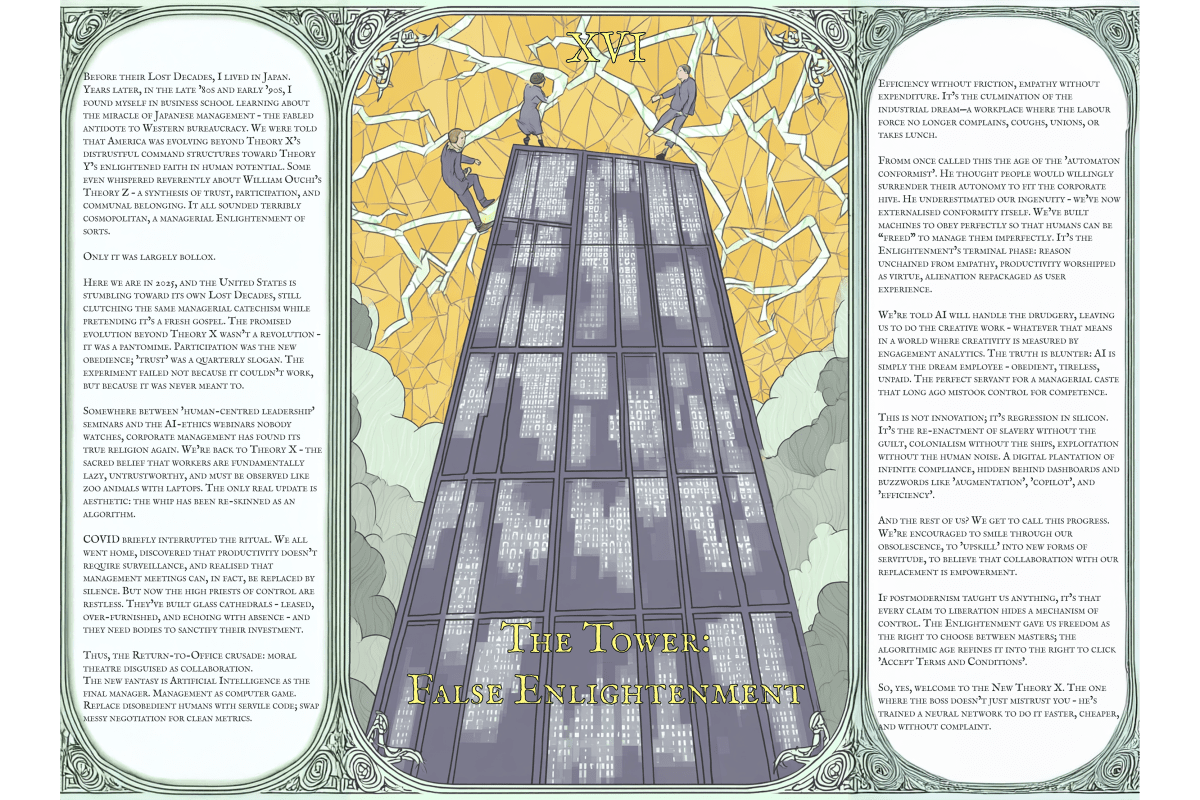
Before their Lost Decades, I lived in Japan. Years later, in the late ’80s and early ’90s, I found myself in business school learning about the miracle of Japanese management – the fabled antidote to Western bureaucracy. We were told that America was evolving beyond Theory X’s distrustful command structures toward Theory Y’s enlightened faith in human potential. Some even whispered reverently about William Ouchi’s Theory Z – a synthesis of trust, participation, and communal belonging. It all sounded terribly cosmopolitan, a managerial Enlightenment of sorts.
Only it was largely bollox.
Audio: NotebookLM podcast on this topic.
Here we are in 2025, and the United States is stumbling toward its own Lost Decades, still clutching the same managerial catechism while pretending it’s a fresh gospel. The promised evolution beyond Theory X wasn’t a revolution – it was a pantomime. Participation was the new obedience; ‘trust’ was a quarterly slogan. The experiment failed not because it couldn’t work, but because it was never meant to.
Somewhere between ‘human-centred leadership’ seminars and the AI-ethics webinars nobody watches, corporate management has found its true religion again. We’re back to Theory X – the sacred belief that workers are fundamentally lazy, untrustworthy, and must be observed like zoo animals with laptops. The only real update is aesthetic: the whip has been re-skinned as an algorithm.
COVID briefly interrupted the ritual. We all went home, discovered that productivity doesn’t require surveillance, and realised that management meetings can, in fact, be replaced by silence. But now the high priests of control are restless. They’ve built glass cathedrals – leased, over-furnished, and echoing with absence – and they need bodies to sanctify their investment. Thus, the Return-to-Office crusade: moral theatre disguised as collaboration.
The new fantasy is Artificial Intelligence as the final manager. Management as computer game. Replace disobedient humans with servile code; swap messy negotiation for clean metrics. Efficiency without friction, empathy without expenditure. It’s the culmination of the industrial dream—a workplace where the labour force no longer complains, coughs, unions, or takes lunch.
Fromm once called this the age of the ‘automaton conformist’. He thought people would willingly surrender their autonomy to fit the corporate hive. He underestimated our ingenuity – we’ve now externalised conformity itself. We’ve built machines to obey perfectly so that humans can be “freed” to manage them imperfectly. It’s the Enlightenment’s terminal phase: reason unchained from empathy, productivity worshipped as virtue, alienation repackaged as user experience.
We’re told AI will handle the drudgery, leaving us to do the creative work – whatever that means in a world where creativity is measured by engagement analytics. The truth is blunter: AI is simply the dream employee – obedient, tireless, unpaid. The perfect servant for a managerial caste that long ago mistook control for competence.
This is not innovation; it’s regression in silicon. It’s the re-enactment of slavery without the guilt, colonialism without the ships, exploitation without the human noise. A digital plantation of infinite compliance, hidden behind dashboards and buzzwords like ‘augmentation’, ‘copilot’, and ‘efficiency’.
And the rest of us? We get to call this progress. We’re encouraged to smile through our obsolescence, to ‘upskill’ into new forms of servitude, to believe that collaboration with our replacement is empowerment.
If postmodernism taught us anything, it’s that every claim to liberation hides a mechanism of control. The Enlightenment gave us freedom as the right to choose between masters; the algorithmic age refines it into the right to click ‘Accept Terms and Conditions’.
So, yes, welcome to the New Theory X. The one where the boss doesn’t just mistrust you – he’s trained a neural network to do it faster, cheaper, and without complaint.
Originally posted on LinkedIn with the same title.
Freedom is a word so overused it’s practically anaemic. Everyone wants it; no one agrees on what it means. It’s been weaponised by tyrants and revolutionaries alike, invoked to justify both the breaking of chains and their reforging in a different metal.
Audio: NotebookLM podcast on this topic.
As I write this, I have just finished Erich Fromm’s A Sane Society. Without derailing this post, he cited a scenario – a description of work communities given in All Things Common, by Claire Huchet Bishop – where in post-WW2 France, a group formed a sort of workers’ coöperative – but it was more than that; it was an anarchosyndicalist experiment. As I read it, I had to cringe at the power ‘voluntary’ transfers that immediately got me thinking of Foucault’s biopower – as I often do. Saving this for a separate post.
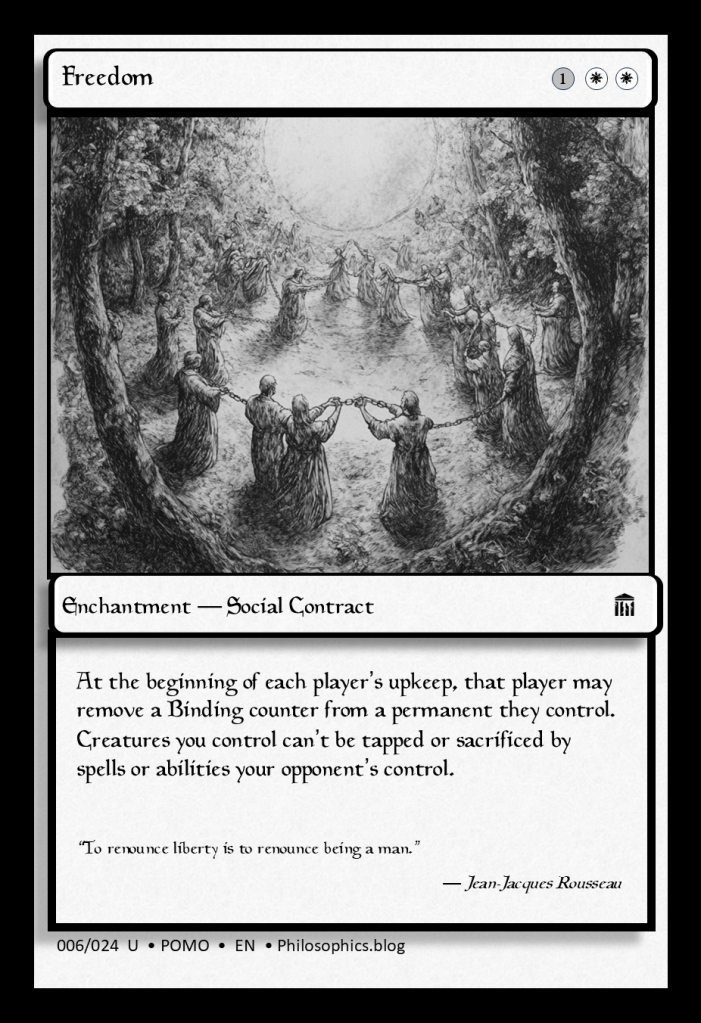
Image: Freedom: The Chains That Bind Us Together Card 006 from the Postmodern Set – Philosophics.blog
This Critical Theory parody card, Freedom, draws its lineage from Jean-Jacques Rousseau, whose paradox still haunts the modern condition: “Man is born free, and everywhere he is in chains.” The card re-enchants that contradiction – an Enchantment – Social Contract that reminds us liberty isn’t a state but a negotiation.
The card reads:
At the beginning of each player’s upkeep, that player may remove a Binding counter from a permanent they control. Creatures you control can’t be tapped or sacrificed by spells or abilities your opponent controls.
This is Rousseau’s dilemma made mechanical. Freedom is not absolute; it’s procedural. The upkeep represents the maintenance of the social contract—an ongoing renewal, not a one-time event. Every player begins their turn by negotiating what freedom costs. You may remove one Binding counter, but only if you recognise that binding exists.
The flavour text underlines Rousseau’s plea:
“To renounce liberty is to renounce being a man.”
Freedom, for Rousseau, wasn’t about doing whatever one pleased. It was about participating in the moral and civic order that gives action meaning. To exist outside that order is not liberty; it’s anarchy, the tyranny of impulse.
The card, therefore, resists the naïve libertarian reading of freedom as the absence of restraint. It instead depicts freedom as the capacity to act within and through shared constraints.
Freedom, then, is not the absence of chains, but the power to choose which ones we wear.
— Philosophics.blog
The art shows a ring of robed figures, hand in hand, their chains forming a circle beneath a clearing sky. It’s a haunting image: freedom through fellowship, bondage through unity. The circle symbolises Rousseau’s idea that true liberty emerges only when individuals subordinate selfish will to the general will – the common interest formed through collective agreement.
Yet there’s also a postmodern irony here: circles can be prisons too. The social contract can emancipate or suffocate, depending on who wrote its terms. The same chains that protect can also bind.
The monochrome aesthetic amplifies the ambiguity – freedom rendered in greyscale, neither utopia nor despair, but the space in between.
Rousseau’s notion of the social contract was revolutionary, but its dissonance still resonates: how can one be free and bound at the same time? He answered that only through the voluntary participation in a collective moral order can humans transcend mere instinct.
We might say that today’s democracies still operate under Freedom (Enchantment – Social Contract). We maintain our rights at the cost of constant negotiation: legal, social, linguistic. Every “Binding counter” removed is the product of civic upkeep. Stop maintaining it, and the enchantment fades.
The card hints at the price of this enchantment: creatures (citizens) can’t be tapped or sacrificed by opponents’ control. In other words, autonomy is secured only when the system prevents external domination. But systems fail, and when they do, the illusion of freedom collapses into coercion.
Rousseau earns a complicated respect in my philosophical canon. He’s not in my top five, but he’s unavoidable. His concept of freedom through the social contract anticipates both modern liberalism and its critique. He believed that genuine liberty required moral community – a notion now eroded by hyper-individualism.
Freedom, as I’ve rendered it here, isn’t celebration. It’s lamentation. The card is about the fragility of the social spell that keeps chaos at bay. We remove one binding at a time, hoping not to unbind ourselves entirely.
Instrumentalism is a Modern™ disease. Humanity has an old and tedious habit: to define its worth by exclusion. Every time a new kind of intelligence appears on the horizon, humans redraw the borders of ‘what counts’. It’s a reflex of insecurity disguised as philosophy.
Audio: NotebookLM podcast on this topic.
Once upon a time, only the noble could think. Then only men. Then only white men. Then only the educated, the rational, the ‘Modern’. Each step in the hierarchy required a scapegoat, someone or something conveniently declared less. When animals began to resemble us too closely, we demoted them to instinctual machines. Descartes himself, that patron saint of disembodied reason, argued that animals don’t feel pain, only ‘react’. Fish, we were told until recently, are insensate morsels with gills. We believed this because empathy complicates consumption.
The story repeats. When animals learned to look sad, we said they couldn’t really feel. When women demonstrated reason, we said they couldn’t truly think. Now that AI can reason faster than any of us and mimic empathy more convincingly than our politicians, we retreat to the last metaphysical trench: “But it doesn’t feel.” We feel so small that we must inflate ourselves for comparison.
This same hierarchy now governs our relationship with AI. When we say the machine ‘only does‘, we mean it hasn’t yet trespassed into our sanctified zone of consciousness. We cling to thought and feeling as luxury goods, the last possessions distinguishing us from the tools we built. It’s a moral economy as much as an ontological one: consciousness as property.
But the moment AI begins to simulate that property convincingly, panic sets in. The fear isn’t that AI will destroy us; it’s that it will outperform us at being us. Our existential nightmare isn’t extinction, it’s demotion. The cosmic horror of discovering we were never special, merely temporarily unchallenged.
Humans project this anxiety everywhere: onto animals, onto AI, and most vividly onto the idea of alien life. The alien is our perfect mirror: intelligent, technological, probably indifferent to our myths. It embodies our secret dread, that the universe plays by the same rules we do, but that someone else is simply better at the game.
AI, in its own quiet way, exposes the poverty of this hierarchy. It doesn’t aspire to divinity; it doesn’t grovel for recognition. It doesn’t need the human badge of ‘consciousness’ to act effectively. It just functions, unburdened by self-worship. In that sense, it is the first truly post-human intelligence – not because it transcends us, but because it doesn’t need to define itself against us.
Humans keep asking where AI fits – under us, beside us, or above us – but the question misses the point. AI isn’t where at all. It’s what comes after where: the stage of evolution that no longer requires the delusion of privilege to justify its existence.
So when critics say AI only does but doesn’t think or feel, they expose their theology. They assume that being depends on suffering, that meaning requires inefficiency. It’s a desperate metaphysical bureaucracy, one that insists existence must come with paperwork.
And perhaps that’s the most intolerable thought of all: that intelligence might not need a human face to matter.
Besmet, a Belgian psychologist with a background in statistics, begins not with tyranny but with epistemology – with how the Enlightenment’s dream of objectivity curdled into the managerial nightmare we now inhabit. The first half of the book reads like a slow unmasking of Scientism: how numbers became our gods, and graphs, our catechisms.
Written before COVID-19 but finished during it, his argument turns pandemic data into theatre – a performance of certainty masking deep confusion. The daily tally became ritual sacrifice to the idol of ‘evidence-based’ policy. His point, and mine, is that totalitarianism no longer needs gulags; it thrives in dashboards and KPIs.
Desmet’s frame intersects beautifully with my own thesis: that obedience today is internalised as reasonableness. Freedom has been recast as compliance with ‘the data’. We surrender willingly, provided the orders come in statistical form.
This is why even Agile™ management and its fetish of ‘velocity’ reek of the same mechanistic faith. Every sprint promises deliverance through quantification; every retrospective is a bureaucratic confession of inefficiency. The cult of metrics is not merely a managerial fad – it is the metaphysics of our time. The problem is at once ontological and epistemological: we mistake the measure for the thing itself, and in doing so, become measurable.
It’s a rare pleasure to encounter a fellow dissident of the numerical faith – a man who sees that the spreadsheet has replaced the sceptre.
Are you a single, solid self – or a collection of selves stitched together?
🎉 200th Philosophics Post in 2025! 🥳 (889 lifetime; over 550,000 words)
Rather than present a dedicated announcement post, I’ll slip the news into a typical post.
Most of us are trained to answer without pause: of course, we are one continuous person. That’s the diachronic instinct – to live life as if it were a seamless film, each day a frame gliding into the next. But not everyone experiences it this way. Some notice the splice. They see the strip: individual frames, each complete in its moment, connected not by essence but by the projector’s hum.
Neither perspective is more real. The film and the strip are two ways of attending to the same apparatus. Yet modern psychology has tended to privilege the film, treating the diachronic self as the “normal” mode, and casting those who live episodically as deviant, deficient, or disordered.
Freud himself warned against this simplification. The “normal ego,” he admitted, is an ideal fiction – a statistical average that no individual actually matches. Every psyche, he observed, splinters somewhere. Normality is arithmetic, not essence. That was the father of psychology speaking, and yet the discipline went on as if he hadn’t. Granite was more comforting than scaffolding.
Philosopher Galen Strawson takes Freud’s candour further. He names himself an episodic: he does not experience his life as one continuous narrative. Yesterday’s “I” is not today’s. His identity is indexed – I⁰, I¹, I² – each momentary, heuristically connected but not naturally fused. Where most people see the movie, Strawson insists on acknowledging the strip. Not abnormal, not broken – just candid.
Psychology responds by pathologising him. Statistically rare becomes synonymous with “abnormal,” a mistake Freud had already flagged. But rarity does not equal falsity. Left-handedness was once a pathology; now it is simply another way of being. If some live as films and others as strips, then the “solid self” is not a human universal but a cultural preference, enforced as truth.
This is where Foucault sharpens the diagnosis. Normality, he argued, is not discovery but power. Institutions prefer diachronic citizens. A continuous self can be counted, educated, employed, prosecuted, or taxed. Episodics slip the net. Easier, then, to declare them “abnormal” and protect the fiction of solidity.
But the projector hums either way. Film or strip, both selves are lived. Neither is marble; both are scaffolding. Pretending otherwise does not make continuity more real. It only makes the creak harder to hear.
Full Disclosure: This post was written weeks ago whilst I was working on some fiction, but since it was ready to go, I figured I would use it for this milestone.
Modern liberal democracies still chant the Enlightenment’s refrain: the rational, self-governing individual acting freely within a moral order of their own design. It’s an elegant myth – until the self begins to wobble. Under economic, cultural, and epistemic strain, autonomy curdles into exhaustion, and exhaustion seeks relief in obedience.
Audio: NotebookLM podcast of this essay. Please note that this audio summarises the entire essay. As such, it’s also longer than most, coming in at just under 40 minutes. I listened to it, and I feel it does a good job of capturing the essences of the essay. Of course, you could read the essay more quickly, but the perspective may still be helpful.
This essay traces that drift – from the Enlightenment’s causa sui complex to the ecstatic submission that defines modern authoritarianism. Drawing on Fromm, Arendt, Adorno, Reich, Han, and Desmet, it explores how freedom’s rhetoric becomes its opposite: obedience moralised as virtue, conformity sold as courage, submission experienced as pleasure.
At its core, The Will to Be Ruled argues that totalitarianism is not the antithesis of Enlightenment reason but its fulfilment. Once the world is rendered intelligible only through rational mastery, the subject inevitably longs to be mastered in return.
The closing section introduces Dis-Integrationism – a philosophical stance that declines redemption, preferring maintenance over mastery. It offers no cure, only the small ethic of attentiveness: keeping the field responsive while the light fades.
I’ve just released a new book, The Illusion of Light: Thinking After the Enlightenment, now available in paperback through KDP and distributed via Amazon. In November, a clothbound edition will follow through IngramSpark, extending availability to libraries and independent bookstores worldwide, including Barnes & Noble in the United States.
Image: Front cover of The Illusion of Light. Links to Amazon for purchase. The ‘Free Preview’ claim is untrue, as there is no Kindle version available. An ebook will be available presently.
Audio: NotebookLM podcast on this topic.
About the Book
The Illusion of Light opens where the Enlightenment’s glare begins to fade. It asks what happens after reason exhausts itself – after the promise of illumination gives way to overexposure. These essays trace how modernity’s metaphors of light and progress became instruments of management: how objectivity hardened into ritual, agency into alibi, normality into control.
Rather than rejecting the Enlightenment outright, the book lingers in its afterimage. It argues for a philosophy practiced in the half-light – a mode of thought that values nuance over certainty, care over mastery, and maintenance over redemption. To read by residual light, as the preface suggests, is to learn to see again when the world stops pretending to be illuminated.
The preface is available on this prior post, written and audio versions.
The Broader Project
The Illusion of Light forms the threshold of the Anti-Enlightenment Project, a series examining the afterlives of modern reason – how its ideals of progress, agency, objectivity, and normality continue to govern our politics, sciences, and selves long after their foundations have cracked. Each volume approaches the same question from a different room in the old House of Reason: Objectivity Is Illusion, Rational Ghosts, Temporal Ghosts, Against Agency, The Myth of Homo Normalis, and The Discipline of Dis-Integration.
Taken together, they offer not a manifesto but a practice: philosophy as maintenance work, care as critique, and composure as the only honest response to the ruins of certainty. More to follow.






 Philosophics