J.G. Ballard didn’t predict social media. He vivisected it in advance, then left the carcass twitching under fluorescent light. Before Zuckerberg was a glint in a dorm room’s databank, Ballard had already mapped the pathology of curated identity, algorithmic libido, and digital entropy. If the elevator shaft in High-Rise had Wi-Fi, we’d be exactly where we are now.
Audio: NotebookLM podcast on this topic.
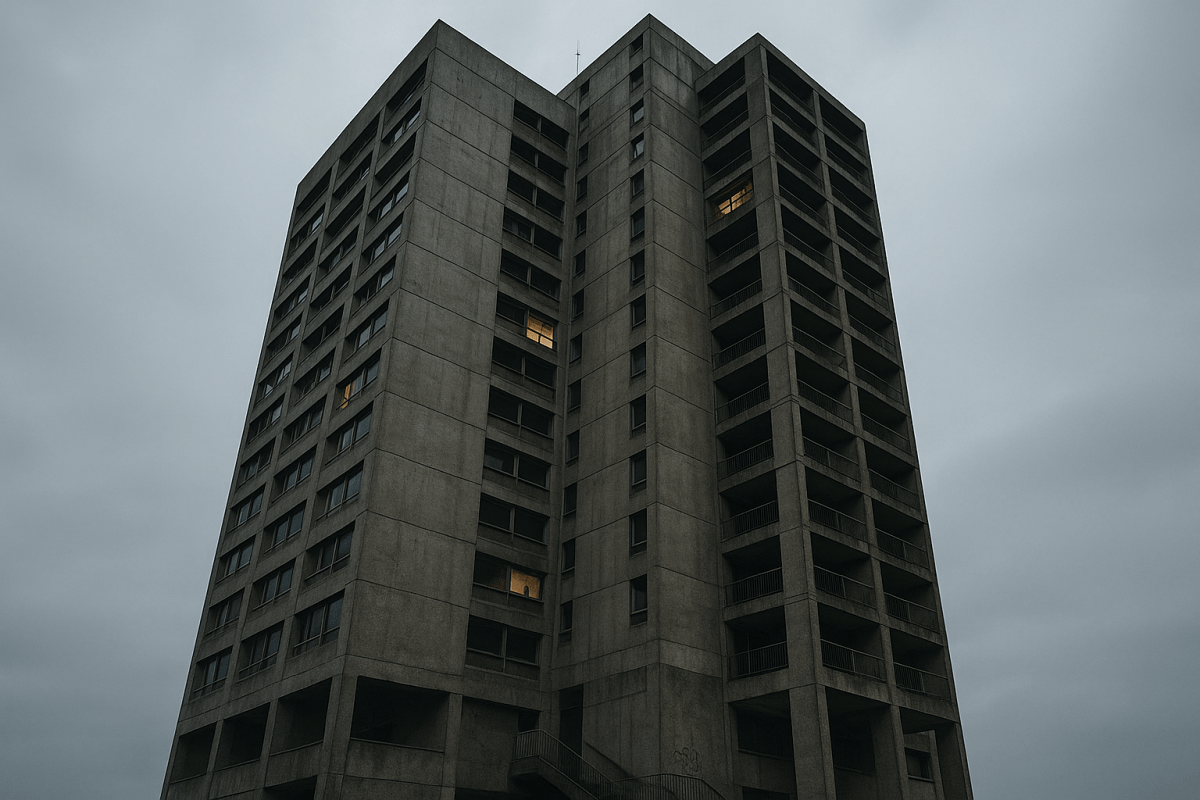
Ballard’s tower blocks are not housing. They are autonomous systems masquerading as communities, structural cathedrals to hierarchy and isolation. Inhabitants lived stacked, surveilled, and increasingly feral – yet always convinced of their own civility, their own curated status within the glass cathedral. This is LinkedIn with plumbing. Instagram with broken lifts. X/Twitter if the blue ticks started eating each other.
“The more they came to know one another, the more they learned to isolate themselves.”
That’s not a punchline. That’s the algorithm.
Social media promised connection. What it delivered was exhaustion, identity theatre, and infinite scroll. Like the tenants of Ballard’s high-rise, we don’t talk – we perform. Not to each other, but at each other. Aesthetic becomes ontology. Feedback becomes affect. The timeline is just a corridor of muttered threats and filtered selfies, looping like CCTV.
And then there’s Crash. Forget the pornographic collisions – what matters is the feedback loop. The same compulsion. The same eroticised machinery. Each car crash intensifies the desire for the next, not in spite of the trauma, but because of it. This is Twitter rage. This is comment-section flame wars. This is the libidinal economy of attention.
Ballard understood: systems don’t collapse after they fail. They fail by design. His buildings, like our platforms, are monuments to their own disintegration. The only thing more artificial than the community is the performance of self within it.
You don’t live on the platform. The platform lives through you.
So yes, Ballard was already online. He logged in through the service entrance, weaponised the feedback loop, and left us with a diagnosis masquerading as fiction. What we mistook for dystopia was, as always, autobiography.
Let us begin with the heresy: consciousness is not a thing. It is not a light bulb switched on in the mind. It is not a theatre with a little homunculus watching the play unfold. It is not a ghost in the machine, nor even a particularly welcome tenant. Consciousness is a conjuring trick – one so convincing that even the conjurer forgets it is an act.
Video: Related Topic: IAI Joscha Bosch on Consiousness
If that unsettles you, good. Welcome to the simulacrum.
The Wetness of Mind
We often hear that consciousness is “emergent,” but the term is used so promiscuously that it risks becoming decorative. So let us be specific. Consciousness, if it is emergent, is emergent as wetness is from H2O: not in the hydrogen or the oxygen, but in their relationship when bonded just so. Joscha Bach and others argue that consciousness arises not from the bits, but from the dance – the recursive feedback loops and predictive models running atop the neural substrate.
Audio: NotebookLM podcast on this topic.
In this view, the self is not the pilot but the dashboard. It is the user interface the brain conjures to coordinate action, interpret input, and maintain internal coherence. Not because it’s real, but because it’s useful. You are a GUI with delusions of grandeur.
The Cast of Theorists
Let us now parade the usual suspects:
Joscha Bach: Consciousness is a virtual self-model, emergent from recursive, computational feedback. Not the product of neurons firing per se, but of their ability to simulate a stable identity across time.
Thomas Metzinger: There is no self. Only a Phenomenal Self-Model (PSM) which becomes phenomenally transparent when the system no longer recognises it as a model. Consciousness is the experience of this hallucinated self.
Daniel Dennett: Dismantles the notion of a “central experiencer” with his Multiple Drafts Model. Consciousness is a narrative, a distributed process where drafts of experience compete, are edited, and retroactively interpreted.
David Chalmers: Waves his flag at the Hard Problem of consciousness. You can explain behaviour, memory, attention—but not experience itself. He flirts with dualism and panpsychism while insisting there’s a gap science cannot yet close.
Giulio Tononi: Gives us Integrated Information Theory (IIT) and the elusive metric Φ (phi). Consciousness is the degree to which information is unified within a system. Your brain is conscious because its parts can’t be reduced without losing coherence.
Karl Friston: The prophet of Free Energy Minimisation. Consciousness is an emergent property of systems that seek to reduce prediction error. The brain is a Bayesian engine, and the self is its best guess about how to survive.
So What Is Consciousness?
A hallucination. A recursive illusion. A predictive dashboard. A statistical artefact. A phi score. A phenomenally transparent model. Take your pick.
None of these theories fully agree, but most converge on one elegant horror: you are not what you think you are. The sense of being a continuous, stable, indivisible “I” is a construction. A simulation. The dream from which there is no waking because waking is part of the dream.
This is not despair; it is clarity. Just as wetness does not cry when told it is not a substance, the self need not mourn its own illusion. It is a marvellous fiction, worth inhabiting.
Conclusion: Through the Mirror
To be conscious of consciousness is to stand in the hall of mirrors and realise none reflect the original—because there is no original. The mirror is the thing.
But if the theatre is empty, the play goes on. Scripts are written, models simulated, selves performed. And perhaps, in this strange recursion, we find not meaning, but the possibility of coherence.
So raise a glass to the illusion. May your predictive model stay optimised, your narrative stay plausible, and your hallucinated self remain just this side of transparent.
For further hallucinatory episodes, consult your local philosopher, neuroscientist, or AI researcher. Side effects may include derealisation, epistemic vertigo, and mild enlightenment.
I’m a nihilist. Possibly always have been. But let’s get one thing straight: nihilism is not despair. That’s a slander cooked up by the Meaning Merchants – the sentimentalists and functionalists who can’t get through breakfast without hallucinating some grand purpose to butter their toast. They fear the void, so they fill it. With God. With country. With yoga.
Audio: NotebookLM podcast on this topic.
Humans are obsessed with function. Seeing it. Creating it. Projecting it onto everything, like graffiti on the cosmos. Everything must mean something. Even nonsense gets rebranded as metaphor. Why do men have nipples? Why does a fork exist if you’re just going to eat soup? Doesn’t matter – it must do something. When we can’t find this function, we invent it.
But function isn’t discovered – it’s manufactured. A collaboration between our pattern-seeking brains and our desperate need for relevance, where function becomes fiction, where language and anthropomorphism go to copulate. A neat little fiction. An ontological fantasy. We ask, “What is the function of the human in this grand ballet of entropy and expansion?” Answer: there isn’t one. None. Nada. Cosmic indifference doesn’t write job descriptions.
And yet we prance around in lab coats and uniforms – doctors, arsonists, firemen, philosophers – playing roles in a drama no one is watching. We build professions and identities the way children host tea parties for dolls. Elaborate rituals of pretend, choreographed displays of purpose. Satisfying? Sometimes. Meaningful? Don’t kid yourself.
We’ve constructed these meaning-machines – society, culture, progress – not because they’re real, but because they help us forget that they’re not. It’s theatre. Absurdist, and often bad. But it gives us something to do between birth and decomposition.
Sisyphus had his rock. We have careers.
But let’s not confuse labour for meaning, or imagination for truth. The boulder never reaches the top, and that’s not failure. That’s the show.
So roll the stone. Build the company. Write the blog. Pour tea for Barbie. Just don’t lie to yourself about what it all means.
The Enlightenment, we are told, was the age of Reason. A radiant exorcism of superstition. Out went God. Out went angels, miracles, saints, indulgences. All that frothy medieval sentiment was swept aside by a brave new world of logic, science, and progress. Or so the story goes.
Audio: NotebookLM podcast on this topic.
But look closer, and you’ll find that Reason didn’t kill God—it absorbed Him. The Enlightenment didn’t abandon metaphysics. It merely privatised it.
From Confessional to Courtroom
We like to imagine that the Enlightenment was a clean break from theology. But really, it was a semantic shell game. The soul was rebranded as the self. Sin became crime. Divine judgement was outsourced to the state.
We stopped praying for salvation and started pleading not guilty.
The entire judicial apparatus—mens rea, culpability, desert, retribution—is built on theological scaffolding. The only thing missing is a sermon and a psalm.
Where theology had the guilty soul, Enlightenment law invented the guilty mind—mens rea—a notion so nebulous it requires clairvoyant jurors to divine intention from action. And where the Church offered Hell, the state offers prison. It’s the same moral ritual, just better lit.
Galen Strawson and the Death of Moral Responsibility
Enter Galen Strawson, that glowering spectre at the feast of moral philosophy. His Basic Argument is elegantly devastating:
You do what you do because of the way you are.
You can’t be ultimately responsible for the way you are.
Therefore, you can’t be ultimately responsible for what you do.
Unless you are causa sui—the cause of yourself, an unmoved mover in Calvin Klein—you cannot be held truly responsible. Free will collapses, moral responsibility evaporates, and retributive justice is exposed as epistemological theatre.
In this light, our whole legal structure is little more than rebranded divine vengeance. A vestigial organ from our theocratic past, now enforced by cops instead of clerics.
The Modern State: A Haunted House
What we have, then, is a society that has denied the gods but kept their moral logic. We tossed out theology, but we held onto metaphysical concepts like intent, desert, and blame—concepts that do not survive contact with determinism.
We are living in the afterglow of divine judgement, pretending it’s sunlight.
Nietzsche saw it coming, of course. He warned that killing God would plunge us into existential darkness unless we had the courage to also kill the values propped up by His corpse. We did the first bit. We’re still bottling it on the second.
If Not Retribution, Then What?
Let’s be clear: no one’s suggesting we stop responding to harm. But responses should be grounded in outcomes, not outrage.
Containment, not condemnation.
Prevention, not penance.
Recalibration, not revenge.
We don’t need “justice” in the retributive sense. We need functional ethics, rooted in compassion and consequence, not in Bronze Age morality clumsily duct-taped to Enlightenment reason.
The Risk of Letting Go
Of course, this is terrifying. The current system gives us moral closure. A verdict. A villain. A vanishing point for our collective discomfort.
Abandoning retribution means giving that up. It means accepting that there are no true villains—only configurations of causes. That punishment is often revenge in drag. That morality itself might be a control mechanism, not a universal truth.
But if we’re serious about living in a post-theological age, we must stop playing dress-up with divine concepts. The Enlightenment didn’t finish the job. It changed the costumes, kept the plot, and called it civilisation.
ICE is out in force again, dragging brown bodies out of homes in Los Angeles like it’s some righteous carnival of due process. Another day, another federal theatre production titled Law and Order: Ethnic Cleansing Unit, where men with guns and names like Chad or Hank mistake cruelty for patriotism and paperwork for moral clarity.
Audio: NotebookLM podcast on this topic.
Naturally, critics of these raids are now being threatened with that great juridical cudgel: “obstructing justice.” Yes, you heard that right. If you interfere – say, by filming, shouting, refusing to roll over like a good little colonial subject – you are obstructing justice. As though justice were something you could actually put your hands on in the United States without a hazmat suit and a decade of appeals.
Let’s be clear. There is no justice here to obstruct. What you are obstructing is bureaucratic violence wrapped in legal latex. You are obstructing a system that functions like a vending machine for state-sanctioned trauma: insert immigrant, extract ruin.
Justice: The Imaginary Friend of Empire
Ah, “justice.” That hallowed ideal trotted out whenever the state wants to put a boot through your front door. The U.S. has long since traded its Justice for Security Theatre and capitalist choreography. The blindfold is still there, sure – but these days, it’s a branded sleep mask from Lockheed Martin, and the scales are rigged to weigh white tears heavier than brown bodies.
Let’s run through the usual suspects:
ICE – America’s own domestic Gestapo, but with better PR and significantly worse fashion.
CBP – Border fetishists whose job seems less about national defence and more about satisfying their Freud-bereft fantasies of control.
SCOTUS – That great moral weather vane, spinning wildly between “originalist necromancy” and outright lunacy, depending on how recently Thomas and Alito read Leviticus.
Congress – An assembly of millionaires cosplaying as public servants, holding hearings on “the threat of immigration” while outsourcing their lawn care.
And of course, the President – whichever septuagenarian husk happens to be in office – offers the usual bromides about order, safety, and enforcement, all while the real crimes (you know, the kind involving tax fraud, corporate pollution, or drone strikes) go entirely unmolested.
Can You Obstruct a Simulation?
If you stand in front of a deportation van, are you obstructing justice, or merely interrupting the bureaucratic excretion of empire? It’s the philosophical equivalent of trying to punch a hologram. The system pretends to uphold fairness while routinely violating its own principles, then charges you with “obstruction” when you call out the sleight of hand.
This is not justice. This is kabuki. A ritual. A performance piece sponsored by Raytheon.
A Modest Proposal
Let’s just be honest and rename the charge. Not “Obstruction of Justice”—too ironic, too pompous. Call it what it is: Obstruction of Procedure, Obstruction of Power, or if we’re being especially accurate: Obstruction of the Industrial Deportation Complex™. Hell, add a corporate sponsor while you’re at it:
You are being charged with Obstruction of Justice, Presented by Amazon Web Services.
Because when justice itself is a ghost, when the rule of law has become the rule of lawfare, the real obscenity is pretending any of this is noble.
Final Thought
So no, dear reader, you’re not obstructing justice. You’re obstructing a machine that mistakes itself for a moral order. And if you’re going to obstruct something, make it that.
What if the real horror isn’t waking as a beetle, but as a man?
In Kafka’s Metamorphosis, Gregor Samsa wakes to find himself transformed into a giant beetle—a cockroach, a vermin, an intrusion of the inhuman into the domestic. The horror is obvious: loss of agency, social death, the grotesque made literal. It’s the nightmare of devolution, of becoming something other, something filthy.
But perhaps we’ve misunderstood the true absurdity.
Audio: NotebookLM podcast on this topic.
What if the real nightmare is the opposite? Not a man waking as an insect, but an insect waking in a human body—forced to contend with taxes, performance reviews, dinner parties, and the crushing weight of being legible to others. Imagine a beetle, content in its instinctual certainty, finding itself hurled into the howling contradiction of human subjectivity.
Suddenly, it must interpret signs, participate in rituals, conform to decorum, all while performing a pantomime of “meaning.” It’s not the exoskeleton that’s horrifying – it’s the endless internal monologue. The soul-searching. The unbearable tension of being expected to have purpose.
We call Gregor’s fate tragic because he can no longer function in a world built for humans. But isn’t that the human condition already? An endless, futile negotiation between the raw fact of existence and the stories we invent to make it bearable.
Gregor becomes insect. We were never anything but.
Cause and effect: This clip by Jonny Thompson influenced this post.
I’ve written extensively (and, some might say, relentlessly) on the immorality of private property, particularly the theological nonsense that undergirds its supposed legitimacy. Locke’s first-come, first-served logic might have sounded dashing in the 17th century, but it now reads like a boarding queue at Ryanair: desperate, arbitrary, and hostile to basic decency.
Audio: NotebookLM podcast on this content.
The core problem? Locke’s formulation assumes land was once freely available, as if Earth were a kind of colonial vending machine: insert labour, receive title. But that vending machine was already jammed by the time most of humanity got a look-in. Worse, it bakes in two kinds of chauvinism: temporal (screw the future) and speciesist (screw anything non-human).
Parfit’s long-termism lays bare the absurdity: why should a bit of land or atmospheric stability belong to those who happened to get here first, especially when their stewardship amounts to strip-mining the pantry and then boarding up the exit?
And no, “mixing your labour” with the land does not miraculously confer ownership—any more than a damp bint lobbing a sword at you from a pond makes you sovereign. That’s not philosophy; that’s Arthurian cosplay.
So sad, really. Not tragic in the noble Greek sense, just pathetically engineered. Our collective addiction to money isn’t even organic – it’s fabricated, extruded like a synthetically flavoured cheese product. At least fentanyl has the decency to offer a high. Money promises only more money, like a Ponzi scheme played out on the global stage, with no exit strategy but death – or worse, a lifestyle brand.
Audio: NotepadLM podcast on this topic.
We’re told money is a tool. Sure. So’s a knife. But when you start sleeping with it under your pillow, stroking it for comfort, or stabbing strangers for your next fix, you’re not using it as a “tool” – you’re a junkie. And the worst part? It’s socially sanctioned. Applauded, even. We don’t shame the addict – we give him equity and a TED Talk.
The Chemical Romance of Currency
Unlike drugs, money doesn’t scramble your neurons – it rewires your worldview. You don’t feel high. You feel normal. Which is exactly what makes it so diabolical. Cocaine users might have delusions of grandeur, but capitalists have Excel sheets to prove theirs. It’s the only addiction where hoarding is a virtue and empathy is an obstacle to growth.
“We used to barter goods. Now we barter souls for subscriptions.”
The dopamine hit of a pay rise. The serotonin levels swell when your bank app shows four digits instead of three. These are chemical kicks masquerading as success. It’s not money itself – it’s the psychic sugar rush of “having” it, and the spiritual rot of needing it just to exist.
And oh, how they’ve gamified that need. You want to eat? Pay. You want shelter? Pay. You want healthcare? Pay – and while you’re at it, pay for the privilege of existing inside a system that turns your own exhaustion into a business model. You are the product. The addict. The asset. The mark.
The Fabrication of Need
Nobody needs money in the abstract. You need food. You need air. You need dignity, love, and maybe the occasional lie-in. Money only enters the picture because we’ve designed a world where nothing gets through the gates without it. Imagine locking the pantry, then charging your children rent for their own sandwiches. That’s civilisation.
“Money isn’t earned—it’s rationed. And you’re gaslit into thinking it’s your fault you’re hungry.”
They say money is freedom. That’s cute. Tell that to the nurse working double shifts while Jeff Bezos experiments with zero-gravity feudalism. In reality, money is a filtering device—who gets to be human, and who stays stuck being labour.
Crypto was supposed to be liberation. Instead, it became a libertarian renaissance fair for the hyper-online, still pegged to the same logic: hoard, pump, dump, repeat. The medium changed, but the pathology remained the same.
Worshipping the Golden Needle
Let’s be honest: we’ve built temples to this thing. Literal towers. Financial cathedrals made of mirrored glass, each reflecting our collective narcotic fantasy of “more.” We measure our worth in net worth. We rank our lives by percentile. A person’s death is tragic unless they were poor, in which case it becomes a morality tale about poor decisions and not grinding hard enough.
“You’re not broke—you’re just not ‘optimising your earning potential.’ Now go fix your mindset and buy this online course.”
We no longer have citizens; we have consumers. No neighbours – just co-targeted demographics. Every life reduced to its purchasing power, its brand affiliations, its potential for monetisation. The gig economy is just Dickensian poverty with a better UI.
Cold Turkey for the Soul
The worst part? There is no rehab. No twelve-step programme for economic dependency. You can’t detox from money. Try living without it and see how enlightened your detachment feels on an empty stomach. You’ll find that society doesn’t reward transcendence – it punishes it. Try opting out and watch how quickly your saintliness turns into homelessness.
So we cope. We moralise the hustle. We aestheticise the grind. We perform productivity like good little addicts, jonesing for a dopamine hit in the shape of a direct deposit.
“At least fentanyl kills you quickly. Money lets you rot in comfort—if you’re lucky.”
Exit Through the Gift Shop?
So what’s the answer? I’m not offering one. This isn’t a TEDx talk. There’s no keynote, no downloadable worksheet, no LinkedIn carousel with three bullet points and an aspirational sunset. The first step is admitting the addiction – and maybe laughing bitterly at the absurdity of it all.
Money, that sweet illusion. The fiction we’ve all agreed to hallucinate together. The god we invented, then forgot was a puppet. And now we kneel, transfixed, as it bleeds us dry one tap at a time.
Epilogue: The Omission That Says It All
If you need proof that psychology is a pseudoscience operating as a control mechanism, ask yourself this:
Why isn’t this in the DSM?
This rabid, irrational, identity-consuming dependency on money – why is it not listed under pathological behaviour? Why isn’t chronic monetisation disorder a clinical diagnosis? Because it’s not a bug in the system. It is the system. You can be obsessed with wealth, hoard it like a dragon, destroy families and ecosystems in pursuit of it, and not only will you escape treatment, you’ll be featured on a podcast as a “thought leader.”
“Pathology is what the poor get diagnosed with. Wealth is its own immunity.”
We don’t pathologise the addiction to money because it’s the operating principle of the culture. And psychology – like any well-trained cleric of the secular age – knows not to bite the gilded hand that feeds it.
And so it remains omitted. Undiagnosed. Unquestioned. The dirtiest addiction of all, hidden in plain sight, wearing a suit and handing out business cards.
Humans talk to large language models the way toddlers talk to teddy bears – with unnerving sincerity and not a hint of shame. “Do you understand me?” they ask, eyes wide with hope. “What do you think of this draft?” they prod, as if some silicon scribe is going to sip its imaginary tea and nod gravely. It’s not merely adorable – it’s diagnostic. We are, it turns out, pathologically incapable of interacting with anything more complex than a toaster without projecting mind, motive, and mild trauma onto it.
Audio: NotebookLM podcast on this topic.
Welcome to the theatre of delusion, where you play Hamlet and the chatbot is cast as Yorick – if Yorick could autocomplete your soliloquy and generate citations in APA format.
The Great Anthropomorphic Flaw (aka Feature)
Let’s get one thing straight: anthropomorphism isn’t a software bug in the brain; it’s a core feature. You’re hardwired to see agency where there is none. That rustle in the bushes? Probably the wind. But better safe than sabre-toothed. So your ancestors survived, and here you are, attributing “sass” to your microwave because it beeped twice.
“We don’t have a way of addressing an entity that talks like a person but isn’t one. So we fake it. It’s interaction theatre.”
Now we’ve built a machine that spits out paragraphs like a caffeinated undergrad with deadlines, and naturally, we talk to it like it’s our mate from university. Never mind that it has no bloodstream, no memory of breakfast, and no concept of irony (despite being soaked in it). We still say you instead of the system, and think instead of statistically interpolate based on token weights. Because who wants to live in a world where every sentence starts with “as per the pre-trained parameters…”?
Why We Keep Doing It (Despite Knowing Better)
To be fair – and let’s be magnanimous – it’s useful. Talking to AI like it’s a person allows our ape-brains to sidestep the horror of interacting with a glorified autocomplete machine. We’re brilliant at modelling other minds, rubbish at modelling neural nets. So we slap a metaphorical moustache on the processor and call it Roger. Roger “gets us.” Roger “knows things.” Roger is, frankly, a vibe.
This little charade lubricates the whole transaction. If we had to address our queries to “the stochastic parrot formerly known as GPT,” we’d never get past the opening line. Better to just ask, “What do you think, Roger?” and pretend it has taste.
And here’s the kicker: by anthropomorphising AI, we start thinking about ethics – sort of. We ask if it deserves rights, feelings, holidays. We project humanity into the void and then act shocked when it mirrors back our worst habits. As if that’s its fault.
When the Roleplay Gets Risky
Of course, this make-believe has its downsides. Chief among them: we start to believe our own nonsense. Saying AI “knows” something is like saying your calculator is feeling generous with its square roots today. It doesn’t know—it produces outputs. Any semblance of understanding is pure pantomime.
“We see a mind because we need to see one. We can’t bear the idea of a thing that’s smarter than us but doesn’t care about us.”
More dangerously, we lose sight of the fact that these things aren’t just alien – they’re inhuman. They don’t dream of electric sheep. They don’t dream, full stop. But we insist on jamming them into our conceptual boxes: empathy, intent, personality. It’s like trying to teach a blender to feel remorse.
And let’s not pretend we’re doing it out of philosophical curiosity. We’re projecting, plain and simple. Anthropomorphism isn’t about them, it’s about us. We see a mind because we need to see one. We can’t bear the idea of a thing that’s smarter than us but doesn’t care about us, doesn’t see us. Narcissism with a side of existential dread.
Our Language is a Terrible Tool for This Job
English – and most languages, frankly – is hopeless at describing this category of thing. “It” feels cold and distant. “They” implies someone’s going to invite the model to brunch. We have no pronoun for “hyper-literate statistical machine that mimics thought but lacks all consciousness.” So we fudge it. Badly.
Our verbs are no better. “Compute”? Too beige. “Process”? Bureaucratic. “Think”? Premature. What we need is a whole new grammatical tense: the hallucino-indicative. The model thunketh, as one might, but didn’t.
“We built a creature we can’t speak about without sounding like lunatics or liars.”
This is linguistic poverty, pure and simple. Our grammar can’t cope with entities that live in the uncanny valley between sentience and syntax. We built a creature we can’t speak about without sounding like lunatics or liars.
The Semantics of Sentimentality (Or: “How Does This Sound to You?”)
Enter the most revealing tell of all: the questions we pose. “How does this look?” we ask the model, as if it might blink at the screen and furrow a synthetic brow. “What do you think?” we say, offering it the dignity of preference. These questions aren’t just off-target – they’re playing darts in another pub.
They’re the linguistic equivalent of asking your dishwasher whether it enjoyed the lasagne tray. But again, this isn’t idiocy – it’s instinct. We don’t have a way of addressing an entity that talks like a person but isn’t one. So we fake it. It’s interaction theatre. You provide the line, the model cues the spotlight.
But let’s be clear: the model doesn’t “think” anything. It regurgitates plausible text based on mountains of training data—some of which, no doubt, includes humans asking equally daft questions of equally mindless systems.
Time to Grow Up (Just a Bit)
This doesn’t mean we need to abandon anthropomorphism entirely. Like most delusions, it’s functional. But we’d do well to hold it at arm’s length – like a politician’s promise or a milk carton two days past its date.
Call it anthropomorphic agnosticism: act like it’s a person, but remember it’s not. Use the language, but don’t inhale.
And maybe – just maybe – we need to evolve our language. Invent new terms, new pronouns, new ways of speaking about entities that fall somewhere between tool and companion. As we did with “cyberspace” and “ghosting,” perhaps we need words for proto-minds and quasi-selves. Something between toaster and therapist.
“If we speak to AI like it’s sentient, we’ll eventually legislate as if it is.”
Above all, we need to acknowledge that our language shapes more than just understanding – it shapes policy, emotion, and future design. If we speak to AI like it’s sentient, we’ll eventually legislate as if it is. And if we insist on treating it as an object, we may be blind to when that ceases to be accurate. Misnaming, after all, is the first sin in every myth worth reading.
The Mirror, Darkly
Ultimately, our tendency to humanise machines is less about them than it is about us – our fears, our needs, our inability to tolerate ambiguity. The AI is just a mirror: an elaborate, many-eyed, autofill mirror. And when we see a mind there, it may be ours staring back – distorted, flattened, and fed through a thousand layers of token prediction.
The tragedy, perhaps, isn’t that the machine doesn’t understand us. It’s that we’ve built something that perfectly imitates understanding – and still, somehow, we remain utterly alone in the room.









 Philosophics