Video: No-Self, Self, and Selves

First, this is an extension of sorts from a prior post on No-Self, Selves & Self, but I wanted to create a short video for my YouTube channel to establish somewhat of a foundation for my intended video on the causa sui argument. Related content can be found on this one of the Theseus posts.

This video is under 8-minutes long and provides some touch-points. I had considered making it longer and more comprehensive, but since it is more of a bridge to a video I feel is more interesting, I cut some corners. This leaves openings for more in-depth treatment down the road.

As has become a routine, I share the transcript here for convenience and SEO relevance.

Transcript

In this segment of free will scepticism, we’ll establish some perspectives on the notion of the self.
Most of us in the West are familiar with the notion of the self. What’s your self? It’s me. For the more pedantic crowd, It is I.

We’re inundated with everything from self-help to self-awareness to self-esteem to selfies and self-love. We’ve got self-portraits, self-image, and self-harm. We’ve got self-ish and self-less.
We’ve even got self-oriented psychological disorders like narcissism. Attending to the self is a billion-dollar industry.

And whilst psychology and pop-psychology seem to consider the self to be a nicely wrapped package fastened tightly with a bow, it’s a little more contentious within philosophy. But there are other perspectives that don’t include the self, from no-self to slices of discontiguous selves. Let’s shift gears and start from the notion of having no self, what Buddhism calls no-self.

No-Self

Buddhism is an Eastern discipline, so it does not have the same foundations as the West. According to this system of belief, the notion of a personal identity is delusional, so there is no self at all. This obsession and clinging to this delusional self is a major cause of suffering.

the notion of a personal identity is delusional,
so there is no self at all.

In this view, all is one and indivisible, but self-deception leads us to believe we are individuals, each with a discrete self. In fact, the Buddhist notion of Enlightenment—as opposed to the Western notion of Enlightenment—is precisely this realisation that there is only one self, and this is the collective self. But, to be fair, except for the times where the self has yet to be developed—we’ll get to this in a bit—, this notion of no-self is aspirational in the sense of losing one’s self in order to reduce suffering.

The concept of selflessness exists in language, but this is more aimed at sublimating the self in favour of a greater collective good.

Self

The self is the central feature of many personality theories from Sigmund Freud and Carl Jung to Rollo May and Abraham Maslow. From individuation to self-actualisation. The self is self-referenced as I and me. Historically, the self had been considered to be synonymous with some metaphysical soul. Nowadays, psychology has taken the reigns on definitions.

One version of the self can be thought of as a single thread connecting beads of experience through time, time-slices of experience. We’ll come back to this. This sense of self extends backwards in time until now and contains aspirations projected forward in time as viewed from the perspective of now.

This sense of self extends backwards in time until now and contains aspirations projected forward in time as viewed from the perspective of now.

Whilst we use terms like ‘person’, ‘self’, and ‘individual’ somewhat synonymously, they each have different meanings. Whereas ‘individual’ is a biological term; ‘person’ is sociological or cultural; ‘self’ is psychological. Although the default position in the West is the adoption of the psychological notion, where each person has a self, there is also a philosophical notion. Given that the perspective of self is so ubiquitous with people accepting it as obvious, that it feels like I shouldn’t even spend time producing content to fill this space. But for a sense of completeness, I shall.

Psychologist William James distinguished between the ‘I’ and ‘me’ sense of the self, but let’s not parse this and consider each a stand-in for the self as experienced by the self. In this view, the self is generally considered to be the aggregation of continuous phenomenological moments and how we interpret them into a sense of ‘identity’.

In the West, the notion of having a self is imposed by convention. To feel otherwise is considered to be a sign of mental illness. As much as I want to share Foucault’s perspective on how delineating mental illness operates to the benefit of power structures, let’s just consider this out of scope. The Diagnostic and Statistical Manual of Mental Disorders, DSM-5, notes that a key symptom of borderline personality disorder, BPD, is a ‘markedly and persistently unstable self-image or sense of self’. Become selfless at your own peril.

There are challenges with the notion of self even in psychology. In developmental psychology, the self—differentiating one’s self into an identity separate from the world—, is not acquired until about the age of 18 months. Lacan had suggested that this so-called mirror stage developed at around 5 months as part of ego formation, but further research disputes this.

Although I won’t go into detail, individualist cultures experience the self differently than collectivist cultures. The origin of the concept of the individualistic view of self can be traced to early Christianity. In American culture, Protestantism seems to be a primary driver of the individualistic view of self. Let’s continue.

Selves

Heraclitus quipped, ‘No man ever steps in the same river twice, for it’s not the same river and he’s not the same man’. This is a nod to the impermanence of the self. Instead, there are selves.

No man ever steps in the same river twice, for it’s not the same river and he’s not the same man

Heraclitus

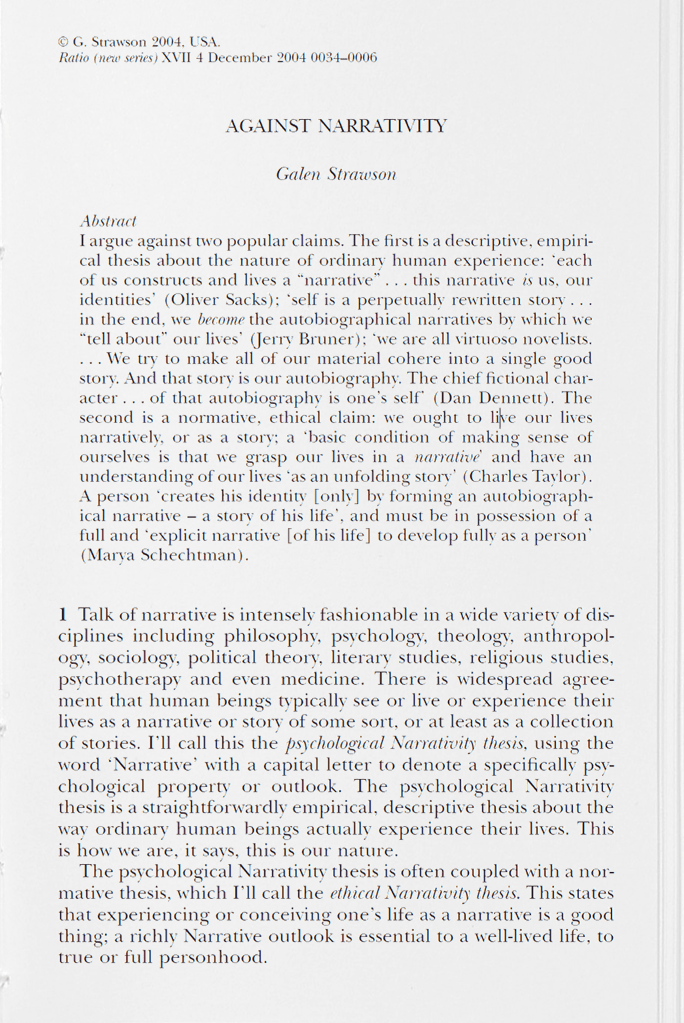
Galen Strawson proposes that although he understands intellectually what others mean when they use the word self, he doesn’t share this experience emotionally. Unlike the phenomenological slices connected by a thread, he doesn’t feel he has a thread. He posits that he experiences this prevailing sense of narrativity episodically without continuity.

A typical view of the self is that one feels narratively connected to past slices—the 5-year-old self with the 20-year-old self and with the 50-year-old self, whether that 50-year-old self is in the past, present, or future. Even though we are not the same person, there is some felt affinity.

My View

As for me, I consider the self to be a constructed fiction that serves a heuristic function. I don’t feel as disconnected as it seems Strawson does, but I don’t feel very connected to my 7 or 8-year-old self. And I can’t even remember before that. I’m not even sure I’ve got one data point for each year between 8 and 12, and it doesn’t get much better until 18 or 20. From there, I may be able to cobble together some average of a dozen or so per year without prompting, but I don’t even feel like the same person. Many of my views and perspectives have changed as well.

I don’t even feel like the same person

I was in the military until I quit as a Conscientious Objector. During that time, I became aware of Buddhism, and I doubled down on my musical interests. I worked in the Entertainment industry until I became an undergrad student, transitioning to become a wage slave whilst also attending grad school until I graduated. I’ve had several career foci since then. With each change, I’ve had a different self with a different outlook.

Can I connect the dots? Sort of. But I can also create a thematic collage out of magazine clippings or create art with found objects. I can tell a disjointed story of how I transitioned from X to Y to Z. It may even contain some elements of truth. Given how memory operates, who can tell?

In any case, what about you? In the next segment, I’m going to be discussing why we may not have free will owing to a lack of agency based on a causa sui argument.

Do you feel like you have a self? Does your sense of self have any gaps or inconsistencies? Do you feel you don’t have a self at all?

Let me know in the comments below.

Palaeolithic Emotions

The answer is P F Strawson.

When I was watching the video by Bob Doyle that inspired me to write No Escape from Moral Responsibility, Bob made an offhand remark about Galen Strawson that made me question how Bob couldn’t make a connection. In fact, that would make two because the trigger for my having penned the post in the first place is his comment about not understanding how probability in a system wouldn’t necessarily lead to zero degrees of agential freedom. After noting that Strawson, the younger, was an Impossibilist, he flippantly remarked that although Strawson, as the strictest species of Determinists, he and his ilk would be put off if someone knocked their coffee over.

Bob had already mentioned P F Strawson’s position that whether or not the universe was deterministic or indeterministic, people would still have an emotional response and seek a target—likely the animate entity nearest the cup. It may have been a cat or a gust of wind, but if there is a person nearby, blame will be cast.

People don’t even need a target. They’ll look for structural defects in the cup; perhaps the table is not level; why didn’t they leave more space between the tables? If I hadn’t had to stop for petrol, I’d have gotten another seat? Or if I had stopped for petrol, I wouldn’t have been in the vicinity. Humans are imbued with all sorts of magical thinking. I’d almost be willing to bet that this thing overruns the logical sort.

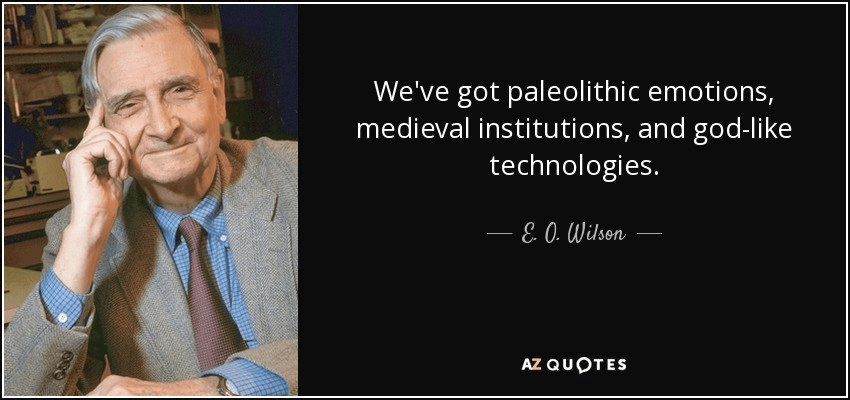
E O Wilson Quote

As E O Wilson once said.

We’ve got Paleolithic emotions…

E O Wilson

His context was different, but the point remains. Humans should be reclassified from Homo sapiens sapiens to Homo pathos sapiens.

This post has been in draft for a month or so. When I was looking for a cover image, I came across a post by SoundEagle on the topic of Palaeolithic Emotions. I opted to not appropriate the attendant art. Check it out of you are interested in what I didn’t purloin.

Intuition Showdown

Two different colleagues have independently recommended The Matter With Things by Dr Iain McGilchrist, who is also known for The Master and His Emissary, published in 2009.

As a result of these recommendations, I’ve watched some 6 or more hours of video interviews with Iain, some of which are hosted on his own site, Channel McGilchrist, including this one. Before I get to the topic promised by the title of this post, I’ll say that I like Iain. I respect his intellect, his demeanour, and his approach. If you are a credentialist, his an Oxford-educated psychiatrist—so he’s no slouch.

Iain’s positions are well researched, informed, and articulated. I could listen to him for hours. In fact, I have. And yet I disagree with a fundamental position he takes on intuition. Allow me to build up to that.

My first recommendation was due to a reaction I shared that depicting left-right brain hemisphere as analytic-creative was overly reductionist and quaint. McGilchrist was recommended because he disagreed. But it turns out his disagreement was more in the way it was being portrayed. The answer was wrong because the question was wrong. In a nutshell, his contention is that we shouldn’t be asking what each hemisphere processes, but how it goes about processing. I agree with this.

we shouldn’t be asking what each hemisphere processes, but how it goes about processing

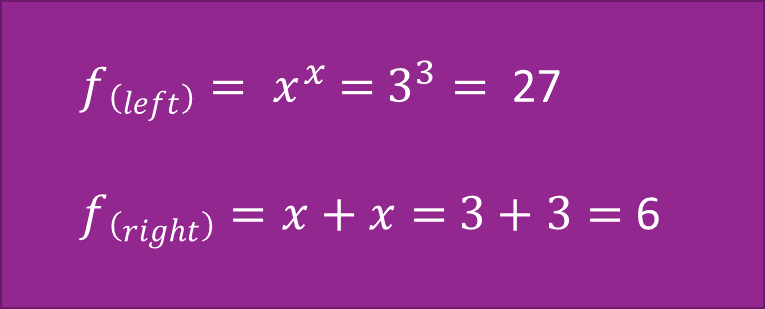
His point is that in cases where an experience (inputs) might be processed on one side versus another, the interpretation (outputs) would necessarily differ. To make a false analogy, the left brain might be performing an exponential function whilst the right brain might be performing an arithmetic function. So, if ƒ(left) = xx and ƒ(right) = x+x, then an input of 3 would yield 27 and 6, respectively. There is nothing wrong with either side, they just produce different results. In context, this difference might matter: How many feet across is that chasm I must leap. I say, ‘Oops’, as I am falling to my demise having underestimated the difference, having used the right rather than the left function.

False Analogy by the Numbers

So where is this showdown you are wittering on about? A little more setup.

Science is stereotypically an analytic function, which is the say it requires a lot of left hemisphere processing. Psychology—and keep in mind that I cast psychology as pseudoscience, or para-science when I am being more charitable—elevates the notion of intuition as not only having value but of being largely ignored by science.

Those who have been following me for a while, know that I am also critical of Scientistm™, the blind-faith devotion to the current state of science as being some infallible truth. But neither am I an advocate for metaphysical claims. This is what I feel Psychology™ is trying to do with intuition. It feels like they are not only trying to inject a metaphysical claim; they are simultaneously making a normative claim that you should have (and trust) intuition; further, they are staking out the territory to be able to say an absence of this acceptance is pathological, so this is a power play. We’ve got the tea leaf readers taking up arms against science.

Of course, I am being hyperbolic and polemic for effect, but this division exists. Iain is not the first to attempt to elevate intuition. A central idea that Jonathan Haidt tries to sell the reader on in his book, The Righteous Mind, is that we need to be more accepting and trusting of intuition. Even Malcolm Gladwell pushed this point in Blink: The Power of Thinking Without Thinking.

I do think that this will escalate. Even if it doesn’t materialise into a full-scale war, people will take sides—they already have—, and we’ll see more us versus them fingerpointing. Whilst I am not fully on the side of science, my propensity is to lean in that direction.

UPDATE: Even before I post this, I discover that I am behind the times with this prediction. In searching for a suitable image for this post, I find the book Science and Pseudoscience in Clinical Psychology, which calls out pseudoscience presented as fact not only in the obvious realm of pop psychology but in the offices of practising psychologists. I have not read it, so I am not in a position to recommend it. I may get a copy for myself, if only just to have it on hand.

Before I end this, I also wish to anticipate a point of disagreement. I’ve encountered practitioners of ‘scientific psychology’ who vehemently defend their vocation as science. Without addressing this directly, let’s just raise the point that applying the scientific method and maths to a discipline doesn’t graduate it to become a science. I can apply this to Tarot or haruspicy. If fact, this is how, in general, social sciences became so-called soft sciences: ‘Look at me, mum. I’m using numbers’.

Where do you fall on the topic of intuition? Am I exaggerating and making mountains out of molehills?

Small Print (enlarged for texture): I’ve been approved as an Amazon.com Affiliate, so any links to Amazon are monetised. The purchase price to you remains unaffected, but I may be compensated for these purchases. If a purchase does not accrue to an affiliate, Amazon keeps the difference.

PSA: If you know of an affiliate you want to support—whether me or another—, purchaser through the affiliate. It costs you nothing and benefits the little guy.

Revisiting Time Reborn

I’ve just finished with Time Reborn. I wasn’t expecting to be converted to Smolin’s proposition that time is real rather than constructed. I enjoyed the book, and he provided a solid foundational understanding of the conventional scientific perspective (circa 2013, when the book was published).

I understand that Smolin is a professional physicist with a PhD and his grasp of the fundamentals is solid, and I am a peripheral scientist at best. I fully grant that I may be on the left of the Dunning-Kruger curve and making rookie mistakes.

The biggest contention I have is that he insists that everything needs to have a reason, citing Leibnitz. His argument is based on the question of why is our universe so perfectly structured, that it would be improbable to have happened purely by chance.

Whilst I agree that everything has a cause, reasons are an artifice imposed by humans. In practice, where reasons don’t exist, we make them up. This is how we get false theories and gods. Smolin does discuss false theories of the past and attempts to claim that the prevailing theories occupy this space whilst his theory should replace it.

Any universe created without the ability to sustain life would not have us asking why it did not support life.

My reaction is that it just is. Whether Roger Penrose is correct in saying that the universe is continually recreated and destroyed, rinse and repeat, the reason the universe is constructed in such an (improbably) ordered fashion that can sustain life is that there is no reason. Any universe created without the ability to sustain life would not have us asking why it did not support life. It does. We are here to question, and so we do. End of story.

We can make up all sorts of stories, whether through science, religion, or some other origin myth. None of them is provable. As Smolin notes, this is a one-time event. If it is destroyed, so are we and our memories. If life is sustainable in a future—or even parallel—configuration, we’re sent back to start where we can fabricate new stories.

Perhaps in another universe, it will be configured so differently that some other sort of life is created, perhaps this life will not be DNA-based and be anaerobic? Who knows?

It seems that he has an interest in reserving a place for human agency, which has little room for movement in current scientific models. His model provides this room. Moreover, he further thinks that even in current models, human agency should be injected into the models. I suppose he is not familiar with Keynes’ animal spirits.

For some reason, he decided to devote the final chapter to the hard problem of consciousness. This was a particularly hot topic around that time, so he didn’t want to miss the boat. The long and the short of it, he didn’t think the qualia-consciousness answer would be found through physics—though he reserved that there was a non-zero probability that it could be. He posits this as an existential, experiential challenge, and science is not designed to address such affairs.

Supernatural

There is a battle being waged in the United States today, but it is not centred on the lack of separation of Church and State. I suppose this may be a uniquely American issue given its Constitutional roots, but the root cause is rather a lack of separation between Natural and Supernatural, not between Church and State.

Tomorrow America is celebrating Independence Day [sic], but until we are independent of religion, we cannot be independent. The only real independence is for the politicians who are independent of British control. There is nothing more substantial than this, and nothing for the ordinary citizen, who might as well be taking orders from England. Canada doesn’t look any worse for the wear and tear. I’m not a Monarchist, but it’s no less ridiculous than the Oligarchy or Plutarchy in play today.

I’ve got nothing again churches, per se. I don’t prefer the brainwashing that passes as organised religion, but neither am I fond of the brainwashing that is organised politics. And why is it called ‘brainwashing’? It’s clearly mind-muddling. I digress.

I do believe that it’s in the best interest to separate Church and State, not least because I need freedom from religion. It is already force-fed down my throat and codified into laws. We need less, not more.

Of course, a key topical debate is the abortion issue. This is strictly a religious issue. Even if you want to argue that it’s a moral rather than religious issue, it is still the result of supernatural beliefs. This is where the separation needs to happen.

Why won’t it happen? It won’t happen because people who believe in supernatural forces—especially active supernatural forces—are easy to manipulate. This has been true historically as well as contemporaneously. It’s too convenient for politicians to pull the old Santa Claus trick—if you aren’t good, Santa won’t give you any presents; and if you’re bad, he’s going to bring you coal instead.

I’ve said my peace. In the end, I don’t really even care if you believe in the supernatural, but if you believe that you (or anyone) can interpret these forces, I claim foul and out of bounds. This belief is not different to believing that you can understand what your dog or cat is ‘saying’—or your pet unicorn in the garden. It’s certifiable.

I know that other countries have to contend with this interference. Some even don’t mind the union. Is this a problem in other countries? Is it a problem in yours? Or do you consider it to be a necessary solution?

DISCLAIMER: This post has absolutely nothing to do with the Supernatural television series.

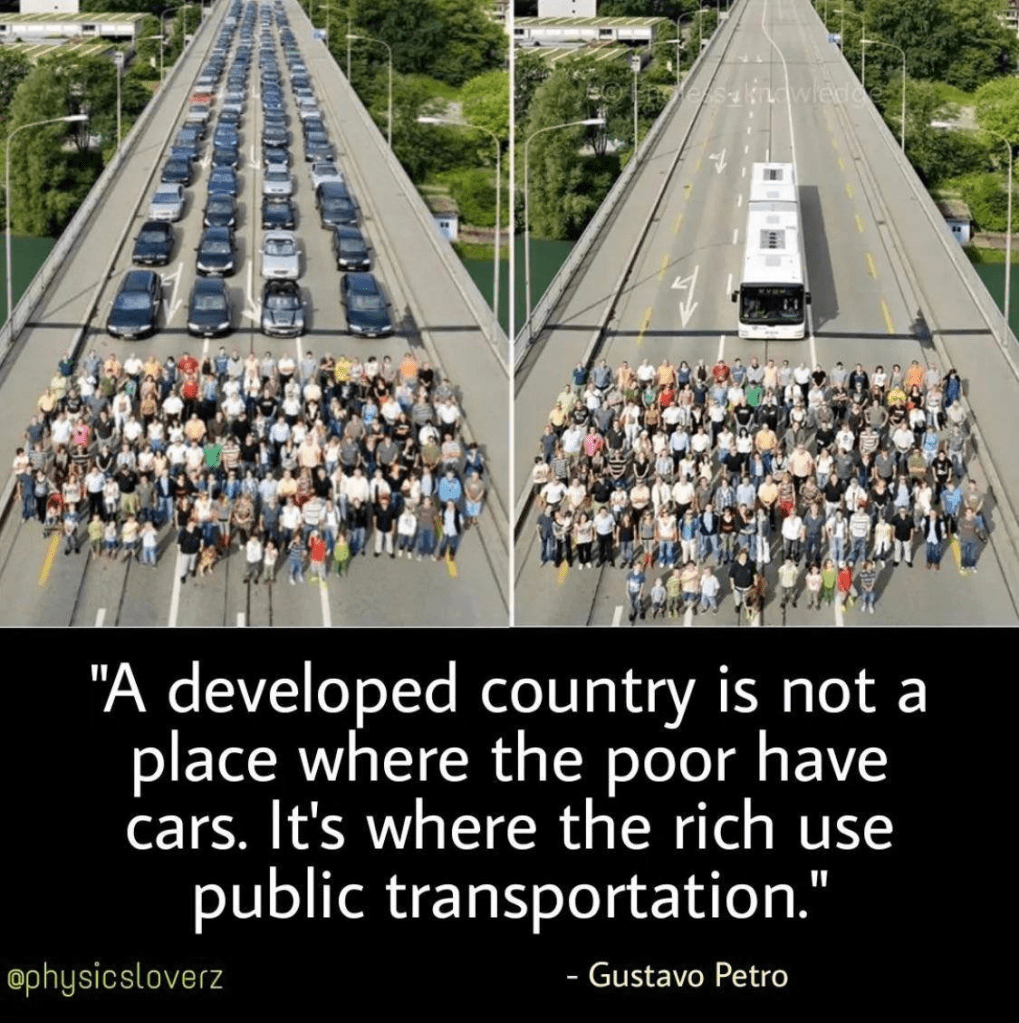
Cyclists are Economic Disasters

A colleague of mine posted this today. It was in quotations but was uncited. I attempted to discover the source, but the best I could do was to find a post from 2017 citing another author, Kaushik Patel on LinkedIn, but I do not know if this person originated this. It doesn’t really matter. In the spirit of full disclosure, my colleague is a fully indoctrinated, unapologetic Libertarian Capitalist. He also is an avid bicyclist, so reconciling the meta must be a challenge.

A Cyclist – is a disaster for the economy:

1. He does not buy the car and does not take a car loan.
2. Does not buy vehicle insurance.
3. Does not buy fuel.
4. Does not use the services of repair shops and car washes.
5. Does not use paid parking.
6. Does not become obese.
7. Yes, and well, dammit ! Healthy people are not needed for the economy. They do not buy drugs. They do not go to private doctors. They do not increase the country’s GDP ! On the contrary, every new McDonald’s outlet creates 30 jobs: 10 Dentists, 10 Cardiologists and 10 Weight Loss Experts.

So, what do you prefer- Cycling or fast food?

Like the Jackass parable, I recently shared, how one reacts to this is largely predictable if you know the worldview of the reactor.

This piece takes the perspective of the cyclist critiquing GDP economics satirically through the lens of an orthodox economist. Of course, there are also many internal contradictions and mistruths. I don’t intend to fully critique what I take to be a meme, but I’ll comment somewhat. To be fair, I get annoyed by bicycles intermingling with either automobiles or pedestrians. I’d prefer there be dedicated thoroughfares for bikes. When I am walking, I feel they’re like mosquitos or horseflies. When I’m driving, I see them as drunken toddlers. Who knows what they’re going to do next.

Meantime

Crossed my Facebook Feed

To be honest, I see them as anachronistic. They serve a purpose—many purposes, in fact—, but that doesn’t obviate the nuisance factors. I am not wholly anti-bicycle, but I feel they need a better implementation strategy. I rode bicycles until I was twelve years old or so. Not being the nineteenth century, I still view them as child’s toys. Regarding adults, there are generally two categories—the privileged (and self-righteous) and the underprivileged (and disenfranchised).

Privilege

The author of this quote is likely in this category. How dare someone try to undermine my god-given right to responsibly ride a bike for the greater good of humankind. These people not only own expensive bicycles. Some own several for on-road cycling, off-road cycling, and perhaps even performance cycling. Generally, they own the accoutrements and matching aerodynamic vestiments—padded bicycle shorts, a tight jersey, a sleek helmet, and proper cycling shoes, each contributing to the economy.

In the categories are the commuters, who cannot necessarily wear their gear on the commute, but trust me, they got it in the closet, and they’d wear it if they could.

Underprivilege

This category is for the poor who need to commute a relative distance but either can’t afford or justify an automobile or have had their licence revoked. These people are not a part of bike culture. They are bicyclists by necessity. This is not a play to the greater good. It’s just a way to not have to walk as much.

More Colour and Shape

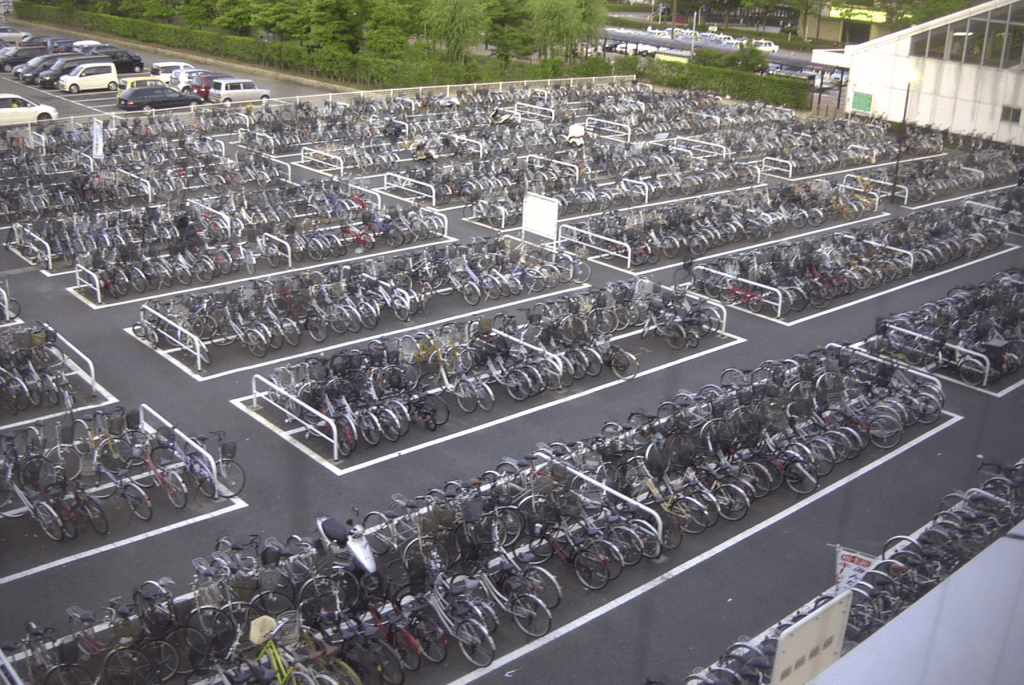
There is a large cultural component evident here. Japan has a bike culture. When I lived outside of Tokyo, I could drive past parking lots filled with thousands of bicycles. But that’s their culture.

A parking lot for bicycles in Niigata, Niigata, Japan

I didn’t even own a car in Japan. I relied on their public transportation system and my feet. I drove friends’ cars and motorbikes. Japan also has favourable motorbike regulations, but that’s another topic.

What does it mean?

The meta of this satire is that from the perspective of the GDP, the cyclist does not contribute to the larger economy. I’ll not mention beyond this that the cyclist is a male.

He does not buy the car and does not take a car loan

This presumes that the bicycle is the sole means of transportation. Perhaps it is. Perhaps it isn’t. Perhaps he buys a car but pays cash. Why is he introducing financing into the equation? Of course, the bike needs to be purchased. Some are more expensive than a used car.

Does not buy vehicle insurance

This relies on the previous situation, but—and I hate to be the one to break it to you— not all people who own cars or drive buy automobile insurance. Do all jurisdictions actually require a person to purchase insurance?

Does not buy fuel

Ditto. Presuming this means petrol for the motorcar.

Does not use the services of repair shops and car washes

This is just silly. As with fuel, obviously, this is scoped to auto repair. And many people don’t use or rarely use car washes. Whilst one may bypass auto repair, you may not escape the need for bicycle repairs or tyres or frames and so on. Sure, these might be less expensive, but they are no zero-cost events.

Does not use paid parking

I am presuming this person either does not live in a congested city where one would have to pay for parking or his city subsidises parking, thus contributing to GDP.

Does not become obese

A bit of fat-shaming, perhaps? I guess he’s never seen a fat person on a bike. I’ll give him that the person on the bike might get some cardiovascular activity that wouldn’t have happened otherwise, and perhaps he’d avoid becoming morbidly obese, but I’m not accepting this one. Moreover, I’ll suggest that selection bias is more the factor.

Healthy people are not needed for the economy

Here’s the punchline. Healthy people don’t contribute to the Medical-Industrial Complex. Speaking from the perspective of the US, these people pay for preventative care, buy upscale food, eat in upscale restaurants—not to mention McDonald’s—, live in upscale housing in upscale neighbourhoods, shop in upscale stores, and so on. I’ve heard the sentiment that if you don’t spend money on Organic™ food and health supplements and treatment modalities, then you’ll spend it later in trying to recover your (inevitable) lost health.

How does McDonald’s generate dentists? Conveniently, he left out the medical personnel who get to treat knee injuries, injuries from falling and getting hit by cars (or maybe just car doors).

Closing

In the end, economics is not a good measure for much of anything, but it is a measure that can increase or decrease and, for what it’s worth, we can compare X to Y.

After all is said and done, I don’t care about the GDP, and I don’t care about cycling. Chalk it up to non-attachment or apathy—perhaps a little of each.

Disinterested

I must have missed the memo. Disinterested has merged into uninterested. Disinterested used to mean you mean impartial; now it means not interested. Whereas uninterested means not interested in a topic.

I am not strictly a prescriptivist when it comes to language, but it does provide a certain level of efficiency in communication. Descriptively, one needs to interpret conversation through some local lens, but one can’t persist a description for too long because it might have drifted the next time you try to apply it. Imagine having to negotiate meaning and intent every time we engage in communication.

Uninterested means not interested in a topic.

A car was a vehicle last week, but those are now called ABC because this week car means XYZ—only to have to reevaluate this shared meaning in the next contextual engagement.

Disinterested used to mean not being interested in the outcome.

Disinterested used to mean not being interested in the outcome. But that’s changed. It seems that now, in order to provide clarity of communication, we need to use the word impartial so as not to introduce the ambiguity now embedded in disinterested.

Recently, I was speaking with a well-educated linguaphile, and I mentioned that I was looking for a disinterested person to mediate a debate. This man is in his eighties, yet he immediately interpreted disinterested as uninterested. When I shared my understanding of the meaning, he conveyed that he was unfamiliar with that parsing. This came as a surprise to me because he is a psychiatrist and psychoanalyst—quite the word wordsmith in a Jungian sort of way. I presumed that he would have understood the distinction and nuance in the interpretation. Once I clarified, he adopted my meaning—at least within the scope of our conversation. This said, I might drop disinterested from my vocabulary altogether. I’ll retain uninterested in the way a always have, and I’ll employ impartial where I would have heretofore employed disinterested.

Did you get this memo? Do you use disinterested and uninterested as close synonyms or do you retain the nuance?

Lions and Tigers and—a Jackass?

The donkey told the tiger, “The grass is blue.”

The tiger replied, “No, the grass is green .”

The discussion became heated, and the two decided to submit the issue to arbitration, so they approached the lion.

As they approached the lion on his throne, the donkey started screaming: ′′Your Highness, isn’t it true that the grass is blue?”

The lion replied: “If you believe it is true, the grass is blue.”

The donkey rushed forward and continued: ′′The tiger disagrees with me, contradicts me and annoys me. Please punish him.”

The king then declared: ′′The tiger will be punished with 3 days of silence.”

The donkey jumped with joy and went on his way, content and repeating ′′The grass is blue, the grass is blue…”

The tiger asked the lion, “Your Majesty, why have you punished me, after all, the grass is green?”

The lion replied, ′′You’ve known and seen the grass is green.”

The tiger asked, ′′So why do you punish me?”

The lion replied, “That has nothing to do with the question of whether the grass is blue or green. The punishment is because it is degrading for a brave, intelligent creature like you to waste time arguing with an ass, and on top of that, you came and bothered me with that question just to validate something you already knew was true!”

Moral of the Story: The biggest waste of time is arguing with the fool and fanatic who doesn’t care about truth or reality, but only the victory of his beliefs and illusions. Never waste time on discussions that make no sense. There are people who, for all the evidence presented to them, do not have the ability to understand. Others are blinded by ego, hatred and resentment, and the only thing that they want is to be right even if they aren’t.

When emotions run high, intellect goes low.

This story is circulating on LinkedIn and has made the social media circuits. As you can judge from the attendant ‘moral of the story’ that this has been interpreted by an absolutist. This is a telltale sign of a Modern versus a so-called Postmodern who will allow for a different translation.

Self-Identity

I readily admit to being provocative, sometimes edgy, and polemic, but not without qualification. I keep coming across Strawson’s work, and I agree with much of it, though I feel he’s an edge case in the eyes of many. Even when discussing Strawson’s views with others, I get ‘the look’, this incredulous half-cocked quizzical glare.

In fact, I am reminded of an online conversation altercation I had recently on the topic of identity, cutting to the chase, here’s the big reveal:

You are intentionally being contrarian for no reason other than attempting to appear worldly and intellectually superior.

All living people have an identity. Every single human being. It’s not a philosophical argument. It’s basic vocabulary. Just because another culture has a different name for it, doesn’t make it untrue.

Out of courtesy I’ll withhold the ‘identity’ of this individual, save to say it is an undergraduate.

I think it’s obvious to consider the notion of identity to be self-referential. I am supposed to have a self with some concomitant identity, and so are you. According to the dictionary definition, shared by the student I engaged with, individuals possess some distinguishing character or personality. This is vague. Presumably, there needs to be some constellation of characteristics to make them distinguishing. I don’t suspect that I’m allowed to be identified by non-distinguishing features.

I’m imagining a Ku Klux Klan meeting somewhere in America. Seeking ‘Sam’, I ask the doorman where I can find him. He knows Sam and conveys that he’s a white guy wearing a white sheet with a pillowcase with eye holes.”

Never mind, perhaps I should have referenced penguins. I suppose that’s why they tag them. Is that their identity. It doesn’t feel right. I’m rambling.

Identity is predicated on the notion of the self. I’m partial to Strawson here, but I think I am somewhere in the middle. I understand that the standard narrative is that we construct a narrative to represent our self. This creates a heuristic. But life is not a story.

The problem with this concept is that people configure this narrative differently. Using video vocabulary as a reference, I can think of several approaches straightaway:

  1. 60 FPS (frames per second)
  2. 15 FPS
  3. Dropping frames

There is a memory component. I can also think of only capturing high-lights, low-lights, or some combination. My event-triggered home security camera system captures certain movement and sound, but different cameras capture different frames under different conditions, for differing durations, at different intervals, and at different fidelity. Moreover, it also captures certain aspects of any given frame.

Add to this false memories and misremembered content as well as conveyed narratives that you include in this composite. Examples from my life are stories I heard my mum telling her friends over and over as I was growing up. I have no native memory, but if I were to reconstruct a sense of self, I’d want to include them with native memories.

Memories of my early life are fragmented, and I don’t remember anything before age 5 or so. And even then, I can recall maybe 2 or 3 events unprompted. If asked if I remember this or that event, I may or may not, and it might be true or not.

I can’t claim the same lack of continuity as Strawson, I do feel that it might be substantially weaker than that of the general public. Just reflecting back top of mind, I remember these select events:

  • Relating my judo lessons to my grade three classmates
  • Being bored to tears in grade four because I had been demoted to a ‘standard’ class and being re-promoted to advanced placement classes when I ‘acted out’ due to shear boredom
  • Being adopted by my stepdad and taking his last name in grade four
  • My mate, Carl, also being adopted and taking an entirely new name—not just the last name
  • Various domestic abuse episodes
  • Choosing the coronet as a grade five school band instrument because my dad wouldn’t allow me to play the drums

After this, I can start to remember more and more, but not significantly so. I can remember certain classmates and interactions, teachers, friends and neighbours. If I stitched it together as a single filmstrip, it would be underwhelming and wouldn’t likely make much sense to anyone else. And who could even identify dramatic effect?

In stop motion parlance, there is a notion of keyframes and tweening. The aforementioned events would serve as keyframes. Tweening is the interpolation between these frames that morph and create the appearance of motion. This tweening never actually happened. It’s only realised during playback. How much of self and indentity are this filler?

At this point, I am thinking that what I am doing is setting the stage to say that the self is incomplete and imperfect, but I am leaving room for its existence. And of course, it exists. It’s a phenomenon, and we’ve labelled it. What more can one ask for?

I’m still trying to put it all together, but my ‘I’ keeps changing. How can I tame Haidt’s elephant?

“The mind is divided, like a rider on an elephant, and the rider’s job is to serve the elephant.”

― Jonathan Haidt, The Righteous Mind: Why Good People Are Divided by Politics and Religion

Pragmatic Limitations of Language

Heather at https://hermeneutrix.com/ commented briefly on the recent Political Spectrum post. Visting her site, she is all about words. Check it out. But even before visiting, I had the idea to visualise my reaction to her response.

To be fair, this is a response I get from my Pragmatist colleagues: don’t get your knickers in a twist arguing semantics. But in my noggin, I envision this Venn diagamme. (Well, not exactly. I just made this up, but you get the point.) Since the topic happened to be on the definition of Conservative, I’ll retain the context, but this is arbitrary.

Before I get to this, I want to set the stage with a more common and arguably more agreeable term: tree. If we ask a large number of people on the street to provide attributes of a tree, we might get something like this image abstraction below.

Tree

Venn: Tree

Although people may have different ideas, there will be some key core elements—trunks, branches, and roots. Of course, within the taxonomy of trees, there are types—pine, oak, willow, redwood, birch, and so on—each sharing these key attributes. These trees have some distinct attributes—coniferous versus deciduous, green versus red, flowering versus non versus, fruit-bearing, nut-bearing, height, and age. I think I can stop.

In general, I think it’s safe to say that if you point to a tree, and ask what it is to a person with sight and language, they will either respond ‘It’s a tree’ or ‘It’s an elm’. Even the elm response can be quickly qualified with a follow-up question, “What is an Elm?”

I understand that a botanist or an arborist may have a more nuanced definition. In fact, when I lived in a rental property outside of Chicago, my wife at the time defended the life of a tree that looked rather like a berry-bearing ficus, but that the village elders said was a weed and not allowed to remain. Here, we get into whether a tomato is a fruit or a vegetable or a squash is a berry or a fruit, or is corn a vegetable or a grain—or are we discussing maize? I get it. Even here, we can quickly come to terms. I said chips; I meant fries.

I could even get into the political conversation where the US justice system tried to redefine person to strip the rights away from those they didn’t want to have them. Of course, the United States has a history of not considering people to be people, though some were given 3/5ths and 4/5ths of personhood. Mighty white of them.

Back to trees. There are natural and artificial trees, but these are just simulations—hullo, Baudrillard. In the English language, there are non-arboreal trees, some not even rendered from fibres. We’ve got shoe trees—for which I fail to see the relationship to trees—and bell trees. We even have tree structures, like a taxonomy or a family tree, leveraging the branching metaphor. Some of these things escape the main bubble, but the connexion is never lost and is easy to navigate to a core understanding.

Conservative

I think we are amicably on the same page here and ready to move on from tree to conservative. Here, the circles are much more varied and divergent. Although there is common ground, as well there are points where there is no intersection in meaning.

Venn: Conservative

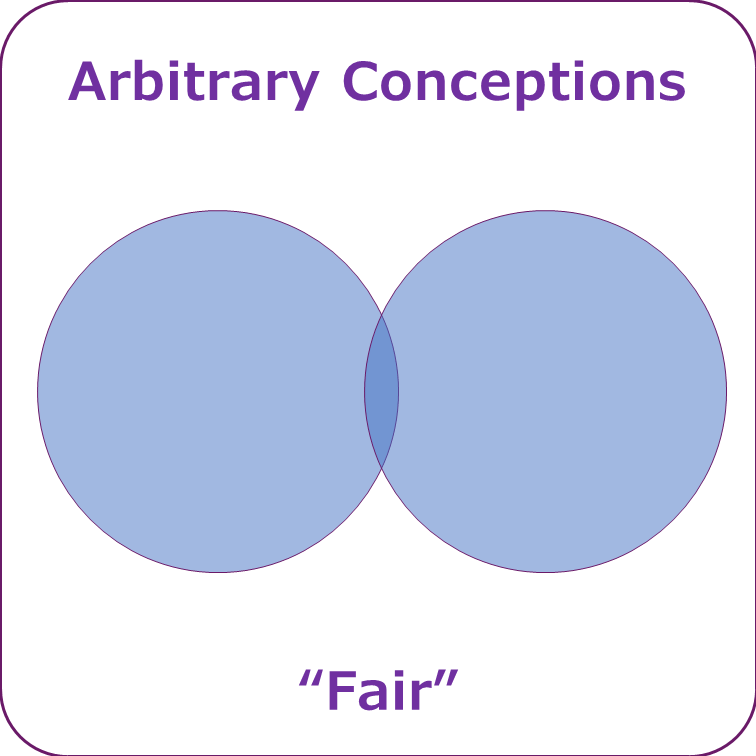
I’ve discussed a simpler abstract term before: fairness. To recapitulate, most people will tell you they want situations in the world to be fair. Only fair means entirely different things to different people. I’ve written about this in several places, so I’ll continue on our conservative journey.

Venn: Fair (oversimplified for effect)

Not only has the term conservative morphed over the years, it has different meanings—though to be fair, probably fewer than ‘liberal’. As I’ve discussed here before prior to the recent post, liberals are conservatives, but no one is really defending this position because the goal is identity, and identity involved separation to be distinguished.

Like fair, conservative has some common ground. The challenge is to understand which flavour is being used. Are you communicating by using the same term, or are you talking across each other? In some cases, this can lead to what I’ll call false positives (borrowing the language of statistical errors) where you think you are in agreement, except you aren’t. The other side of this coin is the false negative, where you think you are in disagreement when in fact you are talking about two different things.

This happened to me. A mate asked me to meet her at a certain time and place —I’ll just use McDonald’s because it is so ubiquitous. I went to the McDonald’s and waited. After a while, she called.

“Are you close?”

I scan the car park.

“I don’t see you. Maybe I missed you. I’m parked on the side near Taco Bell, not the oil change place.”

“There’s no Taco Bell at McDonald’s. What McDonald’s did you go to?”

It turns out that she was a distance away and wanted me to meet her halfway—like two-thirds to be honest. I assumed she meant the one we’d commonly visit.

This is a false positive. Communication was presumed to occur. It did. It just wasn’t useful. And since the reason for the rendezvous in the first place is to save time—one might say to ‘conserve’ time, but even I wouldn’t stoop to such a low target.

Wrapping up, the challenge is that trees are objects in the world. We can quickly recalibrate ourselves by reference. This is not possible for abstract concepts. I tend to refer to these are weasel words. Some use these words unknowingly. Whenever I hear some yahoo wintering on about freedom or justice, my first impression is that this bloke is tripping on a Kool-Aid propaganda overdose. Most common people falsely believe that people can understand what’s in their heads.

And to be fair—the left sort, not the one on the right—, when these yahoos utter the term, they are probably using it like their neighbour. But walk a few blocks or miles, and that bet is off. Sure, if the people have a common connexion, this might moderate the differences. But if one attempts to triangulate across worldviews, all bets are off. You may or may not be singing from the same hymnal.