Whilst researching a chapter on the notion of blame among hominids, I was chasing down a rabbit hole and I ended up finding Schopenhauer’s oft-quoted,
Man can do what he wants, but he cannot will what he wants
And that’s where the trouble started. Memory is fallible. Although I feel deceived, I don’t feel bad because many people have misattributed this quote to Schopenhauer, but if the Wikipedia footnote is steering me right, this was actually Einstein’s misquote—the Einstein; Albert Einstein of E = MC2 fame.
According to the citation, Albert said this:
„Der Mensch kann wohl tun, was er will, aber er kann nicht wollen, was er will.”
— Albert Einstein, Mein Glaubensbekenntnis (August 1932)
It translates into the offending sentence.
‘Man can do what he wants, but he cannot will what he wants.’
The full translated quote reads,
‘I do not believe in free will. Schopenhauer’s words: ‘Man can do what he wants, but he cannot will what he wants’ accompany me in all situations throughout my life and reconcile me with the actions of others, even if they are rather painful to me. This awareness of the lack of free will keeps me from taking myself and my fellow men too seriously as acting and deciding individuals, and from losing my temper.’
Albert Einstein
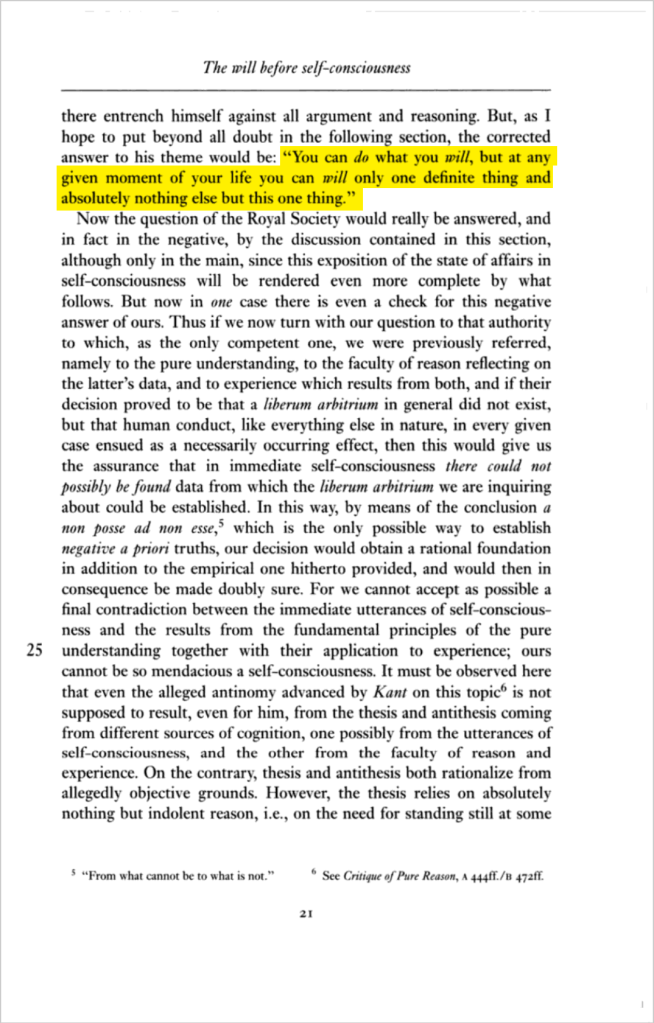
What Schopenhauer actually said not only doesn’t resonate quite so well, it doesn’t even convey the same notion. His actual words were:
‘You can do what you will, but in any given moment of your life you can will only one definite thing and absolutely nothing other than that one thing.’
Du kannst tun was du willst: aber du kannst in jedem gegebenen Augenblick deines Lebens nur ein Bestimmtes wollen und schlechterdings nichts anderes als dieses eine.
— Arthur Shopenhauer, Ueber die Freiheit des menschlichen Willens
Arnold Schopenhauer, On the Freedom of the Will
In the spirit of misattributed quotes, here are a few things Einstein never said but are attributed to I’m anyway.
“The definition of insanity is doing the same thing over and over again and expecting different results.”
“Everyone is a genius. But if you judge a fish by its ability to climb a tree, it will live its whole life believing that it is stupid.”
Not Albert Einstein
“I refuse to believe that God plays dice with the universe.”
Not Albert Einstein
Though to be fair, the last one at least directionally reflects something he did say,
“It seems hard to sneak a look at God’s cards. But that He plays dice and uses ‘telepathic’ methods… is something that I cannot believe for a single moment.”
Albert Einstein
Yet again, I am confused. I feel I’ve been living a lie.
This quote was made by Owen Jones in an article published in 2012. I share it because I feel the author is not only being cavalier but wrongly so. According to the bio at the end of the article, Owen D. Jones is a professor of law and biological sciences at Vanderbilt University. As I see it, the problem is not some theoretical—What is the sound of one hand clapping?—pseudo-problem. Human agency is the basis of our legal and jurisprudence systems.
Like good magicians, people like Owen want to redirect your focus to neuroscience and consciousness rather than have to explain how the causal engine that is the brain manifests itself ex nihilo.
Doubling down on my causa sui position, humans may be able to make constrained solutions, and yet they never have control over the constrained system they inherit. I discuss this at length elsewhere, but I wanted to address this comment forthright.
I’ll leave with a quote I tend to trot out a lot.
It is difficult to get a man to understand something when his salary depends on his not understanding it.
— Upton Sinclair, prepared speech, I, Candidate for Governor (1935)
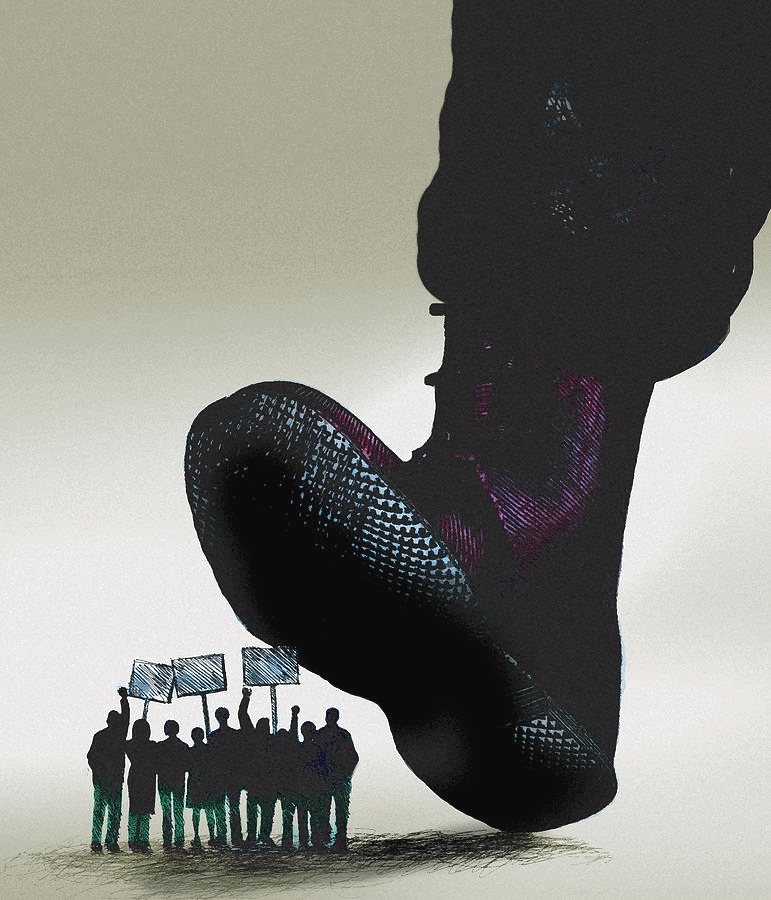
Free will is a necessary illusion for power structures to propagate or they will lose a cornerstone of their control mechanisms. And since humans want to feel they are in control, they are willing to accept the downside for the illusion of an upside.
Neuroscience and Philosophy was recently released by MIT Press and came to my attention. I’ve only skimmed it so far, but it looks interesting. Portions are available on Google books.
I may return to comment, but I just wanted to share before I retire for the night.
I just wrapped up chapter eleven of The Righteous Mind by Jonathan Haidt. I’ve got only 35 pages to go to get through chapter twelve. I’ve been tempted to stop reading. Chapter eleven—and I am tempted to inject a bankruptcy pun here—has been more frustrating than the rest thus far. And yet I am glad to have persisted.
My intellectual focus these past months has been on agency. Et voilà, paydirt. Chapter eleven’s title reveals the context: Religion is a Team Sport. Let’s walk through this garden together.
A goal of Haidt is to educate the reader on his third principle of moral psychology: Morality binds and blinds. He establishes parallels between sports and religion. And here’s the thing—I don’t disagree. But here’s the other thing—I feel that are equally vapid—, with no apologies to sports fans or the religious. Let’s keep moving.
“A college football game is a superb analogy for religion.”
Jonathan Haidt, The Righteous Mind, Chapter 12: Religion is a Team Sport
He talks about the organising and unifying functions of both. But here’s the thing. It unifies the like-minded. Haidt claims to be irreligious and not be into sports, and yet he cites these as somehow desirable. I find him to be an apologist for religion.
I am not a psychologist, but if I were, I’d be tempted to claim that Haidt’s conclusions follow from his personal beliefs. He believes in morals, society, order, intuition, and institutions. He is a textbook Modern and an extrovert to boot. I think he also falls into teleological fallacy traps. Was that a play on words?
Although he views religion through rose-coloured glasses, he comes to the conclusion that religions have done a great deal of harm over the millennia, but the good outweighs the bad, especially if you consider it through a social-moral lens. But if religion creates in-groups versus out-groups, which they do, and religious in-groups outlive even non-religious ingroups, then this is a winning option. But what if you don’t like that option?
Personally, I am a collectivist, but this is not willy-nilly any collective.
Haidt contrasts the New Atheist vantage that religious belief is an evolutionary byproduct versus a position that what started as a byproduct evolved into group selection and then, perhaps, an epigenetic phenomenon.
Here’s my contention:
Borrowing from New Atheism, Haidt adopts the notion of a “hypersensitive agency detection device [that] is finely tuned to maximize survival, not accuracy”.
The first step in the New Atheist story—one that I won’t challenge—is the hypersensitive agency detection device. The idea makes a lot of sense: we see faces in the clouds, but never clouds in faces, because we have special cognitive modules for face detection. The face detector is on a hair trigger, and it makes almost all of its mistakes in one direction—false positives (seeing a face when no real face is present, e.g., ), rather than false negatives (failing to see a face that is really present). Similarly, most animals confront the challenge of distinguishing events that are caused by the presence of another animal (an agent that can move under its own power) from those that are caused by the wind, or a pinecone falling, or anything else that lacks agency.
The solution to this challenge is an agency detection module, and like the face detector, it’s on a hair trigger. It makes almost all of its mistakes in one direction—false positives (detecting an agent when none is present), rather than false negatives (failing to detect the presence of a real agent). If you want to see the hypersensitive agency detector in action, just slide your fist around under a blanket, within sight of a puppy or a kitten. If you want to know why it’s on a hair trigger, just think about which kind of error would be more costly the next time you are walking alone at night in the deep forest or a dark alley. The hypersensitive agency detection device is finely tuned to maximize survival, not accuracy.
Op Cit, p. 292
I fully agree with the assertion that the brain values fitness over truth, and I’ve commented in several posts that pareidolia and apophenia create false-positive interpretations of reality.
But now suppose that early humans, equipped with a hypersensitive agency detector, a new ability to engage in shared intentionality, and a love of stories, begin to talk about their many misperceptions. Suppose they begin attributing agency to the weather. (Thunder and lightning sure make it seem as though somebody up in the sky is angry at us.) Suppose a group of humans begins jointly creating a pantheon of invisible agents who cause the weather, and other assorted cases of good or bad fortune. Voilà—the birth of supernatural agents, not as an adaptation for anything but as a by-product of a cognitive module that is otherwise highly adaptive.
Op Cit, p. 293
For me, this supports my contention that agency is a wholly constructed fiction. The same agency we ascribe to unknown natural events, we ascribe to ourselves. And perhaps this ability served an egoistic function, which was then generalised to the larger world we inhabit.
I have an issue with his teleological bias. He feels that because we have evolved a certain way to date; this will serve as a platform for the next level as it were. I’ll counter with a statement I often repeat: It is possible to have adapted in a way that we have been forced into an evolutionary dead end. Historically, it’s been said that 99 per cent of species that ever occupied this earth are no longer extant. That’s a lot of evolutionary dead ends. I am aware that few species could have survived an asteroid strike or extended Ice Ages, but these large-scale extinction events are not the only terminal points for no longer extant species.
So finally, Haidt essentially says that it doesn’t matter that these religious and cultural narratives are wholly fictitious, if they promote group survival, we should adopt them. This seems to elevate the society over the individual, which is fine, but perhaps the larger world would be better off still without the cancer? Just because it can survive—like some virulent strain—doesn’t mean we should keep it.
Finally, given these fictions, what’s a logical reasonable person to do? I don’t buy into ‘this country is superior to that country’ or ‘this religion is better than that religion’ or even ‘this sports team is better than that’ or ‘this company is better than that’.
Haidt does idolise Jeremy Bentham, but this is more Pollyannaism. It sounds good on paper, but as an economist, I’ll reveal that it doesn’t work in the real world. No one can effectively dimensionalise and define ‘good’, and it’s a moving target at that.
No thank you, Jonathan. I don’t want to buy what you are selling.
News Flash: From the time I started this content, I’ve since read the final chapter. Where I categorically reject a lot of what Haidt proposes in this chapter, I tend to find chapter twelve to fit more amicably with my worldview. Perhaps I’ll share my thoughts on that next.
If you’ve reached this far, apologies for the disjointed presentment. I completed this over the course of a day through workaday interruptions and distractions. I wish I had an editor who could assert some continuity, but I am on to the next thing, so…
Bonus: I happened upon this journal article, and it somehow ended up here. I haven’t even read it yet, so I’ve got no commentary. Perhaps someday.
Rai, T. S., and A. P. Fiske. 2011. “Moral Psychology Is Relationship Regulation: Moral Motives for Unity, Hierarchy, Equality, and Proportionality.” Psychological Review 118:57–75
I’m about 60 per cent done with Jonathan Haidt’s The Righteous Mind, having just read another couple of chapters and found my way into the third of three sections. As I said at the start, I didn’t think this was quite up my street, but I forced myself to read it to understand the perspective.
I composited this illustration to illustrate what I feel the problem is. I believe the Media-Industrial complex deliberately marginalises and vilified anyone not in-frame. This is flat Earth territory, where passage beyond the boundaries cannot be attained because, if not empty space, it’s filled with monsters.
Media-Industrial Political Frame – United States Edition
I may have depicted myself on a Z-axis, but that may have been more difficult to digest. The effect is the same. In-frame are institutionalists like Haidt who need their adopted morals to unify around.
Firstly, this book is VERY (read: too) focused on the American political condition. It’s more about party politics through a moral lens (Moral Foundations Theory) lens. Although there is some relevance to the wider world, Haidt could have better generalised the model, and this leads me to my second criticism.
Secondly, Haidt is mired in fundamental attribution bias. Because he frames this in the same way he views the world and his world is Liberal Democrats and Conservative Republicans, he excludes many people not beholden to these partisan beliefs. I keep finding myself, saying that doesn’t describe me.
In Haidt’s defence, these party-affiliated automatons do exist and in large numbers, but they are not the whole story. Also in his defence, he was working as a Democratic strategist—rather, speechwriter—so his personal frame was how to get more of these voters to side with a Democratic message that touched on the 5 moral tenets.
If you are someone with a Nietzschean/Foucauldian perspective and a non-cognitivist like me, then you realise that both of these sides are arguing over the definition of morality rather than whether this was all a construct with the intent to manipulate. Since Haidt’s challenge is to convert believers in one moral framework to another—rather, to convince them that the morals they subscribe to are available in different packaging on the other team—, it doesn’t serve his purpose to try to convince those of us who see that the emperor is not wearing any clothing. Telling us that the nonexistent robe is blue rather than red will do little to convince us to manifest a robe.
This chart illustrates that all represented groups value harm [sic. negation of the care-harm value pair) and fairness. Conservatives value Authority, Ingroup, and Purity. I am not sure what he means by ‘moderates’, save to say that they are some imaginary middle. As I associate Liberals with Moderates, it makes little sense to me. He does not clarify this group in the book.
As noted above, my biggest contention is that this group contains institutionalists exclusively, so anarchists are excluded. These people are proponents of social contract theories. Moreover, it excludes noncognitivists who view morals as constructed bollox. Haidt clearly sides with both of these views.
Here is my take on these pairs.
Care – Harm
I don’t feel that these two are a true dichotomy. Neglect or perhaps apathy is the absence of caring. Harm is a negative activity. Although if one cares, one is unlikely to inflict harm (unnecessarily), one can not inflict harm and still not care. Moreover, this is subjective. If a person one cares for dislocates a shoulder, one may inflict pain (harm) relocating it in an attempt to reduce longer-term suffering.
Fairness – Cheating
Both fairness and cheating are loaded terms. As I’ve discussed at length, fairness is defined differently, which creates ambiguity. Haidt acknowledges this, but he does not further parse the distinction. My strongest rejection may be on this pair.
First, if I reject the notion of property, then from my perspective no one has exclusive rights to it. So a ‘society’ like the United States centred on property rights will consider this to be ‘cheating’ the putative property owner and ‘unfair’, but from the opposite vantage, the property owner acquired the property unfairly, and reclaiming the property may be seen as reestablishing balance.
Secondly, perhaps a non-capitalist feels that profits are excessive, so they feel they are entitled to take an item. Even more justifiable might be software piracy, where the ‘property’ is intellectual and not physical, so the producer never loses possession of their ‘good’.
Thirdly, a person from a collectivist culture may assist a mate who is taking a test. The individualist will condemn this as cheating. The collectivist culture may consider this cooperation to be answering to a higher moral calling. As it happens, this also breaks down on biological sex markers, with women answering in line with collectivists.
Authority – Subversion
This is the first Conservative pair. It feels to me that authority is a relationship one doesn’t need to accept out of hand. I suppose respect comes into play here as well. To me, respect is earned, and one does not deserve authority until they’ve proven oneself. I am not big on authority. Perhaps I stand with Liberals on this one. I may not directly subvert or undermine it, but neither do I take it without question.
Loyalty (Ingroup) – Betrayal
I have a tough time thinking about this one. I feel it may be more about what you are loyal to. Even on the Conservative side. For example, when I view Republicans, it appears that these people are loyal to their party but to the detriment of the country and the world at large. Haidt points out that they do not care about the greater world, as they are groupish or tribalists, so this makes sense, but disloyalty to their country is less clear. What I feel is that these people (not unlike the Democrats) are like an invasive species. They feel self-righteous and will only accept a country populated with others who share their values. In practice, a common refrain from these people is that ‘if you don’t like it, just leave’. They do not accept the response that a person might prefer to stay and ‘fix’ it. They’ll betray their country at the drop of a hat.
As I say, Democrats (Liberals) will do this, too, but according to the charge, they aren’t claiming to be loyal from the start. But I disagree with this assertion. I participate in a lot of ‘Vote Blue no matter who’ groups. When I tell them that their candidates suck, they dig in hard. When I point out that their candidates predictably get voted into office and not even fail to follow through on promises, they don’t even pretend to try. I attribute this to the public being loyal to their parties and the party members being loyal to their funders and handlers.
Sanctity (Purity) – Degradation
Defined, sanctity is the state or quality of being holy, sacred, or saintly, so it’s a metaphysical position or claim. This is where Conservatives get hung up on virginity and the such. The body is a temple. Haidt had initially used purity, as captured in the chart above, which is more in line with secular speech but still poses problems.
The argument is that the brain has a module that recognises and distinguishes clean from dirty—potable versus unpotable; edible versus inedible; fresh versus rotten, and so on. Through evolution, humans use this facility to process metaphorical concepts on this same hardware through firmware updates because hardware updates are extremely rare. It’s similar to adapting a GPU (Graphics Processing Unit) to process AI/machine learning for pattern recognition. It was not the original or intended purpose, but it works—sort of.
I believe a counterargument is that this retrofitting is defective and produces poor results. Being a cynic, I see opportunists exploiting this glitch. They want to leave this glitch in place—not that they could remove it anyway—, so they can manipulate the masses. In fact, Haidt’s argument is that Republican operatives know how to work these levers; the problem in his eyes is that Democrats haven’t figured out how to hack their constituents.
Liberty – Oppression
Liberty is another weasel word. This is a dog whistle—or rather a foghorn. And it doesn’t mean much. When I hear ‘Liberty’, it immediately throws up red flags. I interpret it as government-granted freedoms. So, if we are born free—whatever that might mean to you—into a place with a social contract, Liberty are areas carved out where we retain our otherwise inherent freedoms. In this view, liberty has no context outside of government; freedom transcends government. It’s more archetypal albeit nebulous.
Oppression is subjective. I recall reading about casted people in India and Bangladesh. These people would be viewed from a Western lens as oppressed, but they saw themselves as part of a karmic process. They did not feel oppressed. Of course, an interloper from the West might convey their own narrative to convince the other person that they were being oppressed.
It can work in reverse as well. Cognitive dissonance assuaging mechanisms are strong forces. I’ll argue that most Westerners are wage slaves being oppressed by a system, and yet they’ll defend their exploiting Capitalistic system. We’ve been here before.
Last Word
We humans have a dual nature—we are selfish primates who long to be a part of something larger and nobler than ourselves.
Jonathan Haidt, The Righteous Mind
“We humans have a dual nature—we are selfish primates who long to be a part of something larger and nobler than ourselves.” This is a quote in the last paragraph of chapter nine, Why Are We So Groupish?
He does provide some sensible albeit not wholly uncontroversial rationale supporting group selection dominating individual or ‘selfish’ selection. I share this quote because this describes him as part of the in-frame groups above.
Like me, Haidt is an atheist. Unlike me, he feels that there is some higher calling. In chapter 9, he discusses how his feelings for Country were triggered by the events of 11 September 2001. This was not my experience. I didn’t believe in countries prior to the World Trade Centre attacks, and I still don’t. I vocally protested the illegal invasion, though I know a lot of Liberals who became drawn in by the Jingoism.
In the terrible days after the terrorist attacks of September 11, 2001, I felt an urge so primitive I was embarrassed to admit it to my friends: I wanted to put an American flag decal on my car.
Jonathan Haidt, openning sentence to chapter 9 of The Righteous Mind, Why Are We So Groupish?
I am a collectivist, so I value social interaction, but I don’t elevate this as some higher purpose. It’s just a potentially beneficial configuration, but not all configurations are so. Again, I’ll suggest that this is his attribution bias affecting his judgment.
As a person dismissive of individual human agency, of course, I am not going to rate the probability of collective agency highly. However, I am very drawn to this topic because I am sure there will be attempts to make parallels and connexions between the individual and the collectives. My guess is that attacks by those who support individual agency yet deny collective agency will pose arguments that will in the end undermine their own position that they will nonetheless cling to.
Colloquium Poster
This event is being broadcast on Zoom on 21 through 23 July 2022 from 17:00 – 21:00 Tawain Time (GMT +8).
Conversational topics will be (i) The Reality of Free Will and (ii) The Loci of Responsibility, two topics near and dear to my interest.
A question that exercises the minds of philosophers is the existential status and role of groups and collectives. Do ‘forests’ exist, or are there just trees in proximity? Do “herds” exist, or are there just elephants? Perhaps the answers to these questions are of little consequence, but there are other, more interesting questions like, for example:
Do collectives act as single units, and if so, how? Do properties of individuals ‘scale’? For example, we readily attribute consciousness and intelligence to individual humans, can we also attribute consciousness and intelligence to a committee, or community? How is a collective conscious or intelligent? Also, individuals have ‘agency’ – they can/do exercise their individual “will” – but does a collective have a “will”, or “agency”? Does a large population of agents (a ‘country’, say) have a ‘will’ of its own? Does a country have ‘free will’,, and ‘know’ what it is ‘doing’? Do such questions even make sense?
On July 21-23, the National Taiwan University is holding a mini-conference about such “social ontology” conundrums, via ZOOM: https://ucl.zoom.us/j/98941995734, Zoom room ID:989 4199 5734
The system is broken. It’s not just broken in the United States. It’s the entirety of Western Civilisation. It’s not time for a reboot. The virus is still inherent in the system. It’s time for a new system.
The reaction to this line of reasoning does something along the lines of, ‘It’s easy to criticise. What’s your solution?’ So let’s begin by parsing this enquiry.
Firstly, not all problems have solutions.
Humans, it seems, need resolution and closure. And they seem to gravitate towards easy answers, specious or otherwise. But humans have an abysmal track record of solving complex problems—political issues, social issues, economic issues, and so on. It’s not as much as there is no solution, per se, but that the interactions within the complexities are too many to consider. The system has a temporal dimension, which means even if I solve the problem at time-nought, the solution may not hold at time-prime.
Secondly, that one can recognise a problem does not mean one can fix it.
This was the denouement of Occupy Wall Street a few years back. They shed light on the problems, but those in charge—hawking ‘solutions’—established a frame wherein a problem without a solution is worse than a problem ‘remedied’ with the wrong solution. You don’t have to be a mechanic or body shop guy to recognise a smashed car even if you can’t fix it.
Auto smash
What then?
Harry Potter’s Hermione’s Magic Wand
If I had a magic wand, for a start, I’d abolish Capitalism, private property, and religion and go from there.
What’s wrong with private property?
‘Do you live on the street?’ is a typical response I hear when I suggest abolishing private property. ‘Give me your address. I suppose you wouldn’t mind if I moved in’ is another. I’ve discussed eliminating private property elsewhere, but the underlying problems remain:
Why accept the usurpation of the commons to private property?
Why accept the premise that one can own what one doesn’t possess?
Why accept the premise of a first-come, first-served principle?
Why accept, given the notion of property rights, that distribution must occur within the domain of economics?
If one accepts that property should fall into the domain of economics, why not apply a ‘best use’ litmus instead of a ‘first come’ or ‘ability to purchase’ litmus?
Usurpation of the Commons
I don’t accept this usurpation. In nature, where conflict exists, violence or the threat of violence is the arbiter. As humans in nature, it’s no different. Like the meat one purchases behind the veil of a grocery mart, we are shielded from the inherent violence,
In many jurisdictions, property owners are justified in homicide if another person encroaches on their property. Many homeless or indigent people have tried to squat on unoccupied property only to be forcibly removed.
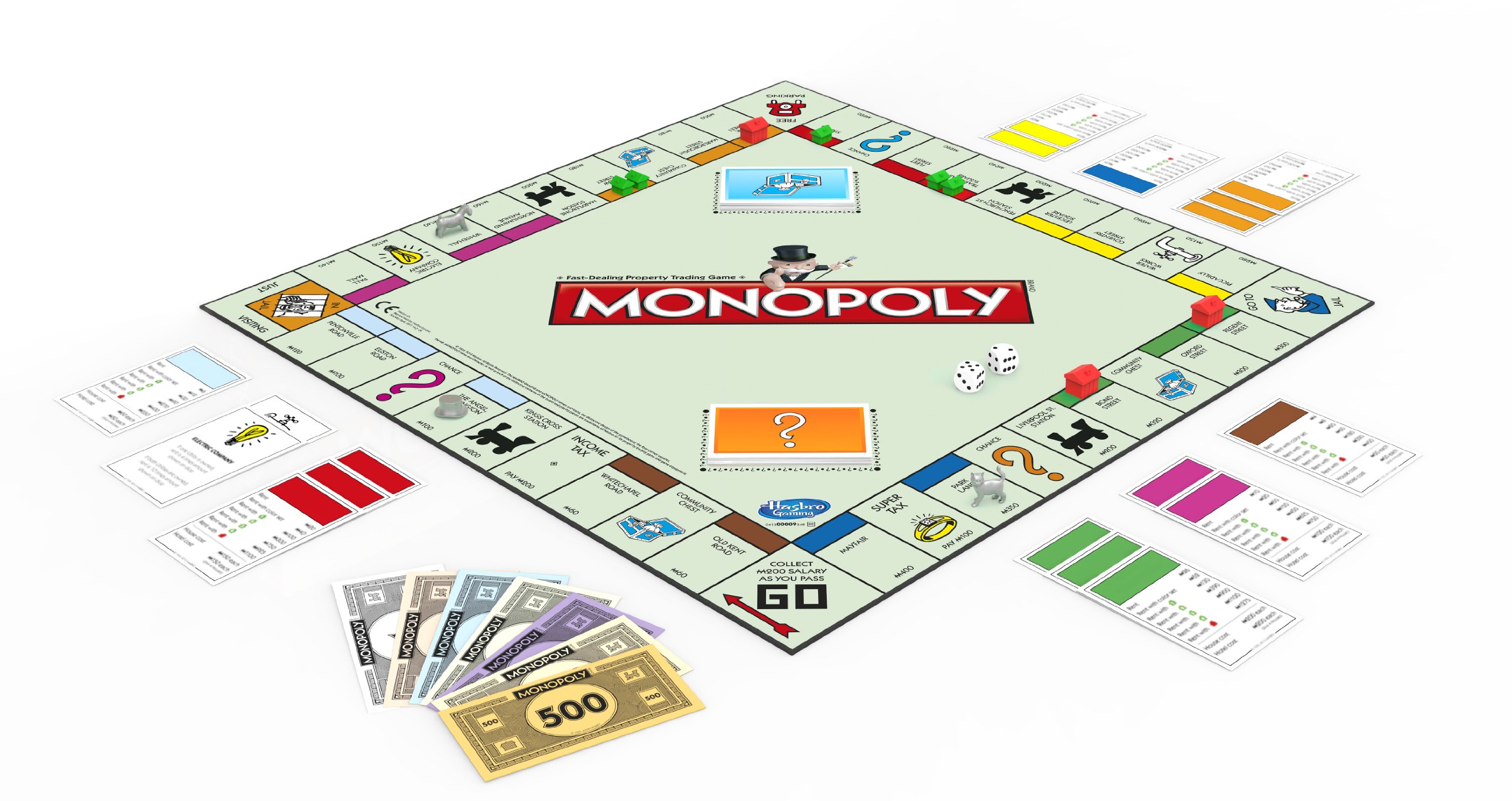
Monopoly Game Board
Property is like the game of musical chairs. And if you are late to the game, the chairs may already be taken. Imagine joining a game of monopoly late in the game and ownership of all the property has already been distributed. How do you think you might fare?
Possession is 9/10 of the Law
Possession is different to property. That I possess a place offers a different justification for my occupancy of it than a place that I own in absentia. Sure a philosophical argument could be made against any right to possess, but I’m not going there—at least not today.
This becomes a situation where usage is a determining factor. Can this ownership be justified if you’ve got a dozen places scattered around the globe?
First Come, First Served
It’s easy to see why this is in place: It’s simple. And at the start, there were few people and a seemingly infinite amount of land, but this was not sustainable. Land is ostensibly a fixed resource whilst humans multiply somewhat geometrically. So, given enough time, this allocation problem was predictable and inevitable.
But, given that property is something we insist on, what are the alternatives? Do we have a lottery periodically to redistribute property? Do we reset ownership whenever a new potentially qualifying owner emerges? Do we establish duration of ownership with some expiry? Do we not allow property to pass to forward generations? Or do we simply disallow ownership because this solution is too cumbersome to implement?
Disclaimer: In an attempt to economise my time yet still contribute content, this is a post dredged from Drafts (from May 2020) and posted with touchups in the manner of applying lipstick on a pig. Sadly, it’s still relevant.
I feel this article runs the reader down a rabbit hole, but as it already contains several points of view, I’ll uncharacteristically restrain commentary for now. Perhaps I’ll return to it later.
There are a lot of valid points in this article, but it misframes (perhaps unintentionally) and misses points just out of frame. As you read this, keep in mind that even if you accept the entire position, it does not invalidate the causa sui argument. This is the elephant in the room—hiding over there behind the ficus.
In other news, Boris Johnson resigns. Another Conservative politician hits the bin. I’m neither Conservative nor Liberal, so I think I am in a place where I can comment as a disinterested observer. Of course, I am not fully disinterested; I am rather apathetic to it all. None of my horses is in the prevailing parties.
As I’ve been reading (too much) Jonathan Haidt, of all things, a Liberal apologist for Conservatives aimed at a Liberal audience. I have to wonder why Conservative politicians are so corrupt.
Hear me out. Before you accuse me of a hack job, allow me to explain. Are Liberal politicians corrupt? Of course, they are. Probably as corrupt. By and large, they have the same handlers and funding sources. But then why call out Conservatives as being corrupt?
According to Haidt and his Moral Foundations Theory (MFT), Conservatives collectively have more moral dimensions than Liberals and they have elevated ‘disgust’ triggers. This is what makes them more obsessed with ‘purity’.
According to MFT, Liberals have two moral dimensions: Care and Fairness, regarding the left side of the value pairs. Conservatives share these, but they also include Loyalty, Authority, and Sanctity.
“The Righteous Mind: Why Good People Are Divided by Politics and Religion,” Haidt 2012
I am distracted for a moment by the epiphany that this explains a lot about why American police units operate the way they do—dysfunctionally from the Liberal and minority perspective. Whilst they care and want ‘fairness’, how they care is typically different (though there are clear overlaps), and ‘fairness’ means something different to them. Next, dogpile on loyalty, authority, and sanctity.
Loyalty is to their group of other blue lives as well as their nationalistic and paternal fealty. Authority is them. They are the authority, and this is an inviolable relationship. Don’t question it. And then there’s sanctity. We need to clean up the neighbourhoods and cleanse them of criminals. The dirty people need to be taken off the streets as we perform our moral duties.
And I’m back. Whilst this intermission was a diversion, it is at the same time on point because they share this worldview with Conservative politicians—tough on crime, law and order. But what I am calling out is that if this is their worldview, they should be measured by a higher standard.
Distracted again, this also explains a lot about the outrage over Julian Assange, Chelsea Manning, and Edward Snowden. Each of these people exposed unfathomable corruption, and Conservatives want their heads on platters. This reflects their viewing of the world through a deontological lens and as measured by a different sense of fairness.
I am not judging here. I am merely pointing out that their loyalty to country (or whatever) trumps the fairness mechanism. In a way, they see it as unfair that someone would have the audacity to betray their (notably corrupt) government. They even buy into the argument that they could have used the reporting mechanisms in place rather than air the dirty laundry in the public forum. These people find no discomfort in maintaining state secrets, even when the secrecy is for nefarious intent.
Back again. My point is that if these are primary drivers for Conservatives—fundamental attribution bias notwithstanding—, why do they subvert their own morals? For Liberals, there is no such subversion because they don’t believe these are relevant moral dimensions. This bleeds into the abortion debate—the sanctity of life: Life is sacred (and too much hypocrisy on the Right to unpack here), so you need to abide by moral code. Let’s not run astray again.
Wrapping this up, even if Conservatives are no more or less corrupt than Liberals, they are claiming to have a higher standard and yet they fail to abide by it. For a Conservative to call out a Liberal for the same violation is rather silly because the Liberal never agreed to the Terms & Conditions at the start.
Done
As I was mistyping the title, I realised that ‘resigns’ is ‘reigns’ with an inserted ‘s’. Nothing more.
Je m’accuse. I am as guilty as the next bloke when it comes to constructing false dichotomies. I like reading Steven Pinker, Jonathan Haidt, and Joshua Greene, though I disagree with some fundamental aspects. Having put Time Reborn to bed, I’ve reengaged with The Righteous Mind and it’s dawned on me what goes against my grain. In retrospect, it should have been obvious all along, and perhaps it was. When I read works by these cats, I catch myself saying, ‘Yeah, but…’. A lot.
To be fair, I’ve not read much of Greene, so I’ll focus on the other two, Haidt in particular. From what I can tell, Greene is cut from the same cloth. I’ll elaborate. When I cite Haidt, just know that I mean the other two and their ilk.
Haidt divides the world into Liberals and Conservatives. This is the false dichotomy. I’m aware that I recently expounded on the political spectrum, but this is more than that. Whether this would be better depicted as further Left on the political spectrum or another dimension is open to debate.
I believe the biggest dissonance I feel against this common perspective is that these guys are all Liberals. In particular, they are Ivory Tower Liberals™—paternalistic know-it-alls. Upon reflection, Cass Sunstein falls into this category: paternalistic intellectuals. I don’t mean this pejoratively, but each of these is a privileged prescriptivist. But that’s not my beef.
The other common thread is that these people are all institutionalists. This brings everything into focus. These people are defenders of Enlightenment Age morality, so they’ve all adopted the same metanarrative.
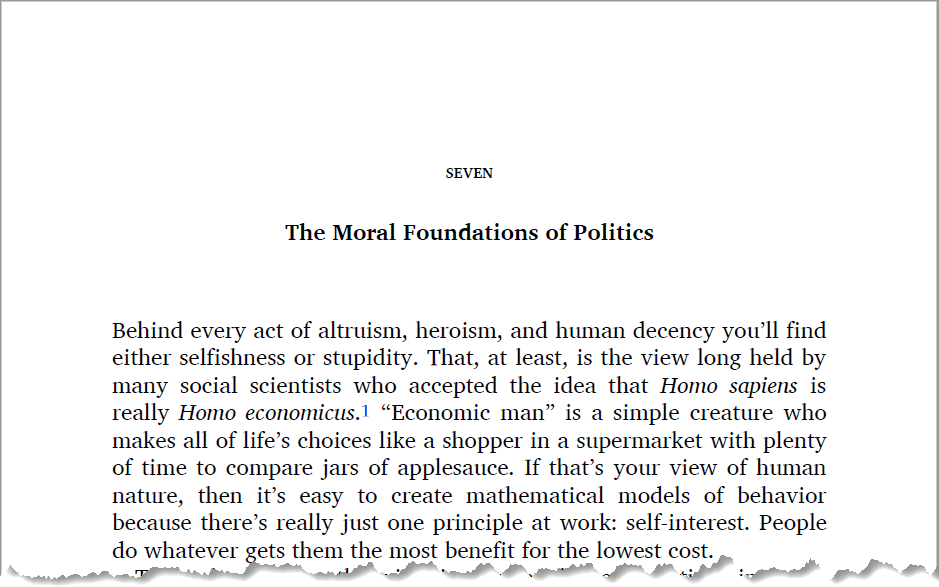
The Righteous Mind – Chapter 7
Haidt’s observations are accurate enough, but only within the frame of institutionalism—a frame I reject. This leaves my perspective out of view and unrepresented. In chapter seven, he establishes his action pairs that serve to divine moral truths about a person’s foundational political beliefs. He argues, like Pinker, that the mind is not a Blank Slate. He adopts neuroscientist Gary Marcus’ definition of innate:
“Nature bestows upon the newborn a considerably complex brain, but one that is best seen as prewired—flexible and subject to change—rather than hardwired, fixed, and immutable.”
— Gary Marcus, The Birth of the Mind (2004)
He further morphs Marcus’ ideas into this:
Nature provides a first draft, which experience then revises.… “Built-in” does not mean unmalleable; it means “organized in advance of experience.”
— Jonathan Haidt, The Righteous Mind (2012)
Given this background, Haidt invented these action pairs:
Care – Harm
Fairness – Cheating
Loyalty – Betrayal
Authority – Subversion
Sanctity – Degradation
I suppose I could reserve an entire post to disintegrate these. Suffice it to say that, categorically, I have issues with the meta of some of them—particularly, the last four. I am more accepting of the care – harm dichotomy, so my commentary would be more nuanced, especially in light of the scenario he cited, which shed light on his own thought processes.
I’m getting off track. The point I want to make is that these shared perspectives on society and identity, respectively macro- and microcosmic, make sense in an institutional framework, but is less necessary otherwise. And although Haidt attempts to defend his positions as not being invasive [my words, not his], this is simply because he accepts the underlying metanarratives blindly.
I’ll probably return to expound on this later, but for now, I am on to other things. Meantime, here is a review from a European, who rightly points out that this is a book written by an American for an American audience, even if he feels it is more universally applicable.
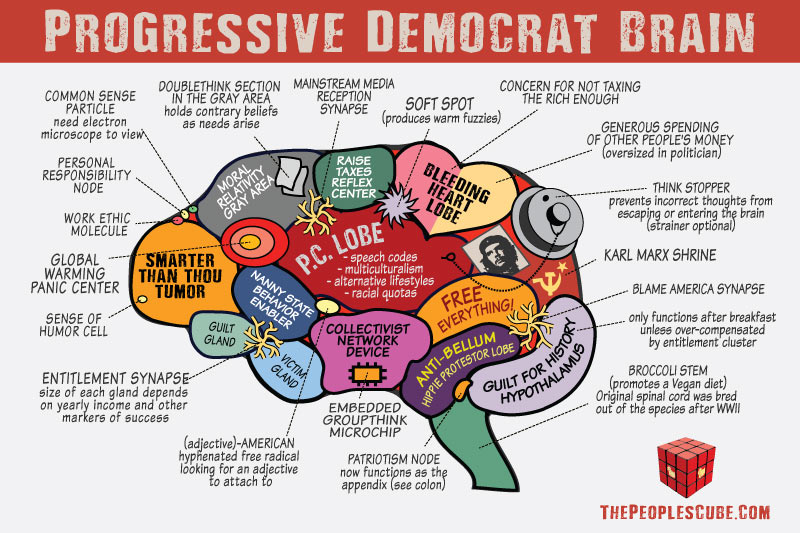
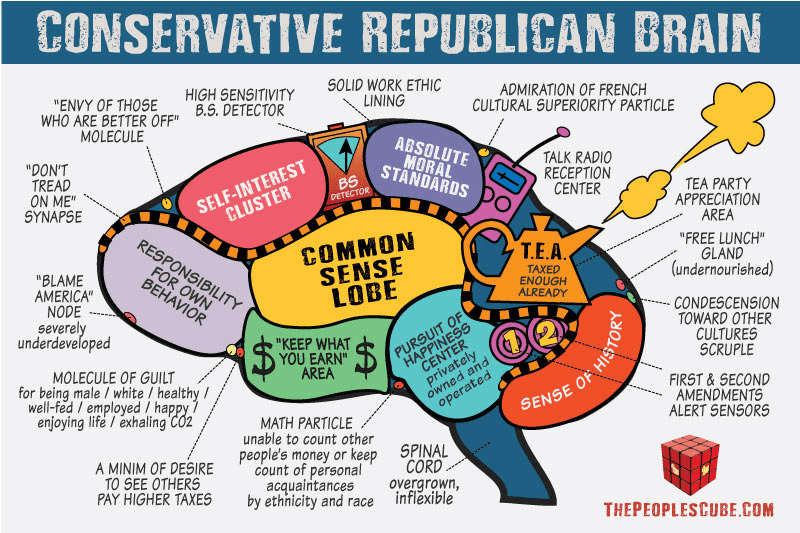
Out of a sense of fairness, I’ve included the Conservative brain image.