I am trying to avoid commenting on the recent SCOTUS decision and how it is symptomatic of how the United States remains a failed state—at least a zombie state—, so this preamble should suffice for now.
I was chatting politics into the wee hours with my son, who’s been on this earth for almost 25 years now. I consider myself to be on the left of traditional political scales. He considers himself to be on the right, but he’s trying to make sense of the scales and dimensions. He had two questions: First, ‘What are the crucial dimensions and positions that define left and right?’ Second, ‘Where do Liberals fit into the equation?’
Knowing me, he wanted to provide some context and confer with me his knowledge that would also serve to frame and anchor the conversation. A key point was to have clarified the adopted nomenclature and positioning on a theoretical map.
We started with the origins of the left-right distinction, which was barely a valid dichotomy even as it was coined in France. There was no duolith. Those on the left or right had features in common but taken holistically, this was a reductionist categorisation, as tends to happen. Exacerbating this, as it does today, still, the politicians with voices remained to the right of the unvoices masses.
He asked about the difference between freedom and liberty because his sources differentiate the two. Whilst connotation and nuance may enter the picture, etymologically speaking, freedom is a native English word whilst liberty is French via Latin. Connotatively, freedom is an absolute measure whilst liberty is granted within a political framework. Positive and negative liberties aside, liberty is an attenuator. It restricts freedom even if it allows most of the signal through. Effectively, liberty is permission by the state to act in certain ways.
By the end of the conversation, he was framing the key difference around notions of national identity and nationalism—I versus we. I shared my thoughts on the construction of identity, thus making for a poor foundation, though we both agreed that national narratives have been the impetus for much activity. (I am reluctant to insert the word progress here.)
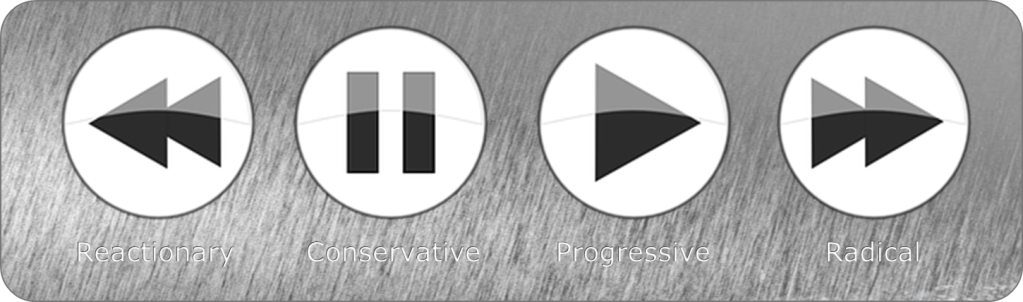
After our conversation, I began researching dimensions established or otherwise proposed by political science. This led me to a place I found interesting—the distinction between radical, progressive, conservative, and reactionary positions. For some reason, this never really occurred to me.
I’m not sure one can employ these terms in general discussion without definition and qualification, but I feel they are useful in their own right. Typically, I view the political landscape—at the highest level and with a US-bent—as Left (communists, socialists, anarchists, progressives) and Right (conservatives, liberals, and fascists). I also know that this is imprecise, but maps always are.
This new vocabulary helps by distilling the map to this—ordered differently:
Right
Conservative
Reactionary
Left
Progressive
Radical
Conservative
Conservatives want to maintain the status quo. This is interesting usage adoption. Fundamentally, advocates of this view want to promote and to preserve traditional social institutions and practices. In Western culture, conservatives seek to preserve a range of institutions such as organized religion, parliamentary government, and property rights. Conservatives tend to favour institutions and practices that guarantee stability and evolved gradually. Adherents of conservatism often oppose progressivism and seek a return to traditional values
In Western culture, conservatives seek to preserve a range of institutions such as organized religion, parliamentary government, and property rights.
My first thoughts when I hear the term are a harkening back to the old ways—the Ozzie and Harriott mythos, white picket fences, Mom and apple pie. But this is different. Effectively, rather than reaching back, it wants to preserve the current moment in time. Where it gets more nebulous, I think, is that some people include nostalgia in the now. Duratively, perhaps a person might remember some aspect of their childhood. Though this has been lost by now, they imagine it as part of their identity. This can also extend further back as they wish some other historical aspects can be cherry-picked. Perhaps the white conservative wishes to be able to subjugate women as was the practice in the 1950s of America, but to not conserve high union participation and high marginal tax rates, as affronts to freedom (or whatever). This ends up being an exercise in selective memory and revisionist history-making.
This needs to be distinguished from a so-called traditional conservativism in the tradition of Burke or Hobbes, who want to conserve some sense of fundamental morality they feel derives from nature.
Reactionary
Reactionaries oppose whatever is in effect at the moment—the petulant toddler—but with a twist. Like the conservatives, there is a conservation effort but rather than a focus on the status quo, the focus is on status quo ante, which is a return to the old ways, tried and true.
Progressive
Progressives support social reform. Ostensibly, they don’t oppose tradition, but they feel that old structures need to be reimagined and reinterpreted in face of social and technological change. An underlying metanarrative is the notion of progress. I am not going to comment on progressivism generally and the nuances evident in the American flavour of it.
During the 20th century, radical politicians took power in many countries across the world. Such radical leaders included Vladimir Lenin and Joseph Stalin in Russia, Mao Zedong in China, Adolf Hitler in Germany, as well as more mainstream radicals such as Ronald Reagan in the United States and Margaret Thatcher in the United Kingdom. Of course, Donald Trump is a more recent example in the United States.
Summary
To me, these terms operate on a gravity to now. Conservatives are heavily anchored in the familiar and seek stability. Then they see factors in the past that they imagine will also serve this purpose, so they wish to incorporate these and carry them forward. Conservatives are not unaware of the need for change, they just want to not create waves in the process.
Likewise, although placing a heavier weight on the past than even conservatives, reactionaries are not fundamentally opposed to retaining what is working currently. The term working is subjective and perspectival, so they may wish to retain something that works for them at the expense of others. This is a challenge for conservatism as well. Just because racial segregation seemed to work for an equivalent person in the past doesn’t mean it worked well for the excluded.
Like reactionaries, progressives aren’t afraid of keeping a foot in the present—and there may be plenty of lessons to learn from the past—, but they feel that given the change in the underlying terrain, some refactoring is in order.
And then there are the radicals. I suppose that radicals have different motivators, but in essence, they feel that the current implementation is substantially broken, and it needs more than a few small tweaks and a fresh coat of paint. These people are renovating rather than redecorating. They may even want to throw the baby out with the bath water. Some may wish to keep the baby.
As for me, I usually place myself in the Progressive camp, but under the definition, I am more of a radical. The system is broken. We don’t just need to delete it, we need to install a new one.
Thomas Jefferson said that the United States should rewrite the Constitution every 19 years. Why 19 years? Who knows? Given the intransigence in American politics, this would have been a disaster. And given the powers that be, the debate would be over which parts to conserve and which to progress. Being the cynic that I am, my guess is that it would devolve to worse than we have now.
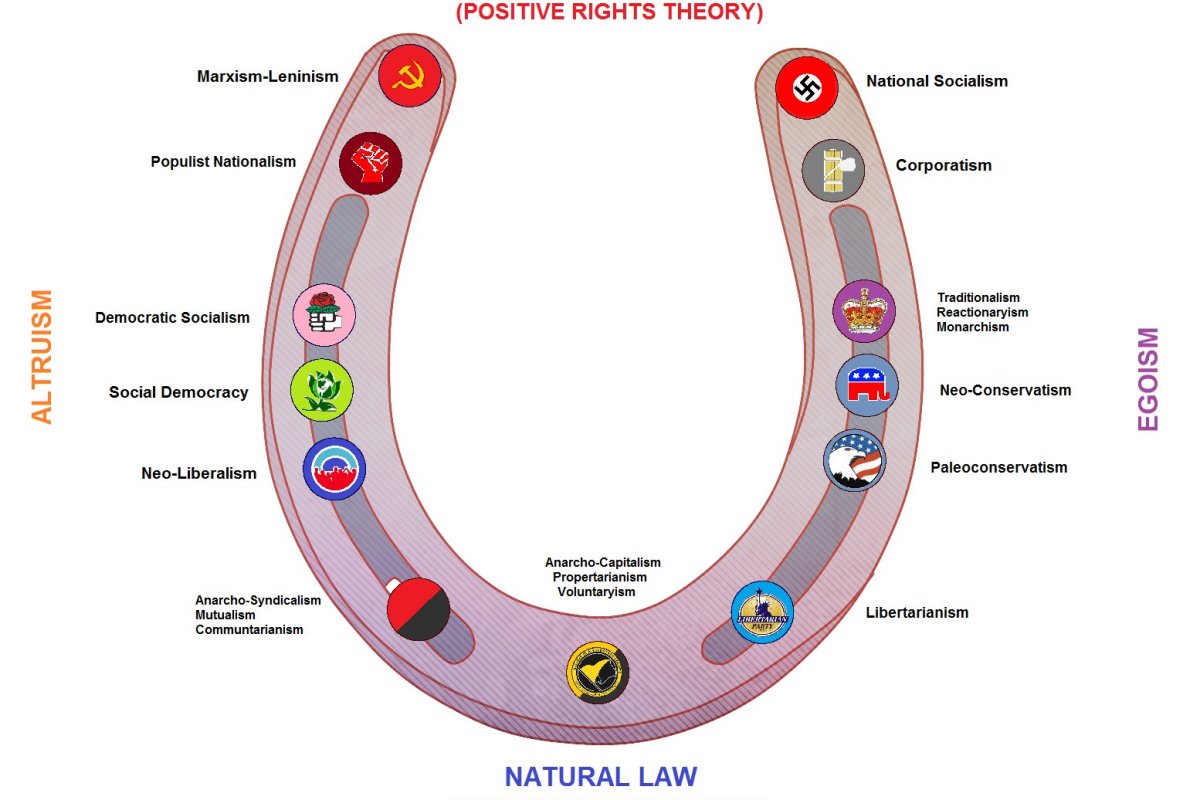
DISCLAIMER: For the record, I don’t endorse the placement of the political ideologies on the horseshoe image, but I find it interesting and it grabbed my attention. I hope it grabbed yours, too.
This infographic helps to articulate various notions of consciousness. Not much more to add.
I think I am partial to emergent theories, but I favour property dualism over emergent. The dualism employed in property dualism doesn’t feel accurate. It’s not dual so much as it just hasn’t been described yet.
I don’t think that physics can express or descriptively characterize everything that exists.
I want to accept the Buddhist notion, but I can’t seem to not differentiate.
I don’t feel I have enough information on the remainder of these. I could lean on the name and short description, but I feel this would necessarily establish me firmly in Dunning-Kruger territory. There may be even more hypotheses than are captured here.
I discovered a new image cache for my videos, and this one caught my eye. Since I posted off-topic earlier, I just wanted to share something a bit more on point.
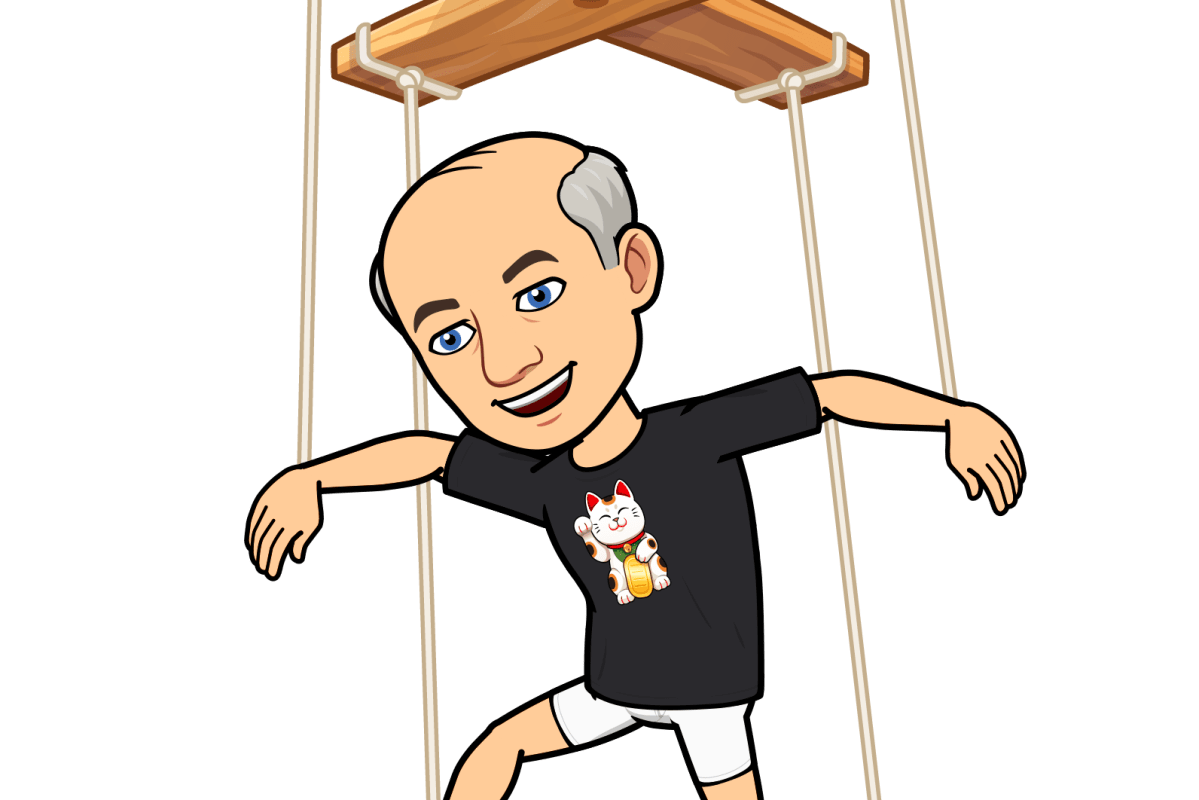
Although we are all automatons—puppets—, society is also puppets. These are puppets controlling puppets controlling puppets controlling puppets…
That’s the post. If you haven’t read my last post on the infertility trap, it is much more significant.
Gregg Caruso is interested in the notion of Agency from the perspective of justice, desert, and sentencing. This is applied philosophy.
My main argument against the possibility of free will is Nietzsche-Strawson’s causa sui argument, which I’ve touched on a few times by now, but I haven’t yet fully articulated my position. I’ll get to that another day. I’d also like to create another video, as I would like to do for this as I explore in more detail.
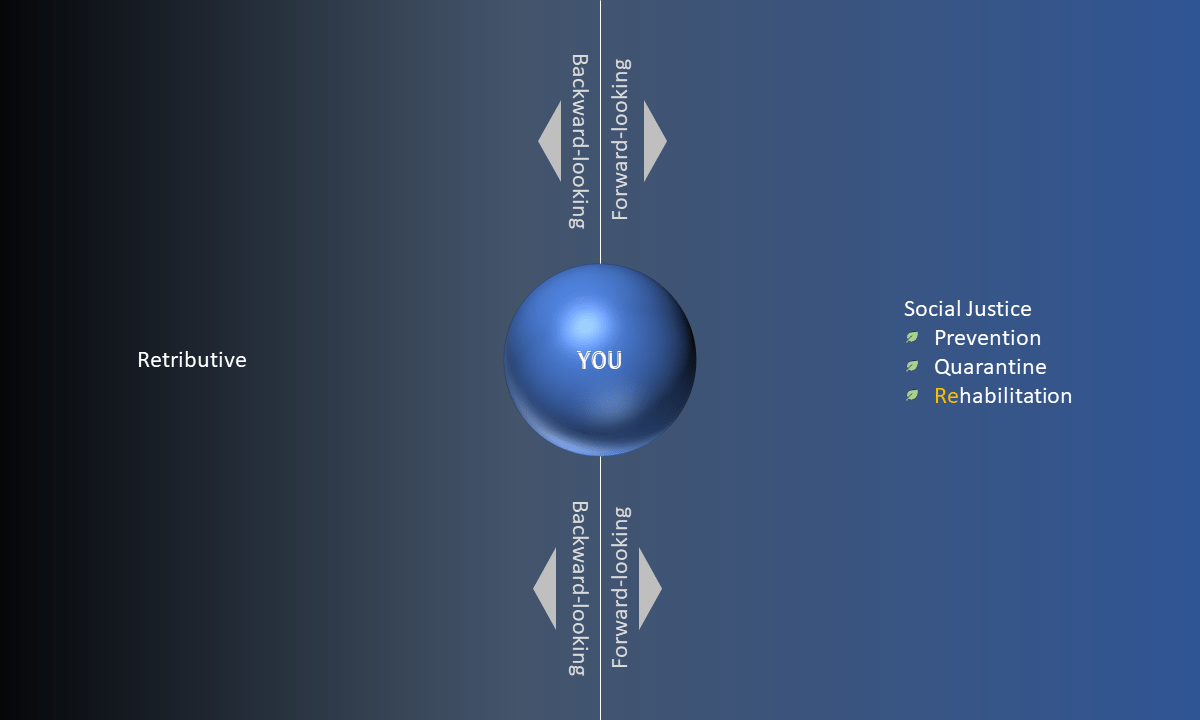
Ostensibly, this is a compatibilist view that leaves a modicum of free will, even with causa sui in place. I hope this illustration will be helpful.
In the centre of the illustration is you, the self of some arbitrary person who shall act as our subject. Let’s assume a couple of basic premises:
We either live in a relaxed causal, deterministic or indeterministic universe.
Causa sui is in full force and effect: one cannot cause any aspect of one’s self.
I include the term relaxed in the first premise, so I don’t have to deal with a fully deterministic universe governed entirely by the notion captured by Schrödinger’s equation. The second premise is in place to serve as a limitation: even if consciousness is an emergent property, its emergence doesn’t grant some insuperable metaphysical powers. One cannot reach outside of one’s self.
The scenario plays out as follows. You have been apprehended for violating some statute. Let’s say that you’ve taken an item from a retail store. As you are leaving the store, the police stop you. When asked if you took the item, you answer in the affirmative. This is a very efficient municipality, so you are taken immediately to a magistrate to make a plea.
In this scenario, Caruso is your attorney at law. His argument is that, given causa sui, you cannot be responsible for who you are. We’ve been here before. Since you can’t be responsible for who you are, any sentence to punish you would be unethical, as you’ve done nothing to deserve it. This is the notion of desert in the realm of retributive justice.
The judge buys this argument, but s/he counters with three possible courses of action. You may not be responsible for who you are, but we are a community of laws. You are a victim of your circumstances, so we cannot look backwards. For whatever reason—and through no fault of your own, by definition—, you were broken relative to complying with community norms.
Social Justice
Firstly, we may wish to make an example of you, to signal the community that we will incarcerate people who break the laws. This is more a public service purpose than a punishment.
Secondly, if you had contracted a communicable disease—we’re looking at you Covid—, you can be quarantined under the consideration of the common good. Framed this way, it is not a punishment, we just don’t want it to happen again.
Lastly, we may also be justified on the grounds of rehabilitation. I highlight the ‘re‘ in rehabilitation because some people may not have been ‘habilitated’ in the first place. Perhaps think of them as feral. In any case, a computer programming analogy might make sense here.
So what’s this all about? Remember, causa sui says that you cannot be held responsible for creating yourself. The claim is that you are a product of your nature and nurture. Genetically speaking, perhaps there was some reason that you could not incorporate inputs into factors that allowed you to appropriately interpret this law—or any law, more generally. Or maybe, you were never exposed to this law or category of law before.
In the preventative vein, we could be signalling, ‘We caught You taking an item from a shop without paying. Now you know this, and we may make an example of you since you are caught as well’.
Quarantine may be a bit of a stretch in this scenario, so feel free to substitute a more serious offence if it helps you to remember this. Perhaps You killed someone. Even without punishment, we may want to get You off the streets before another killing is perpetrated. I’ll come back to this one.
Rehabilitation makes sense even if one is not responsible for one’s self. Presuming that you are a product of programming—family, culture, peers, and so on—, perhaps you just need to be rewired. Perhaps a particular subroutine was not implemented or activated correctly. This rationality could be used as a non-punitive justification.
Counterarguments
The public prevention case may be why offenders were pilloried in by-gone days. Display in a public square may inform some who may have missed the lesson the first time around, hence dissuading taking similar actions. But unless this ‘public service message’ reached enough people, it would probably not be the best rationale.
Quarantine may sound OK on the surface, but it’s actually rather specious. Firstly, that You knicked a trinket. What exactly is the risk of contagion? Petty theft is not known to be particularly communicable. Secondly, just because you’ve done something once is little measure of whether you’ll do it again. In fact, if this were true, then one might have assumed that you could never have committed the offence because of your history.
Rehabilitation may likely be the best option among these. If you missed that particular lesson or had forgotten or diminished the calculus, remediation may do just the trick. However, if your ‘operating system’ is not up to snuff, it’s not a matter of inputs. It’s a matter of processing capability.
Psychological intervention is in its infancy, so the probability of remediating this is low, if not a crap shoot. And not all such processes can be remediated. This could lead one to fall back on the quarantine option, but who is the competent assessor in this case?
It’s easy enough to assess if You is Hannibal Lecter or tells you straight out that s/he intends to repeat the offence. Some cognitive deficiencies are simple enough to recognise. But what about the grey areas—all of that space in between?
And who is making sure that the judges are not being punitive simply because they haven’t yet eaten lunch?
Enfin
Bringing this to a close, if we have no free will, it makes no sense to punish. Sadly, most justice systems promote retributive justice and punishment in sentencing. I’ll spare you my diatribe on how I believe most people attracted to jurisprudence, law, and law enforcement have been conditioned. And whilst Caruso feels justified in foreword action, I am more sceptical. This said, I’ll take what I can get.
This post is pretty much a stream of consciousness. I hope to give it better treatment in a future video.
Physicist, Sean Carroll, gives Robert Lawrence Kuhn his take on free will. I was notified about this when it was posted, and given the topical subject matter, I took the 8-odd minutes to listen to it straight away.
I wish I had been there to pose a follow-up question because, although he provided a nice answer, I feel there was more meat on the table.
Like me, Sean is a Determinist who feels that the question of determinism versus indeterminism is beside the point, so we’ve got that in common. Where I feel we may diverge is that I am an incompatibilist and Sean is a compatibilist. I could be interpreting his position wrong, which is what the follow-up question would be.
I say that Sean is a compatibilist because he puts forth the standard emergence argument, but that’s where my confusion starts. Just to set up my position for those who don’t prefer to watch the short clip, as a physicist, Sean believes that the laws of physics, Schrödinger’s equation in particular.
We have an absolutely good equation that tells us what’s going to happen there’s no room for anything that is changing the predictions of Schrödinger’s equation.
— Sean Carroll
Schrödinger’s Equation
This equation articulates everything that will occur in the future and fully accounts for quantum theory. Some have argued that quantum theory tosses a spanner into the works of Determinism and leaves us in an Indeterministic universe, but Sean explains that this is not the case. Any so-called probability or indeterminacy is captured by this equation. There is no explanatory power of anything outside of this equation—no souls, no spirits, and no hocus pocus. So far, so good.
But Sean doesn’t stop talking. He then sets up an analogy in the domain of thermodynamics and statistical mechanics and the ‘fundamental theory of atoms and molecules bumping into each other and [the] emergent theory of temperature and pressure and viscosity‘. I’ve explained emergence in terms of adding two hydrogen and one oxygen atom to create water, which is an emergent molecule with emergent properties of wetness.
My position is that one can view the atomic collection of matter at a moment as an emergent property and give it a name to facilitate conversation. In this case, the label we are applying is free will. But there is a difference between labelling this collection “free will” as having an analogous function to what we mean by free will. That’s a logical leap I am not ready to take. Others have equated this same emergence to producing consciousness, which is of course a precursor to free will in any case.
Perhaps the argument would be that since one now has emergent consciousness—I am not saying that I accept this argument—that one can now accept free will, agency, and responsibility. I don’t believe that there is anything more than rhetoric to prove or disprove this point. As Sean says, this is not an illusion, per se, but it is a construction. I just think that Sean gives it more weight than I am willing to.
Making video content for even the simplest of concepts is time-consuming, but I wanted to create some visual content. Even though this material is hardly controversial, I feel it is important to set the stage for more advanced conversations.
Video: Free Will Scepticism: Determinism, Indeterminism, and Luck
I am getting better at understanding how the video editor works, so subsequent videos should be of higher quality. As I use free repurposed video content, I am forced to accept what’s available. In plenty of cases, more apt content is available from Adobe or iStock, but I can’t justify purchasing content at this time—especially given that the channel isn’t even monetised. Patience.
Follows is the transcript I used as a guide.
Free Will Scepticism. Determinism, Indeterminism & Luck
[REDACTED]
In this segment of free will scepticism, I talk about what free will is, why it’s important, and why it creates challenges that lead to a debate that’s lasted millennia.
Once we’ve established a foundation, we’ll look at the nemesis of free will that is determinism and its attendant nuances—indeterminism and luck.
As we unravel this problem, we’ll evaluate the relationship between these and whether these competing concepts can coexist.
In future segments, I intend to dig deeper into the question of free will as it relates to human agency and moral responsibility.
Defining Free Will
A good starting point is to define our terms. As we’ll discover, a fundamental challenge in the free will debate is that there is no common, agreed-upon definition, so let’s at least put some on the table.
A quick Google search yields these two definitions.
the apparent human ability to freely and consciously make choices that are not externally determined
the doctrine that such human freedom of choice is not illusory Let’s break down the first one by touching on the terms. This is an ability. No controversy here. Choices are the focus of this ability, and this ability is limited to humans. Not everyone limits the notion of free will to humans. In general, the reason free will gets so much attention is in relation to moral choice. As we don’t generally impose morality on non-human animals, we can live with this for now.
Note that this definition concedes that this is just an apparent human ability. This is because some people believe that if free will exists at all, it is just an illusion.
This ability. I’ll drop the ‘apparent’ qualifier so I don’t come across like an attorney and their ‘alleged’ perpetrator. This ability needs to be made freely and consciously. Free means without restriction, and consciously means with conscious intent. The definition further qualifies the free and conscious choice-making by stating that these choices are not externally determined. A person cannot be under a spell, hypnotised, or driven by unconscious intents. We’ll eventually see that disagreement centres around each of these terms, freely, conscious, and externally determined.
Stanford Encyclopaedia of Philosophy, an excellent online resource, defines free will as ‘a philosophical term of art for a particular sort of capacity of rational agents to choose a course of action from among various alternatives’. The ability to freely make choices is a common thread for all of these.
Another way to think about free will is to ask if you could have chosen otherwise. This is a thought experiment, and we’ll spend more time on this later. If you could turn back the clock and rerun the scenario, could you have chosen otherwise. As Jerry Coyne put it, ‘if you could rerun the tape of your life up to the moment you make a choice, with every aspect of the universe configured identically, free will means that your choice could have been different’. Let’s work through a simple scenario with no moral implications. All of the events of your life have led up to this moment. A server asks, tea or coffee. You choose tea. Black or lemon—or cream? Let’s not get ahead of ourselves. Let’s re-run the scenario. Everything leading up to this server asking for your order is the same—the same seat at the same table, in the same restaurant, the same server. Even the same jelly stain on the curtain and the same blue Buick parked outside your window. And the same parent trying to quiet her unruly child. You get the idea. Everything until now has played out the same. Last time you ordered tea. Do you possess the free will to order coffee this time around? We don’t need to answer this question quite yet. Keep whatever idea you have and we can compare it against the competing perspectives.
You might be thinking, so what? Who cares? Why is free will so important?
Free will is not just some abstract philosophical concept. Philosophy gets accused of pondering topics with no application in the real world. What is the sound of one hand clapping sort of fare.
Free will is at the centre of human agency and autonomy. The only reason it makes sense to praise or blame someone is because they could have done otherwise. We might praise a robot that was programmed to rescue people from fires. Even if we marvelled at the achievement of the robot, we’d more likely praise the programmer or the operator over the robot.
Likely more important than praise is blame. Humans’ propensity for blame could be its own series, so let’s just consider the notion idiomatically. If a person is remotely controlling a robot and steers it into your table, spilling your tea, you may be miffed at the robot, but your blame will be aimed at the one who’s holding the remote controller.
After blame comes punishment, or reward in the case of praise. This is another subdiscipline in its own right, so let’s continue.
Many people just presume that free will exists, so where are the challenges? First, the definition of free will is unstable, and it has drifted over time. Sometimes this has been innocent enough whilst at other times the definition has been amended to suit an argument. Sort of moving the goal posts. So, there’s no standard definition. This means that I can accept the notion under one definition and reject it under another. This hardly makes for fruitful debate.
Related to these first two is that for some people, the concept is reduced to something so narrow, so laser-focused, that it doesn’t seem to matter in the real world. Daniel Dennett has said that he’d be willing to concede that one doesn’t have free will except in matters of decisions in the order of ‘one cube of sugar or two in your tea’ or ‘taking the lavender blouse over the lilac one’. If you contend that this is the limiting boundary for free will, sure. You’ve got free will, for what it’s worth.
Still others say that free will is nothing more than an illusion. That a person perceives having free will is akin to perceiving that the sun rises in the East. We know this not to be true, and yet it appears to be true. We even commit this faulty observation to language, and it’s difficult not to envisage it differently.
The strongest position against free will comes from the Impossibilists, who hold unsurprisingly, the belief that free will is impossible given what we know about physical laws and the universe. Galen Strawson is likely the most notable of these people.
Determinism
Contrary to free will is Determinism. Defined, Determinism is the doctrine that all events, including human action, are ultimately determined by causes external to the will.
Ostensibly, this is a strong belief in cause and effect. That every event is caused by a prior event. The implication is that if one were to turn back time to the Big Bang and let history run again, everything down to the smallest atomic movement would run the same course of events. Absolutely nothing would change. This includes any thoughts and decisions. Unchanged.
Given this worldview, some philosophers have taken determinism to imply that individual human beings have no free will and cannot be held morally responsible for their actions.
Without going too deep, Determinism can be a view adopted from a sectarian or secular perspective. The sectarian narrative is that God created the natural laws and set the universe in motion. The secular vantage is that there are physical laws, and the big bang set the universe in motion. These days, not many people hold this view. Indeterminism is the reason.
Indeterminism
Indeterminism is another idea cursed with multiple definitions. The name originated as a counterargument to Determinism, hence the ‘in‘ prefix in the name. Not determinism. Indeterminism says that deliberate choice and actions are not determined by or predictable from antecedent causes, or that although there may be deterministic behaviours in the universe, not every event has a cause.
I’d like to qualify ‘not every event has a cause’ to ‘not every event has a known cause’ or some events have probabilistic causes, hence indeterminate. There is a bit of overlap here with the notion of luck, and we’ll get to that presently.
Our knowledge of physics and the advent of quantum mechanics has put hard determinism out of favour. As we saw, under strict determinism, if we turned back time, the future would always unfold identically. Think of this as a film strip or a video. No matter how many times you replay it the events manifest the same way. You can warn the camper not to go down into the cellar alone, but every time, she will. You can almost think of this as a sort of fate, although one must be careful to note that rewinding and replaying to the parts we’ve already seen does not mean that we can predict what we haven’t.
Quantum physics notes that there are many events that are stochastic or probabilistic. So even if you rewound and played it again, it would be like the girl flipping a coin before opening the cellar door—or I suppose the director. Heads, she goes down. Tails, she remains up, or she gets a friend.
The less strict version of Indeterminism doesn’t say that nothing is determined. Rather, that there are enough probabilistic events that we can’t claim to know what’s going to happen next.
Luck
Then there’s luck. Luck is also indeterministic, but it tries to clarify some cases. By definition, luck is success or failure apparently brought by chance rather than through one’s own actions. If you flip a fair coin or throw a fair die or pull the handle on a slot machine, you may win or lose, but this outcome had nothing to do with you except that you were there at that moment. But there is more to it than this because a strict Determinist might claim that the outcome was determined by the state of molecules in history, that if you reran history, it would unfold the same way.
Apart from the luck that we tend to think of in gambling—good luck and bad—, there is the notion of moral luck, that is treating people as objects of moral judgement even when what they do depends on factors out of their control.
Not all luck is created equal, so let’s look at the various flavours of luck. Most of these were articulated by Thomas Nagel.
Resultant Luck
Resultant luck is the way things turn out. This notion evaluates luck in reverse. It involves what is known as survivorship bias.
I’ll share a true story. An acquaintance of mine got married and took a honeymoon in Jamaica. On holiday, the couple ate some seafood. His wife became sick and was hospitalised. There she died. One can imagine a story with a happier ending, where the couple took holiday and won a large cash prize in a casino, again a situation that could not have happened unless they had happened to be there. In the first case, one might say she had bad luck. In the second case, her luck was good.
Circumstantial Luck
Circumstantial luck is the circumstance one finds oneself in. You had no control over how you got to a certain place, but because you got there, you are faced with a choice. The gist of this is that the choice would not have been given, so you would never have made it.
Perhaps, expecting you to be out, a burglar enters your home one evening and you confront him and he shoots you (or you shoot him; it doesn’t matter). Maybe you were driving to someplace and another vehicle crashes into yours, totalling it. This is circumstantial. You had no intention of getting into an accident. Had you not been driving, this could not have happened. Perhaps, because of the accident, you won a lawsuit that yielded you a lot of money; perhaps, your back was irreparably damaged. Circumstantial luck.
Constitutive Luck
Constitutive luck relates to who one is or their traits and dispositions. Think of this as character. Some people are ‘born’ with a persuasive disposition. Some are born to excel at football or maths. Some are The Rain Man. This is the genetic lottery. Perhaps you want to be a famous singer. Only you can’t sing. And maybe you can sing, but you lack charisma.
Billionaire Warren Buffett readily concedes that he would not likely be a billionaire if he happened to be born in India rather than the United States. This is constitutive luck.
Present Luck
Present luck is about luck at or around the moment of a putatively free action or decision point. This is a term used by Levy, borrowed from Mele. At any point in time, you are who you are and where you are as a matter of luck. You were born in a place at a time in history into a family. Heidegger called this ‘thrownness’. A person is thrown into this world and has to survive or not on their own terms. In any case, this family moulded you and schooled you with whatever constraints that they may have had: money, class, access, location. All the usual suspects. You interacted with the kids who were available. You got whatever teachers you got, and on and on. I think you get it. None of this is within your control. Examples I think of are musical acts, bands like The Beatles, Korn, U2, and so many others that are comprised entirely or largely of friends. They just happened to be born in the same general time and vicinity. I imagine if either of these were different, they wouldn’t have manifested the same way. Imagine Mozart being born in the 21st century. Perhaps he’d be a YouTube star. Who knows?
Causal Luck
Causal luck is how one is determined by antecedent circumstances. This is the type of luck most closely aligned with free will and determinism. Simply put, it says that everything that preceded you is outside of your control as is everything leading up to what you have become. Causal luck is about the directional relationship between cause and effect.
For the record, some view causal luck as redundant to the combination of constitutive and circumstantial luck. I think that’s a fair charge, but let’s continue and see how these concepts play together.
At the highest level, there are two competing perspectives. Free will and determinism are either incompatible or compatible. Let’s begin with incompatibilism.
Incompatibilism
As it would seem, this view holds that free will and determinism are mutually exclusive. This holds for indeterminism as well. One cannot simultaneously hold the view that everything is determined, and that one can still manage to have free will in this determined universe.
A puppet is free as long as he loves his strings
SAM HARRIS
Sam Harris famously wrote, ‘a puppet is free as long as he loves his strings’. Harris is a neuroscientist and free will sceptic, who believes that free will is an illusion. And I was determined to not let this image go to waste.
Compatibilism
Finally, we have compatibilism, where the belief is that free will and determinism can coexist—and do. There are two basic reasons this might be possible: metaphysics or emergence.
Metaphysics
I’ll let you know that I find the metaphysical argument to be weak tea. The argument is that maybe there is a god or something not bound by the constraints of our universe, who can put ideas into your brain, thus manipulating your decision. You were going to order tea, but this intervention led you to order coffee. I think that this perspective falls on its face right out of the gate. If some force is controlling you, the resulting actions may not have been predictably determined, but neither are they caused by you. In this scenario, this force might as well be the person controlling the robot to spill your tea.
Emergence
Then there’s emergence. Quickly, emergence is the notion that one can combine two or more elements with the outcome being a substance with different ‘emergent’ properties. An example most people are familiar with is the combining of hydrogen and oxygen to produce water. Two Hs plus an O creates H20. Hydrogen and Oxygen are both gasses, but water is a liquid with a further emergent property of being wet.
The argument is that this free will occurs independently of all the inputs and processes. If this were true, then free will and determinism could coexist. There is no evidence of this, and I’ll just leave it here. I intend to add to this by reviewing articles for and against free will and the compatibilist position.
Do you believe you have free will? If so, why. Are you a determinist or an indeterminist? Are you a compatibilist or an incompatibilist?
“There is no spoon” is a classic line from The Matrix. Reality is a construct. I agree, but I’m not sure I believe that we can get under this reality to experience it differently. And this might hinge on a distinction between experience and perception.
Losing Ourselves is a book just published in the US and forthcoming (July 2022) in the UK promoting the Buddhist notion of no-self or selflessness. I’ve been partial to Buddhism since, when I lived outside of Tokyo, I was exposed to it in 1980.
Book Cover: Losing Ourselves
For me, this intersects with my anti-Agency endeavour. If the Self is a construct, there is no Agent, and without an agent, there is no Agency. I realise that this is a meta-position and not uncontroversial, but I do like to collect ideas and perspectives in my quiver.
Obviously, there seems to be a strong drive (at least in the West) to construct selves, not the least of which serves the purpose of an object to confer praise or blame. Interestingly, I’ve heard much about objectification, but not many seem to care about this form. It’s more about sub-objectification.
It’s OK to parse the person from the fabric of the universe, but don’t further disintegrate that person.
Caruso: [Dan,] you have famously argued that freedom evolves and that humans, alone among the animals, have evolved minds that give us free will and moral responsibility. I, on the other hand, have argued that what we do and the way we are is ultimately the result of factors beyond our control, and that because of this we are never morally responsible for our actions, in a particular but pervasive sense – the sense that would make us truly deserving of blame and praise, punishment and reward. While these two views appear to be at odds with each other, one of the things I would like to explore in this conversation is how far apart we actually are. I suspect that we may have more in common than some think – but I could be wrong. To begin, can you explain what you mean by ‘free will’ and why you think humans alone have it?
Gregg Caruso
Dennett: A key word in understanding our differences is ‘control’. [Gregg,] you say ‘the way we are is ultimately the result of factors beyond our control’ and that is true of only those unfortunates who have not been able to become autonomous agents during their childhood upbringing. There really are people, with mental disabilities, who are not able to control themselves, but normal people can manage under all but the most extreme circumstances, and this difference is both morally important and obvious, once you divorce the idea of controlfrom the idea of causation. Your past does not control you; for it to control you, it would have to be able to monitor feedback about your behaviour and adjust its interventions – which is nonsense.
In fact, if your past is roughly normal, it contains the causal chains that turned you into an autonomous, self-controlling agent. Lucky you. You weren’t responsible for becoming an autonomous agent, but since you are one, it is entirely appropriate for the rest of us to hold you responsible for your deeds under all but the most dire circumstances.
Daniel Dennett
if your past is roughly normal, it contains the causal chains that turned you into an autonomous, self-controlling agent
Dan Dennett
So commences this debate. The argument unfolds largely on semantic grounds. Even here, one can see the debate over the distinction between control and causation. I understand what Dennett is attempting to parse here, but I object on the grounds of causa sui.
I recommend reading the Aeon article as there is much more than this distinction, but it does remain a semantic issue. I started a post on backwards- and forward-looking perspectives, that better articulate Caruso’s perspective, but I am also working on other things. This was quicker to post and I wanted to keep a bookmark anyway, so it’s a win-win.
Agency is going through the same fits as religion. When Nietzsche regarded society around him at the time, he declared that God is dead and asked now what? This is precisely the same challenge in different clothes.
Preserving “law and order” without a concept of real responsibility is a daunting task.
Dan Dennett
Without a God to use as a bully pulpit and mechanism of fear, how could we keep people in line in cohesive societies? Without the notion of human agency to allow for responsibility and blame, how can we keep people in line in cohesive societies? Only the predicate has changed, but the question remains, do we persist in lying for the so-called greater good? This is similar to the Santa Claus myth to keep young children in line.
If nobody is responsible, not really, then not only should the prisons be emptied, but no contract is valid, mortgages should be abolished, and we can never hold anybody to account for anything they do. Preserving “law and order” without a concept of real responsibility is a daunting task.
—Dan Dennett, “Reflections on Free Will” (naturalism.org)
One might like to think that lying is psychologically pathological, but it seems to be a significant part of the human condition. The fundamental question doesn’t appear to be ‘should I tell the truth’, but rather ‘Can I get away with lying?’ Despite all the talk of Truth and integrity, this seems to be the default state of humans. This renders integrity just another lie. But you knew that already, but let’s not fall into another Foucauldian rabbit hole.
We no longer have any sympathy today with the concept of ‘free will’: we know only too well what is is — the most infamous of all the arts of the theologian for making mankind ‘accountable’. . . Everywhere accountability is sought, it is usually the instinct for punishing and judging which seeks it… the doctrine of will has been invented essentially for the purpose of punishment, that is of finding guilty.
— Twilight of the Idols: ‘The Four Great Errors’, 7
Whenever I hear the phrase, ‘We don’t need to argue semantics’, two thoughts come immediately to mind.
We do need to argue semantics
Your position is shrouded in the ambiguity that you’d prefer remain intact—even if you are unaware of the ambiguity
This might be something less, but I find that many philosophical arguments are caused—at least in part—by a lack of a common foundation.
A common response to a ‘definition check’ is ‘you know what I mean’ or ‘everyone knows what X means’. My response is, respectively, ‘I might know what you mean, but I want to be sure’ or ‘great, so this should be easy for you to provide’.