People outside of this space have been suggesting that I read Iain McGilchrist. I started by watching his YouTube content, but I was put off by two things. But first, let me say that I really enjoy listening to Iain speak. He’s an Oxford psychiatrist and just a font of information—full of knowledge to retrieve and synthesise on a whim.
So what’s the problem? First, McGilchrist is a Panpsychist. And although Galen Strawson, whom I adore, is also a Panpsychist, I just don’t relate to the notion that everything has consciousness. I might be able to get there through semantic acrobatics, but that’s just a cheap parlour trick. I don’t mind engaging in idealists, as I am partial to Analytic Idealism, and I don’t mind saying there is a consciousness that we are all part of—though admittedly, I feel that this is just another parlour trick I am somehow more apt to forgive. I believe there is material and this material is what we can measure and try to measure, but ostensibly it’s merely a poor reflection of the larger reality that may be described alternatively as consciousness or information depending on which theory you support.
I said there are two problems. The second is less fundamental and more practical. His latest book release, The Matter with Things, is a two-volume set that costs around £70 in Britain but is twice that in the US at around $150. Oh. And it’s almost 3,000 pages.
As it turns out, I’ve read the first two chapters. Some Preliminaries and Attention. So far, it’s been some setup and ground setting with some narratives about persons with split and damaged hemispheres in order to establish the relative function of each side of the human brain.
I am familiar with some of these case studies from other neuroscience literature I’ve read, but he has a nice way of expanding the narratives. Plus, he’s got some new ones.
I don’t expect that I’ll be documenting a play-by-play here, but I wanted to share what I am doing. I expect that the first volume will be more of the same. Perhaps the second volume will delve more into the metaphysical arena. Time will tell.
I decided to try my hand at reading. I came upon Peter Zapffe when I was reading The Conspiracy against the Human Race, and The Last Messiah is a relatively short essay. It’s under 25 minutes.
My first goal was to figure out how to pronounce Zapffe. As it happens, the terminal E is pronounced as a schwa. And that makes sense. My heritage, as it were, is Norwegian. My grandad was born in Norway, emigrating during the so-called World War 2. His family surname is Gade, with the E pronounced the same way, so the name is pronounced as /gäʹdə/, but Anglicised, it the A becomes a long vowel owing to the silent E, so it becomes /geɪd/.
What was new to me is that in Norwegian, Peter is pronounced /pɛt ə/ [as if spelt Petta] rather than /ˈpiːtɚ/ or perhaps /ˈpiːtɹ/ in some American renditions more familiar to English readers.
I love the panels, interviews, and insights presented on The Institute of Art and Ideas channels. In this segment, I am familiar with the host, Robert Lawrence Kuhn, who has put this all together, and two of the panellists, Iain McGilchrist and Donald Hoffman. I am not familiar with Eva Jablonka or Michelle Montague. This is an interesting conversation on consciousness, but I am commenting on McGilchrist’s position on love and how science can never capture the essence or dimensions of it because it is subjective and experiential. I’ve cued the video clip below to just prior to his response to provide he view with a set up.
As I’ve been saying for some decades now, I believe that love is a weasel word in the realm of justice and freedom. It’s an archetypal extreme, but it doesn’t mean anything more than trebled or analogical references.
McGilchrist resorts to the age-old, you don’t know it if you haven’t experienced it. This was famously captured by the US Supreme court’s take on pornography, “I can’t tell you what it is, but I know it when I see it.” This is used with God and faith as well. So, bollox, really. They’ve got nothing. And if you haven’t experienced it, then you aren’t a member of the club, and it’s your loss. Rubbish.
From the transcript, Iain tells the viewer (edited below for clarity),
“Love is a very real experience. and you only know it when you’ve had it. But it’s something that science can only refer to physical correlates of—rather ineffectively… But it’s not the same as knowing what love actually is.
“And the same is true of consciousness. It’s a subjective phenomenon, and as such, it’s not open to the kind of science that that i think is being required.”
Notice that this is the same defence asserted by religions. If you are seeking evidence, you are barking up the wrong tree. The evidence is that you can experience it, but this is not a shared experience. The shared experience occurs when people who feel they have had a similar experience can gather together and compare notes and share stories like they were participating in a 12-Steps program. Hullo, my name is Bukowski, and I’m an alcoholic.
Love is a delusion. Consider the notion of romantic love —just one of several purported flavours of love. What do we mean by this? We mean that we are very attracted to and emotionally attached to some other entity. Let’s limit this to other people. We care for this person and about what happens to this person, and we’d presumably like to remain a partner with this person. Generally, there would also be a sense that the other party reciprocates this feeling, but unrequited love is another aspect.
Given this state, we can measure hormonal changes, pupil dilation, and other physiological changes. And if we want to label this state love, then great. In practice, that’s what we’ve done. But so what? All we’ve really done is to take a bundle of descriptions and collated them into a nebulous term.
There are a couple of perspectives on this type of love. There is the person who senses their own feelings about their experience of love, as in “I love X”. Then there is a target of this love who may experience that they are loved by someone. Finally, there is the observer that might assess that Y loves X and or vice versa.
But what does this really mean? Is it just that Y like X very very much and has painted a picture of a future than includes this person? That Y has constructed some narrative storyline that includes X? That there is likely some lust involved in this particular flavour of love? Is love more than this? Is love more than just a shortcut? Is it just an acronym for “Likes Other Very Extremely”? Alright, I’ll stay out of the acronym construction business and end this just now.
A short podcast on the reason Postmodernism is rubbish.
Video: YouTube (added 2/9/2022)
Postmodernism is rubbish. It makes no sense, and here’s why.
The term ‘modern’ is analogous to the term ‘now’. It is a time reference that privileges the moment. With time, we have a structure of yesterday, today, and tomorrow. Now fits into a structure of before, now, and later.
Conversely, where ‘modern’ means now, postmodern would mean ‘later’, it makes no sense to label an ongoing pursuit postmodern, anymore than tomorrow can run contemporaneously with today.
Just labelling something as modern is pretentious enough. It’s similar to labels such as New Wave or New Age. It’s just trying to privilege a movement by branding it new.
So, if Modern was the new kid on the block, how might postmodern operate.
Another problem with the term postmodern is that most people considered postmodern, did not consider themselves to be postmodern. In fact, many vehemently disagreed.
A reason for this disagreement, is that the term is not owned by the purported Postmoderns. Rather, it’s a disparaging slur by so-called and improperly named Moderns.
Apart from the nomenclature challenge, postmodern is a reaction to the promise of modernity, but the reactions differ by discipline. Postmodern art and architecture are different to postmodern literature, which is different to postmodern philosophy.
And since postmodernism is rather a disparaging catchall, those with ideas not conformant to mainstream doctrine get tossed into the bin. This means that any number of feminists and post-colonialists are thrown onto the postmodernist pyre.
Here’s some food for thought. I argue that postmodernism cannot have a privileged perspective, because it claims that there is no such perspective available. If a feminist or a post-colonialist is saying anything, they are pointing out, that one needs to look through their lens too. By and large, they are not claiming that it is the lens of lenses.
In essence, if the modern lens is red, they might recommend viewing the same events through a blue lens or from a different angle. Walk a mile in another’s shoes. This shift in perspective can make all the difference.
The difference between a modern and the bolloxed-up postmodern is that the Modern thinks either that they have the only lens, or in any case, they have the right one. Moderns tend to be absolutists and universalists, so subjectivists and relativists rather rub them the wrong way.
The final thing I’d like to say about postmodernism is the notion of Deconstruction as made famous by one Jacques Derrida and misunderstood and misapplied by millions since. I’ll spare you the instruction, but I like to capture the sentiment of the way it is misunderstood by suggesting my own term, Disintegration. Perhaps, I’ll share more on Disintegrationism™ in future. Meantime, it’s just the process of breaking systems down to their core elements to inspect the working parts. Disintegrationism notes that these pieces can be re-integrated into new systems, but it makes no claim that one is better than another because that can only be determined by purpose. Another thing Moderns tend to ‘know’, is what the purpose is. Conditionally, if I know what the purpose is, I can claim to know, by extension, what the best system is.
Abraham Maslow gave us the law of the instrument, popularly conveyed as the aphorism, if you’re a hammer, everything looks like a nail. Moderns are hammers and insist that every solution can be solved as if it were a nail. Only, everything is not a nail. The postmodern reminds us that hammers don’t make the best knives or screwdrivers or spanners.
What are your thoughts on postmoderns and postmodernism? What about moderns? Is there a term you feel might better capture the essence of these two schools?
Here’s an audio version of my review of Deborah Bennett’s Logic Made Easy.
tl;dr If you’ve had some exposure to formal logic, this may be just the fresher you need. If you are not already familiar with the basics, I suggest you commence elsewhere,
I’ve been reading David Benatar’s Better Never to Have Been, which I expect to review presentlyhave reviewed, but that’s not what this post is about. In it, I happened upon the Non-Identity Paradox asserted by Derek Parfit. In essence, the argument affecting three intuitions runs like this:
Person-affecting, intuition. According to that intuition, an act can be wrong only if that act makes things worse for, or (we can say) harms, some existing or future person.
A person an existence, though flawed, is worth having in a case in which that same person could never have existed at all, and the absence of that act does not make things worse for, or harm, and is not “bad for,” that person.
The existence-inducing acts under scrutiny in the various nonidentity cases are wrong.
The first intuition is my interest: an act can be wrong only if that act makes things worse for some existing or future person. In particular, relative to the future person.
I’ve long held that private property is immoral. One reason is that it favours an extant person over a non-extant person. It also favours humans over non-humans, but I suppose that’s an argument for another day. Plus, it appropriates common public property into private hands—and by ‘public’, I don’t mean property of the state, which is of course just another misappropriation but at a higher level
I believe that this intuition hones the edge of the extant person, person-affecting, argument insomuch as it puts future persons at a disadvantage relative to existing ones.
Nothing more to add. Back to reading Benatar. Thoughts?
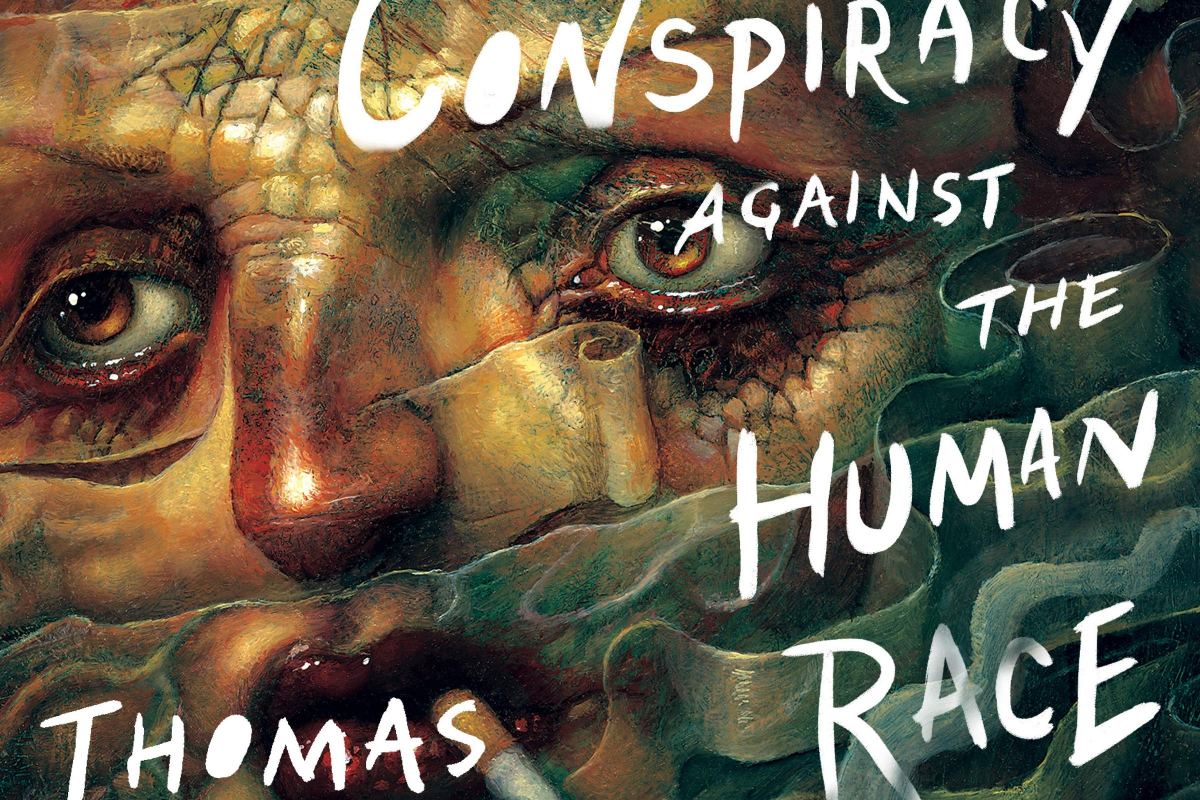
The Conspiracy against the Human Race is a work of non-fiction by horror author Thomas Ligotti. There is an audio podcast version and a YouTube video version. Feel free to leave comments in the space below or on YouTube.
Transcript
In this segment, I’ll be reviewing a book by Thomas Ligotti, The Conspiracy Against the Human Race, A Contrivance of Horror.
I haven’t done any book reviews, but since I tend to read a lot of books, I figure why not share my take and see how it’s received? If you like these reviews, click the like button and I’ll consider creating more.
Let’s get started.
First, I’ll be providing a little background, and then I’ll summarise some of the content and main themes. I’ll close with my review and perspective.
The author is Thomas Ligotti. He is a published writer in the horror genre in the vein of Lovecraft’s atmospheric horror. I’ve not read any of his work and haven’t read much fiction in ages.
The Conspiracy Against the Human Race is Ligotti’s first work of non-fiction. The book was originally published in 2010. I read the 2018 paperback version published by Penguin Books.
Conspiracy Against the Human Race falls into the category of Ethics and Moral Philosophy in a subcategory of pessimism. The main thesis of this book is that humans ought never to have been born. Following in the footsteps of anti-natalist David Benatar, who published Better Never to Have Been Born in 2007, Ligotti doubles down on Benatar’s position on the harm of coming into existence and argues that humans should just become extinct. Moreover, we should take out life in general.
In the book, Ligotti posits that consciousness was a blunder of nature and is the root of all suffering. He argues the derived Buddhist position of dukkha, which translates as Life is suffering. He establishes that most people are aware of this fact, but that we are nonetheless wired to be biased toward optimism through delusion and what a psychoanalyst might call repressed memories. Moreover, pessimists are a cohort not tolerated by society, who don’t want their delusions shattered.
Philosophically, Ligotti is a determinist. I’ve created content on this topic, but in a nutshell, determinism is the belief that all events are caused by antecedent events, leading to a chain of causes and effects stretching back to the beginning of time and bringing us to where we are now. If we were able to rewind time and restart the process, we would necessarily end up in the same place, and all future processes will unfold in a like manner.
Ligotti likes the metaphor of puppets. He employs puppets in two manners. Firstly, being the determinist he is, he reminds us that we are meat puppets with no free will. Our strings are controlled by something that is not us. This something ends up being Schopenhauer’s Will, reminding us that one can want what we will, but we can’t will what we will. This Will is the puppeteer. Secondly, puppets are soulless, lifeless homunculi that are employed in the horror genre to create unease by means of an uncanny association. He cites the work and philosophy of Norwegian author Peter Zapffe, who also elucidates human existence as a tragedy. Humans are born with one and only one right—the right to die. And death is the only certainty. The knowledge of this causes unnecessary suffering.
Quoting Ligotti,
“Stringently considered, then, our only natural birthright is a right to die. No other right has ever been allocated to anyone except as a fabrication, whether in modern times or days past. The divine right of kings may now be acknowledged as a fabrication, a falsified permit for prideful dementia and impulsive mayhem. The inalienable rights of certain people, on the other hand, seemingly remain current: somehow we believe they are not fabrications because hallowed documents declare they are real.”
Ligotti reminds us that consciousness is a mystery. We don’t really know what it is or what causes it other than it exists and we seem to have it, to be cursed with it. He adopts Zapffe’s position that consciousness is also responsible for the false notion of the self.
As all life is, humans are the result of an evolutionary process. Consciousness was just the result of an evolutionary blunder. He cites Zapffe and conveys that “mutations must be considered blind. They work, are thrown forth, without any contact of interest with their environment.”
Whilst pessimists view consciousness as a curse, optimists such as Nicholas Humphry think of it as a marvellous endowment.
He summarises the reason humans have it worse than the rest of nature:
“For the rest of the earth’s organisms, existence is relatively uncomplicated. Their lives are about three things: survival, reproduction, death—and nothing else. But we know too much to content ourselves with surviving, reproducing, dying—and nothing else. We know we are alive and know we will die. We also know we will suffer during our lives before suffering—slowly or quickly—as we draw near to death. This is the knowledge we “enjoy” as the most intelligent organisms to gush from the womb of nature. And being so, we feel shortchanged if there is nothing else for us than to survive, reproduce, and die. We want there to be more to it than that, or to think there is. This is the tragedy: Consciousness has forced us into the paradoxical position of striving to be unself-conscious of what we are—hunks of spoiling flesh on disintegrating bones.”
I’ll repeat that: Consciousness has forced us into the paradoxical position of striving to be unself-conscious.
He cites Zapffe’s four principal strategies to minimise our consciousness, isolation, anchoring, distraction, and sublimation
Isolation is compartmentalising the dire facts of being alive. So, he argues, that a coping mechanism is to push our suffering out of sight, out of mind, shoved back into the unconscious so we don’t have to deal with it.
Anchoring is a stabilisation strategy by adopting fictions as truth. We conspire to anchor our lives in metaphysical and institutional “verities”—God, Morality, Natural Law, Country, Family—that inebriate us with a sense of being official, authentic, and safe in our beds.
Distraction falls into the realm of manufactured consent. People lose themselves in their television sets, their government’s foreign policy, their science projects, their careers, their place in society or the universe, et cetera. Anything not to think about the human condition.
Sublimation. This reminds me of Camus’ take on the Absurd. Just accept it. Embrace it and incorporate it into your routine. Pour it into your art or music. Ligotti invokes Camus’ directive that we must imagine Sisyphus happy, but he dismisses the quip as folly.
Ligotti underscores his thesis by referencing the works of other authors from David Benatar to William James.
Interestingly, he suggests that people who experience depression are actually in touch with reality and that psychology intervenes to mask it again with the preferred veil of delusion and delf-deception. Society can’t operate if people aren’t in tune with the masquerade. Citing David Livingstone Smith in his 2007 publication, Why We Lie: The Evolution of Deception and the Unconscious Mind, Ligotti writes: “Psychiatry even works on the assumption that the “healthy” and viable is at one with the highest in personal terms. Depression, “fear of life,” refusal of nourishment and so on are invariably taken as signs of a pathological state and treated thereafter.”
Ligotti returns to the constructed notion of the self and presents examples of how a lack of self is an effective horror trope, citing John Carpenter’s The Thing and Invasion of the Body Snatchers.
He spends a good amount of time on ego-death and the illusion of self, a topic I’ve covered previously. He mentions Thomas Metzinger and his writings in several places including his Being No One, published in 2004, ostensibly reinforcing a position described as naïve realism, that things not being knowable as they really are in themselves, something every scientist and philosopher knows.
He delves into Buddhism as a gateway to near-death experiences, where people have dissociated their sense of self, illustrating the enlightenment by accident of U. G. Krishnamurti, who after some calamity “was no longer the person he once was, for now he was someone whose ego had been erased. In this state, he had all the self-awareness of a tree frog. To his good fortune, he had no problem with his new way of functioning. He did not need to accept it, since by his report he had lost all sense of having an ego that needed to accept or reject anything.” Krishnamurti had become a veritable zombie. He also cited the examples of Tem Horwitz, John Wren-Lewis, and Suzanne Segal, but I won’t elaborate here.
Russian Romantic author, Leo Tolstoy, famous for War and Peace and Anna Karenina, was another pessimist. He noticed a coping approach his associates had employed to deal with their morality.
Ignorance is the first. As the saying goes, ignorance is bliss. For whatever reason, these people are simply blind to the inevitability of their mortal lives. As Tolstoy said these people just did not know or understand that “life is an evil and an absurdity”.
Epicureanism comes next. The tactic here is to understand that we are all in here and no one gets out alive, so we might as well make the best of it and adopt a hedonistic lifestyle.
Following Camus’ cue, or rather Camus following Tolstoy and Schopenhauer, he suggests the approach of strength and energy, by which he means the strength and energy to suicide.
Finally, one can adopt the path of weakness. This is the category Tolstoy finds himself in, writing “People of this kind know that death is better than life, but not having the strength to act rationally—to end the deception quickly and kill themselves—they seem to wait for something.”
The last section of the book feels a bit orthogonal to the rest. I won’t bother with details, but essentially he provides the reader with examples of how horror works by exploring some passages, notably Radcliffe’s, The Mysteries of Udolpho; Conrad’s Heart of Darkness; Poe’s Fall of the House of Usher; Lovecraft’s Call of Cthulhu; and contrasting Shakespeare’s Macbeth and Hamlet.
This has been a summary of Thomas Logotti’s Conspiracy against the human race. Here’s my take. But first some background, as it might be important to understand where I am coming from.
I am a Nihilist. I feel that life has no inherent meaning, but people employ existentialist strategies to create a semblance of meaning, much akin to Zapffe’s distraction theme or perhaps anchoring. This said I feel that, similar to anarchism, people don’t understand nihilism. Technically, it’s considered to be a pessimistic philosophy because they are acculturated to expect meaning, but I find it liberating. People feel that without some constraints of meaning, that chaos will ensue as everyone will adopt Tolstoy’s Epicureanism or to fall into despair and suicide. What they don’t know is they’ve already fabricated some narrative and have adopted one of Zappfe’s first three offerings: isolation, which is to say repression); anchoring on God or country; or distracting themselves with work, sports, politics, social media, or reading horror stories.
Because of my background, I identify with Ligotti’s position. I do feel the suffering and anguish that he mentions, and perhaps I am weak and rationalising, but I don’t feel that things are so bad. I may be more sympathetic to Benatar’s anti-natalism than to advocate for a mass extinction event, though I feel that humans are already heading down that path. Perhaps this could be psychoanalysed as collective guilt, but I won’t go there.
I recommend reading this. I knocked it out in a few hours, and you could shorten this by skipping the last section altogether. If you are on the fence, I’d suggest reading David Benatar’s Better Never to Have Been. Perhaps I’ll review that if there seems to be interest. If you’ve got the time, read both.
So there you have it. That’s my summary and review of Thomas Ligotti’s The Conspiracy against the Human Race.
Before I end this, I’ll share a personal story about an ex-girlfriend of mine. Although she experienced some moments of happiness and joy, she saw life as a burden. Because she had been raised Catholic and embodied the teachings, she was afraid that committing suicide would relegate her to hell. In fact, on one occasion, she and her mum had been robbed at gunpoint, and her mum stepped between my girlfriend and the gun. They gave the gunmen what they wanted, so the situation came to an end.
My girlfriend laid into her mother that if she ever did something like that again and took a bullet that was her ticket out, she would never forgive her. As it turned out, my girlfriend died as collateral damage during the Covid debacle. She became ill, but because she was living with her elderly mum, she didn’t want to go to hospital and bring something back. One early morning, she was writhing in pain and her mum called the ambulance. She died later that morning in hospital, having waited too long.
For me, I saw the mercy in it all. She got her ticket out and didn’t have to face the hell eventuality. Not that I believe in any of that, but she was able to exit in peace. Were it not for the poison of religion, she could have exited sooner. She was not, in Tolstoy’s words, weak, so much as she had been a victim of indoctrination. I feel this indoctrination borders on child abuse, but I’ll spare you the elaboration. So, what are your thoughts on this book? Is there a conspiracy against humanity? Are optimists ruining it for the pessimists? What do you think about anti-natalism or even extinction of all conscious beings or the extreme case of all life on earth? Is Ligotti on to something or just on something?
I have agreed with this sentiment for as long as I can remember, at least stretching back to age 10 or 12 and long before I had ever heard of the likes of Proudhon. I don’t believe that Proudhon is a big focus in the United States. I never encountered him in all of my studies from kindergarten to grad school—and I was an economics major.
In the US, disparaging Marx was always in vogue, with the off-hand remark along the lines of “Communism works on paper, but because of human nature, it can’t work in practice. And by the way, look at the Soviet Union. That’s all the proof you need.” Of course, I was left thinking that at least it worked on paper, something I can’t say with a straight face for Democracy.
For those who are familiar with Proudhon, he is likely remembered for his quote, “Property is theft!” I’ve discussed this before.
La propriété, c’est le vol!
Property is theft!
But this is a different quote: “I do not wish to be either ruler or ruled.” When I was in high school, there was a saying, lead, follow, or get out of the way. As imperfect of a metaphor as it is, I just wanted out of the way. In the world of leaders and followers, I wanted to be an advisor. In a manner—given the false dichotomy of followers and leaders—, this relegated me a de facto follower. Only I am not a follower. I not only question authority and authority figures, I question the legitimacy of their power. Not a great follower, to be sure.
I feel I am the peasant in Monty Python’s Holy Grail who tells King Arthur upon encountering him, “Well, I didn’t vote for you.” Not that voting yields some source of legitimacy. What options does one have?
Philosophically speaking, there is no justification for personal bodily autonomy. Someone just made this claim, and some others agreed. Sounds good to me, but there is no real reason to support the idea save for selfish rationale.
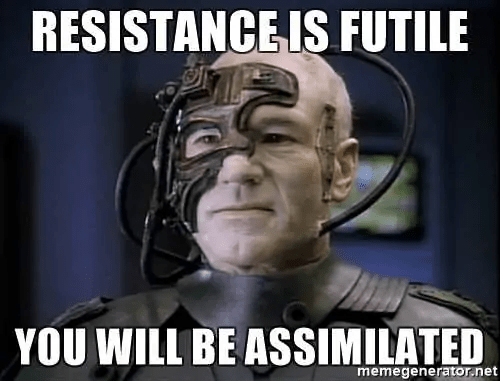
The science fiction staple, Star Trek, famously created a Borg where autonomy was futile. Because of our acculturation, we find this idea perhaps silly or perhaps appalling or absurd, but one is not more justifiable than another except by rhetorical devices. Yet neither is right.
Resistance is futile!
In the West, we tend to prefer a rather middle path, and perception doesn’t actually comply with reality. I think that people believe that they are more autonomous than they are. I’d be willing to argue that this is the same delusion underlying a sense of free will. Sartre might have argued that we each retain a sort of nuclear option as a last resort, but a choice between two options is hardly freedom. It sounds a lot like Sophie’s Choice (spoiler alert).
Not so come across like Hobbes, but I do feel that violence (subject to semantic distinction), or at least the potential for it, is inherent in any living system. With political and legal systems, violence just shifts from explicit to implicit, and so out of sight, out of mind.
In any case, I do not wish to be either ruler or ruled. I just want to advise. I’m an introvert. I want to be left alone. I value the benefits of society and I participate at the margins, and that’s where I prefer to remain. If the direction of the train I am on seems to be running off the tracks I’d presume it should be on, then I’ll get vocal. Otherwise, I’ll take the privilege to concentrate on cerebral and philosophical interests.
I finally decided to read Peter Strawson’s essay, Freedom and Resentment, as it seems to be a somewhat seminal work. As the essay is part of a larger collection, Freedom and Resentment and Other Essays, I also read Strawson’s autobiography, which is interesting. I especially enjoyed the part where he had published a piece only to discover that it dovetailed with some of Frege’s work and was cast as the Frege-Strawson view despite him never having read Frege.
Although on a lesser scale, I feel this captures some of my circumstances where I feel I have some original thought only to discover that someone’s already been there, in some cases before I was even born—or before my grandparents for that matter. There is just so much to read and time is a limited resource. In any case. Moving on.
He begins with these two sentences:
Some philosophers say they do not know what the thesis of determinism is. Others say, or imply, that they do know what it is.
Strawson employs the terminology of optimism and pessimism. These are in consideration of the notion of free will. Each claims that as far as we know, determinism cannot be shown to be false. But optimists believe that we can assume we have an adequate basis for moral practices whilst pessimists believe that we cannot make this assumption, so we must find some other basis; this means that the pessimists are forced to concede that although determinism cannot be proven to be false, it must nonetheless be false.
Some pessimists “hold that if the thesis [of determinism] is true, then the concepts of moral obligation and responsibility really have no application, and the practices of punishing and blaming, of expressing moral condemnation and approval, are really unjustified.”
Some optimists “hold that these concepts and practices in no way lose their raison d’être if the thesis of determinism is true.”
as far as we know, determinism cannot be shown to be false
A genuine moral sceptic may hold that “the notions of moral guilt, of blame, of moral responsibility are inherently confused and that we can see this to be so if we consider the consequences either of the truth of determinism or of its falsity.”
Like Frege to Strawson, I now find myself adopting his line of argumentation—that people presume people to be competent agents by default unless exempted as non compos mentis and such. If one or more of these mitigating factors is not present, then one may be considered to be a morally responsible agent. (In my mind, this creates many false positives in the resultant sample, but let’s continue.)
Then he establishes the groundwork for moral obligation and responsibility to arrive here:
Strawson contrasts optimistic with pessimistic with a smattering of sceptics.
If I am asked which of these parties I belong to, I must say it is the first of all, the party of those who do not know what the thesis of determinism is.
But this does not stop me…
Desert is his next topic. What does the threshold of the agent to have to deserve “blame or moral condemnation”?
Effectively, Strawson separates determinists and libertarians (philosophical, not the capital-L political flavour).
He distinguishes reasons from rationalisation, with the former having more weight and the second being akin to excuses. Here, he tries to tease out notions of positive and negative freedoms on a concept defined negatively, i.e., the absence of some deficiency. He also calls out supporters for not only having an insufficient basis but “not even the right sort of basis”.
Strawson makes a point to delineate desert as following from a positive act rather than some omission, allowing for ignorance to serve as an escape clause. Being an older publication, he points out the by-now obvious contradiction between freedom and determinism, but he continues to clarify the waffling between various definitions of freedom, hiding behind the ambiguous meaning, whether intentioned or not.
Soon enough, he notes a challenge. Humans have a cognitive bias wherein they have a difficult time maintaining an objective attitude toward people who we interact with. Instead, we engage in participant reactive attitudes. This is to say that we make judgments we would not make on a non-reactive object. If we bump into a chair (object), we don’t activate the same mental protocols as if we bump into a person (participant reactive). In the latter case, our blame-resentment mechanism is activated. This may result in feelings of ‘resentment, gratitude, forgiveness, anger‘ or some sort of reciprocated love in another instance. In the end, he supposed that we blame people because we have reactive attitudes toward them.
Ultimately, irrespective of whether determinism is true or not, we cannot seem to control our personal reactive urges, so we need to deal with it.
To be honest, I don’t feel I got a lot out of this essay. Perhaps it just didn’t age well or others have already incorporated this into their work, so the logic may be sound, but it doesn’t feel particularly profound. I can tick off the ‘read this’ box and move on.







 Philosophics