Given the number of posts related to Iain McGilchrist’s The Matter with Things, I created a content index followed by a PDF copy of the table of contents for no reason in particular. I hope this doesn’t infringe on any copyrights.
I was browsing YouTube, and I got captivated by reaction videos, where a younger audience listens to music some of us grew up with and reacts to it. Time is a song I grew up on. Pink Floyd were a major influence on my music and my worldview. I have to admit that I am partial to the David Gilmour years and stopped caring about anything released after Roger Waters left. I have spent hours listening to their back catalogue with Syd Barrett and early David Gilmour, but Meddle, released in 1971, is about as far back as I prefer to go—even that old gem, Seamus.
Roger Waters penned the deepest lyrics for Pink Floyd, and this was one of his best. He wrote this in his late twenties, though it feels like he would have been older and wiser. I suppose he’s an old soul. Here’s the first verse:
Ticking away the moments that make up a dull day
Fritter and waste the hours in an offhand way
Kicking around on a piece of ground in your hometown
Waiting for someone or something to show you the way
This speaks to how we tend to take time for granted. Sometimes, we just want the time to pass. We’re bored, and we want to get on to something meaningful, eventful, or perhaps exciting. We might be sat in work or school just waiting for quitting time. We aren’t living in the moment or enjoying the moment. And we might just be kicking around on a piece of ground in our hometowns rather aimlessly. And whilst I am aware that many people are looking for someone to guide them to the next level, whether a religion, a vocation, a guru, or a hero, that bit’s never really resonated with me. I suppose I’ve always been naturally insouciant and Zen. Some have said to a fault.
you missed the starting gun
Tired of lying in the sunshine, staying home to watch the rain
You are young and life is long, and there is time to kill today
And then one day you find ten years have got behind you
No one told you when to run, you missed the starting gun
The second verse picks up where the first one left off. Let’s not forget that this is Britain—London—plenty of rain. But some people do get tired of lying in the sunshine living their routine workaday lives. When we are younger, the days feel longer. Time is stretched. Einsteinian relativity. Again, we’ve got time to pad out and fill. Something’s happening at the weekend. Let’s just fast-forward, but we can’t, so let’s fill the time with mindless prattle and television or somesuch. Once you were 18 and now you’re 28. What happened? Tens years gone. Where’d the time go?
The last line in the second verse is telling. For me, it’s more an indictment of quote-modern-unquote society. It only applies to those who buy into this worldview. I never bought in. It’s’ always been a sham. But for some, they reach 28 and realise they’ve made the wrong decisions for their lives to end up the way they may have envisaged. I’ve never had this grand vision.
one day closer to death
And you run, and you run to catch up with the sun but it's sinking
Racing around to come up behind you again
The sun is the same in a relative way but you're older
Shorter of breath and one day closer to death
Resistance is futile. You can’t escape the movement of time as represented by the quotidian sun. It will always lap you. The sun ages on a different time scale to you. The sun doesn’t appear to age. It was here when we arrived. It will be here when we leave. It was here before any of us were born. It will be here after we’ve all left. Yet with every lap of the sun, we are each another day closer to death. That day may be tomorrow, next week, or in a hundred years, but as Twelve-Step programmes remind us, we live one day at a time. Perhaps even this is too large of a time slice, as we can only live moment to moment. Anything else is but a construction. Nothing else is real. Memento Mori.
thought I’d something more to say
Every year is getting shorter, never seem to find the time
Plans that either come to naught or half a page of scribbled lines
Hanging on in quiet desperation is the English way
The time is gone, the song is over, thought I'd something more to say
Again, time is relative. When we are young, we yearn for things: perhaps to graduate high school; get a driver’s license; graduate college; get the job we wanted; get some promotion or recognition; get signed to a big label; get a big break; the list goes on.
For those who are planners, the best-laid plans go awry. We dream of whatever and even journal these thoughts, but in the words of another song, “you can’t always get what you want”.
We want to do this or that, but life gets in the way. We can’t do everything. Economists capture this by the notion of opportunity costs. We can do this but not that. It doesn’t matter if we are Elon Musk, Jeff Bezos, Bill Gates, or whomever. Time is the ultimate leveller.
We can just keep a stiff upper lip and persevere. Just occupy some place on this third rock, Next thing you know, the time is gone. I recall my ninety-odd-year-old father-in-law after his wife of seventy-five years died. He just wanted to die. He was done. He was ready to quit, but the music was still playing. Any semblance of hope was exchanged for the hope to reach the ending peacefully.
home again
Home, home again
I like to be here when I can
And when I come home cold and tired
It's good to warm my bones beside the fire
In this verse, Roger becomes reflective. He’s nostalgic for home. Anyone with a home has a place to return to after work, after school, or a childhood memory, but to touring performers, home is an even more special place. It’s a place to return to after life on the road, perhaps for months or years. Consider Odysseus and the travellers of old. This home.
He wants to be in this comfortable, familiar place. And after a long day or excursion, it’s a place to rejuvenate and rekindle by the warmth of the fire.
softly spoken magic spells
Far away across the field
The tolling of the iron bell
Calls the faithful to their knees
To hear the softly spoken magic spells
The final verse is even more metaphorical than the others. There’s an allusion. Religious allegory. In the distance, we hear the peal of the church bell beckoning the parishioners to hear the palliative words of the vicars and priests and whatnot. Or perhaps these softly spoken magic spells are simply the prayers of the individuals.
In deference to Barthes, the author is dead. But it doesn’t matter this is my interpretation—my meaning. Even more so, in deference to chapter eight of the Matter with Things, poetry and music are meant to be appreciated as a whole, not dissected. We can reflect on the words and phrases—even the melodies and rhythms—but the words are less than they sum to. Still, this piece moves me. It always has.
In the last chapters, the topics were about different intelligences. As we’ll see, intelligence is one of the factors for creativity, but there are more. Let’s crack on.
Podcast: Audio rendition of this page content
Content
Creativity is an elusive phenomenon that cannot only not be summoned at will, the very act of trying inhibits it. Unlike left-hemisphere-oriented intelligence, there are no simple tests for creativity because of their very nature. Assessing the left-hemisphere is relatively simple because it is systematic and any tests have definite known solutions—whether calculating some figure, solving a puzzle, choosing analogies, or recounting some trivia. There is no such test for creating something not yet created, but there are some proxies that most people categorically fail.
Psychologist, Colin Martindale, had this to say about the personal characteristics of creativity
“Creativity is a rare trait. This is presumably because it requires the simultaneous presence of a number of traits (e.g., intelligence, perseverance, unconventionality, the ability to think in a particular manner). None of these traits is especially rare. What is quite uncommon is to find them all present in the same person.”
— Colin Martindale
Whereas the left hemisphere is analytical, the right hemisphere (hence creativity) is a Gestalt. When given a difficult time-boxed challenge, the left hemisphere dominant individual who does not arrive at the expected response on time will commit to and defend an incorrect response (think escalating commitment), and the right hemisphere dominant individual will simply not commit to a response under the thought that there were still options to be explored.
Effectively, creativity can be broken down into three phases: preparation, incubation, and illumination.
In essence, for the creative individual, the best we can do is to leave well enough alone. Anything but space and permission will kill the creative impulse.
Preparation is simply the accumulation of a particular domain of knowledge. For an artist, it will be to understand, perhaps, colour, shape, texture, form, shadow, media, or so forth; for a musician, it might be to understand melody, harmony, tempo, timbre, dynamics, and so on; for a mathematician, it might be basic arithmetic, theories, proofs, and on and on. It’s also important to note that accumulated information in multiple domains also forms a foundation leveraged by many polymaths.
Incubation is simply waiting for something to grow in the prepared garden. Incubation is an unconscious activity and cannot be controlled or accessed by the conscious mind. In fact, conscious effort and introspection will serve only to impede cultivation. Digging up planted seeds to see how they are growing will only hinder the process.
Illumination is the final phase. Again, this is unwilled. Prepared and incubated flowers bloom. Of course, this is an imperfect metaphor because the ground must already have been fertile at the start. Tossing seeds on fallow ground still yields no blooms no matter how carefully attended.
In essence, for the creative individual, the best we can do is to leave well enough alone. Anything but space and permission will kill the creative impulse.
McGilchrist discusses generative, permissive, and translational requirements.
“The key element in generation seems to be the ability to think of many diverse ideas quickly, demanding breadth, flexibility and analogical thinking – seeing likeness within apparent dissimilarity.” This can be summed up as divergent thinking. This is the openness afforded by the right hemisphere as opposed to the convergent behaviour of the left. As it happens, this is where artificial intelligence falls flat as it is predicated on convergent activity.
The right hemisphere Gestalten surveys the environment and notes otherwise unperceived parallels. It is not a systematic approach. In the words of Oscar Wilde, “Education is an admirable thing. But it is well to remember from time to time that nothing that is worth knowing can be taught.”
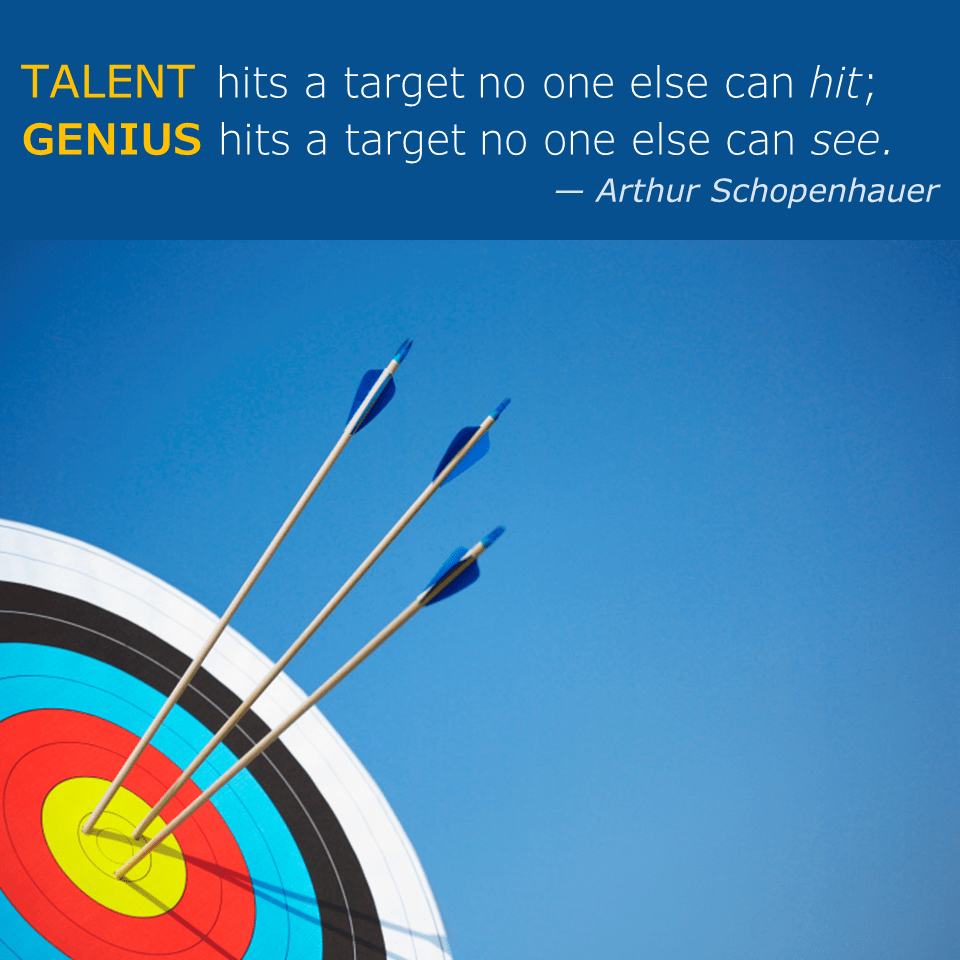
“Talent hits a target no-one else can hit; genius hits a target no-one else can see”.
Arthur Schopenhauer
Schopenhauer sums it up nicely, “Talent hits a target no-one else can hit; genius hits a target no-one else can see”.
Citing Isaac Asimov writing about Darwin’s insight, he notes that before Darwin, many people had read Malthus and studied species, but they lacked the creative spark that Darwin had.
Steve Jobs noted that
“Creativity is just connecting things. When you ask creative people how they did something, they feel a little guilty because they didn’t really do it, they just saw something. It seemed obvious to them after a while. That’s because they were able to connect experiences they’ve had and synthesize new things … A lot of people in our industry haven’t had very diverse experiences. So, they don’t have enough dots to connect, and they end up with very linear solutions without a broad perspective on the problem. The broader one’s understanding of the human experience, the better design we will have.”
— Steve Jobs
This is a failing of the business world and of specialisation more generally. McGilchrist writes, “Linear approaches and analytic thinking, characteristic of the left hemisphere, are fine in the right context, and may at a subsequent phase take part in creativity by narrowing things down and eliminating some of them, but on their own will not achieve creativity”.
There is a direct link between intelligence and creativity. Ego crushes creativity.
There is a direct link between intelligence and creativity. Ego crushes creativity.
He again cites Asimov:
“My feeling is that as far as creativity is concerned, isolation is required. The creative person is, in any case, continually working at it. His mind is shuffling his information at all times, even when he is not conscious of it …The presence of others can only inhibit this process, since creation is embarrassing.”
— Isaac Asimov
Some people excel at maths, but many are systematic and procedural left-hemisphere types; they apply logic and reason—insert tab A into slot B. The famous mathematicians understand the procedures, but their ideas come from intuition rather than reason. The left hemisphere doesn’t recognise this as a viable vector, and therein lies the rub. “Math is not about following directions; it’s about making new directions,” writes mathematician Paul Lockhart.
This is why we hear so many accounts of aha moments, something coming to one person in a dream or Isaac Newton’s falling apple anecdote.
“These thoughts did not come in any verbal formulation. I very rarely think in words at all. A thought comes, and I may try to express it in words afterward”
Albert Einstein
Einstein told Max Wertheimer, founder of Gestalt psychology, “These thoughts did not come in any verbal formulation. I very rarely think in words at all. A thought comes, and I may try to express it in words afterward”. Words are a left-hemisphere phenomenon.
Many accomplished musicians hear a piece whole. All they need to do is to compose it to staff paper or perform it. We hear this regularly: “I was driving from here to there and it just came to me. All I needed to do is to remember it long enough to get it down.”
I found McGilchrist’s inclusion of hemispheric damage quite interesting. He provides many examples of artists, composers, and poets, but I’ll only summarise them. For musicians and Artists with right hemisphere damage, those who even retained the urge to create did so at a lower quality level. However, those with left hemisphere damage operated at the same level and oftentimes at a higher level, without the inhibition and censorship of the left hemisphere.
It’s important to note that most people rely on both hemispheres. When I write left hemisphere dominant, I mean to say that either the right hemisphere simply underperforms or that the left hemisphere does not cede control back to the right hemisphere. Generally speaking, both hemispheres experience the world, and a strong right hemisphere will act as air traffic controller, or perhaps have the right of first refusal, but this is a loose metaphor because sometimes the left hemisphere just fields an experience and takes its best guess how to handle it even if it should have been fielded by the right hemisphere and even if the left hemisphere provides the wrong answer. The left hemisphere is the hemisphere of the ego and identity, so it is somewhat relentless and defensive even when it is wrong.
As a side note, I trust that political identity and escalating commitment are left-hemisphere activities and why modern Western politics feel so intractable.
After a strong argument for right hemisphere dominance and divergent thinking being hallmarks of creativity, he offers some counter-evidence and counters some of it.
A paper by Arne Dietrich and Riam Kanso co-authored a book citing instances of convergent thought processes that led to something innovative or creative. At the onset, McGilchrist calls them out for conflating problem-solving with creativity. In the end, the left hemisphere does play a role. He calls this the translational phase. Essentially, this is Mozart having heard his symphony and needing to put his thoughts to paper. Or the poet.
He goes off on a bit of a tangent noting how words pale concepts, and divergence and convergence are no exception. This fits in with my own insufficiency of language theory, but McGilchrist and I have different rationales for our arguments, so I’ll not side-track this summary.
He cites some statistics correlating creativity with mental health disorders and incidences of suicide. This will set the reader up perfectly for the next chapter about schizophrenia and autism.
Perspective
In summary, creativity has got me riled up more than in the previous chapters. This is partially due to how it comports with my own observations. I have always felt that humans are not very creative or innovative despite protests to the contrary. In fact, I’ve often commented when I’ve heard people say something like “artificial intelligence will never create the next…” Fill in the blank: Mozart, Picasso, Michelangelo, Nabokov, Wordsworth. Or Einstein. Of course, neither will a human be the next of these.
All these people are right cerebral hemisphere dominant. AI operates systematically, in the manner of the left hemisphere. None of these people built up systematically. Instead, their ideas were wholly formed, and their creations were reductive rather than additive. Famously, Michelangelo was to have said, “The sculpture is already complete within the marble block before I start my work. It is already there. I just have to chisel away the superfluous material.” He sees the solution first and then builds towards it.
In my professional life, I have been a strategist as a management consultant as well as a business analyst. In each case, I could quickly assess a situation and then spend weeks or months defending my intuition with words, diagrams, and numbers.
As a business analyst, I would offer a recommendation, and this would need to come with an estimate to deliver the recommendation. This figure would come to me in a matter of minutes. Then, per protocol, I would need to enter micro-level details into a pricing model so it could calculate from the ground up. First, this was time-consuming. Second, this would be circulated for review where different people would (almost invariably) reduce the number of hours estimated, typically due to pressure to reduce the cost. Ultimately, a number would be output and tendered to the client or the person footing the bill. Again (almost invariably), the number initially intuited was more accurate and reflective of what was ultimately invoiced. Unfortunately, business is a left-hemisphere endeavour, and that will be its Achilles’ heel and denouement.
This wraps up the chapter on Creativity. The next chapter is “what schizophrenia and autism can tell us”, and is the end of part one of The Matter with Things.
What are your thoughts and experiences with creativity now that you’ve heard McGilchrist’s take?
Full Disclosure: This post has absolutely nothing to do with philosophy.
The Netherlands consists of 12 provinces. Two of them are considered Holland. Until about 2020, the Netherlands was OK with taking the name of its more famous provinces, but no longer.
The Netherlands with Holland highlighted
Referring to the Netherlands as Holland is like referring to Canada as Saskatchewan or the United States as California or France as Bretagne. Complete this cycle for your own favourite countries and regions. It works on the subregion level, too. It reminds me of times when you announce that you were raised in Inverness or wherever and someone asks if you happen to know Angus Macleod because he was also from Inverness and so you may have crossed paths. Because that’s remotely plausible.
So why the geography lesson? I have family in the Netherlands—in fact in Holland—and I’ve recently had a mate have to return to Holland. He was living and working in the US during the Covid debacle, and his employment was terminated, which meant that his H1-B sponsorship was terminated, and he was summarily forced to return to the Netherlands with his wife and two older children. This was more than slightly disruptive, as one might imagine.
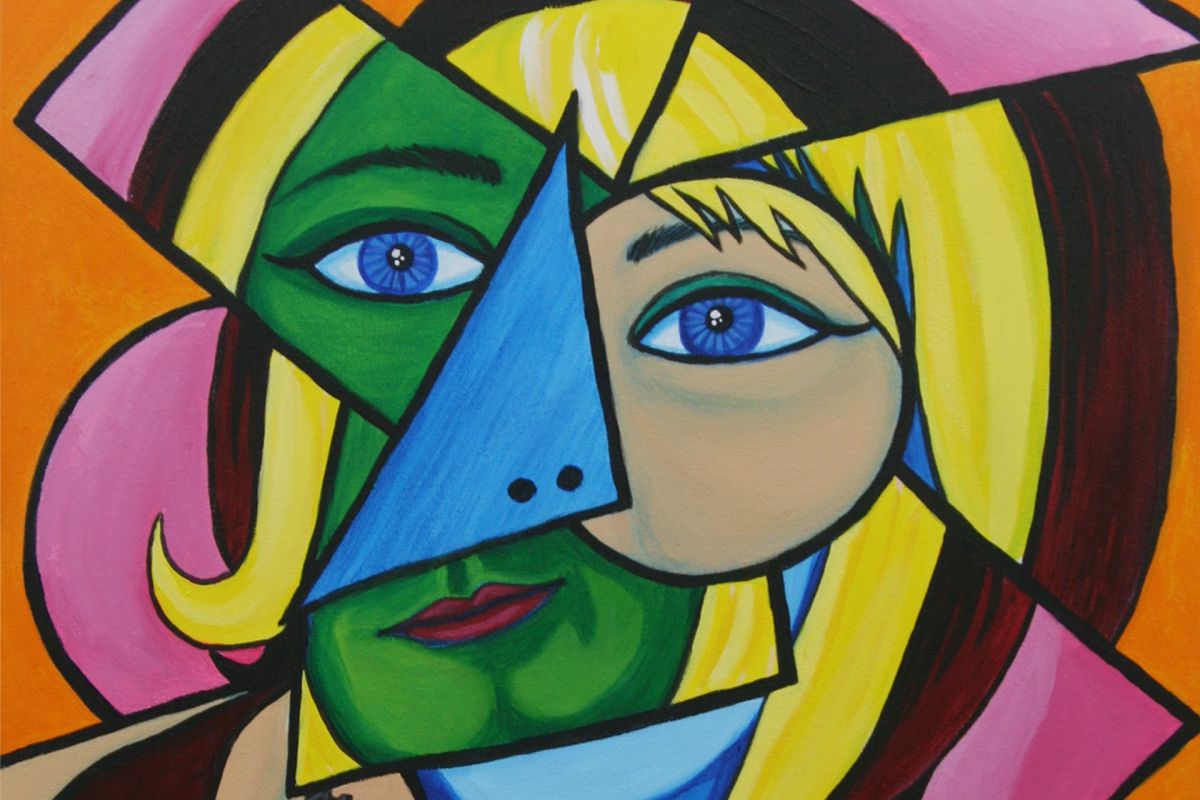
Cubism reminds us that we don’t see the world as it is. We see pieces, and we fill in the gaps. From the front, we can’t see the back. From the top, we can’t see the bottom.
Video: YouTube Video
The illusion that, if we can see something clearly, we see it as it really is, is hugely seductive. John Ruskin makes the point that clarity is bought at the price of limitation. He paints a scenario wherein we are asked to imagine viewing an open book and an embroidered handkerchief on a lawn. From a quarter mile away, the two are indistinguishable. Moving closer, we can see which is which, but we can neither read the book nor trace the embroidery. Closer still, we can read the text and trace the embroidery, but we can’t see the fibres of the paper or the threads of the kerchief. And we can’t simultaneously focus on both and see detail in each. Focusing on the book, we can look closer and see the watermark, the hills and dales in the paper’s surface. With a microscope, we can see more still, as infinitum.
But at which point do we see it clearly?
I’ve created a YouTube short. I have to admit that I dislike the format. Sixty seconds isn’t really enough time to convey a concept. There’s too much missing context, and no time to elaborate. Nonetheless, I was reading The Master and His Emissary and wanted to share a point. I don’t feel I succeeded. I posted it anyway, and here it is.
Life is an opportunistic parasite. It’s been speculated that life on Mars annihilated itself. This is almost a truism. In most models, there are only two options: life annihilates life or the inanimate environment intervenes. As regards anthropogenic climate change, occasionally, it’s both, though some are afforded a sense of plausible deniability—they get to throw their hands up into the air and proclaim that these things just happen to happen in cycles. It’s happened before; it’ll happen again. What can you do?
Podcast: Audio rendition of this page content
“Besides, they threatened a new Ice Age in the 1970s, and now they’re warning about climate change? I’ll have none of it. Climate change is just another way for certain so-called green industries to fleece the public and abscond with government subsidies, but we’re wise to them.”
Dramatic Reanactment
Humans refer to life feeding off of other life as parasites, seeing no irony in fitting the same description. This is not a novel observation, but most prefer to ignore it. We proclaim that we are at the top of the food chain, except it’s a food web, and we’re not at the top. We’re a mediocre species on a unique but mediocre planet in a mediocre galaxy supported by a mediocre star, we call the sun, and so on. As the saying goes, “as above, so below”. Mediocre all the way down.
But life annihilates life. Of course, there is war and hate and intolerance and ignorance. These comprise the lion’s share. In fact, I’m not sure what one might add. We annihilate other life, and we annihilate ourselves. Sure, there’s age and disease and trauma and asteroid strikes, but most of these are beyond our control.
Annihilation is inevitable, whether on an individual micro-level or a macro-level. Annihilation is entropy—the Second Law of Thermodynamics. Earth is a macrocosm of Easter Island, driven to extinction through resource depletion. There are other ways to go. We’ve even got some locked and loaded.
I recently posted a YouTube Short video titled You Have No Free Will, but this is still debatable.
Video: You Have No Free Will
The premise of the belief in free-will is that human decisions are made approximately half a second before we are conscious of them, and then the conscious brain convinces itself that it just made a choice. This sounds pretty damning, but let’s step back for a moment.
Podcast: Audio rendition of this page content
If you’ve been following this blog these past few months, you’ll be aware that I feel the question of free will is a pseudo-question hinging primarily on semantics. As well, there’s the causa sui argument that I’d like to ignore for the purpose of this post.
There remains a semantic issue. The free will argument is centred around the notion that a person or agent has control or agency over their choices. This means that how we define the agent matters.
In the study this references, the authors define the agent as having conscious awareness. Since this occurs after the decision is made, then the person must have had no agency. But I think an argument can be made that the earlier decision gateway is formed through prior experience. Applying computer metaphors, we can say that this pre-consciousness is like embedded hardware or read-only logic. It’s like autopilot.
In business, there are various decision management schemes. In particular, the conscious but slow version is for a person to be notified to approve or deny a request. But some decisions are automatic. If a purchase is over, say 50,000 then a manager needs to sign off on the request. But if the purchase is under 50,000, then the request is made automatically and then the manager is notified for later review if so desired.
I am not saying that I buy into this definition, but I think the argument could be made.
You might not know it by the number of posts discussing it, but I am not really concerned about whether or not free will really exists. I don’t lose any sleep over it. At the same time, I tend to react to it. Since I feel it’s a pseudo-problem where tweaking the definition slightly can flip the answer on its head, it’s just not worth the effort. On to better things.
“We knew that conscious processes were simply too slow to be actively involved in music, sports, and other activities where split-second reflexes are required. But if consciousness is not involved in such processes, then a better explanation of what consciousness does was needed,”
Andrew Budson, MD, professor of neurology, Boston University
Under this new theory, supported by recent studies, choices are made unconsciously and then we are made conscious of the choices after the fact. This tosses a spanner in the works of some proponents of free will. Some may still claim that it was uniquely ‘you’ who made this choice—conscious or otherwise—, but others may not be so fanciful.
“According to the researchers, this theory is important because it explains that all our decisions and actions are actually made unconsciously, although we fool ourselves into believing that we consciously made them.”
“What is completely new about this theory is that it suggests we don’t perceive the world, make decisions, or perform actions directly. Instead, we do all these things unconsciously and then—about half a second later—consciously remember doing them.”
Andrew Budson, MD, professor of neurology, Boston University
And here we are again with more evidence that we are not consciously responsible for our choices, and yet the conscience has such a fragile ego, it needs to think it does.
As I’ve been engaging in the works of Iain McGilchrist, several concepts remain unresolved in my head. One was unresolved even before I engaged with his work, but he touches on the topic with a strong opinion. In fact, I wrote about it recently.
Podcast: Audio rendition of this page content
As a refresher, let’s re-establish that the right brain is the open experiential hemisphere and the left brain is the closed re-presentative hemisphere. Where the right diverges, the left converges. Where the right composes, the left decomposes.
The difference can be seen in the way the left brain views a person. Ostensibly, it not only sees a person as body parts—face, hands, torso, and whatever—, but it also sees these things as discrete slices of time. The right brain doesn’t see the parts. It only recognises the whole. Yes, it can discern you from me, but this is by a Gestalt heuristic that doesn’t ‘care’ about the details, per se. It just knows. Call it intuition.
When we experience something anew, the right hemisphere takes it in and signals the left hemisphere to categorise it and name it. This may be utilised by the right hemisphere at a later time.
From a practical perspective, on a day-to-day basis, it makes it more convenient to view these holistic concepts rather than elements. The challenge I am facing is that I know these to be constructions. McGilchrist seems to claim that we perceive them as they are and only then deconstruct them.
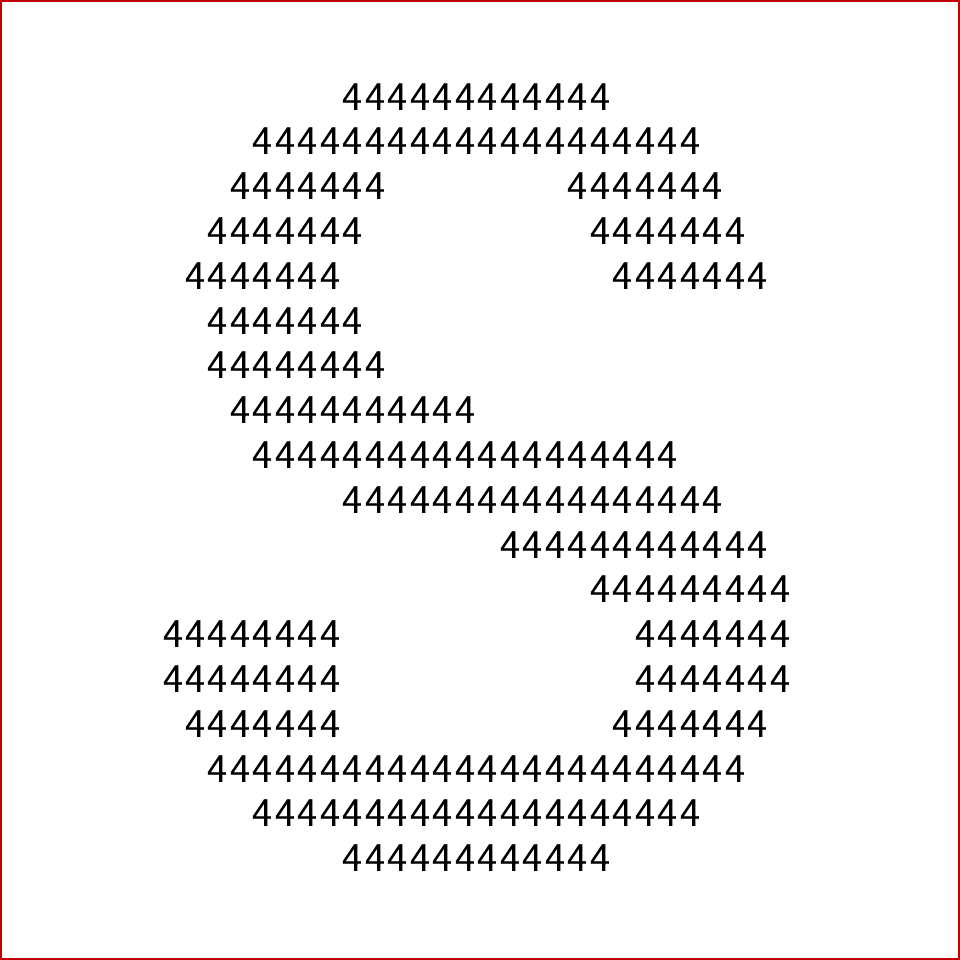
Regarding the image below, the right brain sees the S-shape and the left brain sees the 4s. I am oversimplifying, but the notion gets us where we need to be.
Schizophrenics will first see the 4s. If you registered the 4s first, don’t worry. There are other reasons why a person might see the 4s before the S, but as I said I am simplifying for discussion.
McGilchrist’s claim is that the S-ness is more important than the 4-ness, generally speaking. Even further, he asserts that the S is more real whilst the 4 is only part of the construction—that the elemental nature is less real. As always, I leave room for my own misunderstanding, but I think I’ve got it—precisely what the left hemisphere would say in its defence.
My contention is that the self, like the S, is a construct. We may perceive the S holistically, but without the notion of S, it’s just a shape. In fact, I could have rendered the 4s as gibberish, and Gestalt-driven apophenia would still have an opinion. We only have to look to the stars to note that we can render any number of constellations. Only there is no Archer or Taurus or Scorpion; there is no Little Dipper or Ursa Minor. These are wholly fabricated. My favourite is what has been named Orion in the West is The Giant in Arabic. Other examples connect stars identified in one culture’s constellation and configure it with different stars to create another constellation, obviously given a relevant name by and for the culture.
So why should I accept that the fabrication of the self or an identity is somehow real? How is this not apophenia? More importantly, why should I accept it as true or real or more real?
I feel that the point here may be more about balance. I am not a fan of the facile Greek notion of moderation, though this and the middle path seem to attract many eyes.
Image: Hemisphere Dominance Scale
The hemisphere dominance scale above represents the spectrum of possibilities of seeing the S or the 4s. It doesn’t account for blindness, the inability to see it, nor attention, having not noticed it. Each of these may have its own cognitive reason.
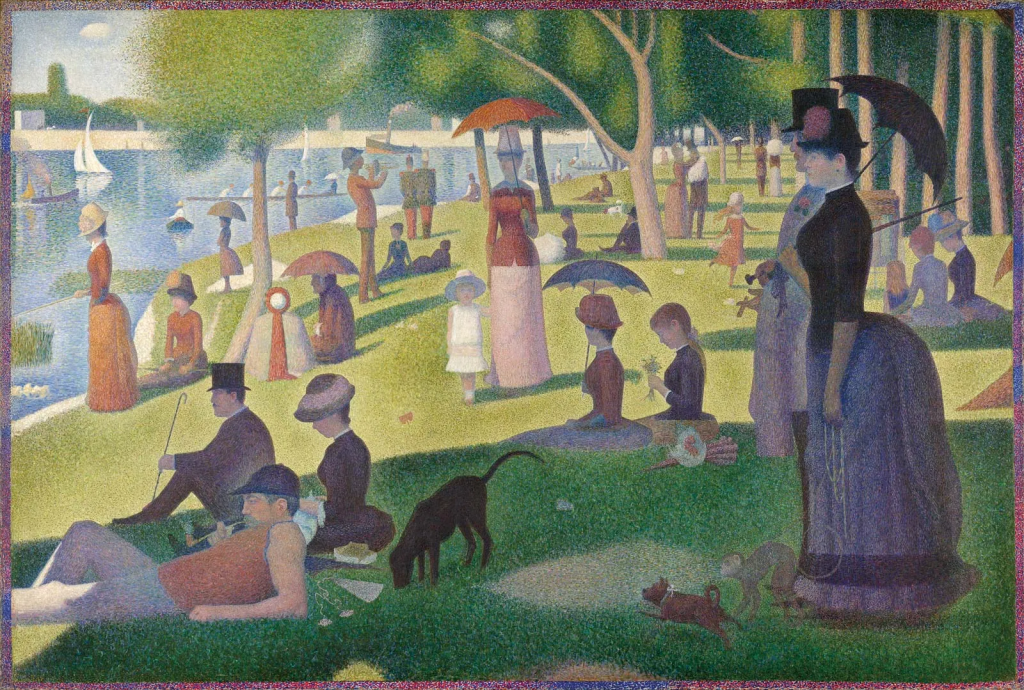
There are two key elements aside from if these are perceived. One is the relative speed of recognition; the other is the order in which they are perceived. One may be able to add proximity. I often use Pointillism analogies, and I feel it is appropriate here.
Georges Saurat: A Sunday Afternoon on the Island of La Grande Jatte
From a distance, Saurat renders the whole, but from a foot away, it’s pretty much colours and dots. Perhaps showing my age, but when I was younger and went to a cinema, I had the occasional bad fortune of having to sit in the front row. Although being hypervigilant to detail was not a problem, seeing the entire picture was. I recall tracking an object travelling left to right by turning my head. Of course, if anything else was supposed to come to my attention, it would have likely been missed.
In the end, we should see that, as with the Saurat, this whole is the sum of its parts, but in the world, we can and perhaps should see the forest before the trees.
I’ve decided to do something a bit different. In this, I read a selection from Polly Jean Harvey’s narrative poem, Orlam. The book offers a rather bilingual version of the poem, in both standard English and the Dorset dialect whence hails Ms Harvey.
Podcast: Audio rendition of this page content
The piece I’ve selected is titled Overwehelem. I’m going to recite the Dorset rendition.
Voul village in a hag-ridden hollow.
All ways to it winding, all roads to it narrow.

Auverlooked bog, veiled in vog,
thirtover, undercreepen, rank with seepings;

Jeyes Fluid, slurry, zweat and pus,
anus greaze, squitters, jizz and blood

Breeder of asthma, common warts, ringworm.
Ward of ancient occupations;

ploughshares rusting in the brembles,
half-walls, smuggler's runs and ditches,

blackened heth stones, lured lullabies;
Mummy's going to smack you if you don't . . .

The crossroads a red hanging-post
to GOAT HILL, RANSHAM, OVERWELEM.

Three hoar-stones, one Golden Fleece
connected by a single Riddle.

Gramf'er blackthorn bent by wind.
Shabby mothers trying to die.

A haunted wood in the realm of an Eye.
A farm of hooks with a rout of Rawles.

a mother of sorrow, a faterous fiend,
a runstick son and his inward friend,

and a not-gurrel born amongst them:
fouling her fig in the forest,

honking a conk-load of creosote,
downing a dram of diazinon,

flaying a fleece-full of maggots,
gorging a gutful of entrails,

scrounching the scabs o' engripement,
hoarding the horrible heissens,

bearing the burden of wordle.
So there you have it. Overwhelem from PJ Harvey’s Orlam.
As I mentioned, the book presents the English side-to-side with the Dorset. As Dorset in the south of Britain is an English dialect, most of the words and form should be familiar. There are a few that are less obvious than others. If you’d like a translation, pick up the book or ask in the comments.






 Philosophics