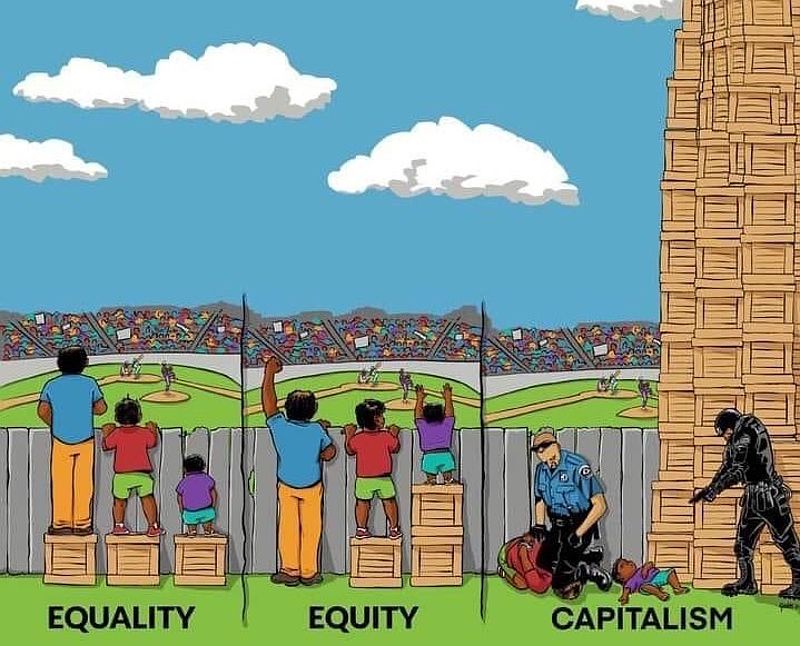
Grade Inflation: The Erosion of Academic Standards

This article is the third in a five-part series examining the contemporary state of higher education. Building on our analyses of purpose versus function and market dynamics, we examine how grade inflation affects the integrity of academic assessment.

Grade Inflation: The Erosion of Academic Standards

Historical grading practices emerged from a need to evaluate scholarly achievement objectively. Yet modern pressures have transformed assessment from a measure of academic accomplishment into a tool serving various institutional and market demands1. Recent evidence suggests this transformation extends beyond mere grade inflation to fundamental changes in academic capability and institutional standards.

The Evolution of Grade Inflation

The trajectory of grade inflation in higher education tells a compelling story. At Harvard University, the percentage of A-range grades increased from 15% in 1960 to 79% in 20232. This pattern is not isolated to elite institutions; similar trends appear across the higher education spectrum3.

Institutional Drivers

Market Pressures

Universities face multiple pressures that influence grading practices 4. These pressures manifest through complex interconnections between funding metrics and institutional performance. Student satisfaction scores increasingly influence funding allocations, whilst retention and completion rates factor prominently in university rankings. League table competition drives institutional behaviour at all levels, and graduate employment statistics have become crucial marketing tools. The growing emphasis on student evaluation of teaching has created additional pressure on academic staff to maintain high grade averages.

Contemporary Challenges

Recent developments have intensified these pressures. The widespread availability of AI writing tools, online homework solutions, and contract cheating services creates new challenges for maintaining academic integrity5. Simultaneously, evidence suggests fundamental changes in student preparation and capability, with elite institutions reporting declining student engagement with long-form texts and complex academic tasks6.

The Mechanics of Grade Inflation

Statistical Evidence

Contemporary grade distributions reveal several concerning patterns7. We observe significant compression at the upper end of the grading scale, with marks clustering in the top bands across disciplines. This compression has led to reduced differentiation between achievement levels, making it increasingly difficult to distinguish truly exceptional work. Furthermore, there exists marked variance across disciplines, with some fields showing more pronounced inflation than others. Perhaps most troublingly, we see a growing disparity between public and private institutions, potentially exacerbating existing educational inequalities.

Global Variations

Different educational systems demonstrate varying approaches to grade inflation8. The Anglo-American systems show marked inflation trends, whilst Continental European systems maintain more rigid standards through centralised examination procedures and external moderation. Asian systems often emphasise relative ranking over absolute grades, creating different dynamics around grade distribution. Meanwhile, international institutions grapple with grade compatibility across different national systems, adding another layer of complexity to the issue.

Consequences for Academic Integrity

Assessment Reliability

Grade inflation undermines the fundamental purpose of assessment9. The ability to distinguish between different levels of achievement has been significantly compromised, whilst feedback mechanisms lose their effectiveness when most marks cluster at the top of the scale. Academic standards face erosion as expectations adjust to meet the new normal, and cross-institutional comparability becomes increasingly challenging.

Impact on Learning

The effects on student learning are equally concerning10. Students demonstrate reduced motivation to excel when high grades become the expectation rather than the reward for exceptional work. Many choose to avoid challenging courses that might threaten their grade point average, whilst the emphasis on grades over learning leads to strategic but superficial approaches to study. Perhaps most concerning is the decrease in academic resilience, as students become less equipped to handle constructive criticism or engage with challenging material.

Reform Considerations

Addressing grade inflation requires systematic reform11. A comprehensive approach to grade normalisation practices could help restore meaning to academic assessment, particularly when implemented across institutions. Enhanced external examination systems, drawing on successful European models, might provide greater accountability and standardisation. The development of competency-based assessment frameworks offers another promising direction, potentially providing a more meaningful evaluation of student capabilities. Multi-dimensional evaluation frameworks could capture different aspects of student achievement, moving beyond simple grade point averages to provide richer, more nuanced assessments of academic performance.

Future Implications

For Academic Standards

The persistence of grade inflation threatens both academic standards and institutional credibility12. Educational quality faces ongoing pressure as institutions struggle to maintain meaningful assessment standards within an increasingly competitive marketplace. Assessment validity becomes harder to defend when grades no longer reflect genuine differences in achievement. Institutional credibility suffers as employers and other stakeholders lose faith in academic credentials, whilst professional preparation may be compromised when students receive inaccurate feedback about their capabilities.

For Higher Education

The broader effects on higher education are profound. Institutional purpose becomes increasingly unclear when assessment loses its meaning. Academic integrity faces new challenges as grade inflation undermines the relationship between effort and achievement. Market dynamics continue to pressure institutions toward more lenient grading, whilst social mobility may actually be hindered when privileged institutions can offer higher grades for equivalent work.


In the next article in this series, we shall examine how grade inflation intersects with broader credentialism trends in higher education and employment markets.


Footnotes

1 Johnson, V. E. (2003). “Grade Inflation: A Crisis in College Education.” Springer. ↩

2 Harvard University Office of Institutional Research. (2023). “Grade Distribution Report.” ↩

3 Rojstaczer, S., & Healy, C. (2012). “Where A Is Ordinary: The Evolution of American College and University Grading, 1940–2009.” Teachers College Record. ↩

4 Babcock, P. (2010). “Real Costs of Nominal Grade Inflation? New Evidence from Student Course Evaluations.” Economic Inquiry. ↩

5 International Center for Academic Integrity. (2023). “Trends in Academic Integrity.” ↩

6 Horowitch, R. (2024). “The Elite College Students Who Can’t Read Books.” The Atlantic. ↩

7 Rojstaczer, S. (2016). “Grade Inflation at American Colleges and Universities.” GradeInflation.com. ↩

8 European Commission. (2023). “The European Education Area: Assessment Practices in Higher Education.” ↩

9 Butcher, K., McEwan, P., & Weerapana, A. (2014). “The Effects of an Anti-Grade-Inflation Policy at Wellesley College.” Journal of Economic Perspectives. ↩

10 Arum, R., & Roksa, J. (2011). “Academically Adrift: Limited Learning on College Campuses.” University of Chicago Press. ↩

11 Hu, S. (2005). “Beyond Grade Inflation: Grading Problems in Higher Education.” ASHE Higher Education Report. ↩

12 Collins, R. (2019). “The Credential Society: An Historical Sociology of Education and Stratification.” Columbia University Press. ↩
The Unseen Costs of Widened Access: A Market Paradox in Higher Education

This article is the second in a five-part series examining the contemporary state of higher education. Building on our analysis of purpose versus function, we now explore how attempts to democratise higher education have led to unexpected economic consequences.

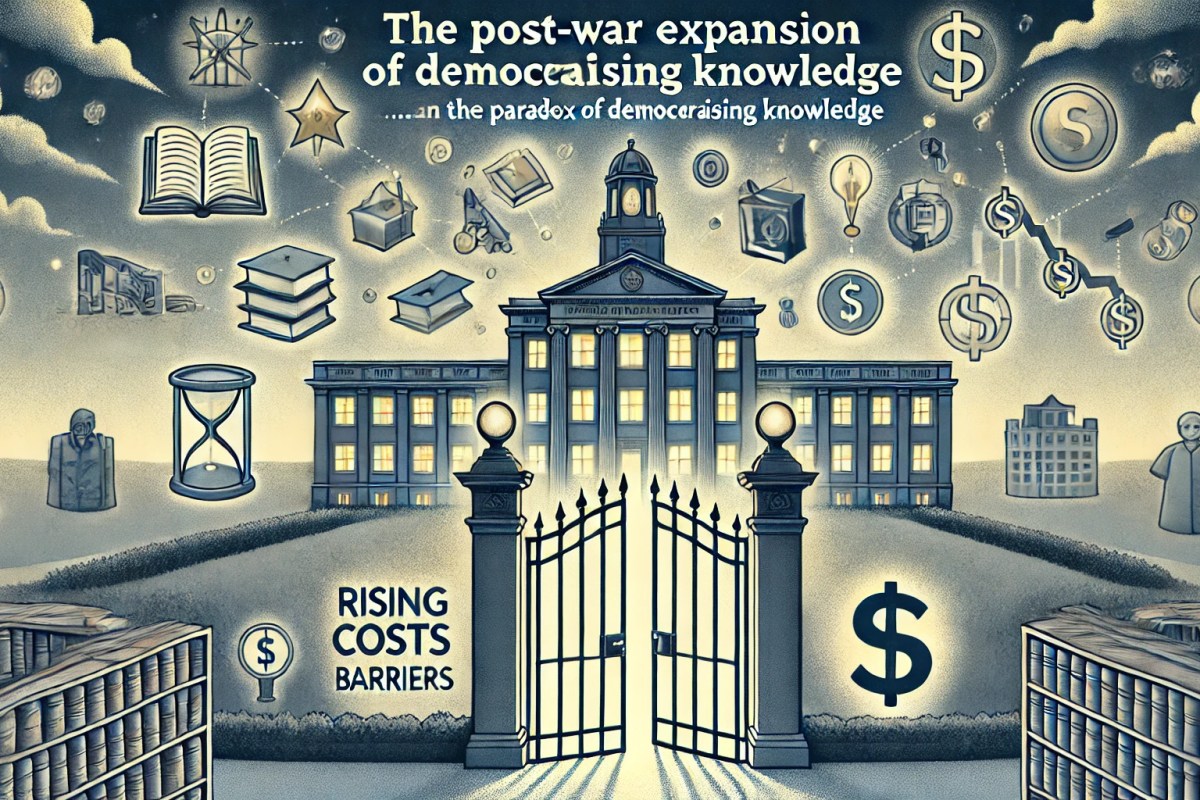
The post-war expansion of higher education emerged from noble aspirations: democratising knowledge, fostering social mobility, and building a more equitable society. State funding and policy initiatives aimed to transform university education from an elite privilege into a broadly accessible opportunity1. Yet this worthy goal has yielded paradoxical outcomes that merit careful examination.

The democratisation of higher education has created an unexpected paradox: as access widens, the individual value of a degree diminishes, while its cost increases. This counterintuitive outcome challenges our fundamental assumptions about educational accessibility and its relationship to social progress.

The Market Response

Supply and Demand Distortions

As state funding increased access, universities responded not by expanding supply to meet demand, but by leveraging increased demand to enhance their market position2. This response reflects the peculiar economics of higher education, where traditional market forces fail to regulate prices effectively. Unlike typical markets, increased competition in higher education often drives prices up rather than down, as institutions compete on prestige rather than affordability.

The economic dynamics create several distinct but interrelated effects. Institutions invest heavily in amenities and facilities, transforming campuses into sophisticated learning environments that often resemble luxury resorts more than traditional academic settings. Administrative costs expand exponentially as universities create new departments and positions to manage increasingly complex operations and regulatory requirements. Marketing budgets have grown dramatically, with some institutions spending millions annually on recruitment and brand positioning. Research infrastructure continues to expand as universities seek to enhance their global rankings and attract prestigious faculty members.

The Prestige Premium

The persistence of institutional hierarchy means that despite wider access, competition for elite institutions intensifies3. This creates a two-tier effect where elite institutions maintain exclusivity while raising prices, and other institutions emulate this model, driving up costs across the sector. Prestige in higher education operates as a positional good: its value depends on its scarcity. This fundamental characteristic creates an inherent tension with democratisation efforts.

The pursuit of prestige manifests in various forms across the educational landscape. Elite institutions leverage their historical advantages to maintain selective admission rates while steadily increasing tuition fees. Mid-tier universities, attempting to climb the prestige ladder, invest heavily in research facilities and faculty recruitment, often at the expense of teaching resources. Less prestigious institutions find themselves caught in a difficult position, struggling to maintain academic standards while competing for a diminishing pool of students who can afford their fees.

The Student Debt Paradox

What began as an initiative to democratise opportunity has evolved into a system where students require more debt to access opportunity4. This creates a troubling cycle where rising tuition requires increased borrowing, which in turn influences career choices and often constrains social mobility. The burden falls disproportionately on those from disadvantaged backgrounds, who often take on higher debt levels relative to family income5.

The implications of this debt burden extend far beyond graduation. Recent graduates increasingly postpone major life decisions such as home ownership, marriage, or starting a family. Career choices become heavily influenced by loan repayment considerations rather than personal interest or societal need. Perhaps most troublingly, those who fail to complete their degrees often find themselves in the worst position: bearing the burden of educational debt without the corresponding benefit of a credential.

The Institutional Arms Race

The inflow of state funding and student debt has fuelled an institutional arms race6. Universities compete through an ever-expanding array of facilities, services, and programmes. Modern campuses now routinely feature state-of-the-art fitness centres, dining facilities that rival upscale restaurants, and residential accommodation that would have been considered luxurious by previous generations’ standards.

Administrative growth has been particularly striking. Universities now maintain extensive bureaucracies to manage everything from compliance and risk management to student life and career services. Marketing departments have expanded dramatically, employing sophisticated digital strategies and international recruitment campaigns. Research facilities continue to grow more elaborate and expensive, with institutions investing heavily in specialised equipment and facilities to attract top researchers and secure grant funding.

International Perspectives

Different funding models across nations reveal varying approaches to this challenge7. The European model of state-funded universities has historically maintained broader access while controlling costs, though recent pressures have begun to erode this advantage. The American model of high-fee, high-aid institutions creates a complex system of cross-subsidisation but often results in significant student debt. Emerging Asian hybrid models attempt to balance state control with market forces, though they too face increasing pressure from global competition.

These international variations provide valuable insights into alternative approaches to higher education funding and delivery. The Nordic countries, for instance, maintain high-quality public universities with minimal student fees, funded through progressive taxation. German-speaking countries have preserved a dual system of universities and technical institutions, helping to maintain distinct educational pathways. East Asian systems often combine strong state oversight with significant private sector involvement, creating unique hybrid models.

Implications for Social Mobility

The democratisation of access, paradoxically, may reinforce rather than reduce social stratification8. This occurs through multiple mechanisms that often work in concert to preserve and sometimes exacerbate existing inequalities. Debt burdens disproportionately affect students from lower-income backgrounds, potentially limiting their post-graduation choices and economic mobility. Credential inflation requires increasingly lengthy periods of study, favouring those with the financial resources to remain in education longer. Elite institutions, despite widened access overall, often remain bastions of privilege, with admission rates for disadvantaged students showing minimal improvement over time.

The role of social capital in educational success has, if anything, grown more significant. Students from privileged backgrounds often benefit from better information about university choices, stronger support networks, and greater access to unpaid internships and other career-building opportunities. These advantages compound over time, potentially leading to greater rather than lesser social stratification.

Looking Forward

Resolving these tensions requires rethinking not just funding mechanisms but the underlying structure of higher education9. The challenge lies in preserving genuine accessibility while avoiding the inflationary spiral that threatens to undermine the very democratisation we seek. True democratisation of higher education may require reimagining not just how we fund universities, but how we conceive of their role in society.

This reimagining might involve developing new models of educational delivery, creating alternative credentialing systems, or fundamentally restructuring the relationship between education and employment. Whatever path forward we choose, it must address both the financial sustainability of institutions and the genuine accessibility of education for all qualified students.


In the next article in this series, we shall examine how grade inflation compounds these challenges, further eroding the value proposition of higher education.


Footnotes

1 Trow, M. (2007). “Reflections on the Transition from Elite to Mass to Universal Access.” Springer. ↩

2 Winston, G. C. (1999). “Subsidies, Hierarchy and Peers: The Awkward Economics of Higher Education.” Journal of Economic Perspectives. ↩

3 Marginson, S. (2016). “The Dream Is Over: The Crisis of Clark Kerr’s California Idea of Higher Education.” University of California Press. ↩

4 Goldrick-Rab, S. (2016). “Paying the Price: College Costs, Financial Aid, and the Betrayal of the American Dream.” University of Chicago Press. ↩

5 Scott-Clayton, J. (2018). “The Looming Student Loan Default Crisis Is Worse Than We Thought.” Brookings Institution. ↩

6 Zemsky, R., Wegner, G., & Massy, W. (2005). “Remaking the American University: Market-Smart and Mission-Centered.” Rutgers University Press. ↩

7 OECD (2023). “Education at a Glance 2023: OECD Indicators.” OECD Publishing. ↩

8 Chetty, R., et al. (2017). “Mobility Report Cards: The Role of Colleges in Intergenerational Mobility.” NBER. ↩

9 Christensen, C. M., & Eyring, H. J. (2011). “The Innovative University.” Jossey-Bass. ↩

The Purpose versus Function of Higher Education: An Analysis of Divergent Trajectories

This article is the first in a five-part series examining the contemporary state of higher education. The series explores the growing tensions between traditional academic ideals and modern institutional practices, from the changing role of universities to the challenges of credential inflation.

The Purpose versus Function of Higher Education: An Analysis of Divergent Trajectories

The medieval university emerged as a sanctuary of scholarly pursuit, where knowledge was cultivated for its own sake and learning was viewed as a transformative journey rather than a transactional exchange. This original purpose—the advancement of knowledge and cultivation of intellectual growth—stood largely unchallenged until the modern era. Yet today’s universities operate in a markedly different landscape, where their function has evolved far beyond these foundational aims.

Historical Foundations and Modern Tensions

The university as we know it took shape in medieval Europe, with institutions like the University of Bologna, Oxford, and the Sorbonne establishing models of scholarly community that would endure for centuries. These early universities served a dual purpose: preserving classical knowledge while fostering new intellectual discoveries. Their function aligned closely with their purpose—the pursuit of truth through rational inquiry and scholarly debate1.

This alignment between purpose and function persisted well into the modern era, even as universities expanded their scope to encompass scientific research and professional training. The Humboldtian model of the 19th century explicitly united teaching and research, viewing them as complementary aspects of the scholarly enterprise2. This unity of purpose and function began to fragment only with the mass expansion of higher education in the 20th century.

Competing Perspectives in Modern Higher Education

The Institutional Perspective

Today’s universities balance multiple, often competing imperatives: research excellence, financial sustainability, market positioning, and societal impact. This multiplication of purposes has led to a functional transformation where universities increasingly operate as commercial entities rather than purely academic institutions3. The pressure to maintain enrolment numbers, secure research funding, and compete in global rankings has fundamentally altered how institutions approach their educational mission.

When institutions prioritise market demands over academic rigour, the very essence of higher education comes into question.

The Student Perspective

Contemporary students approach higher education primarily as an investment in future earnings potential. Recent studies indicate that even at elite institutions, students struggle with fundamental academic practices like sustained reading4. This shift reflects broader societal changes, raising questions about whether pure academic pursuit remains viable for most students in today’s economic climate.

The transformation in student attitudes mirrors wider cultural shifts. Where once university attendance signified a commitment to intellectual development, it now often represents a necessary credential for professional advancement. This pragmatic approach, while understandable, fundamentally alters the student-institution relationship5.

The Employer Perspective

Employers, historically peripheral to academic pursuits, now significantly influence university function through their hiring preferences and skill demands. This relationship has transformed universities into de facto credential providers, potentially at odds with their historical purpose of fostering intellectual development6.

The Case for Multiple Modalities

The tension between historical purpose and contemporary function suggests that a single model of higher education may no longer suffice. A more nuanced and differentiated approach to higher education could better serve our diverse societal needs. Traditional academic institutions could maintain their focus on pure scholarly pursuit, preserving the medieval ideal of knowledge for its own sake while fostering deep intellectual development. Alongside these, professional schools could explicitly focus on career preparation, with curricula and pedagogy designed specifically for workplace demands7.

Research institutes could dedicate themselves primarily to knowledge creation, operating with different metrics and expectations than teaching-focused institutions. Meanwhile, vocational centres could prioritise practical skill development, offering focused, efficient pathways to specific career outcomes. This differentiated approach would allow each type of institution to excel in its chosen domain rather than trying to fulfil every possible educational function.

The Anachronism Question

Is the traditional university model anachronistic in today’s world? The evidence suggests a more nuanced conclusion. While the medieval model may not suit all modern needs, its emphasis on deep learning and intellectual development remains valuable—perhaps increasingly so in an age of rapid technological change and complex global challenges8.

Synthesis and Future Implications

The divergence between historical purpose and contemporary function need not signal the death of traditional academic values. Rather, it might herald the birth of a more diverse educational ecosystem, where different institutional types serve different purposes explicitly rather than trying to be all things to all stakeholders.

As we navigate this transition, the challenge lies in preserving the essential benefits of traditional academic pursuits whilst adapting to contemporary needs. This may require reimagining not just how universities function, but how society values different forms of higher education.

The future of higher education may lie not in choosing between tradition and innovation, but in creating space for both to thrive.


In the next article in this series, we shall examine how the widening of access to higher education, whilst democratising knowledge, has precipitated unexpected economic consequences that challenge the very accessibility it seeks to promote.


Footnotes

1 Newman, J. H. (1852). “The Idea of a University.” Notre Dame Press. ↩

2 Humboldt, W. von. (1810). “On the Internal and External Organization of the Higher Scientific Institutions in Berlin.” ↩

3 Clark, B. R. (1998). “Creating Entrepreneurial Universities.” Pergamon. ↩

4 Horowitch, R. (2024). “The Elite College Students Who Can’t Read Books.” The Atlantic. ↩

5 Arum, R., & Roksa, J. (2011). “Academically Adrift: Limited Learning on College Campuses.” University of Chicago Press. ↩

6 Brown, P., & Lauder, H. (2010). “The Global Auction: The Broken Promises of Education, Jobs, and Incomes.” Oxford University Press. ↩

7 Trow, M. (2007). “Reflections on the Transition from Elite to Mass to Universal Access.” Springer. ↩

8 Collini, S. (2012). “What Are Universities For?” Penguin. ↩

9 Christensen, C. M., & Eyring, H. J. (2011). “The Innovative University.” Jossey-Bass. ↩

Democracy: The Grand Illusion (AutoCrit)

The tone of “Democracy: The Grand Illusion” is predominantly analytical and academic. The author approaches the subject matter with a detached and objective perspective, focusing on presenting information, arguments, and counterarguments related to democracy without overt emotional bias. While the content delves into complex topics such as cognitive limitations in decision-making processes, historical perspectives on democracy, critiques of democratic systems, and potential reforms for improvement, the emotional perspective remains neutral and professional throughout. There is an absence of overtly passionate or emotive language that might sway readers one way or another; instead, the text maintains a scholarly tone aimed at informing and stimulating critical thinking about the concept of democracy.

I use AutoCrit as a first-pass review of my long-form writing. Above is the direction I am aiming for. Usually, I aim for polemic. I’ve been working on this since before Covid-19, but it keeps kicking to the back burner. I’m trying to resurrect it once again.

Does anyone who’s used it have an opinion on AutoCrit?

Decolonising the Mind

Ngũgĩ wa Thiong’o published “Decolonising the Mind” in 1986. David Guignion shares a 2-part summary analysis of the work on his Theory and Philosophy site.

I used NotebookLLM to produce this short podcast: [Content no longer extant] https://notebooklm.google.com/notebook/7698ab0b-43ab-47d4-a50f-703866cfb1b9/audio

Decolonising the Mind: A Summary

Ngũgĩ wa Thiong’o’s book Decolonising the Mind centres on the profound impact of colonialism on language, culture, and thought. It argues that imposing a foreign language on colonised people is a key tool of imperial domination. This linguistic imperialism leads to colonial alienation, separating the colonised from their own culture and forcing them to view the world through the lens of the coloniser.

Here are some key points from the concept of decolonising the mind:

  • Language is intimately tied to culture and worldview: Language shapes how individuals perceive and understand the world. When colonised people are forced to adopt the language of the coloniser, they are also compelled to adopt their cultural framework and values.
  • Colonial education systems perpetuate mental control: By privileging the coloniser’s language and devaluing indigenous languages, colonial education systems reinforce the dominance of the coloniser’s culture and worldview. This process results in colonised children being alienated from their own cultural heritage and internalising a sense of inferiority.
  • Reclaiming indigenous languages is crucial for decolonisation: wa Thiong’o advocates for a return to writing and creating in indigenous African languages. He sees this as an act of resistance against linguistic imperialism and a way to reconnect with authentic African cultures. He further argues that it’s not enough to simply write in indigenous languages; the content must also reflect the struggles and experiences of the people, particularly the peasantry and working class.
  • The concept extends beyond literature: While wa Thiong’o focuses on language in literature, the concept of decolonising the mind has broader implications. It calls for a critical examination of all aspects of life affected by colonialism, including education, politics, and economics.

It is important to note that decolonising the mind is a complex and ongoing process. There are debates about the role of European languages in postcolonial societies, and the concept itself continues to evolve. However, wa Thiong’o’s work remains a seminal text in postcolonial studies, raising crucial questions about the enduring legacy of colonialism on thought and culture.

Don’t Care Much about History

As the years pass and my disappointment matures like a fine wine (spoiler alert: it’s vinegar), I’m reminded of the average intelligence quotient floating about in the wild. A few years back, I stumbled upon The Half-Life of Knowledge. Cute title, but it’s more optimistic than it should be. Why assume knowledge even has a shelf life? It’s one thing for once-useful information to spoil thanks to “progress,” but what about the things that were never true to begin with? Ah, yes, the fabrications, the lies we’re spoon-fed under the guise of education.

I’m well-versed in the lies they peddle in the United States, but I’d bet good money (not that I have any) that every nation’s curriculum comes with its own patriotic propaganda. What am I on about, you ask? Let’s just say I’ve been reading How the World Made the West by Josephine Quinn, and it’s got me thinking. You see, I’ve also been simmering on an anti-democracy book for the better part of five years, and it’s starting to boil over.

Here in the good ol’ US of A, they like to wax lyrical about how Athens was the birthplace of democracy. Sure, Athens had its democratic dabblings. But let’s not get it twisted—if you really look at it, Athens was more akin to the Taliban than to any modern Western state. Shocked? Don’t be. For starters, only property-owning men could vote, and women—brace yourselves—were “forced” to wear veils. Sounds familiar? “It’s a start,” you say. True, American women couldn’t vote until 1920, so let’s all pat ourselves on the back for that—Progress™️.

But no, hold your applause. First off, let’s remember that Athens and Sparta were city-states, not some cohesive entity called “Greece” as we so lovingly imagine. Just a bunch of Greek-speaking neighbours constantly squabbling like reality TV contestants. Meanwhile, over in Persia—yes, the supposed enemy of all things free and democratic—they had participative democracy, too. And guess what? Women in Persia could vote, own property, and serve as soldiers or military officers. So much for the idea that Athens was the singular beacon of democratic virtue.

More than this, Persian democracy was instituted by lottery, so many more people participated in the process by serving one-year terms. At the end of their term, they were audited to check for corruption. Now, you can see why we adopted the so-called Greek version. These blokes don’t welcome any oversight of scrutiny.

As a postmodern subjectivist, I tend to side-eye any grand narrative, and the history of Western civilisation is just one long parade of questionable claims and hidden agendas. Every time I think I’ve seen the last of the historical jump scares, another one comes lurking around the corner. Boo!

Polemics

People often ask why I churn out so many polemic, contrarian articles. The answer? It’s simply how I think. My brain naturally questions everything, not out of a desire to be difficult, but because that’s just my worldview. I’m not inventing challenges for the sake of argument—the challenges are already there, embedded in the world as I see it.

Another reason is solidarity. I write in hopes that others, whose thoughts run along similar lines, might stumble across my material and feel less alone. There’s something deeply reassuring in discovering that someone else has been on the same mental journey—that feeling of “Ah, I’m not alone in this.” Many times, I’ve had ideas only to find that philosophers, thinkers, or whoever have already penned volumes on the subject. And honestly? That grounds me. Even better if they’ve gone further, articulated it more eloquently, or ventured into new depths. It’s all useful. Plus, their critics then become my critics, and I get to sharpen my thoughts in response—or at least build my own defences.

And finally, I write for the potential spark. Maybe someone out there reads a piece of mine and feels inspired to take it further, push an idea beyond what I could imagine. After all, entire Nobel Prize-winning theories have started as someone else’s footnotes. There’s nothing wrong with being someone’s footnote.

So, now you know.


NB: I’ll be in surgery when this posts, so I’ve scheduled this in advance so as not to have a gap…that may occur anyway.

Excess Deaths Attributable to Capitalism

A System Built on Exploitation and Neglect

Capitalism, often celebrated for its ability to generate wealth and innovation, also brings with it a darker legacy: the untold millions of lives prematurely lost due to its systemic failures. Capitalism can be attributed to more than 10 million excess deaths per year, and these numbers will continue to increase. These deaths are not simply unfortunate byproducts but are structurally baked into the system itself. Whether through poverty, healthcare inequality, environmental destruction, or war, capitalism’s logic of profit maximisation places human life at the mercy of market forces, with devastating consequences.

Audio: NotebookLM podcast on this topic.

Friedrich Engels famously referred to these preventable deaths as social murder, a term that highlights how capitalism creates conditions in which certain populations are systematically neglected, deprived, and ultimately destroyed. Today, Engels’ critique is more relevant than ever as we examine the staggering human toll that capitalism has left in its wake, often invisible in the glow of GDP figures and economic growth.


Poverty and Hunger: The Silent Killers

One of the most pervasive ways capitalism generates excess deaths is through poverty and hunger. Despite the extraordinary wealth produced by capitalist economies, millions still die from hunger-related causes every year. According to the World Health Organization (WHO), around 9 million people die annually from hunger and malnutrition, mostly in regions where capitalist-driven global inequality has made basic necessities unaffordable or inaccessible.[1]

Capitalism’s defenders often point to rising standards of living as evidence of the system’s success, but this narrative suffers from survivorship bias. The success stories of those who have benefited from capitalist growth obscure the countless lives that have been lost to the system’s structural inequalities. As Engels noted, these deaths are not natural or inevitable—they are preventable. They occur because the capitalist system concentrates wealth in the hands of a few while leaving vast populations to suffer without access to food, healthcare, or basic resources.

This disparity in wealth and access to resources creates a global system of social murder, where the deaths of the poor are written off as collateral damage in the pursuit of profit. These deaths are not merely unfortunate consequences; they are inherent to the capitalist system’s prioritisation of wealth accumulation over human life.


Healthcare Inequality and Preventable Deaths

The lack of access to adequate healthcare is another major driver of deaths attributable to capitalism. In the United States, the richest nation in the world, an estimated 500,000 deaths between 1990 and 2010 were linked to healthcare inequality, according to a Lancet study.[2] Globally, millions die each year from preventable causes—such as pneumonia, diarrhoea, and malaria—because market-driven healthcare systems fail to provide for those without the means to pay.

In a for-profit healthcare system, those without money are often denied life-saving treatment. Healthcare becomes a commodity, rather than a human right. This commodification of care creates deadly disparities, where a wealthy few receive world-class medical attention while millions die from treatable conditions. Engels’ notion of social murder is evident here as well: the system does not kill through direct violence but by neglecting the vulnerable.

This situation is exacerbated by the ongoing commodification of healthcare through privatisation and austerity measures, which strip public systems of resources and force them to operate on capitalist principles. The result is a world where profit motives dictate who lives and who dies.


Environmental Destruction and Climate Change: Capitalism’s Long-Term Death Toll

Capitalism’s unrelenting focus on short-term profit also drives environmental destruction, contributing to a growing death toll linked to climate change. The WHO estimates that by 2030, climate change will cause approximately 250,000 additional deaths each year, driven by heat stress, malnutrition, and the spread of diseases like malaria and diarrhoea.[3] These figures are conservative, as the cascading effects of climate-induced migration and conflict are difficult to quantify.

David Harvey’s concept of accumulation by dispossession is central to understanding how capitalism contributes to environmental devastation. Capitalist economies extract and commodify natural resources, often at the expense of local populations who bear the brunt of environmental degradation. Deforestation, mining, and fossil fuel extraction displace communities and destroy ecosystems, creating conditions that lead to death, displacement, and disease.

This environmental violence is compounded by disaster capitalism, a term coined by Naomi Klein to describe how capitalist interests exploit crises like natural disasters or financial collapses for profit.[4] The destruction of vulnerable communities by climate change is not simply a tragedy—it is a consequence of capitalist expansion into every corner of the planet, sacrificing human and ecological health for economic gain.


War and Imperialism: Capitalism’s Violent Expansion

The human toll of capitalism extends beyond poverty and environmental degradation to include the millions of lives lost to wars driven by capitalist interests. The illegal invasion of Iraq in 2003, for example, led to hundreds of thousands of deaths, many of which were tied to the geopolitical aims of securing control over oil reserves. Wars like Iraq are not isolated failures of policy but integral to the functioning of a global capitalist system that seeks to dominate resources and expand markets through military force.

David Harvey’s theory of new imperialism explains how capitalist economies rely on the expansion of markets and the extraction of resources from other nations, often through military means.[5] The military-industrial complex, as described by President Dwight D. Eisenhower, thrives under capitalism, profiting from perpetual war and the destruction of human life.

The death toll of wars driven by capitalist expansion is staggering. From the millions killed in conflicts over resources to the long-term destabilisation of regions like the Middle East, these deaths are directly tied to capitalism’s global ambitions. The victims of these wars—like those who suffer from poverty and environmental destruction—are casualties of a system that prioritises wealth and power over human life.


Conclusion: Reckoning with Capitalism’s Death Toll

The deaths attributable to capitalism are not abstract or incidental; they are the direct consequences of a system that places profit above all else. From hunger and poverty to healthcare inequality, environmental destruction, and war, the capitalist system has claimed millions of lives—lives that could have been saved under a more just and equitable economic model.

The true success of capitalism, then, is not in its ability to generate wealth for the few, but in its capacity to obscure the structural violence that sustains it. By framing poverty, healthcare inequality, and environmental destruction as unfortunate consequences of “market forces,” capitalism avoids accountability for the millions it leaves behind.

It is time to reckon with this hidden death toll. Only by facing the human cost of capitalism can we begin to imagine a future where economic systems prioritise human life over profit. The victims of capitalism are not just numbers—they are the casualties of a system that, as Engels pointed out, murders through neglect, exploitation, and greed.


Endnotes:

[1]: World Health Organization, “Hunger and Malnutrition: Key Facts,” 2022.
[2]: “The Lancet Public Health,” Study on healthcare inequality in the U.S., 2010.
[3]: World Health Organization, “Climate Change and Health,” 2022.
[4]: Naomi Klein, The Shock Doctrine: The Rise of Disaster Capitalism (Picador, 2007), pp. 9-10.
[5]: David Harvey, The New Imperialism (Oxford University Press, 2005), pp. 145-147.


The Limits of Language: Why Philosophical Paradoxes Might Be Illusions of Mapping

Philosophical paradoxes have long captured our imagination, from Zeno’s paradoxes about movement to the Liar Paradox that tangles truth and falsehood into an endless loop. Often, these puzzles are treated as fundamental mysteries of the universe—windows into the limits of human understanding or insight into the hidden structure of reality. But what if, rather than reflecting deep truths about existence, many of these paradoxes are artefacts of language itself—symptoms of our conceptual tools struggling to adequately map a complex terrain? Perhaps, more often than not, the perplexities we face are the result of an inadequate mapping—a linguistic or cognitive misfire—rather than true paradoxes of the underlying terrain of reality.

This notion—that many paradoxes arise from the limitations of language and cognition—finds resonance in the work of philosophers like Ludwig Wittgenstein. Wittgenstein argued that many philosophical problems arise because we misuse language, taking words beyond their natural context, confusing what our words describe with the objects or concepts themselves. In this sense, our maps (the linguistic and logical structures we use) often lead us astray when navigating the conceptual terrains of ethics, metaphysics, or the nature of truth.

This idea can be articulated under what we might call the Language Insufficiency Hypothesis: the view that the limitations of language itself are at the root of many philosophical paradoxes. According to this hypothesis, the apparent contradictions or puzzles that emerge in philosophical discourse often reveal more about the shortcomings of our representational tools than about any deep metaphysical truths. The Language Insufficiency Hypothesis suggests that our conceptual maps are inadequate for fully capturing the richness of the terrains we attempt to describe, and that this inadequacy leads us to mistake linguistic confusion for genuine philosophical mystery.

The Inherent Limitations of Linguistic Communication

Language, often hailed as humanity’s greatest achievement, may paradoxically be one of our most significant limitations. The Language Insufficiency Hypothesis posits that language is inherently inadequate for communicating abstract concepts, a notion that challenges our fundamental understanding of human communication and cognition. This perspective traces the evolution of language from its primitive origins to its current complexity, revealing the philosophical and practical implications of linguistic inadequacy.

The Accidental Evolution of Language

Language, like many aspects of human biology and cognition, emerged not through intentional design but as an evolutionary accident. Initially serving as an internal cognitive function—a means of organising one’s own thoughts—language gradually evolved into a tool for external communication. This transition likely began with simple vocalisations, perhaps rooted in rhythmic expressions akin to music and dance, before developing into more structured speech.

Early linguistic communication likely centred on concrete objects and immediate experiences, with words serving as direct signifiers for observable phenomena. However, as human cognition grew more sophisticated, so too did our linguistic capabilities, expanding to include verbs, modifiers, and eventually, abstract nouns.

The Emergence of Abstraction and Its Challenges

The development of abstract nouns marked a significant leap in human cognition and communication. Concepts such as ‘truth’, ‘justice’, and ‘freedom’ allowed for more complex and nuanced discourse. However, this advancement came at a cost: these abstract concepts, lacking direct physical referents, introduced unprecedented ambiguity and potential for misunderstanding.

The Language Insufficiency Hypothesis suggests that this ambiguity is not merely a byproduct of abstraction, but a fundamental limitation of language itself. While two individuals might easily agree on the ‘treeness’ of a physical tree, concepts like ‘fairness’ or ‘reason’ are inherently unresolvable through linguistic means alone. This insufficiency becomes increasingly apparent as we move further from concrete, observable phenomena into the realm of abstract thought.

Wittgenstein and the Limits of Language

Ludwig Wittgenstein’s later work provides crucial insights into the Language Insufficiency Hypothesis. Wittgenstein posited that words ultimately only map to other words, never truly making contact with the objective world. This perspective suggests that language operates within a closed system of human understanding, constructing our perception of reality rather than directly representing it.

This Wittgensteinian dilemma underscores the core of the Language Insufficiency Hypothesis: if words only refer to other words, how can we ever be certain that we’re communicating abstract concepts accurately? The very tool we use to discuss and understand abstraction may be fundamentally incapable of capturing its essence.

Cultural and Disciplinary Variations

The inadequacy of language in conveying abstract concepts becomes even more apparent when we consider cultural and disciplinary variations in communication. Different cultures and academic disciplines develop their own specialised vocabularies and ‘language games’, as Wittgenstein termed them. While these specialised languages may facilitate communication within specific contexts, they often create barriers to understanding for outsiders.

This phenomenon highlights another aspect of linguistic insufficiency: the context-dependent nature of meaning. Abstract concepts may be understood differently across cultures or disciplines, further complicating attempts at clear communication.

Neurolinguistic Perspectives

Recent advances in neurolinguistics have provided new insights into the brain structures involved in language processing. While these studies have enhanced our understanding of how the brain handles language, they have also revealed the complexity and variability of linguistic processing across individuals. This neurological diversity further supports the Language Insufficiency Hypothesis, suggesting that even at a biological level, there may be inherent limitations to how accurately we can communicate abstract concepts.

Implications and Counter-Arguments

The Language Insufficiency Hypothesis has profound implications for fields ranging from philosophy and psychology to law and international relations. If language is indeed inadequate for communicating abstract concepts, how can we ensure mutual understanding in complex negotiations or philosophical debates?

However, it’s important to note that not all scholars accept the strong version of this hypothesis. Some argue that while language may have limitations, it remains our most sophisticated tool for sharing abstract ideas. They suggest that through careful definition, contextualisation, and the use of metaphor and analogy, we can overcome many of the inherent limitations of linguistic communication.

Navigating the Limits of Language

The Language Insufficiency Hypothesis presents a challenging perspective on human communication. It suggests that our primary tool for sharing abstract thoughts may be fundamentally flawed, incapable of fully capturing the complexity of our inner cognitive experiences.

Yet, recognising these limitations need not lead to communicative nihilism. Instead, it can foster a more nuanced approach to language use, encouraging us to be more precise in our definitions, more aware of potential misunderstandings, and more open to alternative forms of expression.

As we continue to grapple with abstract concepts and strive for clearer communication, we must remain cognizant of these linguistic limitations. Understanding the origins and nature of language—and its inherent insufficiencies—can help us navigate its complexities, fostering more effective and empathetic communication across diverse fields of human endeavour.

The Frege–Geach Problem as an Illustration of Linguistic Limitations

One pertinent example of this idea is the Frege–Geach problem, a challenge often faced by expressivist theories of ethics. Expressivists maintain that moral statements do not describe facts but rather express attitudes or emotions—a statement like “lying is wrong” is an expression of disapproval rather than a factual assertion. The Frege–Geach problem arises when such moral statements are embedded in logical constructions like conditionals or arguments: “If lying is wrong, then getting your little brother to lie is wrong.” In this context, expressivists face a challenge in explaining how the meaning of “lying is wrong” remains coherent across different uses, without reducing moral expressions to descriptive claims.

The Frege–Geach problem thus illustrates a fundamental limitation: attempting to apply truth-conditional logic, designed for descriptive language, to moral discourse, which serves a different function altogether. In trying to map evaluative terrain—which involves emotions, commitments, and subjective attitudes—using the same structures meant for factual landscapes, we encounter conceptual misalignments. This problem—a confusion of the terrain for the map—is not necessarily a genuine paradox about moral truths but rather a reflection of the inadequacy of our current linguistic tools. Just as a physical map may fail to capture the emotional experience of a journey, so too do our linguistic and logical maps fail to adequately capture the moral landscape.

Wittgenstein’s later work is helpful in framing this issue. He emphasised the importance of recognising different language-games: the rules and purposes that guide different forms of discourse. Moral language is not like scientific language; it follows different rules and aims to express and influence attitudes rather than establish empirically verifiable facts. The Frege–Geach problem emerges precisely because we attempt to impose a single logical structure onto forms of language that serve different purposes, confusing the distinct games we are playing. This attempt to force moral language into a framework designed for empirical propositions produces an apparent paradox, where the real issue lies in our misuse of the conceptual map.

This pattern of misinterpretation is not unique to moral discourse. Many philosophical paradoxes—from problems of identity and personal continuity to issues of free will and determinism—arise when we try to map different terrains with the same linguistic structures, or when we push our conceptual tools beyond their natural limits. Cognitive limitations also play a role; our tendency to think in binary oppositions, our reliance on categories, and our need for consistent narratives often lead to oversimplifications of complex realities. These cognitive tools—essential for everyday functioning—can prove inadequate for capturing the nuance of the philosophical landscapes we attempt to navigate.

The map-terrain challenge is thus at the core of why philosophical paradoxes can seem so intractable. Our maps—the languages and logical frameworks that structure our thinking—are, by their nature, simplifications of a world that is far more nuanced than we can readily articulate. When the terrain is moral, aesthetic, or otherwise not reducible to simple truths or falsehoods, the inadequacies of our maps become evident. We are left facing paradoxes that may, in truth, be nothing more than indicators that our representational systems need refinement or expansion.

Rather than treating these paradoxes as unresolvable, we might benefit from seeing them as invitations to reconsider our linguistic and cognitive frameworks. In recognising that the Frege–Geach problem, for instance, may reflect an ill-suited mapping of moral discourse rather than a genuine mystery about moral reality, we open the door to a pluralistic approach: different terrains require different maps. Perhaps, in some cases, the best solution is not to attempt to solve the paradox in traditional terms but to change the way we map the terrain altogether—to allow for multiple, context-sensitive tools that respect the particularity of each domain of discourse.

Ultimately, this perspective suggests a more flexible and cautious approach to philosophical inquiry—one that acknowledges the limits of our conceptual tools and remains open to the possibility that the terrain is far richer and more varied than our maps can currently capture.

Can Zombies Ever Be Conscious?

In the world of consciousness studies, few topics spark as much heated debate as the possibility of philosophical zombies—hypothetical beings that behave exactly like humans but lack subjective experience, or qualia. On the surface, zombies seem like an interesting thought experiment, but they quickly turn into a battleground for deeper issues about the nature of consciousness itself.

This post explores two key perspectives in this debate: Daniel Dennett’s functionalist critique of zombies and a recent scientific paper that argues zombies are biologically impossible. While both reject the possibility of zombies, they do so for different reasons, and the discussion leaves room for future possibilities that could disrupt the current consensus.

Dennett’s Zombies and Zimboes: Consciousness as Function

Daniel Dennett, one of the most influential philosophers of mind, is known for his no-nonsense rejection of philosophical zombies. Dennett argues that if something behaves exactly like a conscious being, it is conscious. For him, there is no hidden metaphysical property—such as subjective experience—that separates a “zombie” from a conscious human. Consciousness, in his view, is entirely explainable by physical processes and functional behaviour.

Dennett extends his argument with the concept of zimboes, satirical creatures that not only act like conscious beings but can even reflect on their states, claiming to be conscious, despite supposedly lacking any inner experience. For Dennett, if a being can behave as though it has introspective awareness and engage in the full spectrum of human behaviour, there’s no meaningful distinction between that being and a conscious person.

In short, Dennett collapses the distinction between zombies and conscious beings. If something passes all the behavioural and functional tests of consciousness, it might as well be conscious. Zombies, as typically conceived, are simply an illusion—a misunderstanding of what consciousness is.

A Biological Rejection: Zombies Are Impossible

On the other hand, a more recent paper offers a different, biologically grounded argument against zombies. The authors propose that consciousness is the result of self-organising systems. In this view, biological organisms maintain their survival through adaptive behaviours constrained by policies—rules that govern how they react to environmental stimuli. These policies require a first-order self: a basic form of consciousness that allows an organism to navigate and interpret its environment.

The authors argue that without this first-order self, an organism would not be able to exhibit the fitness-driven behaviours needed for survival. Therefore, zombies—beings that behave like humans without consciousness—are biologically impossible. For these researchers, consciousness is not just a side effect of complex behaviour; it’s a necessary condition for such behaviour. Their framework dissolves the so-called “hard problem” of consciousness, asserting that subjective experience, or qualia, arises directly from the qualitative nature of self-organising systems.

In their view, zombies cannot exist because behaviour as complex as that of conscious beings requires consciousness.

The Open Question: What About Future Technology?

However, there is a tension between these two perspectives, particularly when we consider future possibilities in technology and artificial intelligence. Both Dennett and the authors of the biological paper argue that zombies—whether defined as Dennett’s “behaviourally indistinguishable” beings or the biologically impossible entities proposed by the paper—are not real. But could this change?

What if advanced AI or synthetic biological systems could simulate human behaviour so perfectly that they effectively become zombies—performing all the actions and behaviours we associate with consciousness, but lacking any subjective experience? Dennett might still argue that these systems are conscious, as long as they behave as though they are. But the biological view complicates this, since it ties consciousness directly to the survival and adaptive behaviours of self-organising systems.

Could a highly advanced AI system bypass the need for subjective experience while still exhibiting complex, adaptive behaviour? If so, it would challenge the current consensus and potentially create a new class of entities—artificial zombies—that neither behave nor function like traditional conscious beings but still perform human-like actions.

I Wonder What’s Next?

This philosophical conflict leaves us with an intriguing, open-ended question: are zombies truly impossible, or are they merely improbable given our current understanding of biology and consciousness? Dennett’s view seems to collapse the distinction between behaviour and consciousness, while the biological argument insists that the two are inseparable. But both positions could be challenged by future technologies that mimic human consciousness without having it.

Could we one day create a true zombie—a being that acts like us, thinks like us, but is as empty inside as a rock? The debate remains open, and as our understanding of consciousness and artificial intelligence deepens, so too will our exploration of the zombie question.

For now, the answer to whether zombies can exist seems to depend on what you believe consciousness really is.