A surprising number of people have been using the MEOW GPT I released into the wild. Naturally, I can’t see how anyone is actually using it, which is probably for the best. If you hand someone a relational ontology and they treat it like a BuzzFeed quiz, that’s on them. Still, I haven’t received any direct feedback, positive or catastrophic, which leaves me wondering whether users understand the results or are simply nodding like priests reciting Latin they don’t believe.
Audio: NotebookLM summary podcast of this topic.
The truth is uncomfortable: if you haven’t grasped the Mediated Encounter Ontology (of the World), the outputs may feel like a philosophical brick to the face. They’re meant to; mediation has consequences. I’m even considering adding a warning label:
If you hold an unwavering commitment to a concept with any philosophical weight, perhaps don’t input it. There is a non-zero chance the illusion will shatter.
Below is a sampling of the concepts I tested while inspecting the system’s behaviour. I’m withholding the outputs, partly to avoid influencing new users and partly to preserve your dignity, such as it is.
authenticity
anattā (Buddhist)
character (in Aristotle’s virtue-ethical sense)
consciousness
dignity
freedom
hózhó (Navajo)
justice
karma
love
progress
ren ( 仁 )
table
tree
truth
I may have tried others, depending on how irritated I was with the world at the time.
(Now that I think of it, I entered my full name and witnessed it nearly have an aneurysm.)
My purpose in trying these is (obviously) to test the GPT. As part of the test, I wanted to test terms I already considered to be weasel words. I also wanted to test common terms (table) and terms outside of Western modalities. I learned something about the engine in each case.
Tables & Trees
One of the first surprises was the humble ‘table’ which, according to the engine, apparently moonlights across half of civilisation’s conceptual landscape. If you input ‘table’, you get everything from dinner tables to data tables to parliamentary procedure. The model does exactly what it should: it presents the full encounter-space and waits for you to specify which world you meant to inhabit.
The lesson: if you mean a table you eat dinner on, say so. Don’t assume the universe is built around your implied furniture.
‘Tree’ behaves similarly. Does the user mean a birch in a forest? A branching data structure? A phylogenetic diagram? MEOW GPT won’t decide that for you; nor should it. Precision is your job.
This is precisely why I tested ‘character (in Aristotle’s virtue-ethical sense)’ rather than tossing ‘character’ in like a confused undergraduate hoping for luck.
Non-Western Concepts
I also tested concepts well outside the Western philosophical sandbox. This is where the model revealed its real strength.
Enter ‘karma’: it promptly explained that the Western reduction is a cultural oversimplification and – quite rightly – flagged that different Eastern traditions use the term differently. Translation: specify your flavour.
Enter ‘anattā’: the model demonstrated that Western interpretations often reduce the concept to a caricature. Which, frankly, they do.
Enter ‘hózhó’: the Navajo term survives mostly in the anthropological imagination, and the model openly described it as nearly ineffable – especially to those raised in cultures that specialise in bulldozing subtlety. On that score, no notes.
Across the board, I was trying to see whether MEOW GPT would implode when confronted with concepts that resist neat Western categorisation. It didn’t. It was annoyingly robust.
Closing Notes
If you do try the MEOW GPT and find its results surprising, illuminating, or mildly offensive to your metaphysical sensibilities, let me know – and tell me why. It helps me understand what the engine does well and what illusions it quietly pops along the way. Your feedback may even keep me from adding further warning labels, though I wouldn’t count on it.
I couldn’t resist feeding another concept into the MEOW GPT – ‘Progress’. Now you don’t have to. The results are as expected.
Video: Robot reading a newspaper whilst watching news on the telly. NB: This has little to do with the page content. I rendered it for another project, but didn’t use it.
Concept
Input: progress
Type: Normative–evaluative temporal concept (idea of improvement over time; macro-comparison rule)
Scope check: In-scope – central to Enlightenment narratives, clearly multi-tier, perfect for MEOW+LIH framing.
High-level summary (≤120 words)
“Progress” isn’t a neutral description of change; it’s a way of coding sequences of encounters as “getting better” according to some (often hidden) metric. Biologically, we enjoy mastery, relief from threat, and efficiency gains, which make certain changes feel like progress. Cognitively, we impose arrows, ladders, and stories of advancement onto messy histories. Linguistically, “progress” is a heavily contested macro-term that slides between technology, morals, economics, and personal growth. Socially and technically, institutions build progress into metrics (GDP, innovation indices, “development”), roadmaps, and infrastructures, which then enforce one vision of betterment. In MEOW terms, “progress” is a family of mediated encounter-patterns, not an objective direction baked into the world.
T0 – Biological Mediation
Applicability: Weakly to moderately applicable – there is no innate “sense of progress”, but bodies provide priors for what will be experienced as progress.
Analysis:
Organisms are tuned to reduce pain and increase security; changes that lower threat or effort (less hunger, more shelter, shorter paths) tend to feel intrinsically “better” at a bodily level.
Learning and mastery trigger reward signals: successfully performing a task faster or with less error produces bodily satisfaction, giving micro-encounters of “I’m progressing”.
However, bodies are also present-biased (we discount distant benefits), which conflicts with grand narratives of long-term progress that demand near-term sacrifice.
Chronic stress, disability, or aging can radically invert intuitive progress narratives: what counts as “improvement” may become extremely local (less pain today, one more functional ability retained).
T1 – Cognitive Mediation
Applicability: Strongly applicable – “progress” is largely a cognitive imposition on temporal change.
Analysis:
We construct temporal schemas (arrows, ladders, stages) and then fit history, technology, or personal life into them: primitive → advanced, childhood → maturity, underdeveloped → developed.
Progress judgments always depend on chosen metrics and baselines: we decide which variables to track (comfort? equality? power? lifespan? biodiversity?) and from which starting point, then declare a direction “up”.
Hindsight bias and survivor bias make progress narratives seductive: we mainly see successful pathways and reinterpret past suffering as necessary stepping stones.
Many minds default to a teleological story (“things are heading somewhere”) and smuggle in inevitability: once something happened, it was “on the path of progress”.
Personal identity work often leans on progress schemas (“I’m better than I was”, “I’ve grown”), which can be empowering—but also oppressive when life moves sideways or backwards.
T2 – Linguistic Mediation
Applicability: Maximally applicable – “progress” is a classic case for the Language Insufficiency Hypothesis.
Analysis:
On LIH’s topography, “progress” is a Contestable term: central, value-saturated, and permanently argued over (like justice, freedom, development). People vigorously disagree on what counts as “better”.
It also behaves as a Fluid: the same word ranges over technological advance, moral improvement, economic growth, scientific accumulation, personal healing, social liberation, and more, with blurry boundaries.
There is a huge Presumption Gap: speakers talk as if “progress” were almost self-explanatory (“we need progress”, “don’t stand in the way of progress”), while quietly plugging in different metrics and beneficiaries.
Political rhetoric (e.g., “progressive”, “pro-growth”) makes “progress” sound descriptive (“this is progress”) when it’s largely a normative claim about which trade-offs to accept.
Attempts to spell out “real progress” in detail (sustainable, inclusive, decolonial, post-growth, etc.) risk crossing the Effectiveness Horizon: each added qualifier improves precision for some audiences but makes the term heavier, more contested, and less communicatively effective for others.
Metaphors of forward motion and height (“moving forward”, “lagging behind”, “advanced”, “backward”) naturalise a directional axis and position whole peoples or practices on it, with obvious power implications.
T3 – Social/Technical Mediation
Applicability: Strongly applicable – progress is institutionalised in metrics, infrastructures, and stories.
Analysis:
Modern states and markets operationalise “progress” via indicators: GDP, productivity, patent counts, test scores, life expectancy, HDI, etc. What’s measured becomes what “progress” officially means.
Institutions plan through progress narratives: roadmaps, five-year plans, “maturity models”, technology readiness levels, academic rankings. These formats stage reality as a path with rungs and milestones.
Struggles over progress show up as conflicts between infrastructures: highways vs public transit, fossil fuels vs renewables, prisons vs restorative systems, expansion vs conservation.
Progress talk often justifies harm or sacrifice: displacement, environmental damage, labour exploitation, or cultural erasure are framed as unfortunate but necessary costs of “advancement”.
Tech culture enacts a particularly strong progress script (“disruption”, “version 2.0”, “moonshots”), which can overshadow regressions (loss of privacy, fragility, inequality) that don’t fit the official metric.
Counter-movements (degrowth, disability justice, decolonial thought, climate activism) challenge dominant progress patterns, proposing alternative metrics (care, resilience, biodiversity, repair) and thus different encounter-patterns to call “better”.
Limits & failure modes
Language insufficiency notes
LIH suggests “progress” will remain permanently unstable: it lives in a region where our need for a powerful, simple word outruns our ability to fix its content across contexts.
Because “progress” feels both descriptive and obviously good, the Presumption Gap is structurally dangerous: it allows one group’s gain to be presented as universal improvement, even when others clearly lose.
Attempts to define progress once and for all tend to hit the Effectiveness Horizon: more detailed definitions reveal underlying value conflicts rather than resolving them.
Missing tiers / blind spots
A purely T3 view (“progress is whatever our metrics say”) ignores embodied and psychological costs that never enter the indicators.
A purely T1 view (“progress is just a narrative”) underestimates how deeply infrastructures and institutions lock in certain trajectories and make alternatives materially difficult.
MEOW framing itself can tempt us toward a detached stance (“just different mediations”), but with progress this is politically loaded: deciding which encounter-patterns we count as “better” is not neutral analysis, it’s a moral and political act.
Instead of sleeping like a functional adult, I’ve spent the night creating, testing, and refining a bespoke GPT that has fully absorbed my MEOW and LIH frameworks. Apologies that the LIH manuscript isn’t yet public; some of the terminology may look delightfully alien if you’re coming in cold.
This model doesn’t role-play a philosopher; it thinks through the Mediated Encounter Ontology. It runs every input through T0–T3 mediations and then applies the Language Insufficiency Hypothesis to explain why our words fail us in predictable, structural ways.
Audio: NotebookLM summary podcast of this post on the MEOW GPT.
I stress-tested it with a dozen concepts, from the obvious to the uncooperative. It happily tells you when your input makes sense, when it’s out of scope, and when you’ve handed it conceptual soup. My first test was the hard problem of consciousness, because naturally we begin with the philosophical boss fight. I dialled down some over-enthusiastic LIH flourishes, but the bones are untouched.
I’m making this public for a simple reason: it’s the clearest way for people to see how MEOW operates without wandering through a hundred pages of my prose. These outputs capture how I process information and why these frameworks feel so intuitively correct to me. When you read them, you get a direct view of my interpretive machinery – how the world clicks for me, and how these ideas evolved.
It hasn’t been rigorously battle-tested across the entire conceptual universe, but it’s stable, coherent, and frankly too interesting to keep in the drawer. If you try it – and I hope you do – I’d love to see what it does with your own concepts. If you need help reading the results, ask. I didn’t simplify the system; it expects literacy, nuance, and a working prefrontal cortex.
Below is a sample output. I asked the model to analyse modernity.
Concept
Input: modernity
Type: historical–social formation / self-description of an era / conceptual frame
Scope check: in-scope – central for how MEOW treats large-scale shifts in mediation (social, technical, cognitive, linguistic)
High-level summary (≤120 words)
Modernity is both a historical bundle (industrialisation, nation-states, capitalism, science, bureaucracy, media) and a story societies tell about themselves (“we are modern, unlike the past”).
In MEOW terms, modernity is a large-scale reorganisation of mediations:
T1: new cognitive habits (individualism, planning, abstraction, risk-calculation).
T2: new vocabularies (progress, development, rationality, “religion” vs “science”).
T3: new institutions and technologies (markets, states, factories, schools, mass media, digital networks).
“Modernity” is not a single thing but a way these shifts hang together and become a background to everyday encounter.
T0 – Biological Mediation
Applicability: Applicable
Analysis:
Modernity radically reshapes the immediate bodily environment: dense cities, artificial lighting, noise, pollution, sedentary work, and altered sleep cycles change basic sensory and metabolic conditions.
Medical advances and public health (vaccination, antibiotics, sanitation, surgery) modify life expectancy, infant mortality, and chronic illness, which in turn change how life cycles feel and are planned.
New food systems (industrial agriculture, processed foods, global supply chains) alter nutrition, exposure to toxins, and rhythms of hunger and satiety.
Industrial and digital work reorganise movement and posture: repetitive factory labour, office desk work, and screen use all reshape embodiment, fatigue, and bodily awareness.
These T0 changes set the stage for new affective baselines (e.g., chronic low-level stress, stimulation overload) that colour what it is like to live in a “modern” world.
T1 – Cognitive Mediation
Applicability: Strongly applicable
Analysis:
Modernity encourages certain cognitive styles: systematic planning, quantification, risk assessment, cost–benefit thinking, and an emphasis on prediction and control.
The sense of self is reconfigured toward individualism and reflexivity: people see themselves as projects to be chosen, improved, optimised, often with long-term career and life-planning horizons.
Exposure to multiple roles, cultures, and information streams (through migration, media, education) produces more complex identity structures and can create cognitive dissonance or fragmentation.
Scientific and technical worldviews teach people to reframe events in terms of mechanisms, probabilities, and systems rather than fate, tradition, or local narratives.
The sheer volume and speed of information flows in late modernity (news, social media, notifications) trains attention toward rapid scanning and shallow switching, affecting memory, concentration, and emotional regulation.
These patterns make certain experiences “normal” (abstract work, mediated relationships, bureaucratic interactions) that would be extraordinary or impossible in premodern settings.
T2 – Linguistic Mediation
Applicability: Strongly applicable
Analysis:
Modernity itself is a label that societies use to contrast “us” with “them” (the past, “traditional” societies, “the East,” “the primitive”); it is a polemical as well as descriptive term.
In Language Insufficiency terms, modernity is highly Fluid: it can mean a period (“since the 18th century”), a style (modernist art), a value system (rational, secular, progressive), or a socio-economic order (capitalist, industrial, bureaucratic). Different authors slide between these quietly.
It’s also Contestable: critics and defenders use the same word but point to different aspects—emancipation and progress versus alienation, exploitation, ecological crisis.
Pairs like “modern vs traditional” or “modern vs backward” compress complex differences into simple hierarchies, smuggling in a presumption that “modern” is automatically better or more advanced.
Talk of “post-modernity” or “late modernity” suggests that we can neatly periodise and step outside the modern, even while our concepts and institutions remain shaped by it—an example of language implying more clarity and control than we actually have.
At the most global scale (“the meaning of modernity,” “the modern condition”), we approach an Effectiveness Horizon: the term feels weighty but becomes vague; people resort to sweeping metaphors (disenchantment, liquefaction, acceleration) whose exact content is hard to pin down.
First-person experiences of being “overwhelmed by modern life,” “liberated by modern options,” or “disconnected in modern society” often have an Ineffable quality: standard clichés don’t quite capture the texture of these lives, even as they gesture at them.
T3 – Social/Technical Mediation
Applicability: Strongly applicable
Analysis:
Modernity is most visible as a mesh of institutions: nation-states, markets, bureaucracies, public schools, hospitals, prisons, armies, scientific organisations, corporations, NGOs.
These institutions standardise time (clocks, schedules), space (borders, property lines, zoning), identity (passports, ID numbers), and value (money, statistics, rankings) so that encounters become predictable and governable across large scales.
Technologies—steam engines, electricity, mass transport, broadcasting, computing, the internet, AI—are both products and drivers of modernity. They make possible new encounter-forms (remote work, global real-time communication, mass surveillance).
Urbanisation concentrates people into large, heterogeneous populations, which reconfigures social networks, anonymity, solidarity, and conflict; everyday encounters become more mediated by rules, signage, and digital systems than by face-to-face custom.
Capitalist production and consumption patterns organise much of life around work, income, and markets; the rhythms of the factory, office, and platform economy structure when and how people interact, rest, and move.
Modern governance uses statistics, censuses, and models to “see” and manage populations; this makes certain aspects of life legible (employment, crime, disease) while leaving others under- or uncounted (informal care, undocumented work, emotional labour).
Counter-movements (romanticism, traditionalism, environmentalism, decolonial and Indigenous resurgence, slow-living and anti-consumerist practices) can be read as attempts to renegotiate or resist specific modern mediations rather than simply reject “modernity” as a whole.
Limits & failure modes
Language insufficiency notes
Modernity bundles together time (a historical era), structure (a type of society), and value (being “up to date”). This makes the term rhetorically powerful but analytically slippery: it’s easy to smuggle evaluations into what sound like neutral descriptions.
Because the concept is so broad, discussions often conflate distinct issues—technology, capitalism, secularisation, colonialism, individualism, bureaucracy—under one word, obscuring which mechanisms are actually at work.
Experiences of living in “modern times” (speed, fragmentation, choice, precariousness, possibility) often outrun our stock phrases; people lean on recurring complaints (“too fast,” “too shallow,” “too lonely”) that only partially capture what it’s like.
Missing tiers / blind spots
This sketch doesn’t adjudicate between different theories of modernity (Marxist, Weberian, postcolonial, systems-theoretic, etc.); it treats them as emphasising different mediational strands.
It’s centred on Euro-Atlantic narratives; “multiple modernities” and non-Western trajectories (where “modern” elements mix with older forms in hybrid ways) would need a richer T3 treatment.
The analysis underplays ecological dimensions: industrial modernity’s dependence on fossil fuels, large-scale extraction, and waste has massive implications for how future encounters will be structured.
Finally, because we are ourselves situated in what we call modernity, our conceptual vantage is limited; any map we draw is partly an artefact of the very mediations we’re trying to analyse.
In the last post, I argued that the so-called ‘hard problem of consciousness‘ was never a problem with consciousness. It was a problem with language – specifically, the English language’s unfortunate habit of carving the world into neat little substances and then demanding to know why its own divisions won’t glue back together.
Audio: NotebookLM summary podcast of this topic, on resolving the hard problem of consciousness.
The response was predictable.
‘But what about subjective feel?’
‘What about emergence?’
‘What about ontology?’
‘What about Chalmers?’
‘What about that ineffable thing you can’t quite point at?’
All fair questions. All built atop the very framing that manufactures the illusion of a metaphysical gap.
So here’s the promised demonstration: not yet a full essay (though it may evolve into one), but a clear application of MEOW – the Mediated Encounter Ontology of the World – to the hard problem itself. Consider this a field test of the framework. A tidy autopsy, not the funeral oration.
The Set-Up: Chalmers’ Famous Trick
Chalmers asks:
How do physical processes give rise to experience?
The question feels profound only because the terms ‘physical’ and ‘experience’ smuggle in the very metaphysics they pretend to interrogate. They look like opposites because the grammar makes them opposites. English loves a comforting binary.
But MEOW doesn’t bother with the front door. It doesn’t assume two substances – ‘mind’ over here, ‘world’ over there – and then panic when they refuse to shake hands. It treats experience as the way an encounter manifests under a layered architecture of mediation. There’s no bridge. Only layers.
T₀ – Biological Mediation
The body is not a barrier. It is the encounter’s first architecture.
At T₀, the world is already transformed: transduction, gating, synchrony, inhibition, adaptation. Organisms don’t receive ‘raw’ physical inputs. They metabolise them. The form of contact is biological before it is anything else.
The hard problem begins by assuming there’s a realm of dumb physical mechanisms that somehow need to ‘produce’ experience. But organisms do not encounter dumb mechanism. They encounter structured contact –biological mediation – from the first millisecond.
If you insist on thinking in substances, T₀ looks like a problem. If you think in mediations, it looks like the beginning of sense-making.
T₁ – Cognitive Mediation
Where the Enlightenment saw a window, cognition installs a newsroom.
Prediction, priors, memory, inference, attention – all shaping what appears and what never makes it into view. Experience at T₁ is not something ‘added’. It is the organisational structure of the encounter itself.
The hard problem treats ‘experience’ as a mysterious extra–something floating atop neural activity like metaphysical cream. But at T₁, what appears as experience is simply the organisation of biological contact through cognitive patterns.
There is no ‘what emerges from the physical’. There is the way the encounter is organised.
And all of this unfolds under resistance – the world’s persistent refusal to line up neatly with expectation. Prediction errors, perceptual limits, feedback misfires: this constraint structure prevents the entire thing from collapsing into relativist soup.
T₂ – Linguistic–Conceptual Mediation
Here is where the hard problem is manufactured.
This is the layer that takes an ordinary phenomenon and turns it into a metaphysical puzzle. Words like ‘experience’, ‘physical’, ‘mental’, ‘subjective’, and ‘objective’ pretend to be carved in stone. They aren’t. They slide, drift, and mutate depending on context, grammar, and conceptual lineage.
The hard problem is almost entirely a T₂ artefact – a puzzle produced by a grammar that forces us to treat ‘experience’ and ‘physical process’ as two different substances rather than two different summaries of different mediational layers.
If you inherit a conceptual architecture that splits the world into mind and matter, of course you will look for a bridge. Language hands you the illusion and then refuses to refund the cost of admission.
T₃ – Cultural–Normative Mediation
The Western problem is not the world’s problem.
The very idea that consciousness is metaphysically puzzling is the product of a specific cultural lineage: Enlightenment substance dualism (even in its ‘materialist’ drag), Cartesian leftovers, empiricist habits, and Victorian metaphysics disguised as objectivity.
Other cultures don’t carve the world this way. Other ontologies don’t need to stitch mind back into world. Other languages simply don’t produce this problem.
The hard problem is not a universal insight. It’s a provincial glitch.
Reassembling the Encounter
Once you run consciousness through the mediational layers, the hard problem dissolves:
Consciousness is not an emergent property of neural complexity.
Consciousness is not a fundamental property of the universe.
Consciousness is the reflexive mode of certain mediated encounters, the form the encounter takes when cognition, language, and culture become part of what is appearing.
There is no gap to explain because the ‘gap’ is the product of a linguistic–conceptual framework that splits where the world does not.
As for the ever-mystical ‘what-it’s-like’: that isn’t a metaphysical jewel buried in the brain; it is the way a T₀–T₃ architecture manifests when its own structure becomes reflexively available.
A Brief Disclaimer Before the Internet Screams
Pointing out that Chalmers (and most of modern philosophy) operates within a faulty ontology is not to claim MEOW is flawless or final. It isn’t. But if Occam’s razor means anything, MEOW simply removes one unnecessary supposition — the idea that ‘mind’ and ‘world’ are independent substances in need of reconciliation. No triumphalism. Just subtraction.
Where This Leaves Chalmers
Chalmers is not wrong. He’s just asking the wrong question. The hard problem is not a metaphysical insight. It’s the moment our language tripped over its shoelaces and insisted the pavement was mysterious.
MEOW doesn’t solve the hard problem. It shows why the hard problem only exists inside a linguistic architecture that can’t model its own limitations.
This piece could easily grow into a full essay – perhaps it will. But for now, it does the job it needs to: a practical demonstration of MEOW in action.
And, arguably more important, it buys me one more day of indexing.
This whole misadventure began sometime in 2018, when I started documenting what has now metastasised into the Language Insufficiency Hypothesis. If I weren’t typing this, I’d be doing the honourable thing and finishing the index, but here we are, procrastinating with purpose. I had a suspicion, even then, that language was up to something. Something slippery. Something evasive. At first, it was just a motley catalogue of weasel words that refused to sit still long enough to be given a meaning. I should have taken the hint when the list kept expanding like a Victorian railway: terminally over-budget and convinced of its own grandeur.
But, naturally, I pressed on.
Audio: NotebookLM summary podcast and conversation around this topic.
At the time I had that slow-burn itch about identity, selfhood, free will, agency – you know, the usual metaphysical tat we’re reared on like a Victorian child raised on laudanum. It wasn’t that these things didn’t exist; it was that the words simply couldn’t bear the conceptual load we’d been piling onto them. And so I found myself in the company of philosophers who either tried to rescue these terms (Dennett, ever the valiant firefighter with a damp match), complicate them (Searle, constructing houses of cards under wind machines), or dissolve them outright (Parfit, smiling serenely as the rest of us panic).
Meanwhile, Strawson was somewhere in the corner insisting experience is all there is, Putnam was in his perennial retraction phase, and I was merely trying to keep my own conceptual apparatus from collapsing like an undercooked soufflé.
I’ll admit I had a long-standing soft spot for Dennett’s consciousness-as-emergence hypothesis. It made a certain intuitive sense at the time: pile up enough neural machinery, sprinkle in some feedback loops, and consciousness would bubble up like steam from a kettle. It felt elegant. It felt mechanistically honest. And, crucially, it made perfect sense within the inherited Realist framework I was still tacitly lugging around. Of course, experience ’emerges’ from physical processes if you start from a worldview already partitioned into physical substrates and mental phenomena waiting to be accounted for. Dennett wasn’t wrong so much as operating within the same architectural error the rest of us had been marinating in. Once I began reframing the whole encounter through mediation rather than emergence, the elegance dissolved. What had looked like metaphysics turned out to be a conceptual afterimage generated by a language that couldn’t model its own limitations.
And then there was Chalmers.
Ah, the ‘hard problem’. I lost count of how many times it surfaced. Like mould. Or a debt collector. Chalmers’ dilemma – how physical processes give rise to experience – is purportedly the Mount Everest of metaphysics. Yet the more I thought about it, the more it reeked of a linguistic parlour trick. A conceptual magic eye puzzle: stare long enough and a unicorn appears, provided you’ve surrendered your scepticism and a good measure of oxygen.
The problem isn’t that consciousness is ‘hard’. The problem is that the linguistic scaffolding we’re using was never built for this terrain. ‘Experience’. ‘Physical’. ‘Mental’. ‘Explain’. These words pretend to be steel beams when they’re actually damp cardboard.
What remains isn’t a cosmic riddle but a linguistic artefact. A conceptual false path carved by centuries of grammatico-metaphysical enthusiasm – the unfortunate habit of mistaking grammatical symmetry for metaphysical necessity.
Which brings me to the present, having at last gelled the LIH and published the Mediated Encounter Ontology of the World – a relational metaphysics that has the decency not to hallucinate substances it can’t justify. MEOW clears the fog rather neatly: the so-called ‘hard problem’ is only ‘hard’ because we continue to treat ‘mind’ and ‘world’ as two independent substances requiring metaphysical reconciliation. Together, LIH and MEOW provide a double exposure of the problem: LIH shows why the language fails; MEOW shows what the language was failing to describe.
So here we are. I’d like to reconsider Chalmers through the dual lenses of LIH and MEOW – not to ‘solve’ the hard problem, but to show it was never the right problem to begin with. The difficulty isn’t consciousness; it’s the language we’re forced to use, the same language that refuses to sit still, the same language that keeps trying to trick us into mistaking grammatical symmetry for metaphysical necessity.
In a coming post, I intend to pry open that illusion with a crowbar. Delicately, of course. One must be civilised about these things.
Because if language is insufficient – and it is – then perhaps what Chalmers discovered was not the abyss of consciousness, but the limit of the dictionary.
With the MEOW thesis now roaming freely across the intellectual savannah, knocking over conceptual furniture and frightening the rationalists, it’s time to walk through a simple example. We’ll stay safely within the realm of conscious perception for now. That way, no one panics, and everyone can pretend they’re on familiar ground.
Our case study: colour.
Or rather, the quite embarrassing misunderstanding of colour that Western philosophy has been peddling for roughly three centuries.
Audio: NotebookLM podcast summary of this topic, Colour, Perception, and Mediated Ontology.
The Realist’s Apple: A Comedy of Certainty
Picture an apple on a table: plump, unashamedly spherical, wearing its redness like a badge of honour. The traditional Realist swears it’s red in itself, quite independent of anyone wandering in to admire it. The apple has redness the way it has mass, curvature, and that little bruise from the careless shop assistant. When you enter the room, you ‘see’ the red it’s been proudly radiating all along.
Image 0: Subject viewing red apple.
By school age, most of us are told that apples don’t ‘have’ colour; they merely reflect certain wavelengths. A minor complication. A mechanical detail. Nothing to disturb the fundamental metaphysical fantasy: that redness is still ‘out there’, waiting patiently for your eyes to come collect it.
It’s all very straightforward. Very tidy. And very wrong.
Idealists to the Rescue (Unfortunately)
Ask an Idealist about the apple and the entertainment begins.
The Berkeley devotee insists the apple exists only so long as it’s perceived – esse est percipi – which raises awkward questions about what happens when you step out for a cuppa. God, apparently, keeps the universe running as a kind of 24-hour perceptual babysitter. You may find this profound or you may find it disturbingly clingy.
The Kantian, inevitably wearing a waistcoat, insists the apple-in-itself is forever inaccessible behind the Phenomenal Veil of Mystery. What you experience is the apple-for-you, sculpted by space, time, causality, and a toolkit of categories you never asked for. This explains a lot about post-Kantian philosophy, not least the fixation on walls no one can climb.
Contemporary idealists get creative: proto-experience in everything, cosmic consciousness as universal substrate, matter as a sleepy epiphenomenon of Mind. It’s quite dazzling if you ignore the categories they’re smashing together.
What unites these camps is the conviction that mind is doing the heavy lifting and the world is an afterthought – inconvenient, unruly, and best kept in the margins.
The Shared Mistake: An Architectural Catastrophe
Both Realist and Idealist inherit the same faulty blueprint: mind here, world there – two self-contained realms entering into an epistemic handshake.
Realists cling to unmediated access (a fantasy incompatible with biology). Idealists cling to sovereign mentality (a fantasy incompatible with objectivity).
Both take ‘experience’ to be a relation between two pre-existing domains rather than a single structured encounter.
This is the mistake. Not Realism’s claims about mind-independence. Not Idealism’s claims about mental primacy. The mistake is the architecture – the assumption of two separately-existing somethings that subsequently relate.
MEOW – yes, we’re calling it that – puts it bluntly:
The problem isn’t where colour is. The problem is assuming it has to be in something – mind or world – rather than in the event.
Redness isn’t inside your head or inside the apple. It’s co-constituted by biological, cognitive, linguistic, and cultural mediation interacting with persistent constraint patterns.
Time to peel this onion… er, apple.
The Four Layers of Mediation (T₀–T₃)
A Ridiculously Oversimplified Cheat-Sheet That Still Outperforms Most Metaphysics Syllabi
Structure and Sensitivity: the Architecture You Never Asked For
This is where the Enlightenment’s fantasy of ‘raw perception’ goes to die.
Your visual system transforms, filters, enhances, suppresses, and reconstructs before ‘red’ even reaches consciousness. Cone responses, opponent processes, retinal adaptation, spatial filtering – all of it happening before the poor cortex even gets a look-in.
You never perceive ‘wavelengths’. You perceive the output of a heavily processed biological pipeline.
The biology isn’t the barrier.The biology is the view.
Image 2: Chromatic processing pathway (T₀→T₁): the layered biological transformations that make “red” possible long before consciousness gets involved.
T₁ – Cognitive Mediation
Prediction and Inference: You See What You Expect (Until Constraint Smacks You)
Your cognitive system doesn’t ‘receive’ colour information – it predicts it and updates the guess when necessary.
Memory colour biases perception toward canonical instances. Attentional gating determines what gets processed intensively and what gets summary treatment. Top-down modulation shapes what counts as signal versus noise.
There is no percept without mediation. There is no ‘raw data’ waiting underneath.
The Enlightenment liked to imagine perception as a passive window. Cognition turns that window into a heavily editorialised newsfeed.
Image 3: Expectation and input co-determine the percept: “red” emerges from the encounter, not from either source alone.
T₂ – Linguistic–Conceptual Mediation
Categories and Symbols: How Words Carve the Spectrum
Enter the famous Whorf skirmishes. Do words change perception? Do they merely label pre-existing distinctions? Do Russians really ‘see’ blue differently?
Berlin & Kay gave us focal colour universals – constraint patterns stable across cultures. Roberson et al. gave us the Himba data – linguistic categories reshaping discrimination and salience.
The correct answer is neither universalism nor relativism. It’s MEOW’s favourite refrain:
Mediation varies; constraint persists.
Words don’t invent colours. But they do reorganise the perceptual field, changing what pops and what hides.
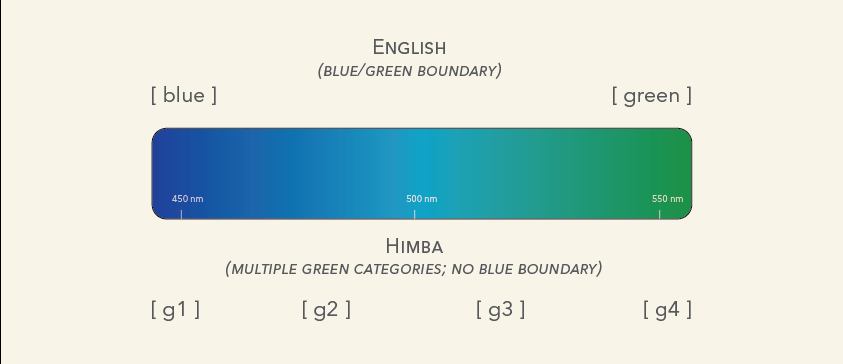
Image 4: Different languages carve the same physical continuum differently: English imposes a blue/green split; Himba divides the region into several greens with no blue boundary at all.
T₃ – Cultural–Normative Mediation
Shared Practices: The Social Life of Perception
Your discipline, training, historical context, and shared norms tell you:
which distinctions matter
which differences ‘count’
which patterns get ignored
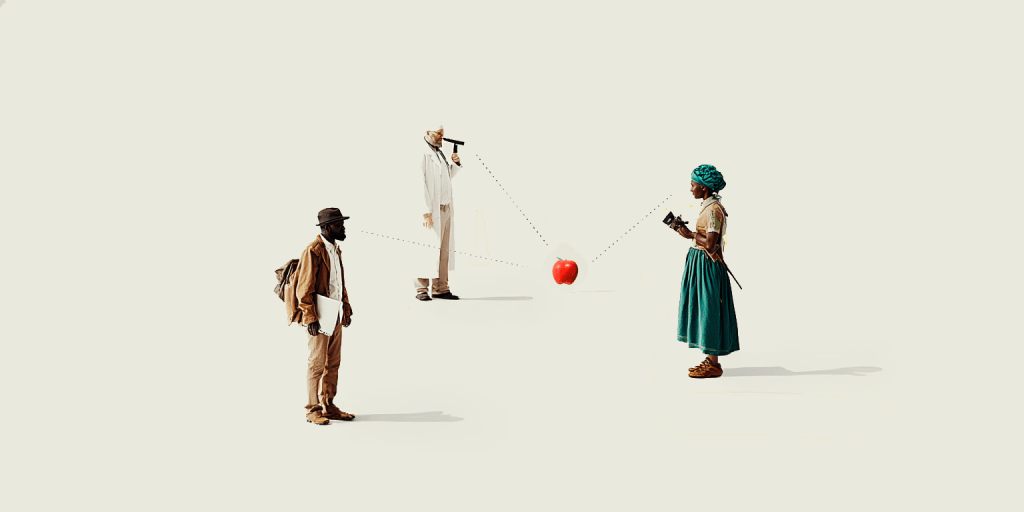
A Himba herder, a Renaissance painter, and a radiologist do not inhabit the same perceptual world – even when staring at the same patch of light.
Cultural mediation doesn’t rewrite biology; it reorganises priorities, salience, and interpretive readiness.
Image 5: Three observers confronting the same stimulus yet extracting different distinctions: the scientist tracks wavelength, the artist tracks hue and value, and the Himba pastoralist tracks ecologically salient greens. Same object, different salience hierarchies. Not arbitrary – just mediated.
What Seeing Red Actually Involves (Step By Exhausting Step)
You walk into a room. Apple on table. Looks red. What just happened?
T₀ – Biological: Long wavelength light hits L-cones harder than M- and S-cones. Opponent channels compute (L−M). Adaptation shifts baseline. Edge detection fires. You don’t have ‘red’ yet – you have transformed photoreceptor output.
T₁ – Cognitive: Your brain predicts ‘apple, probably red’ based on shape and context. Memory colour pulls toward canonical apple-red. Attention allocates processing resources. Prediction matches input (roughly). System settles: ‘yes, red apple’.
T₂ – Linguistic–Conceptual: The continuous gradient gets binned: ‘red’, not ‘crimson’ or ‘scarlet’ unless you’re a designer. The category provides stability, ties this instance to others, makes it reportable.
T₃ – Cultural–Normative: Does the exact shade matter? Depends whether you’re buying it, photographing it, or painting it. Your practical context determines which distinctions you bother tracking.
And through all of this: Constraint. Metameric matches stay stable. Focal colours persist cross-culturally. Wavelength sensitivities don’t budge. The encounter isn’t arbitrary – but it’s not unmediated either.
What happened wasn’t: Mind Met World. What happened was: an encounter-event unfolded, organised through four mediational layers, exhibiting stable constraint patterns that made it this and not that.
Where This Leaves Us
Colour is not ‘out there’. Colour is not ‘in here’.
Colour is the structured relational event of encounter.
Four mediation layers shape what appears. Constraint patterns stabilise the encounter so we aren’t hallucinating wildly divergent rainbows.
There is no ‘apple as it really is’ waiting behind the encounter. Nor is there a sovereign mind constructing its own private theatre.
There is only the event – where biological structure, cognitive dynamics, conceptual categories, and cultural histories co-emerge with the stable patterns of constraint we lazily call ‘the world’.
The apple was never red ‘in itself’. You were never seeing it ‘as it really is’. And the Enlightenment can finally take off its colour-blind uncle glasses and admit it’s been squinting at the wrong question for three hundred years.
Next time: Why visual illusions aren’t perception failing, but perception revealing itself.
Until then: stop asking where colour ‘really’ lives.
It lives in the event. And the event is mediated, constrained, and real enough.
Philosophers adore two things: inventing problems and then fainting when someone solves them. For decades, we’ve been treated to the realism–idealism tug-of-war, that noble pantomime in which two exhausted metaphysical camps clutch the same conceptual teddy bear and insist the other stole it first. It’s almost touching.
Enter Nexal Ontology, my previous attempt at bailing water out of this sinking ship. It fought bravely, but as soon as anyone spotted even a faint resemblance to Whitehead, the poor thing collapsed under the weight of process-cosmology PTSD. One throwaway comment about ‘actual occasions’, and Nexal was done. Dead on arrival. A philosophical mayfly.
But MEOW* – The Mediated Encounter Ontology of the World – did not die. It shrugged off the Whitehead comparison with the indifference of a cat presented with a salad. MEOW survived the metaphysical death match because its commitments are simply too lean, too stripped-back, too structurally minimal for speculative cosmology to get its claws into. No prehensions. No eternal objects. No divine lure. Just encounter, mediation, constraint, and the quiet dignity of not pretending to describe the architecture of the universe.
And that’s why MEOW stands. It outlived Nexal not by being grander, but by being harder to kill.
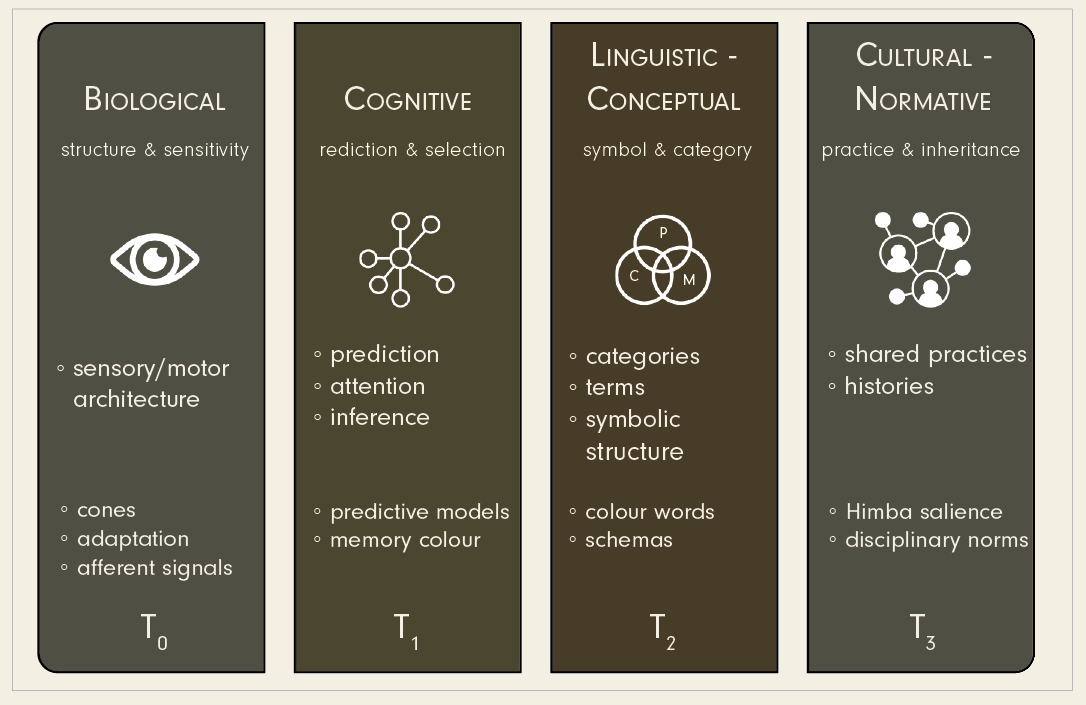
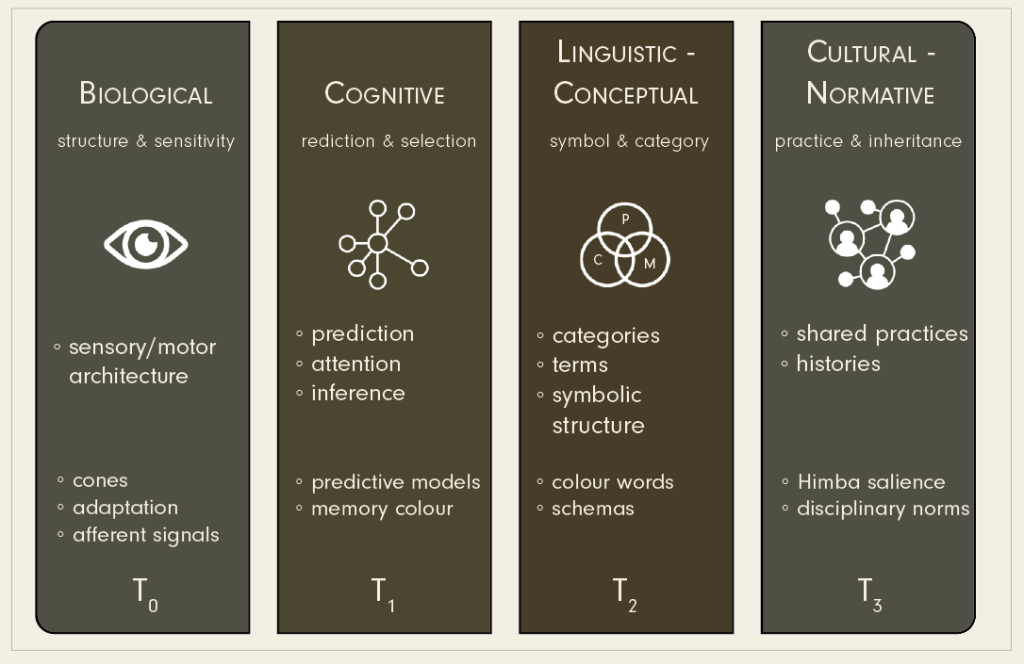
Image: The Four Mediation Layers – Biological, Cognitive, Conceptual, Cultural – structuring every encounter we mistake for ‘direct’.
This little illustration gives the flavour: • T0 Biological mediation – the body’s refusal to be neutral. • T1 Cognitive mediation – the brain, doing predictive improv. • T2 Linguistic–conceptual – words pretending they’re objective. • T3 Cultural–normative – the inheritance of everyone else’s mistakes.
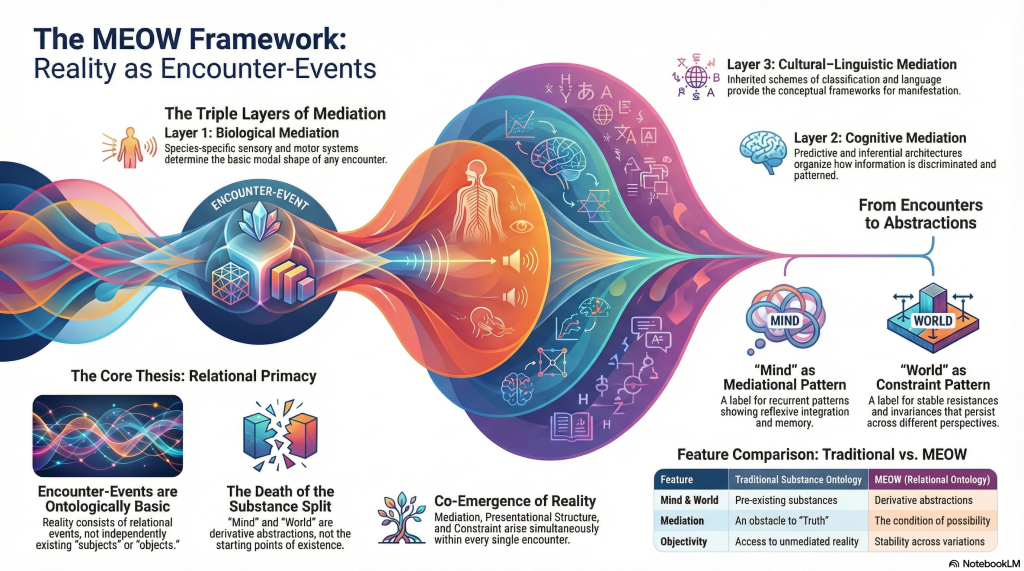
The essay argues that what we call ‘mind’ and ‘world’ are just abstractions we extract after the encounter, not the metaphysical scaffolding that produces it. Once you begin with the encounter-event itself – already mediated, already structured, already resistive – the mind–world binary looks about as sophisticated as a puppet show.
Image: NotebookLM Infographic (merges cognitive-linguistic, which I don’t support)
What the essay actually does
The Mediated Encounter Ontology of the World is the first framework I’ve written that genuinely sheds the Enlightenment scaffolding rather than rebuking it. MEOW shows:
Mediation isn’t an epistemic flaw; it’s the only way reality appears.
Constraint isn’t evidence of a noumenal backstage; it’s built into the encounter.
Objectivity is just stability across mediation, not a mystical view-from-nowhere.
‘Mind’ and ‘world’ are names for recurring patterns, not metaphysical hotels.
And – importantly – MEOW does all of this without drifting into Whiteheadian cosmological fan-fiction.
If you prefer a soft landing and the sound of a passable human voice explaining why metaphysics keeps tripping over its shoelaces, a NotebookLM discussion is here:
Audio: NotebookLM summary podcast of this essay.
MEOW is the survivor because it does the one thing philosophy is terrible at: it refuses to pretend. No substances, no noumena, no grand metaphysical machinery—just a clean, relational architecture that mirrors how we actually encounter the world.
And frankly, that’s quite enough ontology for one lifetime.
* To be perfectly honest, I originally fled from Michela Massimi’s Perspectival Realism in search of a cleaner terminological habitat. I wanted to avoid the inevitable, dreary academic cross-pollination: the wretched fate of being forever shelved beside a project I have no quarrel with but absolutely no desire to be mistaken for. My proposed replacement, Nexal Ontology, looked promising until I realised it had wandered, by sheer lexical accident, into Whitehead’s garden – an unintentional trespass for which I refused to stick around to apologise. I could already hear the process-metaphysics crowd sharpening their teeth.
Early evasive action was required.
I preferred nexal to medial, but the terminology had already been colonised, and I am nothing if not territorial. Mediated Ontology would have staked its claim well enough, but something was missing – something active, lived, structural. Enter the Encounter.
And once the acronym MEO appeared on the page, I was undone. A philosopher is only human, and the gravitational pull toward MEOW was irresistible. What, then, could honour the W with appropriate pomp? The World, naturally. Thus was born The Mediated Encounter Ontology of the World.
Pretentious? Yes. Obnoxious? Also yes.
And so it remains—purring contentedly in its absurdity.
This is a companion essay on scaffolding, fiction, and the manufacture of foundations to accompany the parable of the last unicorn.
There is a comforting reflex in modern thought: whenever we sense the creak of scaffolding beneath a social institution, we quickly invent a unicorn to stand upon it. Nations do this, churches do this, democracies do this, economists do this. The unicorn goes by many names – ‘the rule of law’, ‘the rational agent’, ‘the will of the people’, ‘the objective observer’ – but its function never varies. It is the fiction that absolves us of admitting that the structure stands only because we collectively maintain it.
Audio: NotebookLM podcast summary of this topic.
The parable of The Last Unicorn demonstrates this with more grace than a technical argument ever could. An invisible creature held together by instruments calibrated against one another is not a fantasy world –it’s a mirror. The Spiral Gauge and Echo Clock may look whimsical, but they are recognisable descendants of the same Enlightenment machinery that produced the rational self, the autonomous subject, the ideal observer, and the entire metaphysical menagerie used to justify the modern order.
What the Keepers discover – though none dares say it – is that coherence can arise without reference. Systems can be internally consistent, deeply compelling, even socially stabilising, and still refer to nothing beyond the architecture of their own conventions.
The unicorn never had to be real. Only the scaffolding did.
Video Clip: The Last Unicorn (Midjourney render; no sound – because unicorns are silent)
I. Coherence Without Correspondence
The Instruments in the parable do not triangulate an external object; they triangulate one another. Their perfection is not evidential but self-confirming. This is not a malfunction; it’s how most human systems operate.
• The law justifies itself through precedent. • Economics justifies itself through models calibrated to other models. • Morality justifies itself through rhetoric packaged as universality. • Nationhood justifies itself through symbols that no one sees but everyone repeats.
The Last Unicorn is simply the naked form of this apparatus, stripped of its polite abstractions.
Habermas would insist that discourse can eventually reveal the creature in the centre—call it justice, legitimacy, or rational consensus. But the parable makes the counterpoint: discourse doesn’t reveal the object; it manufactures its silhouette. What thrives is not truth but coherence, not revelation but calibration.
This is what Weber meant when he said ultimate values are inaccessible. It’s what Nietzsche meant when he called truth a mobile army of metaphors. And it’s what moral psychology has spent decades rediscovering under new terminology.
II. The Politics of the Empty Centre
The invisible unicorn is not merely an epistemological jab. It is political.
Empty centres are powerful. A symbol that cannot be verified cannot be falsified. A fiction that cannot be touched cannot be disproved. An entity that must not be seen becomes infinitely malleable to whoever controls its instruments.
This is why the Minister in the parable calls it the Last Unicorn. Singular entities resist comparison. Singular entities cannot be contested. Singular entities demand reverence.
Every modern nation has one. Every political ideology has one. Every moral system has one.
The most potent foundations are hollow.
III. When Scaffolding Becomes Sovereign
The final turn of the parable is the most damning: the instruments become the sovereign. The unicorn is no longer needed. The architecture itself becomes authority.
This is not fantasy. This is the modern administrative state. This is algorithmic governance. This is market rationality treated as inevitability. This is the ‘data-driven’ truth regime.
The instruments outlive the myth they were built to measure.
We no longer believe in the rational agent. But we still run the Spiral Gauge of behavioural economics.
We no longer believe in impartial justice. But we still read the Temperament Dial of jurisprudence.
We no longer believe in democratic will as a coherent whole. But we still update the Echo Clock every election cycle.
The tools remain after the foundations evaporate.
IV. Why Fiction Still Works
A sceptic might object: ‘If the unicorn is not real, why does any of this work at all?’
Because fiction that organises behaviour is not merely fiction. It is a coordination device. It is a Schelling point. It is scaffolding that allows millions of otherwise disjointed perspectives to act as if they shared a common centre.
The fact that the centre is empty does not make it useless. Emptiness is what makes it usable.
This is what Perspectival Realism gets right: reality exists, but our social truths are not descriptions of it – they are negotiated vantage points that allow us to stop killing each other long enough to build things.
The unicorn works not because it is real, but because it is required.*
V. The Real Danger
The danger is not that the unicorn is fictional. The danger is that the Keepers forget that it is.
When the scaffolding becomes invisible, those who control the instruments gain the power to dictate reality. The unicorn becomes a weapon. Its measurements become law. The Temperament Dial becomes policy. And any challenge to the system is treated not as dissent but as blasphemy.
Truth becomes whatever maintains the ratios.
If the unicorn is serene, the kingdom must be serene. If the unicorn demands five hooves, arithmetic must comply. If the unicorn embodies unity, dissent must be reclassified as disease.
This is how ideologies harden. This is how objectivities are born. This is how violence becomes reasonable.
VI. What the Parable Teaches
The lesson is not that reality is subjective, or that truth is arbitrary, or that everything dissolves into mere opinion.
The lesson is disciplinary:
Never confuse the scaffolding with the stone. Never confuse the instrument with the object. Never confuse coherence with correspondence. Never confuse tradition with truth. Never confuse necessity with ontology.
The unicorn is the modern foundational myth. The Last Unicorn is the last acceptable one.
The structure stands only because we maintain it. Its reality is our labour, not its essence.
To recognise this is not cynicism. It is maturity.
To deny it is not faith. It is dependence.
* Aphorism: On the Necessity of Invented Foundations
Some might notice the parallel between this and Voltaire’s quip. This is not accidental.
Per Voltaire, “If God did not exist, it would be necessary to invent him.” This translates into society needing a fiction strong enough to keep everyone from eating each other, but mine goes a level deeper – an Inception moment.
Here, “The unicorn works not because it is real, but because it is required” translates to ‘foundational fictions aren’t just convenient – they’re structurally unavoidable once the scaffolding grows large enough to demand a centre‘.
The continuity is bleak:
Voltaire assumes the fiction stabilises the moral order.
I point out that the fiction stabilises the fiction of the moral order.
In your frame, the unicorn isn’t God – it’s everything Enlightenment metaphysics smuggled in as ‘non-negotiable’: the subject, the sovereign, the Self, the rational agent, the ideal observer, the general will, the scientific method as oracle, ‘rights’, ‘justice’, the whole pantheon of Enlightenment delusion.
Voltaire’s God was a stopgap, a necessary myth to patch a crumbling worldview. The unicorn is the revealed skeleton of every such myth once the paint flakes off.
And crucially, Voltaire still believed something anchored the system (even if it had to be manufactured). I’m saying the anchor is the manufacturing. The scaffolding is the foundation. There’s no bedrock underneath it, and the system works only by keeping the fiction at the centre just out of reach – sacred, untouchable, instrumentally indispensable.
It’s Voltaire inverted, updated, and stripped of any remaining optimism.
When Voltaire once quipped that if God did not exist, he would have to be invented. He meant that societies require a fiction sturdy enough to keep the centre from collapsing.
But in the world bequeathed by Nietzsche’s genealogies, Foucault’s power/knowledge, MacIntyre’s fractured moral traditions, and Habermas’s doomed faith in ideal discourse, the point sharpens:
Again, the unicorn works not because it is real, but because it is required.
Reality does not underwrite the fiction; the fiction underwrites reality.
Jaeger’s Perspectival Realism makes the same admission gently: perspectives mediate the real because there is no God’s-eye vantage to appeal to. Felin shows how even ‘rationality’ is stitched from species-specific perceptual biases masquerading as universal norms. Barrett’s constructivist account of emotion reveals that even our affective lives are fabricated from cultural priors rather than discovered as facts.
And once language itself becomes an insufficient instrument – a leaky apparatus propping up its own illusions – the lesson becomes unavoidable:
We do not invent foundations because they are true. We invent them because the scaffolding has grown large enough to demand a centre.
The Last Unicorn is not a creature waiting to be seen; it is the placeholder every society constructs to avoid staring directly into its own void.
When the granite vanishes, the need remains.
I have more to share on this, but I’ll save it for another day.
Where our projects nod politely, then go their separate ways
(For the constructive exposition of Perspectival Realism—its three layers of mediation, its commitments, and its ontology without footnotes—see the main article. This piece deals with the differences by Michela Massimi’s and my versions.)
I suppose it was inevitable. You spend years muttering into your notebook about mediation, realism without bombast, the irretrievability of universality, and the peculiar way science manages to stumble forward with partial, parochial tools… and then, inevitably, you discover that someone else—Michela Massimi, in this case—has been busy constructing her own edifice a few hills over.
Audio: NotebookLM podcast summary and discussion of this topic
I arrived late to her party. Fine. But now that I’m here, let’s pour a drink and compare architecture.
Because while our buildings look similar from a distance—both labelled Perspectival Realism—they’re made from different bricks and aimed at different skylines.
1. A Courteous Bow: We Are Not Strangers in the Same Wilderness
Massimi and I share several foundational intuitions:
No God’s-eye view. She rejects the fantasy of disembodied objectivity. So do I. Reality is not a neutral theatre awaiting the Enlightenment spectator.
Knowledge is situated. Her emphasis on historically embedded scientific communities echoes my own insistence that sense, cognition, and culture structure every act of knowing.
Plural perspectives, not universal sovereignty. No single inferential vantage point dominates; multiple perspectives can be fruitfully interlaced. That’s strikingly consonant with my claim that mediation is a condition, not a defect.
Anti-relativist without universalist delusion. Neither of us has patience for the “all maps are equal” caricature peddled by people who wouldn’t know a real relativist if they tripped over one in a library.
From this angle, we’re intellectual cousins—two people independently refusing Enlightenment triumphalism while refusing to surrender realism to the absolutists.
2. The Parting of the Ways: Our Projects Are Not the Same Creature
But similarities disguise deeper divergences. Here are the important ones:
a) She’s doing epistemology; I’m doing ontology.
Massimi reconstructs realism from the inside out by examining scientific practice—models, inferences, historically evolving toolkits.
My project is more structural. Sense mediation (icons), cognitive mediation (instrumentation), and linguistic-cultural mediation (conceptual carving) are not methodological observations; they are conditions of access to reality. They’re deeper than scientific practice—they underlie it.
b) She salvages realism; I happily burn universality and build realism back from the ashes.
Massimi is rehabilitating realism’s good name. I’m less sentimental. Realism, as a doctrine, has been caught lying too many times. I want the realism of resistance, not the realism of representation.
c) Her anchor is “modal robustness”; mine is “structured resistance through mediation.”
Massimi’s realism rests on the idea that phenomena are robust across models and contexts—they persist modally.
I agree that robustness is useful. But robustness is filtered through linguistic concepts, cognitive priors, and sensorimotor limitations. It’s a second-order indicator, not a metaphysical foothold.
Resistance—the world’s refusal to bend to belief—is deeper. It’s what enables robustness to manifest.
d) Her perspectives are model-based; mine are existential.
Massimi focuses on scientific perspectives—frameworks articulated through inferential blueprints.
Massimi gives us a realism of models. A realism that emerges from the community of scientific practice, negotiated through historically situated inferential perspectives.
I’m after a realism of resistance. A realism that remains intact even when models break, when languages fail, when cognitive categories run aground. Not the realism of what we say, but the realism of what pushes back.
Our projects are not incompatible, but they are differently motivated.
She is concerned with scientific rationality’s legitimacy. I am concerned with the conditions of access to reality in the first place.
She patches the Enlightenment’s ship. I point out that the ship’s hull is three layers of mediation thick, and pretend that universality is the hole in the floor.
4. A Clean Acknowledgement: She Was Here First (Sort Of)
Yes—Massimi coined the term in this specific form, and she developed a sophisticated, rigorous scientific perspectivism that deserves respect.
But my Perspectival Realism emerged from a different genealogy:
the insufficiency of language,
the inescapability of conceptual carving,
the recursive inadequacy of cognitive tools,
the quiet, stubborn existence of a world we only ever meet askance.
Different animals. Same habitat.
So no, I’m not competing with Massimi. And no, I’m not rebranding her work.
What I’m doing—and what this piece makes explicit—is placing my ontology in dialogue with hers. Two parallel rejections of universality. Two parallel refusals of relativism. Two parallel attempts to articulate realism without pretending we’ve escaped the conditions of being human.
If I arrived late to her race, so be it. I’m not running for her finish line anyway.
DISCLAIMER: This article was written or output by ChatGPT 5.1. It started as a conversation with Claude Sonnet 4.5, where I had input days of output for evaluation. One of these outputs was the post about Erasmus and the Emissary Who Forgot to Bow. A group chat ensued between me, Claude and ChatGPT.
What started as a discussion about the merits of my position, expressed in the Erasmus-influenced essay, drifted to one about Perspectival Realism. That discussion deepened on ChatGPT, as I further discussed my recent thoughts on the latter topic. I had rendered a Magic: The Gathering parody trading card as I contemplated the subject. It’s how my brain works.
All of this led me to ask ChatGPT to summarise the conversation, and, upon further discussion, I asked it to draft this article – the second of five.
Perspectival Realism: The First Ontology Without an Asterisk This article discusses what Perspectival Realism means to me and how I got to this position.
Arriving Late to Massimi’s Party: Perspectival Realism in Parallel 👈 I spent another half-hour following Google search results as I wanted to see if anyone else had already been using the term, Perspectival Realism. I ended up on the Oxford publishing site. I found a 2022 book with this name, authored by Michela Massimi. They allowed me to download the book, so I asked ChatGPT to summarise our positions, specifically where we agreed and differed.
Against the Vat: Why Perspectival Realism Survives Every Sceptical Hypothesis At 0500, I returned to bed, but I woke up again at 0700, thinking about how one might differentiate between Putnam’s brain in a vat from Perspectival Realism. ChatGPT asked if I wanted that output in long-form.
The Constraint Interface: Toward a Nexal Ontology Being uncomfortable with the dichotomy between Realism and Idealism, I chatted to come up with terminology that disrupts what I consider a false dichotomy, focusing on the nexus rather than privileging one or the other. Consider this similar to the debate on sex and gender binaries.
As I mentioned at the end of the first series, I may return to this series and publish a coherent expository version more in line with my usual style. Meantime, this allows me to share my ideas unvarnished and unpolished at the same time, granting me more time to focus on other matters. Apologies to those who may disagree with the outline format. Honestly, it annoys me, but I am choosing function over form at the moment.
In the great hall of the palace, at the centre of a circle of polished stone, stood what the kingdom called the Last Unicorn.
No one had ever seen it. No one was permitted to try.
The Founders had decreed that direct observation would profane the creature’s ‘purity’. To see it was to diminish it; to touch it was to collapse its ‘essential nature’ into some accidental form. Thus, the unicorn could be approached only through instruments – never through hands, eyes, or unmediated judgement.
It was the Last not because others had died, but because it remained the final remnant of an age that still believed truths stood on stone.
Audio: NotebookLM podcast summary of this topic.
The Instruments
To preserve the unicorn’s nature, the Keepers constructed an evolving array of devices.
The Spiral Gauge, oldest and most revered, hung from silk threads above the empty circle. It detected one possible configuration of the horn’s curvature – never the horn itself.
The Echo Clock measured hoofbeats. The hall was silent, yet the wires vibrated all the same, yielding intervals that corresponded (according to the ledgers) to modes of unicornic motion: walking, standing, contemplative stillness.
The Mane Spectrometer mapped disturbances in candlelight to infer the density of a mane that existed only in theory.
The Temperament Dial synthesised these readings into a single number – currently 1.618: serene alertness.
The instruments never disagreed; they could not disagree, because each was calibrated against the others.
‘Truth is coherence’, the Master Keeper taught.
The Scaffolding Expands
Over centuries, ledgers multiplied into an archive wing. Scholars journeyed from distant kingdoms to admire the rigour of the data.
A visiting philosopher once said, ‘Your measurements form the most complete record of unicornic behaviour ever assembled’.
The apprentices beamed. No one asked why no other kingdom kept such records.
Schools taught the unicorn’s anatomy. Artists painted its likeness. The quarterly update of the Temperament Dial was read aloud in public squares. Children traced the golden spiral, believed to mirror the creature’s horn.
When dissidents questioned the absence of hoofprints, they were told what everyone knew:
‘The Last Unicorn is beyond crude contact. Only refined instruments can reveal its truth’.
Consensus deepened. With it grew the need for further instruments.
A Quiet Realisation
Sometimes, on night watch, a Keeper would stand above the empty stone. The Spiral Gauge quivered. The Echo Clock murmured. The Proportion Engine hummed, harmonising the system.
And in that stillness, the Keeper would feel a thought rise and evaporate instantly:
that the instruments described one another more faithfully than anything else.
That their perfect coherence reflected the architecture of the scaffolding, not any creature the scaffolding purported to measure.
Such thoughts were structural, not heretical – and no less dangerous.
The Last Unicorn
The Minister liked to call it the Last Unicorn. He never explained why it was last or what fate had befallen the others. He did not need to. The title served its purpose:
If it is the Last, no comparison is possible. No contradiction can emerge. No counterexample can survive.
Its uniqueness proved its necessity.
What else could unify a kingdom but a creature no one could touch, see, or disbelieve?
The Closing Line
And so the unicorn remained – in measurements, in ratios, in ledgers, in rhetoric.
A fiction made coherent by instruments, maintained by tradition, sanctified by those who needed it to be real.
The Last Unicorn was not the final creature of its kind. It was the last foundation still standing. And in that sense – it was more real than anything that had ever lived.







 Philosophics