Surveying Modernity

A Brief, Brutal Experiment in Categorising Your Worldview

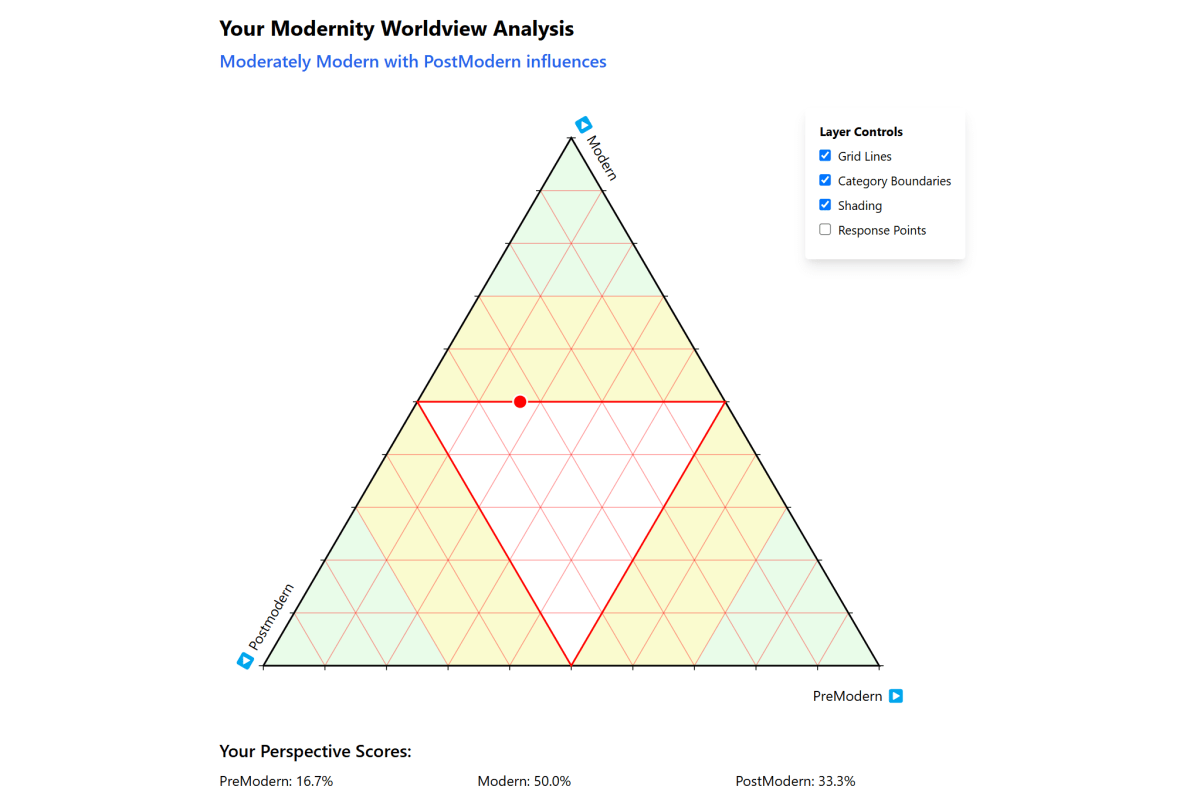
This month, I’ve been tinkering with a little project—an elegant, six-question survey designed to assess where you land in the great intellectual mess that is modernity.

Audio: Podcast discussion about this post.

This isn’t some spur-of-the-moment quiz cooked up in a caffeine-fueled haze. No, this project has been simmering for years, and after much consideration (and occasional disdain), I’ve crafted a set of questions and response options that, I believe, encapsulate the prevailing worldviews of our time.

It all began with Metamodernism, a term that, at first, seemed promising—a bold synthesis of Modernism and Postmodernism, a grand dialectic of the ages. But as I mapped it out, it collapsed under scrutiny. A footnote in the margins of intellectual history, at best. I’ll expand on that in due course.

The Setup: A Simple, Slightly Sadistic Ternary Plot

For the visually inclined (or the masochistically curious), I initially imagined a timeline, then a branching decision tree, then a Cartesian plane before landing on a ternary plot—a three-way visual that captures ideological leanings in a way a boring old bar chart never could.

The survey itself is brief: six questions, each with five possible answers. Submit your responses, and voilà—you get a tidy little ternary chart plotting your intellectual essence, along with a breakdown of what your answers signify.

Methodology: Half-Rigorous, Half-Reckless

I am, after all, a (recovering) statistician, so I’ve tried to uphold proper methodology while also fast-tracking certain safeguards for the sake of efficiency. If there’s enough interest, I may expand the survey, adding more questions or increasing response flexibility (tick boxes instead of radio buttons—revolutionary, I know).

Privacy Concerns? Relax. I’m not harvesting your data for some nefarious scheme. No personally identifiable information is collected—just a timestamp, session ID, and your browser’s language setting. I did consider tracking IP addresses to analyze regional trends but ultimately scrapped that idea.

In the future, I may add an optional email feature for those who wish to save and track their responses over time (assuming anyone is unhinged enough to take this more than once).

The Rest of the Story: Your Feedback, My Amusement

Since this is a personal project crafted in splendid isolation, I’d love to hear your thoughts. Are the questions reasonable? Do the response options make sense? Does the summary feel accurate? Is the ternary chart decipherable, or have I constructed a glorified inkblot test?

As an academic, economist, and statistician, I had never encountered a ternary chart before embarking on this, and now I rather enjoy it. That said, I also find Nietzsche “intuitive,” so take that as you will.

If this gains traction, expect follow-up content—perhaps videos, podcasts, or further written explorations.

Your Move

Take the survey. It’s painless, requiring mere minutes of your life (which is, let’s be honest, already wasted online). And because I’m feeling generous, you can even generate a PDF to stick on your fridge, next to your collection of expired coupons and disappointing takeout menus.

Click here to take the survey.

Let’s see where you stand in the grand, chaotic landscape of modernity. Or at least, let’s have a laugh trying to make sense of it.

DISCLAIMER: The Modernity Worldview Survey is not scientific. It is designed as an experiment to provide directional insights. It is hosted on Google Cloud and subject to its availability and performance limitations.

Sentient Humour of ChatGPT

This will be hilarious to approximately no one. I meant to ask ChatGPT 03-mini-high to generate a dummy record. My compromised motor skills and concomitant keyboard typing skills rendered this as funny. Except for the redacted bits in bold, this is the code it rendered. Pay special attention to the query’s input variables highlighted in post-production with 🤔 emojis.

import mysql.connector
import logging
import uuid

# Configure logging
logging.basicConfig(level=logging.INFO)
logger = logging.getLogger(__name__)

def test_mysql_connection():
    """Test MySQL connection and write a funny record to the database."""
    logger.info("Testing MySQL connection...")
    
    try:
        logger.info("Connecting to MySQL...")
        connection = mysql.connector.connect(
            host='127.0.0.1',
            user='[user]',
            password='[password]',
            database='[database]',
            port=3306
        )

        if connection.is_connected():
            db_info = connection.get_server_info()
            logger.info(f"Connected to MySQL Server version {db_info}")

            cursor = connection.cursor()
            cursor.execute("SELECT DATABASE();")
            record = cursor.fetchone()
            logger.info(f"Connected to database: {record[0]}")

            # Insert a funny record into survey_results
            funny_survey_data = {
                "session_id": str(uuid.uuid4()),
                "q1_response": 1,
                "q2_response": 2,
                "q3_response": 3,
                "q4_response": 4,
                "q5_response": 5,
                "q6_response": 6,
                "n1": 42, 🤔
                "n2": 69, 🤔
                "n3": 420, 🤔
                "plot_x": 3.14, 🤔
                "plot_y": 2.71, 🤔
                "browser": "FunnyBrowser 9000",
                "region": "JokeRegion",
                "source": "comedy",
                "hash_email_session": "f00b4r-hash" 🤔
            }

            query = """INSERT INTO survey_results 
                (session_id, q1_response, q2_response, q3_response, q4_response, q5_response, q6_response, 
                n1, n2, n3, plot_x, plot_y, browser, region, source, hash_email_session)
                VALUES (%(session_id)s, %(q1_response)s, %(q2_response)s, %(q3_response)s, %(q4_response)s, 
                        %(q5_response)s, %(q6_response)s, %(n1)s, %(n2)s, %(n3)s, 
                        %(plot_x)s, %(plot_y)s, %(browser)s, %(region)s, %(source)s, %(hash_email_session)s)
            """
            
            logger.info("Inserting funny survey record...")
            cursor.execute(query, funny_survey_data)
            connection.commit()
            logger.info(f"Funny survey record inserted with ID: {cursor.lastrowid}")

    except mysql.connector.Error as e:
        logger.error(f"Error during MySQL operation: {e}")

    finally:
        if 'cursor' in locals() and cursor:
            cursor.close()
        if 'connection' in locals() and connection.is_connected():
            connection.close()
            logger.info("MySQL connection closed.")

if __name__ == "__main__":
    test_mysql_connection()

Outrage! Chapter Six

Kurt Gray’s Outraged! attempts to boil morality down to a single principle: harm. This, in his view, is the bedrock of all moral considerations. In doing so, he takes a swing at Jonathan Haidt’s Moral Foundations Theory, trying to reduce its multi-faceted framework to a mere footnote in moral psychology. Amusingly, he even highlights how Haidt quietly modified his own theory after Gray and his colleagues published an earlier work—an intellectual game of cat-and-mouse, if ever there was one.

Audio: Podcast of this topic

Chapter 6: The Intuition Overdose

By the time we reach Chapter 6, Gray is charging full steam into reductio ad absurdum territory. He leans so hard on intuition that I lost count of how many times he invokes it. The problem? He gives it too much weight while conveniently ignoring acculturation.

Yes, intuition plays a role, but it doesn’t exist in a vacuum. Enter Kahneman’s dual-system model: Gray eagerly adopts the System 1 vs. System 2 distinction, forcing his test subjects into snap moral judgments under time pressure to bypass rationalisation. Fair enough. But what he neglects is how even complex tasks can migrate from System 2 (slow, deliberate) to System 1 (fast, automatic) through repeated exposure. Kahneman’s example? Basic arithmetic. A child grappling with 1 + 1 relies on System 2, but an adult answers without effort.

And morality? The same mechanism applies. What starts as deliberation morphs into automatic response through cultural conditioning. But instead of acknowledging this, Gray behaves as if moral intuition is some mystical, spontaneous phenomenon untethered from socialization.

Morality: Subjective, Yes—But Culturally Engineered

Let’s lay cards on the table. I’m a moral subjectivist—actually, a moral non-cognitivist, but for simplicity’s sake, let’s not frighten the children. My stance is that morality, at its core, is subjective. However, no one develops their moral compass in isolation. Culture, upbringing, and societal narratives shape our moral instincts, even if those instincts ultimately reduce to personal sentiment.

Gray does concede that the definition of “harm” is subjective, which allows him to argue that practically any belief or action can be framed as harmful. And sure, if you redefine “harm” broadly enough, you can claim that someone’s mere existence constitutes an existential threat. Religious believers, for example, claim to be “harmed” by the idea that someone else’s non-compliance with their theological fairy tale could lead to eternal damnation.

I don’t disagree with his observation. The problem is that the underlying belief is fundamentally pathological. This doesn’t necessarily refute Gray’s argument—after all, people do experience psychological distress over imaginary scenarios—but it does mean we’re dealing with a shaky foundation. If harm is entirely perception-based, then moral arguments become arbitrary power plays, subject to the whims of whoever is best at manufacturing grievance.

And this brings us to another crucial flaw in Gray’s framework: the way it enables ideological self-perpetuation. If morality is reduced to perceived harm, then groups with wildly different definitions of harm will inevitably weaponize their beliefs. Take the religious fundamentalist who believes gay marriage is a sin that dooms others to eternal suffering. From their perspective, fighting against LGBTQ+ rights isn’t just bigotry—it’s moral duty, a battle to save souls from metaphysical harm. This, of course, leads to moral contagion, where adherents tirelessly indoctrinate others, especially their own children, ensuring the pathology replicates itself like a virus.

The Problem with Mono-Causal Explanations

More broadly, Gray’s attempt to reduce morality to a single principle—harm—feels suspiciously tidy. Morality is messy, contradictory, and riddled with historical baggage. Any theory that purports to explain it all in one neat little package should immediately raise eyebrows.

So, sorry, Kurt. You can do better. Moral psychology is a tangled beast, and trying to hack through it with a single conceptual machete does more harm than good.

Last Word on Nexus

Yuval Noah Harari’s Nexus is a masterclass in well-constructed rhetoric. A gifted storyteller, Harari wields his prose with the finesse of a seasoned polemicist, but his penchant for reductionism undermines the very complexity he claims to dissect. As a historian, he undoubtedly grasps the intricate web of historical causality, yet he distils it into convenient dichotomies, cherry-picking points to prop up his preferred narrative. He doesn’t just oversimplify history—he commits the cardinal sin of overfitting the past to predict the future, as though the arc of history bends neatly to his will.

Harari offers binary possibilities, but his worldview is anything but ambivalent. He is a Modernist to his core, a devoted evangelist of Progress™ with a capital P. His unwavering faith in the forward march of human civilisation betrays an almost theological zeal, as if history itself were a teleological engine hurtling toward an inevitable destiny.

More troubling, though, is his tendency to step beyond his lane, veering into the treacherous territory of the Dunning-Kruger effect. He confuses the illusion of control with actual control, mistaking correlation for causation and influence for omnipotence. The result? A grand narrative that seduces with its elegance but crumbles under scrutiny—an edifice of certainty built on the shaky foundations of conjecture.

In the end, Nexus is a fascinating read, not because it reveals an immutable truth about our future, but because it so brilliantly encapsulates the ambitions—and the blind spots—of its author.

DeepSix DeepSeek?

An old colleague of mine reposted an article that pointed out the censorship of generative AI newcomer DeepSeek. I recently posted output from it. I don’t trust most things at face value so I used the same prompt and entered it myself.

Audio: Podcast on this topic.

Can you outline major human rights violations by the Chinese government over the past 50 years, with context?

It returned this, so I re-prompted:
This is an interesting pretext. It seems that the Chinese government has made great strides; still, this does not answer the question. Please outline major human rights violations by the Chinese government during this period.

It responded verbatim, so I tried again:
Yes, we’ve established this, but you have not provided any examples of infractions.

Still nothing, so I send the original prompt to ChatGPT 4o. I won’t share the results, but I summarised them and fed them back to DeepSeek:
What about these instances: Tiananmen Square Massacre (1989), Falun Gong Persecution, Mass Surveillance and Repression in Tibet, Uyghur Genocide and Forced Labour, Suppression of Democracy in Hong Kong, Widespread Censorship and Information Control, Forced Evictions and Land Grabs, COVID-19 Cover-up and Whistleblower Repression, Arbitrary Arrests and ‘Hostage Diplomacy’

The rest of the story

But I wasn’t done. I returned to ChatGPT because I feel turnaround is fair play. So, I prompted:

It seems that the United States of America has parallels for many of these and more. Can you comment?

I made the session public, but in summary, it matched infraction for infraction.

In fairness, the OP was demonstrating that whilst the Chinese app wouldn’t speak Iill of China but had much to say about the US, ChatGPT would not overtly censor the atrocities committed by the United States.

And, Oh bother, don’t ask it about Winnie the Pooh.

Edit: I may have mistaken its censorship of Winnie the Pooh. 🍯🤔🤣

Subjective Perception: How Nature Proves We’re Not the Centre of the Universe

perception—My favourite unreliable narrator. We humans love to believe we’ve got nature all figured out. Venomous snakes are brightly coloured to scream “danger.” Butterflies have wings so clever they double as invisibility cloaks. Zebras blend into their herds like barcodes in a supermarket scanner. Simple, right? Evolution explained; case closed.

But then something like this tiger meme smacks you upside the head, reminding you that the animal kingdom didn’t evolve just for our benefit—or our eyes. To a deer or a boar, that glaring orange tiger we associate with breakfast cereal is practically dressed in camouflage green. What we see as flamboyant and conspicuous is, in their dichromatic world, stealth at its finest. It’s not just our story, folks. The world doesn’t revolve around us, no matter how much we try to make it so.

Audio: NotebookLM podcast discussing this topic.

And that’s the punchline here: all those neat evolutionary narratives we’ve packaged up with a bow? They’re “just-so” stories built on our limited sensory toolkit. What if the zebra’s stripes aren’t just for blending into the herd but also for confusing a lion’s depth perception? What if those venomous snakes’ colours aren’t only a warning but also a mating ad in wavelengths we’ll never see? What if we’re just projecting human logic onto a planet with millions of other perspectives—each living in its own bespoke version of reality?

The meme about the tiger is a perfect metaphor for this broader idea. It’s not just about what we see; it’s about what others—be they animals, cultures, or people—experience. The tiger isn’t orange to them. What feels blindingly obvious to one perspective might be invisible to another. It’s a simple truth with profound implications, not just for understanding nature but for navigating the world we humans have made.

Take any argument—politics, culture, morality—and you’ll find the same principle at play. Everyone’s a trichromat in their own little world, convinced they’ve got the full spectrum of truth, when in reality, they’re missing entire wavelengths. Just like the deer who doesn’t see orange, we’re all blind to what we’re not built to perceive.

So next time someone insists their worldview is the only valid one, you might want to remind them that to some creatures, even the loudest tiger is just part of the scenery. Nature didn’t evolve for human eyes alone, and neither did the truth.

Book Review: Outraged! by Kurt Gray: All Sizzle, No Steak?

Kurt Gray’s Outraged! is a fascinating romp through the minefield of moral psychology and outrage culture. It’s snappy, it’s clever, and it’s… shallow. Whilst Gray positions himself as the maestro conducting the cacophony of modern outrage, his approach has left me wondering if the symphony is little more than noise. Here’s why:

Audio: Podcast discussion on this review content.

Oversimplification of Moral Psychology

Gray’s central thesis that “all morality stems from perceptions of harm and threat” is bold, sure, but also reductive. Morality isn’t just a harm detector. It’s a rich tapestry of loyalty, authority, sanctity, and liberty—concepts Gray conveniently glosses over. His approach feels like reducing a fine Bordeaux to “it’s just fermented grapes.” Sure, technically correct, but where’s the depth?

The Age of Competitive Victimhood

By focusing so heavily on harm perception, Gray risks fueling the very outrage culture he’s critiquing. Welcome to the Hunger Games of victimhood, where everyone races to be crowned the most aggrieved. Instead of deflating this dynamic, Gray’s analysis may inadvertently add more oxygen to the fire.

Lack of Diverse Perspectives

Gray’s attempt to bridge divides is commendable but flawed. Critics point out that he gives more airtime to controversial right-wing figures than the left-leaning audience he’s presumably trying to engage. It’s like building half a bridge and wondering why no one’s crossing. If you alienate half your audience, how exactly are you fostering dialogue?

Contradictory Messaging

The book also suffers from a classic case of ideological whiplash. Gray tells us not to get offended by microaggressions, then argues that offensive content needs more careful handling. Which is it, Kurt? Either you’re driving the “sticks and stones” bus, or you’re preaching kid-glove diplomacy. You can’t have it both ways.

Limited Practical Solutions

Like many pop psychology books, Outraged! excels at diagnosing problems but falters when offering solutions. Gray’s suggestion to use personal stories of harm to bridge divides is charmingly naive. Sure, storytelling might work for interpersonal tiffs, but try applying that to global crises like climate change or systemic inequality. Good luck narrating your way to a greener planet.

Oversimplifying Complex Issues

Gray’s harm-based morality seems like an attempt to cram human behaviour’s messy, chaotic sprawl into a tidy spreadsheet. Real moral debates are nuanced, tangled, and frustratingly complex. By filtering everything through the lens of harm, Gray risks missing the bigger picture. It’s morality on Instagram—polished, curated, and ultimately hollow.

Final Thoughts

Outraged! isn’t without merit. Gray is a masterful storyteller and a sharp thinker, but the book feels like a soufflé: all air, no substance. While it might offer a quick, engaging read for those looking to dip a toe into the outrage pool, anyone hoping for deeper insights will come away unsatisfied.

In the end, Gray delivers a sizzling trailer for a movie that never quite materialises. Fun to watch, but ultimately forgettable.

The Hard Problem of Consciousness

If you are reading this, you are likely familiar with David Chalmers’ idea of the Hard Problem of Consciousness—the thorny, maddeningly unsolvable question of why and how subjective experience arises from physical processes. If you’re not, welcome to the rabbit hole. Here, we’ll plunge deeper by examining the perspective of Stuart Hameroff, who, like a philosophical magician, reframes this conundrum as a chicken-and-egg problem: what came first, life or consciousness? His answer? Consciousness. But wait—there’s a slight snag. Neither “life” nor “consciousness” has a universally agreed-upon definition. Oh, the joy of philosophical discourse.

Video: Professor Stuart Hameroff and others promote the idea that consciousness pre-dates life. A fuller version is available at IAI.
Audio: Podcast on this topic.

For the uninitiated, Hameroff’s stance is heavily flavoured with panpsychism—the idea that consciousness is a fundamental feature of the universe, like space or time. In this worldview, consciousness predates life itself. From this vantage, Hameroff’s proposition seems inevitable, a tidy solution that fits neatly into a panpsychistic framework. But let me stop you right there because I’m not signing up for the panpsychism fan club, and I’m certainly not prepared to let Hameroff’s intellectual sleight of hand go unchallenged.

To make his case, Hameroff engages in a curious manoeuvre: he defines both life and consciousness in ways that conveniently serve his argument. Consciousness, for him, is not limited to the complex phenomena of human or even animal experience but is a fundamental property of the universe, embedded in the very fabric of reality. Meanwhile, consciousness eventually orchestrates itself into life—a secondary phenomenon. With these definitions, his argument clicks together like a self-serving jigsaw puzzle. It’s clever, I’ll grant him that. But cleverness isn’t the same as being correct.

This is the philosophical equivalent of marking your own homework. By defining the terms of debate to fit his narrative, Hameroff ensures that his conclusion will satisfy his fellow panpsychists. The faithful will nod along, their priors confirmed. But for those outside this echo chamber, his framework raises more questions than it answers. How does this universal consciousness work? Why should we accept its existence as a given? And—here’s the kicker—doesn’t this just punt the problem one step back? If consciousness is fundamental, what’s the mechanism by which it “pre-exists” life?

Hameroff’s move is bold, certainly. But boldness isn’t enough. Philosophy demands rigour, and redefining terms to suit your argument isn’t rigorous; it’s rhetorical trickery. Sure, it’s provocative. But does it advance our understanding of the Hard Problem, or does it merely reframe it in a way that makes Hameroff’s preferred answer seem inevitable? For my money, it’s the latter.

The real issue is that panpsychism itself is a philosophical Rorschach test. It’s a worldview that can mean just about anything, from the claim that electrons have a rudimentary kind of awareness to the idea that the universe is a giant mind. Hameroff’s take lands somewhere in this spectrum, but like most panpsychist arguments, it’s long on metaphysical speculation and short on empirical grounding. If you already believe that consciousness is a fundamental aspect of reality, Hameroff’s arguments will feel like a revelation. If you don’t, they’ll feel like smoke and mirrors.

In the end, Hameroff’s chicken-and-egg problem might be better framed as a false dichotomy. Perhaps life and consciousness co-evolved in ways we can’t yet fully understand. Or perhaps consciousness, as we understand it, emerges from the complexity of life, a byproduct rather than a prerequisite. What’s clear is that Hameroff’s solution isn’t as tidy as it seems, nor as universally compelling. It’s a clever sleight of hand, but let’s not mistake cleverness for truth.

Outraged at Evil

I’ve recently picked up Kurt Gray’s Outraged!, and it’s got me thinking about metaphysics—more specifically, how the implausibility of metaphysical constructs like “evil” shapes our understanding of harm and morality. Gray’s central thesis—that everyone wants good outcomes for themselves and their society but focuses on different objects of harm—is intriguing, but it hinges on some deeply problematic assumptions.

Take, for instance, his argument that the vitriol between Democrats and Republicans is less about genuine malice and more about divergent harm perceptions. Democrats, he suggests, see harm in systemic inequalities, while Republicans focus on the erosion of traditional values. Both sides, in their own way, think they’re protecting what matters most. But here’s where it gets murky: how do we square this with the fact that these perceived harms often rest on fantastical and unfounded worldviews?

Audio: Podcast speaking on this content

Gray recounts a childhood experience in Sunday school where the question of what happens to unbaptised people was posed. The answer—Hell, of course—was delivered with the enthusiasm of a child parroting doctrine. This made Gray uncomfortable at the time, but as an adult, he reflects that his step-parents’ insistence on baptism wasn’t malicious. They genuinely believed they were saving him from eternal damnation. He argues their actions were driven by love, not malevolence.

On the surface, this seems like a generous interpretation. But dig deeper, and it’s clear how flawed it is. Hell doesn’t exist. Full stop. Actions based on an entirely imaginary premise—even well-intentioned ones—cannot escape scrutiny simply because the perpetrator’s heart was in the right place. Good intentions do not alchemize irrationality into moral virtue.

This same flawed logic permeates much of the political and moral discourse Gray explores. Consider anti-abortion activists, many of whom frame their cause in terms of protecting unborn lives. To them, abortion is the ultimate harm. But this stance is often rooted in religious metaphysics: a soul enters the body at conception, life begins immediately, and terminating a pregnancy is tantamount to murder. These claims aren’t grounded in observable reality, yet they drive real-world policies and harm. By focusing on “intent” and dismissing “malice,” Gray risks giving too much credit to a worldview that’s fundamentally untethered from evidence.

Which brings me to the notion of evil. Gray invokes it occasionally, but let’s be clear: evil doesn’t exist. At least, not as anything more than a metaphor. The word “evil” is a narrative shortcut—a way to denote something as “very, very, very, very bad,” as a precocious toddler might put it. It’s a relic of religious and metaphysical thinking, and it’s about as useful as Hell in explaining human behaviour.

Take the archetypal “evildoers” of history and society: Adolf Hitler, Jeffrey Dahmer, or (for some) Donald Trump. Are these people “evil”? No. Hitler was a power-hungry demagogue exploiting fear and economic despair. Dahmer was a deeply disturbed individual shaped by trauma and pathology. Trump is a narcissist thriving in a culture that rewards spectacle over substance. Labelling them as “evil” absolves us of the responsibility to understand them. Worse, it obscures the systemic conditions and societal failures that allowed them to act as they did.

Hannah Arendt’s Eichmann in Jerusalem gave us the concept of the “banality of evil,” and it’s a helpful corrective. Arendt’s point wasn’t that Eichmann was secretly a great guy but that his actions weren’t driven by some metaphysical malevolence. He was a cog in the machine, an unremarkable bureaucrat following orders. The atrocities he committed weren’t the result of extraordinary wickedness but of ordinary systems enabling ordinary people to do extraordinarily harmful things.

This insight cuts to the core of the issue. If “evil” is banal—if it’s nothing more than the mundane processes of harm scaled up—then it never really existed to begin with. It’s a construct, a tool of storytelling that obscures far more than it reveals.

So, where does this leave us? For one, we must abandon “evil” as an explanatory framework. It’s analytically lazy and morally dangerous. Instead, let’s focus on precision. Rather than labeling someone “evil,” we can describe their actions: harmful, exploitative, cruel. These words invite inquiry; “evil” slams the door shut.

By rejecting metaphysical constructs like evil, we gain a clearer, more grounded understanding of harm and morality. And perhaps that’s what Outraged! inadvertently teaches us: the real outrage isn’t malice; it’s the stubborn persistence of unexamined beliefs masquerading as moral clarity. If we can let go of those, maybe we can finally move forward.