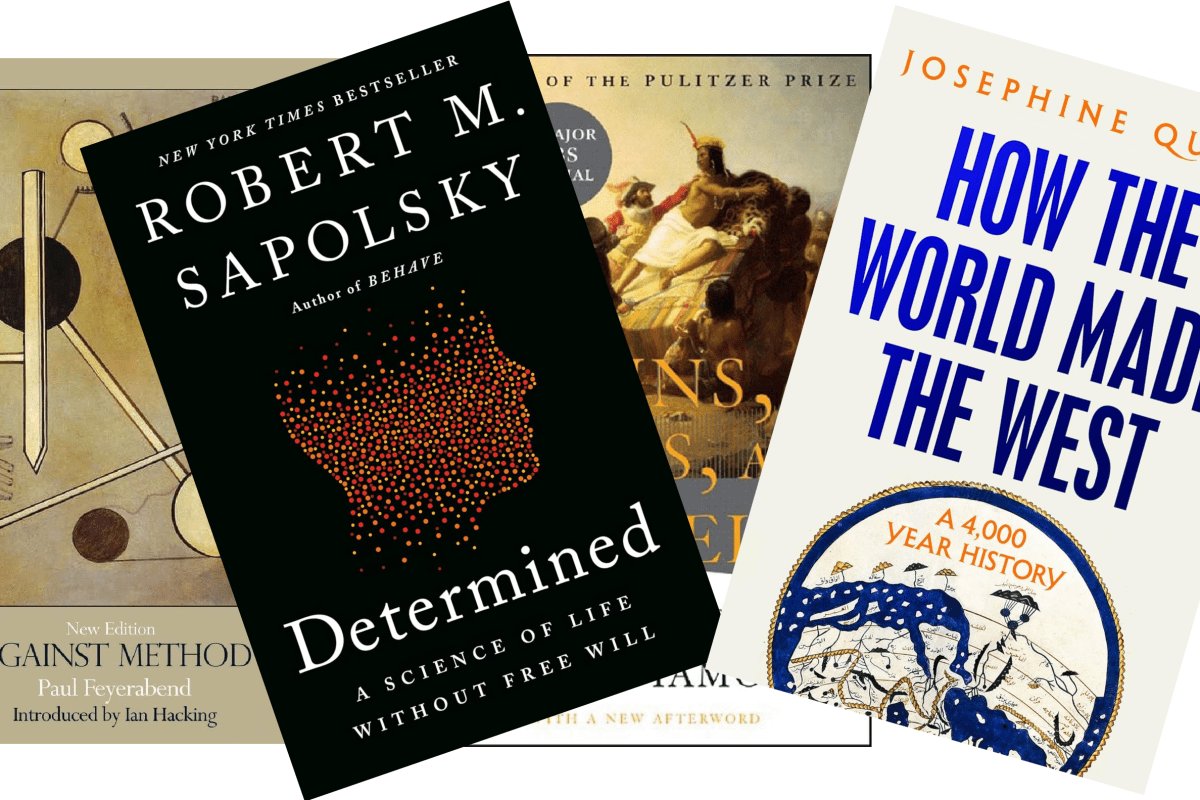
These are my favourite books I read in 2024. Only one was first published this year, so it seems I was playing catch-up and rereading. Two are about history; two are about the philosophy of science; and one is about biological free will or the lack thereof.
Against Method is a re-read for me. It makes the list on the coattails of a higher-ranked book. Feyerabend makes a compelling case against the Scientific Method™. To complete the set, I’d also recommend Bruno Latour‘s We Have Never Been Modern.
Determined arrives on the heels of Sapolsky’s Behave, another classic that I’d recommend even more, but I read it in 2018, so it doesn’t make the cut. In Determined, Sapolsky makes the case that there is no room or need for free will to explain human behaviour.
As with Against Method, Guns, Germs, and Steel makes the list only to complement my next choice. It views history through an environmental lens. To fill out the historical perspective, I recommend David Graeber’s The Dawn of Everything: A New History of Humanity (with David Wengrow). I’d recommend Yuval Noah Harari‘s Sapiens: A Brief History of Humankind, but it occupies a different category and is more about a plausible broad narrative than the detail explored in the others listed.
Quinn makes history approachable as she questions the uniformity of civilisations pushed by orthodoxy. Read this in context with the aforementioned historical accounts for a fuller perspective.
I was born in 1961. This should have been bedtime reading for me. I’d heard of this work, but one really has to read it. It’s less Modernist than I had presumed—though not to the extent of Feyerabend or Latour mentioned above. Again, reading all three provides a robust perspective on the philosophy of science.
Like Quinn, the writing is approachable. I had expected it to be stilted. It is academic, and it may boost your vocabulary, but give it a gander. It also works well in an audiobook format if you are so inclined.
This about closes out 2024. What do you think about these choices? Agree or disagree? What are your top recommendations?
I’ve written about this topic before. Metamodernism has been heralded as the great reconciler of Modernism and Postmodernism, a dialectical triumph that purports to synthesise these two oppositional paradigms. On the one hand, Modernism clings to its belief in objective truths, rationality, and universal principles. On the other, Postmodernism dismantles those certainties, exposing them as fragile constructs, rooted as much in ideology as in reason. The promise of metamodernism is to bridge this divide, to create a space where the objectivity of Modernism and the relativism of Postmodernism can coexist. But can it?
Audio: NotebookLM Podcast about this topic.
Spoiler alert: it cannot. In fact, metamodernism doesn’t even attempt to fulfil its stated goal. Instead, what it really does—intentionally or not—is meld Modernism’s objective framework with Pre-Enlightenment mysticism, offering a regressive concoction that romanticises the past while pretending to chart a bold new future. This isn’t synthesis; it’s nostalgia masquerading as innovation.
The Unbridgeable Divide: Objective vs. Relative
To understand why metamodernism’s claimed synthesis is untenable, we need to examine the fundamental incompatibility of its supposed components. Modernism rests on the firm foundation of objectivity: truth is universal, reason is supreme, and progress is inevitable. Postmodernism, however, thrives in the cracks of that foundation, pointing out that these so-called universal truths are culturally and historically contingent, and that “progress” often serves as a euphemism for domination or erasure.
Reconciling these two positions is like trying to mix oil and water. Modernism’s faith in absolutes cannot coexist with Postmodernism’s celebration of ambiguity and multiplicity without reducing one to a mere aesthetic flourish for the other. The result is not a synthesis but a superficial oscillation, an endless back-and-forth that achieves neither clarity nor coherence.
The Real Agenda: A Fusion of Objectivities
What metamodernism actually achieves is something quite different. Instead of bridging the gap between Modernism and Postmodernism, it fuses Modernism’s objective certainties with the equally objective but pre-rational framework of Pre-Enlightenment mysticism. In doing so, it abandons the critical lens of Postmodernism altogether, retreating to a worldview that is comfortingly familiar but intellectually regressive.
Consider the resurgence of myth, spirituality, and transcendence in metamodernist discourse. These elements hark back to a time when objective truths were dictated by divine authority or cosmological narratives rather than scientific inquiry. By incorporating these pre-modern ideas into its framework, metamodernism sidesteps the hard questions posed by Postmodernism, offering a fusion that is plausible only because both Modernism and Pre-Enlightenment mysticism share a common belief in absolute truths.
Plausible but Retrograde
This melding of Modernist and Pre-Enlightenment frameworks might seem plausible because, in truth, many Moderns never fully abandoned their mystical roots. The Enlightenment’s project of replacing religious dogma with reason was always incomplete; its foundational assumptions about universality and objectivity often carried an unspoken theological residue. Metamodernism taps into this latent nostalgia, offering a vision of the world that feels grounded and comforting, but at the cost of intellectual progress.
The problem is that this vision is fundamentally retrograde. By retreating to the certainties of the past, metamodernism ignores the most valuable insight of Postmodernism: that all frameworks, whether Modern or mystical, are ultimately constructed and contingent. To move forward, we need to grapple with this contingency, not escape from it.
Conclusion: Nostalgia in Disguise
Far from being a dialectical synthesis, metamodernism is a retreat. It cloaks itself in the language of progress while recycling old patterns of thought. Its attempt to reconcile Modernism and Postmodernism collapses into a fusion of Modernist objectivity and Pre-Enlightenment mysticism, leaving the critical insights of Postmodernism by the wayside.
If we are to truly progress, we must resist the siren song of metamodernism’s nostalgia. Instead, we should embrace the challenge of living without absolutes, grappling with the ambiguity and multiplicity that define our postmodern condition. Anything less is not synthesis but surrender.
It’s interesting to me that as an atheist and non-cognitivist, I can take the moral high ground relative to health insurance concerns in the United States. So, I write about it.
Blood Money and Broken Principles
In the aftermath of the tragic killing of Brian Thompson, the CEO of a health insurance conglomerate, a striking narrative has emerged. Many Americans view this act—shocking though it is—as emblematic of the anger and despair born of a system that profits by exploiting human vulnerability. Such reactions compel us to examine the ethics of industries that flourish on what can only be described as blood money. From health insurance to tobacco, alcohol, and the arms trade, these livelihoods raise profound ethical questions when viewed through the lens of the Buddhist Noble Eightfold Path, specifically Right Livelihood and Right Action.
The Moral Framework: Buddhism’s Path to Ethical Livelihood
Buddhism’s Eightfold Path provides a blueprint for ethical living, with Right Livelihood and Right Action serving as its ethical cornerstones. These principles demand that one’s work and deeds contribute to the welfare of others, avoid harm, and align with compassion and integrity. In short, they urge us to earn a living in a manner that uplifts rather than exploits. The health insurance industry’s business model—which often prioritises profits over the preservation of life—challenges these tenets in ways that are difficult to overlook.
Consider the denial of coverage for life-saving treatments, the exploitation of legal loopholes to reduce payouts, or the systemic perpetuation of healthcare inequality. These actions, while legally sanctioned, conflict sharply with the Buddhist ideal of avoiding harm and promoting well-being. Yet, this industry is not alone in its ethical failings. Many others—both legal and illegal—fall similarly short.
Industries of Exploitation: Tobacco, Alcohol, and Arms
The tobacco and alcohol industries provide stark examples of livelihoods that thrive on human suffering. Their products, despite their legality, are designed to foster dependency and harm. They exact a heavy toll on both individual lives and public health systems, a reality that makes them incompatible with Right Livelihood. The arms trade—arguably the most egregious example—profits directly from conflict and human misery. How can such industries possibly align with the Buddhist ideal of ahimsa (non-violence) or the compassionate aspiration to alleviate suffering?
In these cases, the harm caused is not incidental; it is fundamental to their business models. Whether one manufactures cigarettes, brews alcohol, or sells weapons, the destruction wrought by these activities is integral to their profitability. The contradiction is stark: the greater the harm, the greater the profit. This stands in direct opposition to the Buddhist call for livelihoods that sustain and support life.
Organised Crime: The Dark Mirror
When we turn to organised crime, the parallels become even more unsettling. Whether it’s the drug trade, human trafficking, or financial fraud, these activities epitomise unethical livelihoods. They exploit the vulnerable, foster violence, and undermine social cohesion. Yet, when viewed alongside certain legal industries, the line between “organised crime” and “corporate enterprise” begins to blur. Is the denial of life-saving healthcare less egregious than a gang’s extortion racket? Both profit by preying on human suffering. Both thrive in systems that prioritise gain over humanity.
The Buddhist Response: From Outrage to Action
Buddhism does not condone violence, no matter how symbolic or righteous it may appear. Right Action demands non-violence not only in deeds but also in thoughts and intentions. The killing of Brian Thompson, though perhaps an act of desperation or symbolism, cannot align with Buddhist ethics. Yet this tragedy should not eclipse the broader systemic critique. The true challenge is not to exact retribution but to transform the systems that perpetuate harm.
To move forward, we must ask how our societies can pivot toward livelihoods that align with compassion and justice. This entails holding exploitative industries to account and fostering economic systems that prioritise well-being over profit. The Buddhist path offers not only a critique of harmful practices but also a vision for ethical living—a vision that demands courage, compassion, and unwavering commitment to the common good.
Conclusion: Choosing a Better Path
The case of Brian Thompson’s killing is a symptom of a much larger ethical crisis. It forces us to confront uncomfortable truths about the industries that shape our world. Whether we scrutinise health insurance, tobacco, alcohol, the arms trade, or organised crime, the moral calculus remains the same: livelihoods that thrive on harm cannot be reconciled with the principles of Right Livelihood and Right Action.
As individuals and societies, we face a choice. We can continue to turn a blind eye to the suffering embedded in these industries, or we can commit to transforming them. The Buddhist path challenges us to choose the latter, to build systems and livelihoods rooted in compassion and justice. In doing so, we can begin to heal not only the wounds of individual tragedies but also the deeper fractures in our collective soul.
The assassination of UnitedHealth CEO Brian Thompson is more than just a shocking headline—it’s a vivid tableau of modern society’s darkest impulses. For some, Thompson’s death represents long-overdue justice, a symbolic blow against the machinery of corporate greed. For others, it’s an unforgivable act of chaos that solves nothing. But as the dust settles, we’re left with an unsettling truth: both sides may be acting rationally, yet neither side emerges morally unscathed.
It’s not just about one man or one system—it’s about the cycles of conflict and violence that have defined human societies for millennia.
This event takes on deeper significance when viewed through the lens of René Girard’s theories on mimetic rivalry and the scapegoat mechanism. It’s not just about one man or one system—it’s about the cycles of conflict and violence that have defined human societies for millennia.
Mimetic Rivalry: The Root of Conflict
Girard’s theory begins with a simple observation: human desires are not unique; they are mimetic and shaped by observing what others want. This inevitably leads to rivalry, as individuals and groups compete for the same goals, power, or symbols of status. Left unchecked, these rivalries escalate into social discord, threatening to tear communities apart.
Enter the scapegoat. To restore order, societies channel their collective aggression onto a single victim, whose sacrifice momentarily alleviates the tension. The scapegoat is both a symbol of the problem and a vessel for its resolution—a tragic figure whose elimination unites the community in its shared violence.
Thompson as Scapegoat
In this story, Brian Thompson is the scapegoat. He was not the architect of the American healthcare system, but his role as CEO of UnitedHealth made him its most visible face. His decisions—denying claims, defending profits, and perpetuating a system that prioritises shareholders over patients—embodied the injustices people associate with healthcare in America.
manifesto of a society pushed to its breaking point
The assassin’s actions, however brutal, were a calculated strike against the symbol Thompson had become. The engraved shell casings found at the scene—inscribed with “Deny,” “Defend,” and “Depose”—were not merely the marks of a vigilante; they were the manifesto of a society pushed to its breaking point.
But Girard would caution against celebrating this as justice. Scapegoating provides only temporary relief. It feels like resolution, but it doesn’t dismantle the systems that created the conflict in the first place.
The Clash of Rationalities
Both Thompson and his assassin acted rationally within their respective frameworks. Thompson’s actions as CEO were coldly logical within the profit-driven model of American capitalism. Deny care, maximise profits, and satisfy shareholders—it’s a grim calculus, but one entirely consistent with the rules of the system.
sacrifice one life to save countless others
The assassin’s logic is equally clear, though rooted in desperation. If the system won’t provide justice, then justice must be taken by force. From a Consequentialist perspective, the act carries the grim appeal of the trolley problem: sacrifice one life to save countless others. In this view, Thompson’s death might serve as a deterrent, forcing other executives to reconsider the human cost of their policies.
Yet Girard’s framework warns us that such acts rarely break the cycle. Violence begets violence, and the system adapts. The hydra of modern healthcare—the very beast Thompson represented—will grow another head. Worse, it may become even more entrenched, using this event to justify tighter security and greater insulation from public accountability.
“An Eye for an Eye”
Mahatma Gandhi’s warning, “An eye for an eye will only make the whole world blind,” resonates here. While the assassin may have acted with moral intent, the act itself risks perpetuating the very cycles of harm it sought to disrupt. The scapegoat mechanism may provide catharsis, but it cannot heal the underlying fractures in society.
Moving Beyond the Scapegoat
To truly break the cycle, we must confront the forces that drive mimetic rivalry and scapegoating. The healthcare system is just one manifestation of a larger problem: a society that prizes competition over cooperation, profit over people, and violence over dialogue.
The hydra story looms in the background here, its symbolism stark. Slaying one head of the beast—be it a CEO or a policy—will not bring about systemic change. But perhaps this act, as tragic and flawed as it was, will force us to reckon with the deeper question: How do we create a society where such acts of desperation are no longer necessary?
The answer lies not in finding new scapegoats but in dismantling the systems that create them. Until then, we remain trapped in Girard’s cycle, blind to the ways we perpetuate our own suffering.
Jean-François Lyotard’s Le Différend has a way of gnawing at you—not with profound revelations, but with the slow, disquieting erosion of assumptions. It got me thinking about something uncomfortably obvious: political orientation is nothing more than the secular cousin of religious indoctrination. Just as most people will, without much scrutiny, cling to the religion of their upbringing and defend it as the One True Faith, the same applies to their political worldview. Whether you’re baptised into Anglicanism or wade knee-deep into the waters of neoliberalism, the zeal is indistinguishable.
Of course, there are the self-proclaimed rebels who smugly declare they’ve rejected their parents’ politics. The ones who went left when Mum and Dad leaned right or discovered anarchism in the ruins of a conservative household. But let’s not be fooled by the patina of rebellion: they may have switched teams, but they’re still playing the same game. They’ve accepted the foundational myths of institutions and democracy—those hallowed, untouchable idols. Like religion, these constructs are not just defended but sanctified, preached as the best or only possible versions of salvation. Dissenters are heretics; non-believers are unthinkable.
It’s not that political ideologies are inherently bad (just like religion has its occasional charm). It’s that the devout rarely stop to question whether the framework itself might be the problem. They assume the boundaries are fixed, the terms are immutable, and the debate is merely about the correct interpretation of the catechism. But if Lyotard has taught us anything, it’s this: the real battles—the différends—are the ones no one’s even acknowledging because the language to articulate them doesn’t exist in the prevailing orthodoxy.
At a time when scientific authority faces unprecedented challenges—from climate denial to vaccine hesitancy—the radical critiques of Paul Feyerabend and Bruno Latour offer surprising insight. Their work, far from undermining scientific credibility, provides a more nuanced and ultimately more robust understanding of how scientific knowledge actually progresses. In an era grappling with complex challenges like artificial intelligence governance and climate change, their perspectives on the nature of scientific knowledge seem remarkably prescient.
The Anarchist and the Anthropologist: Challenging Scientific Orthodoxy
When Paul Feyerabend declared “anything goes” in his critique of scientific method, he launched more than a philosophical provocation—he opened a fundamental questioning of how we create and validate knowledge. Bruno Latour would later expand this critique through meticulous observation of how science operates in practice. Together, these thinkers reveal science not as an objective pursuit of truth, but as a deeply human enterprise shaped by social forces, rhetoric, and often, productive chaos.
Consider how modern climate scientists must navigate between pure research and public communication, often facing the challenge of translating complex, probabilistic findings into actionable policies. This mirrors Feyerabend’s analysis of Galileo’s defence of heliocentrism—both cases demonstrate how scientific advancement requires not just empirical evidence, but rhetorical skill and strategic communication.
The Social Construction of Scientific Facts
Latour’s concept of “black boxing”—where successful scientific claims become unquestioned facts—illuminates how scientific knowledge achieves its authority. Contemporary examples abound: artificial intelligence researchers like Timnit Gebru and Joy Buolamwini have exposed how seemingly objective AI systems embed social biases, demonstrating Latour’s insight that technical systems are inseparable from their social context.
The COVID-19 pandemic provided a stark illustration of these dynamics. Public health responses required combining epidemiological models with social science insights and local knowledge—precisely the kind of epistemological pluralism Feyerabend advocated. The pandemic revealed what sociologist Harry Collins calls “interactional expertise”—the ability to communicate meaningfully about technical subjects across different domains of knowledge.
Beyond Method: The Reality of Scientific Practice
Both Feyerabend and Latour expose the gap between science’s methodological ideals and its actual practice. This insight finds contemporary expression in the work of Sheila Jasanoff, who developed the concept of “sociotechnical imaginaries”—collectively imagined forms of social life reflected in scientific and technological projects. Her work shows how scientific endeavours are inseparable from social and political visions of desirable futures.
The climate crisis perfectly exemplifies this interweaving of scientific practice and social context. Scholars like Kyle Whyte and Robin Wall Kimmerer demonstrate how indigenous environmental knowledge often provides insights that Western scientific methods miss. This validates Feyerabend’s assertion that progress often requires breaking free from established methodological constraints.
The Pluralistic Vision in Practice
Neither Feyerabend nor Latour advocates abandoning science. Instead, they argue for recognising science as one way of knowing among many—powerful but not exclusive. This vision finds practical expression in contemporary movements like citizen science, where projects like Galaxy Zoo or FoldIt demonstrate how non-experts can contribute meaningfully to scientific research.
The “slow science” movement, championed by Isabelle Stengers, similarly echoes Feyerabend’s critique of methodological orthodoxy. It advocates for more thoughtful, inclusive approaches to research that acknowledge the complexity and uncertainty inherent in scientific inquiry.
Knowledge in the Age of Complexity
Today’s challenges—from climate change to artificial intelligence governance—demand precisely the kind of epistemological pluralism Feyerabend and Latour advocated. Kate Crawford’s research on the politics of AI parallels Latour’s network analysis, showing how technical systems are shaped by complex webs of human decisions and institutional priorities.
Feminist scholars like Karen Barad propose “agential realism,” suggesting that scientific knowledge emerges from specific material-discursive practices rather than revealing pre-existing truths. This builds on Feyerabend’s insight that knowledge advances not through rigid methodology but through dynamic interaction with multiple ways of knowing.
Towards a New Understanding of Scientific Authority
The critiques of Feyerabend and Latour, amplified by contemporary scholars, suggest that scientific authority rests not on infallible methods but on science’s capacity to engage with other forms of knowledge while remaining open to revision and challenge. This understanding might help address contemporary challenges to scientific authority without falling into either naive scientism or radical relativism.
The rise of participatory research methods and citizen science projects demonstrates how this more nuanced understanding of scientific authority can enhance rather than diminish scientific practice. Projects that combine traditional scientific methods with local knowledge and citizen participation often produce more robust and socially relevant results.
Conclusion: Embracing Complexity
Feyerabend and Latour’s critiques, far from being merely historical curiosities, offer vital insights for navigating contemporary challenges. Their work, extended by current scholars, suggests that the future of knowledge lies not in establishing new orthodoxies but in maintaining openness to multiple approaches and perspectives.
In an age of increasing complexity, this pluralistic vision offers our best path forward—one that recognises science’s value while acknowledging the essential contribution of other ways of knowing to human understanding. As we face unprecedented global challenges, this more nuanced and inclusive approach to knowledge creation becomes not just philosophically interesting but practically essential.
The lesson for contemporary science is clear: progress depends not on rigid adherence to method but on maintaining open dialogue between different ways of understanding the world. In this light, the apparent chaos Feyerabend celebrated appears not as a threat to scientific authority but as a necessary condition for genuine advancement in human knowledge.
What if science’s greatest achievements came not from following rules, but from breaking them? What if progress depends more on chaos than on order? In Against Method, philosopher Paul Feyerabend presents a provocative thesis: there is no universal scientific method, and the progress we celebrate often emerges from breaking established rules rather than following them.
I read Against Method years ago but decided to re-read it. It’s especially interesting to me because although I advocate systems thinking, I don’t believe everything should be or can be systematised. More generally, this bleeds into my feelings about government, politics, and institutions.
Whilst Feyerabend’s focus is on science, one can pull back the lens and see that it covers all such systems and systematic beliefs. I may write a separate article on this, but for now, I’ll focus on Against Method.
The Anarchist’s View of Science
Feyerabend’s critique strikes at the heart of how we think about knowledge and progress. He argues that science has advanced not through rigid adherence to methodology, but through a combination of creativity, rhetoric, and sometimes even deception. His concept of “epistemological anarchism” suggests that no single approach to knowledge should dominate – instead, multiple methods and perspectives should compete and coexist.
Consider Galileo’s defense of heliocentrism. Rather than relying solely on empirical evidence, Galileo employed persuasive rhetoric, selective data, and careful manipulation of public opinion. For Feyerabend, this isn’t an aberration but a typical example of how scientific progress actually occurs. The story we tell ourselves about the scientific method – as a systematic, purely rational pursuit of truth – is more myth than reality.
From Religious Dogma to Scientific Orthodoxy
The Age of Enlightenment marked humanity’s shift from religious authority to scientific rationality. Yet Feyerabend argues that we simply replaced one form of dogma with another. Scientism – the belief that science alone provides meaningful knowledge – has become our new orthodoxy. What began as a liberation from religious constraints has evolved into its own form of intellectual tyranny.
This transition could have taken a different path. Rather than elevating scientific rationality as the sole arbiter of truth, we might have embraced a more pluralistic approach where multiple ways of understanding the world – scientific, artistic, spiritual – could coexist and cross-pollinate. Instead, we’ve created a hierarchy where other forms of knowledge are dismissed as inferior or irrational.
The Chaos of Progress
In Chapter 1 of Against Method, Feyerabend lays the groundwork for his radical critique. He demonstrates how strict adherence to methodological rules would have prevented many of science’s greatest discoveries. Progress, he argues, often emerges from what appears to be irrational – from breaking rules, following hunches, and embracing contradiction. Indeed, rationalism is over-rated.
This isn’t to say that science lacks value or that methodology is meaningless. Rather, Feyerabend suggests that real progress requires flexibility, creativity, and a willingness to break from convention. Many breakthrough discoveries have been accidental or emerged from practices that would be considered unscientific by contemporary standards.
Beyond the Monolith
Our tendency to view pre- and post-Enlightenment thought as a simple dichotomy – superstition versus reason – obscures a richer reality. Neither period was monolithic, and our current reverence for scientific method might be constraining rather than enabling progress. Feyerabend’s work suggests an alternative: a world where knowledge emerges from the interplay of multiple approaches, where science exists alongside other ways of understanding rather than above them.
As we begin this exploration of Against Method, we’re invited to question our assumptions about knowledge and truth. Perhaps progress depends not on rigid adherence to method, but on the freedom to break from it when necessary. In questioning science’s monopoly on truth, we might discover a richer, more nuanced understanding of the world – one that embraces the chaos and contradiction inherent in human inquiry.
This is the first in a series of articles exploring Feyerabend’s Against Method. Join me as we challenge our assumptions about science, knowledge, and the nature of progress itself.
Reparations, Sovereignty, and the Enduring Legacy of Colonialism
The story of Indigenous peoples in the United States is a story of profound loss—loss of land, culture, and sovereignty. But perhaps the most painful and enduring losses are the broken promises: the hundreds of treaties signed in good faith and then systematically violated. These broken promises have not only left Native nations impoverished and disenfranchised but have also created a debt so immense that, by some estimates, it could run into the trillions if fully accounted for.
The Weight of Broken Treaties
From the earliest days of European settlement, treaties were used as a tool of diplomacy between the United States government and Native nations. These treaties, over 370 in total, were meant to secure peace, land agreements, and coexistence. In exchange, Native peoples were promised sovereign rights, land, and, crucially, compensation in the form of resources, healthcare, education, and protection. Yet, these promises were almost universally broken, often within years of being signed.
The true cost of these broken promises is impossible to measure in simple monetary terms.
The true cost of these broken promises is impossible to measure in simple monetary terms. Land, culture, and sovereignty are not commodities that can be easily priced. However, if one were to quantify the economic and material loss incurred by Native peoples—through stolen land, expropriated resources, and missed opportunities—the total would be staggering. Some estimates suggest the cost could run into the hundreds of billions if not trillions when factoring in centuries of economic injustice, treble damages, and interest.
Calculating Reparations: Land, Wealth, and Justice
Any serious discussion of reparations must start with the land. Native nations once held over 2 billion acres of land in what is now the United States, a vast expanse rich with natural resources. Through a series of coercive treaties, legislation, and outright theft, much of this land was lost, culminating in the General Allotment Act (or Dawes Act) of 1887, which further fragmented Native lands and opened millions of acres for white settlers.
Reparations would need to account for the value of this land and the resources extracted from it—timber, minerals, oil, gas, and agricultural produce
Reparations would need to account for the value of this land and the resources extracted from it—timber, minerals, oil, gas, and agricultural produce—that have enriched generations of non-Native Americans. The land itself is invaluable, not just in terms of its market price but as the foundation of Indigenous identity, culture, and sovereignty. The land is not only an economic asset but a spiritual and cultural one. In this context, mere monetary compensation seems inadequate.
However, if we were to calculate reparations based on these lost lands and resources, the numbers quickly skyrocket. Consider the Black Hills of South Dakota, illegally seized from the Lakota after the discovery of gold, despite an 1868 treaty guaranteeing their sovereignty over the region. The Lakota have refused financial compensation for the Black Hills, insisting instead on the return of the land. The value of the Black Hills alone, when adjusted for inflation and interest, would be immense. And this is just one example. If treble damages were applied—tripling the original valuation to account for the egregiousness of the theft—the total would become astronomical.
Interest on Injustice
A crucial factor in calculating reparations is the interest accrued over time. The land was not just taken, but taken centuries ago, meaning that any fair compensation would need to account for the economic opportunities missed due to that loss. Compounded interest, a financial mechanism commonly applied in lawsuits to reflect the time value of money, would exponentially increase the debt owed. This debt is not just economic but cultural, as the loss of land also meant the loss of a way of life.
Reparations could…easily run into the trillions.
Reparations could, therefore, easily run into the trillions. This is not merely hypothetical. In 1980, the U.S. Supreme Court ruled in United States v. Sioux Nation of Indians that the U.S. government had illegally taken the Black Hills, and the Sioux were entitled to compensation. The sum awarded was $106 million—today, with interest, that figure exceeds $1 billion. Yet the Sioux have refused the payment, demanding the return of their land instead. Their stance underscores the inadequacy of financial compensation for the cultural and spiritual dimensions of the loss.
Beyond Dollars: The Moral and Ethical Case for Reparations
While the financial dimension of reparations is essential, the moral and ethical dimensions are equally important. Reparations are not simply about writing a cheque; they are about justice. The broken treaties were not merely legal failures but moral failures, reflecting a systemic disregard for Native sovereignty and human dignity. The U.S. government’s persistent violations of treaties reveal a deep-rooted pattern of exploitation and dishonour that continues to reverberate through Native communities today.
broken treaties were not merely legal failures but moral failures
Reparations, in this broader sense, must include the return of lands, the restoration of cultural and political autonomy, and a fundamental rethinking of the relationship between Native nations and the U.S. government. The return of land—such as in the Land Back movement—is a critical component of this. Land is not only a material asset but a living connection to identity, tradition, and the future. Restoring land to Native nations would not only right historical wrongs but also empower them to rebuild their communities on their own terms.
The Political Challenge of Justice
Despite the moral clarity of the case for reparations, political challenges remain immense. Many Americans are unaware of the extent of Native dispossession or may see reparations as impractical or divisive. Yet, as the fight for racial justice has shown, justice is often uncomfortable. The fact that reparations would be costly, complex, and difficult is not an excuse to avoid the issue. If anything, it highlights how deep and enduring the injustice is.
Reparations are not a “handout” but a payment of a debt long overdue.
Reparations are not a “handout” but a payment of a debt long overdue. Native nations were once economically, politically, and culturally self-sufficient. The disruption of their societies, through land theft and broken treaties, is the root cause of the poverty, health disparities, and political marginalisation they face today. Addressing this requires more than just policy tweaks; it demands a fundamental reckoning with the past.
Conclusion: Trillions Owed, Promises to Keep
The reparations owed for centuries of broken treaties, stolen land, and unfulfilled promises are not simply about money but about honouring the sovereignty and humanity of Indigenous peoples. The debt is vast—financially, morally, and ethically—but it must be addressed if there is to be any hope for genuine reconciliation. Justice, long delayed, can no longer be denied. This underscores the larger point that the United States rarely follow through on their commitments, but this is a story for another day. Meantime, they’ll continue running roughshod over their people and the world, bullying their way through it.
Ngũgĩ wa Thiong’o published “Decolonising the Mind” in 1986. David Guignion shares a 2-part summary analysis of the work on his Theory and Philosophy site.
Ngũgĩ wa Thiong’o’s book Decolonising the Mind centres on the profound impact of colonialism on language, culture, and thought. It argues that imposing a foreign language on colonised people is a key tool of imperial domination. This linguistic imperialism leads to colonial alienation, separating the colonised from their own culture and forcing them to view the world through the lens of the coloniser.
Here are some key points from the concept of decolonising the mind:
Language is intimately tied to culture and worldview: Language shapes how individuals perceive and understand the world. When colonised people are forced to adopt the language of the coloniser, they are also compelled to adopt their cultural framework and values.
Colonial education systems perpetuate mental control: By privileging the coloniser’s language and devaluing indigenous languages, colonial education systems reinforce the dominance of the coloniser’s culture and worldview. This process results in colonised children being alienated from their own cultural heritage and internalising a sense of inferiority.
Reclaiming indigenous languages is crucial for decolonisation: wa Thiong’o advocates for a return to writing and creating in indigenous African languages. He sees this as an act of resistance against linguistic imperialism and a way to reconnect with authentic African cultures. He further argues that it’s not enough to simply write in indigenous languages; the content must also reflect the struggles and experiences of the people, particularly the peasantry and working class.
The concept extends beyond literature: While wa Thiong’o focuses on language in literature, the concept of decolonising the mind has broader implications. It calls for a critical examination of all aspects of life affected by colonialism, including education, politics, and economics.
It is important to note that decolonising the mind is a complex and ongoing process. There are debates about the role of European languages in postcolonial societies, and the concept itself continues to evolve. However, wa Thiong’o’s work remains a seminal text in postcolonial studies, raising crucial questions about the enduring legacy of colonialism on thought and culture.
As the years pass and my disappointment matures like a fine wine (spoiler alert: it’s vinegar), I’m reminded of the average intelligence quotient floating about in the wild. A few years back, I stumbled upon The Half-Life of Knowledge. Cute title, but it’s more optimistic than it should be. Why assume knowledge even has a shelf life? It’s one thing for once-useful information to spoil thanks to “progress,” but what about the things that were never true to begin with? Ah, yes, the fabrications, the lies we’re spoon-fed under the guise of education.
I’m well-versed in the lies they peddle in the United States, but I’d bet good money (not that I have any) that every nation’s curriculum comes with its own patriotic propaganda. What am I on about, you ask? Let’s just say I’ve been reading How the World Made the West by Josephine Quinn, and it’s got me thinking. You see, I’ve also been simmering on an anti-democracy book for the better part of five years, and it’s starting to boil over.
Here in the good ol’ US of A, they like to wax lyrical about how Athens was the birthplace of democracy. Sure, Athens had its democratic dabblings. But let’s not get it twisted—if you really look at it, Athens was more akin to the Taliban than to any modern Western state. Shocked? Don’t be. For starters, only property-owning men could vote, and women—brace yourselves—were “forced” to wear veils. Sounds familiar? “It’s a start,” you say. True, American women couldn’t vote until 1920, so let’s all pat ourselves on the back for that—Progress™️.
But no, hold your applause. First off, let’s remember that Athens and Sparta were city-states, not some cohesive entity called “Greece” as we so lovingly imagine. Just a bunch of Greek-speaking neighbours constantly squabbling like reality TV contestants. Meanwhile, over in Persia—yes, the supposed enemy of all things free and democratic—they had participative democracy, too. And guess what? Women in Persia could vote, own property, and serve as soldiers or military officers. So much for the idea that Athens was the singular beacon of democratic virtue.
More than this, Persian democracy was instituted by lottery, so many more people participated in the process by serving one-year terms. At the end of their term, they were audited to check for corruption. Now, you can see why we adopted the so-called Greek version. These blokes don’t welcome any oversight of scrutiny.
As a postmodern subjectivist, I tend to side-eye any grand narrative, and the history of Western civilisation is just one long parade of questionable claims and hidden agendas. Every time I think I’ve seen the last of the historical jump scares, another one comes lurking around the corner. Boo!











 Philosophics